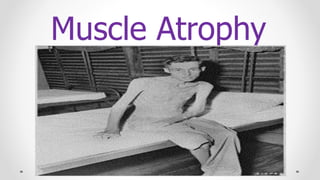
Muscle Atrophy
Presented by :
• Eman Elsayed Elsayed
• Esraa Nabil Morsy
• Eman Ahmed Ali
• Alaa Talha Elsayed Elshitany
• Asmaa Gamal Ali Alaraby
• Aya Mohamed Nour Eldein
• Alaa Ramadan Shoraky
Under supervision:
DrAzaa Helal
definition:
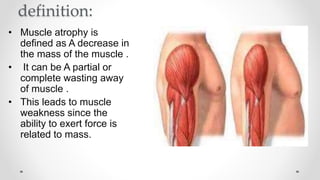
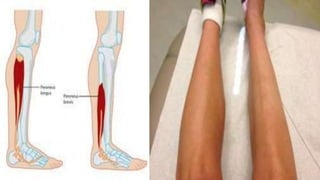
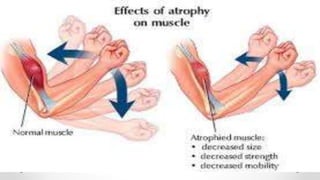
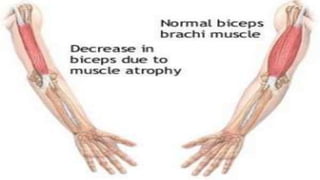
• Muscle atrophy is
defined as A decrease in
the mass of the muscle .
• It can be A partial or
complete wasting away
of muscle .
• This leads to muscle
weakness since the
ability to exert force is
related to mass.
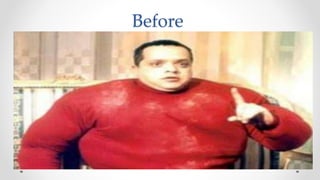
Before
After
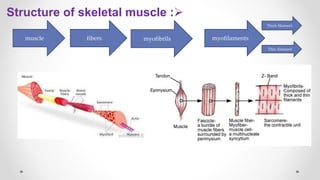
Structure of skeletal muscle :
muscle fibers myofibrils myofilaments
Thin filament
Thick filament
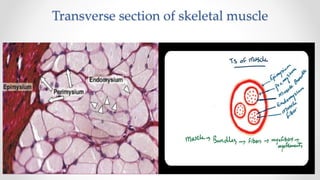
Transverse section of skeletal muscle
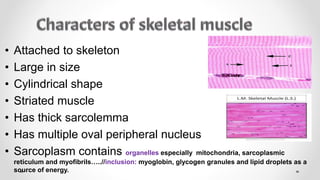
• Attached to skeleton
• Large in size
• Cylindrical shape
• Striated muscle
• Has thick sarcolemma
• Has multiple oval peripheral nucleus
• Sarcoplasm contains organelles especially mitochondria, sarcoplasmic
reticulum and myofibrils…..//inclusion: myoglobin, glycogen granules and lipid droplets as a
source of energy.
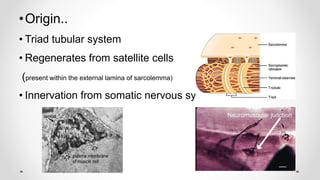
•Origin..
• Triad tubular system
• Regenerates from satellite cells
(present within the external lamina of sarcolemma)
• Innervation from somatic nervous system
symptoms
• Muscular atrophy affects a high number of the elderly .
• Symptoms that frequently affect the muscles may also involve
other body systems .
• Muscular atrophy decreases qualities of life as the sufferer
becomes unable to perform certain tasks or worsen the risks of
accidents while performing those (like walking). Muscular
atrophy increases the risks of falling in conditions such as IBM
(inclusion body myositis).
• Muscle atrophy may accompany other
symptoms affecting the neuromuscular system
including:
• Balance problems, difficulty walking, and falls.
• Difficulty with speaking and swallowing.
• Facial weakness.
• memory loss, tingling or weakness of extremities.
• Loss of muscle coordination.
• Impaired balance and coordination.
• Numbness in arms or legs.
• Progressive loss of movement.
• Progressive weakness and numbness in the legs.
• Symptoms of multiple sclerosis, such as weakness, vision
problems, unsteady walk, fatigue, and depression.
Causes Of Muscle Atrophy
Disuse Atrophy caused by situations or conditions
including :
Being bedridden(not moving for a long time like paralysis.)
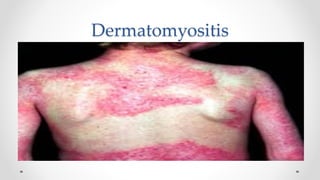
 Dermatomyositis (a condition characterized by muscle
inflammation and skin rash)
Dermatomyositis
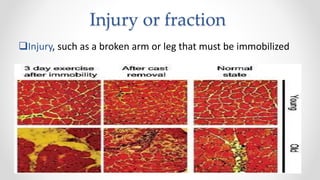
Injury or fraction
Injury, such as a broken arm or leg that must be immobilized
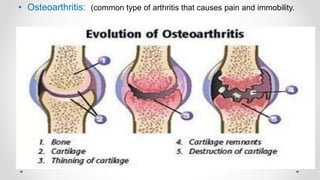
• Osteoarthritis: (common type of arthritis that causes pain and immobility.
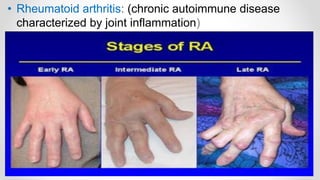
• Rheumatoid arthritis: (chronic autoimmune disease
characterized by joint inflammation)
 Muscular dystrophy: (inherited disorder that causes a
progressive loss of muscle tissue and muscle weakness)
 Polymyositis: (widespread inflammation and weakness of
muscles)
Malnutrition (progressive weakening and inability to adequately use
muscles)
Neurogenic causes of muscle
atrophy :
 Multiple sclerosis (disease that affects the brain and spinal cord causing weakness,
coordination, balance difficulties, and other problems)
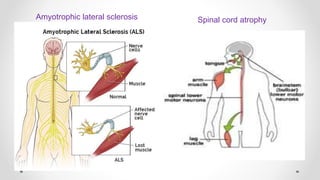
 Amyotrophic lateral sclerosis (ALS, also known as Lou Gehrig’s disease; a severe
neuromuscular disease that causes muscle weakness and disability)
 Spinal cord atrophy (genetic disease causing decreased muscle function from a neural
defect)
Amyotrophic lateral sclerosis Spinal cord atrophy
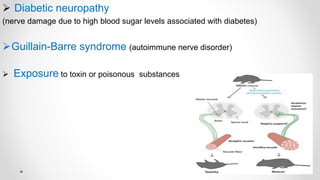
 Diabetic neuropathy
(nerve damage due to high blood sugar levels associated with diabetes)
Guillain-Barre syndrome (autoimmune nerve disorder)
 Exposure to toxin or poisonous substances
Diagnosis
1- your doctor will take a complete medical history and to understand all of
your symptoms.
2- Tell him or her about old or recent injuries you’ve experienced and
previously diagnosed medical conditions.
3- List prescriptions, over-the counter medications, and supplements you are
taking and your symptoms.
4-Your doctor may order additional tests to help
With the diagnosis and to rule out certain diseases
What to do??
• blood tests
• X-rays
• magnetic resonance imaging (MRI)
• computed tomography (CT) scan
• nerve conduction studies
• muscle or nerve biopsy
• electromyography (EMG)
• Your doctor may refer you to a specialist depending on the results of these
tests
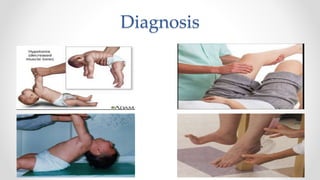
Diagnosis
Treatment
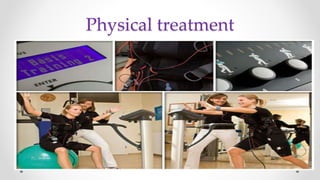
 Electrical stimulation
 Physical therapy
 Surgery
 Medication
 Diet
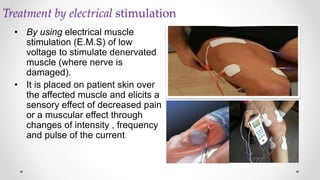
Treatment by electrical stimulation
• By using electrical muscle
stimulation (E.M.S) of low
voltage to stimulate denervated
muscle (where nerve is
damaged).
• It is placed on patient skin over
the affected muscle and elicits a
sensory effect of decreased pain
or a muscular effect through
changes of intensity , frequency
and pulse of the current.
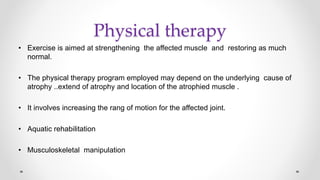
Physical therapy
• Exercise is aimed at strengthening the affected muscle and restoring as much
normal.
• The physical therapy program employed may depend on the underlying cause of
atrophy ..extend of atrophy and location of the atrophied muscle .
• It involves increasing the rang of motion for the affected joint.
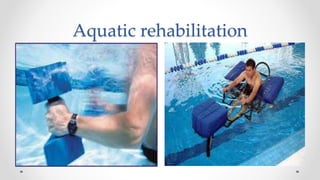
• Aquatic rehabilitation
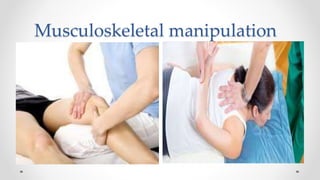
• Musculoskeletal manipulation
Aquatic rehabilitation
Musculoskeletal manipulation
Physical treatment
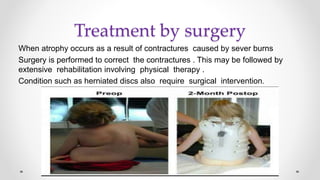
Treatment by surgery
When atrophy occurs as a result of contractures caused by sever burns
Surgery is performed to correct the contractures . This may be followed by
extensive rehabilitation involving physical therapy .
.Condition such as herniated discs also require surgical intervention
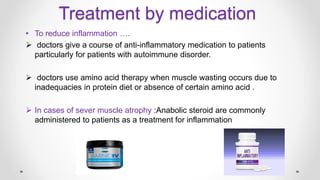
Treatment by medication
• To reduce inflammation ….
 doctors give a course of anti-inflammatory medication to patients
particularly for patients with autoimmune disorder.
 doctors use amino acid therapy when muscle wasting occurs due to
inadequacies in protein diet or absence of certain amino acid .
 In cases of sever muscle atrophy :Anabolic steroid are commonly
administered to patients as a treatment for inflammation
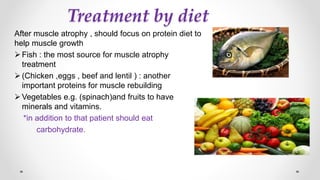
Treatment by diet
After muscle atrophy , should focus on protein diet to
help muscle growth
Fish : the most source for muscle atrophy
treatment
(Chicken ,eggs , beef and lentil ) : another
important proteins for muscle rebuilding
Vegetables e.g. (spinach)and fruits to have
minerals and vitamins.
*in addition to that patient should eat
carbohydrate.
skeletal Muscle atrophy

skeletal Muscle atrophy

  • 1.
  • 2.
    Presented by : •Eman Elsayed Elsayed • Esraa Nabil Morsy • Eman Ahmed Ali • Alaa Talha Elsayed Elshitany • Asmaa Gamal Ali Alaraby • Aya Mohamed Nour Eldein • Alaa Ramadan Shoraky Under supervision: DrAzaa Helal
  • 3.
    definition: • Muscle atrophyis defined as A decrease in the mass of the muscle . • It can be A partial or complete wasting away of muscle . • This leads to muscle weakness since the ability to exert force is related to mass.
  • 4.
  • 5.
  • 6.
    Structure of skeletalmuscle : muscle fibers myofibrils myofilaments Thin filament Thick filament
  • 7.
    Transverse section ofskeletal muscle
  • 8.
    • Attached toskeleton • Large in size • Cylindrical shape • Striated muscle • Has thick sarcolemma • Has multiple oval peripheral nucleus • Sarcoplasm contains organelles especially mitochondria, sarcoplasmic reticulum and myofibrils…..//inclusion: myoglobin, glycogen granules and lipid droplets as a source of energy.
  • 9.
    •Origin.. • Triad tubularsystem • Regenerates from satellite cells (present within the external lamina of sarcolemma) • Innervation from somatic nervous system
  • 10.
    symptoms • Muscular atrophyaffects a high number of the elderly . • Symptoms that frequently affect the muscles may also involve other body systems . • Muscular atrophy decreases qualities of life as the sufferer becomes unable to perform certain tasks or worsen the risks of accidents while performing those (like walking). Muscular atrophy increases the risks of falling in conditions such as IBM (inclusion body myositis).
  • 11.
    • Muscle atrophymay accompany other symptoms affecting the neuromuscular system including: • Balance problems, difficulty walking, and falls. • Difficulty with speaking and swallowing. • Facial weakness. • memory loss, tingling or weakness of extremities. • Loss of muscle coordination. • Impaired balance and coordination.
  • 12.
    • Numbness inarms or legs. • Progressive loss of movement. • Progressive weakness and numbness in the legs. • Symptoms of multiple sclerosis, such as weakness, vision problems, unsteady walk, fatigue, and depression.
  • 17.
    Causes Of MuscleAtrophy Disuse Atrophy caused by situations or conditions including : Being bedridden(not moving for a long time like paralysis.)  Dermatomyositis (a condition characterized by muscle inflammation and skin rash)
  • 18.
  • 19.
    Injury or fraction Injury,such as a broken arm or leg that must be immobilized
  • 20.
    • Osteoarthritis: (commontype of arthritis that causes pain and immobility.
  • 21.
    • Rheumatoid arthritis:(chronic autoimmune disease characterized by joint inflammation)
  • 22.
     Muscular dystrophy:(inherited disorder that causes a progressive loss of muscle tissue and muscle weakness)  Polymyositis: (widespread inflammation and weakness of muscles) Malnutrition (progressive weakening and inability to adequately use muscles)
  • 23.
    Neurogenic causes ofmuscle atrophy :  Multiple sclerosis (disease that affects the brain and spinal cord causing weakness, coordination, balance difficulties, and other problems)  Amyotrophic lateral sclerosis (ALS, also known as Lou Gehrig’s disease; a severe neuromuscular disease that causes muscle weakness and disability)  Spinal cord atrophy (genetic disease causing decreased muscle function from a neural defect)
  • 24.
    Amyotrophic lateral sclerosisSpinal cord atrophy
  • 25.
     Diabetic neuropathy (nervedamage due to high blood sugar levels associated with diabetes) Guillain-Barre syndrome (autoimmune nerve disorder)  Exposure to toxin or poisonous substances
  • 26.
    Diagnosis 1- your doctorwill take a complete medical history and to understand all of your symptoms. 2- Tell him or her about old or recent injuries you’ve experienced and previously diagnosed medical conditions. 3- List prescriptions, over-the counter medications, and supplements you are taking and your symptoms. 4-Your doctor may order additional tests to help With the diagnosis and to rule out certain diseases
  • 27.
    What to do?? •blood tests • X-rays • magnetic resonance imaging (MRI) • computed tomography (CT) scan • nerve conduction studies • muscle or nerve biopsy • electromyography (EMG) • Your doctor may refer you to a specialist depending on the results of these tests
  • 28.
  • 29.
    Treatment  Electrical stimulation Physical therapy  Surgery  Medication  Diet
  • 30.
    Treatment by electricalstimulation • By using electrical muscle stimulation (E.M.S) of low voltage to stimulate denervated muscle (where nerve is damaged). • It is placed on patient skin over the affected muscle and elicits a sensory effect of decreased pain or a muscular effect through changes of intensity , frequency and pulse of the current.
  • 31.
    Physical therapy • Exerciseis aimed at strengthening the affected muscle and restoring as much normal. • The physical therapy program employed may depend on the underlying cause of atrophy ..extend of atrophy and location of the atrophied muscle . • It involves increasing the rang of motion for the affected joint. • Aquatic rehabilitation • Musculoskeletal manipulation
  • 32.
  • 33.
  • 34.
  • 35.
    Treatment by surgery Whenatrophy occurs as a result of contractures caused by sever burns Surgery is performed to correct the contractures . This may be followed by extensive rehabilitation involving physical therapy . .Condition such as herniated discs also require surgical intervention
  • 36.
    Treatment by medication •To reduce inflammation ….  doctors give a course of anti-inflammatory medication to patients particularly for patients with autoimmune disorder.  doctors use amino acid therapy when muscle wasting occurs due to inadequacies in protein diet or absence of certain amino acid .  In cases of sever muscle atrophy :Anabolic steroid are commonly administered to patients as a treatment for inflammation
  • 37.
    Treatment by diet Aftermuscle atrophy , should focus on protein diet to help muscle growth Fish : the most source for muscle atrophy treatment (Chicken ,eggs , beef and lentil ) : another important proteins for muscle rebuilding Vegetables e.g. (spinach)and fruits to have minerals and vitamins. *in addition to that patient should eat carbohydrate.