Endocrine
Pathophysiology
Functions of the Endocrine System
• Collection of glands that produce hormones to:
Regulate metabolism
Regulate growth and development
Regulate tissue function
Regulate sexual function
Regulate reproduction
Regulate sleep
Regulate mood
Anatomy of the Endocrine System
• Pituitary Gland
 Master gland of the endocrine system
 Produces critical hormones
Anterior Lobe
 Releases hormones upon receiving releasing/inhibiting
hormones from the hypothalamus
Posterior Lobe
 Contains the ends of nerve cells from the
hypothalamus
 Hypothalamus sends hormones directly to the posterior
lobe via these nerves and then the pituitary gland
releases them
Anatomy of the Endocrine System
• Hypothalamus
 Part of the brain that links the endocrine
system to the nervous system
 Controls the pituitary gland
Anatomy of the Endocrine System
• Parathyroid Glands
 Four tiny glands located in the neck
 Control body’s calcium levels
 Produce parahormone
• Thyroid
 Gland found in the neck
 Regulates rate of metabolism
 Produces thyroxine
Anatomy of the Endocrine System
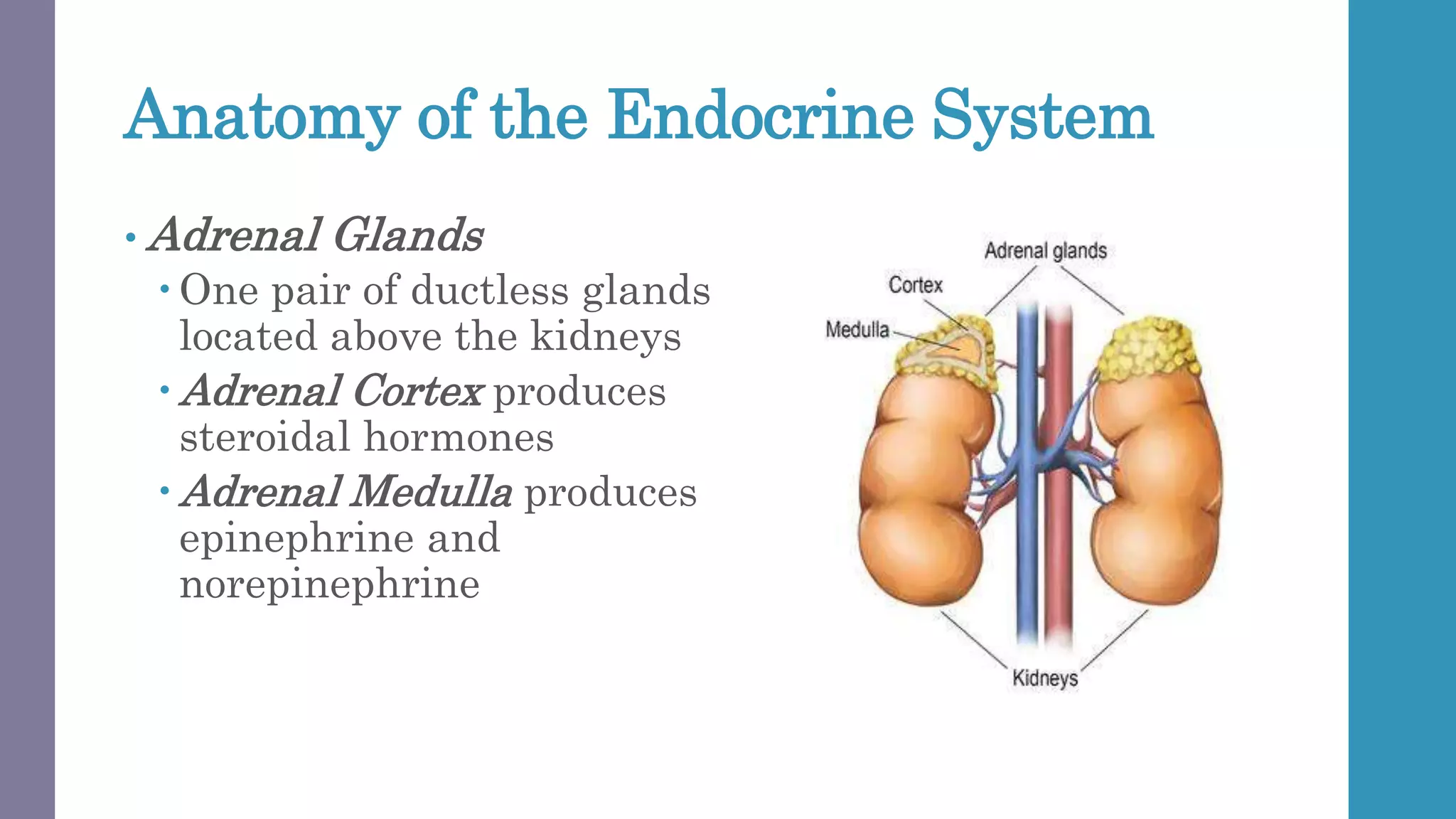
• Adrenal Glands
 One pair of ductless glands
located above the kidneys
 Adrenal Cortex produces
steroidal hormones
 Adrenal Medulla produces
epinephrine and
norepinephrine
Anatomy of the Endocrine System
• Pancreas
 Located partially behind the stomach and the
abdomen
 Functions as both an endocrine and exocrine
gland
 Produces digestive enzymes
 Produces insulin and glucagon
Anatomy of the Endocrine System
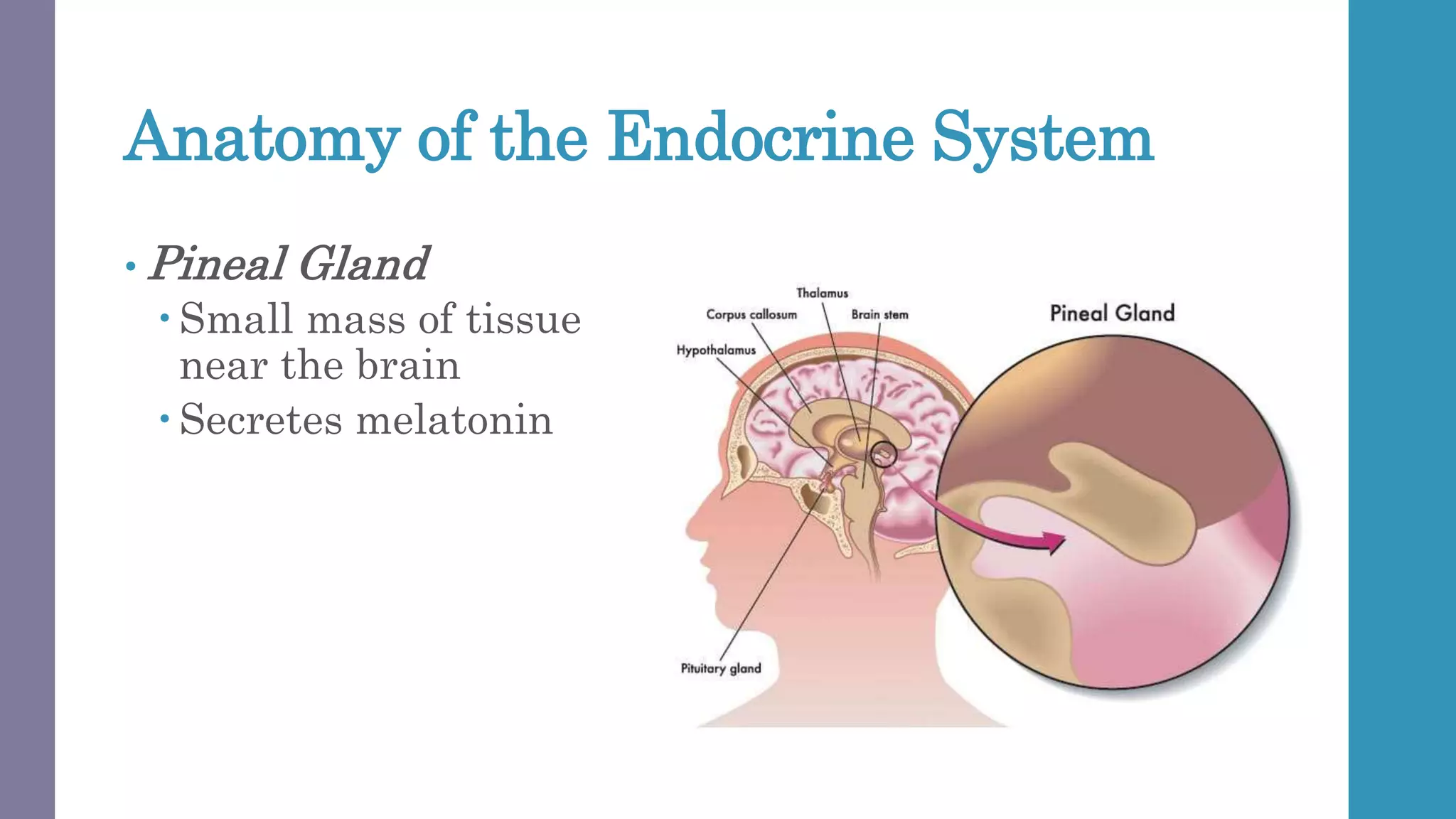
• Pineal Gland
 Small mass of tissue
near the brain
 Secretes melatonin
Anatomy of the Endocrine System
• Thymus Gland
 Gland located near
the heart
 Aid’s in the body’s
defense against
infection by making
antibodies
Anatomy of the Endocrine System
• Ovaries in females
Secrete estrogen and progesterone,
hormones that are vital to normal
reproductive development and fertility
• Testicles in males
Secrete testosterone, a hormone that is vital
to the normal development of male
characteristics
Endocrine Hormones
• Hormones are the chemical messengers of the
endocrine system that are released into the blood
• Protein Hormones
Class of hormones that cannot pass through the cell
membrane
Less likely to be stored in the body
• Steroid Hormones
Class of hormones that can pass through the cell
membrane
Can be stored in the body
Endocrine Hormones
• Prostaglandins
 Local hormones that do not enter the
bloodstream
• Growth Hormone
 Secreted by anterior pituitary gland
 Stimulates bone growth
• Luteinizing Hormone
 Protein hormone secreted by anterior pituitary
gland
 Stimulates ovulation in females and androgen
production in males
Endocrine Hormones
• Prolactin
Peptide hormone released by anterior pituitary
Promotes lactation
• Follicle-Stimulating Hormone
Secreted in increasing amounts during puberty
by the anterior pituitary
Stimulates development of reproductive cell
follicles
Endocrine Hormones
• Adrenocorticotropic Hormone
 Peptide hormone released from anterior
pituitary
 Stimulates production and secretion of steroid
hormones by adrenal cortex
• Oxytocin
 Produced by the hypothalamus and released
from posterior pituitary
 Induces contractions of uterine muscles during
labor
Endocrine Hormones
• Antidiuretic Hormone
 Secreted by posterior pituitary
 Aids in water reabsorption by the kidney
• Calcitonin
 Produced by thyroid gland
 Decreases blood calcium levels by stimulating
calcium deposit in the bones
 Antagonist of parathyroid hormone
• Parahormone
 Secreted by parathyroid glands
 Controls calcium and phosphate metabolism
Endocrine Hormones
• Cortisol
 Secreted from adrenal cortex
 Aids the body during stress
 Regulates glucose, carbohydrate, and fat levels
• Aldosterone
 Corticosteroid hormone secreted by adrenal cortex
 Regulates mineral balance in blood
 Controls fluid volume
Endocrine Hormones
• Insulin
 Hormone secreted by the beta cells of the
pancreas
 Responsible for regulating the metabolism of
glucose
• Glucagon
 Hormone secreted by the alpha cells of the
pancreas
 Raises blood glucose levels
Endocrine Hormones
• Estrogen
 General term for female steroid sex hormones
 Secreted by the ovary
 Responsible for typical female sexual
characteristics
• Progesterone
 Hormone produced by the ovaries
 Acts with estrogen to bring about the menstrual
cycle
Endocrine Hormones
• Testosterone
 Male sex hormone produced by the testes
 Promotes maturation of the reproductive system
accessory structures
 Promotes development of the male secondary sex
characteristics
• Melatonin
 Hormone secreted by the pineal gland
 Used to regulate sleep patterns
Classification of Hormones
• Anterior Pituitary Gland
Adrenocorticotrophic Hormone (ACTH)
Thyroid-Stimulating Hormone (TSH)
Luteinizing Hormone (LH)
Follicle-Stimulating Hormone (FSH)
Growth Hormone (GH)
Melanocyte-stimulating hormone (MSH)
Classification of Hormones
• Posterior Pituitary Gland
Anti-diuretic Hormone (ADH)
Oxytocin
Hormone Regulation
• Nervous System Signals
• Chemical Changes in the Blood
• Hormones regulate other hormones
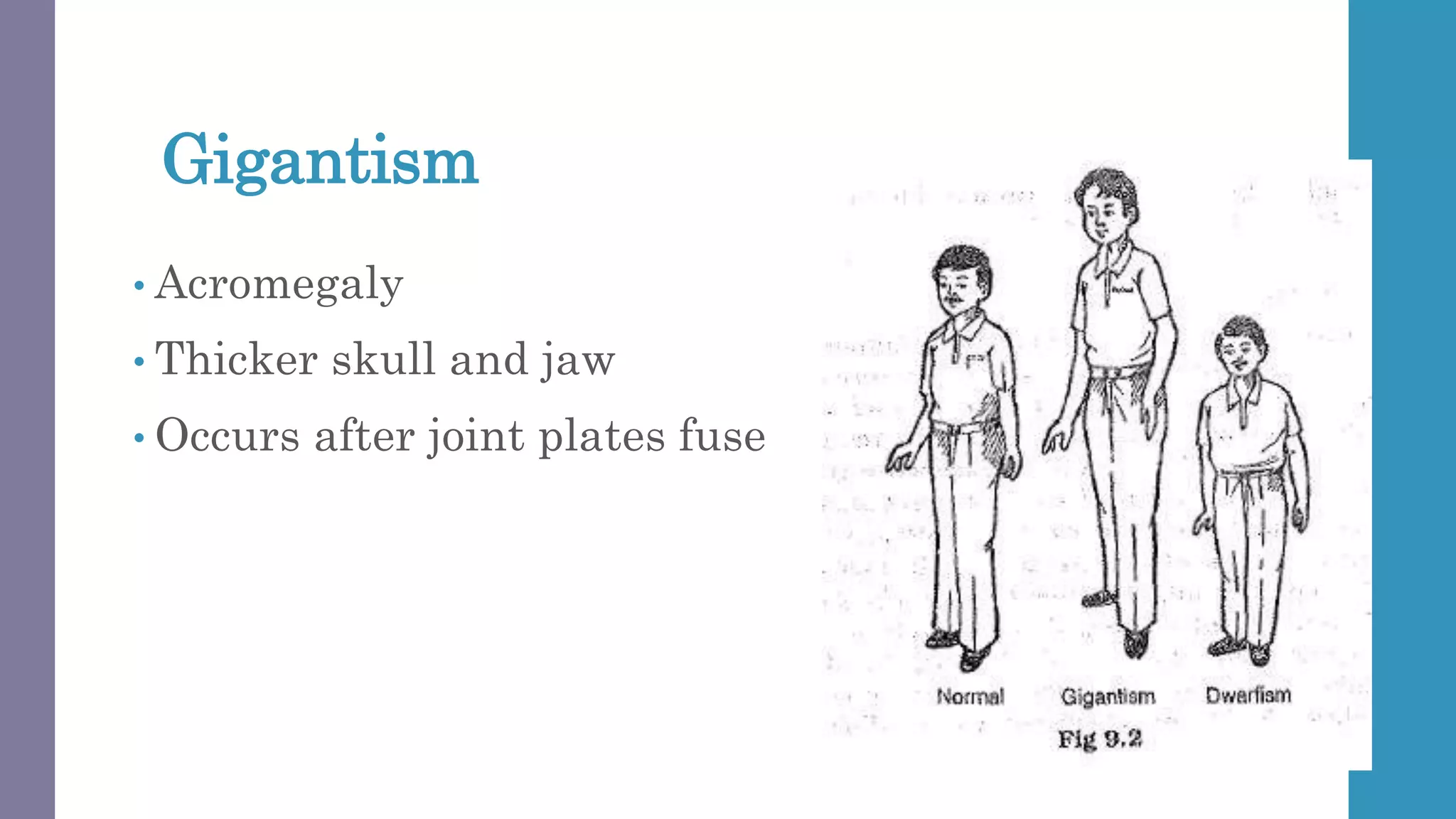
Gigantism
• Acromegaly
• Thicker skull and jaw
• Occurs after joint plates fuse
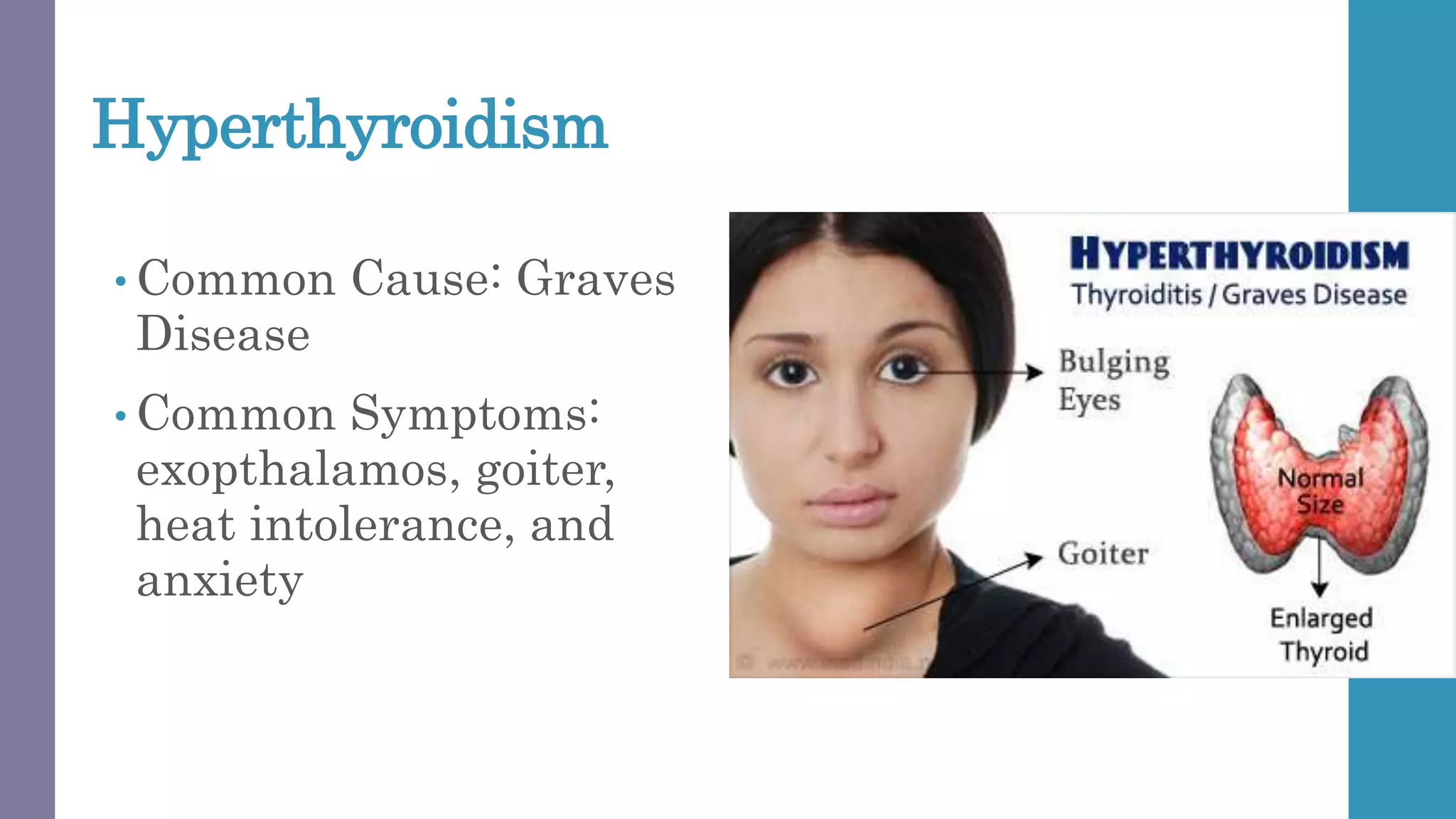
Hyperthyroidism
• Common Cause: Graves
Disease
• Common Symptoms:
exopthalamos, goiter,
heat intolerance, and
anxiety
Hypothyroidism
• Very familial; 4 times more likely in
women
• Common Symptoms: weight gain, cold
intolerance, and fatigue
• Myxedema
Fluid buildup that does not pit
Can look like fibromyalgia because of
muscle aches and trigger point
tenderness
Sparse hair, brittle nails, Buffalo
hump
Thyroid Storm
• T3 and T4 are dumped into the system
• Causes tachycardia, fever, and agitation
• Life-threatening condition associated
with untreated or undertreated
hyperthyroidism
Thyroid Cancer
• Very treatable
• Most are benign – only 5%
are malignant and most do
not metastasize
• Palpation will be painless,
unilateral, and in one spot
Parathyroid Cancer
• Cannot be easily distinguished from thyroid
cancer
• Weakness, feeling tired, lump in the neck
Addison’s Disease
• HYPOADRENAL
autoimmune disease
• Skin changes color to a
slight grey
Cushing’s Syndrome
• HYPERADRENAL
• Too much glucocorticoids in the system
• Can cause muscle wasting, bone
demineralization, and ligament laxity
Diabetes
• Fasting plasma glucose >126 mg/dL
• Insulin makes glucose transporters closer to
the cell
• Three types:
Type 1
Type 2
Gestational
Type 1 Diabetes
• Autoimmune; typically presents in under
age 20
• Insulin produces B-cell destruction
• Risk Factors: sibling or parents have type 1
Type 2 Diabetes
• Obesity; insulin resistance; pancreas intact
• Receptor does not bind to insulin as well as
it used to
• Hyperglycemia develops slowly
• Risk Factors: genetic predisposition;
overweight, over 45 y/o, sedentary lifestyle,
women who have had a baby over 9 lbs,
and low HDL levels
Gestational Diabetes
• Associated with type 2 diabetes
• Glucose intolerance with pregnancy
• increased risk of diabetes later on if it
continues >6 weeks after pregnancy
Acute Hyperglycemia
• Early Signs
 Blood sugar >180 mg/dL
 Blurred vision
 Ketones, dry skin, fatigue
 Thirsty, increased urination
• Late Signs
 Blood sugar > 240 mg/dL
 Nausea/vomiting
 Deep/rapid breathing
 Large ketones in urine, fruity breath
• Some patients don’t sense changes because of neuropathy
Acute Hypoglycemia
• Causes: over treatment with insulin, missed meal,
exercising when insulin is peaking, or stress
• Early Signs: tachycardia, hunger, headache, dizziness,
sweating, shaking, pale skin, and tingling around the
mouth
• Late Signs: slurred speech, confusion, sudden
moodiness, clumsiness, jerky movements, seizures,
and syncope
• Treatment: quick action is essential
Obesity: BMI Classification
• Underweight <18.5
• Normal Weight 18.5 to 24.9
• Overweight 25 to 29.9
• Obese >30
Obesity: Fat Locations
• Subcutaneous Fat
Necessary for thermal control
• Intra-abdominal Fat
Abdominal obesity is the most important
factor in determining pre-diabetic state
1 in 5 adults have metabolic syndrome
Goal: avoid fat around organs, especially the
liver
Obesity: Hormonal Regulation
• Fat
 Largest and most active endocrine organ
 Releases 50 hormones
• Adiponectin
 Signals to the brain that we are full
 As fat cells get bigger, less is released

Endocrine Pathophysiology

  • 1.
  • 2.
    Functions of theEndocrine System • Collection of glands that produce hormones to: Regulate metabolism Regulate growth and development Regulate tissue function Regulate sexual function Regulate reproduction Regulate sleep Regulate mood
  • 3.
    Anatomy of theEndocrine System • Pituitary Gland  Master gland of the endocrine system  Produces critical hormones Anterior Lobe  Releases hormones upon receiving releasing/inhibiting hormones from the hypothalamus Posterior Lobe  Contains the ends of nerve cells from the hypothalamus  Hypothalamus sends hormones directly to the posterior lobe via these nerves and then the pituitary gland releases them
  • 4.
    Anatomy of theEndocrine System • Hypothalamus  Part of the brain that links the endocrine system to the nervous system  Controls the pituitary gland
  • 6.
    Anatomy of theEndocrine System • Parathyroid Glands  Four tiny glands located in the neck  Control body’s calcium levels  Produce parahormone • Thyroid  Gland found in the neck  Regulates rate of metabolism  Produces thyroxine
  • 8.
    Anatomy of theEndocrine System • Adrenal Glands  One pair of ductless glands located above the kidneys  Adrenal Cortex produces steroidal hormones  Adrenal Medulla produces epinephrine and norepinephrine
  • 9.
    Anatomy of theEndocrine System • Pancreas  Located partially behind the stomach and the abdomen  Functions as both an endocrine and exocrine gland  Produces digestive enzymes  Produces insulin and glucagon
  • 10.
    Anatomy of theEndocrine System • Pineal Gland  Small mass of tissue near the brain  Secretes melatonin
  • 11.
    Anatomy of theEndocrine System • Thymus Gland  Gland located near the heart  Aid’s in the body’s defense against infection by making antibodies
  • 12.
    Anatomy of theEndocrine System • Ovaries in females Secrete estrogen and progesterone, hormones that are vital to normal reproductive development and fertility • Testicles in males Secrete testosterone, a hormone that is vital to the normal development of male characteristics
  • 13.
    Endocrine Hormones • Hormonesare the chemical messengers of the endocrine system that are released into the blood • Protein Hormones Class of hormones that cannot pass through the cell membrane Less likely to be stored in the body • Steroid Hormones Class of hormones that can pass through the cell membrane Can be stored in the body
  • 14.
    Endocrine Hormones • Prostaglandins Local hormones that do not enter the bloodstream • Growth Hormone  Secreted by anterior pituitary gland  Stimulates bone growth • Luteinizing Hormone  Protein hormone secreted by anterior pituitary gland  Stimulates ovulation in females and androgen production in males
  • 15.
    Endocrine Hormones • Prolactin Peptidehormone released by anterior pituitary Promotes lactation • Follicle-Stimulating Hormone Secreted in increasing amounts during puberty by the anterior pituitary Stimulates development of reproductive cell follicles
  • 16.
    Endocrine Hormones • AdrenocorticotropicHormone  Peptide hormone released from anterior pituitary  Stimulates production and secretion of steroid hormones by adrenal cortex • Oxytocin  Produced by the hypothalamus and released from posterior pituitary  Induces contractions of uterine muscles during labor
  • 17.
    Endocrine Hormones • AntidiureticHormone  Secreted by posterior pituitary  Aids in water reabsorption by the kidney • Calcitonin  Produced by thyroid gland  Decreases blood calcium levels by stimulating calcium deposit in the bones  Antagonist of parathyroid hormone • Parahormone  Secreted by parathyroid glands  Controls calcium and phosphate metabolism
  • 18.
    Endocrine Hormones • Cortisol Secreted from adrenal cortex  Aids the body during stress  Regulates glucose, carbohydrate, and fat levels • Aldosterone  Corticosteroid hormone secreted by adrenal cortex  Regulates mineral balance in blood  Controls fluid volume
  • 19.
    Endocrine Hormones • Insulin Hormone secreted by the beta cells of the pancreas  Responsible for regulating the metabolism of glucose • Glucagon  Hormone secreted by the alpha cells of the pancreas  Raises blood glucose levels
  • 20.
    Endocrine Hormones • Estrogen General term for female steroid sex hormones  Secreted by the ovary  Responsible for typical female sexual characteristics • Progesterone  Hormone produced by the ovaries  Acts with estrogen to bring about the menstrual cycle
  • 21.
    Endocrine Hormones • Testosterone Male sex hormone produced by the testes  Promotes maturation of the reproductive system accessory structures  Promotes development of the male secondary sex characteristics • Melatonin  Hormone secreted by the pineal gland  Used to regulate sleep patterns
  • 22.
    Classification of Hormones •Anterior Pituitary Gland Adrenocorticotrophic Hormone (ACTH) Thyroid-Stimulating Hormone (TSH) Luteinizing Hormone (LH) Follicle-Stimulating Hormone (FSH) Growth Hormone (GH) Melanocyte-stimulating hormone (MSH)
  • 23.
    Classification of Hormones •Posterior Pituitary Gland Anti-diuretic Hormone (ADH) Oxytocin
  • 24.
    Hormone Regulation • NervousSystem Signals • Chemical Changes in the Blood • Hormones regulate other hormones
  • 25.
    Gigantism • Acromegaly • Thickerskull and jaw • Occurs after joint plates fuse
  • 26.
    Hyperthyroidism • Common Cause:Graves Disease • Common Symptoms: exopthalamos, goiter, heat intolerance, and anxiety
  • 27.
    Hypothyroidism • Very familial;4 times more likely in women • Common Symptoms: weight gain, cold intolerance, and fatigue • Myxedema Fluid buildup that does not pit Can look like fibromyalgia because of muscle aches and trigger point tenderness Sparse hair, brittle nails, Buffalo hump
  • 28.
    Thyroid Storm • T3and T4 are dumped into the system • Causes tachycardia, fever, and agitation • Life-threatening condition associated with untreated or undertreated hyperthyroidism
  • 29.
    Thyroid Cancer • Verytreatable • Most are benign – only 5% are malignant and most do not metastasize • Palpation will be painless, unilateral, and in one spot
  • 30.
    Parathyroid Cancer • Cannotbe easily distinguished from thyroid cancer • Weakness, feeling tired, lump in the neck
  • 31.
    Addison’s Disease • HYPOADRENAL autoimmunedisease • Skin changes color to a slight grey
  • 32.
    Cushing’s Syndrome • HYPERADRENAL •Too much glucocorticoids in the system • Can cause muscle wasting, bone demineralization, and ligament laxity
  • 33.
    Diabetes • Fasting plasmaglucose >126 mg/dL • Insulin makes glucose transporters closer to the cell • Three types: Type 1 Type 2 Gestational
  • 34.
    Type 1 Diabetes •Autoimmune; typically presents in under age 20 • Insulin produces B-cell destruction • Risk Factors: sibling or parents have type 1
  • 36.
    Type 2 Diabetes •Obesity; insulin resistance; pancreas intact • Receptor does not bind to insulin as well as it used to • Hyperglycemia develops slowly • Risk Factors: genetic predisposition; overweight, over 45 y/o, sedentary lifestyle, women who have had a baby over 9 lbs, and low HDL levels
  • 38.
    Gestational Diabetes • Associatedwith type 2 diabetes • Glucose intolerance with pregnancy • increased risk of diabetes later on if it continues >6 weeks after pregnancy
  • 40.
    Acute Hyperglycemia • EarlySigns  Blood sugar >180 mg/dL  Blurred vision  Ketones, dry skin, fatigue  Thirsty, increased urination • Late Signs  Blood sugar > 240 mg/dL  Nausea/vomiting  Deep/rapid breathing  Large ketones in urine, fruity breath • Some patients don’t sense changes because of neuropathy
  • 41.
    Acute Hypoglycemia • Causes:over treatment with insulin, missed meal, exercising when insulin is peaking, or stress • Early Signs: tachycardia, hunger, headache, dizziness, sweating, shaking, pale skin, and tingling around the mouth • Late Signs: slurred speech, confusion, sudden moodiness, clumsiness, jerky movements, seizures, and syncope • Treatment: quick action is essential
  • 42.
    Obesity: BMI Classification •Underweight <18.5 • Normal Weight 18.5 to 24.9 • Overweight 25 to 29.9 • Obese >30
  • 43.
    Obesity: Fat Locations •Subcutaneous Fat Necessary for thermal control • Intra-abdominal Fat Abdominal obesity is the most important factor in determining pre-diabetic state 1 in 5 adults have metabolic syndrome Goal: avoid fat around organs, especially the liver
  • 44.
    Obesity: Hormonal Regulation •Fat  Largest and most active endocrine organ  Releases 50 hormones • Adiponectin  Signals to the brain that we are full  As fat cells get bigger, less is released