Skeletal-Muscle Energy Metabolism
 ATP (Adenosine Triphosphate) performs functions directly related to muscle-fiber contraction and relaxation provides energy for myosin cross-bridge movementsallosteric binding of ATP on myosin cross-bridge provide energy for Ca+  transport ATP molecules must be produced rapidly to sustain contractile activity
 Three ways to form ATP during contractile activityPhosphorylation of ADP by creatine phosphate Oxidative phosphoryation of ADP in the mitochondria Substrate-level phosphorylation of ADP by the glycotic pathway in the cytosol
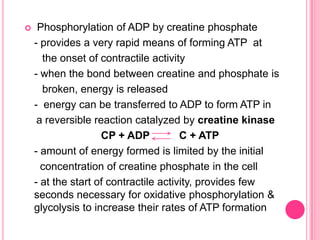
Phosphorylation of ADP by creatine phosphate	- provides a very rapid means of forming ATP  at           the onset of contractile activity	- when the bond between creatine and phosphate is       broken, energy is released	-  energy can be transferred to ADP to form ATP in     a reversible reaction catalyzed by creatinekinaseCP + ADP          C + ATP- amount of energy formed is limited by the initial 	  concentration of creatine phosphate in the cell	- at the start of contractile activity, provides few seconds necessary for oxidative phosphorylation & glycolysis to increase their rates of ATP formation
 oxidative phosphorylation of ADP in the mitochondria- produced most of the ATP used for muscle contraction at moderate levels of muscular activity muscle glycogenThe major fuel contributing to oxidative phosphorylation during the first 5 – 10 minutes o exerciseBlood glucose & fatty acidsBecome dominant in the next 30 minutes of the exercise fatty acidsBecome more important beyond 30 minutes of the exerciseGlycolysisContributes to the total ATP when the intensity of the exercise exceeds 70% of the maximal rate of ATP breakdown
Glycolytic pathwaysCan produce large quantities of ATP when enough enzymes and substrates are available in the absence of oxygen two sources of glucose for glycolysisBloodStores of glycogen within the contracting muscle fibers  as intensity of muscle activity increasesGreater fraction of total ATP production is formed by anaerobic glycolysis at the end of muscle activityCreatine phosphate & glycogen levels in the muscle decreases
creatine phosphate & glycogen (energy-storing compounds)Must be replaced Replacement requires energy  elevated consumption of oxygen following an exercise repays oxygen dept – the increased production of ATP by oxidative phosphorylation following exercise that is used to restore the energy reserves in the form of creatine phosphate & glycogen
Muscle fatigue the decline in muscle tension as a result of previous contractile activity decreased shortening velocity and a slower rate of relaxation at the onset, its rate of development depend on the type of skeletal-muscle fiber that is active on the intensity duration of contractile activity
 if a muscle is allowed to rest after the onset of fatigue it can recover its ability to contract upon restimulation the rate of recovery depends uponThe duration and the intensity of the previous activity types of fatigueHigh-frequency fatigueAccompanies high-intensity, short duration exercise (ex. Weight lifting) Low-frequency fatigueDevelops more slowly with low-intensity, long duration exercise (ex. Long-distance running requires much longer periods of rest before the muscles achieves complete recovery
 Muscle fatigue have evolved as a mechanism for preventing the onset of rigorHigh-frequency fatigue occurs primarily because of a failure of the muscle action potential to be conducted into the fiber along the T tubules and thus a failure to release calcium from the sarcomastic reticulumRecovery is rapid with restNo single process can account for the low-frequency fatigueOne major factor is the build up of lactic acidRecovery probably requires protein synthesis
Central command fatigueDue to failure of the appropriate regions of the cerebral cortex to send excitatory signals to the motor neuronsCauses an individual to stop exercising though the muscle are not fatigue
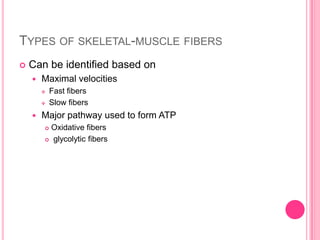
Types of skeletal-muscle fibersCan be identified based on Maximal velocitiesFast fibers
Slow fibersMajor pathway used to form ATPOxidative fibersglycolytic fibers
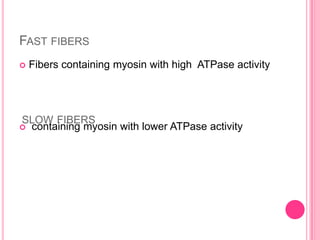
Fast fibersFibers containing myosin with high  ATPase activity containing myosin with lower ATPase activityslow fibers

part7b2

  • 1.
  • 2.
    ATP (AdenosineTriphosphate) performs functions directly related to muscle-fiber contraction and relaxation provides energy for myosin cross-bridge movementsallosteric binding of ATP on myosin cross-bridge provide energy for Ca+ transport ATP molecules must be produced rapidly to sustain contractile activity
  • 3.
    Three waysto form ATP during contractile activityPhosphorylation of ADP by creatine phosphate Oxidative phosphoryation of ADP in the mitochondria Substrate-level phosphorylation of ADP by the glycotic pathway in the cytosol
  • 4.
    Phosphorylation of ADPby creatine phosphate - provides a very rapid means of forming ATP at the onset of contractile activity - when the bond between creatine and phosphate is broken, energy is released - energy can be transferred to ADP to form ATP in a reversible reaction catalyzed by creatinekinaseCP + ADP C + ATP- amount of energy formed is limited by the initial concentration of creatine phosphate in the cell - at the start of contractile activity, provides few seconds necessary for oxidative phosphorylation & glycolysis to increase their rates of ATP formation
  • 5.
    oxidative phosphorylationof ADP in the mitochondria- produced most of the ATP used for muscle contraction at moderate levels of muscular activity muscle glycogenThe major fuel contributing to oxidative phosphorylation during the first 5 – 10 minutes o exerciseBlood glucose & fatty acidsBecome dominant in the next 30 minutes of the exercise fatty acidsBecome more important beyond 30 minutes of the exerciseGlycolysisContributes to the total ATP when the intensity of the exercise exceeds 70% of the maximal rate of ATP breakdown
  • 6.
    Glycolytic pathwaysCan producelarge quantities of ATP when enough enzymes and substrates are available in the absence of oxygen two sources of glucose for glycolysisBloodStores of glycogen within the contracting muscle fibers as intensity of muscle activity increasesGreater fraction of total ATP production is formed by anaerobic glycolysis at the end of muscle activityCreatine phosphate & glycogen levels in the muscle decreases
  • 7.
    creatine phosphate &glycogen (energy-storing compounds)Must be replaced Replacement requires energy elevated consumption of oxygen following an exercise repays oxygen dept – the increased production of ATP by oxidative phosphorylation following exercise that is used to restore the energy reserves in the form of creatine phosphate & glycogen
  • 8.
    Muscle fatigue thedecline in muscle tension as a result of previous contractile activity decreased shortening velocity and a slower rate of relaxation at the onset, its rate of development depend on the type of skeletal-muscle fiber that is active on the intensity duration of contractile activity
  • 9.
    if amuscle is allowed to rest after the onset of fatigue it can recover its ability to contract upon restimulation the rate of recovery depends uponThe duration and the intensity of the previous activity types of fatigueHigh-frequency fatigueAccompanies high-intensity, short duration exercise (ex. Weight lifting) Low-frequency fatigueDevelops more slowly with low-intensity, long duration exercise (ex. Long-distance running requires much longer periods of rest before the muscles achieves complete recovery
  • 10.
    Muscle fatiguehave evolved as a mechanism for preventing the onset of rigorHigh-frequency fatigue occurs primarily because of a failure of the muscle action potential to be conducted into the fiber along the T tubules and thus a failure to release calcium from the sarcomastic reticulumRecovery is rapid with restNo single process can account for the low-frequency fatigueOne major factor is the build up of lactic acidRecovery probably requires protein synthesis
  • 11.
    Central command fatigueDueto failure of the appropriate regions of the cerebral cortex to send excitatory signals to the motor neuronsCauses an individual to stop exercising though the muscle are not fatigue
  • 12.
    Types of skeletal-musclefibersCan be identified based on Maximal velocitiesFast fibers
  • 13.
    Slow fibersMajor pathwayused to form ATPOxidative fibersglycolytic fibers
  • 14.
    Fast fibersFibers containingmyosin with high ATPase activity containing myosin with lower ATPase activityslow fibers