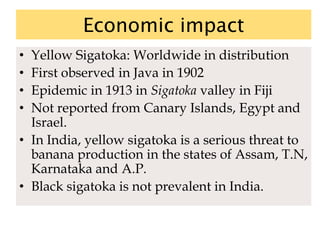
Economic impact
• YellowSigatoka: Worldwide in distribution
• First observed in Java in 1902
• Epidemic in 1913 in Sigatoka valley in Fiji
• Not reported from Canary Islands, Egypt and
Israel.
• In India, yellow sigatoka is a serious threat to
banana production in the states of Assam, T.N,
Karnataka and A.P.
• Black sigatoka is not prevalent in India.
4.
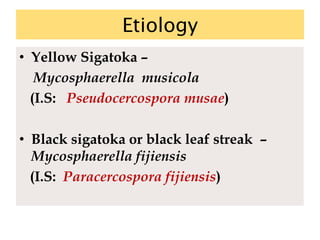
Etiology
• Yellow Sigatoka–
Mycosphaerella musicola
(I.S: Pseudocercospora musae)
• Black sigatoka or black leaf streak –
Mycosphaerella fijiensis
(I.S: Paracercospora fijiensis)
5.
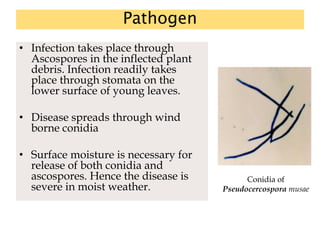
Conidia of
Pseudocercospora musae
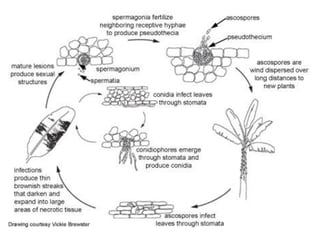
•Infection takes place through
Ascospores in the inflected plant
debris. Infection readily takes
place through stomata on the
lower surface of young leaves.
• Disease spreads through wind
borne conidia
• Surface moisture is necessary for
release of both conidia and
ascospores. Hence the disease is
severe in moist weather.
Pathogen
7.
Favourable conditions
• Highhumidity, heavy dew and rainy weather
with temp above 21o C
• Prolonged leaf wetness periods
• Poor drainage and low soil fertility particularly of
potassium
• Closer planting
• Susceptible cultivars like Grand Naine, Dwarf
Cavendish and Giant Cavendish
• More suckers in a mat because of non removal
8.
Diagnostic symptoms
• Earlysymptoms appear on the lower leaves
• Initially small reddish brown specks develop on
leaves near the tip or margin of lamina
• Specks may also be produced near the midrib
• Specks increase in size and turn in to spindle
shaped spots with reddish brown margin and
gray centre surrounded by a yellow halo
• Spots formed near the midrib enlarge and extend
towards the margin of lamina
9.
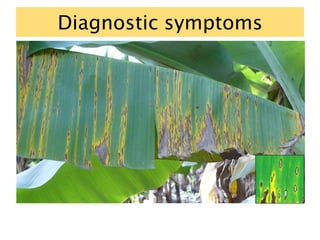
Diagnostic symptoms
• Spotscoalesce and the entire spotted area
appears dried
• Disease gradually progresses on to upper
leaves
• Infection becomes severe after bunch
emergence with the entire foliage infected
under favourable conditions
• Fruits in bunches of infected plants are under
developed and may ripen prematurely
Management
• Planting bananain well drained soils
• Growing moderately resistant cultivars like
Karpura Chakkerakeli
• Planting at recommended density (1000
plants/acre)
• Pruning suckers periodically to avoid
overcrowding in the field
• Removal and destruction of affected leaves
followed by spraying with BM 1% + linseed
oil 2%
12.
Management
• Applying recommendeddose of
potassium fertilizer
• Spraying mancozeb or cholorothalonil @
0.2% suspended in mineral (paraffin) oil
• Spraying chlorothalonil 0.2% with non
ionic adhesive in pre-monsoon period and
propiconazole 0.1% interspersed with
tridemorph 0.1% at 20 days interval in
rainy period
Economic impact
• Firstreported from Australia in 1874
• The popular variety Gros Michel, mostly grown
for export quality fruits, was most susceptible and
had to be replaced with Cavendish bananas which
were resistant in the Latin American countries
• Cultivars Rasthali (Amrutapani), Gros Michel,
Karpooravalli cultivars are susceptible
• Four races of the pathogen are known to exist but
race 1 is mostly prevalent in India attacking Silk
group of cultivars (Rasthali or Amritapani)
15.
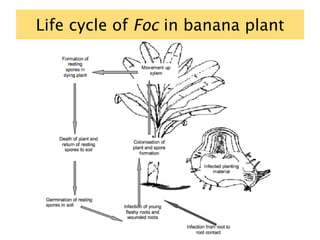
Etiology
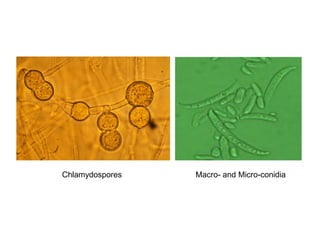
• Fusarium oxysporumf.sp. cubense
• Primary: Chlamydospores in soil and
propagules in infected suckers used for
planting
• Secondary: Micro and macro conidia
through irrigation water
Favourable conditions
• Saturatedpoorly drained heavy soils
• Cultivation of susceptible cultivars like
Amritapani
• Infection by burrowing nematode,
Radopholus similis, predisposes the plants
to disease
18.
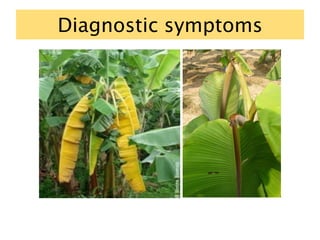
Diagnostic symptoms
• Conspicuoussymptoms usually appear on 3 to 5
months old plants, although 2-3 months old
plants are also killed under highly favourable
conditions
• Symptoms initially seen in older plants in a mat
• The earliest symptoms are faint yellow streaks
on the petiole of oldest, lower most leaves
• Affected leaves show progressive yellowing,
break at the petiole and hang down along the
pseudostem
19.
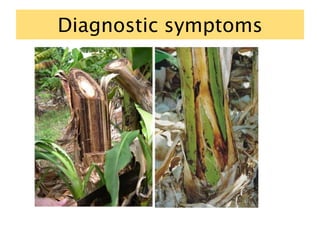
Diagnostic symptoms
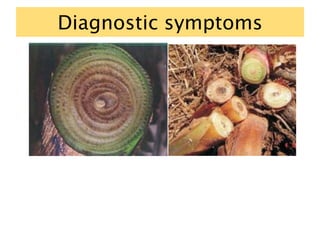
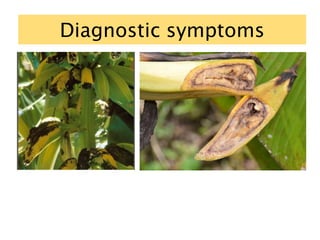
• Longitudinalsplitting of pseudostem is very
common
• Light yellow to dark brown discolouration of
vascular strands in pseudostem. Usually the
discolouration appears first in the outer or oldest
leaf sheath and extends in to the inner sheaths
• The fungus grows and blocks the vascular system
resulting in wilting of the plant
• Vascular discolouration in cross sections of rhizome
appears reddish brown towards periphery
progressing in to centre of rhizome
20.
Diagnostic symptoms
• Rhizomesof affected plants give
characteristic odour of rotten fish if infection
is due to odoratum isolate of the pathogen
• Young suckers also develop the disease but
rarely develop external symptoms
• Affected plants do not produce bunches.
Even if produced, fruits are malformed and
ripen prematurely or irregularly. However
the pathogen does not infect the fruits
Management
• Use ofdisease free suckers for planting
• Avoid ill drained soils
• Flood fallowing for 6 to 24 months or crop
rotation with puddle rice
• Application of lime (1-2 kg/pit) to the
infected pits after chopping of the plants
parts
25.
Management
• Dipping ofsuckers in carbendazim (0.1%)
solution before planting
• Neem cake + Trichoderma viride should be
applied in planting pits
• Soil drench with 0.2% carbendazim or
rhizome injection with 0.2% carbendazim
• Growing resistant Cavendish varieties, viz.,
Basrai (Vamanakeli or Dwarf cavendish),
Poovan (Karpura chakkarakeli) etc.
Economic impact
• Firstrecorded in Guyana in 1840 in Moko plantain
• Reductions in yield due to Moko of up to 74% have
been reported in Guyana.
• A disease outbreak in Trinidad in the late 1890’s
caused severe losses of Moko cooking bananas.
• Moko is endemic to Central and South America
• Not reported from India
• Moko disease affects ornamental Heliconia spp. It
also affects commonly grown dessert bananas
(Musa), plantains (Musa paradisiaca) and cooking
bananas
28.
Etiology
• Ralstonia solanacearumrace 2, biovar 1
• Pathogen spreads through infected plant
parts, including root, trunk, bunch, fruit,
peel, sucker or leaf material.
• It can be spread through infested soil on
hands, tools, shoes, machinery, animals
and water run-off.
29.
Favourable conditions
• Cropresidues infected with pathogen in the
field
• Injured roots caused by farm tools or by soil
pests
• Warm temperature and high soil moisture
• Slightly acidic soils
• Poor and unfertile soils
• Infestation by nematodes
30.
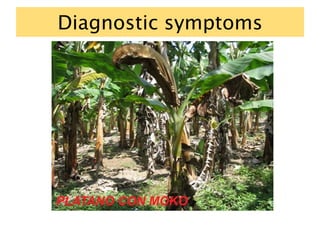
Diagnostic symptoms
• Symptomsstart on rapidly growing young
plants
• The youngest three to four leaves turn pale
green or yellow and collapse near the junction of
lamina and petiole
• Characteristic discoloration of vascular strands,
wilting and blackening of suckers
• Vascular discolouration (pale yellow to dark
brown or bluish black) is concentrated near the
centre of the pseudostem, becoming less
apparent on the periphery
31.
Diagnostic symptoms
• Greyishbrown bacterial ooze is seen when the
pseudostem of affected plant is cut transversely
• A firm brown dry rot is found within fruits of
infected plants
• Death of whole plant occurs under severe
infection.
Management
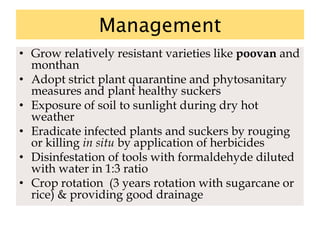
• Grow relativelyresistant varieties like poovan and
monthan
• Adopt strict plant quarantine and phytosanitary
measures and plant healthy suckers
• Exposure of soil to sunlight during dry hot
weather
• Eradicate infected plants and suckers by rouging
or killing in situ by application of herbicides
• Disinfestation of tools with formaldehyde diluted
with water in 1:3 ratio
• Crop rotation (3 years rotation with sugarcane or
rice) & providing good drainage
36.
Management
• Allow fallowperiod or flooding during
off-season
• Fumigation of infected site with Methyl
Bromide or chloropicrin
• Drenching soil in infected pockets with
bleaching powder solution (1.5%) and
Bordeaux mixture 1% + streptocycline
(0.02%)
• Biocontrol with Pseudomonas fluorescens
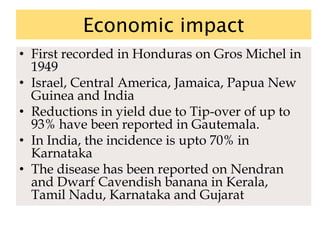
Economic impact
• Firstrecorded in Honduras on Gros Michel in
1949
• Israel, Central America, Jamaica, Papua New
Guinea and India
• Reductions in yield due to Tip-over of up to
93% have been reported in Gautemala.
• In India, the incidence is upto 70% in
Karnataka
• The disease has been reported on Nendran
and Dwarf Cavendish banana in Kerala,
Tamil Nadu, Karnataka and Gujarat
39.
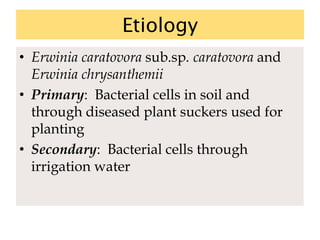
Etiology
• Erwinia caratovorasub.sp. caratovora and
Erwinia chrysanthemii
• Primary: Bacterial cells in soil and
through diseased plant suckers used for
planting
• Secondary: Bacterial cells through
irrigation water
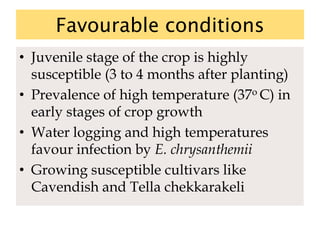
40.
Favourable conditions
• Juvenilestage of the crop is highly
susceptible (3 to 4 months after planting)
• Prevalence of high temperature (37o C) in
early stages of crop growth
• Water logging and high temperatures
favour infection by E. chrysanthemii
• Growing susceptible cultivars like
Cavendish and Tella chekkarakeli
41.
Diagnostic symptoms
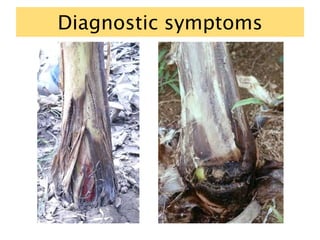
• Usuallyyoung plants are attacked. Under
favourable conditions even mature plants are
infected
• In newly planted young sprouting sucker the
rhizome is infected and infection progresses in
to pseudostem leading to toppling or tipover of
the germinating sucker
• In established plants water soaked spots
develop on outer leaf sheaths on base of
pseudostem near the soil line
42.
Diagnostic symptoms
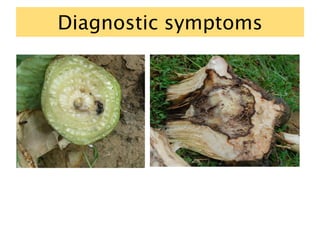
• Thespots turn brown and soft rotting of
pseudostem tissue and rhizomes takes place
• Infected plants have scanty roots with dark
brown lesions and necrotic tip
• Infection spreads to upper part of pseudostem
and to rhizomes
• In many cases, the pseudostem tips over because
of breaking caused by rotting at the ground level
43.
Diagnostic symptoms
• Matureplants are slow to exhibit symptoms and
may produce small sized bunches which may
fail to emerge from the shoot tip
• In infected rhizomes, pockets of dark water
soaked areas develop. Infection may result in the
production of cavities which resemble root borer
tunnels
Management
• Avoid plantingsusceptible varieties during
periods of high rainfall or in water logged soils in
problematic areas
• Crop rotation with rice or sugarcane for three to
four years
• Ensure that only healthy suckers are planted. Dip
the suckers in copper oxychloride (5g/lt) +
monochrotophos (2.5ml/l) solution
• Drenching the base of the plant with
Pseudomonas fluorescens @1-2 lt/plant (50g/lt of
water at 0, 2nd,4th and 6th months after planting)
• Maintain proper soil aeration by intercultivation
47.
Management
• Maintain optimumsoil moisture by light and
frequent irrigation
• Grow sunhemp or cowpea (2-3 times) in
interspaces till 5 months after planting
• Remove and destroy infected plants along
with roots
• Drench the infected suckers with bleaching
powder (1.5%) solution
• Restrict to one or two ratoons based on
disease incidence
48.
Bunchy top /Curly top /
cabbage top /strangles
disease
49.
Economic impact
• Firstreported from Fiji in 1889 in Cavendish
varieties
• Around 1940, introduced into India from
Srilanka through cyclone
• The virus is a domestic quarantine pest in
India.
• The movement of planting suckers from North
East, Tamil Nadu, Karnataka and Kerala to
other parts of the country is restricted
50.
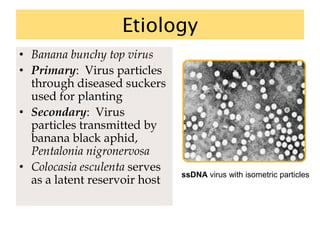
Etiology
• Banana bunchytop virus
• Primary: Virus particles
through diseased suckers
used for planting
• Secondary: Virus
particles transmitted by
banana black aphid,
Pentalonia nigronervosa
• Colocasia esculenta serves
as a latent reservoir host
ssDNA virus with isometric particles
51.
Favourable conditions
• Progressivelyincreasing temperature
from February onwards favours virus
spread and symptom expression
• Prevalence of infected reservoir host
(Canna, Heliconia, Strelitzia)
• Prevalence of aphid vector
52.
Diagnostic symptoms
• Infectionmay start at any stage of crop growth
• Paling of lamina with interveinal chlorosis that
is evident against light
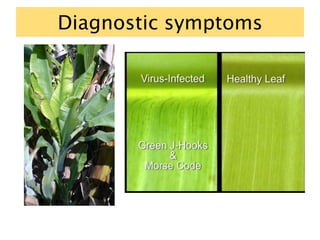
• Prominent dark green streaks on the petioles
and along midrib and leaf veins that range from
a series of dark green dots to a continuous dark
green line (Morse code)
• Infected plants show marked stunting
53.
Diagnostic symptoms
• Leavesare reduced in size with narrowed lamina
and shortened petiole, produced at shortened
internodal length, become erect and brittle and
crowded at the top (bunchy top)
• Leaf margins also show chlorosis and slight curling
and necrosis
• Infection of young plants leads to failure of bunch
emergence
• Tips of inflorescence bracts of infected plants remain
green and do not turn to normal pink or purple
Management
• Adoption ofstrict quarantine measures
• Use of only certified banana suckers or
tissue culture plants for planting
• Periodical monitoring and rouging of
infected plants with all suckers in the mat
by rouging or killing by injecting
herbicide, 2, 4-D
56.
Management
• Raising barriercrops like sunhemp in
three to four rows on the field boundaries
to check aphids from entering the fields
from neighbouring infected fields
• Vector control with systemic insecticides,
viz., Phosphomidon @ 1ml/l or Methyl
demeton or Dimethoate @ 2 ml/l
• Discouraging intercropping with Colocasia
in disease endemic areas
Economic impact
• Thisdisease is under domestic quarantine
in India.
• The movement of planting suckers from
Gujarat and Maharashtra to other parts of
the country is banned
• CMV causes great losses in vegetables,
ornamentals and fruit crops
59.
Etiology
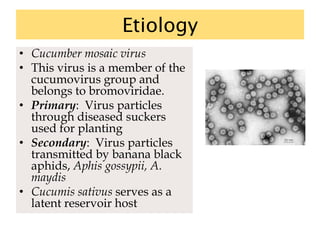
• Cucumber mosaicvirus
• This virus is a member of the
cucumovirus group and
belongs to bromoviridae.
• Primary: Virus particles
through diseased suckers
used for planting
• Secondary: Virus particles
transmitted by banana black
aphids, Aphis gossypii, A.
maydis
• Cucumis sativus serves as a
latent reservoir host
60.
Favourable conditions
• Lateand post monsoon period favours
virus spread and symptom expression
• Prevalence of infected reservoir host
• Prevalence of vector
61.
Diagnostic symptoms
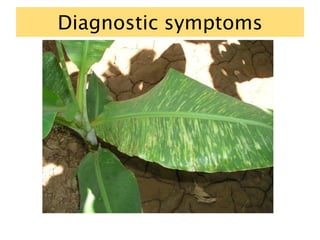
• Typicalmosaic-like or discontinuous linear
streaking in bands extending from margin to
midrib running parallel to veins (Mosaic)
• Chlorosis of newly emerged leaves (Infectious
chlorosis)
• Occasionally rotting of central youngest leaf and
leaf sheaths in severe cases (Heart rot) which
progress into the pseudostem leading to death of
plants
• Diseased plants do not reach maturity and may
fail to produce bunch
Management
• Adoption ofstrict quarantine measures
• Use of disease free suckers for planting
• Dry heat treatment of suckers at 400 C for 1 day
• Avoid growing cucurbits as intercrop
• Raising barrier crops like sunhemp in three to
four rows on the field boundaries to check
aphids from entering the fields from
neighbouring infected fields
• Vector control with Methyl demeton or
dimethoate or Dimethoate @ 2 ml/l at 3 – 4
weeks interval
Economic impact
• Firstreported from Mindanao, Philippines
in 1979
• Recorded in Srilanka, India, Vietnam and
Philippines
• In India, this virus disease was first
reported in Kerala as Kokkan disease
• Very rapidly spreading in all the banana
growing states of India in the absence of
regulation on the movement of suckers
66.
Etiology
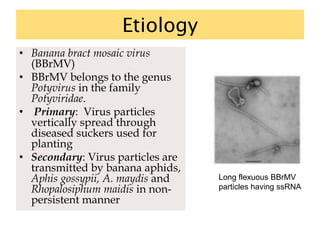
• Banana bractmosaic virus
(BBrMV)
• BBrMV belongs to the genus
Potyvirus in the family
Potyviridae.
• Primary: Virus particles
vertically spread through
diseased suckers used for
planting
• Secondary: Virus particles are
transmitted by banana aphids,
Aphis gossypii, A. maydis and
Rhopalosiphum maidis in non-
persistent manner
Long flexuous BBrMV
particles having ssRNA
67.
Favourable conditions
• Useof infected planting material
• Disease spread and symptom expression
is severe in winter months
• Prevalence of vector
68.
Diagnostic symptoms
• Incooking bananas water soaked chlorotic streaks
initially develop on sheaths and petioles of leaves at the
top. The streaks later turn pinkish
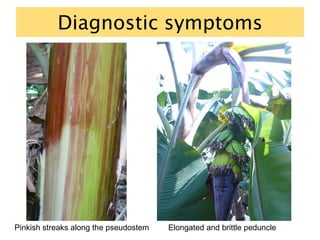
• In Karpura Chakkerakeli and other commercial cultivars
like the Cavendish the disease is characterised by
continuous or discontinuous pinkish streaks along the
pseudostem
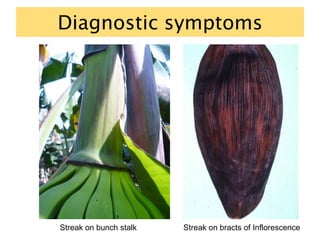
• The most characteristic and confirmatory symptom is
development of pinkish to purplish streaks that are
either continuous or discontinuous on bracts of
inflorescence
• In severe cases, pink streaks continue on the lower
surface along the length of midrib
69.
Diagnostic symptoms
• Flatteningat the top of the plants (crown) with leaves
arranged as in travelers palm is common in cooking
banana cultivars
• Unclasping of leaf sheaths from the pseudostem is a
feature of the disease
• Pseudostems of infected plants bow or curve at an angle
rendering them prone to break even at moderate wind
speeds
• Infected plants generally do not flower or flower very
late and produce a small bunch with elongated and
brittle peduncle
Management
• Early detectionand rouging of infected plants
• Use of disease free suckers for planting
• Dry heat treatment of suckers at 400 C for 1 day
• Use seedlings raised through tissue culture
technology
• Raising barrier crops like sunhemp in three to
four rows on the field boundaries to check
aphids from entering the fields from
neighbouring infected fields
• Vector control with Methyl demeton or
dimethoate@ 0.2% at 3 – 4 weeks interval



![Banana plant deficiency symptoms and corrective measures [compatibility mode]](https://cdn.slidesharecdn.com/ss_thumbnails/bananaplantdeficiencysymptomsandcorrectivemeasurescompatibilitymode-140717060838-phpapp01-thumbnail.jpg?width=640&height=640&fit=bounds)


![Diseases of mulberry and banana.pptx [Repaired].pptx](https://cdn.slidesharecdn.com/ss_thumbnails/diseasesofmulberryandbanana-221027111408-6c4d0e63-thumbnail.jpg?width=640&height=640&fit=bounds)


