ALLPPT.com _ Free PowerPoint Templates, Diagrams and Charts
Name :Hajran Hussain
Roll No:P2F18ASBZ0002
Topic :Family Cucurbitaceae
Subject:Plant Systematic
Submitted By:Prof. Subtain
Title Page
 Kingdom : Plantae
 Scientific Name : Cucurbitaceae
 Higher Classification :
Cucurbitales
Classification
Family Cucurbitaceae
Deffination
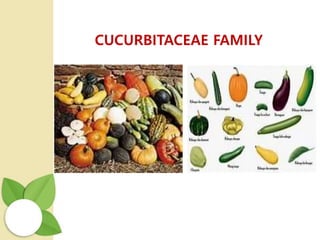
The Cucurbitaceae, also called cucurbits or
the gourd family, are a plant family consisti
ng of about 965 species in around 95 gene
ra, the most important of which are: Cucur
bita – squash, pumpkin, zucchini, some go
urds Lagenaria – calabash, and others that
are inedible
Diagnostic Characters
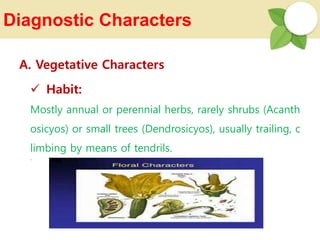
 Habit:
Mostly annual or perennial herbs, rarely shrubs (Acanth
osicyos) or small trees (Dendrosicyos), usually trailing, c
limbing by means of tendrils.
`
A. Vegetative Characters
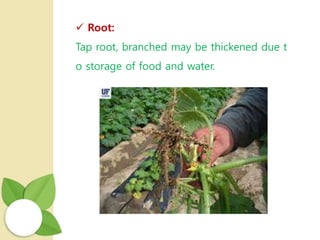
 Root:
Tap root, branched may be thickened due t
o storage of food and water.
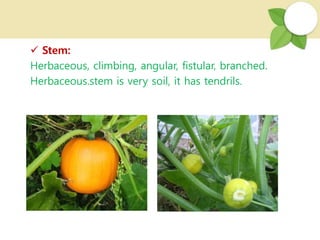
 Stem:
Herbaceous, climbing, angular, fistular, branched.
Herbaceous.stem is very soil, it has tendrils.
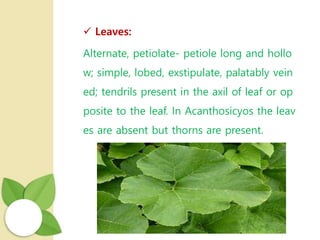
 Leaves:
Alternate, petiolate- petiole long and hollo
w; simple, lobed, exstipulate, palatably vein
ed; tendrils present in the axil of leaf or op
posite to the leaf. In Acanthosicyos the leav
es are absent but thorns are present.
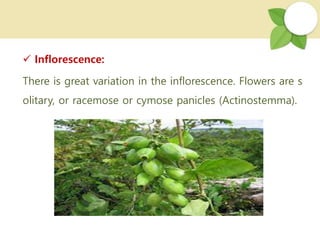
 Inflorescence:
There is great variation in the inflorescence. Flowers are s
olitary, or racemose or cymose panicles (Actinostemma).
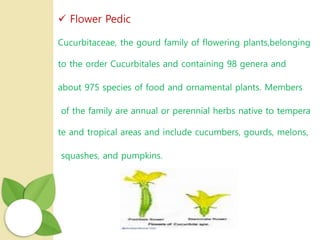
 Flower Pedic
Cucurbitaceae, the gourd family of flowering plants,belonging
to the order Cucurbitales and containing 98 genera and
about 975 species of food and ornamental plants. Members
of the family are annual or perennial herbs native to tempera
te and tropical areas and include cucumbers, gourds, melons,
squashes, and pumpkins.
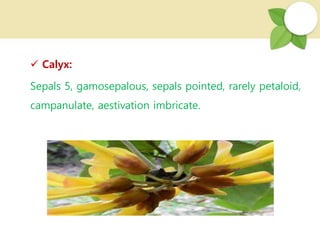
 Calyx:
Sepals 5, gamosepalous, sepals pointed, rarely petaloid,
campanulate, aestivation imbricate.
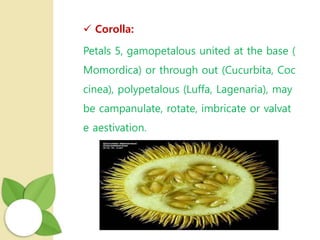
 Corolla:
Petals 5, gamopetalous united at the base (
Momordica) or through out (Cucurbita, Coc
cinea), polypetalous (Luffa, Lagenaria), may
be campanulate, rotate, imbricate or valvat
e aestivation.
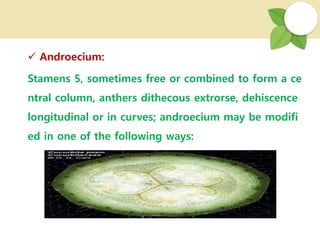
 Androecium:
Stamens 5, sometimes free or combined to form a ce
ntral column, anthers dithecous extrorse, dehiscence
longitudinal or in curves; androecium may be modifi
ed in one of the following ways:
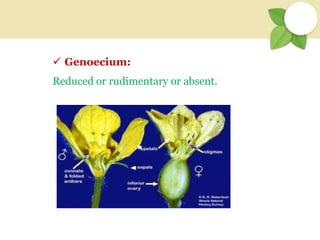
 Genoecium:
Reduced or rudimentary or absent.
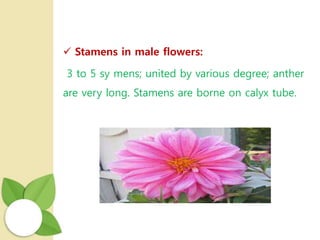
 Stamens in male flowers:
3 to 5 sy mens; united by various degree; anther
are very long. Stamens are borne on calyx tube.
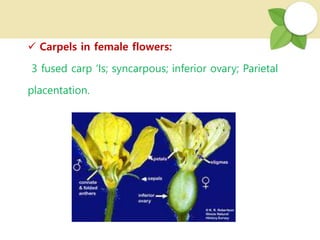
 Carpels in female flowers:
3 fused carp ‘Is; syncarpous; inferior ovary; Parietal
placentation.
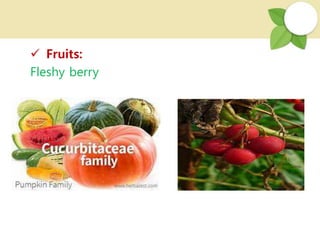
 Fruits:
Fleshy berry
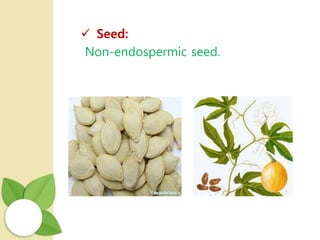
 Seed:
Non-endospermic seed.
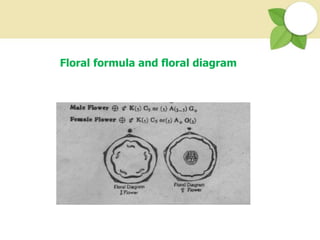
Floral formula and floral diagram
Economic Importance
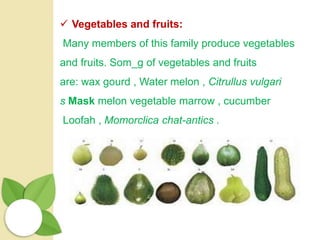
 Vegetables and fruits:
Many members of this family produce vegetables
and fruits. Som_g of vegetables and fruits
are: wax gourd , Water melon , Citrullus vulgari
s Mask melon vegetable marrow , cucumber
Loofah , Momorclica chat-antics .
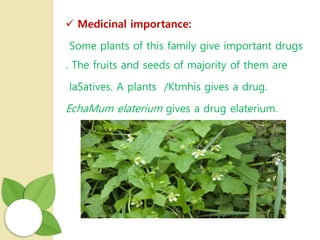
 Medicinal importance:
Some plants of this family give important drugs
. The fruits and seeds of majority of them are
laSatives. A plants /Ktmhis gives a drug.
EchaMum elaterium gives a drug elaterium.
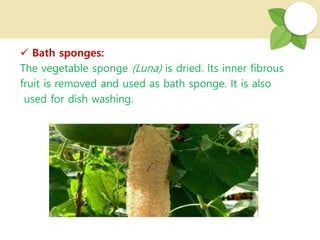
 Bath sponges:
The vegetable sponge (Luna) is dried. Its inner fibrous
fruit is removed and used as bath sponge. It is also
used for dish washing.
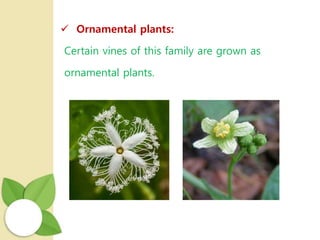
 Ornamental plants:
Certain vines of this family are grown as
ornamental plants.
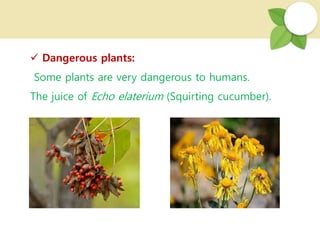
 Dangerous plants:
Some plants are very dangerous to humans.
The juice of Echo elaterium (Squirting cucumber).
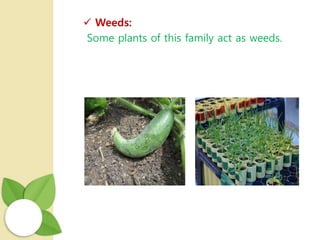
 Weeds:
Some plants of this family act as weeds.
 Distribution pattern
This family has 100 genera and 850 species. Most of
the plants are tropical and sub-tropical. Some species
are temperate.
 Common species
1. Cucurbita pepo (pumpkin)
2. Cucumis meta (melon
3. Cucumis sans (cucumber )
4. Momordica charantia
5. Luffli aeuptica
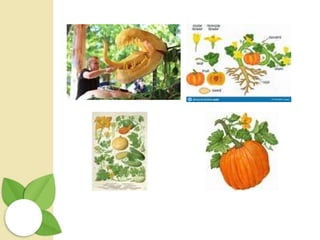
 Pumpkin
(Cucurbita pepo) includes both pumpkin
and several summer squash cultivars. This
plant sometimes escapes from vegetable
gardens and dump areas. The seeds have
medicinal value as a natural antihelminthic
(treatment for intestinal worms).
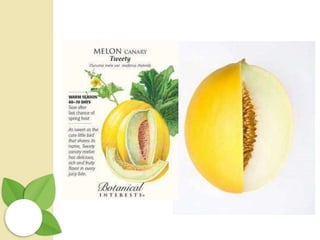
 Melon
The melon is a summer fruit found on markets betwee
n June and August. Nutritional value of melons Low in
calories (30 to 50 kilocalories per 100 grammes), the m
elon provides significant quantities of vitamins C and B
9, fibre and especially provitamin A (carotene).
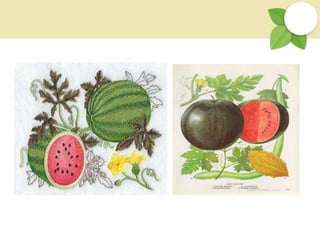
 Water Melon
Watermelon originates in southern Africa and
was domesticated at least four thousand years
ago, having been cultivated in ancient Egypt. It
is now cultivated throughout the tropical, subt
ropical and warm temperate regions of the wo
rld. Escapes are occasionally found in dumps,
pond shores, fields and abandoned gardens in
New England.
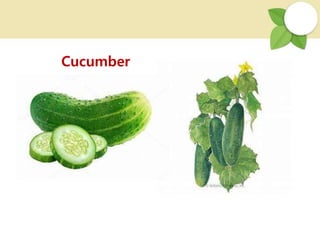
 Cucumber
Cucumber originates in southern Asia, but a large
number of cultivars have been developed and are
grown .
worldwide. It has been collected as escaped individuals
in Massachusetts, but it is unlikely to persist.
Cucumber
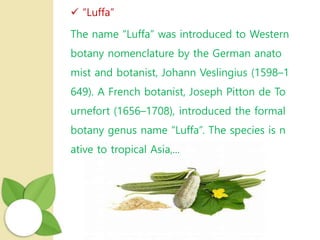
 “Luffa”
The name “Luffa” was introduced to Western
botany nomenclature by the German anato
mist and botanist, Johann Veslingius (1598–1
649). A French botanist, Joseph Pitton de To
urnefort (1656–1708), introduced the formal
botany genus name “Luffa”. The species is n
ative to tropical Asia,...
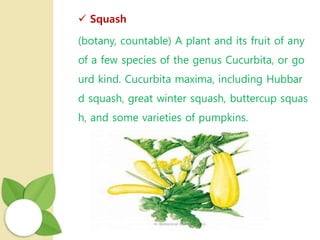
 Squash
(botany, countable) A plant and its fruit of any
of a few species of the genus Cucurbita, or go
urd kind. Cucurbita maxima, including Hubbar
d squash, great winter squash, buttercup squas
h, and some varieties of pumpkins.
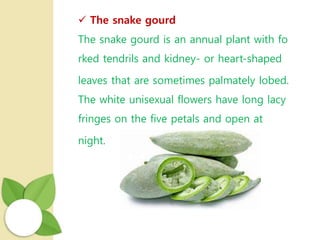
 The snake gourd
The snake gourd is an annual plant with fo
rked tendrils and kidney- or heart-shaped
leaves that are sometimes palmately lobed.
The white unisexual flowers have long lacy
fringes on the five petals and open at
night.
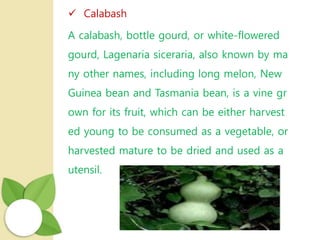
 Calabash
A calabash, bottle gourd, or white-flowered
gourd, Lagenaria siceraria, also known by ma
ny other names, including long melon, New
Guinea bean and Tasmania bean, is a vine gr
own for its fruit, which can be either harvest
ed young to be consumed as a vegetable, or
harvested mature to be dried and used as a
utensil.
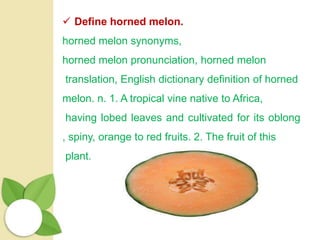
 Define horned melon.
horned melon synonyms,
horned melon pronunciation, horned melon
translation, English dictionary definition of horned
melon. n. 1. A tropical vine native to Africa,
having lobed leaves and cultivated for its oblong
, spiny, orange to red fruits. 2. The fruit of this
plant.
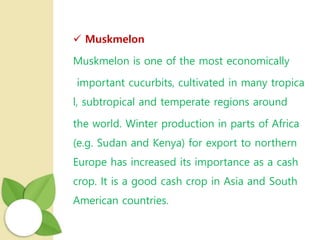
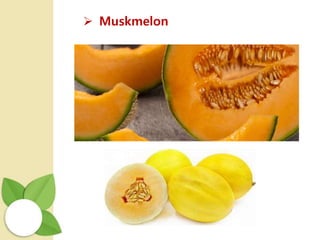
 Muskmelon
Muskmelon is one of the most economically
important cucurbits, cultivated in many tropica
l, subtropical and temperate regions around
the world. Winter production in parts of Africa
(e.g. Sudan and Kenya) for export to northern
Europe has increased its importance as a cash
crop. It is a good cash crop in Asia and South
American countries.
 Muskmelon
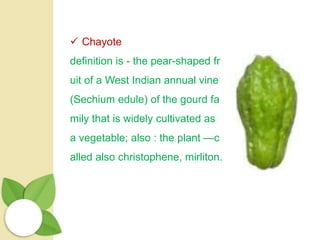
 Chayote
definition is - the pear-shaped fr
uit of a West Indian annual vine
(Sechium edule) of the gourd fa
mily that is widely cultivated as
a vegetable; also : the plant —c
alled also christophene, mirliton.
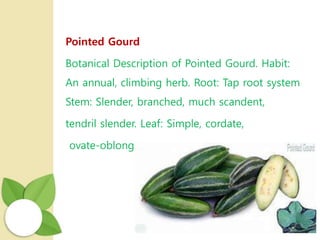
Pointed Gourd
Botanical Description of Pointed Gourd. Habit:
An annual, climbing herb. Root: Tap root system
Stem: Slender, branched, much scandent,
tendril slender. Leaf: Simple, cordate,
ovate-oblong.
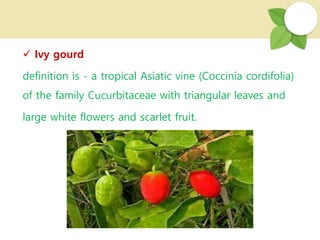
 Ivy gourd
definition is - a tropical Asiatic vine (Coccinia cordifolia)
of the family Cucurbitaceae with triangular leaves and
large white flowers and scarlet fruit.
• The plants are weak stemmed, tendril climbers.
• Leaves are simple, alternate, exstipulate,
• palmately lobed.
• Inflorescence is racemose or solitary axillary
• cyme.
• Flowers are unisexual, actinomorphic, epigynous
• & incomplete.
These are useful in medicines, culinary
purposes because of its essential oils & gums
found in the root, stem & fruit.
Daucas carota- carrot is used as a vegetable.
Carum copticum- omum fruits are used as
carminative.
Coriander sativum- friuts are used as
condiment & spice. Their leaves are aromatic.
CUCURBITACEAE FAMILY
Family Cucurbitaceae

Family Cucurbitaceae

  • 1.
    ALLPPT.com _ FreePowerPoint Templates, Diagrams and Charts
  • 2.
    Name :Hajran Hussain RollNo:P2F18ASBZ0002 Topic :Family Cucurbitaceae Subject:Plant Systematic Submitted By:Prof. Subtain Title Page
  • 3.
     Kingdom :Plantae  Scientific Name : Cucurbitaceae  Higher Classification : Cucurbitales Classification
  • 4.
    Family Cucurbitaceae Deffination The Cucurbitaceae,also called cucurbits or the gourd family, are a plant family consisti ng of about 965 species in around 95 gene ra, the most important of which are: Cucur bita – squash, pumpkin, zucchini, some go urds Lagenaria – calabash, and others that are inedible
  • 5.
    Diagnostic Characters  Habit: Mostlyannual or perennial herbs, rarely shrubs (Acanth osicyos) or small trees (Dendrosicyos), usually trailing, c limbing by means of tendrils. ` A. Vegetative Characters
  • 6.
     Root: Tap root,branched may be thickened due t o storage of food and water.
  • 7.
     Stem: Herbaceous, climbing,angular, fistular, branched. Herbaceous.stem is very soil, it has tendrils.
  • 8.
     Leaves: Alternate, petiolate-petiole long and hollo w; simple, lobed, exstipulate, palatably vein ed; tendrils present in the axil of leaf or op posite to the leaf. In Acanthosicyos the leav es are absent but thorns are present.
  • 9.
     Inflorescence: There isgreat variation in the inflorescence. Flowers are s olitary, or racemose or cymose panicles (Actinostemma).
  • 10.
     Flower Pedic Cucurbitaceae,the gourd family of flowering plants,belonging to the order Cucurbitales and containing 98 genera and about 975 species of food and ornamental plants. Members of the family are annual or perennial herbs native to tempera te and tropical areas and include cucumbers, gourds, melons, squashes, and pumpkins.
  • 11.
     Calyx: Sepals 5,gamosepalous, sepals pointed, rarely petaloid, campanulate, aestivation imbricate.
  • 12.
     Corolla: Petals 5,gamopetalous united at the base ( Momordica) or through out (Cucurbita, Coc cinea), polypetalous (Luffa, Lagenaria), may be campanulate, rotate, imbricate or valvat e aestivation.
  • 13.
     Androecium: Stamens 5,sometimes free or combined to form a ce ntral column, anthers dithecous extrorse, dehiscence longitudinal or in curves; androecium may be modifi ed in one of the following ways:
  • 14.
     Genoecium: Reduced orrudimentary or absent.
  • 15.
     Stamens inmale flowers: 3 to 5 sy mens; united by various degree; anther are very long. Stamens are borne on calyx tube.
  • 16.
     Carpels infemale flowers: 3 fused carp ‘Is; syncarpous; inferior ovary; Parietal placentation.
  • 17.
  • 18.
  • 19.
    Floral formula andfloral diagram
  • 20.
  • 21.
     Vegetables andfruits: Many members of this family produce vegetables and fruits. Som_g of vegetables and fruits are: wax gourd , Water melon , Citrullus vulgari s Mask melon vegetable marrow , cucumber Loofah , Momorclica chat-antics .
  • 22.
     Medicinal importance: Someplants of this family give important drugs . The fruits and seeds of majority of them are laSatives. A plants /Ktmhis gives a drug. EchaMum elaterium gives a drug elaterium.
  • 23.
     Bath sponges: Thevegetable sponge (Luna) is dried. Its inner fibrous fruit is removed and used as bath sponge. It is also used for dish washing.
  • 24.
     Ornamental plants: Certainvines of this family are grown as ornamental plants.
  • 25.
     Dangerous plants: Someplants are very dangerous to humans. The juice of Echo elaterium (Squirting cucumber).
  • 26.
     Weeds: Some plantsof this family act as weeds.
  • 27.
     Distribution pattern Thisfamily has 100 genera and 850 species. Most of the plants are tropical and sub-tropical. Some species are temperate.
  • 28.
     Common species 1.Cucurbita pepo (pumpkin) 2. Cucumis meta (melon 3. Cucumis sans (cucumber ) 4. Momordica charantia 5. Luffli aeuptica
  • 29.
     Pumpkin (Cucurbita pepo)includes both pumpkin and several summer squash cultivars. This plant sometimes escapes from vegetable gardens and dump areas. The seeds have medicinal value as a natural antihelminthic (treatment for intestinal worms).
  • 31.
     Melon The melonis a summer fruit found on markets betwee n June and August. Nutritional value of melons Low in calories (30 to 50 kilocalories per 100 grammes), the m elon provides significant quantities of vitamins C and B 9, fibre and especially provitamin A (carotene).
  • 33.
     Water Melon Watermelonoriginates in southern Africa and was domesticated at least four thousand years ago, having been cultivated in ancient Egypt. It is now cultivated throughout the tropical, subt ropical and warm temperate regions of the wo rld. Escapes are occasionally found in dumps, pond shores, fields and abandoned gardens in New England.
  • 35.
     Cucumber Cucumber originatesin southern Asia, but a large number of cultivars have been developed and are grown . worldwide. It has been collected as escaped individuals in Massachusetts, but it is unlikely to persist.
  • 36.
  • 37.
     “Luffa” The name“Luffa” was introduced to Western botany nomenclature by the German anato mist and botanist, Johann Veslingius (1598–1 649). A French botanist, Joseph Pitton de To urnefort (1656–1708), introduced the formal botany genus name “Luffa”. The species is n ative to tropical Asia,...
  • 38.
     Squash (botany, countable)A plant and its fruit of any of a few species of the genus Cucurbita, or go urd kind. Cucurbita maxima, including Hubbar d squash, great winter squash, buttercup squas h, and some varieties of pumpkins.
  • 39.
     The snakegourd The snake gourd is an annual plant with fo rked tendrils and kidney- or heart-shaped leaves that are sometimes palmately lobed. The white unisexual flowers have long lacy fringes on the five petals and open at night.
  • 40.
     Calabash A calabash,bottle gourd, or white-flowered gourd, Lagenaria siceraria, also known by ma ny other names, including long melon, New Guinea bean and Tasmania bean, is a vine gr own for its fruit, which can be either harvest ed young to be consumed as a vegetable, or harvested mature to be dried and used as a utensil.
  • 41.
     Define hornedmelon. horned melon synonyms, horned melon pronunciation, horned melon translation, English dictionary definition of horned melon. n. 1. A tropical vine native to Africa, having lobed leaves and cultivated for its oblong , spiny, orange to red fruits. 2. The fruit of this plant.
  • 42.
     Muskmelon Muskmelon isone of the most economically important cucurbits, cultivated in many tropica l, subtropical and temperate regions around the world. Winter production in parts of Africa (e.g. Sudan and Kenya) for export to northern Europe has increased its importance as a cash crop. It is a good cash crop in Asia and South American countries.
  • 43.
  • 44.
     Chayote definition is- the pear-shaped fr uit of a West Indian annual vine (Sechium edule) of the gourd fa mily that is widely cultivated as a vegetable; also : the plant —c alled also christophene, mirliton.
  • 45.
    Pointed Gourd Botanical Descriptionof Pointed Gourd. Habit: An annual, climbing herb. Root: Tap root system Stem: Slender, branched, much scandent, tendril slender. Leaf: Simple, cordate, ovate-oblong.
  • 46.
     Ivy gourd definitionis - a tropical Asiatic vine (Coccinia cordifolia) of the family Cucurbitaceae with triangular leaves and large white flowers and scarlet fruit.
  • 47.
    • The plantsare weak stemmed, tendril climbers. • Leaves are simple, alternate, exstipulate, • palmately lobed. • Inflorescence is racemose or solitary axillary • cyme. • Flowers are unisexual, actinomorphic, epigynous • & incomplete.
  • 48.
    These are usefulin medicines, culinary purposes because of its essential oils & gums found in the root, stem & fruit. Daucas carota- carrot is used as a vegetable. Carum copticum- omum fruits are used as carminative. Coriander sativum- friuts are used as condiment & spice. Their leaves are aromatic.
  • 49.