HEALTH
INTRODUCTION
Health can be defined as the physical, social, psychological and
spiritual well-being of individuals. Overall health of the
population is determined by people’s income, education,
employment and housing, as well as a combination of
preventive and rehabilitative approaches and services. Making
a positive impact on the health of individuals is the common
goal among partners in the continuum of wellness promotion,
illness prevention and health care
DEFINITION
Health is a state of complete physical, mental and social
wellbeing and not merely an absence of disease or infirmity.
(WHO-1948)
“ Health is the condition of being sound in body , mind and
spirit ,especially freedom from physical disease or pain.” –
(Webster.)
Concept Of Health
oAn understanding of health is the basis of all the health care.
o Health has evolved over the centuries from the concept of
individual concern to a worldwide social goal.
oThe various changing concepts of health as follows:
1. Biomedical concept
2. Ecological concept
3. Psychosocial concept
4. Holistic concept
1. Biomedical concept
 Traditionally health has been considered as an absence of
the diseases and if someone was free from disease, then that
person was considered healthy.
 This concept is known as biomedical concept, and it is based
on the “germ theory of the disease.”
2. Ecological Concept
• Deficiencies in the biomedical concept gave rise to other
concepts.
• The ecologists put forward the concept of ecological concept.
• Ecologists viewed health as a dynamic equilibrium between
man and his environment, and the disease as a maladjustment
of the human organism to environment.
3. Psychosocial Concept
• Advances in social sciences showed that health is not only a
biomedical phenomenon, but one which is influenced by
social, psychological, cultural, economic and political factors
of the people concerned.
• These factors must be taken into consideration in defining
and measuring health.
• Thus health is both a biological and social phenomenon
4. Holistic Concept
• The holistic model is a synthesis of all the above concepts.
• Holistic concept recognizes the strength of social, economic, political
and environmental influences on health.
• It has been variously described as multidimensional process involving
the wellbeing of the person as a whole.
• The emphasis is on the promotion and protection of health.
• The holistic approach implies that all sectors of the society have an
effect on health, in particular, agriculture, animal husbandry, food,
industry, education, housing, public works and other sectors.
HEALTH ILLNESS CONTINUUM
• The health illness continuum is a graphic illustration of a well being
,concept first proposed by John . W . Travis in 1972.
• It describes how wellbeing is more than simply an absence of illness
, but also incorporates the individuals mental and emotional health.
• Travis believed that the standard approach to medicines , which
assumes a person is well when there are no signs or symptoms of
disease ,was insufficient
DEFINITION OF HEALTH ILLNESS CONTINUUM
 The health illness continuum is an illustration that draws a
connection between the treatment paradigm and the wellness
paradigm.
 The illness-wellness continuum is a graphical illustration of
a well being concept first proposed by travio in 1972.It
proposes that wellbeing include mental and emotional health
,as well as the presence or absence of illness.
HEALTH DEFINITION
Health is a state of complete physical, mental and social
wellbeing and not merely an absence of disease or infirmity.
(WHO-1948)
ILLNESS DEFINITION
A highly personal state in which the person feels unhealthy, may
or may not related to disease
WELLNESS DEFINITION
Wellness is an active process of becoming aware of and making
choices toward a healthy and fulfilling life
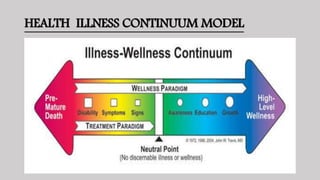
HEALTH ILLNESS CONTINUUM MODEL
 Movement to the right to the arrows (toward the high level of
wellness) equals an increase in level of health and wellbeing Achieved
in three steps ,
 Awareness
 Education
Growth
Movement to the left to the arrows (towards premature death) equates
a progressively decreasing state of health. Achieved in three steps,
Signs
Symptoms
 Disability
Most important is the direction is the individual facing on the pathway
A. If towards high level of health , a person has genuinely optimistic or
positive out look despite his/ her health status.
B. If towards premature death , a person has a genuinely pessimistic or
negative out look about his or her health status.
Compares treatment model with a wellness model,
If treatment model is used ,an individual can move right only to the
neutral point. E.g. : A hypertensive client who only takes his medications
without making any other life style changes.
If wellness model is used , an individual can move right past the neutral
point. E.g. :As hypertensive client not only takes medications but stops
smoking , looses weight , starts an exercise programme etc.
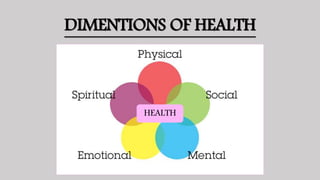
DIMENTIONS OF HEALTH
HEALTH
1. Physical Dimensions
2. Mental Dimensions
3. Social Dimensions
4. Spiritual Dimensions
5. Emotional Dimensions
6. Vocational Dimension
7.Other dimensions :
A few other dimensions also suggested such as
• Cultural dimensions
• Socio-economic dimensions
• Environmental dimensions
• Educational dimensions
• Nutritional dimensions
• Preventive dimensions
1. Physical Dimensions
• Physical health means perfect functioning of the body in
which each organ is working in harmony with the maximum
capacity.
• Physical health is achieved by the exercise, healthy diet,
adequate rest and sleep and no smoking or alcohol intake.
• To maintain proper physical health there is need for taking
safety precautions, and regular follow up with the health care
providers
• Signs of physical health :
1. A good complexion.
2. A clean skin.
3. Bright eyes.
4. Not too fatty.
5. A sweet breath.
6. A good appetite.
7. Sound sleep.
8. Regular activities of bowels and bladder.
9. Smooth, easy, and coordinated bodily movements.
• Evaluation of Physical Health :
1. Self assessment of overall health.
2. Inquiry about ill health and risk factors.
3. Inquiry in to medications.
4. Standardized questionnaire for cardiovascular and
respiratory diseases.
5. Clinical examinations.
6. Nutritional and dietary history.
7. Biochemical and laboratory investigations.
2 Mental Dimensions
• Mental health is a state of balance between body and mind .
Earlier the body and mind were considered two separate
entities.
• But these are interrelated as physical illness can result mental
illness and vice versa. How mental illness influence physical
health has been shown in fig; Mental illness DEPRESSION
Poor nutrition intake Poor hygiene Physical illness Prone to
infection Decreased immune system
• Characteristics of mentally healthy person :
1. Mentally healthy person will be capable of making personal and
social adjustment.
2. Mentally healthy person is free from internal conflicts.
3. He faces problems and tries to solve them intelligently.
4. He has good self control balances rationally and emotionally.
5. He knows him self his needs problems and goals.
6. He has strong sense of self esteem.
7. He searches for identity.
8. He lives a well balanced life means able to maintain the balance
between work rest and recreation.
3.Social Dimensions
• An individual is socially healthy if he is able to maintain harmonious
relationship with other members of society in which he lives. Social
health rooted in “positive material environment” and “positive human
environment” which is concerned with the social network of the
individual.
• The social dimensions of health includes;
1. Communication
2. Intimacy
3. Respect
4. Equality
5. Social functioning
4. Spiritual Dimensions
• Spirituality means in touch with deeper self and exploration
the purpose of life, as people believe in some force that
transcend physiology and psychology of human beings.
• It includes love , charity, purpose , principles , ethics, integrity
, hope of life.
• Meditations ,prayers, or spiritual gatherings are organized to
maintain spiritual health
5. Emotional Dimensions
• Emotional health is closely related to the mental health and is considered as an
important element of health.
• Mental and emotional aspects of health are now viewed as two separate entities
for human life.
• Cognition is related to the mental health whereas emotional health is related to the
feelings of a person.
• Emotional health includes ; An emotionally healthy person has a positive thinking
and is capable of coping and adjusting self. An emotionally healthy person
participates in all the activities which are related to personal growth and his self
esteem. Emotionally well people have the ability to express feelings freely and
manage feelings effectively. They are also aware of and accept a wide range of
feelings in themselves and others
6. Vocational Dimension
• The choice of profession, job satisfaction, career ambitions and personal
performance are all important components of this dimension.
• To be occupationally well, a person is ultimately doing exactly with
what they want to do in life and are comfortable with their future plans.
• Vocational dimension of health can be assessed by ;
1. Assessing the satisfaction level at job ,
2. Facilities attached to the job ,
3. Behaviour of the management and administrator and of colleagues at
job
Health care services
• "Health care services" means the furnishing of medicine, medical or
surgical treatment, nursing, hospital service, dental service,
optometrical service, complementary health services or any or all of the
enumerated services or any other necessary services of like character,
whether or not contingent upon sickness or personal injury, as well as
the furnishing to any person of any and all other services and goods for
the purpose of preventing, alleviating, curing or healing human illness,
physical disability or injury.
• Health care services" means any medical or remedial care or service,
including supplies delivered in connection with the care or service,
that is recognized under state law
Health

Health

  • 1.
  • 2.
    INTRODUCTION Health can bedefined as the physical, social, psychological and spiritual well-being of individuals. Overall health of the population is determined by people’s income, education, employment and housing, as well as a combination of preventive and rehabilitative approaches and services. Making a positive impact on the health of individuals is the common goal among partners in the continuum of wellness promotion, illness prevention and health care
  • 3.
    DEFINITION Health is astate of complete physical, mental and social wellbeing and not merely an absence of disease or infirmity. (WHO-1948) “ Health is the condition of being sound in body , mind and spirit ,especially freedom from physical disease or pain.” – (Webster.)
  • 4.
    Concept Of Health oAnunderstanding of health is the basis of all the health care. o Health has evolved over the centuries from the concept of individual concern to a worldwide social goal. oThe various changing concepts of health as follows: 1. Biomedical concept 2. Ecological concept 3. Psychosocial concept 4. Holistic concept
  • 5.
    1. Biomedical concept Traditionally health has been considered as an absence of the diseases and if someone was free from disease, then that person was considered healthy.  This concept is known as biomedical concept, and it is based on the “germ theory of the disease.”
  • 6.
    2. Ecological Concept •Deficiencies in the biomedical concept gave rise to other concepts. • The ecologists put forward the concept of ecological concept. • Ecologists viewed health as a dynamic equilibrium between man and his environment, and the disease as a maladjustment of the human organism to environment.
  • 7.
    3. Psychosocial Concept •Advances in social sciences showed that health is not only a biomedical phenomenon, but one which is influenced by social, psychological, cultural, economic and political factors of the people concerned. • These factors must be taken into consideration in defining and measuring health. • Thus health is both a biological and social phenomenon
  • 8.
    4. Holistic Concept •The holistic model is a synthesis of all the above concepts. • Holistic concept recognizes the strength of social, economic, political and environmental influences on health. • It has been variously described as multidimensional process involving the wellbeing of the person as a whole. • The emphasis is on the promotion and protection of health. • The holistic approach implies that all sectors of the society have an effect on health, in particular, agriculture, animal husbandry, food, industry, education, housing, public works and other sectors.
  • 9.
    HEALTH ILLNESS CONTINUUM •The health illness continuum is a graphic illustration of a well being ,concept first proposed by John . W . Travis in 1972. • It describes how wellbeing is more than simply an absence of illness , but also incorporates the individuals mental and emotional health. • Travis believed that the standard approach to medicines , which assumes a person is well when there are no signs or symptoms of disease ,was insufficient
  • 10.
    DEFINITION OF HEALTHILLNESS CONTINUUM  The health illness continuum is an illustration that draws a connection between the treatment paradigm and the wellness paradigm.  The illness-wellness continuum is a graphical illustration of a well being concept first proposed by travio in 1972.It proposes that wellbeing include mental and emotional health ,as well as the presence or absence of illness.
  • 11.
    HEALTH DEFINITION Health isa state of complete physical, mental and social wellbeing and not merely an absence of disease or infirmity. (WHO-1948) ILLNESS DEFINITION A highly personal state in which the person feels unhealthy, may or may not related to disease WELLNESS DEFINITION Wellness is an active process of becoming aware of and making choices toward a healthy and fulfilling life
  • 12.
  • 13.
     Movement tothe right to the arrows (toward the high level of wellness) equals an increase in level of health and wellbeing Achieved in three steps ,  Awareness  Education Growth Movement to the left to the arrows (towards premature death) equates a progressively decreasing state of health. Achieved in three steps, Signs Symptoms  Disability
  • 14.
    Most important isthe direction is the individual facing on the pathway A. If towards high level of health , a person has genuinely optimistic or positive out look despite his/ her health status. B. If towards premature death , a person has a genuinely pessimistic or negative out look about his or her health status. Compares treatment model with a wellness model, If treatment model is used ,an individual can move right only to the neutral point. E.g. : A hypertensive client who only takes his medications without making any other life style changes. If wellness model is used , an individual can move right past the neutral point. E.g. :As hypertensive client not only takes medications but stops smoking , looses weight , starts an exercise programme etc.
  • 15.
  • 16.
    1. Physical Dimensions 2.Mental Dimensions 3. Social Dimensions 4. Spiritual Dimensions 5. Emotional Dimensions 6. Vocational Dimension 7.Other dimensions : A few other dimensions also suggested such as • Cultural dimensions • Socio-economic dimensions • Environmental dimensions • Educational dimensions • Nutritional dimensions • Preventive dimensions
  • 17.
    1. Physical Dimensions •Physical health means perfect functioning of the body in which each organ is working in harmony with the maximum capacity. • Physical health is achieved by the exercise, healthy diet, adequate rest and sleep and no smoking or alcohol intake. • To maintain proper physical health there is need for taking safety precautions, and regular follow up with the health care providers
  • 18.
    • Signs ofphysical health : 1. A good complexion. 2. A clean skin. 3. Bright eyes. 4. Not too fatty. 5. A sweet breath. 6. A good appetite. 7. Sound sleep. 8. Regular activities of bowels and bladder. 9. Smooth, easy, and coordinated bodily movements.
  • 19.
    • Evaluation ofPhysical Health : 1. Self assessment of overall health. 2. Inquiry about ill health and risk factors. 3. Inquiry in to medications. 4. Standardized questionnaire for cardiovascular and respiratory diseases. 5. Clinical examinations. 6. Nutritional and dietary history. 7. Biochemical and laboratory investigations.
  • 20.
    2 Mental Dimensions •Mental health is a state of balance between body and mind . Earlier the body and mind were considered two separate entities. • But these are interrelated as physical illness can result mental illness and vice versa. How mental illness influence physical health has been shown in fig; Mental illness DEPRESSION Poor nutrition intake Poor hygiene Physical illness Prone to infection Decreased immune system
  • 21.
    • Characteristics ofmentally healthy person : 1. Mentally healthy person will be capable of making personal and social adjustment. 2. Mentally healthy person is free from internal conflicts. 3. He faces problems and tries to solve them intelligently. 4. He has good self control balances rationally and emotionally. 5. He knows him self his needs problems and goals. 6. He has strong sense of self esteem. 7. He searches for identity. 8. He lives a well balanced life means able to maintain the balance between work rest and recreation.
  • 22.
    3.Social Dimensions • Anindividual is socially healthy if he is able to maintain harmonious relationship with other members of society in which he lives. Social health rooted in “positive material environment” and “positive human environment” which is concerned with the social network of the individual. • The social dimensions of health includes; 1. Communication 2. Intimacy 3. Respect 4. Equality 5. Social functioning
  • 23.
    4. Spiritual Dimensions •Spirituality means in touch with deeper self and exploration the purpose of life, as people believe in some force that transcend physiology and psychology of human beings. • It includes love , charity, purpose , principles , ethics, integrity , hope of life. • Meditations ,prayers, or spiritual gatherings are organized to maintain spiritual health
  • 24.
    5. Emotional Dimensions •Emotional health is closely related to the mental health and is considered as an important element of health. • Mental and emotional aspects of health are now viewed as two separate entities for human life. • Cognition is related to the mental health whereas emotional health is related to the feelings of a person. • Emotional health includes ; An emotionally healthy person has a positive thinking and is capable of coping and adjusting self. An emotionally healthy person participates in all the activities which are related to personal growth and his self esteem. Emotionally well people have the ability to express feelings freely and manage feelings effectively. They are also aware of and accept a wide range of feelings in themselves and others
  • 25.
    6. Vocational Dimension •The choice of profession, job satisfaction, career ambitions and personal performance are all important components of this dimension. • To be occupationally well, a person is ultimately doing exactly with what they want to do in life and are comfortable with their future plans. • Vocational dimension of health can be assessed by ; 1. Assessing the satisfaction level at job , 2. Facilities attached to the job , 3. Behaviour of the management and administrator and of colleagues at job
  • 26.
    Health care services •"Health care services" means the furnishing of medicine, medical or surgical treatment, nursing, hospital service, dental service, optometrical service, complementary health services or any or all of the enumerated services or any other necessary services of like character, whether or not contingent upon sickness or personal injury, as well as the furnishing to any person of any and all other services and goods for the purpose of preventing, alleviating, curing or healing human illness, physical disability or injury.
  • 27.
    • Health careservices" means any medical or remedial care or service, including supplies delivered in connection with the care or service, that is recognized under state law