SMALL POX
Presented By:
Mr. Saurabh Raosaheb Chitte
2nd year Basic Bsc Nursing
Bhonsala Institute of Nursing
Nashik.
Contents
 Introduction
 Anatomy & Physiology
 Defination
 Incidence
 Types
 Etiological Factors
 Risk Factors
 Clinical manifestation
 Pathophysiology
 Transmission of Disease
 Diagnosis
 Management
 Preventive Measures
 Vaccines
Introduction
 A highly contagious & frequently fatal viral disease.
 The disease is also known by the Latin name “Variola” & “Variola vera”, which is
derivative of the Latin “varius”, meaning “spotted”,or “varus”, meaning “pimple”.
 The term “Smallpox” was first used in Europe in 15th century to
distinguish”Variola” from the “great pox” (syphilis).
 Small Pox was responsible for estimated 300 -500 million deaths in 20th century.
 Belived to have begun in Africa & spred to India & China.
Anatomy & Physiology
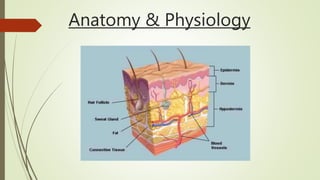
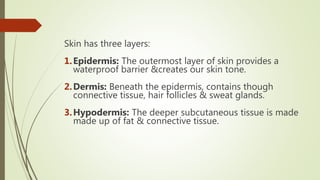
Skin has three layers:
1.Epidermis: The outermost layer of skin provides a
waterproof barrier &creates our skin tone.
2.Dermis: Beneath the epidermis, contains though
connective tissue, hair follicles & sweat glands.
3.Hypodermis: The deeper subcutaneous tissue is made
made up of fat & connective tissue.
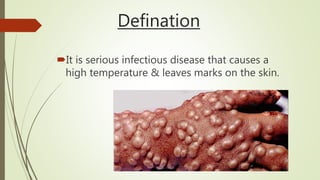
Defination
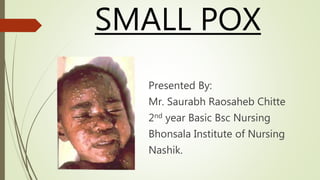
It is serious infectious disease that causes a
high temperature & leaves marks on the skin.
Incidence
 The term “Smallpox” was first used in Europe.
 Various vaccination campaigns are arranged in 16th to 18th centuries.
 After that in 19th & 20th centuries , “WHO” certified the eradication of
Smallpox in 1979.
 The last naturally occurring case of Smallpox was diagnosed on 26th October
1977.
 Smallpox is one of the most infectious diseases to have eradicated, the
other being rinderpest, which was declared eradicated in 2011.
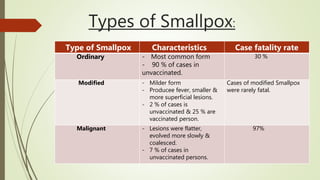
Types of Smallpox:
Type of Smallpox Characteristics Case fatality rate
Ordinary - Most common form
- 90 % of cases in
unvaccinated.
30 %
Modified - Milder form
- Producee fever, smaller &
more superficial lesions.
- 2 % of cases is
unvaccinated & 25 % are
vaccinated person.
Cases of modified Smallpox
were rarely fatal.
Malignant - Lesions were flatter,
evolved more slowly &
coalesced.
- 7 % of cases in
unvaccinated persons.
97%
Etiological Factors
Contaminated clothings.
Contaminated beddings.
Risk Factor
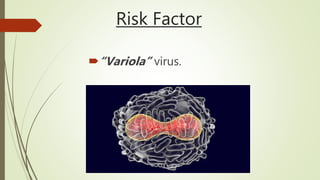
“Variola” virus.
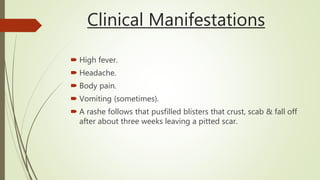
Clinical Manifestations
 High fever.
 Headache.
 Body pain.
 Vomiting (sometimes).
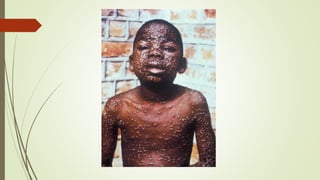
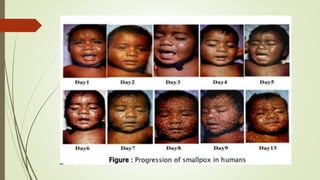
 A rashe follows that pusfilled blisters that crust, scab & fall off
after about three weeks leaving a pitted scar.
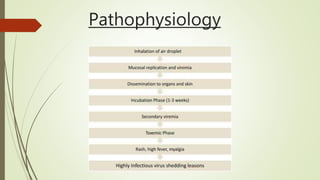
Pathophysiology
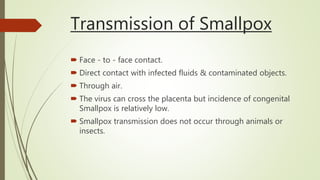
Transmission of Smallpox
 Face - to - face contact.
 Direct contact with infected fluids & contaminated objects.
 Through air.
 The virus can cross the placenta but incidence of congenital
Smallpox is relatively low.
 Smallpox transmission does not occur through animals or
insects.
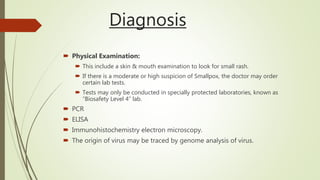
Diagnosis
 Physical Examination:
 This include a skin & mouth examination to look for small rash.
 If there is a moderate or high suspicion of Smallpox, the doctor may order
certain lab tests.
 Tests may only be conducted in specially protected laboratories, known as
“Biosafety Level 4” lab.
 PCR
 ELISA
 Immunohistochemistry electron microscopy.
 The origin of virus may be traced by genome analysis of virus.
Management
 Medical management:
 Antivirals :
1. Tecovirimat
2. Cidofovir
3. Brincidofovir
 Nursing Management:
 Treatment approaches include supportive measures, antiviral therapy,
administration of VZIG ( Varicella Zooster Immune Globulin) &
management of secondary bacterial infection.
Preventive Measures
 The Smallpox vaccine is the only known way to prevent
Smallpox in an exposed person.
 The Smallpox vaccine helps the body develops immunity to
Smallpox.
 Isolation of patients if they develop fever.
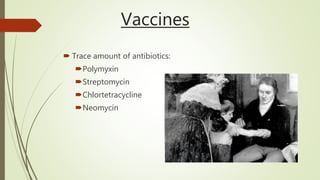
Vaccines
 Trace amount of antibiotics:
Polymyxin
Streptomycin
Chlortetracycline
Neomycin
 Presentation on smallpox

Presentation on smallpox

  • 2.
    SMALL POX Presented By: Mr.Saurabh Raosaheb Chitte 2nd year Basic Bsc Nursing Bhonsala Institute of Nursing Nashik.
  • 3.
    Contents  Introduction  Anatomy& Physiology  Defination  Incidence  Types  Etiological Factors  Risk Factors  Clinical manifestation  Pathophysiology  Transmission of Disease  Diagnosis  Management  Preventive Measures  Vaccines
  • 4.
    Introduction  A highlycontagious & frequently fatal viral disease.  The disease is also known by the Latin name “Variola” & “Variola vera”, which is derivative of the Latin “varius”, meaning “spotted”,or “varus”, meaning “pimple”.  The term “Smallpox” was first used in Europe in 15th century to distinguish”Variola” from the “great pox” (syphilis).  Small Pox was responsible for estimated 300 -500 million deaths in 20th century.  Belived to have begun in Africa & spred to India & China.
  • 5.
  • 6.
    Skin has threelayers: 1.Epidermis: The outermost layer of skin provides a waterproof barrier &creates our skin tone. 2.Dermis: Beneath the epidermis, contains though connective tissue, hair follicles & sweat glands. 3.Hypodermis: The deeper subcutaneous tissue is made made up of fat & connective tissue.
  • 7.
    Defination It is seriousinfectious disease that causes a high temperature & leaves marks on the skin.
  • 8.
    Incidence  The term“Smallpox” was first used in Europe.  Various vaccination campaigns are arranged in 16th to 18th centuries.  After that in 19th & 20th centuries , “WHO” certified the eradication of Smallpox in 1979.  The last naturally occurring case of Smallpox was diagnosed on 26th October 1977.  Smallpox is one of the most infectious diseases to have eradicated, the other being rinderpest, which was declared eradicated in 2011.
  • 9.
    Types of Smallpox: Typeof Smallpox Characteristics Case fatality rate Ordinary - Most common form - 90 % of cases in unvaccinated. 30 % Modified - Milder form - Producee fever, smaller & more superficial lesions. - 2 % of cases is unvaccinated & 25 % are vaccinated person. Cases of modified Smallpox were rarely fatal. Malignant - Lesions were flatter, evolved more slowly & coalesced. - 7 % of cases in unvaccinated persons. 97%
  • 11.
  • 12.
  • 14.
    Clinical Manifestations  Highfever.  Headache.  Body pain.  Vomiting (sometimes).  A rashe follows that pusfilled blisters that crust, scab & fall off after about three weeks leaving a pitted scar.
  • 15.
  • 16.
    Transmission of Smallpox Face - to - face contact.  Direct contact with infected fluids & contaminated objects.  Through air.  The virus can cross the placenta but incidence of congenital Smallpox is relatively low.  Smallpox transmission does not occur through animals or insects.
  • 17.
    Diagnosis  Physical Examination: This include a skin & mouth examination to look for small rash.  If there is a moderate or high suspicion of Smallpox, the doctor may order certain lab tests.  Tests may only be conducted in specially protected laboratories, known as “Biosafety Level 4” lab.  PCR  ELISA  Immunohistochemistry electron microscopy.  The origin of virus may be traced by genome analysis of virus.
  • 18.
    Management  Medical management: Antivirals : 1. Tecovirimat 2. Cidofovir 3. Brincidofovir  Nursing Management:  Treatment approaches include supportive measures, antiviral therapy, administration of VZIG ( Varicella Zooster Immune Globulin) & management of secondary bacterial infection.
  • 19.
    Preventive Measures  TheSmallpox vaccine is the only known way to prevent Smallpox in an exposed person.  The Smallpox vaccine helps the body develops immunity to Smallpox.  Isolation of patients if they develop fever.
  • 20.
    Vaccines  Trace amountof antibiotics: Polymyxin Streptomycin Chlortetracycline Neomycin