FUTUREBIOINFORMATICS
AND
OPTIMIZATION TOOLS FOR
SUSTAINABLE
DEVELOPMENT
BIOINFORMATICS AND OPTIMIZATION TOOLS FOR
SUSTAINABLE DEVELOPMENT ARE CRITICAL TOOLS FOR
ADDRESSING GLOBAL CHALLENGES RELATED TO CLIMATE
CHANGE, ENERGY, AND ENVIRONMENTAL SUSTAINABILITY
• Introduction
• Bioinformatics
• Examples of Bioinformatics Tools
• Optimization
• Examples of Optimization Tools
• Bioinformatics and Optimization Tools for Environmental
Sustainability
• Challenges and Future Directions
• Conclusion
Index
• Bioinformatics and optimization tools play a crucial role in sustainable
development by facilitating the identification of efficient and cost-effective
solutions to global challenges such as climate change, food security, and disease
control.
• Optimization tools can be used to model and simulate complex systems and
optimize resource allocation and management to promote sustainable
development.
• These tools have the potential to revolutionize many industries, from agriculture
to healthcare, by enabling more informed decision-making and promoting
sustainable practices.
• Ultimately, the continued development and application of bioinformatics and
optimization tools will be essential for achieving global sustainability goals and
addressing the challenges that threaten our planet's future.
INTRODUCTION
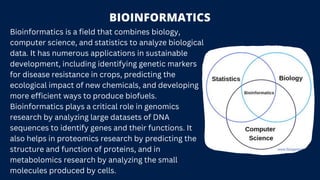
Bioinformatics is a field that combines biology,
computer science, and statistics to analyze biological
data. It has numerous applications in sustainable
development, including identifying genetic markers
for disease resistance in crops, predicting the
ecological impact of new chemicals, and developing
more efficient ways to produce biofuels.
Bioinformatics plays a critical role in genomics
research by analyzing large datasets of DNA
sequences to identify genes and their functions. It
also helps in proteomics research by predicting the
structure and function of proteins, and in
metabolomics research by analyzing the small
molecules produced by cells.
BIOINFORMATICS
EXAMPLES OF BIOINFORMATICS TOOLS
• BLAST: A tool used for sequence alignment to compare DNA, RNA or protein
sequences.
• ClustalW: A software used for multiple sequence alignment of DNA or protein
sequences.
• HMMER: A program used for detecting homologous sequences by Hidden
Markov Model (HMM) profile searching.
• RAST: A web-based platform for annotating bacterial genomes and identifying
metabolic pathways.
Optimization can be applied to a wide range of
sustainable development issues, such as
energy production, waste management, and
resource use. By using optimization
techniques, decision-makers can make
informed decisions that balance economic,
environmental, and social factors, leading to
more sustainable outcomes.
OPTIMIZATION
There are several optimization tools used in sustainable development
research, including Linear Programming, Non-linear Programming, and
Integer Programming. Each tool has its own specific use cases and benefits.
Here are some examples:
• Linear Programming is an optimization tool used for problems with
linear constraints.
• Non-linear Programming is used for problems with non-linear
constraints, and is helpful in optimizing complex systems.
• Integer Programming is used for problems with discrete variables that
take on integer values.
• These optimization tools can be used in sustainable development
research to optimize resource allocation and decision-making
processes, taking into account environmental and social factors.
EXAMPLES OF OPTIMIZATION TOOLS
BIOINFORMATICS AND OPTIMIZATION TOOLS
FOR ENVIRONMENTAL SUSTAINABILITY
• Bioinformatics tools can be used to analyze large amounts of data from
environmental samples, such as DNA or RNA sequencing data, to
identify organisms and their functions in ecosystems.
• Optimization tools can help identify the most effective and cost-
efficient solutions for waste management, pollution control, and
conservation efforts.
• With the help of bioinformatics and optimization tools, sustainable
practices can be tailored to specific environments, such as urban or
rural areas, and customized to meet the unique needs of each location.
• These tools can also be used to monitor and evaluate the effectiveness
of sustainability practices over time, allowing for continuous
improvement and refinement.
CHALLENGES AND FUTURE DIRECTIONS
• Data Integration: One of the significant challenges of bioinformatics
and optimization tools in sustainable development research is the
integration of diverse datasets from various sources. The availability of
a large amount of data from different domains and different formats
poses a significant challenge to researchers. Integrating this data in a
meaningful way requires substantial computational resources and
expertise.
• Algorithm Development: The development of efficient algorithms for
processing and analyzing large-scale biological data is another
challenge. Optimizing algorithms for analyzing diverse data types such
as genomic, proteomic, and metabolomic data is a challenging task.
Developing new algorithms for specific applications is an ongoing effort
in bioinformatics research.
• Data Privacy and Security: Another challenge of bioinformatics and
optimization tools in sustainable development research is data privacy
and security. As more data is generated and shared, there is a growing
concern about data privacy and security. Ensuring the security and
privacy of sensitive data is a critical challenge that needs to be
addressed to ensure the trustworthiness of these tools.
• Future Directions: The future of bioinformatics and optimization tools
in sustainable development research lies in the development of more
powerful tools that can process and analyze large-scale datasets more
efficiently. There is a need to develop algorithms that can integrate
multiple data types to provide a more comprehensive view of biological
systems. The development of new machine learning and artificial
intelligence techniques will also play a crucial role in the future of
bioinformatics and optimization tools. Finally, developing tools that can
be easily accessed and used by non-experts will be critical to realizing
the full potential of these tools in sustainable development research.
CONCLUSION
Overall, the presentation emphasized that bioinformatics and
optimization tools are essential for sustainable development as they
enable us to make informed decisions and optimize resource
utilization to achieve maximum benefits. They can help us address
global challenges such as climate change, food security, and health
disparities by providing innovative solutions that are both efficient
and cost-effective. Therefore, it is crucial that we continue to invest
in research and development in these areas and leverage the power
of bioinformatics and optimization tools to create a more
sustainable future for ourselves and generations to come.
FutureBioinformatics and Optimization tools for sustainable development.pptx

FutureBioinformatics and Optimization tools for sustainable development.pptx

  • 1.
    FUTUREBIOINFORMATICS AND OPTIMIZATION TOOLS FOR SUSTAINABLE DEVELOPMENT BIOINFORMATICSAND OPTIMIZATION TOOLS FOR SUSTAINABLE DEVELOPMENT ARE CRITICAL TOOLS FOR ADDRESSING GLOBAL CHALLENGES RELATED TO CLIMATE CHANGE, ENERGY, AND ENVIRONMENTAL SUSTAINABILITY
  • 2.
    • Introduction • Bioinformatics •Examples of Bioinformatics Tools • Optimization • Examples of Optimization Tools • Bioinformatics and Optimization Tools for Environmental Sustainability • Challenges and Future Directions • Conclusion Index
  • 3.
    • Bioinformatics andoptimization tools play a crucial role in sustainable development by facilitating the identification of efficient and cost-effective solutions to global challenges such as climate change, food security, and disease control. • Optimization tools can be used to model and simulate complex systems and optimize resource allocation and management to promote sustainable development. • These tools have the potential to revolutionize many industries, from agriculture to healthcare, by enabling more informed decision-making and promoting sustainable practices. • Ultimately, the continued development and application of bioinformatics and optimization tools will be essential for achieving global sustainability goals and addressing the challenges that threaten our planet's future. INTRODUCTION
  • 4.
    Bioinformatics is afield that combines biology, computer science, and statistics to analyze biological data. It has numerous applications in sustainable development, including identifying genetic markers for disease resistance in crops, predicting the ecological impact of new chemicals, and developing more efficient ways to produce biofuels. Bioinformatics plays a critical role in genomics research by analyzing large datasets of DNA sequences to identify genes and their functions. It also helps in proteomics research by predicting the structure and function of proteins, and in metabolomics research by analyzing the small molecules produced by cells. BIOINFORMATICS
  • 5.
    EXAMPLES OF BIOINFORMATICSTOOLS • BLAST: A tool used for sequence alignment to compare DNA, RNA or protein sequences. • ClustalW: A software used for multiple sequence alignment of DNA or protein sequences. • HMMER: A program used for detecting homologous sequences by Hidden Markov Model (HMM) profile searching. • RAST: A web-based platform for annotating bacterial genomes and identifying metabolic pathways.
  • 6.
    Optimization can beapplied to a wide range of sustainable development issues, such as energy production, waste management, and resource use. By using optimization techniques, decision-makers can make informed decisions that balance economic, environmental, and social factors, leading to more sustainable outcomes. OPTIMIZATION
  • 7.
    There are severaloptimization tools used in sustainable development research, including Linear Programming, Non-linear Programming, and Integer Programming. Each tool has its own specific use cases and benefits. Here are some examples: • Linear Programming is an optimization tool used for problems with linear constraints. • Non-linear Programming is used for problems with non-linear constraints, and is helpful in optimizing complex systems. • Integer Programming is used for problems with discrete variables that take on integer values. • These optimization tools can be used in sustainable development research to optimize resource allocation and decision-making processes, taking into account environmental and social factors. EXAMPLES OF OPTIMIZATION TOOLS
  • 8.
    BIOINFORMATICS AND OPTIMIZATIONTOOLS FOR ENVIRONMENTAL SUSTAINABILITY • Bioinformatics tools can be used to analyze large amounts of data from environmental samples, such as DNA or RNA sequencing data, to identify organisms and their functions in ecosystems. • Optimization tools can help identify the most effective and cost- efficient solutions for waste management, pollution control, and conservation efforts. • With the help of bioinformatics and optimization tools, sustainable practices can be tailored to specific environments, such as urban or rural areas, and customized to meet the unique needs of each location. • These tools can also be used to monitor and evaluate the effectiveness of sustainability practices over time, allowing for continuous improvement and refinement.
  • 9.
    CHALLENGES AND FUTUREDIRECTIONS • Data Integration: One of the significant challenges of bioinformatics and optimization tools in sustainable development research is the integration of diverse datasets from various sources. The availability of a large amount of data from different domains and different formats poses a significant challenge to researchers. Integrating this data in a meaningful way requires substantial computational resources and expertise. • Algorithm Development: The development of efficient algorithms for processing and analyzing large-scale biological data is another challenge. Optimizing algorithms for analyzing diverse data types such as genomic, proteomic, and metabolomic data is a challenging task. Developing new algorithms for specific applications is an ongoing effort in bioinformatics research.
  • 10.
    • Data Privacyand Security: Another challenge of bioinformatics and optimization tools in sustainable development research is data privacy and security. As more data is generated and shared, there is a growing concern about data privacy and security. Ensuring the security and privacy of sensitive data is a critical challenge that needs to be addressed to ensure the trustworthiness of these tools. • Future Directions: The future of bioinformatics and optimization tools in sustainable development research lies in the development of more powerful tools that can process and analyze large-scale datasets more efficiently. There is a need to develop algorithms that can integrate multiple data types to provide a more comprehensive view of biological systems. The development of new machine learning and artificial intelligence techniques will also play a crucial role in the future of bioinformatics and optimization tools. Finally, developing tools that can be easily accessed and used by non-experts will be critical to realizing the full potential of these tools in sustainable development research.
  • 11.
    CONCLUSION Overall, the presentationemphasized that bioinformatics and optimization tools are essential for sustainable development as they enable us to make informed decisions and optimize resource utilization to achieve maximum benefits. They can help us address global challenges such as climate change, food security, and health disparities by providing innovative solutions that are both efficient and cost-effective. Therefore, it is crucial that we continue to invest in research and development in these areas and leverage the power of bioinformatics and optimization tools to create a more sustainable future for ourselves and generations to come.