Multiple Regression in SPSS
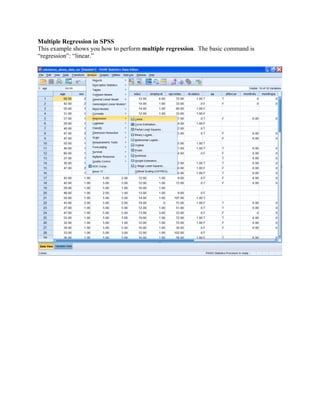
This example shows you how to perform multiple regression. The basic command is
“regression”: “linear.”
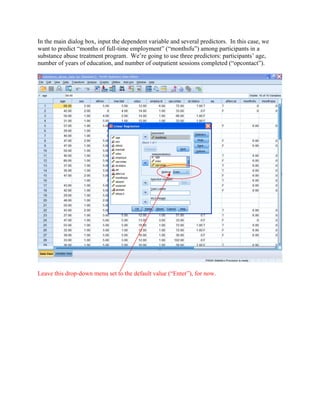
In the main dialog box, input the dependent variable and several predictors. In this case, we
want to predict “months of full-time employment” (“monthsfu”) among participants in a
substance abuse treatment program. We’re going to use three predictors: participants’ age,
number of years of education, and number of outpatient sessions completed (“opcontact”).
Leave this drop-down menu set to the default value (“Enter”), for now.
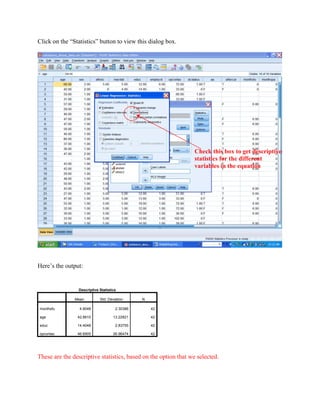
Click on the “Statistics” button to view this dialog box.
Here’s the output:
Descriptive Statistics
Mean Std. Deviation N
monthsfu 4.9048 2.30386 42
age 42.8810 13.22821 42
educ 14.4048 2.83755 42
opcontac 46.6905 26.96474 42
These are the descriptive statistics, based on the option that we selected.
Check this box to get descriptive
statistics for the different
variables in the equation
Correlations
monthsfu age educ opcontac
Pearson Correlation monthsfu 1.000 -.321 .278 -.028
age -.321 1.000 .342 .151
educ .278 .342 1.000 .195
opcontac -.028 .151 .195 1.000
Sig. (1-tailed) monthsfu . .019 .037 .429
age .019 . .013 .170
educ .037 .013 . .108
opcontac .429 .170 .108 .
N monthsfu 42 42 42 42
age 42 42 42 42
educ 42 42 42 42
opcontac 42 42 42 42
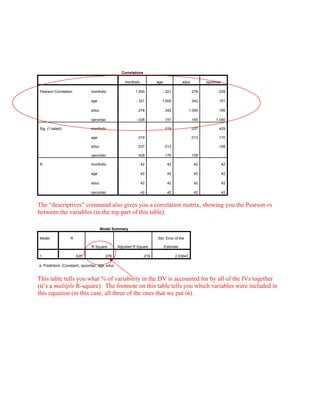
The “descriptives” command also gives you a correlation matrix, showing you the Pearson rs
between the variables (in the top part of this table).
Model Summary
Model R
R Square Adjusted R Square
Std. Error of the
Estimate
1 .525a
.276 .219 2.03647
a. Predictors: (Constant), opcontac, age, educ
This table tells you what % of variability in the DV is accounted for by all of the IVs together
(it’s a multiple R-square). The footnote on this table tells you which variables were included in
this equation (in this case, all three of the ones that we put in).
ANOVAb
Model Sum of Squares df Mean Square F Sig.
1 Regression 60.025 3 20.008 4.825 .006a
Residual 157.594 38 4.147
Total 217.619 41
a. Predictors: (Constant), opcontac, age, educ
b. Dependent Variable: monthsfu
This table gives you an F-test to determine whether the model is a good fit for the data.
According to this p-value, it is.
Coefficientsa
Model
Unstandardized Coefficients
Standardized
Coefficients
t Sig.B Std. Error Beta
1 (Constant) 3.347 1.733 1.932 .061
age -.081 .026 -.467 -3.168 .003
educ .363 .121 .447 3.006 .005
opcontac -.004 .012 -.045 -.319 .752
a. Dependent Variable: monthsfu
Finally, here are the beta coefficients—one to go with each predictor. (Use the “unstandardized
coefficients,” because the constant [beta zero] is included). Based on this table, the equation for
the regression line is:
y = 3.347 - .081(age) + .363(educ) - .004(opcontact)
Using this equation, given values for “age,” “educ,” and “opcontact,” you can come up with a
prediction for the “months of full-time work” variable.
Now go back to the original dialog box, and change this drop-down menu to use the “stepwise”
method instead.
[For the sake of simplicity, I also went under “statistics” and turned off the “descriptives” option
for the following tests]
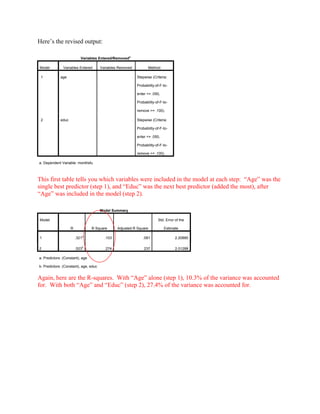
Here’s the revised output:
Variables Entered/Removeda
Model Variables Entered Variables Removed Method
1 age . Stepwise (Criteria:
Probability-of-F-to-
enter <= .050,
Probability-of-F-to-
remove >= .100).
2 educ . Stepwise (Criteria:
Probability-of-F-to-
enter <= .050,
Probability-of-F-to-
remove >= .100).
a. Dependent Variable: monthsfu
This first table tells you which variables were included in the model at each step: “Age” was the
single best predictor (step 1), and “Educ” was the next best predictor (added the most), after
“Age” was included in the model (step 2).
Model Summary
Model
R R Square Adjusted R Square
Std. Error of the
Estimate
1 .321a
.103 .081 2.20880
2 .523b
.274 .237 2.01288
a. Predictors: (Constant), age
b. Predictors: (Constant), age, educ
Again, here are the R-squares. With “Age” alone (step 1), 10.3% of the variance was accounted
for. With both “Age” and “Educ” (step 2), 27.4% of the variance was accounted for.
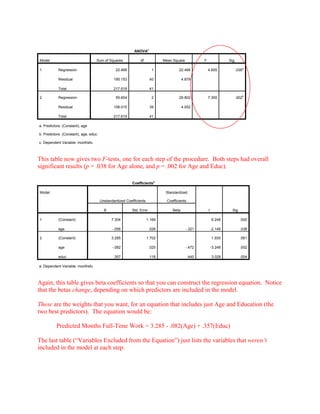
ANOVAc
Model Sum of Squares df Mean Square F Sig.
1 Regression 22.466 1 22.466 4.605 .038a
Residual 195.153 40 4.879
Total 217.619 41
2 Regression 59.604 2 29.802 7.355 .002b
Residual 158.015 39 4.052
Total 217.619 41
a. Predictors: (Constant), age
b. Predictors: (Constant), age, educ
c. Dependent Variable: monthsfu
This table now gives two F-tests, one for each step of the procedure. Both steps had overall
significant results (p = .038 for Age alone, and p = .002 for Age and Educ).
Coefficientsa
Model
Unstandardized Coefficients
Standardized
Coefficients
t Sig.B Std. Error Beta
1 (Constant) 7.304 1.169 6.248 .000
age -.056 .026 -.321 -2.146 .038
2 (Constant) 3.285 1.702 1.930 .061
age -.082 .025 -.472 -3.248 .002
educ .357 .118 .440 3.028 .004
a. Dependent Variable: monthsfu
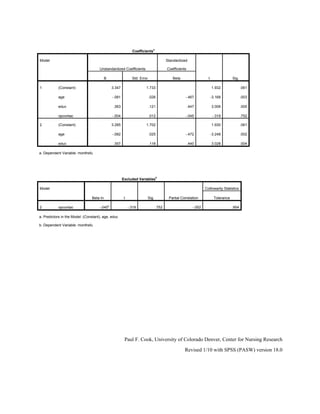
Again, this table gives beta coefficients so that you can construct the regression equation. Notice
that the betas change, depending on which predictors are included in the model.
These are the weights that you want, for an equation that includes just Age and Education (the
two best predictors). The equation would be:
Predicted Months Full-Time Work = 3.285 - .082(Age) + .357(Educ)
The last table (“Variables Excluded from the Equation”) just lists the variables that weren’t
included in the model at each step.
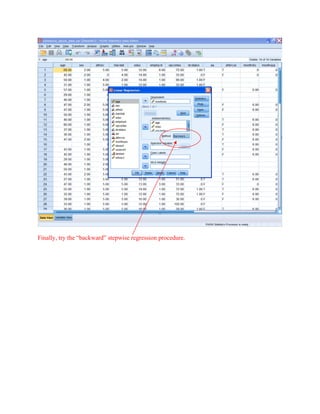
Finally, try the “backward” stepwise regression procedure.
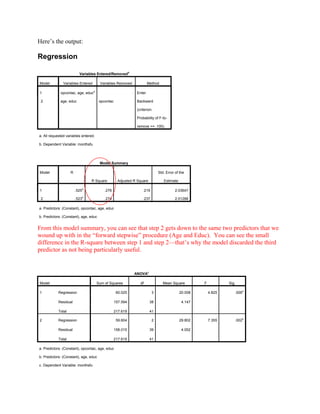
Here’s the output:
Regression
Variables Entered/Removedb
Model Variables Entered Variables Removed Method
1 opcontac, age, educa
. Enter
2 age, educ opcontac Backward
(criterion:
Probability of F-to-
remove >= .100).
a. All requested variables entered.
b. Dependent Variable: monthsfu
Model Summary
Model R
R Square Adjusted R Square
Std. Error of the
Estimate
1 .525a
.276 .219 2.03647
2 .523b
.274 .237 2.01288
a. Predictors: (Constant), opcontac, age, educ
b. Predictors: (Constant), age, educ
From this model summary, you can see that step 2 gets down to the same two predictors that we
wound up with in the “forward stepwise” procedure (Age and Educ). You can see the small
difference in the R-square between step 1 and step 2—that’s why the model discarded the third
predictor as not being particularly useful.
ANOVAc
Model Sum of Squares df Mean Square F Sig.
1 Regression 60.025 3 20.008 4.825 .006a
Residual 157.594 38 4.147
Total 217.619 41
2 Regression 59.604 2 29.802 7.355 .002b
Residual 158.015 39 4.052
Total 217.619 41
a. Predictors: (Constant), opcontac, age, educ
b. Predictors: (Constant), age, educ
c. Dependent Variable: monthsfu
Coefficientsa
Model
Unstandardized Coefficients
Standardized
Coefficients
t Sig.B Std. Error Beta
1 (Constant) 3.347 1.733 1.932 .061
age -.081 .026 -.467 -3.168 .003
educ .363 .121 .447 3.006 .005
opcontac -.004 .012 -.045 -.319 .752
2 (Constant) 3.285 1.702 1.930 .061
age -.082 .025 -.472 -3.248 .002
educ .357 .118 .440 3.028 .004
a. Dependent Variable: monthsfu
Excluded Variablesb
Model
Beta In t Sig. Partial Correlation
Collinearity Statistics
Tolerance
2 opcontac -.045a
-.319 .752 -.052 .954
a. Predictors in the Model: (Constant), age, educ
b. Dependent Variable: monthsfu
Paul F. Cook, University of Colorado Denver, Center for Nursing Research
Revised 1/10 with SPSS (PASW) version 18.0

Multiple regression in spss

  • 1.
    Multiple Regression inSPSS This example shows you how to perform multiple regression. The basic command is “regression”: “linear.”
  • 2.
    In the maindialog box, input the dependent variable and several predictors. In this case, we want to predict “months of full-time employment” (“monthsfu”) among participants in a substance abuse treatment program. We’re going to use three predictors: participants’ age, number of years of education, and number of outpatient sessions completed (“opcontact”). Leave this drop-down menu set to the default value (“Enter”), for now.
  • 3.
    Click on the“Statistics” button to view this dialog box. Here’s the output: Descriptive Statistics Mean Std. Deviation N monthsfu 4.9048 2.30386 42 age 42.8810 13.22821 42 educ 14.4048 2.83755 42 opcontac 46.6905 26.96474 42 These are the descriptive statistics, based on the option that we selected. Check this box to get descriptive statistics for the different variables in the equation
  • 4.
    Correlations monthsfu age educopcontac Pearson Correlation monthsfu 1.000 -.321 .278 -.028 age -.321 1.000 .342 .151 educ .278 .342 1.000 .195 opcontac -.028 .151 .195 1.000 Sig. (1-tailed) monthsfu . .019 .037 .429 age .019 . .013 .170 educ .037 .013 . .108 opcontac .429 .170 .108 . N monthsfu 42 42 42 42 age 42 42 42 42 educ 42 42 42 42 opcontac 42 42 42 42 The “descriptives” command also gives you a correlation matrix, showing you the Pearson rs between the variables (in the top part of this table). Model Summary Model R R Square Adjusted R Square Std. Error of the Estimate 1 .525a .276 .219 2.03647 a. Predictors: (Constant), opcontac, age, educ This table tells you what % of variability in the DV is accounted for by all of the IVs together (it’s a multiple R-square). The footnote on this table tells you which variables were included in this equation (in this case, all three of the ones that we put in).
  • 5.
    ANOVAb Model Sum ofSquares df Mean Square F Sig. 1 Regression 60.025 3 20.008 4.825 .006a Residual 157.594 38 4.147 Total 217.619 41 a. Predictors: (Constant), opcontac, age, educ b. Dependent Variable: monthsfu This table gives you an F-test to determine whether the model is a good fit for the data. According to this p-value, it is. Coefficientsa Model Unstandardized Coefficients Standardized Coefficients t Sig.B Std. Error Beta 1 (Constant) 3.347 1.733 1.932 .061 age -.081 .026 -.467 -3.168 .003 educ .363 .121 .447 3.006 .005 opcontac -.004 .012 -.045 -.319 .752 a. Dependent Variable: monthsfu Finally, here are the beta coefficients—one to go with each predictor. (Use the “unstandardized coefficients,” because the constant [beta zero] is included). Based on this table, the equation for the regression line is: y = 3.347 - .081(age) + .363(educ) - .004(opcontact) Using this equation, given values for “age,” “educ,” and “opcontact,” you can come up with a prediction for the “months of full-time work” variable.
  • 6.
    Now go backto the original dialog box, and change this drop-down menu to use the “stepwise” method instead. [For the sake of simplicity, I also went under “statistics” and turned off the “descriptives” option for the following tests]
  • 7.
    Here’s the revisedoutput: Variables Entered/Removeda Model Variables Entered Variables Removed Method 1 age . Stepwise (Criteria: Probability-of-F-to- enter <= .050, Probability-of-F-to- remove >= .100). 2 educ . Stepwise (Criteria: Probability-of-F-to- enter <= .050, Probability-of-F-to- remove >= .100). a. Dependent Variable: monthsfu This first table tells you which variables were included in the model at each step: “Age” was the single best predictor (step 1), and “Educ” was the next best predictor (added the most), after “Age” was included in the model (step 2). Model Summary Model R R Square Adjusted R Square Std. Error of the Estimate 1 .321a .103 .081 2.20880 2 .523b .274 .237 2.01288 a. Predictors: (Constant), age b. Predictors: (Constant), age, educ Again, here are the R-squares. With “Age” alone (step 1), 10.3% of the variance was accounted for. With both “Age” and “Educ” (step 2), 27.4% of the variance was accounted for.
  • 8.
    ANOVAc Model Sum ofSquares df Mean Square F Sig. 1 Regression 22.466 1 22.466 4.605 .038a Residual 195.153 40 4.879 Total 217.619 41 2 Regression 59.604 2 29.802 7.355 .002b Residual 158.015 39 4.052 Total 217.619 41 a. Predictors: (Constant), age b. Predictors: (Constant), age, educ c. Dependent Variable: monthsfu This table now gives two F-tests, one for each step of the procedure. Both steps had overall significant results (p = .038 for Age alone, and p = .002 for Age and Educ). Coefficientsa Model Unstandardized Coefficients Standardized Coefficients t Sig.B Std. Error Beta 1 (Constant) 7.304 1.169 6.248 .000 age -.056 .026 -.321 -2.146 .038 2 (Constant) 3.285 1.702 1.930 .061 age -.082 .025 -.472 -3.248 .002 educ .357 .118 .440 3.028 .004 a. Dependent Variable: monthsfu Again, this table gives beta coefficients so that you can construct the regression equation. Notice that the betas change, depending on which predictors are included in the model. These are the weights that you want, for an equation that includes just Age and Education (the two best predictors). The equation would be: Predicted Months Full-Time Work = 3.285 - .082(Age) + .357(Educ) The last table (“Variables Excluded from the Equation”) just lists the variables that weren’t included in the model at each step.
  • 9.
    Finally, try the“backward” stepwise regression procedure.
  • 10.
    Here’s the output: Regression VariablesEntered/Removedb Model Variables Entered Variables Removed Method 1 opcontac, age, educa . Enter 2 age, educ opcontac Backward (criterion: Probability of F-to- remove >= .100). a. All requested variables entered. b. Dependent Variable: monthsfu Model Summary Model R R Square Adjusted R Square Std. Error of the Estimate 1 .525a .276 .219 2.03647 2 .523b .274 .237 2.01288 a. Predictors: (Constant), opcontac, age, educ b. Predictors: (Constant), age, educ From this model summary, you can see that step 2 gets down to the same two predictors that we wound up with in the “forward stepwise” procedure (Age and Educ). You can see the small difference in the R-square between step 1 and step 2—that’s why the model discarded the third predictor as not being particularly useful. ANOVAc Model Sum of Squares df Mean Square F Sig. 1 Regression 60.025 3 20.008 4.825 .006a Residual 157.594 38 4.147 Total 217.619 41 2 Regression 59.604 2 29.802 7.355 .002b Residual 158.015 39 4.052 Total 217.619 41 a. Predictors: (Constant), opcontac, age, educ b. Predictors: (Constant), age, educ c. Dependent Variable: monthsfu
  • 11.
    Coefficientsa Model Unstandardized Coefficients Standardized Coefficients t Sig.BStd. Error Beta 1 (Constant) 3.347 1.733 1.932 .061 age -.081 .026 -.467 -3.168 .003 educ .363 .121 .447 3.006 .005 opcontac -.004 .012 -.045 -.319 .752 2 (Constant) 3.285 1.702 1.930 .061 age -.082 .025 -.472 -3.248 .002 educ .357 .118 .440 3.028 .004 a. Dependent Variable: monthsfu Excluded Variablesb Model Beta In t Sig. Partial Correlation Collinearity Statistics Tolerance 2 opcontac -.045a -.319 .752 -.052 .954 a. Predictors in the Model: (Constant), age, educ b. Dependent Variable: monthsfu Paul F. Cook, University of Colorado Denver, Center for Nursing Research Revised 1/10 with SPSS (PASW) version 18.0