Quantitative Methods

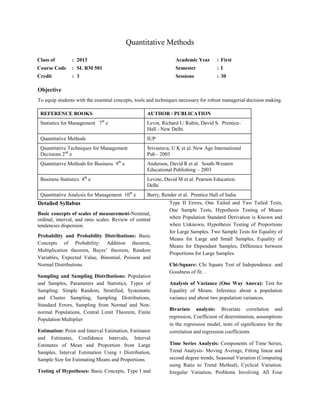
Class of        : 2013                                           Academic Year       : First
Course Code     : SL RM 501                                      Semester            :I
Credit          : 3                                              Sessions            : 30

Objective
To equip students with the essential concepts, tools and techniques necessary for robust managerial decision making.

 REFERENCE BOOKS                                    AUTHOR / PUBLICATION
                              th
 Statistics for Management 7 e                      Levin, Richard I./ Rubin, David S. Prentice-
                                                    Hall - New Delhi
 Quantitative Methods                               IUP
 Quantitative Techniques for Management             Srivastava, U K et al. New Age International
 Decisions 2nd e                                    Pub - 2003
 Quantitative Methods for Business 9th e            Anderson, David R et al. South-Western
                                                    Educational Publishing – 2003
 Business Statistics 4th e                          Levine, David M et al. Pearson Education.
                                                    Delhi
 Quantitative Analysis for Management 10th e        Barry, Render et al. Prentice Hall of India
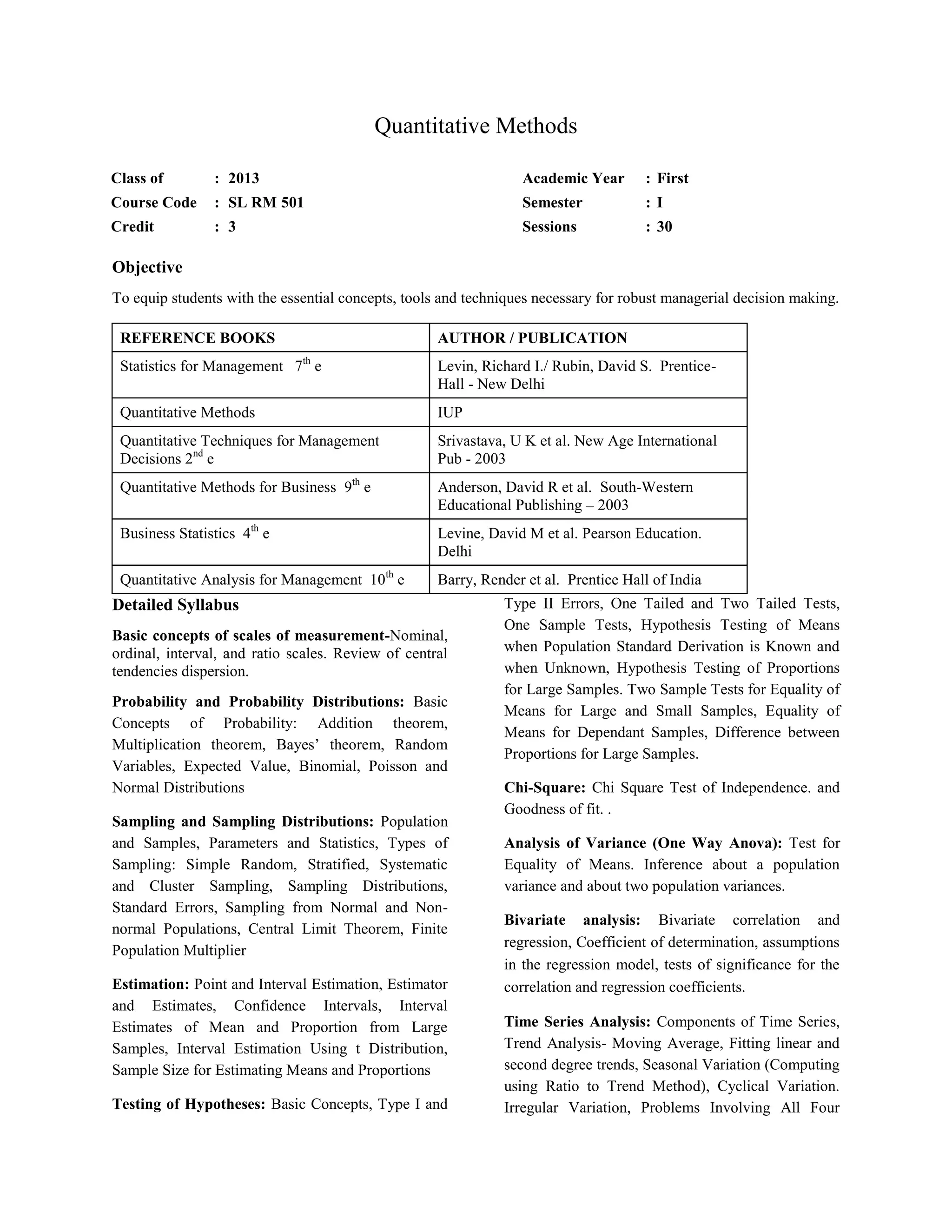
Detailed Syllabus                                             Type II Errors, One Tailed and Two Tailed Tests,
                                                              One Sample Tests, Hypothesis Testing of Means
Basic concepts of scales of measurement-Nominal,
ordinal, interval, and ratio scales. Review of central        when Population Standard Derivation is Known and
tendencies dispersion.                                        when Unknown, Hypothesis Testing of Proportions
                                                              for Large Samples. Two Sample Tests for Equality of
Probability and Probability Distributions: Basic
                                                              Means for Large and Small Samples, Equality of
Concepts of Probability: Addition theorem,
                                                              Means for Dependant Samples, Difference between
Multiplication theorem, Bayes’ theorem, Random
                                                              Proportions for Large Samples.
Variables, Expected Value, Binomial, Poisson and
Normal Distributions                                          Chi-Square: Chi Square Test of Independence. and
                                                              Goodness of fit. .
Sampling and Sampling Distributions: Population
and Samples, Parameters and Statistics, Types of              Analysis of Variance (One Way Anova): Test for
Sampling: Simple Random, Stratified, Systematic               Equality of Means. Inference about a population
and Cluster Sampling, Sampling Distributions,                 variance and about two population variances.
Standard Errors, Sampling from Normal and Non-
                                                              Bivariate analysis: Bivariate correlation and
normal Populations, Central Limit Theorem, Finite
                                                              regression, Coefficient of determination, assumptions
Population Multiplier
                                                              in the regression model, tests of significance for the
Estimation: Point and Interval Estimation, Estimator          correlation and regression coefficients.
and Estimates, Confidence Intervals, Interval
Estimates of Mean and Proportion from Large                   Time Series Analysis: Components of Time Series,
Samples, Interval Estimation Using t Distribution,            Trend Analysis- Moving Average, Fitting linear and
Sample Size for Estimating Means and Proportions              second degree trends, Seasonal Variation (Computing
                                                              using Ratio to Trend Method), Cyclical Variation.
Testing of Hypotheses: Basic Concepts, Type I and             Irregular Variation, Problems Involving All Four
Components of Time Series.

Decision Trees: Decision Tree Analysis-Expected
value under risk, under perfect information, and
under sample information.

Linear Programming, Transportation and
Assignment     problems:   Formulating    Linear
Programming Problems, Graphical approach,
Formulation of Transportation and Assignment
problems, Solutions using Excel solver and other
softwares.

Cases
   ICICI Bank’s “Get up to 100% Cash Back offer”
   Real Foods
   Solnyx Pharmaceuticals: The Atoxeril Clinical
   Trial
   Care Hygiene
   Hindustan Foods
   Roja Silks
   Ram Publishers
   Alexander Machine Company
   Best Fibre
   Lakshmi Engines
(Source: Case Studies in Management
Volume VI)

Exercises
Students will be given exercises to be solved using
SPSS/EXCEL Software.
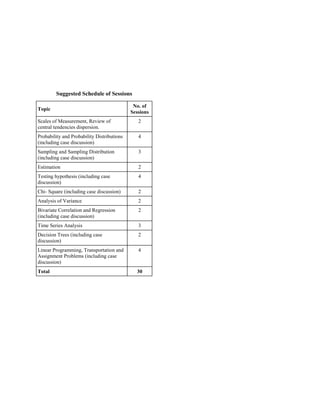
Suggested Schedule of Sessions

                                             No. of
Topic
                                            Sessions
Scales of Measurement, Review of               2
central tendencies dispersion.
Probability and Probability Distributions      4
(including case discussion)
Sampling and Sampling Distribution             3
(including case discussion)
Estimation                                     2
Testing hypothesis (including case             4
discussion)
Chi- Square (including case discussion)        2
Analysis of Variance                           2
Bivariate Correlation and Regression           2
(including case discussion)
Time Series Analysis                           3
Decision Trees (including case                 2
discussion)
Linear Programming, Transportation and         4
Assignment Problems (including case
discussion)
Total                                         30
Quantitative methods

Quantitative methods

  • 1.
    Quantitative Methods Class of : 2013 Academic Year : First Course Code : SL RM 501 Semester :I Credit : 3 Sessions : 30 Objective To equip students with the essential concepts, tools and techniques necessary for robust managerial decision making. REFERENCE BOOKS AUTHOR / PUBLICATION th Statistics for Management 7 e Levin, Richard I./ Rubin, David S. Prentice- Hall - New Delhi Quantitative Methods IUP Quantitative Techniques for Management Srivastava, U K et al. New Age International Decisions 2nd e Pub - 2003 Quantitative Methods for Business 9th e Anderson, David R et al. South-Western Educational Publishing – 2003 Business Statistics 4th e Levine, David M et al. Pearson Education. Delhi Quantitative Analysis for Management 10th e Barry, Render et al. Prentice Hall of India Detailed Syllabus Type II Errors, One Tailed and Two Tailed Tests, One Sample Tests, Hypothesis Testing of Means Basic concepts of scales of measurement-Nominal, ordinal, interval, and ratio scales. Review of central when Population Standard Derivation is Known and tendencies dispersion. when Unknown, Hypothesis Testing of Proportions for Large Samples. Two Sample Tests for Equality of Probability and Probability Distributions: Basic Means for Large and Small Samples, Equality of Concepts of Probability: Addition theorem, Means for Dependant Samples, Difference between Multiplication theorem, Bayes’ theorem, Random Proportions for Large Samples. Variables, Expected Value, Binomial, Poisson and Normal Distributions Chi-Square: Chi Square Test of Independence. and Goodness of fit. . Sampling and Sampling Distributions: Population and Samples, Parameters and Statistics, Types of Analysis of Variance (One Way Anova): Test for Sampling: Simple Random, Stratified, Systematic Equality of Means. Inference about a population and Cluster Sampling, Sampling Distributions, variance and about two population variances. Standard Errors, Sampling from Normal and Non- Bivariate analysis: Bivariate correlation and normal Populations, Central Limit Theorem, Finite regression, Coefficient of determination, assumptions Population Multiplier in the regression model, tests of significance for the Estimation: Point and Interval Estimation, Estimator correlation and regression coefficients. and Estimates, Confidence Intervals, Interval Estimates of Mean and Proportion from Large Time Series Analysis: Components of Time Series, Samples, Interval Estimation Using t Distribution, Trend Analysis- Moving Average, Fitting linear and Sample Size for Estimating Means and Proportions second degree trends, Seasonal Variation (Computing using Ratio to Trend Method), Cyclical Variation. Testing of Hypotheses: Basic Concepts, Type I and Irregular Variation, Problems Involving All Four
  • 2.
    Components of TimeSeries. Decision Trees: Decision Tree Analysis-Expected value under risk, under perfect information, and under sample information. Linear Programming, Transportation and Assignment problems: Formulating Linear Programming Problems, Graphical approach, Formulation of Transportation and Assignment problems, Solutions using Excel solver and other softwares. Cases ICICI Bank’s “Get up to 100% Cash Back offer” Real Foods Solnyx Pharmaceuticals: The Atoxeril Clinical Trial Care Hygiene Hindustan Foods Roja Silks Ram Publishers Alexander Machine Company Best Fibre Lakshmi Engines (Source: Case Studies in Management Volume VI) Exercises Students will be given exercises to be solved using SPSS/EXCEL Software.
  • 3.
    Suggested Schedule ofSessions No. of Topic Sessions Scales of Measurement, Review of 2 central tendencies dispersion. Probability and Probability Distributions 4 (including case discussion) Sampling and Sampling Distribution 3 (including case discussion) Estimation 2 Testing hypothesis (including case 4 discussion) Chi- Square (including case discussion) 2 Analysis of Variance 2 Bivariate Correlation and Regression 2 (including case discussion) Time Series Analysis 3 Decision Trees (including case 2 discussion) Linear Programming, Transportation and 4 Assignment Problems (including case discussion) Total 30