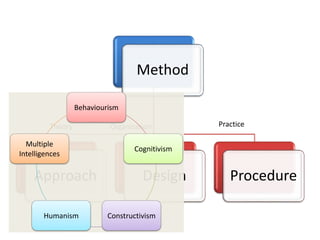
Method
Approach Design Procedure
Theory Organization Practice
Behaviourism
Cognitivism
ConstructivismHumanism
Multiple
Intelligences
CRMEF ENGLISH STUDIUES
SAFI Presentation
Presentation on:
Language
Learning
Theories
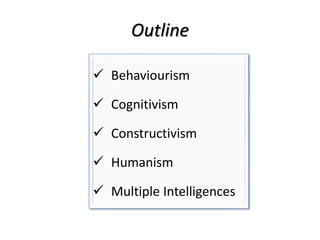
Outline
 Behaviourism
 Cognitivism
 Constructivism
 Humanism
 Multiple Intelligences
4
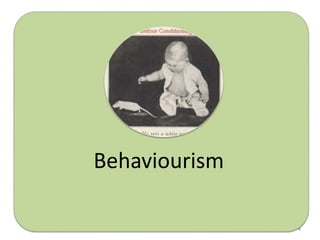
Behaviourism
Behaviorism
Definition:
Behaviorism was established with the publication of
Watson's classic paper Psychology as the Behaviorist Views
It (1913).
theory of learning based upon the idea that all behaviors are
acquired through conditioning. Conditioning occurs through
interaction with the environment. Behaviorists believe that
our responses to environmental shapes our behaviors.
5
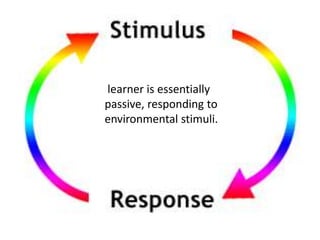
learner is essentially
passive, responding to
environmental stimuli.
behaviorists also hold that all behaviors can
also be unlearned, and replaced by new
behaviors; that is, when a behavior becomes
unacceptable, it can be replaced by an acceptable
one. A key element to this theory of learning is
the rewarded response. The desired response
must be rewarded in order for learning to take
place (Parkay & Hass, 2000).
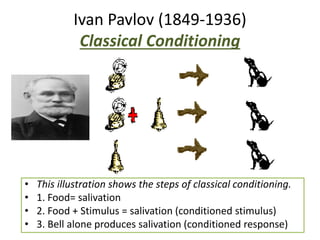
Ivan Pavlov (1849-1936)
Classical Conditioning
• This illustration shows the steps of classical conditioning.
• 1. Food= salivation
• 2. Food + Stimulus = salivation (conditioned stimulus)
• 3. Bell alone produces salivation (conditioned response)
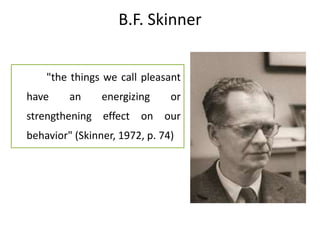
B.F. Skinner
"the things we call pleasant
have an energizing or
strengthening effect on our
behavior" (Skinner, 1972, p. 74)
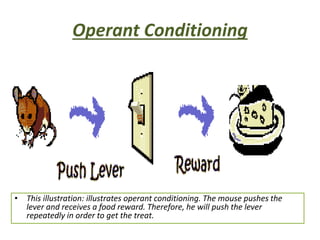
Operant Conditioning
• This illustration: illustrates operant conditioning. The mouse pushes the
lever and receives a food reward. Therefore, he will push the lever
repeatedly in order to get the treat.
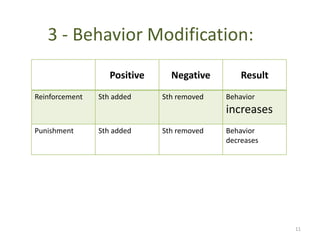
3 - Behavior Modification:
Positive Negative Result
Reinforcement Sth added Sth removed Behavior
increases
Punishment Sth added Sth removed Behavior
decreases
11
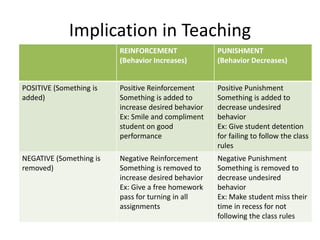
Implication in Teaching
REINFORCEMENT
(Behavior Increases)
PUNISHMENT
(Behavior Decreases)
POSITIVE (Something is
added)
Positive Reinforcement
Something is added to
increase desired behavior
Ex: Smile and compliment
student on good
performance
Positive Punishment
Something is added to
decrease undesired
behavior
Ex: Give student detention
for failing to follow the class
rules
NEGATIVE (Something is
removed)
Negative Reinforcement
Something is removed to
increase desired behavior
Ex: Give a free homework
pass for turning in all
assignments
Negative Punishment
Something is removed to
decrease undesired
behavior
Ex: Make student miss their
time in recess for not
following the class rules
Criticisms of Behaviorism
• Many critics argue that behaviorism is a one-dimensional
approach to understanding human behavior and that
behavioral theories do not account for free will and internal
influences such as moods, thoughts and feelings.
• Behaviorism does not account for other types of learning,
especially learning that occurs without the use
of reinforcement and punishment.
• People and animals are able to adapt their behavior when
new information is introduced, even if a previous behavior
pattern has been established through reinforcement.
Cognitivism
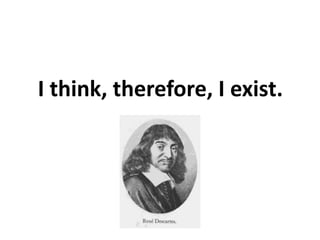
I think, therefore, I exist.
As a response to behaviorism:
‘People are not programmed animals.
People are rational beings that require active
participation in order to learn and whose
actions are a consequence of thinking.’
Cognitivism is the study in psychology rooted in
Gestalt psychology and the work of Jean Piaget.
It has been prominent in psychology since 1960s. It is
a theory of learning which deals with understanding the
human mental functions; unlike behaviorism that views
learning a response to a stimulus or a habit formation.
Historical background
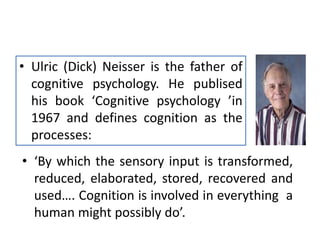
• Ulric (Dick) Neisser is the father of
cognitive psychology. He publised
his book ‘Cognitive psychology ’in
1967 and defines cognition as the
processes:
• ‘By which the sensory input is transformed,
reduced, elaborated, stored, recovered and
used…. Cognition is involved in everything a
human might possibly do’.
•Types of personalities
•Thinking styles
•Learning strategies
the American psychological theorist Isabel
Mayer Briggs(1987-1980):
 Extroversion versus introversion
 Thinking versus feeling
 Sensing versus intuision
 Judging versus perception
Personality types :
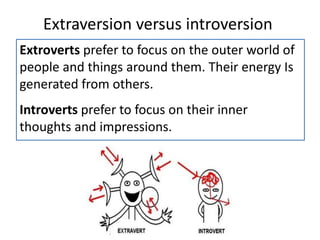
Extraversion versus introversion
Extroverts prefer to focus on the outer world of
people and things around them. Their energy Is
generated from others.
Introverts prefer to focus on their inner
thoughts and impressions.
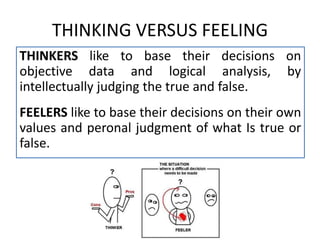
THINKING VERSUS FEELING
THINKERS like to base their decisions on
objective data and logical analysis, by
intellectually judging the true and false.
FEELERS like to base their decisions on their own
values and peronal judgment of what Is true or
false.
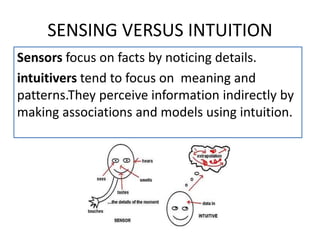
SENSING VERSUS INTUITION
Sensors focus on facts by noticing details.
intuitivers tend to focus on meaning and
patterns.They perceive information indirectly by
making associations and models using intuition.
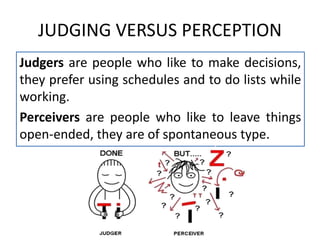
JUDGING VERSUS PERCEPTION
Judgers are people who like to make decisions,
they prefer using schedules and to do lists while
working.
Perceivers are people who like to leave things
open-ended, they are of spontaneous type.
THINKING STYLE
Hudson(1967):
CONVERGENT learners are the ones who look
for unique methods and unique solutions. They
are good at bringing material from various
sources to solve a problem and provide the
correct answer.
DIVERGENT learners are known for their
creativity and lateral thinking.
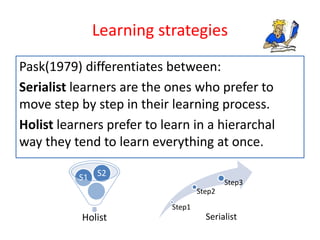
Learning strategies
Pask(1979) differentiates between:
Serialist learners are the ones who prefer to
move step by step in their learning process.
Holist learners prefer to learn in a hierarchal
way they tend to learn everything at once.
Holist
S1 S2
Step1
Step2
Step3
Serialist
A type of learning theory
Appeared as a reaction to behaviorism
Knowledge is constructed rather than acquired
Knowledge is built on personal experiences.
New information/knowledge is related to prior
knowledge
Definition of Constructivism
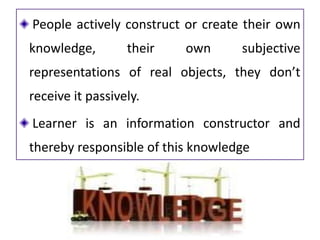
People actively construct or create their own
knowledge, their own subjective
representations of real objects, they don’t
receive it passively.
Learner is an information constructor and
thereby responsible of this knowledge
Assumes that learning process is :
o Active
o Contextualized
o A search of meaning by the learner
o An inherent social activity
Historical Background of
Constructivism
In 1710, Giambattista Vico published a
treatise on the construction of knowledge. It
illuminated the idea that knowledge is
something that is constructed by the knower[…]
(Lo 1996). It is through Vico's writings that we
take the term 'constructivist'. His slogan,
according to Von Glasersfeld, was, "The human
mind can only know what the human mind has
made"(1989, p. 3).
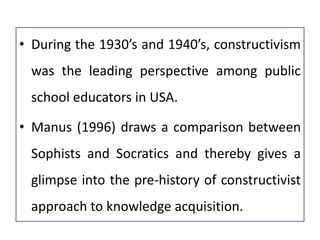
• During the 1930’s and 1940’s, constructivism
was the leading perspective among public
school educators in USA.
• Manus (1996) draws a comparison between
Sophists and Socratics and thereby gives a
glimpse into the pre-history of constructivist
approach to knowledge acquisition.
• Sophists believed that:
– Knowledge could be transmitted via
lecture and modeling.
– Knowledge resided outside the person and
could be acquired […]
• Socratics on the other hand believed that:
– Learning was an inner experience
– Why we learned, was more important that
what was learned.
Pioneers of Constructivism
Originators and important contributors
of this theory are:
• Jean Piaget
•Jerome Bruner
•Lev Vygotsky
•Albert Bandura
•Paulo Freire
•Jürgen Habermas.
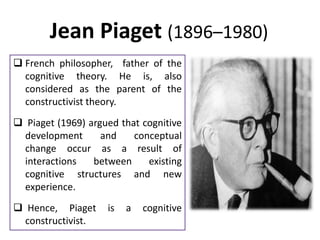
Jean Piaget (1896–1980)
 French philosopher, father of the
cognitive theory. He is, also
considered as the parent of the
constructivist theory.
 Piaget (1969) argued that cognitive
development and conceptual
change occur as a result of
interactions between existing
cognitive structures and new
experience.
 Hence, Piaget is a cognitive
constructivist.
Active Learning
According to Piaget, cognitive development is
based on:
– Active learning: children’s active engagement
with their environment leads them to the
construction of the meaning and to learning.
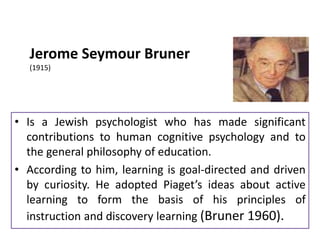
• Is a Jewish psychologist who has made significant
contributions to human cognitive psychology and to
the general philosophy of education.
• According to him, learning is goal-directed and driven
by curiosity. He adopted Piaget’s ideas about active
learning to form the basis of his principles of
instruction and discovery learning (Bruner 1960).
Jerome Seymour Bruner
(1915)
– Discovery learning: children are encouraged to
discover the principles of some subjects such as
mathematics through processes of exploration.
Discovery learning
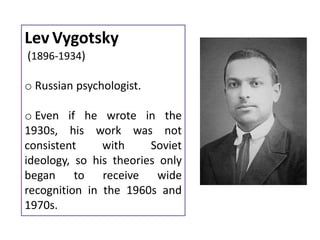
Lev Vygotsky
(1896-1934)
o Russian psychologist.
o Even if he wrote in the
1930s, his work was not
consistent with Soviet
ideology, so his theories only
began to receive wide
recognition in the 1960s and
1970s.
• Understanding arises via social processes.
• For example, interactions with parents and
other adults lead to the creation of
knowledge, which is internalized by children.
(Garton 2004).
• Language is an important tool through which
social interaction and knowledge
construction occur.
Zone of Proximal Development
• The concept for which Vygotsky is best known
is the Zone of Proximal Development (ZPD).
This is an intellectual space where learner and
teacher interact.
• The teacher can gauge intellectual
development of the learner and provide the
appropriate support to advance the learner’s
thinking.
Critiques of Social Constructivism
• Suggests that knowledge is neither given nor
absolute.
• Often seen as less rigorous than traditional
approaches to instruction.
• Does not fit well with traditional age grouping
and rigid terms/semesters.
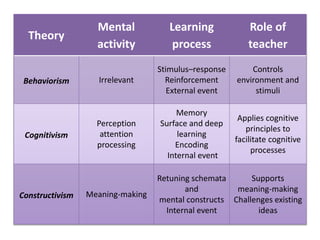
Comparison of Behaviorism,
Cognitivism & Constructivism
Theory
Mental
activity
Learning
process
Role of
teacher
Behaviorism Irrelevant
Stimulus–response
Reinforcement
External event
Controls
environment and
stimuli
Cognitivism
Perception
attention
processing
Memory
Surface and deep
learning
Encoding
Internal event
Applies cognitive
principles to
facilitate cognitive
processes
Constructivism Meaning-making
Retuning schemata
and
mental constructs
Internal event
Supports
meaning-making
Challenges existing
ideas
48
Definition:
49
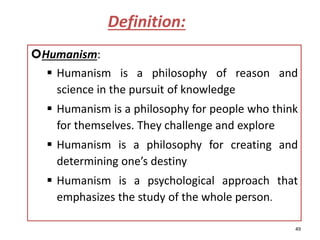
Humanism:
 Humanism is a philosophy of reason and
science in the pursuit of knowledge
 Humanism is a philosophy for people who think
for themselves. They challenge and explore
 Humanism is a philosophy for creating and
determining one’s destiny
 Humanism is a psychological approach that
emphasizes the study of the whole person.
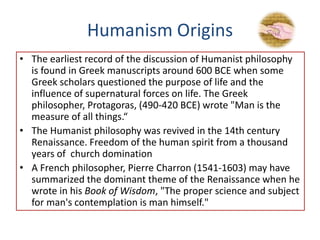
Humanism Origins
• The earliest record of the discussion of Humanist philosophy
is found in Greek manuscripts around 600 BCE when some
Greek scholars questioned the purpose of life and the
influence of supernatural forces on life. The Greek
philosopher, Protagoras, (490-420 BCE) wrote "Man is the
measure of all things.“
• The Humanist philosophy was revived in the 14th century
Renaissance. Freedom of the human spirit from a thousand
years of church domination
• A French philosopher, Pierre Charron (1541-1603) may have
summarized the dominant theme of the Renaissance when he
wrote in his Book of Wisdom, "The proper science and subject
for man's contemplation is man himself."
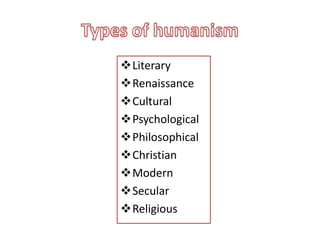
Literary
Renaissance
Cultural
Psychological
Philosophical
Christian
Modern
Secular
Religious
Humanistic psychology
• The humanistic approach in psychology developed as a rebellion
against what some psychologists saw as limitations of the
behaviorist and psychodynamic psychology. The humanistic
approach is thus often called the “third force” in psychology after
psychoanalysis and behaviorism (Maslow, 1968).
• Humanism rejected the assumption of the behaviorist
perspective which is characterized as deterministic, focused on
reinforcement of stimulus-response behavior and heavily
dependent on animal research.
• Humanistic psychology also rejected the psychodynamic approach
because it is also deterministic, with unconscious irrational and
instinctive forces determining human thought and behavior. Both
behaviorism and psychoanalysis are regarded as dehumanizing by
humanistic psychologists.
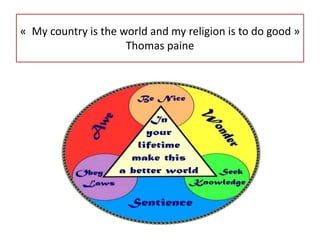
« My country is the world and my religion is to do good »
Thomas paine
Key Humanist Values and
Principles
• Humanists believe that nothing is more important than people.
• Humanist value the human powers of reasoning , imagining, and
love.
• Humanist highlight the importance of concern for the world and for
the future
• Humanistic psychologists look at human behavior not only through
the eyes of the observer, but through the eyes of the person doing
the behaving.
Humanism Beliefs
• Humanists believe that there is not enough evidence to
decide whether or not God exists.
• Humanists believe that this is the only life humans have.
• Humanists stress that morals are a product of human
imagination and reason.
Figures in Humanism
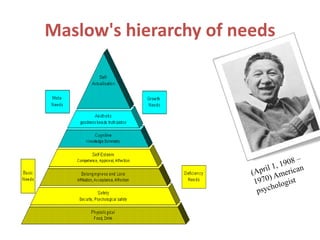
Maslow's hierarchy of needs
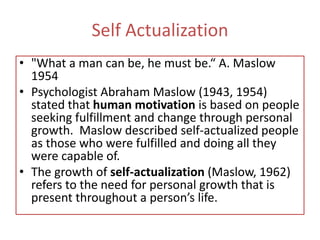
Self Actualization
• "What a man can be, he must be.“ A. Maslow
1954
• Psychologist Abraham Maslow (1943, 1954)
stated that human motivation is based on people
seeking fulfillment and change through personal
growth. Maslow described self-actualized people
as those who were fulfilled and doing all they
were capable of.
• The growth of self-actualization (Maslow, 1962)
refers to the need for personal growth that is
present throughout a person’s life.
• Mezirow
59
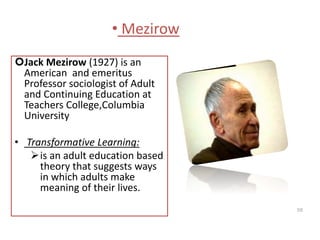
Jack Mezirow (1927) is an
American and emeritus
Professor sociologist of Adult
and Continuing Education at
Teachers College,Columbia
University
• Transformative Learning:
is an adult education based
theory that suggests ways
in which adults make
meaning of their lives.
• Paulo Freire
60
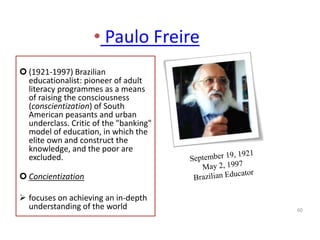
 (1921-1997) Brazilian
educationalist: pioneer of adult
literacy programmes as a means
of raising the consciousness
(conscientization) of South
American peasants and urban
underclass. Critic of the "banking"
model of education, in which the
elite own and construct the
knowledge, and the poor are
excluded.
 Concientization
 focuses on achieving an in-depth
understanding of the world
•Carl Rogers
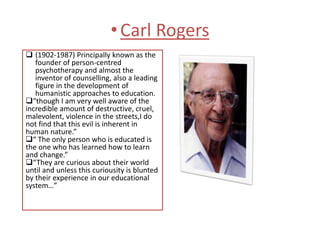
 (1902-1987) Principally known as the
founder of person-centred
psychotherapy and almost the
inventor of counselling, also a leading
figure in the development of
humanistic approaches to education.
“though I am very well aware of the
incredible amount of destructive, cruel,
malevolent, violence in the streets,I do
not find that this evil is inherent in
human nature.”
“ The only person who is educated is
the one who has learned how to learn
and change.”
“They are curious about their world
until and unless this curiousity is blunted
by their experience in our educational
system…”
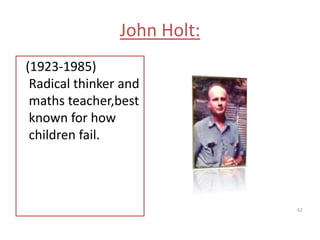
John Holt:
62
(1923-1985)
Radical thinker and
maths teacher,best
known for how
children fail.
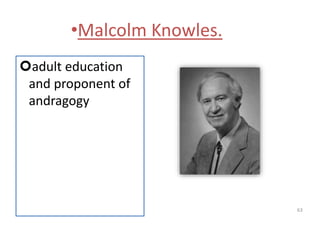
•Malcolm Knowles.
63
adult education
and proponent of
andragogy
64
Humanism and Education
Making the
school
everybody’s
house!
65
66
Purpose of Humanistic Education
• To offer a foundation for personal growth and development
so that learning will continue throughout life in a self-directed
manner (lifelong learners).
• To provide intelligence, self-discipline, self-respect, creativity,
high motivation, affirmative attitude, team player, joyful
living, and good health.
• Education is about creating a need within the child, or
instilling within the child self-motivation
• Humanism is about rewarding yourself
Principles of Humanistic Education
As described by Gage and Berliner (1991) there are five
basic objectives of the humanistic view of education:
1) Students' learning should be self-directed.
2) Schools should produce students who want and know
how to learn.
3) The only form of meaningful evaluation is self-
evaluation.
4) Feelings, as well as knowledge, are important in the
learning process.
5) Students learn best in a nonthreatening environment.
• Allow the student to have a choice in selection of tasks
and activities
• Help students learn to set realistic goals
• Have students participate in cooperative learning
groups
• Acts as a facilitator for group discussions
• Create and maintain a positive learning environment
• Be a positive role model
How to implement the humanist view
towards education?
• Emphasise the "natural desire" of everyone to
learn.
68
69
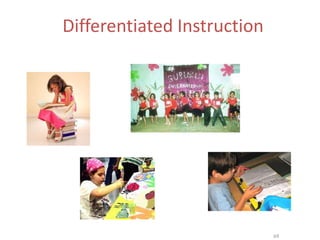
Differentiated Instruction
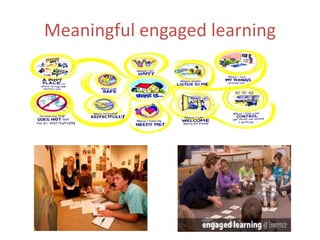
Meaningful engaged learning
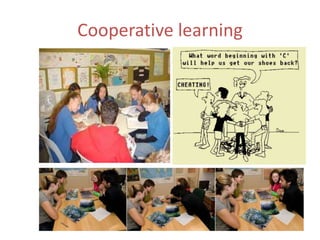
Cooperative learning
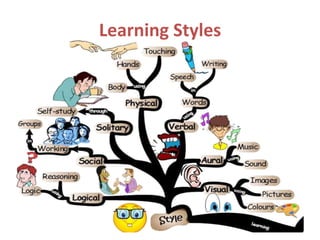
Learning Styles
73
Types of activities
Brainstorming/Discussion
Drawing/Artwork
Field Trips
Games
Music
Project/Problem-based Instruction
Reciprocal Teaching/Cooperative Learning
Role play/Drama/
Storytelling
Visualization/Guided Imagery
Visuals
Writing/Journals
Promotes self-
discovery, increased
motivation, creates a
positive learning
environment, gives
choice in learning
style, and produces
lifelong learners.
The Open Classroom
• Goals - individual growth, critical thinking, self-reliance, co-
operation, commitment to lifelong learning.
Most important person - student not teacher.
Not curriculum bound
Not age/grade locked.
Student-centred - intensive, but relaxed teacher/pupil contact.
de-emphasises schedules.
Almost no control or competition
Difficult to draw the line between chaos and order, rebelliousness
and expression of rights.
Productive and unproductive time.
Students tend to have better self-concepts and are more creative
and co- operative, but academic achievements are lacking.
Some reactions to humanistic
education
Experience Needed
• Humanistic teachers aim for good things, but
these are not clearly defined. Also not easily
measured.
• Humanistic approaches are highly dependent
upon the capabilities of the teacher.
• Open schools do not deliver academic
performance.
Group Emphasis
• Students spend much of the time in class working
in groups. This tends to lead students to
discussing matters unimportant to the topic.
• It leads to extroverted students monopolizing
the discussion, giving a large disadvantage to
more introverted students.
• Students of low achievement often feel
embarrassment or shame in a group, as they fear
lowering the group's overall performance.
Lack of Competitiveness
• the idea of competition is de-emphasized. The
result is that students learning from a humanist
approach are less competitive compared to
students learning in traditional schools. This
places students from humanist schools at a
disadvantage upon graduation when they enter
into the workplace or university.
• humanist teaching does not lead to better
performance
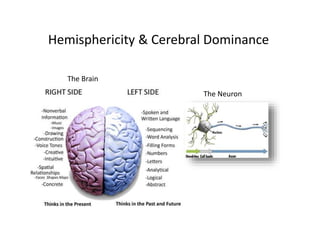
Hemisphericity & Cerebral Dominance
The Brain
The Neuron
too limited
Linguistic Mathematical
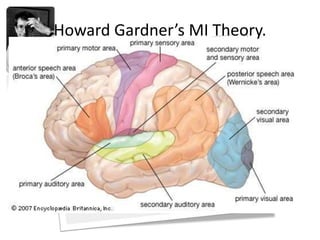
Howard Gardner’s MI Theory.
Verbal / Linguistic
Word Smart
• Sensitivity to the sounds, rhythms, and
meanings of words; sensitivity to the different
functions of language
– End States: Poet, Journalist
Logical Mathematical
(Number/Reasoning Smart):
• Sensitivity to, and capacity to discern, logical
or numerical patterns; ability to handle long
chains of reasoning
– End States: Scientist, Mathematician
Musical / Rhythmic
Music Smart:
• Abilities to produce and appreciate rhythm,
pitch, and timbre; appreciation of the forms of
musical expressiveness
– End States: Composer, Violinist
Visual Spatial
Picture Smart
• Capacities to perceive the visual-spatial world
accurately and to perform transformations on
one’s initial perceptions
– End States: Navigator, Sculptor
Bodily / Kinesthetic
Body Smart
Abilities to control one’s body movements and
to handle objects skillfully
– End States: actor, Athlete
Intrapersonal
Self-Smart
• Access to one’s own feelings and the ability to
discriminate among them and draw on them
to guide behavior
– End States: Personal with detailed, accurate self-
knowledge
Interpersonal
People Smart
• Capacities to discern and respond
appropriately to the moods, temperaments,
motivations, and desires of other people
– End States: Therapist, Salesman
Naturalist
Nature Smart
• Abilities to recognize plants and animals, to
make distinctions in the natural world, to
understand systems and define categories
– End States: Botanist, Farmer, Hunter
Existential
• MI theory proposes a major transformation in the way
schools are run.
• It suggests for teachers to present their lessons in a
wide variety of ways using:
– music,
– cooperative learning,
– art activities,
– role play,
– multimedia,
– field trips,
– inner reflection…
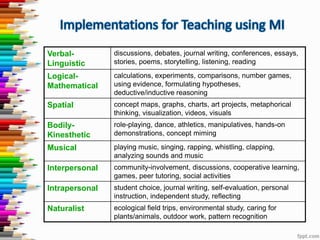
Verbal-
Linguistic
discussions, debates, journal writing, conferences, essays,
stories, poems, storytelling, listening, reading
Logical-
Mathematical
calculations, experiments, comparisons, number games,
using evidence, formulating hypotheses,
deductive/inductive reasoning
Spatial concept maps, graphs, charts, art projects, metaphorical
thinking, visualization, videos, visuals
Bodily-
Kinesthetic
role-playing, dance, athletics, manipulatives, hands-on
demonstrations, concept miming
Musical playing music, singing, rapping, whistling, clapping,
analyzing sounds and music
Interpersonal community-involvement, discussions, cooperative learning,
games, peer tutoring, social activities
Intrapersonal student choice, journal writing, self-evaluation, personal
instruction, independent study, reflecting
Naturalist ecological field trips, environmental study, caring for
plants/animals, outdoor work, pattern recognition
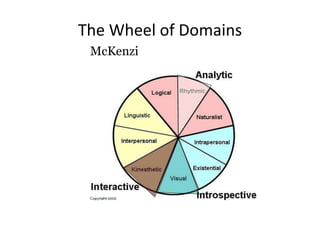
The Wheel of Domains
McKenzi
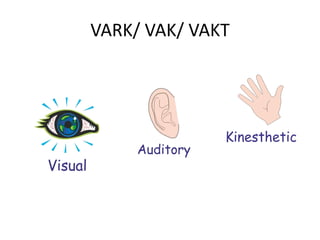
VARK/ VAK/ VAKT
Every now and then, the teacher, stands back and takes a look at what’s going on in his
classroom. Today, in pairs or small groups, his students are working on projects.
Sarah and James are poring over a stack of books from the library, writing notes on
index cards. Shonese draws detailed illustrations, while Tony designs charts and
graphs on the computer. Pedro is bouncing his pencil eraser on his desk and tapping
his foot against the chair leg. Mr. Oakes knows this helps Pedro to stay focused on
his reading. Clara is so excited about explaining her ideas to her partner that she’s
twirling around her braid of hair as if it were a propeller. Megan is staring out the
window, watching the traffic move along the busy street that borders the school.
Mr. Oakes doesn’t call her back to work quite yet. He knows Megan needs this
dream time to relax and allow her ideas to percolate. At the back of the classroom,
good friends Percy and David are laughing and fooling around. He remembers their
huge disagreement from yesterday and knows that neither can accomplish any
work until the friendship is reestablished. Slowly, he heads to the back of the room,
knowing that his presence alone will remind them to get back to work. Mr. Oakes
notices that Mariela is finally engaged in her group’s project. It took the stack of
letters written by seniors at the senior center about her project to capture her
imagination and inspire her research. “These kids are working hard,” Mr. Oakes
thinks. Only a middle school teacher would recognize that amid all these varied
activities, real learning is taking place.
Theories of learning