CLT and Post CLT
Approaches
The Outline
 Communicative language teaching
 Task Based Approach
 Content based Approach
 Lexical Approach
 Project based learning
 The Competency based approach
 Standard based Approach
Communicative
Language Teaching
Nissrine CHBAKOU
Fatima-Zahra. RIFFI
 Definition
Communicative Language Teaching is
“one of the most outstanding approaches to
the teaching of foreign or second language
which emphasizes the role of communication
in the language learning process.”
Longman dictionary of language teaching and Applied linguistics
According to this approach, the main
objective of language learning is
“communicative competence”.
• Emergence
The origin of Communicative Language
Teaching (CLT) dates back to the late 1960s
with the changes occurring in the teaching
tradition of the British language.
Before then and until that time, the
Situational Language approach was the
major dominant approach to teaching
English as a foreign language.
 According to SLT, that is Situational
Language Teaching, the English language
was taught by practicing the basic structures
in meaningful situation-based activities.
 CLT was developed by British applied
linguists as a substitution to the common
trend that was before, that is the SLT.
 According to them, the major emphasis
should be on the functional and
communicative potential of language which is
a fundamental dimension that was ignored in
the previous approach.
 The Situational Language Teaching was
rejected as these linguists realized that the
major focus in language teaching should be
on the communicative proficiency rather than
on the mastery of structures as in the SLL
approach.
Benefits of using CLT
 Focusing on communicative competence:
CLT increases the communicative
competence
 Increasing motivation:
It provides the students with authentic and
meaningful interaction
 Gives equal importance to both the spoken
language (i.e. fluency) and the accuracy of
the production as well.
Teacher/student role
 Learner’s role:
Active participant
 The emphasis in Communicative Language
Teaching on the processes of communication,
rather than mastery of language.
 Teacher’s roles:
- Facilitator: He facilitates the communication process between all
participants in the classroom, and between these participants and the
various activities and texts.
- An independent participant :within the learning-
teaching group.
Elements of CLT
 Fluency as well as accuracy
 Communication – According to Ability
 Motivation
The objectives of CLT :
 Widdowson (1978) holds that language is used to achieve a
communicative purpose.
 Littlewoods (1981) states that language is used as a tool of
communication.
 The objectives of CLT is to develop learner’s ability to use a
language to communicate with others in real life.
 CLT helps learners to become communicatively competent .
 Adopting this approach will allow students to :
 Know how to use language for a range of different purposes and
functions.
 How to vary the use of language according to the setting and the
participants
 Know how to maintain communication despite having limitations
in one’s language learning
Main principles of CLT
 Give students the opportunity to express their ideas
and opinions
 Errors are tolerated, because they are seen as a
natural outcome of the development of
communicative skills.
 Encourage cooperative relationships among S’s
 Give students the opportunity to listen to authentic
communications.
 Have students work in groups to maximize the
amount of communicative practice they receive.
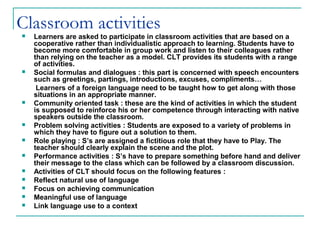
Classroom activities Learners are asked to participate in classroom activities that are based on a
cooperative rather than individualistic approach to learning. Students have to
become more comfortable in group work and listen to their colleagues rather
than relying on the teacher as a model. CLT provides its students with a range
of activities.
 Social formulas and dialogues : this part is concerned with speech encounters
such as greetings, partings, introductions, excuses, compliments…
Learners of a foreign language need to be taught how to get along with those
situations in an appropriate manner.
 Community oriented task : these are the kind of activities in which the student
is supposed to reinforce his or her competence through interacting with native
speakers outside the classroom.
 Problem solving activities : Students are exposed to a variety of problems in
which they have to figure out a solution to them.
 Role playing : S’s are assigned a fictitious role that they have to Play. The
teacher should clearly explain the scene and the plot.
 Performance activities : S’s have to prepare something before hand and deliver
their message to the class which can be followed by a classroom discussion.
 Activities of CLT should focus on the following features :
 Reflect natural use of language
 Focus on achieving communication
 Meaningful use of language
 Link language use to a context
Task-Based LanguageTask-Based Language
TeachingTeaching
Fattoum Slimani
TBLT has strengthened the following principles:
 A needs-based approach to content selection.
 An emphasis on learning to communicate
through interaction in the target language.
 The introduction of authentic texts into the
learning situation.
 An enhancement of the learner’s own personal
experiences.
 The linking of classroom language learning with
language use outside the classroom.
Overview of Task Based Language Teaching
Defining pedagogical tasksDefining pedagogical tasks
 A piece of classroom work that involve
communicative language use in which the
user’s attention is focused on meaning
rather than grammatical form.
PedagogicPedagogic CCriteria for Judging the Qualityriteria for Judging the Quality
of Tasks:of Tasks:
 A good task should:
 Promote attention to meaning negotiation
 Draw objectives from the communicative
needs of learners
 Involve language use
 Allow for co-evaluation
 Promote a critical awareness
Candlin ("Towards TBLL" 9-10)
Tasks in Language TeachingTasks in Language Teaching
 the syllabus is task-based and the approach
is ‘focus on form’. The methodology centres
around students performing a series of
tasks.
Focussing on FormFocussing on Form
 Focus on form … overtly draws students’
attention to linguistic elements as they arise
incidentally in lessons whose overriding
focus is on meaning or communication.
(Long 1991)
Definition of Task Based LanguageDefinition of Task Based Language
teaching:teaching:
 TBLT is an approach to teaching a
second/foreign language that seeks to
engage learners in interactionally authentic
language use by having them perform a
series of tasks. It aims to both enable
learners (1) to acquire new linguistic
knowledge and (2) to proceduralize their
existing knowledge.
  
Methodology of task-based languageMethodology of task-based language
teachingteaching
• Pre-task
• Main task
• Post-task
Advantages of Task Based LanguageAdvantages of Task Based Language
Teaching:Teaching:
 Task-based teaching offers the opportunity for
‘natural’ learning inside the classroom.
 It emphasizes meaning over form but can also cater
for learning form.
 It is intrinsically motivating.
 It is compatible with a learner-centred educational
philosophy but also allows for teacher input.
 It caters to the development of communicative
fluency while not neglecting accuracy.
 It can be used alongside a more traditional
approach.
  
Obstacles to Task Based LanguageObstacles to Task Based Language
Teaching:Teaching:
 Teachers often believe that TBLT is not
possible with beginners
 Students may be unwilling to risk
communicating ‘freely’
 Students will resort to communicating in their
L1
 Teachers may not fully understand the
principles of TBLT or have the proficiency to
teach ‘communicatively’.
TEACHER ROLES IN TASK-BASEDTEACHER ROLES IN TASK-BASED
Language TeachingLanguage Teaching
 Motivating learners to engage in natural
communicative behaviour
 Supporting them to perform tasks
 Evaluating the process of tasks as well as the
eventual outcome
(Donyei, 2002; Freeman & Richards, 1996;
Richard Amato, 2003; Samuda,2001)
Content Based
Approach
Fatima Ezzahra NADIRI
Background
 It has been observed that academic subjects
provide natural content for language
instruction
 Such observations motivated the 'language
across the curriculum' movement for native
English speakers in England, which was
launched in the 1970s, to integrate the
teaching of reading and writing into all other
subjects
 The language curriculum is based directly on
the academic needs of the students, and
generally follows the sequence determined
by a particular subject matter in dealing with
language
 The special contribution of content-based
instruction is that it integrates the learning of
language with the learning of some other
content, often academic subject matter
 The Objectives of CBI are:
 a)To activate and develop existing English
language skills.
 b)To acquire learning skills and strategies that
could be applied in future language development
opportunities .
 c)To develop general academic skills applicable
to University studies in all subject areas.
 d)To broaden students’understanding of English-
speaking peoples.
(Brintonet.al,1989;32)
Theory of Language
 Language is text and discourse- based
 Construction of meaning and information with
text and discourse
 Language use is drawn on integrated skills: read
and write+ listen and write notes, read and
respond orally+ 4 competencies : content,
communication, cognition and cultures
 Language is purposeful: academic, vocational,
social and recreational
 Language contains meaningful context
Theory of learning and teaching
 Build on students’ previous knowledge
 Students motivated to learn because of relevance
 Teacher helps to scaffold linguistic content
 Language is learned best when used to deliver interesting
information
 Vocabulary can be easily acquired with contextual cues
 Teacher gives examples and use comprehensive checks with
authentic matters
 Learners use authentic materials to practice language
 Communicative competence = able to read, discuss, write about
content of other fields
Principles
 Teaching content rather than linguistic syllabus
 CBA is based on the principles of communicative language teaching.
Classroom needs to be filled with real and meaningful communication
where information is exchanged
 The term content means “SUBJECT MATTER”
 Acquiring content through language rather than studying language for
its own sake
 Learners acquire second language more successfully when they use the
language as means of acquiring information rather than an end in itself
Teacher’s role
 Knowledgeable in the subject matter.
 Keeping context and comprehensibility.
 Responsible for selecting and adapting
authentic materials.
Student’s role
 Become autonomous
 Be collaborative
 Active interpreters of input
 Willing to tolerate uncertainty
 Take part in the process of learning
Benefits of CBA
 Learners are exposed to a considerable amount of
language through stimulating content.
 CBI supports contextualized learning; learners are taught
useful language that is embedded within relevant
discourse contexts rather than as isolated language
fragments.
 Complex information is delivered through real life
context for the students to grasp well and leads to
intrinsic motivation.
 flexibility & adaptability in the curriculum can be deployed
according to students’ interest.
 Learner-centred approach
 Taking information from different sources, re-
evaluating and restructuring that
information can help students to develop very
valuable thinking skills that can then be
transferred to other subjects.
 The inclusion of a group work element within
the framework given above can also help
students to develop their collaborative skills,
which can have great social value.
Limitations of CBA
 Because CBI isn't explicitly focused on
language learning, some students may feel
confused or may even feel that they aren't
improving their language skills.
 It can be hard to find information sources and
texts that lower levels can understand.
 Some students may copy directly from the
source texts they use to get their information.
 The goals of teachers: give priority to process over predetermined
linguistic content.
 The roles of the teachers: assist learners in understanding subject
matter.
 The roles of the students: both study academic subject matters and
learn a foreign language.
 The characteristics of the teaching/learning process: integrates the
learning of language with the learning of some content, that is,
academic subject matter. Language objectives are dictated by the texts.
Students are engaged in purposeful use of language.
 The nature of student-teacher/student-student interaction: while
completing the academic tasks in the foreign language, all interaction
types are possible.
 The feelings of the students dealt with: no principles about feelings.
 The views of language and culture: since students have a purpose
that is content, it is easier for them to master the target language.
 The language areas: language areas are dictated by the texts that are
used for content.
 The language skills: all four skills
 The role of the students’ native language: there is no role of the
native language.
 Evaluation: students are evaluated for the content they are learning.
Soliman En-nass
THE LEXICAL APPROACH
 It is a language teaching method published by Michael Lewis in
1993
 Giving importance to the insight of the language lexicon
 Lexis is the basis of language
 The lexical approach concentrates on developing learners'
proficiency with lexis, or words and word combinations.
 Lexis plays the central role
 Alternative approach to traditional grammatical approach
 Chunks, minimal pairs, collacations, lexical units are the specific
characteristics of this approach
o No learning theory
o No theory of language
o The building blocks of language learning and
communication are not grammar, functions or
some of unit of planning but teaching lexis with
the help of chunks and collocations.
What is chunk?
 'Lexical chunk' is an umbrella term which includes all the
other terms.
What are collocations?
 Collocation is a pair of lexical content words commonly found
together
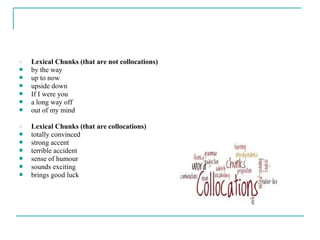
o Lexical Chunks (that are not collocations)
 by the way
 up to now
 upside down
 If I were you
 a long way off
 out of my mind
o Lexical Chunks (that are collocations)
 totally convinced
 strong accent
 terrible accident
 sense of humour
 sounds exciting
 brings good luck
 LEXICAL UNITS
 Binomials ( e.g. Knife and fork…)
 Trinomials ( e.g. Cool, calm and collected…)
 Idioms ( e.g. To rain cats and dogs… )
 Similes ( e.g. As white as snow …. )
 Connectives ( e.g. Finally, to conclude )
 Conversational gambits ( e.g. Guess what… )
 Encountering new learning items
 Noticing lexical chunks or collocations
 Noticing similarities, differences, restrictions and examples
 Acquisition is based not on the application of formal rules
 No linear syllabus can adequately reflect the nonlinear nature of
acquisition
- Objectives:
 To get students to become aware of, use and to eventually master these
meaning-filled, multi-word “chunks”, collocations and fixed utterances.
 To help learners to notice for themselves how language is typically
used
 Language is learnt by an increasing ability to break down wholes into
parts.
 Grammar is acquired by a process of observation, hypothesis and
experiment.
 We can use whole phrases without understanding their constituent
parts.
 Acquisition is accelerated by contact with a sympathetic interlocutor
with a higher level of competence in the target language
 SYLLABUS

Structural syllabus is used.( Also called as “ lexical
syllabus” )
 Teaching vocabulary and grammar
 The talk of the teacher as a major source of learner input( This is the same
with the Natural Approach)
 To understand and implement the methodology which is based on stages
composed of;
-Task
-Planning
- Report
 To create an operative environment(where students operate effectively)
 To help the learners manage their own learning after operation
 “…abandon the idea of the teacher as a knower and concentrate instead of the
idea of the learner as “discoverer”.” (Willis 1990)
 The analyzer of real life language samples based
on his or her own explanations
 To observe, classify and make generalizations
 Making use of computers
 It has lexically based theory of language
 It doesn't have any certain learning theory
 It is an alternative approach
 It focuses on words and word combinations
 Grammar and lexis are the heart of learning
 It aims to teach vocabulary within grammar
 Teachers help learners to discover knowledge instead of giving it
directly
Project-Based Learning
Ayoub choubi
What is Project-Based Learning?
 Project-Based learning (PBL) is an
instructional strategy that enables students
to learn meaningful content and practice
skills needed for life success. The project
contains and frames the curriculum, which
differs from the short “project” or activity
added onto traditional instruction.
 It is a systematic teaching method that
engages students in learning knowledge and
skills through an extended inquiry process
structured around complex, authentic
questions and careful designed products and
tasks.
Rigorous and in-depth Project-Based Learning
 is organized around an open-ended Driving Question or
Challenge. These focus students’ work and deepen their
learning by centering on significant issues, debates, questions
and/ or problems.
 Creates a need to know essential content and skills. Typical
projects begin by presenting students with knowledge and
concepts and then, once learned, give them the opportunity to
apply them.
 Requires inquiry to learn and/or create something new. Not all
learning has to be based on inquiry, but some should. And this
inquiry should lead students to construct something new-an
idea, an interpretation, a new way of displaying what they have
learned.
 Results in a publicly presented product or performance. What
you know is demonstrated by what you do, and what you do
must be open to public scrutiny and critique.
 Allows some degree of student voice and choice. They learn to
work independently and take responsibility when they are
asked to make choices.
 Requires critical thinking, problem solving, collaboration, and
various forms of communication. Students have to learn to
work as tea, and contribute to a group effort. They also have to
listen to others and make their own ideas clear when speaking,
be able to read a variety of materials, write or otherwise
express themselves in various modes, and make effective
presentations.
By: Ahmed Adnan Samaa
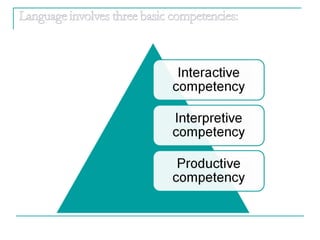
 The ability to act using a range of skills and
knowledge in various situations that may
differ from those in which they were learned.
 An individual’s competency develops over
time.
 A competency is firmly linked to a context-of-
use.
 focuses on what “learners are expected to do
with the language” (Richards & Rodgers,
2001, p.141)
 “defining educational goals in terms of precise
measurable descriptions of the knowledge,
skills, and behaviours students should
possess at the end of a course of study”
(Richards & Rodgers, 2001, p.141).
 In other words, by framing the aims of the
curriculum in terms of competency, the focus
is on what learners can actively do in and with
the language rather than on a discrete list of
items they are expected to remember.
Objectives:
 The competency-based approach is based on
linking learning carried out at school to varied
and relevant contexts-of-use in order to make
the learning useful and durable.
 The aim is for students to develop intellectual,
linguistic and problem-solving capacities in
school that will enable them to tackle
cognitively and pragmatically challenging
situations both in and out of school.
 the ability to use language orally to interact
with others in order to create social relations,
express needs, understand and address
needs of others and to get things
accomplished.
E.g.: Engaging in a discussion is an example of
using one’s interactive competency.
 the ability to understand written language
through reading or spoken language through
listening and to interpret it appropriately.
 Reading is the ability to understand and
interpret written texts, listening is the ability to
understand and interpret oral language.
 Reading and listening are thus addressed
separately in the curriculum.
 the ability to produce coherent, appropriate and
relevant messages in writing and speaking.
 It is also the ability to effectively express ideas and
organize thoughts appropriately.
 Productive competency is more often associated
with writing because writing involves producing texts
 Productive speaking competency is also the
production of texts; it differs from interactive
speaking competency in that it does not involve
interaction with other speakers.
E.g.: Giving a lecture or a presentation are examples
of using one’s productive speaking competency.
 N.B.: Learners have different levels of
competency at different levels of language
proficiency. A beginning language learner can
do less in each competency than an
advanced language learner.
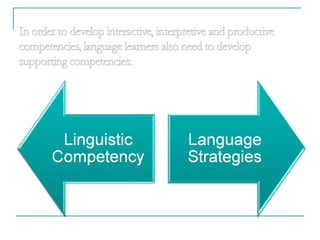
 Linguistic competency:
Linguistic competency includes the learning
and mastery of grammar, pronunciation and
the vocabulary needed in a given context.
 Language Strategies:
Language strategies are ways that help
students to acquire, remember, organize and
use information on an ongoing basis.
 The teacher has to provide positive and
constructive feedback
 Be aware of the learners’ needs so that
everybody feels welcome in class.
 Thus the teacher has to give clear
explanations to make every student
understands the task demanded to deal with.
 Select learning activities and to design a
syllabus according to the competency the
students are going to acquire.
 Students in this approach are expected to
perform the skills learned.
 the learner knows exactly what needs to be
learned” and for which purpose he/she has to
use the competencies .
 The main goal of the learner in Competency-
Based Language Teaching is to be able to adapt
and transfer knowledge from one setting to
another.
 Activities used in CBLT can be described as
systematically designed activities to achieve a
certain competence.
 These activities are real-world tasks which “may
be related to any domain of life.
 These areas can be described as a collection of
units of competencies which consist of specific
knowledge, thinking processes, attitudes, and
perceptual and physical skills.
 Rida QASSAR
What are standards?
 Standards are statements about (1) what students
should know and be able to do, (2) how they give
evidence of learning, and (3) how well they should be
expected to know or do a task.
 Standards are necessary! They serve as rigorous goals
for teaching and learning. Setting high standards
enables students, parents, educators, and citizens to
know what students should have learned at a given
point in time. The absence of standards has
consequences similar to lack of goals in any pursuit.
Without clear goals, students may be unmotivated and
confused.
Types of standards
 Standards fall into (3) types:
*Content standards: refer to what students
should know and be able to do.
*Performance standards: tell how students will
show that they are meeting a standard.
*Proficiency standards: indicate how well
students must perform.
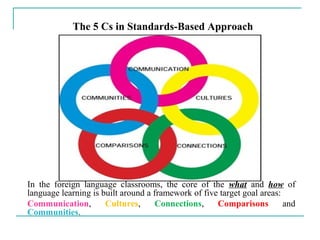
The 5 Cs in Standards-Based Approach
In the foreign language classrooms, the core of the what and how of
language learning is built around a framework of five target goal areas:
Communication, Cultures, Connections, Comparisons and
Communities.
Communication
 The communication standard stresses the use of
language for communication in "real life"
situations.
 It emphasizes "what students can do with
language" rather than "what they know about
language.”
 Students are asked to communicate in oral and
written form, interpret oral and written messages,
show cultural understanding when they
communicate, and present oral and written
information to various audiences for a variety of
purposes.
Cultures
 Cultural understanding is an important part
of world languages education.
 Experiencing other cultures develops a
better understanding and appreciation of
the relationship between languages and
other cultures, as well as the student's
native culture.
 Students become better able to understand
other people's points of view, ways of life,
and contributions to the world.
Connections
 World languages instruction must be
connected with other subject areas.
 Content from other subject areas is integrated
with world language instruction through
lessons that are developed around common
themes.
Comparisons
 Students are encouraged to compare and
contrast languages and cultures.
 They discover patterns, make predictions,
and analyze similarities and differences
across languages and cultures.
 Students often come to understand their
native language and culture better through
such comparisons.
Communities
 Extending learning experiences from the
world language classroom to the home and
multilingual and multicultural community
emphasizes living in a global society.
 Activities may include: field trips, use of e-
mail and the World Wide Web, clubs,
exchange programs and cultural activities,
school-to-work opportunities, and
opportunities to hear speakers of other
languages in the school and classroom.
 Learners are provided with the opportunity
to use English to understand, gain insights
into, and interact with other cultures.
 Learners are also encouraged to relate what
they learn in class to their own community
since the ability to serve one’s community
is the aim of the teaching-learning
operation as a whole.
An effective attainment of these standards requires that teachers
should help learners to:
 Develop the ability to think through
 Problem-solving;
 Informed decision-making;
 Systems thinking (focussing on the whole, not the
parts, of a particular issue or system);
 Critical, creative, and analytical thinking;
 Imagining places, times, and situations different from
their own;
 Developing and testing hypotheses;
 Transferring their English language learning
competencies to other learning situations.
Develop communication skills
* Constructing and defending an argument
Working effectively in duos/-groups;
* Communicating plans and processes for reaching goals;
* Receiving and acting on instructions, plans, and models;
* Communicating purposefully using the skills acquired.
Be tuned to quality work
Acquiring and making effective use of information;
Coming up with quality performances (e.g. well-executed presentations / projects in
class);
Revising their performances for later presentations;
Drawing up and pursuing positive and rewarding goals.
Foster their connections with their community
Being recognizant of their responsibilities and rights as citizens and acting
accordingly;
Being willing to work hard and being long-life learners;
Contributing to the aesthetic and cultural life of their community in any way they
can;
Viewing themselves and their community within the city/town, country and the
world at large;
contributing and adapting to change - be it scientific or technological.
Systems thinking is a way of understanding reality that emphasizes the
relationships among the system’s parts, rather than the parts themselves.
This is a strategy that fosters the learner’s ability to think methodically. Learners
should be encouraged to think both critically and analytically.
Post clt methods

Post clt methods

  • 1.
    CLT and PostCLT Approaches
  • 2.
    The Outline  Communicativelanguage teaching  Task Based Approach  Content based Approach  Lexical Approach  Project based learning  The Competency based approach  Standard based Approach
  • 3.
  • 4.
     Definition Communicative LanguageTeaching is “one of the most outstanding approaches to the teaching of foreign or second language which emphasizes the role of communication in the language learning process.” Longman dictionary of language teaching and Applied linguistics According to this approach, the main objective of language learning is “communicative competence”.
  • 5.
    • Emergence The originof Communicative Language Teaching (CLT) dates back to the late 1960s with the changes occurring in the teaching tradition of the British language. Before then and until that time, the Situational Language approach was the major dominant approach to teaching English as a foreign language.
  • 6.
     According toSLT, that is Situational Language Teaching, the English language was taught by practicing the basic structures in meaningful situation-based activities.  CLT was developed by British applied linguists as a substitution to the common trend that was before, that is the SLT.  According to them, the major emphasis should be on the functional and communicative potential of language which is a fundamental dimension that was ignored in the previous approach.
  • 7.
     The SituationalLanguage Teaching was rejected as these linguists realized that the major focus in language teaching should be on the communicative proficiency rather than on the mastery of structures as in the SLL approach.
  • 8.
    Benefits of usingCLT  Focusing on communicative competence: CLT increases the communicative competence  Increasing motivation: It provides the students with authentic and meaningful interaction  Gives equal importance to both the spoken language (i.e. fluency) and the accuracy of the production as well.
  • 9.
    Teacher/student role  Learner’srole: Active participant  The emphasis in Communicative Language Teaching on the processes of communication, rather than mastery of language.  Teacher’s roles: - Facilitator: He facilitates the communication process between all participants in the classroom, and between these participants and the various activities and texts. - An independent participant :within the learning- teaching group.
  • 10.
    Elements of CLT Fluency as well as accuracy  Communication – According to Ability  Motivation
  • 11.
    The objectives ofCLT :  Widdowson (1978) holds that language is used to achieve a communicative purpose.  Littlewoods (1981) states that language is used as a tool of communication.  The objectives of CLT is to develop learner’s ability to use a language to communicate with others in real life.  CLT helps learners to become communicatively competent .  Adopting this approach will allow students to :  Know how to use language for a range of different purposes and functions.  How to vary the use of language according to the setting and the participants  Know how to maintain communication despite having limitations in one’s language learning
  • 12.
    Main principles ofCLT  Give students the opportunity to express their ideas and opinions  Errors are tolerated, because they are seen as a natural outcome of the development of communicative skills.  Encourage cooperative relationships among S’s  Give students the opportunity to listen to authentic communications.  Have students work in groups to maximize the amount of communicative practice they receive.
  • 13.
    Classroom activities Learnersare asked to participate in classroom activities that are based on a cooperative rather than individualistic approach to learning. Students have to become more comfortable in group work and listen to their colleagues rather than relying on the teacher as a model. CLT provides its students with a range of activities.  Social formulas and dialogues : this part is concerned with speech encounters such as greetings, partings, introductions, excuses, compliments… Learners of a foreign language need to be taught how to get along with those situations in an appropriate manner.  Community oriented task : these are the kind of activities in which the student is supposed to reinforce his or her competence through interacting with native speakers outside the classroom.  Problem solving activities : Students are exposed to a variety of problems in which they have to figure out a solution to them.  Role playing : S’s are assigned a fictitious role that they have to Play. The teacher should clearly explain the scene and the plot.  Performance activities : S’s have to prepare something before hand and deliver their message to the class which can be followed by a classroom discussion.  Activities of CLT should focus on the following features :  Reflect natural use of language  Focus on achieving communication  Meaningful use of language  Link language use to a context
  • 15.
  • 16.
    TBLT has strengthenedthe following principles:  A needs-based approach to content selection.  An emphasis on learning to communicate through interaction in the target language.  The introduction of authentic texts into the learning situation.  An enhancement of the learner’s own personal experiences.  The linking of classroom language learning with language use outside the classroom. Overview of Task Based Language Teaching
  • 17.
    Defining pedagogical tasksDefiningpedagogical tasks  A piece of classroom work that involve communicative language use in which the user’s attention is focused on meaning rather than grammatical form.
  • 18.
    PedagogicPedagogic CCriteria forJudging the Qualityriteria for Judging the Quality of Tasks:of Tasks:  A good task should:  Promote attention to meaning negotiation  Draw objectives from the communicative needs of learners  Involve language use  Allow for co-evaluation  Promote a critical awareness Candlin ("Towards TBLL" 9-10)
  • 19.
    Tasks in LanguageTeachingTasks in Language Teaching  the syllabus is task-based and the approach is ‘focus on form’. The methodology centres around students performing a series of tasks.
  • 20.
    Focussing on FormFocussingon Form  Focus on form … overtly draws students’ attention to linguistic elements as they arise incidentally in lessons whose overriding focus is on meaning or communication. (Long 1991)
  • 21.
    Definition of TaskBased LanguageDefinition of Task Based Language teaching:teaching:  TBLT is an approach to teaching a second/foreign language that seeks to engage learners in interactionally authentic language use by having them perform a series of tasks. It aims to both enable learners (1) to acquire new linguistic knowledge and (2) to proceduralize their existing knowledge.
  • 22.
       Methodology of task-basedlanguageMethodology of task-based language teachingteaching • Pre-task • Main task • Post-task
  • 23.
    Advantages of TaskBased LanguageAdvantages of Task Based Language Teaching:Teaching:  Task-based teaching offers the opportunity for ‘natural’ learning inside the classroom.  It emphasizes meaning over form but can also cater for learning form.  It is intrinsically motivating.  It is compatible with a learner-centred educational philosophy but also allows for teacher input.  It caters to the development of communicative fluency while not neglecting accuracy.  It can be used alongside a more traditional approach.
  • 24.
       Obstacles to TaskBased LanguageObstacles to Task Based Language Teaching:Teaching:  Teachers often believe that TBLT is not possible with beginners  Students may be unwilling to risk communicating ‘freely’  Students will resort to communicating in their L1  Teachers may not fully understand the principles of TBLT or have the proficiency to teach ‘communicatively’.
  • 25.
    TEACHER ROLES INTASK-BASEDTEACHER ROLES IN TASK-BASED Language TeachingLanguage Teaching  Motivating learners to engage in natural communicative behaviour  Supporting them to perform tasks  Evaluating the process of tasks as well as the eventual outcome (Donyei, 2002; Freeman & Richards, 1996; Richard Amato, 2003; Samuda,2001)
  • 26.
  • 27.
    Background  It hasbeen observed that academic subjects provide natural content for language instruction  Such observations motivated the 'language across the curriculum' movement for native English speakers in England, which was launched in the 1970s, to integrate the teaching of reading and writing into all other subjects
  • 28.
     The languagecurriculum is based directly on the academic needs of the students, and generally follows the sequence determined by a particular subject matter in dealing with language  The special contribution of content-based instruction is that it integrates the learning of language with the learning of some other content, often academic subject matter
  • 29.
     The Objectivesof CBI are:  a)To activate and develop existing English language skills.  b)To acquire learning skills and strategies that could be applied in future language development opportunities .  c)To develop general academic skills applicable to University studies in all subject areas.  d)To broaden students’understanding of English- speaking peoples. (Brintonet.al,1989;32)
  • 30.
    Theory of Language Language is text and discourse- based  Construction of meaning and information with text and discourse  Language use is drawn on integrated skills: read and write+ listen and write notes, read and respond orally+ 4 competencies : content, communication, cognition and cultures  Language is purposeful: academic, vocational, social and recreational  Language contains meaningful context
  • 31.
    Theory of learningand teaching  Build on students’ previous knowledge  Students motivated to learn because of relevance  Teacher helps to scaffold linguistic content  Language is learned best when used to deliver interesting information  Vocabulary can be easily acquired with contextual cues  Teacher gives examples and use comprehensive checks with authentic matters  Learners use authentic materials to practice language  Communicative competence = able to read, discuss, write about content of other fields
  • 32.
    Principles  Teaching contentrather than linguistic syllabus  CBA is based on the principles of communicative language teaching. Classroom needs to be filled with real and meaningful communication where information is exchanged  The term content means “SUBJECT MATTER”  Acquiring content through language rather than studying language for its own sake  Learners acquire second language more successfully when they use the language as means of acquiring information rather than an end in itself
  • 33.
    Teacher’s role  Knowledgeablein the subject matter.  Keeping context and comprehensibility.  Responsible for selecting and adapting authentic materials.
  • 34.
    Student’s role  Becomeautonomous  Be collaborative  Active interpreters of input  Willing to tolerate uncertainty  Take part in the process of learning
  • 35.
    Benefits of CBA Learners are exposed to a considerable amount of language through stimulating content.  CBI supports contextualized learning; learners are taught useful language that is embedded within relevant discourse contexts rather than as isolated language fragments.  Complex information is delivered through real life context for the students to grasp well and leads to intrinsic motivation.  flexibility & adaptability in the curriculum can be deployed according to students’ interest.  Learner-centred approach
  • 36.
     Taking informationfrom different sources, re- evaluating and restructuring that information can help students to develop very valuable thinking skills that can then be transferred to other subjects.  The inclusion of a group work element within the framework given above can also help students to develop their collaborative skills, which can have great social value.
  • 37.
    Limitations of CBA Because CBI isn't explicitly focused on language learning, some students may feel confused or may even feel that they aren't improving their language skills.  It can be hard to find information sources and texts that lower levels can understand.  Some students may copy directly from the source texts they use to get their information.
  • 38.
     The goalsof teachers: give priority to process over predetermined linguistic content.  The roles of the teachers: assist learners in understanding subject matter.  The roles of the students: both study academic subject matters and learn a foreign language.  The characteristics of the teaching/learning process: integrates the learning of language with the learning of some content, that is, academic subject matter. Language objectives are dictated by the texts. Students are engaged in purposeful use of language.  The nature of student-teacher/student-student interaction: while completing the academic tasks in the foreign language, all interaction types are possible.  The feelings of the students dealt with: no principles about feelings.  The views of language and culture: since students have a purpose that is content, it is easier for them to master the target language.  The language areas: language areas are dictated by the texts that are used for content.  The language skills: all four skills  The role of the students’ native language: there is no role of the native language.  Evaluation: students are evaluated for the content they are learning.
  • 40.
  • 41.
     It isa language teaching method published by Michael Lewis in 1993  Giving importance to the insight of the language lexicon  Lexis is the basis of language  The lexical approach concentrates on developing learners' proficiency with lexis, or words and word combinations.  Lexis plays the central role  Alternative approach to traditional grammatical approach  Chunks, minimal pairs, collacations, lexical units are the specific characteristics of this approach
  • 42.
    o No learningtheory o No theory of language o The building blocks of language learning and communication are not grammar, functions or some of unit of planning but teaching lexis with the help of chunks and collocations.
  • 43.
    What is chunk? 'Lexical chunk' is an umbrella term which includes all the other terms. What are collocations?  Collocation is a pair of lexical content words commonly found together
  • 44.
    o Lexical Chunks(that are not collocations)  by the way  up to now  upside down  If I were you  a long way off  out of my mind o Lexical Chunks (that are collocations)  totally convinced  strong accent  terrible accident  sense of humour  sounds exciting  brings good luck
  • 45.
     LEXICAL UNITS Binomials ( e.g. Knife and fork…)  Trinomials ( e.g. Cool, calm and collected…)  Idioms ( e.g. To rain cats and dogs… )  Similes ( e.g. As white as snow …. )  Connectives ( e.g. Finally, to conclude )  Conversational gambits ( e.g. Guess what… )
  • 46.
     Encountering newlearning items  Noticing lexical chunks or collocations  Noticing similarities, differences, restrictions and examples  Acquisition is based not on the application of formal rules  No linear syllabus can adequately reflect the nonlinear nature of acquisition
  • 47.
    - Objectives:  Toget students to become aware of, use and to eventually master these meaning-filled, multi-word “chunks”, collocations and fixed utterances.  To help learners to notice for themselves how language is typically used  Language is learnt by an increasing ability to break down wholes into parts.  Grammar is acquired by a process of observation, hypothesis and experiment.  We can use whole phrases without understanding their constituent parts.  Acquisition is accelerated by contact with a sympathetic interlocutor with a higher level of competence in the target language
  • 48.
     SYLLABUS  Structural syllabusis used.( Also called as “ lexical syllabus” )  Teaching vocabulary and grammar
  • 49.
     The talkof the teacher as a major source of learner input( This is the same with the Natural Approach)  To understand and implement the methodology which is based on stages composed of; -Task -Planning - Report  To create an operative environment(where students operate effectively)  To help the learners manage their own learning after operation  “…abandon the idea of the teacher as a knower and concentrate instead of the idea of the learner as “discoverer”.” (Willis 1990)
  • 50.
     The analyzerof real life language samples based on his or her own explanations  To observe, classify and make generalizations  Making use of computers
  • 51.
     It haslexically based theory of language  It doesn't have any certain learning theory  It is an alternative approach  It focuses on words and word combinations  Grammar and lexis are the heart of learning  It aims to teach vocabulary within grammar  Teachers help learners to discover knowledge instead of giving it directly
  • 52.
  • 53.
    What is Project-BasedLearning?  Project-Based learning (PBL) is an instructional strategy that enables students to learn meaningful content and practice skills needed for life success. The project contains and frames the curriculum, which differs from the short “project” or activity added onto traditional instruction.
  • 54.
     It isa systematic teaching method that engages students in learning knowledge and skills through an extended inquiry process structured around complex, authentic questions and careful designed products and tasks.
  • 55.
    Rigorous and in-depthProject-Based Learning  is organized around an open-ended Driving Question or Challenge. These focus students’ work and deepen their learning by centering on significant issues, debates, questions and/ or problems.  Creates a need to know essential content and skills. Typical projects begin by presenting students with knowledge and concepts and then, once learned, give them the opportunity to apply them.  Requires inquiry to learn and/or create something new. Not all learning has to be based on inquiry, but some should. And this inquiry should lead students to construct something new-an idea, an interpretation, a new way of displaying what they have learned.
  • 56.
     Results ina publicly presented product or performance. What you know is demonstrated by what you do, and what you do must be open to public scrutiny and critique.  Allows some degree of student voice and choice. They learn to work independently and take responsibility when they are asked to make choices.  Requires critical thinking, problem solving, collaboration, and various forms of communication. Students have to learn to work as tea, and contribute to a group effort. They also have to listen to others and make their own ideas clear when speaking, be able to read a variety of materials, write or otherwise express themselves in various modes, and make effective presentations.
  • 57.
  • 58.
     The abilityto act using a range of skills and knowledge in various situations that may differ from those in which they were learned.  An individual’s competency develops over time.  A competency is firmly linked to a context-of- use.
  • 59.
     focuses onwhat “learners are expected to do with the language” (Richards & Rodgers, 2001, p.141)  “defining educational goals in terms of precise measurable descriptions of the knowledge, skills, and behaviours students should possess at the end of a course of study” (Richards & Rodgers, 2001, p.141).
  • 60.
     In otherwords, by framing the aims of the curriculum in terms of competency, the focus is on what learners can actively do in and with the language rather than on a discrete list of items they are expected to remember.
  • 61.
    Objectives:  The competency-basedapproach is based on linking learning carried out at school to varied and relevant contexts-of-use in order to make the learning useful and durable.  The aim is for students to develop intellectual, linguistic and problem-solving capacities in school that will enable them to tackle cognitively and pragmatically challenging situations both in and out of school.
  • 63.
     the abilityto use language orally to interact with others in order to create social relations, express needs, understand and address needs of others and to get things accomplished. E.g.: Engaging in a discussion is an example of using one’s interactive competency.
  • 64.
     the abilityto understand written language through reading or spoken language through listening and to interpret it appropriately.  Reading is the ability to understand and interpret written texts, listening is the ability to understand and interpret oral language.  Reading and listening are thus addressed separately in the curriculum.
  • 65.
     the abilityto produce coherent, appropriate and relevant messages in writing and speaking.  It is also the ability to effectively express ideas and organize thoughts appropriately.  Productive competency is more often associated with writing because writing involves producing texts  Productive speaking competency is also the production of texts; it differs from interactive speaking competency in that it does not involve interaction with other speakers. E.g.: Giving a lecture or a presentation are examples of using one’s productive speaking competency.
  • 66.
     N.B.: Learnershave different levels of competency at different levels of language proficiency. A beginning language learner can do less in each competency than an advanced language learner.
  • 68.
     Linguistic competency: Linguisticcompetency includes the learning and mastery of grammar, pronunciation and the vocabulary needed in a given context.  Language Strategies: Language strategies are ways that help students to acquire, remember, organize and use information on an ongoing basis.
  • 69.
     The teacherhas to provide positive and constructive feedback  Be aware of the learners’ needs so that everybody feels welcome in class.  Thus the teacher has to give clear explanations to make every student understands the task demanded to deal with.  Select learning activities and to design a syllabus according to the competency the students are going to acquire.
  • 70.
     Students inthis approach are expected to perform the skills learned.  the learner knows exactly what needs to be learned” and for which purpose he/she has to use the competencies .  The main goal of the learner in Competency- Based Language Teaching is to be able to adapt and transfer knowledge from one setting to another.
  • 71.
     Activities usedin CBLT can be described as systematically designed activities to achieve a certain competence.  These activities are real-world tasks which “may be related to any domain of life.  These areas can be described as a collection of units of competencies which consist of specific knowledge, thinking processes, attitudes, and perceptual and physical skills.
  • 72.
  • 73.
    What are standards? Standards are statements about (1) what students should know and be able to do, (2) how they give evidence of learning, and (3) how well they should be expected to know or do a task.  Standards are necessary! They serve as rigorous goals for teaching and learning. Setting high standards enables students, parents, educators, and citizens to know what students should have learned at a given point in time. The absence of standards has consequences similar to lack of goals in any pursuit. Without clear goals, students may be unmotivated and confused.
  • 74.
    Types of standards Standards fall into (3) types: *Content standards: refer to what students should know and be able to do. *Performance standards: tell how students will show that they are meeting a standard. *Proficiency standards: indicate how well students must perform.
  • 75.
    The 5 Csin Standards-Based Approach In the foreign language classrooms, the core of the what and how of language learning is built around a framework of five target goal areas: Communication, Cultures, Connections, Comparisons and Communities.
  • 76.
    Communication  The communicationstandard stresses the use of language for communication in "real life" situations.  It emphasizes "what students can do with language" rather than "what they know about language.”  Students are asked to communicate in oral and written form, interpret oral and written messages, show cultural understanding when they communicate, and present oral and written information to various audiences for a variety of purposes.
  • 77.
    Cultures  Cultural understandingis an important part of world languages education.  Experiencing other cultures develops a better understanding and appreciation of the relationship between languages and other cultures, as well as the student's native culture.  Students become better able to understand other people's points of view, ways of life, and contributions to the world.
  • 78.
    Connections  World languagesinstruction must be connected with other subject areas.  Content from other subject areas is integrated with world language instruction through lessons that are developed around common themes.
  • 79.
    Comparisons  Students areencouraged to compare and contrast languages and cultures.  They discover patterns, make predictions, and analyze similarities and differences across languages and cultures.  Students often come to understand their native language and culture better through such comparisons.
  • 80.
    Communities  Extending learningexperiences from the world language classroom to the home and multilingual and multicultural community emphasizes living in a global society.  Activities may include: field trips, use of e- mail and the World Wide Web, clubs, exchange programs and cultural activities, school-to-work opportunities, and opportunities to hear speakers of other languages in the school and classroom.
  • 81.
     Learners areprovided with the opportunity to use English to understand, gain insights into, and interact with other cultures.  Learners are also encouraged to relate what they learn in class to their own community since the ability to serve one’s community is the aim of the teaching-learning operation as a whole.
  • 82.
    An effective attainmentof these standards requires that teachers should help learners to:  Develop the ability to think through  Problem-solving;  Informed decision-making;  Systems thinking (focussing on the whole, not the parts, of a particular issue or system);  Critical, creative, and analytical thinking;  Imagining places, times, and situations different from their own;  Developing and testing hypotheses;  Transferring their English language learning competencies to other learning situations.
  • 83.
    Develop communication skills *Constructing and defending an argument Working effectively in duos/-groups; * Communicating plans and processes for reaching goals; * Receiving and acting on instructions, plans, and models; * Communicating purposefully using the skills acquired.
  • 84.
    Be tuned toquality work Acquiring and making effective use of information; Coming up with quality performances (e.g. well-executed presentations / projects in class); Revising their performances for later presentations; Drawing up and pursuing positive and rewarding goals. Foster their connections with their community Being recognizant of their responsibilities and rights as citizens and acting accordingly; Being willing to work hard and being long-life learners; Contributing to the aesthetic and cultural life of their community in any way they can; Viewing themselves and their community within the city/town, country and the world at large; contributing and adapting to change - be it scientific or technological. Systems thinking is a way of understanding reality that emphasizes the relationships among the system’s parts, rather than the parts themselves. This is a strategy that fosters the learner’s ability to think methodically. Learners should be encouraged to think both critically and analytically.