Downloaded 302 times
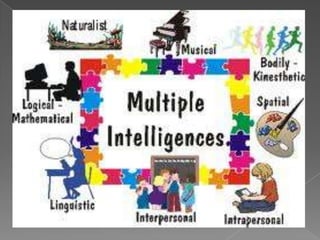


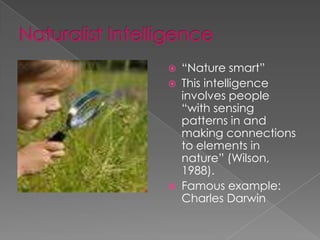


The document summarizes Howard Gardner's theory of multiple intelligences, which posits that intelligence exists in several distinct forms rather than solely as a general mental capacity. It outlines the eight intelligences - linguistic, logical-mathematical, spatial, bodily-kinesthetic, musical, interpersonal, intrapersonal, and naturalist. While the intelligences operate independently, Gardner believes they typically work together to help individuals develop skills and solve problems. The document stresses the importance of teachers understanding and applying lessons to students' varying intelligences.

![Multiple intelligence power point[1]](https://cdn.slidesharecdn.com/ss_thumbnails/multipleintelligencepowerpoint1-111102072020-phpapp02-thumbnail.jpg?width=640&height=640&fit=bounds)

![Multiple intelligence power point[1]](https://cdn.slidesharecdn.com/ss_thumbnails/multipleintelligencepowerpoint1-111102073847-phpapp01-thumbnail.jpg?width=640&height=640&fit=bounds)


