Behaviourism, Cognitivism and
Constructivism: Teaching & Learning
Paradigm
Dr. Yasser Tawfik Associate Professor of Marketing
Dr. Mohamed El Deeb Associate Professor of Accounting
Dr. Emad Elwy Associate Professor of Business Administration
Introduction
In education There are two different types of theories :
What is Learning?
Helps to answer
a prominent question
Descriptive theory Prescriptive theory
What is Learning?
Helps to answer
a prominent question
which attempts to
describe what is
learning?
Descriptive theory
which answers the
question of how
do we help people?
Prescriptive theory
learning theories
which give us methods of
how to foster learning.
Outcome Outcome
Outcome
Introduction Cont’d
Learning Theories
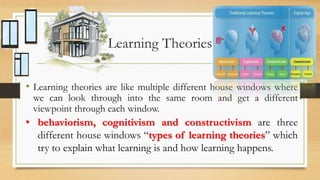
• Learning theories are like multiple different house windows where
we can look through into the same room and get a different
viewpoint through each window.
• behaviorism, cognitivism and constructivism are three
different house windows “types of learning theories” which
try to explain what learning is and how learning happens.
Behaviorism cognitivism constructivism
Quick behavior
change
More Autonomous
Students like being a part of
decision making process.
Learner Adapts Develop cognitive abilities Higher level of thinking occurs
Measurable behavior
change
Develops students potentials Students like hands-on activities.
Interested in Information processing.
Students feel a sense of
ownership.
Concerned with mental processes and relies on
experiments as its main research method.
Focusing on the learning process, that creates a
pedagogical orientation towards active learning.
Pro’s
Con’s
Behaviorism cognitivism constructivism
Internalized
reasoning/understanding.
Questions how one can reach
beyond internal
representations into the reality.
Belief that learning is based on students
ability to discover new knowledge.
Learner can adapt to a
negative
Ignores creative thinking and
consciousness.
teachers may not take responsibility for
poor learning.
Passive learners
May lead students to take a majority rules
attitude rather than an individual
approach to decision making.
Measured behavior change
may not be an indicator of
understanding
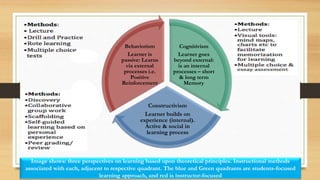
Cognitivism
Learner goes
beyond external:
is an internal
processes – short
& long term
Memory
Constructivism
Learner builds on
experience (internal).
Active & social in
learning process
Behaviorism
Learner is
passive: Learns
via external
processes i.e.
Positive
Reinforcement
Image shows: three perspectives on learning based upon theoretical principles. Instructional methods
associated with each, adjacent to respective quadrant. The blue and Green quadrants are students-focused
learning approach, and red is instructor-focused
References
• Abramson, L.Y., Seligman, M.E.P. & Teasdale, J.D. (1978). Learned helplessness in
humans: Critique and reformulation. Journal of Abnormal Psychology, 87, 49-74.
• Ajzen, I. (1991). The theory of planned behavior. Organizational Behavior and Human
Decision Processes, 50, 179-211.
• Ajzen, I. (2002). Perceived Behavioral Control, Self-Efficacy, Locus of Control, and
the Theory of Planned Behavior. Journal of Applied Social Psychology, 32, 665-683.
• Pritchard, Allan. and Woollard, J., (2013). Psychology for the classroom: The social
context. Routledge.
Behaviourism, Cognitivism and Constructivism:
Teaching & Learning Paradigm Summary

Behaviourism, Cognitivism and Constructivism: Teaching & Learning Paradigm

  • 1.
    Behaviourism, Cognitivism and Constructivism:Teaching & Learning Paradigm Dr. Yasser Tawfik Associate Professor of Marketing Dr. Mohamed El Deeb Associate Professor of Accounting Dr. Emad Elwy Associate Professor of Business Administration
  • 2.
    Introduction In education Thereare two different types of theories : What is Learning? Helps to answer a prominent question Descriptive theory Prescriptive theory
  • 3.
    What is Learning? Helpsto answer a prominent question which attempts to describe what is learning? Descriptive theory which answers the question of how do we help people? Prescriptive theory learning theories which give us methods of how to foster learning. Outcome Outcome Outcome Introduction Cont’d
  • 4.
    Learning Theories • Learningtheories are like multiple different house windows where we can look through into the same room and get a different viewpoint through each window. • behaviorism, cognitivism and constructivism are three different house windows “types of learning theories” which try to explain what learning is and how learning happens.
  • 8.
    Behaviorism cognitivism constructivism Quickbehavior change More Autonomous Students like being a part of decision making process. Learner Adapts Develop cognitive abilities Higher level of thinking occurs Measurable behavior change Develops students potentials Students like hands-on activities. Interested in Information processing. Students feel a sense of ownership. Concerned with mental processes and relies on experiments as its main research method. Focusing on the learning process, that creates a pedagogical orientation towards active learning. Pro’s
  • 9.
    Con’s Behaviorism cognitivism constructivism Internalized reasoning/understanding. Questionshow one can reach beyond internal representations into the reality. Belief that learning is based on students ability to discover new knowledge. Learner can adapt to a negative Ignores creative thinking and consciousness. teachers may not take responsibility for poor learning. Passive learners May lead students to take a majority rules attitude rather than an individual approach to decision making. Measured behavior change may not be an indicator of understanding
  • 10.
    Cognitivism Learner goes beyond external: isan internal processes – short & long term Memory Constructivism Learner builds on experience (internal). Active & social in learning process Behaviorism Learner is passive: Learns via external processes i.e. Positive Reinforcement Image shows: three perspectives on learning based upon theoretical principles. Instructional methods associated with each, adjacent to respective quadrant. The blue and Green quadrants are students-focused learning approach, and red is instructor-focused
  • 11.
    References • Abramson, L.Y.,Seligman, M.E.P. & Teasdale, J.D. (1978). Learned helplessness in humans: Critique and reformulation. Journal of Abnormal Psychology, 87, 49-74. • Ajzen, I. (1991). The theory of planned behavior. Organizational Behavior and Human Decision Processes, 50, 179-211. • Ajzen, I. (2002). Perceived Behavioral Control, Self-Efficacy, Locus of Control, and the Theory of Planned Behavior. Journal of Applied Social Psychology, 32, 665-683. • Pritchard, Allan. and Woollard, J., (2013). Psychology for the classroom: The social context. Routledge.
  • 12.
    Behaviourism, Cognitivism andConstructivism: Teaching & Learning Paradigm Summary

Editor's Notes

  • #2 Behaviourism, cognitivism and constructivism A Teaching & Learning Paradigm Dr. Yasser Tawfik Associate Professor of Marketing Dr. Mohamed El Deeb Associate Professor of Accounting Dr. Emad Elwy Associate Professor of Business Administration