Howard Gardner
Multiple Intelligence Theory expands our definition of intelligence. There are seven original domains of learning or intelligences.  There has been other intelligences mentioned since the original.
The MI Theory is a set of abilities, talents, or mental skills. All humans have some of each intelligence to some extent.
Each persons intelligences are a unique combination. The domains of learning or intelligences range from a more traditional type of intelligence to a more forward thinking intelligences.
The Original Seven Intelligences Logic – Mathematical Intelligence Linguistic  Intelligence Musical Intelligence Spatial Intelligence Bodily – Kinesthetic Intelligence Interpersonal Intelligence Intrapersonal Intelligence Naturalist Intelligence
Pros All students will be seen as successful. All different talents of students will be appreciated.  A variety of instructional practices are used. Lessons are planned with more thought. Meets individual needs better.  Cons More time is needed for lessons. Assessing students' learning could be cumbersome. Uniting a staff would be difficult. More supplies would be needed.
While each student has some of each intelligence, they will not excel at each. It is important to make sure that each intelligence is being taught.
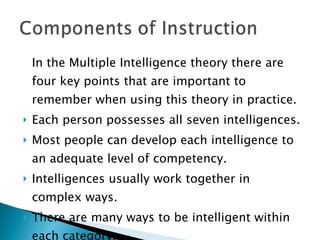
In the Multiple Intelligence theory there are four key points that are important to remember when using this theory in practice. Each person possesses all seven intelligences. Most people can develop each intelligence to an adequate level of competency. Intelligences usually work together in complex ways. There are many ways to be intelligent within each category.
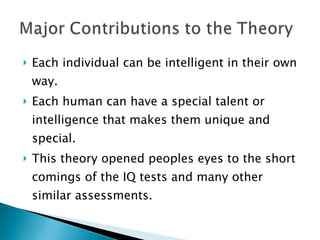
Each individual can be intelligent in their own way.  Each human can have a special talent or intelligence that makes them unique and special.  This theory opened peoples eyes to the short comings of the IQ tests and many other similar assessments.
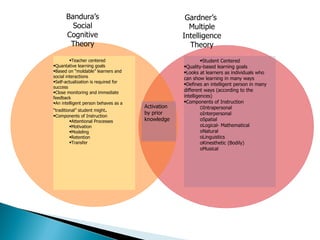
Gardner’s  Multiple Intelligence Theory Bandura’s Social Cognitive   Theory Teacher centered Quantative learning goals Based on “moldable” learners and social interactions Self-actualization is required for success Close monitoring and immediate feedback An intelligent person behaves as a “traditional” student might . Components of Instruction Attentional Processes Motivation Modeling Retention Transfer Student Centered Quality-based learning goals Looks at learners as individuals who can show learning in many ways Defines an intelligent person in many different ways (according to the intelligences) Components of Instruction O Intrapersonal oInterpersonal oSpatial oLogical- Mathematical oNatural oLinguistics oKinesthetic (Bodily) oMusical Activation by prior knowledge
Gardner, Howard (2006,).  Multiple  Intelligences: The Theory in Practice.  http://books.google.com/books?id=qEEC8lyAwWoC&printsec=frontcov er&dq=multiple+intelligence+theory&hl=en&ei=RVaCTrjrLYPMgQeGtsw 6&sa=X&oi=book_result&ct=result&resnum=2&ved=0CDIQ6AEwAQ#v =onepage&q=multiple%20intelligence%20theory&f=false   Armstrong, Thomas  (1994).  Multiple  Intelligence In the Classroom

Multiple intelligence power point[1]

  • 1.
  • 2.
    Multiple Intelligence Theoryexpands our definition of intelligence. There are seven original domains of learning or intelligences. There has been other intelligences mentioned since the original.
  • 3.
    The MI Theoryis a set of abilities, talents, or mental skills. All humans have some of each intelligence to some extent.
  • 4.
    Each persons intelligencesare a unique combination. The domains of learning or intelligences range from a more traditional type of intelligence to a more forward thinking intelligences.
  • 5.
    The Original SevenIntelligences Logic – Mathematical Intelligence Linguistic Intelligence Musical Intelligence Spatial Intelligence Bodily – Kinesthetic Intelligence Interpersonal Intelligence Intrapersonal Intelligence Naturalist Intelligence
  • 6.
    Pros All studentswill be seen as successful. All different talents of students will be appreciated. A variety of instructional practices are used. Lessons are planned with more thought. Meets individual needs better. Cons More time is needed for lessons. Assessing students' learning could be cumbersome. Uniting a staff would be difficult. More supplies would be needed.
  • 7.
    While each studenthas some of each intelligence, they will not excel at each. It is important to make sure that each intelligence is being taught.
  • 8.
    In the MultipleIntelligence theory there are four key points that are important to remember when using this theory in practice. Each person possesses all seven intelligences. Most people can develop each intelligence to an adequate level of competency. Intelligences usually work together in complex ways. There are many ways to be intelligent within each category.
  • 9.
    Each individual canbe intelligent in their own way. Each human can have a special talent or intelligence that makes them unique and special. This theory opened peoples eyes to the short comings of the IQ tests and many other similar assessments.
  • 10.
    Gardner’s MultipleIntelligence Theory Bandura’s Social Cognitive Theory Teacher centered Quantative learning goals Based on “moldable” learners and social interactions Self-actualization is required for success Close monitoring and immediate feedback An intelligent person behaves as a “traditional” student might . Components of Instruction Attentional Processes Motivation Modeling Retention Transfer Student Centered Quality-based learning goals Looks at learners as individuals who can show learning in many ways Defines an intelligent person in many different ways (according to the intelligences) Components of Instruction O Intrapersonal oInterpersonal oSpatial oLogical- Mathematical oNatural oLinguistics oKinesthetic (Bodily) oMusical Activation by prior knowledge
  • 11.
    Gardner, Howard (2006,). Multiple Intelligences: The Theory in Practice. http://books.google.com/books?id=qEEC8lyAwWoC&printsec=frontcov er&dq=multiple+intelligence+theory&hl=en&ei=RVaCTrjrLYPMgQeGtsw 6&sa=X&oi=book_result&ct=result&resnum=2&ved=0CDIQ6AEwAQ#v =onepage&q=multiple%20intelligence%20theory&f=false   Armstrong, Thomas (1994). Multiple Intelligence In the Classroom