MULTIPLE
INTELLIGENCES
LEARNING THEORIES RESEARCH
PREPARED BY KALESSY TWIGLEY AND JULIE HARRISON
MULTIPLE INTELLIGENCES:
KEY FACTS
• Developed in 1983 by Howard Gardner, a psychologist
and professor of neuroscience at Harvard.
• Gardner’s alternative theory suggests that there are that
reflect different ways of interacting with the world. 9
different forms of intelligence.
• Each person has a unique combination of these 9
intelligences.
Gardner's theory provides a much needed
corrective to the shortcomings of traditional
psychometric approaches. Instead of probing
the bases of bubble-sheet results, Gardner sought
to illuminate the mental abilities underlying the actual
range of human accomplishment that are found across cultures.
—Mindy Kornhaber
Gardner’s theory challenged the traditional understanding of
one form of intelligence that can be measured via an IQ test.
Image source
Source
SO, FOR EXAMPLE …
• A person who is strong musically and weak numerically
will be more likely to develop numerical and logical
skills through music, and not by being bombarded by
numbers alone.
• A person who is weak spatially and strong numerically,
will be more likely to develop spatial ability if it is
explained and developed by using numbers and logic,
and not by asking them to pack a suitcase in front of an
audience.
• A person who is weak bodily and physically and strong
numerically might best be encouraged to increase their
physical activity by encouraging them to learn about
the mathematical and scientific relationships between
exercise, diet and health, rather than forcing them to
box or play rugby.
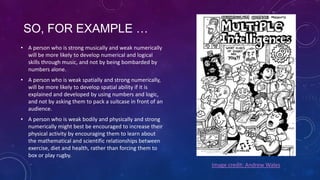
Image credit: Andrew Wales
IMPACT ON THE CLASSROOM
Multiple Intelligences challenges:
• Traditional teaching styles focused on textbooks and lectures
• Traditional curriculum used in schools
• Traditional assessment and evaluation techniques
SELF-CHECK GUIDELINES
• Give options for learners to acquire mastery of material;
• Provide problem-solving opportunities;
• Create “What if?” situations;
• Approach the topic in an orderly and creative fashion;
• Set up situations that require hunches about outcomes
• Set up field-based experiences that go beyond the text or lectures;
• Emphasize the broad nature of the topic;
• Ask learners to explore relationships within or among topics;
• Ask learners to analyze material or information;
• Introduce topics with situations recognized by the learners;
• Use problem-solving group work;
• Help learners to see patterns;
• Provide cultural as well as scientific experiences;
• Offer leadership opportunities.
These “self-check” guidelines are
taken directly from The Journal of
College Science Teaching and can
can be used to ensure that your
teaching addresses a variety of
learning styles and intelligences.
CRITICS OF MULTIPLE INTELLIGENCES
Critics of the Multiple Intelligences theory state that:
• There is not enough empirical evidence for this
theory
• Some “intelligences” are not related to cognitive
skill but rather personal interests
• Not every child is secretly a genius Unfortunately, some children and adults
are just unintelligent. It's not fair, it's not
politically correct, but reality is under no
obligation to be either of those.
-- Christopher J. Ferguson (source)
SOURCES FOR MORE INFORMATION
• A 1997 video interview with Garder. Topics include the need for change in classroom curriculum and
assessment.
• Learning Styles and Multiple Intelligences in Students. The Journal of College Science Teaching.
Retrieved March 2014. http://www.nsta.org/publications/news/story.aspx?id=40969
• Harvard Project Zero (http://pzweb.harvard.edu/). An educational research group at the Harvard
Graduate School of Education, led by Howard Gardner and his colleagues.
• Concept to Classroom: Tapping Into Multiple Intelligences
http://www.thirteen.org/edonline/concept2class/month1/index.html
A free, self-paced teacher workshops, "Tapping Into Multiple Intelligences" offers useful background
information, examples, tips, and strategies related to integrating MI into classroom practice.

Learning theories multiple intelligences

  • 1.
  • 2.
    MULTIPLE INTELLIGENCES: KEY FACTS •Developed in 1983 by Howard Gardner, a psychologist and professor of neuroscience at Harvard. • Gardner’s alternative theory suggests that there are that reflect different ways of interacting with the world. 9 different forms of intelligence. • Each person has a unique combination of these 9 intelligences.
  • 3.
    Gardner's theory providesa much needed corrective to the shortcomings of traditional psychometric approaches. Instead of probing the bases of bubble-sheet results, Gardner sought to illuminate the mental abilities underlying the actual range of human accomplishment that are found across cultures. —Mindy Kornhaber
  • 4.
    Gardner’s theory challengedthe traditional understanding of one form of intelligence that can be measured via an IQ test. Image source
  • 5.
  • 6.
    SO, FOR EXAMPLE… • A person who is strong musically and weak numerically will be more likely to develop numerical and logical skills through music, and not by being bombarded by numbers alone. • A person who is weak spatially and strong numerically, will be more likely to develop spatial ability if it is explained and developed by using numbers and logic, and not by asking them to pack a suitcase in front of an audience. • A person who is weak bodily and physically and strong numerically might best be encouraged to increase their physical activity by encouraging them to learn about the mathematical and scientific relationships between exercise, diet and health, rather than forcing them to box or play rugby. Image credit: Andrew Wales
  • 7.
    IMPACT ON THECLASSROOM Multiple Intelligences challenges: • Traditional teaching styles focused on textbooks and lectures • Traditional curriculum used in schools • Traditional assessment and evaluation techniques
  • 8.
    SELF-CHECK GUIDELINES • Giveoptions for learners to acquire mastery of material; • Provide problem-solving opportunities; • Create “What if?” situations; • Approach the topic in an orderly and creative fashion; • Set up situations that require hunches about outcomes • Set up field-based experiences that go beyond the text or lectures; • Emphasize the broad nature of the topic; • Ask learners to explore relationships within or among topics; • Ask learners to analyze material or information; • Introduce topics with situations recognized by the learners; • Use problem-solving group work; • Help learners to see patterns; • Provide cultural as well as scientific experiences; • Offer leadership opportunities. These “self-check” guidelines are taken directly from The Journal of College Science Teaching and can can be used to ensure that your teaching addresses a variety of learning styles and intelligences.
  • 9.
    CRITICS OF MULTIPLEINTELLIGENCES Critics of the Multiple Intelligences theory state that: • There is not enough empirical evidence for this theory • Some “intelligences” are not related to cognitive skill but rather personal interests • Not every child is secretly a genius Unfortunately, some children and adults are just unintelligent. It's not fair, it's not politically correct, but reality is under no obligation to be either of those. -- Christopher J. Ferguson (source)
  • 10.
    SOURCES FOR MOREINFORMATION • A 1997 video interview with Garder. Topics include the need for change in classroom curriculum and assessment. • Learning Styles and Multiple Intelligences in Students. The Journal of College Science Teaching. Retrieved March 2014. http://www.nsta.org/publications/news/story.aspx?id=40969 • Harvard Project Zero (http://pzweb.harvard.edu/). An educational research group at the Harvard Graduate School of Education, led by Howard Gardner and his colleagues. • Concept to Classroom: Tapping Into Multiple Intelligences http://www.thirteen.org/edonline/concept2class/month1/index.html A free, self-paced teacher workshops, "Tapping Into Multiple Intelligences" offers useful background information, examples, tips, and strategies related to integrating MI into classroom practice.