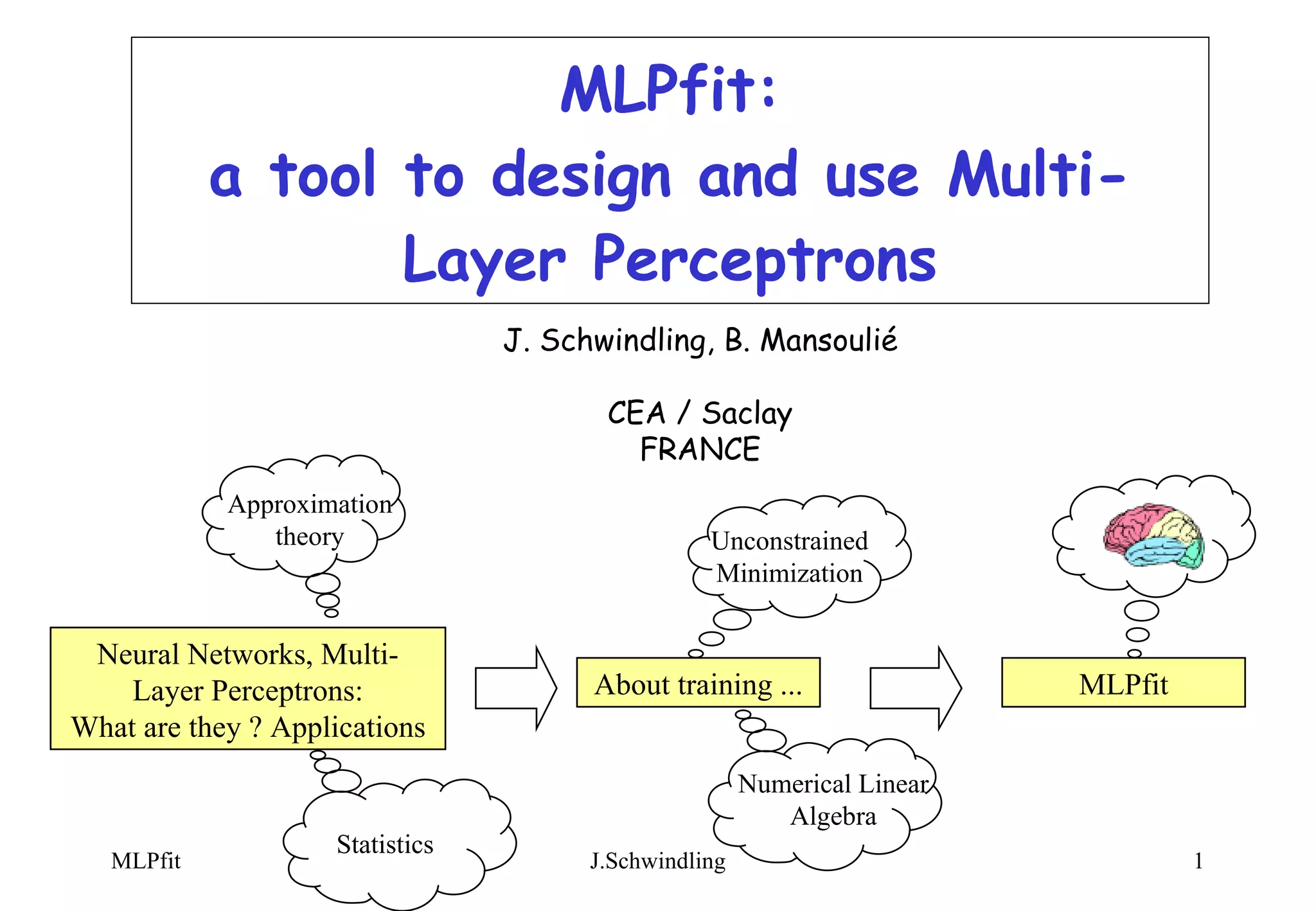
MLPfit: a tool to design and use Multi-Layer Perceptrons J. Schwindling, B. Mansoulié CEA / Saclay FRANCE Neural Networks, Multi-Layer Perceptrons: What are they ? Applications Approximation theory Unconstrained Minimization About training ... MLPfit Numerical Linear Algebra Statistics
(Artificial) Neural Networks Appeared in the 40 ’s Now (since Personal Computers) very widely used, in various domains: in  medecine  (image analysis, help to diagnosis) in  meteorology  (predictions) in  industry  (automatic process control, quality checks by image processing, optimization of ressources allocation) (see for example  IEEE Transactions on Neural Networks )
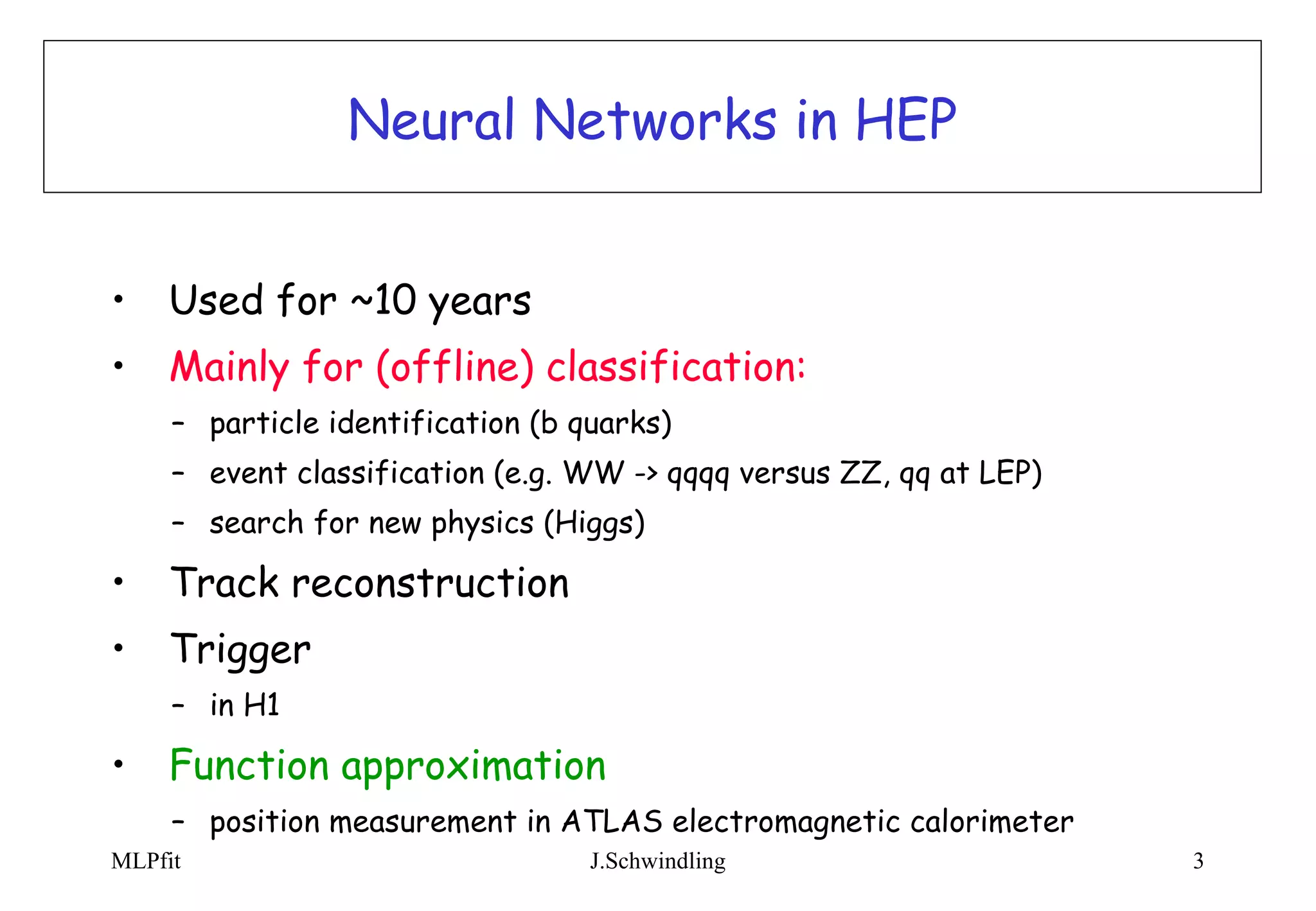
Neural Networks in HEP Used for ~10 years Mainly for (offline) classification: particle identification (b quarks) event classification (e.g. WW -> qqqq versus ZZ, qq at LEP) search for new physics (Higgs) Track reconstruction Trigger  in H1 Function approximation position measurement in ATLAS electromagnetic calorimeter
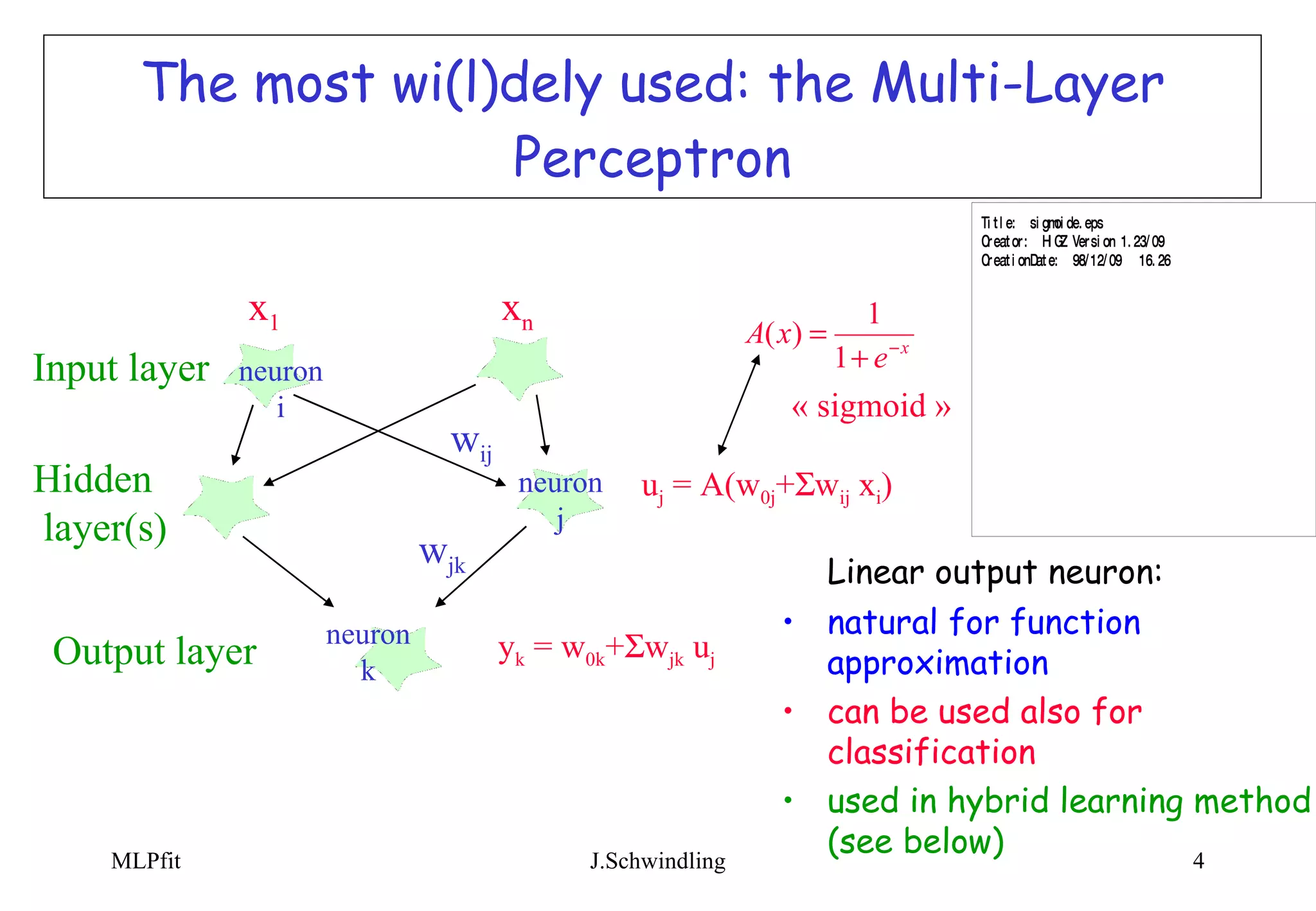
The most wi(l)dely used: the Multi-Layer Perceptron Linear output neuron: natural for function approximation can be used also for classification used in hybrid learning method (see below) Input layer Hidden layer(s) Output layer « sigmoid »  w ij neuron i neuron j x 1 x n w jk y k  = w 0k +  w jk  u j u j  = A(w 0j +  w ij  x i ) neuron k
2 theorems any continuous function (1 variable or more) on a compact set can be approximated to any accuracy by a linear combination of sigmoïds -> function approximation [ for example: K.Hornik et al.  Multilayer Feedforward Networks are Universal  Approximators , Neural Networks, Vol. 2, pp 359-366 (1989) ] trained with f(x) = 1 for signal and = 0 for background, the NN function approximates the probability of signal knowing x -> classification  (cf Neyman-Pearson test) [for example: D.W.Ruck et al.  The Multilayer Perceptron as an Approximation to a  Bayes Optimal Discriminant Function , IEEE Transactions on Neural Networks, Vol. 1,  n r  4, pp 296-298 (1990) ]
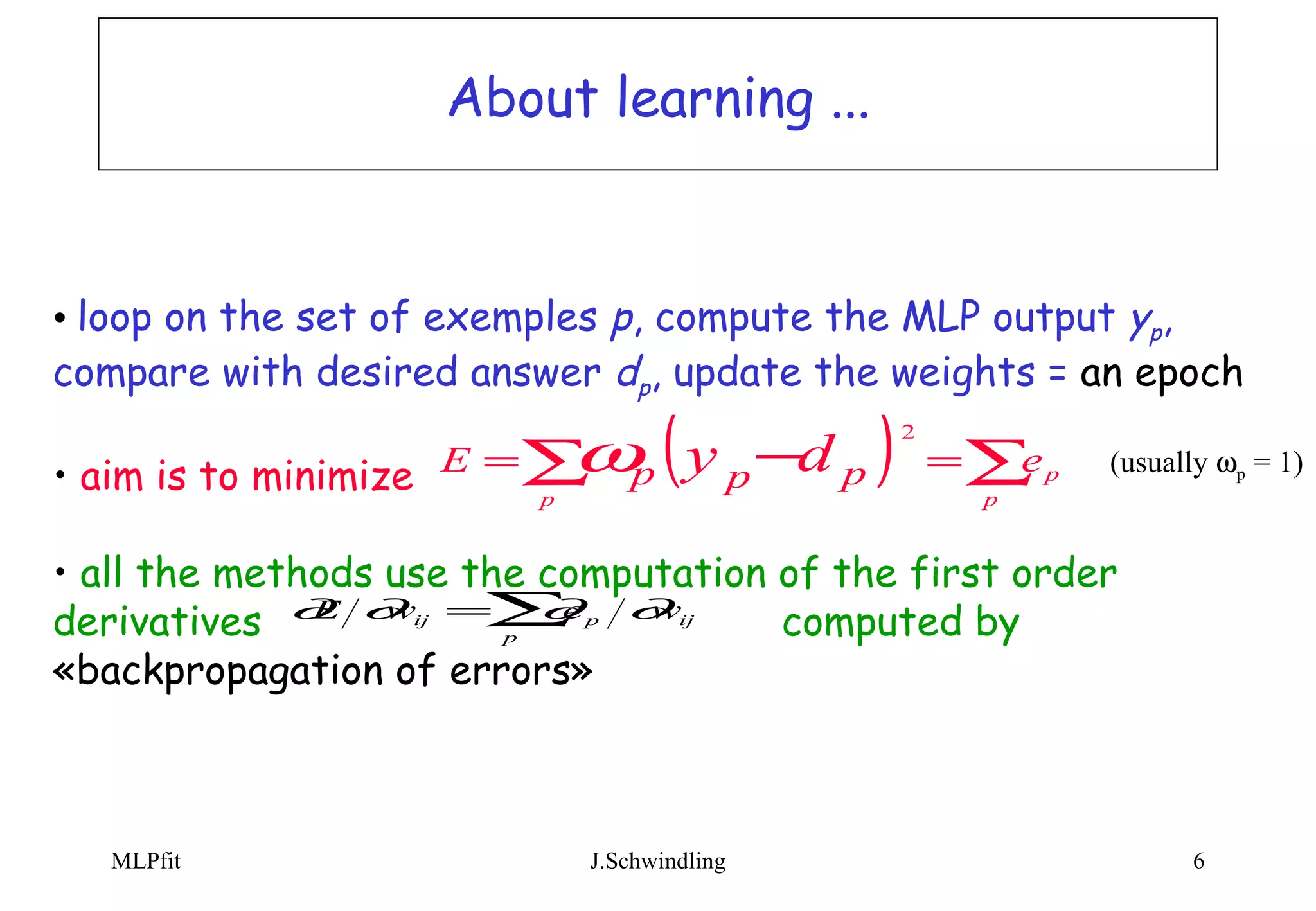
About learning ... loop on the set of exemples  p , compute the MLP output  y p , compare with desired answer  d p , update the weights =  an epoch aim is to minimize all the methods use the computation of the first order derivatives  computed by  «backpropagation of errors»   (usually   p  = 1)
Remark: derivative of sigmoid function Needed for gradient computation Most people use y (1-y)  (no need to recompute e x ) However, precision problems when y ~ 1.  More accurate formula is  y / (1+e x ) (exemple on a toy problem) y = 1 / (1+e -x )
Learning methods Stochastic minimization Linear model fixed steps [variable steps] Remarks:  - derivatives known - other methods exist Global minimization Non-Linear weights  All weights Linear model steepest descent with fixed steps or line search Quadratic model (Newton like) Conjugate gradients or BFGS with line search Solve LLS
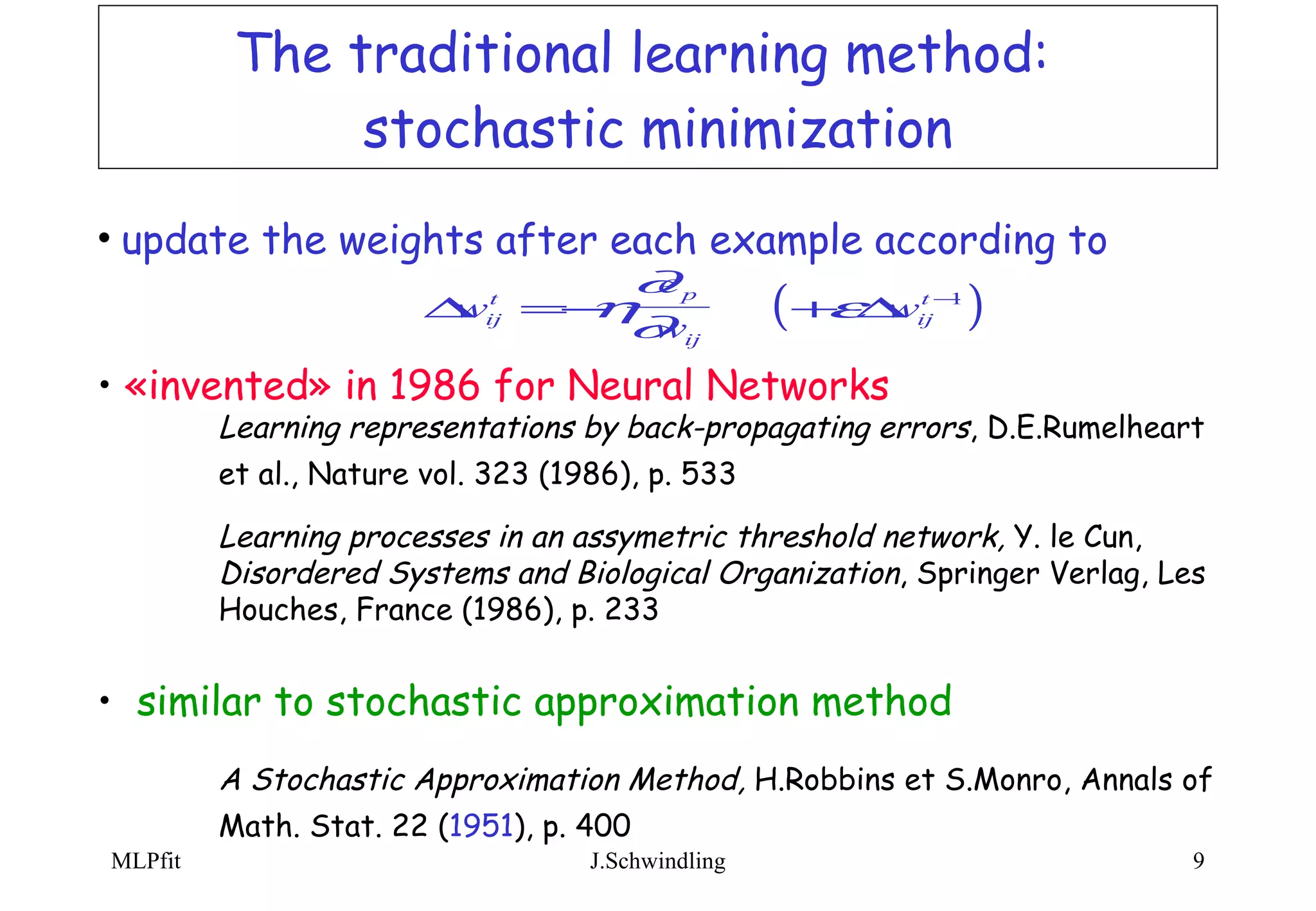
The traditional learning method:  stochastic minimization update the weights after each example according to  «invented» in 1986 for Neural Networks Learning representations by back-propagating errors , D.E.Rumelheart  et al., Nature vol. 323 (1986), p. 533   Learning processes in an assymetric threshold network,  Y. le Cun,  Disordered Systems and Biological Organization , Springer Verlag, Les  Houches, France (1986), p. 233 similar to stochastic approximation method A Stochastic Approximation Method,  H.Robbins et S.Monro, Annals of  Math. Stat. 22 ( 1951 ), p. 400
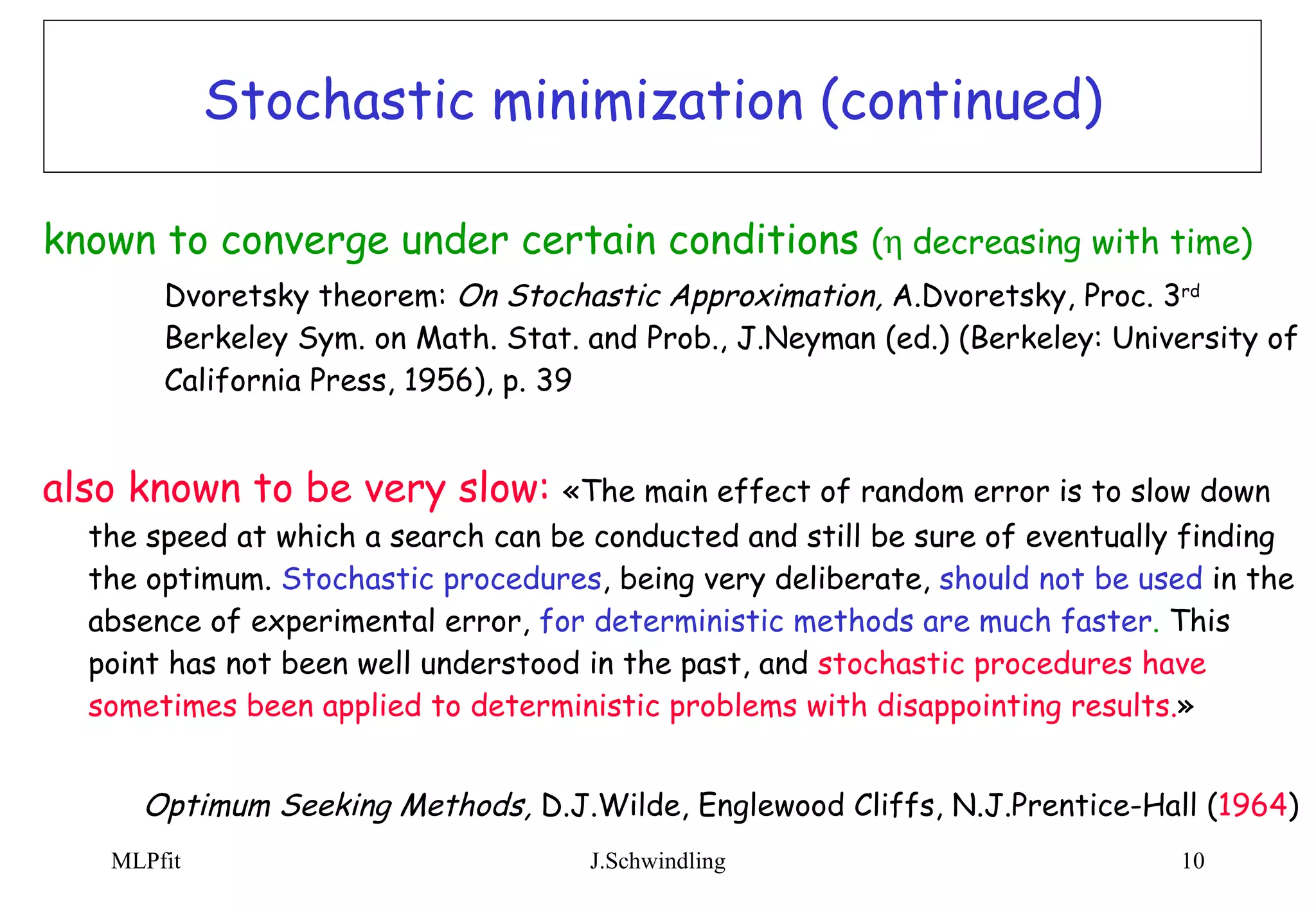
Stochastic minimization (continued) known to converge under certain conditions  (  decreasing with time)  Dvoretsky theorem:  On Stochastic Approximation,  A.Dvoretsky, Proc. 3 rd   Berkeley Sym. on Math. Stat. and Prob., J.Neyman (ed.) (Berkeley: University of  California Press, 1956), p. 39 also known to be very slow:   «The main effect of random error is to slow down the speed at which a search can be conducted and still be sure of eventually finding the optimum.   Stochastic procedures , being very deliberate,   should not be used   in the absence of experimental error,   for deterministic methods are much faster .  This point has not been well understood in the past, and   stochastic procedures have sometimes been applied to deterministic problems with disappointing results. » Optimum Seeking Methods,  D.J.Wilde, Englewood Cliffs, N.J.Prentice-Hall ( 1964 )
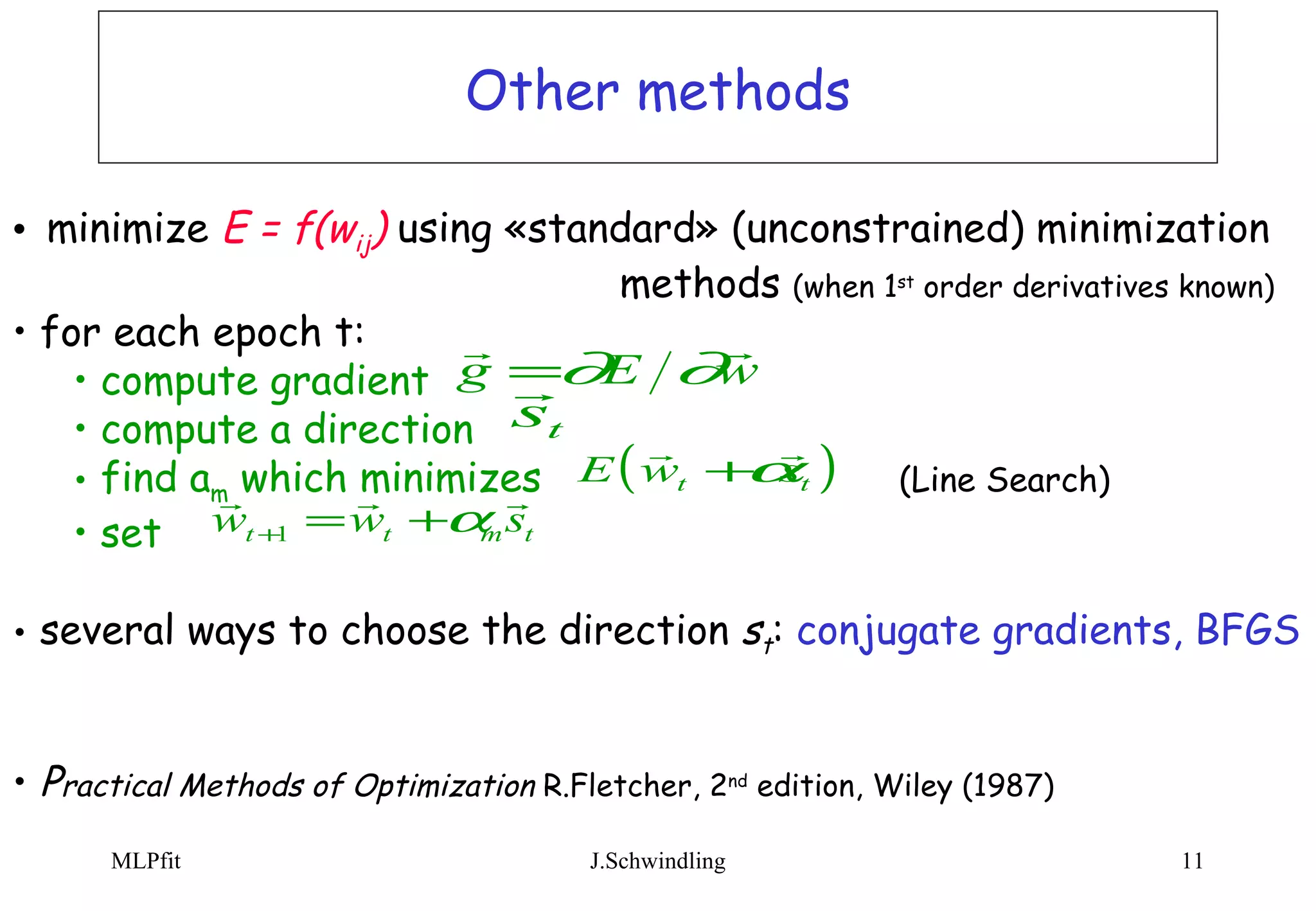
Other methods minimize  E = f(w ij )  using «standard» (unconstrained) minimization  methods   (when 1 st  order derivatives known) for each epoch t: compute gradient  compute a direction find a m  which minimizes    (Line Search) set several ways to choose the direction  s t :  conjugate gradients, BFGS  P ractical Methods of Optimization  R.Fletcher, 2 nd  edition, Wiley (1987)
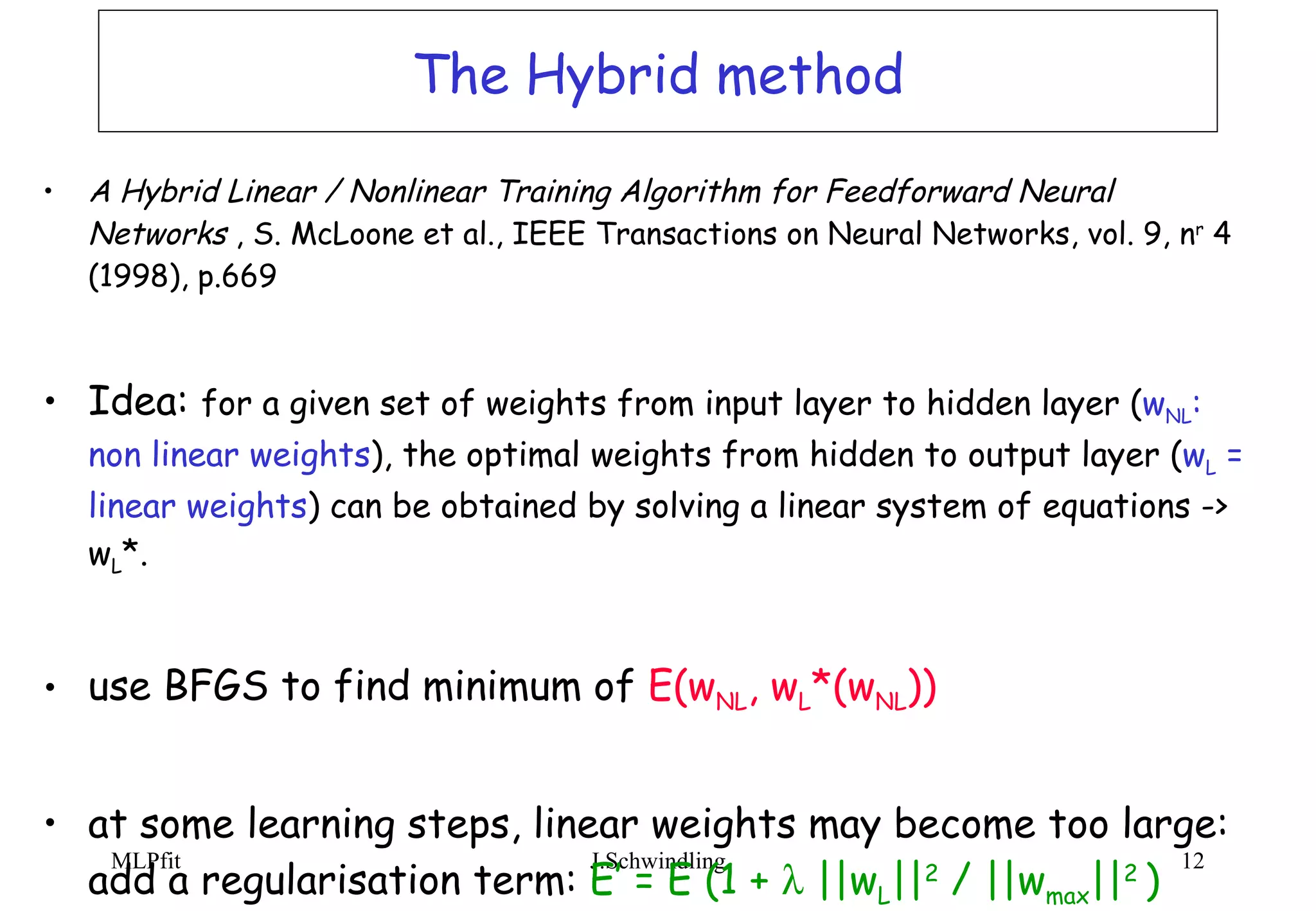
The Hybrid method A Hybrid Linear / Nonlinear Training Algorithm for Feedforward Neural  Networks  , S. McLoone et al., IEEE Transactions on Neural Networks, vol. 9, n r  4 (1998), p.669 Idea:  for a given set of weights from input layer to hidden layer ( w NL : non linear weights ), the optimal weights from hidden to output layer ( w L  = linear weights ) can be obtained by solving a linear system of equations -> w L *. use BFGS to find minimum of  E(w NL , w L *(w NL )) at some learning steps, linear weights may become too large:  add a regularisation term:  E’ = E (1 +    ||w L || 2  / ||w max || 2  )
Comparison on a toy problem fit the function  x 2  sin(5xy)  by a 2-10-1 MLP learning curves: (all curves = 2 minutes CPU)
Comparison on a real problem Position measurement in ATLAS electromagnetic calo. Performance is limited to the calorimeter intrinsic resolution However, in a finite time, BFGS or Hybrid methods lead to a resolution ~ 10 % better than stochastic minimisation but small
The MLPfit package designed to be used both for  function approximation and classification tasks implement  powerful minimization methods Based on the mathematical background:
Software process Simple : less than 3000 lines of (procedural) C in 3 files Precise : all computations in double precision, accurate derivative of sigmoid function Fast : tests of speed are being conducted (see below) Inexpensive : dynamic allocation of memory, examples in single precision (can be turned to double precision by changing one line) Easy to use : currently 4 ways to use it  (see below) Use the POP (1)  methodology to write a code:   (1) POP = Performance Oriented Programming
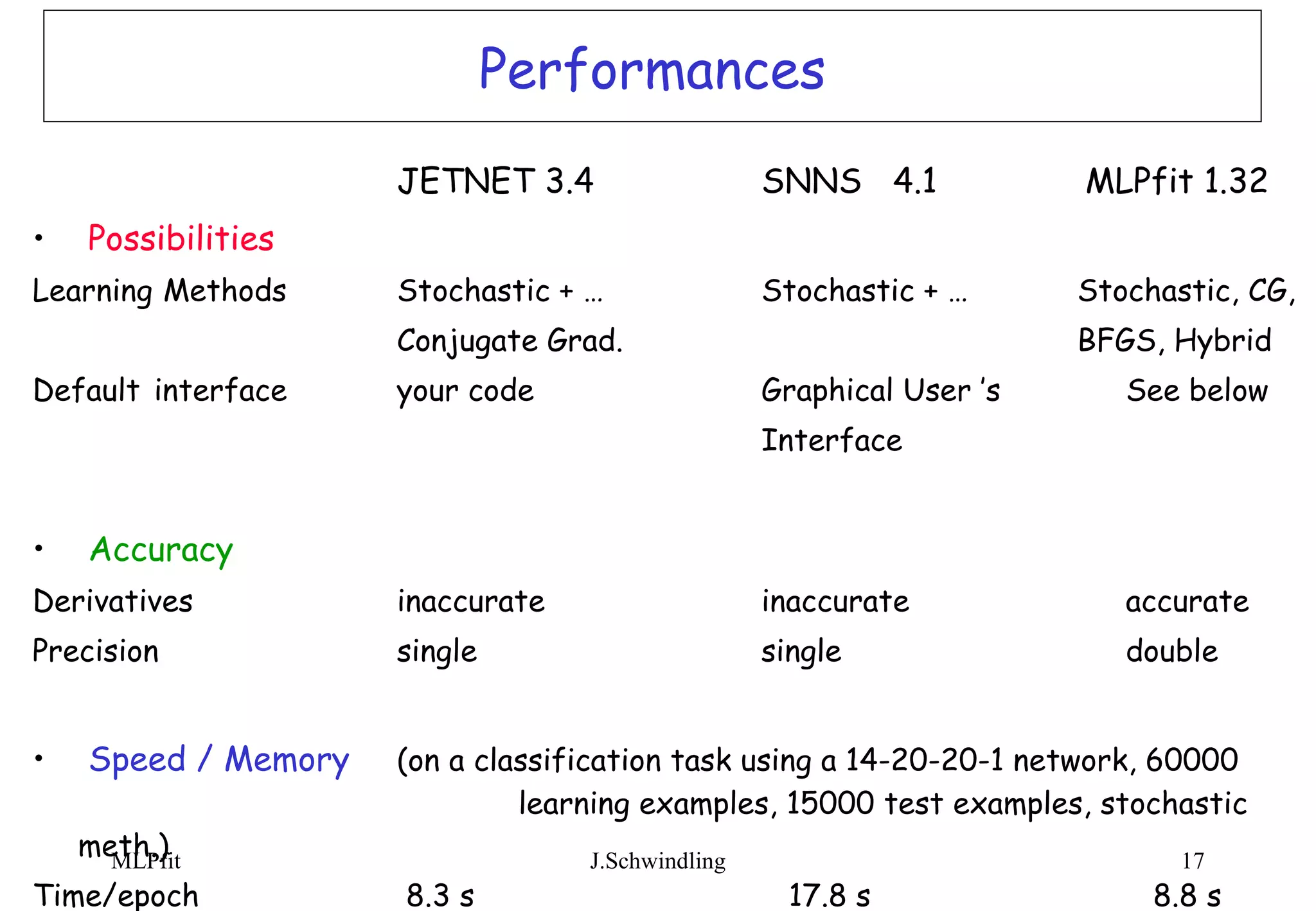
Performances JETNET 3.4 SNNS  4.1   MLPfit 1.32 Possibilities Learning  Methods Stochastic + … Stochastic + …   Stochastic, CG, Conjugate Grad.    BFGS, Hybrid Default interface your code Graphical User ’s See below Interface  Accuracy Derivatives  inaccurate inaccurate accurate Precision single single double Speed / Memory   (on a classification task using a 14-20-20-1 network, 60000  learning examples, 15000 test examples, stochastic meth.) Time/epoch    8.3 s   17.8 s     8.8 s Memory     8.7 Mb   11.6 Mb   10.1 Mb
Using MLPfit as a standalone package Reads ASCII files containing description of network, learning, running conditions examples (learn and test) [initial weights] Writes ASCII files containing output weights MLP (fortran or C) function Writes PAW file containing  learning curves (Tested on HP-UX and alphavax / OSF) MLP_gen.c MLP_main.c PAWLIB MLP_lapack.c
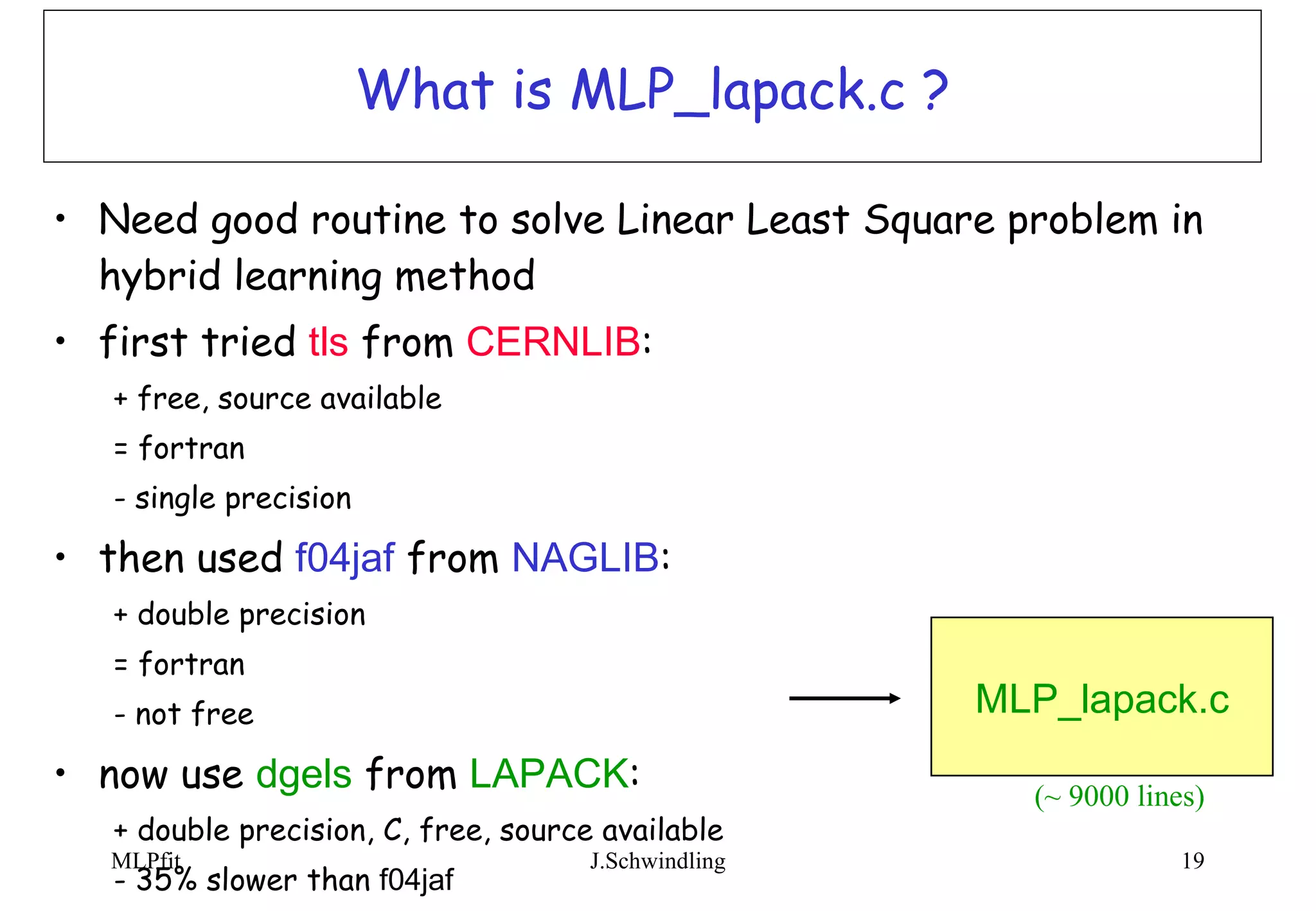
What is MLP_lapack.c ? Need good routine to solve Linear Least Square problem in hybrid learning method first tried  tls  from  CERNLIB : + free, source available = fortran - single precision then used  f04jaf  from  NAGLIB : + double precision = fortran - not free now use  dgels  from  LAPACK : + double precision, C, free, source available - 35% slower than  f04jaf  MLP_lapack.c (~ 9000 lines)
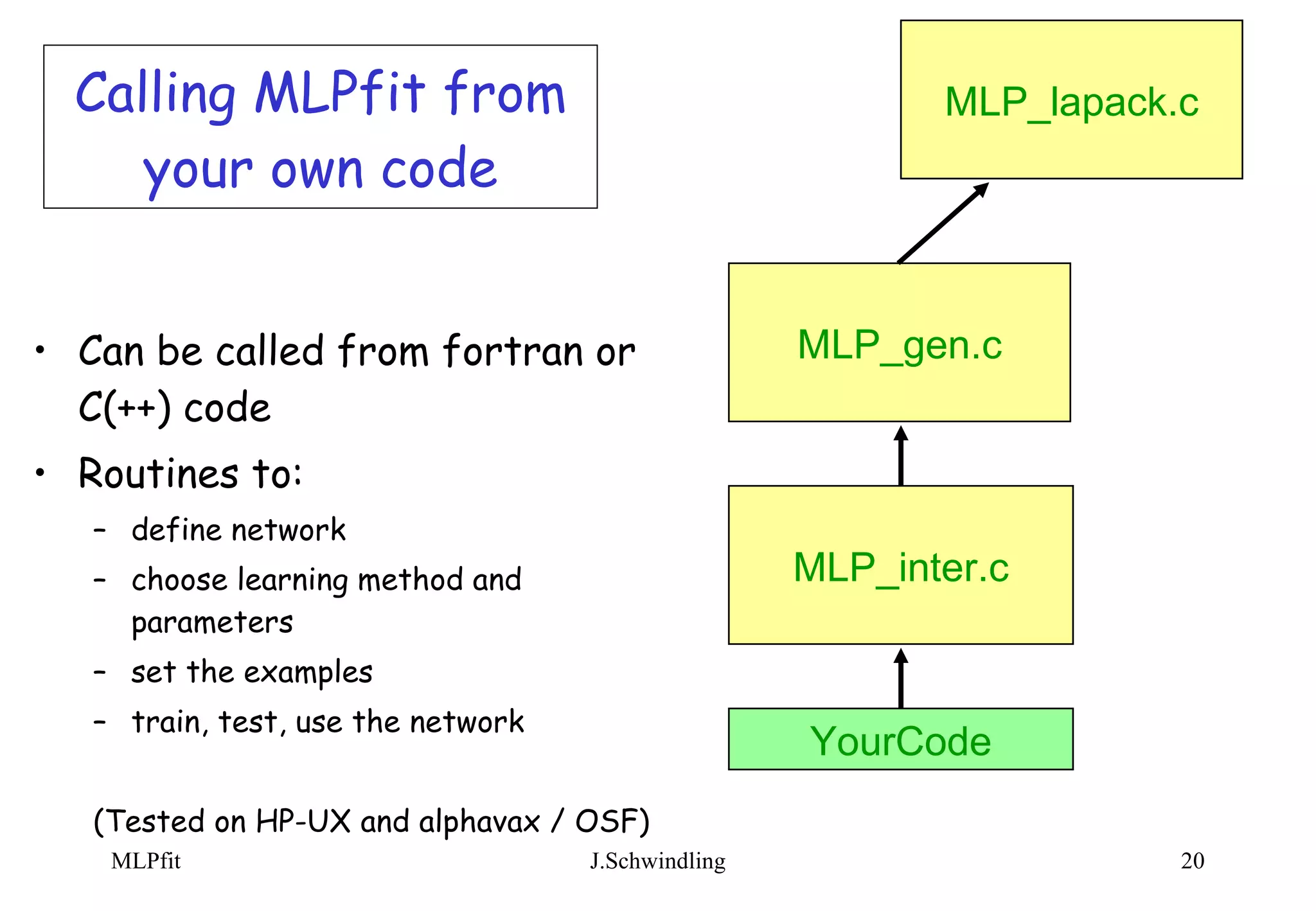
Calling MLPfit from your own code Can be called from fortran or C(++) code Routines to: define network choose learning method and parameters set the examples train, test, use the network (Tested on HP-UX and alphavax / OSF) MLP_gen.c MLP_inter.c YourCode MLP_lapack.c
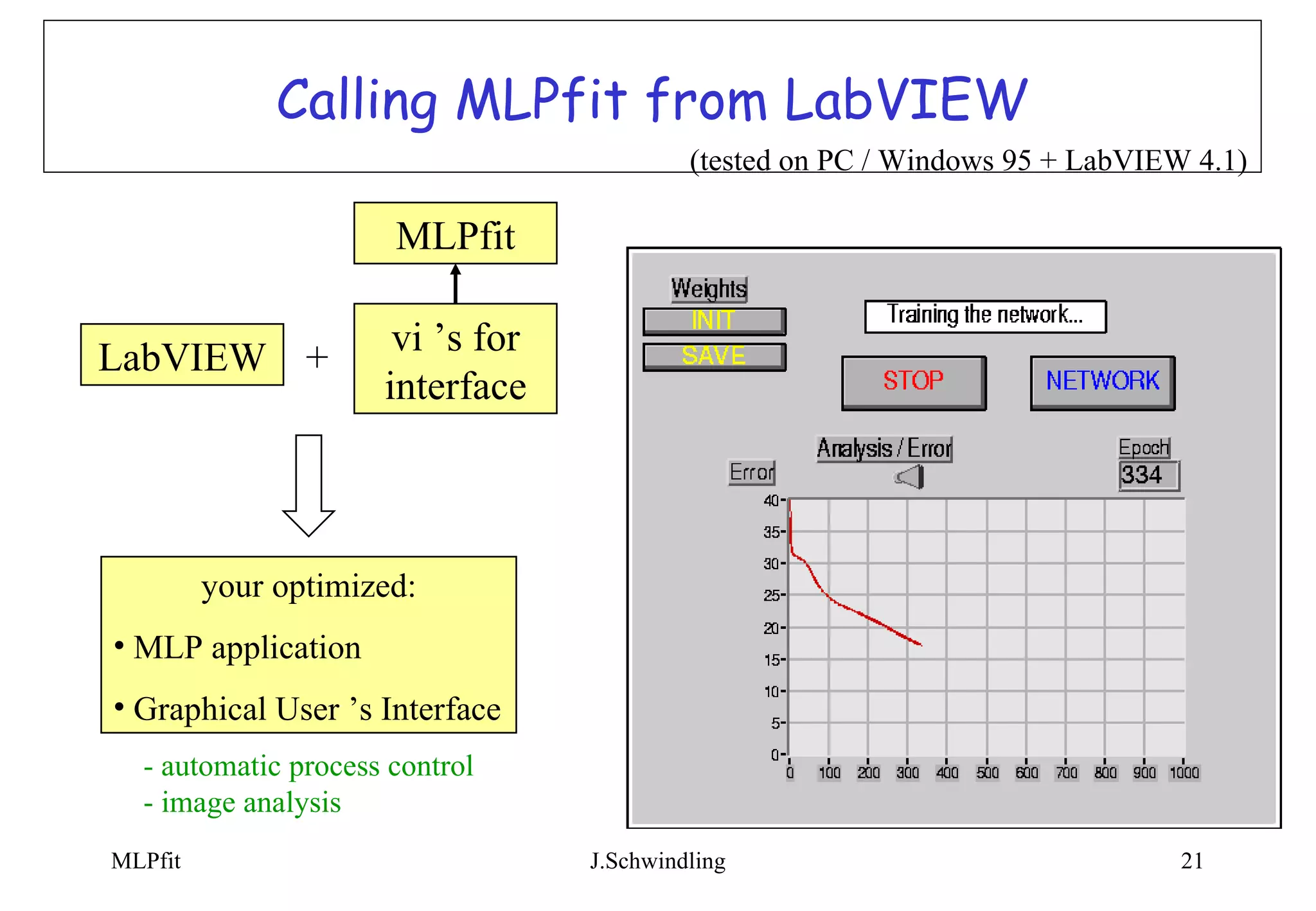
Calling MLPfit from LabVIEW LabVIEW MLPfit vi ’s for interface + your optimized: MLP application Graphical User ’s Interface - automatic process control - image analysis (tested on PC / Windows 95 + LabVIEW 4.1)
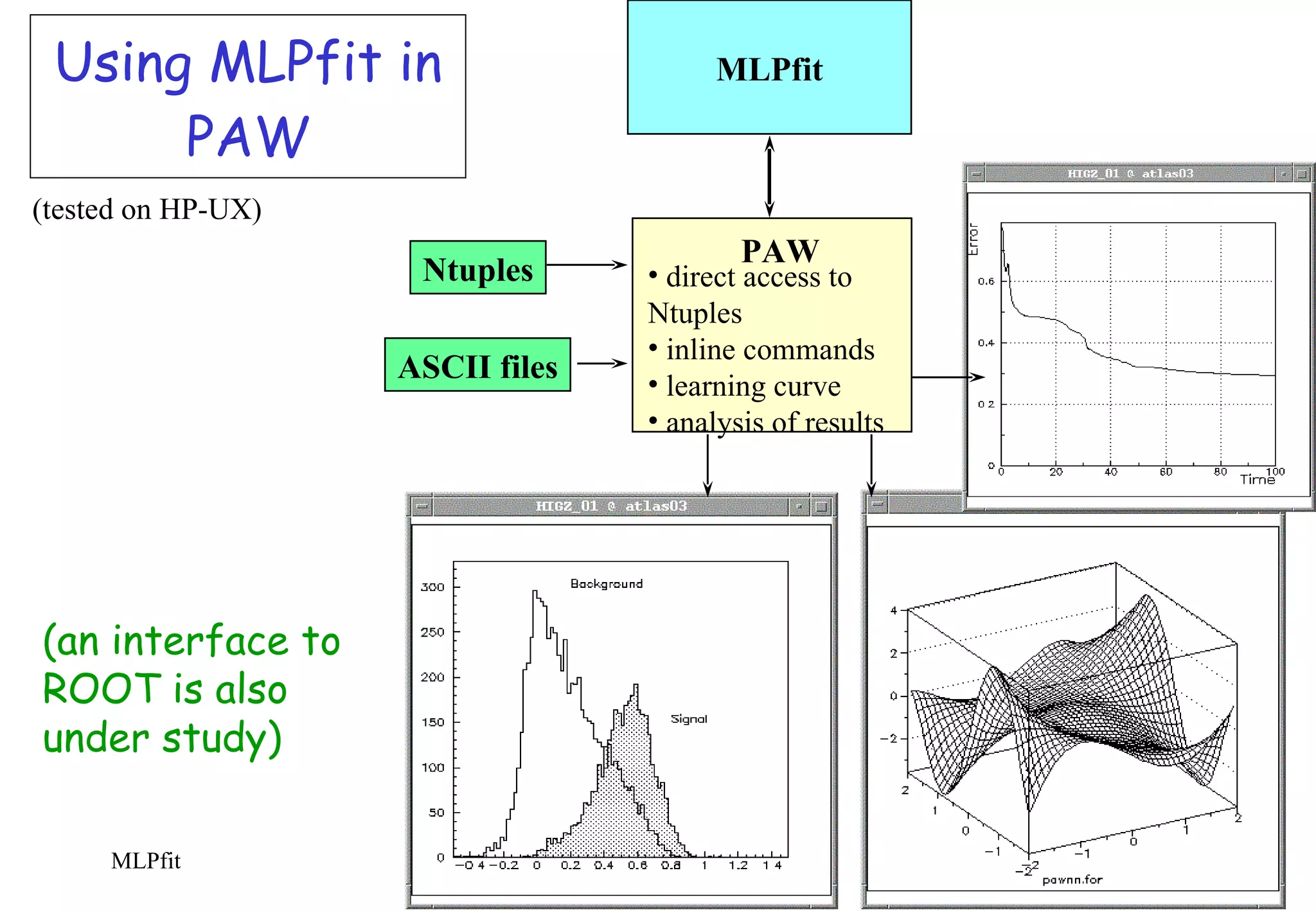
Using MLPfit in PAW direct access to Ntuples inline commands learning curve analysis of results PAW ASCII files Ntuples MLPfit (an interface to ROOT is also under study) (tested on HP-UX)
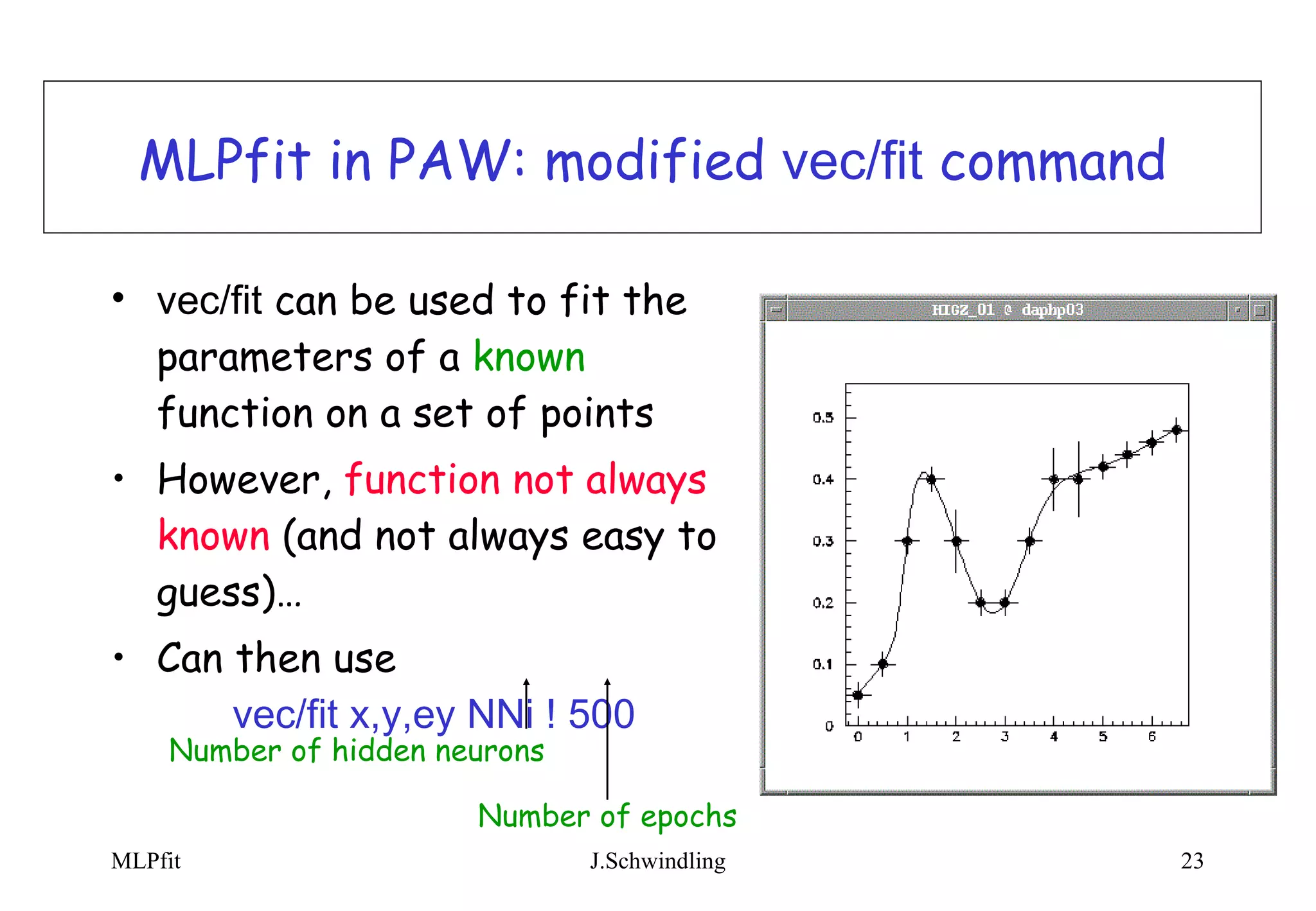
MLPfit in PAW: modified  vec/fit  command vec/fit  can be used to fit the parameters of a  known  function on a set of points However,  function not always known  (and not always easy to guess)… Can then use  vec/fit x,y,ey NNi ! 500 Number of hidden neurons Number of epochs
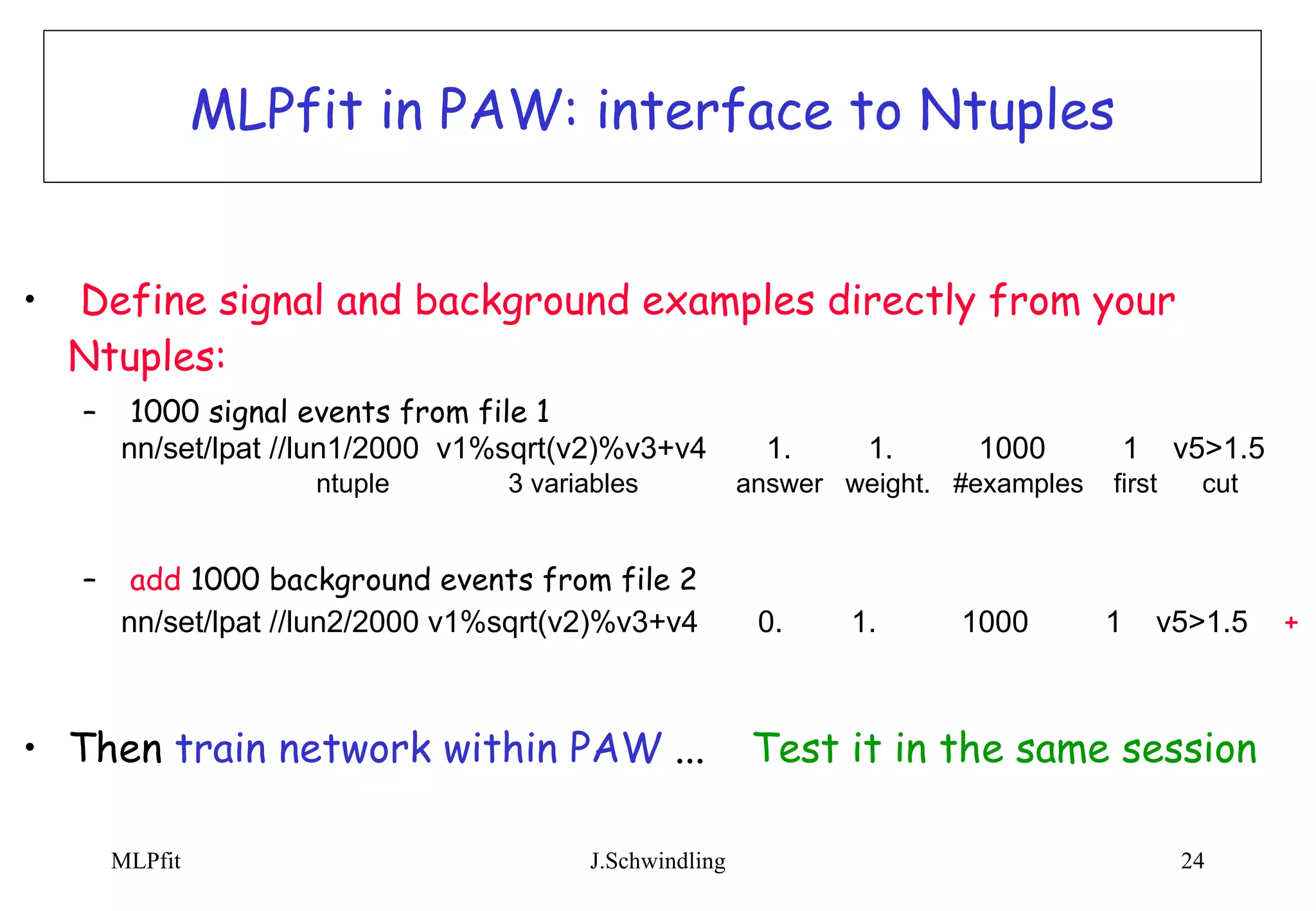
MLPfit in PAW: interface to Ntuples Define signal and background examples directly from your Ntuples: 1000 signal events from file 1  nn/set/lpat //lun1/2000  v1%sqrt(v2)%v3+v4  1.  1.  1000  1  v5>1.5   ntuple  3 variables  answer  weight.  #examples  first  cut add  1000 background events from file 2 nn/set/lpat //lun2/2000 v1%sqrt(v2)%v3+v4  0.  1.  1000  1  v5>1.5   + Then  train network within PAW  ... Test it in the same session
Documentation ... Everything (doc, code, examples, …) can be found at http://home.cern.ch/~schwind/MLPfit.html
Conclusions Neural Networks are  very widely used Multi-Layer Perceptrons are  based on mathematical grounds  (function approximation, classification, learning) MLPfit implements  powerful learning methods  in a  simple, precise, fast  way Several (simple)  interfaces  to use it
We are willing to ... Support the code: help to use it, give advice on MLP, correct bugs Improve the code: try a few more learning methods implement additional features (computation of second derivatives, …) if useful provide other interfaces on request Test the code: compare MLPfit with other NN packages

Multi-Layer Perceptrons

  • 1.
    MLPfit: a toolto design and use Multi-Layer Perceptrons J. Schwindling, B. Mansoulié CEA / Saclay FRANCE Neural Networks, Multi-Layer Perceptrons: What are they ? Applications Approximation theory Unconstrained Minimization About training ... MLPfit Numerical Linear Algebra Statistics
  • 2.
    (Artificial) Neural NetworksAppeared in the 40 ’s Now (since Personal Computers) very widely used, in various domains: in medecine (image analysis, help to diagnosis) in meteorology (predictions) in industry (automatic process control, quality checks by image processing, optimization of ressources allocation) (see for example IEEE Transactions on Neural Networks )
  • 3.
    Neural Networks inHEP Used for ~10 years Mainly for (offline) classification: particle identification (b quarks) event classification (e.g. WW -> qqqq versus ZZ, qq at LEP) search for new physics (Higgs) Track reconstruction Trigger in H1 Function approximation position measurement in ATLAS electromagnetic calorimeter
  • 4.
    The most wi(l)delyused: the Multi-Layer Perceptron Linear output neuron: natural for function approximation can be used also for classification used in hybrid learning method (see below) Input layer Hidden layer(s) Output layer « sigmoid »  w ij neuron i neuron j x 1 x n w jk y k = w 0k +  w jk u j u j = A(w 0j +  w ij x i ) neuron k
  • 5.
    2 theorems anycontinuous function (1 variable or more) on a compact set can be approximated to any accuracy by a linear combination of sigmoïds -> function approximation [ for example: K.Hornik et al. Multilayer Feedforward Networks are Universal Approximators , Neural Networks, Vol. 2, pp 359-366 (1989) ] trained with f(x) = 1 for signal and = 0 for background, the NN function approximates the probability of signal knowing x -> classification (cf Neyman-Pearson test) [for example: D.W.Ruck et al. The Multilayer Perceptron as an Approximation to a Bayes Optimal Discriminant Function , IEEE Transactions on Neural Networks, Vol. 1, n r 4, pp 296-298 (1990) ]
  • 6.
    About learning ...loop on the set of exemples p , compute the MLP output y p , compare with desired answer d p , update the weights = an epoch aim is to minimize all the methods use the computation of the first order derivatives computed by «backpropagation of errors» (usually  p = 1)
  • 7.
    Remark: derivative ofsigmoid function Needed for gradient computation Most people use y (1-y) (no need to recompute e x ) However, precision problems when y ~ 1. More accurate formula is y / (1+e x ) (exemple on a toy problem) y = 1 / (1+e -x )
  • 8.
    Learning methods Stochasticminimization Linear model fixed steps [variable steps] Remarks: - derivatives known - other methods exist Global minimization Non-Linear weights All weights Linear model steepest descent with fixed steps or line search Quadratic model (Newton like) Conjugate gradients or BFGS with line search Solve LLS
  • 9.
    The traditional learningmethod: stochastic minimization update the weights after each example according to «invented» in 1986 for Neural Networks Learning representations by back-propagating errors , D.E.Rumelheart et al., Nature vol. 323 (1986), p. 533 Learning processes in an assymetric threshold network, Y. le Cun, Disordered Systems and Biological Organization , Springer Verlag, Les Houches, France (1986), p. 233 similar to stochastic approximation method A Stochastic Approximation Method, H.Robbins et S.Monro, Annals of Math. Stat. 22 ( 1951 ), p. 400
  • 10.
    Stochastic minimization (continued)known to converge under certain conditions (  decreasing with time) Dvoretsky theorem: On Stochastic Approximation, A.Dvoretsky, Proc. 3 rd Berkeley Sym. on Math. Stat. and Prob., J.Neyman (ed.) (Berkeley: University of California Press, 1956), p. 39 also known to be very slow: «The main effect of random error is to slow down the speed at which a search can be conducted and still be sure of eventually finding the optimum. Stochastic procedures , being very deliberate, should not be used in the absence of experimental error, for deterministic methods are much faster . This point has not been well understood in the past, and stochastic procedures have sometimes been applied to deterministic problems with disappointing results. » Optimum Seeking Methods, D.J.Wilde, Englewood Cliffs, N.J.Prentice-Hall ( 1964 )
  • 11.
    Other methods minimize E = f(w ij ) using «standard» (unconstrained) minimization methods (when 1 st order derivatives known) for each epoch t: compute gradient compute a direction find a m which minimizes (Line Search) set several ways to choose the direction s t : conjugate gradients, BFGS P ractical Methods of Optimization R.Fletcher, 2 nd edition, Wiley (1987)
  • 12.
    The Hybrid methodA Hybrid Linear / Nonlinear Training Algorithm for Feedforward Neural Networks , S. McLoone et al., IEEE Transactions on Neural Networks, vol. 9, n r 4 (1998), p.669 Idea: for a given set of weights from input layer to hidden layer ( w NL : non linear weights ), the optimal weights from hidden to output layer ( w L = linear weights ) can be obtained by solving a linear system of equations -> w L *. use BFGS to find minimum of E(w NL , w L *(w NL )) at some learning steps, linear weights may become too large: add a regularisation term: E’ = E (1 +  ||w L || 2 / ||w max || 2 )
  • 13.
    Comparison on atoy problem fit the function x 2 sin(5xy) by a 2-10-1 MLP learning curves: (all curves = 2 minutes CPU)
  • 14.
    Comparison on areal problem Position measurement in ATLAS electromagnetic calo. Performance is limited to the calorimeter intrinsic resolution However, in a finite time, BFGS or Hybrid methods lead to a resolution ~ 10 % better than stochastic minimisation but small
  • 15.
    The MLPfit packagedesigned to be used both for function approximation and classification tasks implement powerful minimization methods Based on the mathematical background:
  • 16.
    Software process Simple: less than 3000 lines of (procedural) C in 3 files Precise : all computations in double precision, accurate derivative of sigmoid function Fast : tests of speed are being conducted (see below) Inexpensive : dynamic allocation of memory, examples in single precision (can be turned to double precision by changing one line) Easy to use : currently 4 ways to use it (see below) Use the POP (1) methodology to write a code: (1) POP = Performance Oriented Programming
  • 17.
    Performances JETNET 3.4SNNS 4.1 MLPfit 1.32 Possibilities Learning Methods Stochastic + … Stochastic + … Stochastic, CG, Conjugate Grad. BFGS, Hybrid Default interface your code Graphical User ’s See below Interface Accuracy Derivatives inaccurate inaccurate accurate Precision single single double Speed / Memory (on a classification task using a 14-20-20-1 network, 60000 learning examples, 15000 test examples, stochastic meth.) Time/epoch 8.3 s 17.8 s 8.8 s Memory 8.7 Mb 11.6 Mb 10.1 Mb
  • 18.
    Using MLPfit asa standalone package Reads ASCII files containing description of network, learning, running conditions examples (learn and test) [initial weights] Writes ASCII files containing output weights MLP (fortran or C) function Writes PAW file containing learning curves (Tested on HP-UX and alphavax / OSF) MLP_gen.c MLP_main.c PAWLIB MLP_lapack.c
  • 19.
    What is MLP_lapack.c? Need good routine to solve Linear Least Square problem in hybrid learning method first tried tls from CERNLIB : + free, source available = fortran - single precision then used f04jaf from NAGLIB : + double precision = fortran - not free now use dgels from LAPACK : + double precision, C, free, source available - 35% slower than f04jaf MLP_lapack.c (~ 9000 lines)
  • 20.
    Calling MLPfit fromyour own code Can be called from fortran or C(++) code Routines to: define network choose learning method and parameters set the examples train, test, use the network (Tested on HP-UX and alphavax / OSF) MLP_gen.c MLP_inter.c YourCode MLP_lapack.c
  • 21.
    Calling MLPfit fromLabVIEW LabVIEW MLPfit vi ’s for interface + your optimized: MLP application Graphical User ’s Interface - automatic process control - image analysis (tested on PC / Windows 95 + LabVIEW 4.1)
  • 22.
    Using MLPfit inPAW direct access to Ntuples inline commands learning curve analysis of results PAW ASCII files Ntuples MLPfit (an interface to ROOT is also under study) (tested on HP-UX)
  • 23.
    MLPfit in PAW:modified vec/fit command vec/fit can be used to fit the parameters of a known function on a set of points However, function not always known (and not always easy to guess)… Can then use vec/fit x,y,ey NNi ! 500 Number of hidden neurons Number of epochs
  • 24.
    MLPfit in PAW:interface to Ntuples Define signal and background examples directly from your Ntuples: 1000 signal events from file 1 nn/set/lpat //lun1/2000 v1%sqrt(v2)%v3+v4 1. 1. 1000 1 v5>1.5 ntuple 3 variables answer weight. #examples first cut add 1000 background events from file 2 nn/set/lpat //lun2/2000 v1%sqrt(v2)%v3+v4 0. 1. 1000 1 v5>1.5 + Then train network within PAW ... Test it in the same session
  • 25.
    Documentation ... Everything(doc, code, examples, …) can be found at http://home.cern.ch/~schwind/MLPfit.html
  • 26.
    Conclusions Neural Networksare very widely used Multi-Layer Perceptrons are based on mathematical grounds (function approximation, classification, learning) MLPfit implements powerful learning methods in a simple, precise, fast way Several (simple) interfaces to use it
  • 27.
    We are willingto ... Support the code: help to use it, give advice on MLP, correct bugs Improve the code: try a few more learning methods implement additional features (computation of second derivatives, …) if useful provide other interfaces on request Test the code: compare MLPfit with other NN packages