Introduction to machine learning:

Wake up being a data scientist
one day
by Oleksandr Khryplyvenko

m3oucat@gmail.com
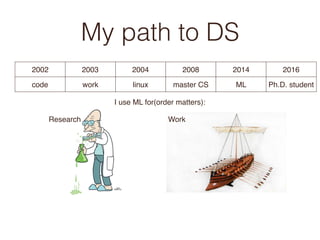
My path to DS
2002 2003 2004 2008 2014 2016
code work linux master CS ML Ph.D. student
WorkResearch
I use ML for(order matters):
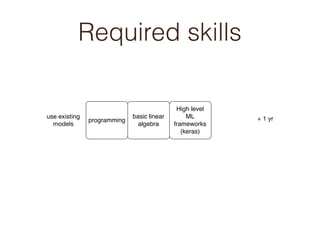
Required skills
programming
basic linear
algebra
use existing
models
High level
ML
frameworks
(keras)
+ 1 yr
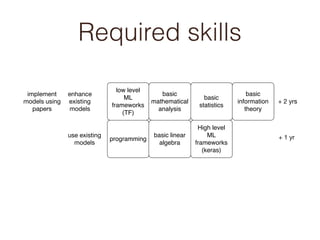
Required skills
programming
basic linear
algebra
use existing
models
High level
ML
frameworks
(keras)
low level
ML
frameworks
(TF)
basic
mathematical
analysis
basic
statistics
implement
models using
papers
enhance
existing
models
basic
information
theory
+ 1 yr
+ 2 yrs
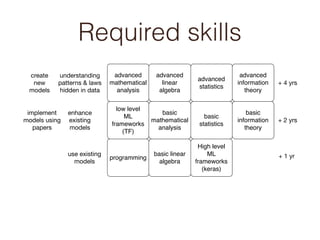
Required skills
programming
basic linear
algebra
use existing
models
High level
ML
frameworks
(keras)
low level
ML
frameworks
(TF)
advanced
linear
algebra
basic
mathematical
analysis
basic
statistics
advanced
information
theory
implement
models using
papers
enhance
existing
models
create
new
models
understanding
patterns & laws
hidden in data
advanced
statistics
advanced
mathematical
analysis
basic
information
theory
+ 1 yr
+ 2 yrs
+ 4 yrs
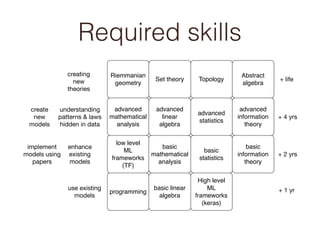
Required skills
programming
basic linear
algebra
use existing
models
High level
ML
frameworks
(keras)
low level
ML
frameworks
(TF)
advanced
linear
algebra
basic
mathematical
analysis
basic
statistics
advanced
information
theory
implement
models using
papers
enhance
existing
models
create
new
models
understanding
patterns & laws
hidden in data
advanced
statistics
advanced
mathematical
analysis
basic
information
theory
creating
new
theories
Riemmanian
geometry
Set theory Topology
Abstract
algebra
+ 1 yr
+ 2 yrs
+ 4 yrs
+ life
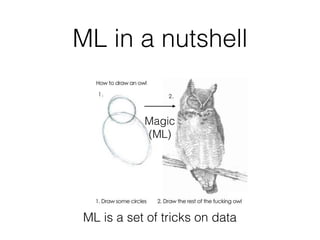
ML in a nutshell
ML is a set of tricks on data
Magic
(ML)
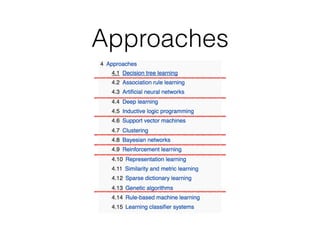
Approaches
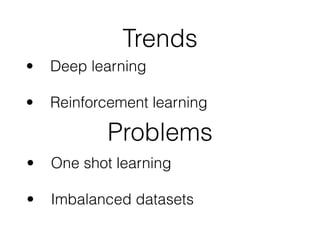
Trends
• Deep learning

• Reinforcement learning
Problems
• One shot learning

• Imbalanced datasets
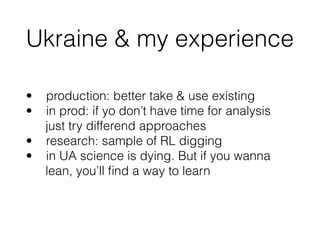
Ukraine & my experience
• production: better take & use existing
• in prod: if yo don’t have time for analysis

just try differend approaches
• research: sample of RL digging
• in UA science is dying. But if you wanna

lean, you’ll find a way to learn
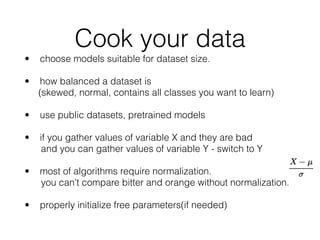
Cook your data
• choose models suitable for dataset size.

• how balanced a dataset is

(skewed, normal, contains all classes you want to learn)
• use public datasets, pretrained models
• if you gather values of variable X and they are bad

and you can gather values of variable Y - switch to Y

• most of algorithms require normalization.

you can’t compare bitter and orange without normalization.

• properly initialize free parameters(if needed)
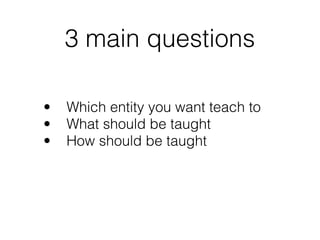
3 main questions
• Which entity you want teach to
• What should be taught
• How should be taught
3 main questions
• model

• cost function:

- regression

- classification

- clusterization

• teaching algorithm

- backpropagation(1st order, 2nd order methods)

- hypotheses check(statistics)

- genetic algorithms

…
3 main questions(sample)
• DQN
• MSE(target Q*, agent Q*):
• backpropagation
parametristic models
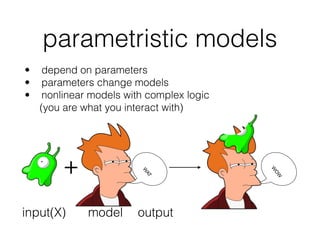
• depend on parameters
• parameters change models
• nonlinear models with complex logic

(you are what you interact with)
+
W
AT
W
OW
input(X) model output
parametristic models
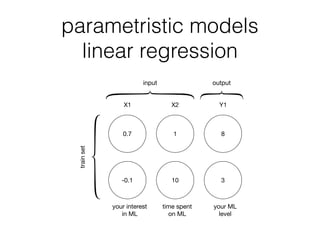
linear regression
10.7
10-0.1
X1 X2
8
3
Y1
input outputtrainset
your interest
in ML
time spent
on ML
your ML
level
linear regression
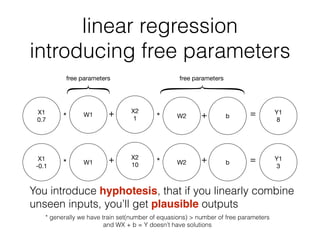
introducing free parameters
* generally we have train set(number of equasions) > number of free parameters

and WX + b = Y doesn’t have solutions
X2
1
X1
0.7
X2
10
X1
-0.1
Y1
8
Y1
3
W1
W1
W2
W2
+*
* +
*
*
=
=
free parameters free parameters
b
b
+
+
You introduce hyphotesis, that if you linearly combine
unseen inputs, you’ll get plausible outputs
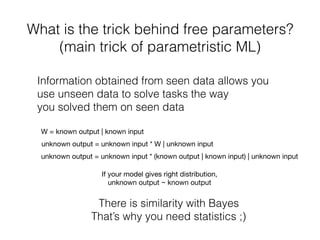
What is the trick behind free parameters?

(main trick of parametristic ML)
W = known output | known input
unknown output = unknown input * W | unknown input
unknown output = unknown input * (known output | known input) | unknown input
If your model gives right distribution,
unknown output ~ known output
There is similarity with Bayes

That’s why you need statistics ;)
Information obtained from seen data allows you
use unseen data to solve tasks the way

you solved them on seen data
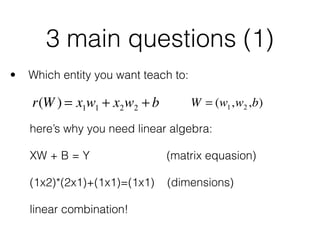
3 main questions (1)
• Which entity you want teach to:


here’s why you need linear algebra:


XW + B = Y (matrix equasion)


(1x2)*(2x1)+(1x1)=(1x1) (dimensions)


linear combination!
r(W ) = x1w1 + x2w2 + b W = (w1,w2,b)
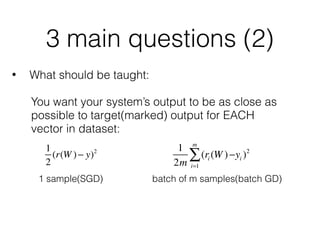
3 main questions (2)
• What should be taught:
You want your system’s output to be as close as

possible to target(marked) output for EACH

vector in dataset:
1 sample(SGD) batch of m samples(batch GD)
1
2m
(ri (W )−
i=1
m
∑ yi )21
2
(r(W )− y)2
3 main questions (3)
• How should be taught:

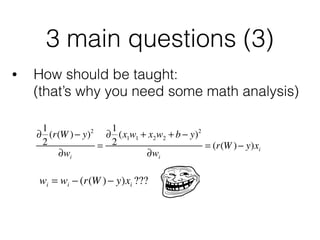
(that’s why you need some math analysis)
∂
1
2
(r(W )− y)2
∂wi
=
∂
1
2
(x1w1 + x2w2 + b − y)2
∂wi
= (r(W )− y)xi
wi = wi − (r(W )− y)xi ???
3 main questions (3)
• How should be taught:

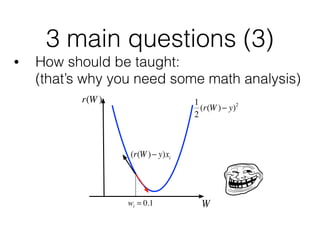
(that’s why you need some math analysis)
1
2
(r(W )− y)2
W
r(W )
(r(W )− y)xi
wi = 0.1
3 main questions (3)
• How should be taught:
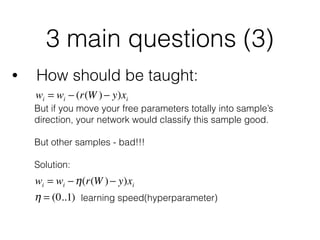
wi = wi − (r(W )− y)xi
But if you move your free parameters totally into sample’s
direction, your network would classify this sample good.


But other samples - bad!!!
Solution:
wi = wi −η(r(W )− y)xi
η = (0..1) learning speed(hyperparameter)
3 main questions (3)
• How should be taught:
This is a simple optimizer, but there are much more.
wi = wi −η(r(W )− y)xi SGD
You may use precise information about error curvature

(2nd order optimization)[1],

or try to simulate 2nd order optimization for faster convergence[2]

Training
Regularization
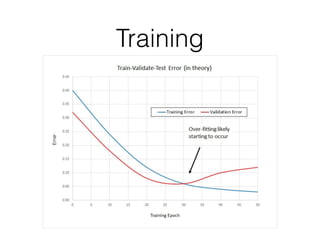
• There is always some noise in data
• so you do regularization
• lots of techniques:

- L1

- L2

- ensembles

- dropout

- batch-normalization

…
Back to linear regression
In [3]: from sklearn import linear_model
In [4]: regr = linear_model.LinearRegression()
In [5]: x_train = [[0.7, 1], [-0.1, 10]]
In [6]: x_test = [[0.8, 2]]
In [7]: y_train = [8, 3]
In [8]: y_test = [9]


In [9]: regr.fit(x_train, y_train)
Out[9]: LinearRegression(copy_X=True, fit_intercept=True, n_jobs=1, normalize=False)


In [10]: regr.coef_
Out[10]: array([ 0.04899559, -0.55120039])


In [11]: regr.predict(x_test)
Out[11]: array([ 7.45369917])
find what’s wrong?
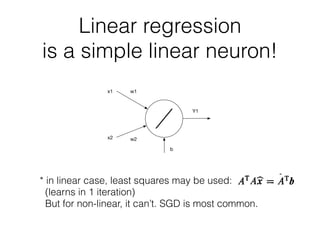
Linear regression
is a simple linear neuron!
w1
w2
Y1
x1
x2
b
* in linear case, least squares may be used:

(learns in 1 iteration)
But for non-linear, it can’t. SGD is most common.
Neural networks?
• There are lots of types & variations of neural networks:


MLP, RNN, CNN

• They use the same ideas, concepts and mathematics as

you’ve been just introduced. Just a bit more complex.

• So you can start your ML path right now!
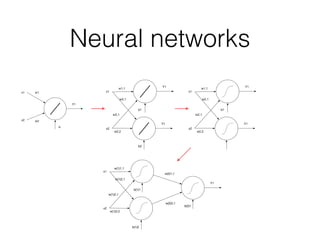
Neural networks
w1
w2
Y1
x1
x2
b
w1,1
w2,1
Y1
x1
x2
b1
w2,1
Y1
w2,2
b2
w1,1
w2,1
Y1
x1
x2
b1
w2,1
Y1
w2,2
w(1)1,1
w(1)2,1
x1
x2
b(1)1
w(1)2,1
w(1)2,2
Y1
b(2)1
b(1)2
w(2)1,1
w(2)2,1
What modern frameworks

do for you
• Symbolic computations
• Automatic differentiation
• Lots of ready-to use models(neural networks)
In few words - alomost everything!
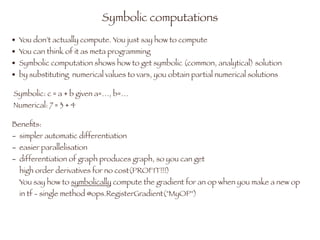
Benefits:
- simpler automatic differentiation
- easier parallelisation
- differentiation of graph produces graph, so you can get

high order derivatives for no cost(PROFIT!!!)

You say how to symbolically compute the gradient for an op when you make a new op

in tf - single method @ops.RegisterGradient("MyOP")
Symbolic computations
• You don’t actually compute. You just say how to compute
• You can think of it as meta programming
• Symbolic computation shows how to get symbolic (common, analytical) solution
• by substituting numerical values to vars, you obtain partial numerical solutions
Symbolic: c = a + b given a=…, b=… 

Numerical: 7 = 3 + 4
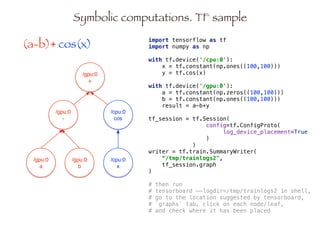
Symbolic computations. TF sample
(a-b)+ cos(x)
/gpu:0
+
/cpu:0
cos
/gpu:0
-
/cpu:0
x
/gpu:0
a
/gpu:0
b
import tensorflow as tf

import numpy as np


with tf.device('/cpu:0'):

x = tf.constant(np.ones((100,100)))

y = tf.cos(x)


with tf.device('/gpu:0'):

a = tf.constant(np.zeros((100,100)))

b = tf.constant(np.ones((100,100)))

result = a-b+y


tf_session = tf.Session(
config=tf.ConfigProto(
log_device_placement=True
)
)

writer = tf.train.SummaryWriter(
“/tmp/trainlogs2",
tf_session.graph
)
# then run

# tensorboard —-logdir=/tmp/trainlogs2 in shell,
# go to the location suggested by tensorboard,

# `graphs` tab, click on each node/leaf,

# and check where it has been placed
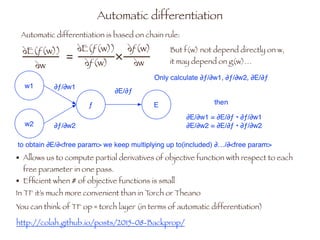
Automatic differentiation
Automatic differentiation is based on chain rule:
http://colah.github.io/posts/2015-08-Backprop/
∂E(ƒ(w))
∂w
∂E(ƒ(w))
∂ƒ(w)
∂ƒ(w)
∂w
But f(w) not depend directly on w,
it may depend on g(w)…
In TF it’s much more convenient than in Torch or Theano
You can think of TF op = torch layer (in terms of automatic differentiation)
• Allows us to compute partial derivatives of objective function with respect to each

free parameter in one pass.
• Efficient when # of objective functions is small
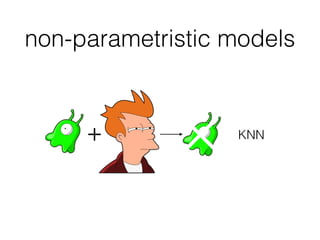
non-parametristic models
+ KNN
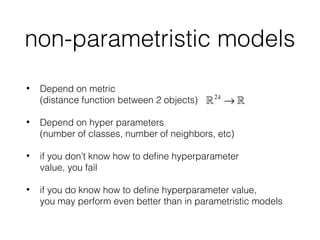
non-parametristic models
• Depend on metric

(distance function between 2 objects)
• Depend on hyper parameters

(number of classes, number of neighbors, etc)
• if you don’t know how to define hyperparameter

value, you fail
• if you do know how to define hyperparameter value,

you may perform even better than in parametristic models
!2k
→ !
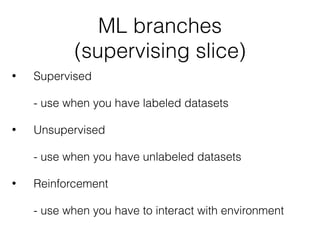
ML branches
(supervising slice)
• Supervised


- use when you have labeled datasets

• Unsupervised


- use when you have unlabeled datasets

• Reinforcement


- use when you have to interact with environment
Starter links
http://openclassroom.stanford.edu/MainFolder/
CoursePage.php?course=MachineLearning
[1] http://andrew.gibiansky.com/blog/machine-learning/
hessian-free-optimization/
[2] http://sebastianruder.com/optimizing-gradient-descent/
index.html#momentum

Introduction to Machine Learning

  • 1.
    Introduction to machinelearning:
 Wake up being a data scientist one day by Oleksandr Khryplyvenko
 m3oucat@gmail.com
  • 2.
    My path toDS 2002 2003 2004 2008 2014 2016 code work linux master CS ML Ph.D. student WorkResearch I use ML for(order matters):
  • 3.
    Required skills programming basic linear algebra useexisting models High level ML frameworks (keras) + 1 yr
  • 4.
    Required skills programming basic linear algebra useexisting models High level ML frameworks (keras) low level ML frameworks (TF) basic mathematical analysis basic statistics implement models using papers enhance existing models basic information theory + 1 yr + 2 yrs
  • 5.
    Required skills programming basic linear algebra useexisting models High level ML frameworks (keras) low level ML frameworks (TF) advanced linear algebra basic mathematical analysis basic statistics advanced information theory implement models using papers enhance existing models create new models understanding patterns & laws hidden in data advanced statistics advanced mathematical analysis basic information theory + 1 yr + 2 yrs + 4 yrs
  • 6.
    Required skills programming basic linear algebra useexisting models High level ML frameworks (keras) low level ML frameworks (TF) advanced linear algebra basic mathematical analysis basic statistics advanced information theory implement models using papers enhance existing models create new models understanding patterns & laws hidden in data advanced statistics advanced mathematical analysis basic information theory creating new theories Riemmanian geometry Set theory Topology Abstract algebra + 1 yr + 2 yrs + 4 yrs + life
  • 7.
    ML in anutshell ML is a set of tricks on data Magic (ML)
  • 8.
  • 9.
    Trends • Deep learning
 •Reinforcement learning Problems • One shot learning
 • Imbalanced datasets
  • 10.
    Ukraine & myexperience • production: better take & use existing • in prod: if yo don’t have time for analysis
 just try differend approaches • research: sample of RL digging • in UA science is dying. But if you wanna
 lean, you’ll find a way to learn
  • 11.
    Cook your data •choose models suitable for dataset size.
 • how balanced a dataset is
 (skewed, normal, contains all classes you want to learn) • use public datasets, pretrained models • if you gather values of variable X and they are bad
 and you can gather values of variable Y - switch to Y
 • most of algorithms require normalization.
 you can’t compare bitter and orange without normalization.
 • properly initialize free parameters(if needed)
  • 12.
    3 main questions •Which entity you want teach to • What should be taught • How should be taught
  • 13.
    3 main questions •model
 • cost function:
 - regression
 - classification
 - clusterization
 • teaching algorithm
 - backpropagation(1st order, 2nd order methods)
 - hypotheses check(statistics)
 - genetic algorithms
 …
  • 14.
    3 main questions(sample) •DQN • MSE(target Q*, agent Q*): • backpropagation
  • 15.
    parametristic models • dependon parameters • parameters change models • nonlinear models with complex logic
 (you are what you interact with) + W AT W OW input(X) model output
  • 16.
    parametristic models linear regression 10.7 10-0.1 X1X2 8 3 Y1 input outputtrainset your interest in ML time spent on ML your ML level
  • 17.
    linear regression introducing freeparameters * generally we have train set(number of equasions) > number of free parameters
 and WX + b = Y doesn’t have solutions X2 1 X1 0.7 X2 10 X1 -0.1 Y1 8 Y1 3 W1 W1 W2 W2 +* * + * * = = free parameters free parameters b b + + You introduce hyphotesis, that if you linearly combine unseen inputs, you’ll get plausible outputs
  • 18.
    What is thetrick behind free parameters?
 (main trick of parametristic ML) W = known output | known input unknown output = unknown input * W | unknown input unknown output = unknown input * (known output | known input) | unknown input If your model gives right distribution, unknown output ~ known output There is similarity with Bayes
 That’s why you need statistics ;) Information obtained from seen data allows you use unseen data to solve tasks the way
 you solved them on seen data
  • 19.
    3 main questions(1) • Which entity you want teach to:


 here’s why you need linear algebra:
 
 XW + B = Y (matrix equasion)
 
 (1x2)*(2x1)+(1x1)=(1x1) (dimensions)
 
 linear combination! r(W ) = x1w1 + x2w2 + b W = (w1,w2,b)
  • 20.
    3 main questions(2) • What should be taught: You want your system’s output to be as close as
 possible to target(marked) output for EACH
 vector in dataset: 1 sample(SGD) batch of m samples(batch GD) 1 2m (ri (W )− i=1 m ∑ yi )21 2 (r(W )− y)2
  • 21.
    3 main questions(3) • How should be taught:
 (that’s why you need some math analysis) ∂ 1 2 (r(W )− y)2 ∂wi = ∂ 1 2 (x1w1 + x2w2 + b − y)2 ∂wi = (r(W )− y)xi wi = wi − (r(W )− y)xi ???
  • 22.
    3 main questions(3) • How should be taught:
 (that’s why you need some math analysis) 1 2 (r(W )− y)2 W r(W ) (r(W )− y)xi wi = 0.1
  • 23.
    3 main questions(3) • How should be taught: wi = wi − (r(W )− y)xi But if you move your free parameters totally into sample’s direction, your network would classify this sample good. 
 But other samples - bad!!! Solution: wi = wi −η(r(W )− y)xi η = (0..1) learning speed(hyperparameter)
  • 24.
    3 main questions(3) • How should be taught: This is a simple optimizer, but there are much more. wi = wi −η(r(W )− y)xi SGD You may use precise information about error curvature
 (2nd order optimization)[1],
 or try to simulate 2nd order optimization for faster convergence[2]

  • 25.
  • 26.
    Regularization • There isalways some noise in data • so you do regularization • lots of techniques:
 - L1
 - L2
 - ensembles
 - dropout
 - batch-normalization
 …
  • 27.
    Back to linearregression In [3]: from sklearn import linear_model In [4]: regr = linear_model.LinearRegression() In [5]: x_train = [[0.7, 1], [-0.1, 10]] In [6]: x_test = [[0.8, 2]] In [7]: y_train = [8, 3] In [8]: y_test = [9]
 
 In [9]: regr.fit(x_train, y_train) Out[9]: LinearRegression(copy_X=True, fit_intercept=True, n_jobs=1, normalize=False)
 
 In [10]: regr.coef_ Out[10]: array([ 0.04899559, -0.55120039])
 
 In [11]: regr.predict(x_test) Out[11]: array([ 7.45369917]) find what’s wrong?
  • 28.
    Linear regression is asimple linear neuron! w1 w2 Y1 x1 x2 b * in linear case, least squares may be used:
 (learns in 1 iteration) But for non-linear, it can’t. SGD is most common.
  • 29.
    Neural networks? • Thereare lots of types & variations of neural networks:
 
 MLP, RNN, CNN
 • They use the same ideas, concepts and mathematics as
 you’ve been just introduced. Just a bit more complex.
 • So you can start your ML path right now!
  • 30.
  • 31.
    What modern frameworks
 dofor you • Symbolic computations • Automatic differentiation • Lots of ready-to use models(neural networks) In few words - alomost everything!
  • 32.
    Benefits: - simpler automaticdifferentiation - easier parallelisation - differentiation of graph produces graph, so you can get
 high order derivatives for no cost(PROFIT!!!)
 You say how to symbolically compute the gradient for an op when you make a new op
 in tf - single method @ops.RegisterGradient("MyOP") Symbolic computations • You don’t actually compute. You just say how to compute • You can think of it as meta programming • Symbolic computation shows how to get symbolic (common, analytical) solution • by substituting numerical values to vars, you obtain partial numerical solutions Symbolic: c = a + b given a=…, b=… 
 Numerical: 7 = 3 + 4
  • 33.
    Symbolic computations. TFsample (a-b)+ cos(x) /gpu:0 + /cpu:0 cos /gpu:0 - /cpu:0 x /gpu:0 a /gpu:0 b import tensorflow as tf
 import numpy as np
 
 with tf.device('/cpu:0'):
 x = tf.constant(np.ones((100,100)))
 y = tf.cos(x)
 
 with tf.device('/gpu:0'):
 a = tf.constant(np.zeros((100,100)))
 b = tf.constant(np.ones((100,100)))
 result = a-b+y
 
 tf_session = tf.Session( config=tf.ConfigProto( log_device_placement=True ) )
 writer = tf.train.SummaryWriter( “/tmp/trainlogs2", tf_session.graph ) # then run
 # tensorboard —-logdir=/tmp/trainlogs2 in shell, # go to the location suggested by tensorboard,
 # `graphs` tab, click on each node/leaf,
 # and check where it has been placed
  • 34.
    Automatic differentiation Automatic differentiationis based on chain rule: http://colah.github.io/posts/2015-08-Backprop/ ∂E(ƒ(w)) ∂w ∂E(ƒ(w)) ∂ƒ(w) ∂ƒ(w) ∂w But f(w) not depend directly on w, it may depend on g(w)… In TF it’s much more convenient than in Torch or Theano You can think of TF op = torch layer (in terms of automatic differentiation) • Allows us to compute partial derivatives of objective function with respect to each
 free parameter in one pass. • Efficient when # of objective functions is small
  • 35.
  • 36.
    non-parametristic models • Dependon metric
 (distance function between 2 objects) • Depend on hyper parameters
 (number of classes, number of neighbors, etc) • if you don’t know how to define hyperparameter
 value, you fail • if you do know how to define hyperparameter value,
 you may perform even better than in parametristic models !2k → !
  • 37.
    ML branches (supervising slice) •Supervised
 
 - use when you have labeled datasets
 • Unsupervised
 
 - use when you have unlabeled datasets
 • Reinforcement
 
 - use when you have to interact with environment
  • 38.