Artificial Neural Networks 
- Introduction - 
Peter Andras 
peter.andras@ncl.ac.uk
Overview 
1. Biological inspiration 
2. Artificial neurons and neural networks 
3. Learning processes 
4. Learning with artificial neural networks
Biological inspiration 
Animals are able to react adaptively to changes in their 
external and internal environment, and they use their nervous 
system to perform these behaviours. 
An appropriate model/simulation of the nervous system 
should be able to produce similar responses and behaviours in 
artificial systems. 
The nervous system is build by relatively simple units, the 
neurons, so copying their behavior and functionality should be 
the solution.
Biological inspiration 
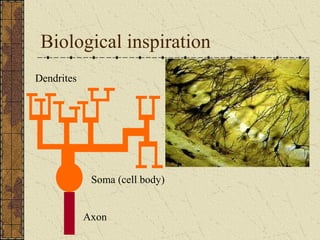
Dendrites 
Soma (cell body) 
Axon
Biological inspiration 
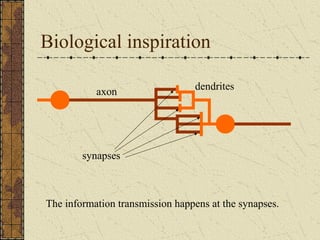
axon dendrites 
synapses 
The information transmission happens at the synapses.
Biological inspiration 
The spikes travelling along the axon of the pre-synaptic 
neuron trigger the release of neurotransmitter substances 
at the synapse. 
The neurotransmitters cause excitation or inhibition in the 
dendrite of the post-synaptic neuron. 
The integration of the excitatory and inhibitory signals 
may produce spikes in the post-synaptic neuron. 
The contribution of the signals depends on the strength of 
the synaptic connection.
Artificial neurons 
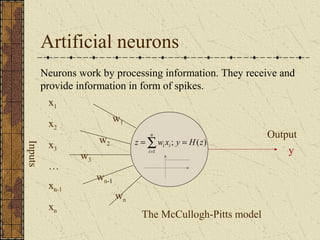
Neurons work by processing information. They receive and 
provide information in form of spikes. 
n 
i i = =å= 
z w x y H z 
The McCullogh-Pitts model 
Inputs 
w1 
w Output 2 
w3 
wn 
wn-1 
. . . 
x1 
x2 
x3 
… 
xn-1 
xn 
y 
; ( ) 
1 
i
Artificial neurons 
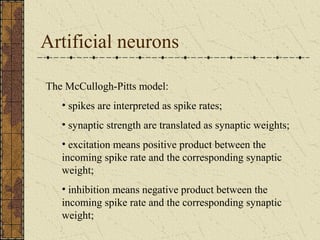
The McCullogh-Pitts model: 
• spikes are interpreted as spike rates; 
• synaptic strength are translated as synaptic weights; 
• excitation means positive product between the 
incoming spike rate and the corresponding synaptic 
weight; 
• inhibition means negative product between the 
incoming spike rate and the corresponding synaptic 
weight;
Artificial neurons 
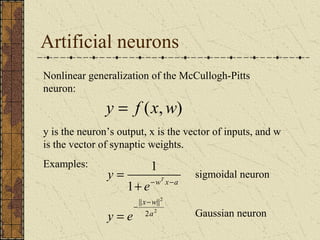
Nonlinear generalization of the McCullogh-Pitts 
neuron: 
y = f (x,w) 
y is the neuron’s output, x is the vector of inputs, and w 
is the vector of synaptic weights. 
Examples: 
y T 
= sigmoidal neuron 
- - 
x w 
|| || 
2 
2 
2 
1 
1 
a 
w x a 
y e 
e 
- - 
= 
+ 
Gaussian neuron
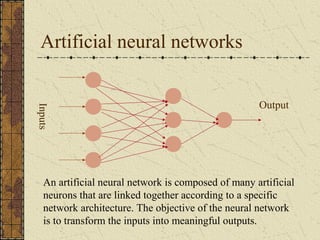
Artificial neural networks 
Inputs 
Output 
An artificial neural network is composed of many artificial 
neurons that are linked together according to a specific 
network architecture. The objective of the neural network 
is to transform the inputs into meaningful outputs.
Artificial neural networks 
Tasks to be solved by artificial neural networks: 
• controlling the movements of a robot based on self-perception 
and other information (e.g., visual 
information); 
• deciding the category of potential food items (e.g., 
edible or non-edible) in an artificial world; 
• recognizing a visual object (e.g., a familiar face); 
• predicting where a moving object goes, when a robot 
wants to catch it.
Learning in biological systems 
Learning = learning by adaptation 
The young animal learns that the green fruits are sour, 
while the yellowish/reddish ones are sweet. The learning 
happens by adapting the fruit picking behavior. 
At the neural level the learning happens by changing of the 
synaptic strengths, eliminating some synapses, and 
building new ones.
Learning as optimisation 
The objective of adapting the responses on the basis of the 
information received from the environment is to achieve a 
better state. E.g., the animal likes to eat many energy rich, 
juicy fruits that make its stomach full, and makes it feel 
happy. 
In other words, the objective of learning in biological 
organisms is to optimise the amount of available resources, 
happiness, or in general to achieve a closer to optimal state.
Learning in biological neural 
networks 
The learning rules of Hebb: 
• synchronous activation increases the synaptic strength; 
• asynchronous activation decreases the synaptic 
strength. 
These rules fit with energy minimization principles. 
Maintaining synaptic strength needs energy, it should be 
maintained at those places where it is needed, and it 
shouldn’t be maintained at places where it’s not needed.
Learning principle for 
artificial neural networks 
ENERGY MINIMIZATION 
We need an appropriate definition of energy for artificial 
neural networks, and having that we can use 
mathematical optimisation techniques to find how to 
change the weights of the synaptic connections between 
neurons. 
ENERGY = measure of task performance error
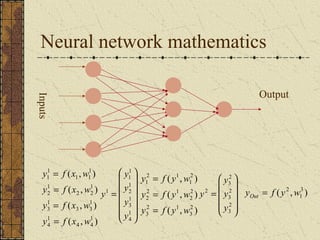
Neural network mathematics 
Inputs 
Output 
y f x w 
( , ) 
= 
y f x w 
( , ) 
= 
y f x w 
( , ) 
1 
( , ) 
4 4 
1 
4 
1 
3 3 
1 
3 
1 
2 2 
1 
2 
1 
1 1 
1 
1 
= 
y = 
f x w 
2 
1 
2 1 
1 
y f y w 
( , ) 
ö 
æ 
= 
2 
3 
y 
y ( , 3 ) 
2 
2 
= 
2 1 
2 
y f y w 
( , ) 
2 
3 
= 
2 1 
3 
y f y w 
( , ) 
= 
ö 
÷ ÷ ÷ ÷ ÷ 
ø 
æ 
= 
ç ç ç ç ç 
è 
1 
1 
1 
2 
1 
3 
1 
4 
1 
y 
y 
y 
y 
y f y2 w Out = 
1 
÷ ÷ ÷ ÷ 
ø 
ç ç ç ç 
è 
2 
3 
2 
3 
2 
y 
y 
y
Neural network mathematics 
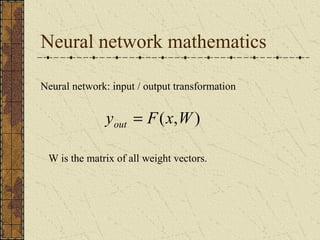
Neural network: input / output transformation 
yout = F(x,W) 
W is the matrix of all weight vectors.
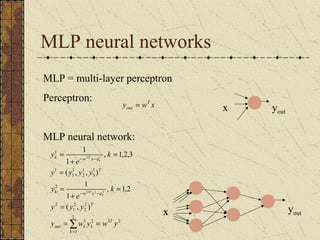
MLP neural networks 
MLP = multi-layer perceptron 
Perceptron: 
y wT x 
out = x yout 
MLP neural network: 
x yout 
k 
k 
T 
3 2 
k w x a 
1 1 
e 
y 
- - 
y y y y 
( , , ) 
= 
k w y a 
e 
y 
y y y 
2 
= 
out k k 
1 
2 
2 
3 2 
2 
1 
1 
2 
2 
1 
3 
1 
2 
1 
1 
1 
( , ) 
, 1,2 
1 
1 
, 1,2,3 
1 
1 
2 1 2 
y w y w y 
k 
T 
T 
k 
kT 
k 
kT 
= = 
= 
+ 
= 
= 
+ 
= 
å= 
- -
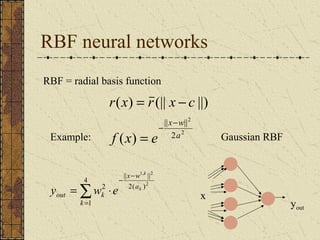
RBF neural networks 
RBF = radial basis function 
r x = r x - 
c 
( ) (|| ||) 
x w 
- - 
= 
|| || 
2 
2 
2 
( ) 
a 
f x e 
Example: Gaussian RBF 
x 
yout 
4 
å= 
x w 
- - 
1, 2 
2 2 
= × 
1 
|| || 
2( ) 
k 
a 
out k 
k 
k 
y w e
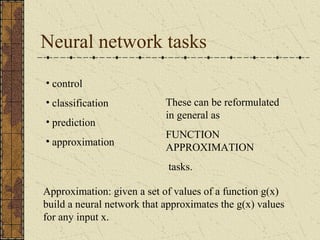
Neural network tasks 
• control 
• classification 
• prediction 
• approximation 
These can be reformulated 
in general as 
FUNCTION 
APPROXIMATION 
tasks. 
Approximation: given a set of values of a function g(x) 
build a neural network that approximates the g(x) values 
for any input x.
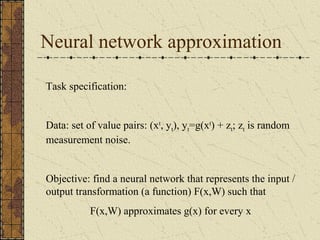
Neural network approximation 
Task specification: 
Data: set of value pairs: (xt, yt), yt=g(xt) + zt; zt is random 
measurement noise. 
Objective: find a neural network that represents the input / 
output transformation (a function) F(x,W) such that 
F(x,W) approximates g(x) for every x
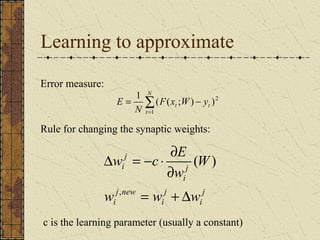
Learning to approximate 
Error measure: 
1 N 
( ( ; ) )2 
å= 
= - 
t 
F xt W yt 
N 
E 
1 
Rule for changing the synaptic weights: 
w c E 
D = - × ¶ 
j 
i 
w w w 
j 
i 
j 
i 
j new 
i 
j 
i 
W 
w 
¶ 
= + D 
, 
( ) 
c is the learning parameter (usually a constant)
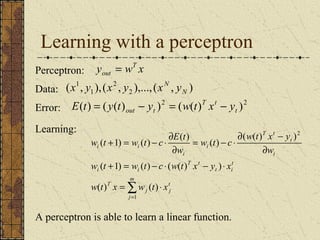
Learning with a perceptron 
Perceptron: y wT x 
out = 
2 
Data: ( , 1 
),( , 2 ),...,( , ) 
1 
N 
x y x y xN y 
T t 
Error: E ( t ) = ( y ( t ) out - yt )2 = ( w ( t ) x - y 
2 t 
)Learning: 
w t c w t x y 
w t + = w t - c × ¶ 
E t 
w ( t + 1) = w ( t ) - c × ( w ( t ) x - y ) 
× 
x 
t 
j 
m 
j 
j 
T 
t 
t i 
T t 
i i 
¶ - 
i 
t 
T t 
i 
i 
i i 
w t x w t x 
w 
w 
= × 
¶ 
= - × 
¶ 
å= 
1 
2 
( ) ( ) 
( ( ) ) 
( 1) ( ) ( ) ( ) 
A perceptron is able to learn a linear function.
Learning with RBF neural 
networks 
M 
1, 2 
2 2 
y = F ( x , W ) 
= w × 
e 
RBF neural network: 
Data: ( 1 
, 1 
),( 2 
, 2 ),...,( , ) 
out k 
N 
x y x y xN y 
x w 
- - 
t k 
|| || 
1, 2 
x w 
å= 
1 
- - 
|| || 
k 
a 
2( ) 
- × = - = å= 
k 
k 
( ) ( ( ) )2 ( 2 ( ) ) 2 
Error: 2 
1 
2( ) 
t 
M 
k 
a 
E t y t out yt wk t e y k 
Learning: 
t i 
a 
1, 2 
x w 
|| || 
2 
2( ) 
w t + = w t - c × ¶ 
E t 
( 1) ( ) ( ) 
E t 
2 
2 
2 2 
( ) 2 ( ( , ( )) ) 
i 
t 
t 
i 
i 
i i 
F x W t y e 
w 
w 
- - 
= × - × 
¶ 
¶ 
¶ 
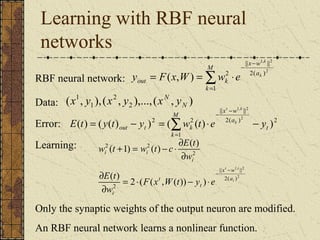
Only the synaptic weights of the output neuron are modified. 
An RBF neural network learns a nonlinear function.
Learning with MLP neural 
networks 
MLP neural network: 
with p layers 
2 
e 
y 
kT 
y y y 
e 
y 
kT 
y y y 
Data: ( , 1 
),( , 2 ),...,( , ) 
1 
N 
x y x y xN y 
t 
k w x a 
1 1 
- - 
k 
( ,..., ) 
k w y a 
2 1 2 
= 
= 
Error: E ( t ) = ( y ( t ) 2 out - yt )= ( F ( x ; W ) - y 
)2 
t k M 
k M 
1 
2 2 
1 
2 
2 
2 
1 1 
1 
1 
1 
1 
( ; ) 
... 
( ,..., ) 
, 1,..., 
1 
1 
, 1,..., 
1 
1 
2 
1 
- 
- - 
= = 
= 
+ 
= 
= 
+ 
= 
pT p 
out 
k 
T 
M 
T 
M 
y F x W w y 
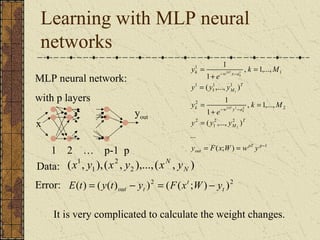
It is very complicated to calculate the weight changes. 
x 
yout 
1 2 … p-1 p
Learning with backpropagation 
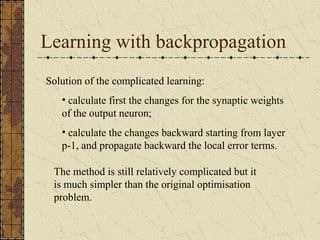
Solution of the complicated learning: 
• calculate first the changes for the synaptic weights 
of the output neuron; 
• calculate the changes backward starting from layer 
p-1, and propagate backward the local error terms. 
The method is still relatively complicated but it 
is much simpler than the original optimisation 
problem.
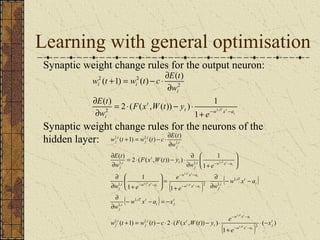
Learning with general optimisation 
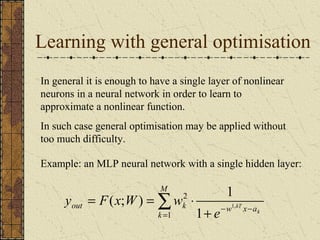
In general it is enough to have a single layer of nonlinear 
neurons in a neural network in order to learn to 
approximate a nonlinear function. 
In such case general optimisation may be applied without 
too much difficulty. 
Example: an MLP neural network with a single hidden layer: 
M 
( ; ) 1 
å= 
out k w x a 
+ - - 
= = × 
k 
k 
kT e 
y F x W w 
1 
2 
1, 1
Learning with general optimisation 
Synaptic weight change rules for the output neuron: 
i 
( ) 2 ( ( , ( )) ) 1 
t w iT xt a 
w t + = w t - c × ¶ 
E t 
t 
E t 
i 
i 
i i 
e 
F x W t y 
w 
w 
+ - - 
= × - × 
¶ 
¶ 
¶ 
1, 1 
( 1) ( ) ( ) 
2 
2 
2 2 
Synaptic weight change rules for the neurons of the 
hidden layer: 
w 1, ( t + 1) = w 1, 
( t ) - c × ¶ 
E ( t 
) 
1, 
E t 
= × - × ¶ 
( ) 2 ( ( , ( )) ) 1 
1 
1, 1, 
w x a 
ö 
æ 
- - 
( ) ( ) 
1 
ö 
1 1 
æ 
( ) 
w x a 
e 
- - = - 
× ¶ 
¶ 
¶ 
w t w t c F x W t y e 
- - 
( ) ( ) 
1 
1, 
1, 
( 1) ( ) 2 ( ( , ( )) ) 
2 
1, 1, 
1, 
1, 2 1, 
1, 
1, 
1, 
1, 
1, 
1, 
t 
j 
w x a 
t 
i t 
j 
i 
j 
t 
i j 
iT t 
i 
j 
i 
iT t 
i 
w x a j 
i w x a 
j 
i w x a 
j 
t 
t 
i 
j 
i 
j 
i 
j 
i 
j 
x 
e 
w x a x 
w 
w x a 
e w 
w e 
w e 
F x W t y 
w 
w 
i 
iT t 
i 
iT t 
i 
iT t 
i 
iT t 
i 
iT t 
i 
iT t 
× - 
+ 
+ = - × × - × 
¶ 
¶ 
- - 
¶ 
+ 
= ÷ ÷ø 
ç çè 
¶ + 
÷ ÷ø 
ç çè 
¶ + 
¶ 
¶ 
- - 
- - 
- - 
- -
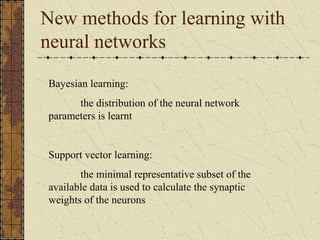
New methods for learning with 
neural networks 
Bayesian learning: 
the distribution of the neural network 
parameters is learnt 
Support vector learning: 
the minimal representative subset of the 
available data is used to calculate the synaptic 
weights of the neurons
Summary 
• Artificial neural networks are inspired by the learning 
processes that take place in biological systems. 
• Artificial neurons and neural networks try to imitate the 
working mechanisms of their biological counterparts. 
• Learning can be perceived as an optimisation process. 
• Biological neural learning happens by the modification 
of the synaptic strength. Artificial neural networks learn 
in the same way. 
• The synapse strength modification rules for artificial 
neural networks can be derived by applying 
mathematical optimisation methods.
Summary 
• Learning tasks of artificial neural networks can be 
reformulated as function approximation tasks. 
• Neural networks can be considered as nonlinear function 
approximating tools (i.e., linear combinations of nonlinear 
basis functions), where the parameters of the networks 
should be found by applying optimisation methods. 
• The optimisation is done with respect to the approximation 
error measure. 
• In general it is enough to have a single hidden layer neural 
network (MLP, RBF or other) to learn the approximation of 
a nonlinear function. In such cases general optimisation can 
be applied to find the change rules for the synaptic weights.

Annintro

  • 1.
    Artificial Neural Networks - Introduction - Peter Andras peter.andras@ncl.ac.uk
  • 2.
    Overview 1. Biologicalinspiration 2. Artificial neurons and neural networks 3. Learning processes 4. Learning with artificial neural networks
  • 3.
    Biological inspiration Animalsare able to react adaptively to changes in their external and internal environment, and they use their nervous system to perform these behaviours. An appropriate model/simulation of the nervous system should be able to produce similar responses and behaviours in artificial systems. The nervous system is build by relatively simple units, the neurons, so copying their behavior and functionality should be the solution.
  • 4.
    Biological inspiration Dendrites Soma (cell body) Axon
  • 5.
    Biological inspiration axondendrites synapses The information transmission happens at the synapses.
  • 6.
    Biological inspiration Thespikes travelling along the axon of the pre-synaptic neuron trigger the release of neurotransmitter substances at the synapse. The neurotransmitters cause excitation or inhibition in the dendrite of the post-synaptic neuron. The integration of the excitatory and inhibitory signals may produce spikes in the post-synaptic neuron. The contribution of the signals depends on the strength of the synaptic connection.
  • 7.
    Artificial neurons Neuronswork by processing information. They receive and provide information in form of spikes. n i i = =å= z w x y H z The McCullogh-Pitts model Inputs w1 w Output 2 w3 wn wn-1 . . . x1 x2 x3 … xn-1 xn y ; ( ) 1 i
  • 8.
    Artificial neurons TheMcCullogh-Pitts model: • spikes are interpreted as spike rates; • synaptic strength are translated as synaptic weights; • excitation means positive product between the incoming spike rate and the corresponding synaptic weight; • inhibition means negative product between the incoming spike rate and the corresponding synaptic weight;
  • 9.
    Artificial neurons Nonlineargeneralization of the McCullogh-Pitts neuron: y = f (x,w) y is the neuron’s output, x is the vector of inputs, and w is the vector of synaptic weights. Examples: y T = sigmoidal neuron - - x w || || 2 2 2 1 1 a w x a y e e - - = + Gaussian neuron
  • 10.
    Artificial neural networks Inputs Output An artificial neural network is composed of many artificial neurons that are linked together according to a specific network architecture. The objective of the neural network is to transform the inputs into meaningful outputs.
  • 11.
    Artificial neural networks Tasks to be solved by artificial neural networks: • controlling the movements of a robot based on self-perception and other information (e.g., visual information); • deciding the category of potential food items (e.g., edible or non-edible) in an artificial world; • recognizing a visual object (e.g., a familiar face); • predicting where a moving object goes, when a robot wants to catch it.
  • 12.
    Learning in biologicalsystems Learning = learning by adaptation The young animal learns that the green fruits are sour, while the yellowish/reddish ones are sweet. The learning happens by adapting the fruit picking behavior. At the neural level the learning happens by changing of the synaptic strengths, eliminating some synapses, and building new ones.
  • 13.
    Learning as optimisation The objective of adapting the responses on the basis of the information received from the environment is to achieve a better state. E.g., the animal likes to eat many energy rich, juicy fruits that make its stomach full, and makes it feel happy. In other words, the objective of learning in biological organisms is to optimise the amount of available resources, happiness, or in general to achieve a closer to optimal state.
  • 14.
    Learning in biologicalneural networks The learning rules of Hebb: • synchronous activation increases the synaptic strength; • asynchronous activation decreases the synaptic strength. These rules fit with energy minimization principles. Maintaining synaptic strength needs energy, it should be maintained at those places where it is needed, and it shouldn’t be maintained at places where it’s not needed.
  • 15.
    Learning principle for artificial neural networks ENERGY MINIMIZATION We need an appropriate definition of energy for artificial neural networks, and having that we can use mathematical optimisation techniques to find how to change the weights of the synaptic connections between neurons. ENERGY = measure of task performance error
  • 16.
    Neural network mathematics Inputs Output y f x w ( , ) = y f x w ( , ) = y f x w ( , ) 1 ( , ) 4 4 1 4 1 3 3 1 3 1 2 2 1 2 1 1 1 1 1 = y = f x w 2 1 2 1 1 y f y w ( , ) ö æ = 2 3 y y ( , 3 ) 2 2 = 2 1 2 y f y w ( , ) 2 3 = 2 1 3 y f y w ( , ) = ö ÷ ÷ ÷ ÷ ÷ ø æ = ç ç ç ç ç è 1 1 1 2 1 3 1 4 1 y y y y y f y2 w Out = 1 ÷ ÷ ÷ ÷ ø ç ç ç ç è 2 3 2 3 2 y y y
  • 17.
    Neural network mathematics Neural network: input / output transformation yout = F(x,W) W is the matrix of all weight vectors.
  • 18.
    MLP neural networks MLP = multi-layer perceptron Perceptron: y wT x out = x yout MLP neural network: x yout k k T 3 2 k w x a 1 1 e y - - y y y y ( , , ) = k w y a e y y y y 2 = out k k 1 2 2 3 2 2 1 1 2 2 1 3 1 2 1 1 1 ( , ) , 1,2 1 1 , 1,2,3 1 1 2 1 2 y w y w y k T T k kT k kT = = = + = = + = å= - -
  • 19.
    RBF neural networks RBF = radial basis function r x = r x - c ( ) (|| ||) x w - - = || || 2 2 2 ( ) a f x e Example: Gaussian RBF x yout 4 å= x w - - 1, 2 2 2 = × 1 || || 2( ) k a out k k k y w e
  • 20.
    Neural network tasks • control • classification • prediction • approximation These can be reformulated in general as FUNCTION APPROXIMATION tasks. Approximation: given a set of values of a function g(x) build a neural network that approximates the g(x) values for any input x.
  • 21.
    Neural network approximation Task specification: Data: set of value pairs: (xt, yt), yt=g(xt) + zt; zt is random measurement noise. Objective: find a neural network that represents the input / output transformation (a function) F(x,W) such that F(x,W) approximates g(x) for every x
  • 22.
    Learning to approximate Error measure: 1 N ( ( ; ) )2 å= = - t F xt W yt N E 1 Rule for changing the synaptic weights: w c E D = - × ¶ j i w w w j i j i j new i j i W w ¶ = + D , ( ) c is the learning parameter (usually a constant)
  • 23.
    Learning with aperceptron Perceptron: y wT x out = 2 Data: ( , 1 ),( , 2 ),...,( , ) 1 N x y x y xN y T t Error: E ( t ) = ( y ( t ) out - yt )2 = ( w ( t ) x - y 2 t )Learning: w t c w t x y w t + = w t - c × ¶ E t w ( t + 1) = w ( t ) - c × ( w ( t ) x - y ) × x t j m j j T t t i T t i i ¶ - i t T t i i i i w t x w t x w w = × ¶ = - × ¶ å= 1 2 ( ) ( ) ( ( ) ) ( 1) ( ) ( ) ( ) A perceptron is able to learn a linear function.
  • 24.
    Learning with RBFneural networks M 1, 2 2 2 y = F ( x , W ) = w × e RBF neural network: Data: ( 1 , 1 ),( 2 , 2 ),...,( , ) out k N x y x y xN y x w - - t k || || 1, 2 x w å= 1 - - || || k a 2( ) - × = - = å= k k ( ) ( ( ) )2 ( 2 ( ) ) 2 Error: 2 1 2( ) t M k a E t y t out yt wk t e y k Learning: t i a 1, 2 x w || || 2 2( ) w t + = w t - c × ¶ E t ( 1) ( ) ( ) E t 2 2 2 2 ( ) 2 ( ( , ( )) ) i t t i i i i F x W t y e w w - - = × - × ¶ ¶ ¶ Only the synaptic weights of the output neuron are modified. An RBF neural network learns a nonlinear function.
  • 25.
    Learning with MLPneural networks MLP neural network: with p layers 2 e y kT y y y e y kT y y y Data: ( , 1 ),( , 2 ),...,( , ) 1 N x y x y xN y t k w x a 1 1 - - k ( ,..., ) k w y a 2 1 2 = = Error: E ( t ) = ( y ( t ) 2 out - yt )= ( F ( x ; W ) - y )2 t k M k M 1 2 2 1 2 2 2 1 1 1 1 1 1 ( ; ) ... ( ,..., ) , 1,..., 1 1 , 1,..., 1 1 2 1 - - - = = = + = = + = pT p out k T M T M y F x W w y It is very complicated to calculate the weight changes. x yout 1 2 … p-1 p
  • 26.
    Learning with backpropagation Solution of the complicated learning: • calculate first the changes for the synaptic weights of the output neuron; • calculate the changes backward starting from layer p-1, and propagate backward the local error terms. The method is still relatively complicated but it is much simpler than the original optimisation problem.
  • 27.
    Learning with generaloptimisation In general it is enough to have a single layer of nonlinear neurons in a neural network in order to learn to approximate a nonlinear function. In such case general optimisation may be applied without too much difficulty. Example: an MLP neural network with a single hidden layer: M ( ; ) 1 å= out k w x a + - - = = × k k kT e y F x W w 1 2 1, 1
  • 28.
    Learning with generaloptimisation Synaptic weight change rules for the output neuron: i ( ) 2 ( ( , ( )) ) 1 t w iT xt a w t + = w t - c × ¶ E t t E t i i i i e F x W t y w w + - - = × - × ¶ ¶ ¶ 1, 1 ( 1) ( ) ( ) 2 2 2 2 Synaptic weight change rules for the neurons of the hidden layer: w 1, ( t + 1) = w 1, ( t ) - c × ¶ E ( t ) 1, E t = × - × ¶ ( ) 2 ( ( , ( )) ) 1 1 1, 1, w x a ö æ - - ( ) ( ) 1 ö 1 1 æ ( ) w x a e - - = - × ¶ ¶ ¶ w t w t c F x W t y e - - ( ) ( ) 1 1, 1, ( 1) ( ) 2 ( ( , ( )) ) 2 1, 1, 1, 1, 2 1, 1, 1, 1, 1, 1, 1, t j w x a t i t j i j t i j iT t i j i iT t i w x a j i w x a j i w x a j t t i j i j i j i j x e w x a x w w x a e w w e w e F x W t y w w i iT t i iT t i iT t i iT t i iT t i iT t × - + + = - × × - × ¶ ¶ - - ¶ + = ÷ ÷ø ç çè ¶ + ÷ ÷ø ç çè ¶ + ¶ ¶ - - - - - - - -
  • 29.
    New methods forlearning with neural networks Bayesian learning: the distribution of the neural network parameters is learnt Support vector learning: the minimal representative subset of the available data is used to calculate the synaptic weights of the neurons
  • 30.
    Summary • Artificialneural networks are inspired by the learning processes that take place in biological systems. • Artificial neurons and neural networks try to imitate the working mechanisms of their biological counterparts. • Learning can be perceived as an optimisation process. • Biological neural learning happens by the modification of the synaptic strength. Artificial neural networks learn in the same way. • The synapse strength modification rules for artificial neural networks can be derived by applying mathematical optimisation methods.
  • 31.
    Summary • Learningtasks of artificial neural networks can be reformulated as function approximation tasks. • Neural networks can be considered as nonlinear function approximating tools (i.e., linear combinations of nonlinear basis functions), where the parameters of the networks should be found by applying optimisation methods. • The optimisation is done with respect to the approximation error measure. • In general it is enough to have a single hidden layer neural network (MLP, RBF or other) to learn the approximation of a nonlinear function. In such cases general optimisation can be applied to find the change rules for the synaptic weights.