Machine 
Learning 
for 
Language 
Technology 
Lecture 
9: 
Perceptron 
Marina 
San2ni 
Department 
of 
Linguis2cs 
and 
Philology 
Uppsala 
University, 
Uppsala, 
Sweden 
Autumn 
2014 
Acknowledgement: 
Thanks 
to 
Prof. 
Joakim 
Nivre 
for 
course 
design 
and 
materials 
1
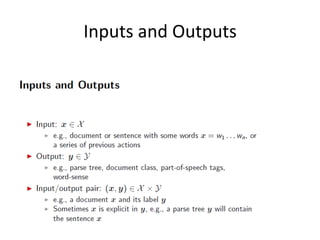
Inputs 
and 
Outputs
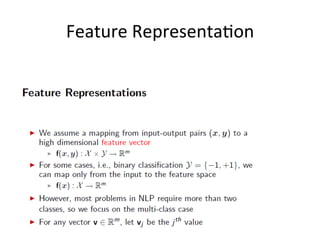
Feature 
Representa2on
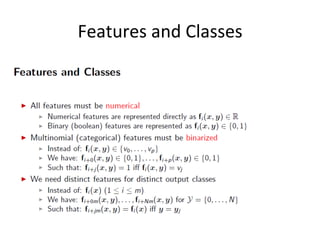
Features 
and 
Classes
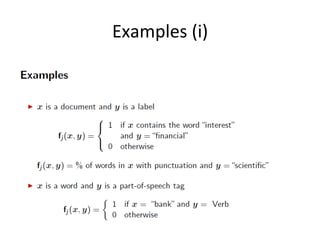
Examples 
(i)
Examples 
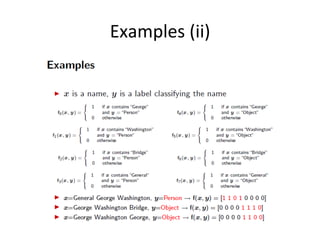
(ii)
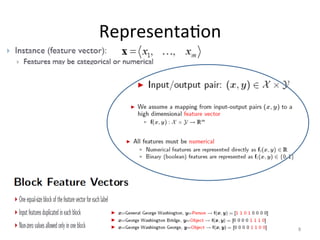
Block 
Feature 
Vectors
Representa2on 
Linear 
Classifiers: 
Repe22on 
& 
Extension 
8
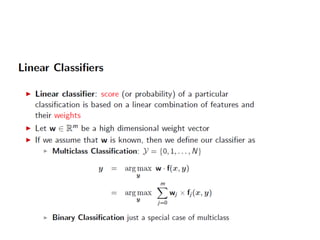
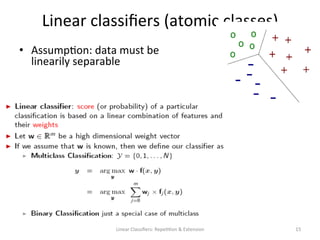
Linear 
classifiers 
(atomic 
classes) 
Linear 
Classifiers: 
Repe22on 
& 
Extension 
15 
• Assump2on: 
data 
must 
be 
linearily 
separable
Perceptron
Perceptron 
(i)
Perceptron 
Learning 
Algorithm
Separability 
and 
Margin 
(i)
Separability 
and 
Margin 
(ii) 
Linear 
Classifiers: 
Repe22on 
& 
Extension 
20 
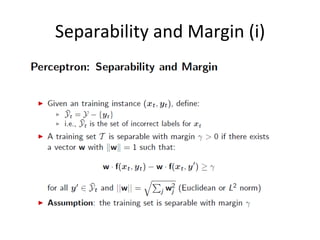
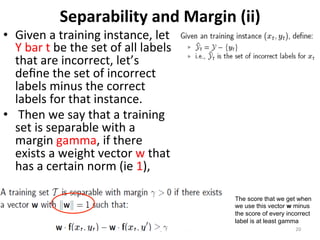
• Given 
a 
training 
instance, 
let 
Y 
bar 
t 
be 
the 
set 
of 
all 
labels 
that 
are 
incorrect, 
let’s 
define 
the 
set 
of 
incorrect 
labels 
minus 
the 
correct 
labels 
for 
that 
instance. 
• 
Then 
we 
say 
that 
a 
training 
set 
is 
separable 
with 
a 
margin 
gamma, 
if 
there 
exists 
a 
weight 
vector 
w 
that 
has 
a 
certain 
norm 
(ie 
1), 
The score that we get when 
we use this vector w minus 
the score of every incorrect 
label is at least gamma
Separability 
and 
Margin 
(iii) 
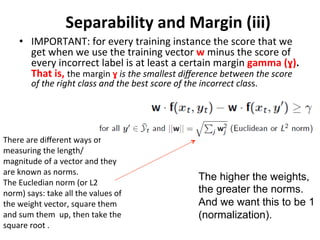
• IMPORTANT: 
for 
every 
training 
instance 
the 
score 
that 
we 
get 
when 
we 
use 
the 
training 
vector 
w 
minus 
the 
score 
of 
every 
incorrect 
label 
is 
at 
least 
a 
certain 
margin 
gamma 
(ɣ). 
That 
is, 
the 
margin 
ɣ 
is 
the 
smallest 
difference 
between 
the 
score 
of 
the 
right 
class 
and 
the 
best 
score 
of 
the 
incorrect 
class. 
The higher the weights, 
the greater the norms. 
And we want this to be 1 
(normalization). 
There 
are 
different 
ways 
of 
measuring 
the 
length/ 
magnitude 
of 
a 
vector 
and 
they 
are 
known 
as 
norms. 
The 
Eucledian 
norm 
(or 
L2 
norm) 
says: 
take 
all 
the 
values 
of 
the 
weight 
vector, 
square 
them 
and 
sum 
them 
up, 
then 
take 
the 
square 
root 
.
Perceptron 
Linear 
Classifiers: 
Repe22on 
& 
Extension 
22
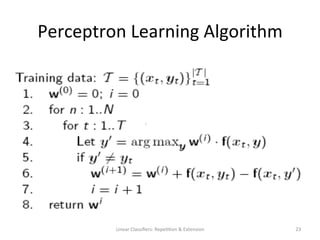
Perceptron 
Learning 
Algorithm 
Linear 
Classifiers: 
Repe22on 
& 
Extension 
23
Main 
Theorem
25 
Linear 
Classifiers: 
Repe22on 
& 
Extension 
Perceptron 
Theorem 
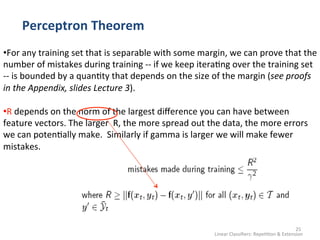
• For 
any 
training 
set 
that 
is 
separable 
with 
some 
margin, 
we 
can 
prove 
that 
the 
number 
of 
mistakes 
during 
training 
-­‐-­‐ 
if 
we 
keep 
itera2ng 
over 
the 
training 
set 
-­‐-­‐ 
is 
bounded 
by 
a 
quan2ty 
that 
depends 
on 
the 
size 
of 
the 
margin 
(see 
proofs 
in 
the 
Appendix, 
slides 
Lecture 
3). 
• R 
depends 
on 
the 
norm 
of 
the 
largest 
difference 
you 
can 
have 
between 
feature 
vectors. 
The 
larger 
R, 
the 
more 
spread 
out 
the 
data, 
the 
more 
errors 
we 
can 
poten2ally 
make. 
Similarly 
if 
gamma 
is 
larger 
we 
will 
make 
fewer 
mistakes.
Summary
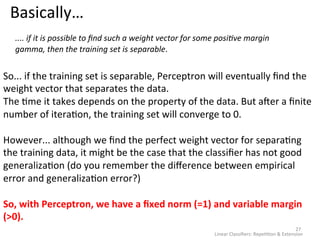
Basically… 
27 
.... 
if 
it 
is 
possible 
to 
find 
such 
a 
weight 
vector 
for 
some 
posiAve 
margin 
gamma, 
then 
the 
training 
set 
is 
Linear 
Classifiers: 
Repe22on 
& 
Extension 
separable. 
So... 
if 
the 
training 
set 
is 
separable, 
Perceptron 
will 
eventually 
find 
the 
weight 
vector 
that 
separates 
the 
data. 
The 
2me 
it 
takes 
depends 
on 
the 
property 
of 
the 
data. 
But 
aeer 
a 
finite 
number 
of 
itera2on, 
the 
training 
set 
will 
converge 
to 
0. 
However... 
although 
we 
find 
the 
perfect 
weight 
vector 
for 
separa2ng 
the 
training 
data, 
it 
might 
be 
the 
case 
that 
the 
classifier 
has 
not 
good 
generaliza2on 
(do 
you 
remember 
the 
difference 
between 
empirical 
error 
and 
generaliza2on 
error?) 
So, 
with 
Perceptron, 
we 
have 
a 
fixed 
norm 
(=1) 
and 
variable 
margin 
(>0).
Appendix: 
Proofs 
and 
Deriva2ons
Lecture 9 Perceptron

Lecture 9 Perceptron

  • 1.
    Machine Learning for Language Technology Lecture 9: Perceptron Marina San2ni Department of Linguis2cs and Philology Uppsala University, Uppsala, Sweden Autumn 2014 Acknowledgement: Thanks to Prof. Joakim Nivre for course design and materials 1
  • 2.
  • 3.
  • 4.
  • 5.
  • 6.
  • 7.
  • 8.
    Representa2on Linear Classifiers: Repe22on & Extension 8
  • 15.
    Linear classifiers (atomic classes) Linear Classifiers: Repe22on & Extension 15 • Assump2on: data must be linearily separable
  • 16.
  • 17.
  • 18.
  • 19.
  • 20.
    Separability and Margin (ii) Linear Classifiers: Repe22on & Extension 20 • Given a training instance, let Y bar t be the set of all labels that are incorrect, let’s define the set of incorrect labels minus the correct labels for that instance. • Then we say that a training set is separable with a margin gamma, if there exists a weight vector w that has a certain norm (ie 1), The score that we get when we use this vector w minus the score of every incorrect label is at least gamma
  • 21.
    Separability and Margin (iii) • IMPORTANT: for every training instance the score that we get when we use the training vector w minus the score of every incorrect label is at least a certain margin gamma (ɣ). That is, the margin ɣ is the smallest difference between the score of the right class and the best score of the incorrect class. The higher the weights, the greater the norms. And we want this to be 1 (normalization). There are different ways of measuring the length/ magnitude of a vector and they are known as norms. The Eucledian norm (or L2 norm) says: take all the values of the weight vector, square them and sum them up, then take the square root .
  • 22.
    Perceptron Linear Classifiers: Repe22on & Extension 22
  • 23.
    Perceptron Learning Algorithm Linear Classifiers: Repe22on & Extension 23
  • 24.
  • 25.
    25 Linear Classifiers: Repe22on & Extension Perceptron Theorem • For any training set that is separable with some margin, we can prove that the number of mistakes during training -­‐-­‐ if we keep itera2ng over the training set -­‐-­‐ is bounded by a quan2ty that depends on the size of the margin (see proofs in the Appendix, slides Lecture 3). • R depends on the norm of the largest difference you can have between feature vectors. The larger R, the more spread out the data, the more errors we can poten2ally make. Similarly if gamma is larger we will make fewer mistakes.
  • 26.
  • 27.
    Basically… 27 .... if it is possible to find such a weight vector for some posiAve margin gamma, then the training set is Linear Classifiers: Repe22on & Extension separable. So... if the training set is separable, Perceptron will eventually find the weight vector that separates the data. The 2me it takes depends on the property of the data. But aeer a finite number of itera2on, the training set will converge to 0. However... although we find the perfect weight vector for separa2ng the training data, it might be the case that the classifier has not good generaliza2on (do you remember the difference between empirical error and generaliza2on error?) So, with Perceptron, we have a fixed norm (=1) and variable margin (>0).
  • 28.