Teaching to Exceed the English
Language Arts Common Core
Standards: MSU Seminar
Richard Beach, University of Minnesota
Resource website:

http://englishccss.pbworks.com
Strengths of the CCSS


Not mandating content to be taught
◦ Versus the Profile of Learning

Emphasis on informational
texts/argumentative writing
 Connection to social studies and science
 Shared curriculum across different
states and districts

Limitations of the CCSS


Formalist approach to reading/writing
instruction
◦ Teaching structures of essay/literature
versus responses/experiences

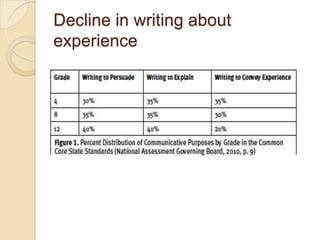
Less attention to writing about
experiences or engagement responses
to literature
 Corporate publishing/testing shaping of
the curriculum

Decline in writing about
experience
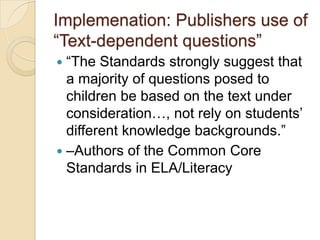
Implemenation: Publishers use of
―Text-dependent questions‖
―The Standards strongly suggest that
a majority of questions posed to
children be based on the text under
consideration…, not rely on students’
different knowledge backgrounds.‖
 –Authors of the Common Core
Standards in ELA/Literacy

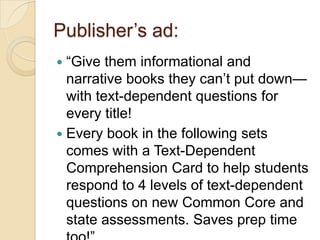
Publisher’s ad:
―Give them informational and
narrative books they can’t put down—
with text-dependent questions for
every title!
 Every book in the following sets
comes with a Text-Dependent
Comprehension Card to help students
respond to 4 levels of text-dependent
questions on new Common Core and
state assessments. Saves prep time

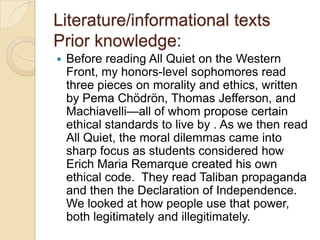
Literature/informational texts
Prior knowledge:


Before reading All Quiet on the Western
Front, my honors-level sophomores read
three pieces on morality and ethics, written
by Pema Chödrön, Thomas Jefferson, and
Machiavelli—all of whom propose certain
ethical standards to live by . As we then read
All Quiet, the moral dilemmas came into
sharp focus as students considered how
Erich Maria Remarque created his own
ethical code. They read Taliban propaganda
and then the Declaration of Independence.
We looked at how people use that power,
both legitimately and illegitimately.
Grade level standards based on
―progressions‖: Literature
6th grade. Interpret the figurative and
connotative meanings of words and
phrases as they are used in a text.
 7th grade. Interpret the figurative and
connotative meanings of words and
phrases as they are used in a text and
describe in detail a specific word choice
and its impact on meaning and tone.
 8th grade. Explain the comparisons an
author makes through metaphors,
allusions, or analogies in a text and
analyze how those comparisons
contribute to meaning.

Karp: The Problems with the
Common Core, Rethinking
Schools

Ignores the larger context shaped by
 Failure of NCLB
 Text-based teacher evaluation
 Budget cuts (Republican legislatures)
 Privatization
 Income inquality
 Increased college costs
 Market/business discourses

CCSS: Educational equity
Kornhaber, M.L., Griffith, K., & Tyler,
A. (2014). It’s not education by zip
code anymore – but what is it?
Conceptions of equity under the
Common Core. Education Policy
Analysis Archives, 22 (4).
http://dx.doi.org/10.14507/epaa.v22n4.
2014

Different conceptions of
addressing inequities
―Equal‖: CCSS provides same ―high
standards‖ for all students:
meritocracy
 ―Equalizing‖: target resources to
assist schools most in need: Legal
issues: Who decides: providing for
both low-and upper income schools
 ―Expansive‖: range of financial and
policy interventions that go beyond
curriculum reform

Shift in funding


Given the steep costs and distribution
of benefits of this, and other,
standards-based reforms, we believe
a more productive course would be to
devise and support policies based on
equalizing or expansive views.
Challenge of PARCC/Smarter
Balanced Summative
Assessments


Assessments are on-line requiring
time for engagement in complex tasks
◦ Studying issues of building a nuclear plant
by online research to identify pro-con
positions



Survey: Level of preparation
◦ Only 11% are ―well-prepared‖
◦ 40%: students lack skills
◦ Lack of computers/bandwidth
CCSS and instructional
models
Skills
Formalist/structuralist/text genre
Process/procedures/strategies (See
Aukerman, 2013 for critique)
Social practices (Barton & Lee, 2013)
Use of practices for social purposes
Texting: Social coordination (Pigg
et al., 2013, Written
Communication) social connections with
 Use of texting: maintain


friends and family members as social
coordination:
Provides college students an active means for
organizing ―things‖ that matter to them within the
contexts of the goals, identities, and domains
that are meaningful to them: projects,
internships, information, personal memory—
even their own learning trajectories…By
bringing people and things (like events or
projects) into alignment, coordination becomes a
way for students to actively participate and
meaningfully direct their relationship to many of
the roles and identities that characterize their
lives in college. (p. 19)
Social practice framework
Framing/contextualizing events and texts
Constructing and enacting identities
Relating to and collaborating with others
Constructing texts or objects
Synthesizing and connecting texts
Critiquing and representing issues
Negotiating identities/adopting
perspectives: Online role-play
Issue: Access to information on
blocked websites
 Students adopt pro-con roles


◦
◦
◦
◦
◦

construct a persona
employ rhetorical appeals
support their position with reasons
identify and refute counter-arguments
revise or modify one’s own positions
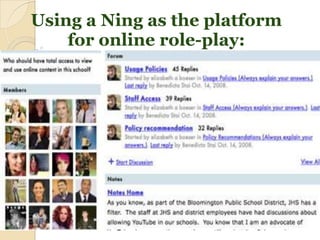
Using a Ning as the platform
for online role-play:
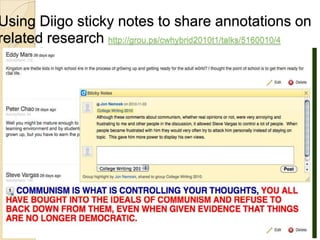
Using Diigo sticky notes to share annotations on
related research http://grou.ps/cwhybrid2010t1/talks/5160010/4
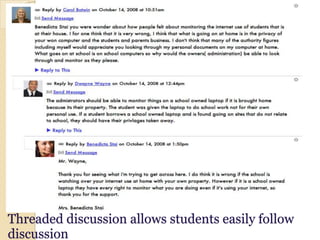
Threaded discussion allows students easily follow
discussion
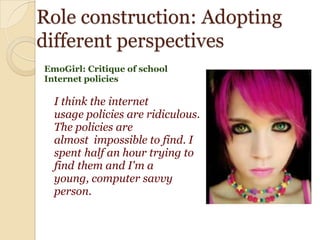
Role construction: Adopting
different perspectives
EmoGirl: Critique of school
Internet policies

I think the internet
usage policies are ridiculous.
The policies are
almost impossible to find. I
spent half an hour trying to
find them and I'm a
young, computer savvy
person.
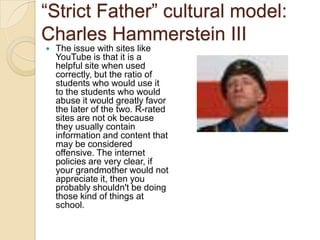
―Strict Father‖ cultural model:
Charles Hammerstein III


The issue with sites like
YouTube is that it is a
helpful site when used
correctly, but the ratio of
students who would use it
to the students who would
abuse it would greatly favor
the later of the two. R-rated
sites are not ok because
they usually contain
information and content that
may be considered
offensive. The internet
policies are very clear, if
your grandmother would not
appreciate it, then you
probably shouldn't be doing
those kind of things at
school.
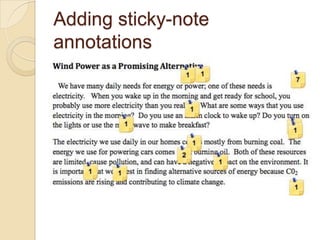
Diigo annotations: Pro-con
readings: benefits of energy from
wind power
th
7 grade students iMelanie
Swandby’s
◦ Lighthouse School Community
Charter School, Oakland, California
 Students posed questions for each
other
◦ ―What does that mean, virtually
free?‖
◦ What are some things that use
energy or power?‖

Adding sticky-note
annotations
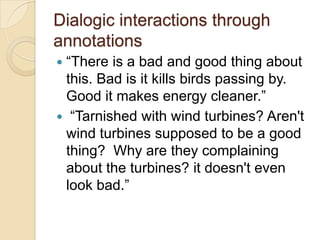
Dialogic interactions through
annotations
―There is a bad and good thing about
this. Bad is it kills birds passing by.
Good it makes energy cleaner.‖
 ―Tarnished with wind turbines? Aren't
wind turbines supposed to be a good
thing? Why are they complaining
about the turbines? it doesn't even
look bad.‖

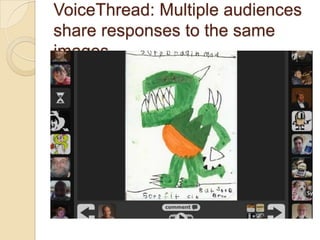
VoiceThread: Multiple audiences
share responses to the same
images
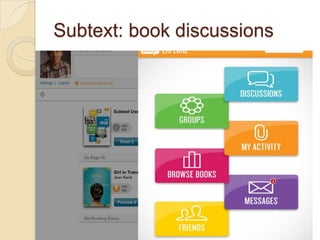
Subtext: book discussions
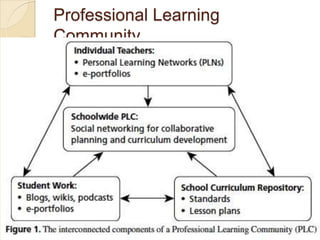
Professional Learning
Community

Msu standards pp

  • 1.
    Teaching to Exceedthe English Language Arts Common Core Standards: MSU Seminar Richard Beach, University of Minnesota Resource website: http://englishccss.pbworks.com
  • 2.
    Strengths of theCCSS  Not mandating content to be taught ◦ Versus the Profile of Learning Emphasis on informational texts/argumentative writing  Connection to social studies and science  Shared curriculum across different states and districts 
  • 3.
    Limitations of theCCSS  Formalist approach to reading/writing instruction ◦ Teaching structures of essay/literature versus responses/experiences Less attention to writing about experiences or engagement responses to literature  Corporate publishing/testing shaping of the curriculum 
  • 4.
    Decline in writingabout experience
  • 5.
    Implemenation: Publishers useof ―Text-dependent questions‖ ―The Standards strongly suggest that a majority of questions posed to children be based on the text under consideration…, not rely on students’ different knowledge backgrounds.‖  –Authors of the Common Core Standards in ELA/Literacy 
  • 6.
    Publisher’s ad: ―Give theminformational and narrative books they can’t put down— with text-dependent questions for every title!  Every book in the following sets comes with a Text-Dependent Comprehension Card to help students respond to 4 levels of text-dependent questions on new Common Core and state assessments. Saves prep time 
  • 7.
    Literature/informational texts Prior knowledge:  Beforereading All Quiet on the Western Front, my honors-level sophomores read three pieces on morality and ethics, written by Pema Chödrön, Thomas Jefferson, and Machiavelli—all of whom propose certain ethical standards to live by . As we then read All Quiet, the moral dilemmas came into sharp focus as students considered how Erich Maria Remarque created his own ethical code. They read Taliban propaganda and then the Declaration of Independence. We looked at how people use that power, both legitimately and illegitimately.
  • 8.
    Grade level standardsbased on ―progressions‖: Literature 6th grade. Interpret the figurative and connotative meanings of words and phrases as they are used in a text.  7th grade. Interpret the figurative and connotative meanings of words and phrases as they are used in a text and describe in detail a specific word choice and its impact on meaning and tone.  8th grade. Explain the comparisons an author makes through metaphors, allusions, or analogies in a text and analyze how those comparisons contribute to meaning. 
  • 9.
    Karp: The Problemswith the Common Core, Rethinking Schools Ignores the larger context shaped by  Failure of NCLB  Text-based teacher evaluation  Budget cuts (Republican legislatures)  Privatization  Income inquality  Increased college costs  Market/business discourses 
  • 10.
    CCSS: Educational equity Kornhaber,M.L., Griffith, K., & Tyler, A. (2014). It’s not education by zip code anymore – but what is it? Conceptions of equity under the Common Core. Education Policy Analysis Archives, 22 (4). http://dx.doi.org/10.14507/epaa.v22n4. 2014 
  • 11.
    Different conceptions of addressinginequities ―Equal‖: CCSS provides same ―high standards‖ for all students: meritocracy  ―Equalizing‖: target resources to assist schools most in need: Legal issues: Who decides: providing for both low-and upper income schools  ―Expansive‖: range of financial and policy interventions that go beyond curriculum reform 
  • 12.
    Shift in funding  Giventhe steep costs and distribution of benefits of this, and other, standards-based reforms, we believe a more productive course would be to devise and support policies based on equalizing or expansive views.
  • 13.
    Challenge of PARCC/Smarter BalancedSummative Assessments  Assessments are on-line requiring time for engagement in complex tasks ◦ Studying issues of building a nuclear plant by online research to identify pro-con positions  Survey: Level of preparation ◦ Only 11% are ―well-prepared‖ ◦ 40%: students lack skills ◦ Lack of computers/bandwidth
  • 14.
    CCSS and instructional models Skills Formalist/structuralist/textgenre Process/procedures/strategies (See Aukerman, 2013 for critique) Social practices (Barton & Lee, 2013) Use of practices for social purposes
  • 15.
    Texting: Social coordination(Pigg et al., 2013, Written Communication) social connections with  Use of texting: maintain  friends and family members as social coordination: Provides college students an active means for organizing ―things‖ that matter to them within the contexts of the goals, identities, and domains that are meaningful to them: projects, internships, information, personal memory— even their own learning trajectories…By bringing people and things (like events or projects) into alignment, coordination becomes a way for students to actively participate and meaningfully direct their relationship to many of the roles and identities that characterize their lives in college. (p. 19)
  • 16.
    Social practice framework Framing/contextualizingevents and texts Constructing and enacting identities Relating to and collaborating with others Constructing texts or objects Synthesizing and connecting texts Critiquing and representing issues
  • 17.
    Negotiating identities/adopting perspectives: Onlinerole-play Issue: Access to information on blocked websites  Students adopt pro-con roles  ◦ ◦ ◦ ◦ ◦ construct a persona employ rhetorical appeals support their position with reasons identify and refute counter-arguments revise or modify one’s own positions
  • 18.
    Using a Ningas the platform for online role-play:
  • 19.
    Using Diigo stickynotes to share annotations on related research http://grou.ps/cwhybrid2010t1/talks/5160010/4
  • 20.
    Threaded discussion allowsstudents easily follow discussion
  • 21.
    Role construction: Adopting differentperspectives EmoGirl: Critique of school Internet policies I think the internet usage policies are ridiculous. The policies are almost impossible to find. I spent half an hour trying to find them and I'm a young, computer savvy person.
  • 22.
    ―Strict Father‖ culturalmodel: Charles Hammerstein III  The issue with sites like YouTube is that it is a helpful site when used correctly, but the ratio of students who would use it to the students who would abuse it would greatly favor the later of the two. R-rated sites are not ok because they usually contain information and content that may be considered offensive. The internet policies are very clear, if your grandmother would not appreciate it, then you probably shouldn't be doing those kind of things at school.
  • 23.
    Diigo annotations: Pro-con readings:benefits of energy from wind power th 7 grade students iMelanie Swandby’s ◦ Lighthouse School Community Charter School, Oakland, California  Students posed questions for each other ◦ ―What does that mean, virtually free?‖ ◦ What are some things that use energy or power?‖ 
  • 24.
  • 25.
    Dialogic interactions through annotations ―Thereis a bad and good thing about this. Bad is it kills birds passing by. Good it makes energy cleaner.‖  ―Tarnished with wind turbines? Aren't wind turbines supposed to be a good thing? Why are they complaining about the turbines? it doesn't even look bad.‖ 
  • 26.
    VoiceThread: Multiple audiences shareresponses to the same images
  • 27.
  • 28.