Librarians …


@ the Core of Common Core !
Outcomes
Learn:
•How CCSS Standards are vertically and
    horizontally aligned and how they flow.
•How to unwrap CCSS and understand their
    relationship to PASS.
•How to bump up PASS lessons to CCSS higher
    level thinking and rigor.
Reactions to the words,
“Common Core”
Writing, rigor, READ,
informational text,
language arts, social
studies, science,
gather, analyze,
evaluate, compare,
argue, synthesize,
research,
internationally
benchmarked,
technology, literate,
evidence,
interdisciplinary,                    2014
independent
           Common Core…It’s all about us!
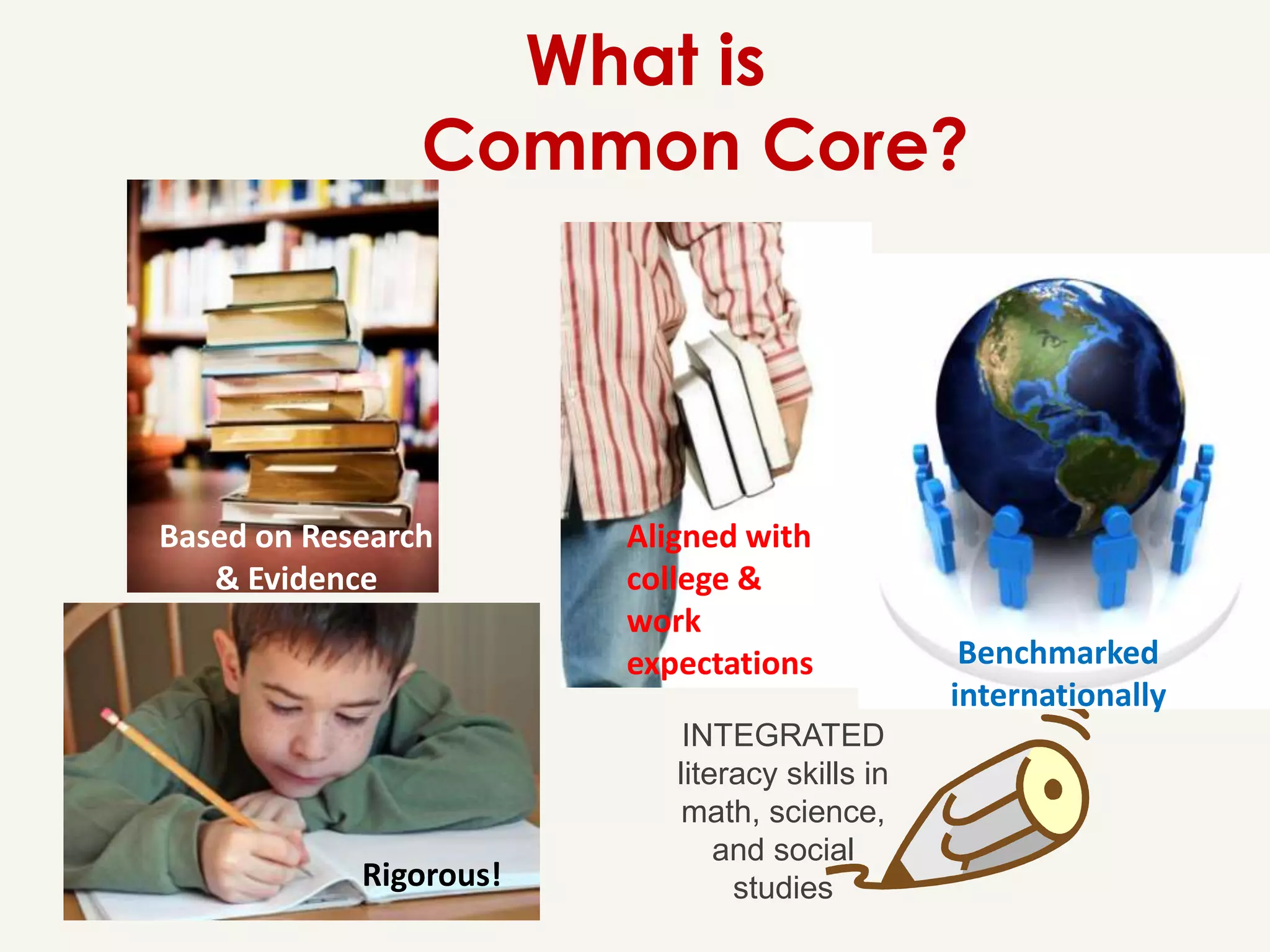
What is
                Common Core?


Based on Research       Aligned with
   & Evidence           college &
                        work
                        expectations             Benchmarked
                                                internationally
                            INTEGRATED
                           literacy skills in
                            math, science,
                               and social
            Rigorous!           studies
Common Core Standards:
Do NOT tell teachers how to teach.

Do NOT include all content students
   should learn.


   CCSS is meant to supplement state
     standards – not supplant them.
       Focus: PROCESS not CONTENT
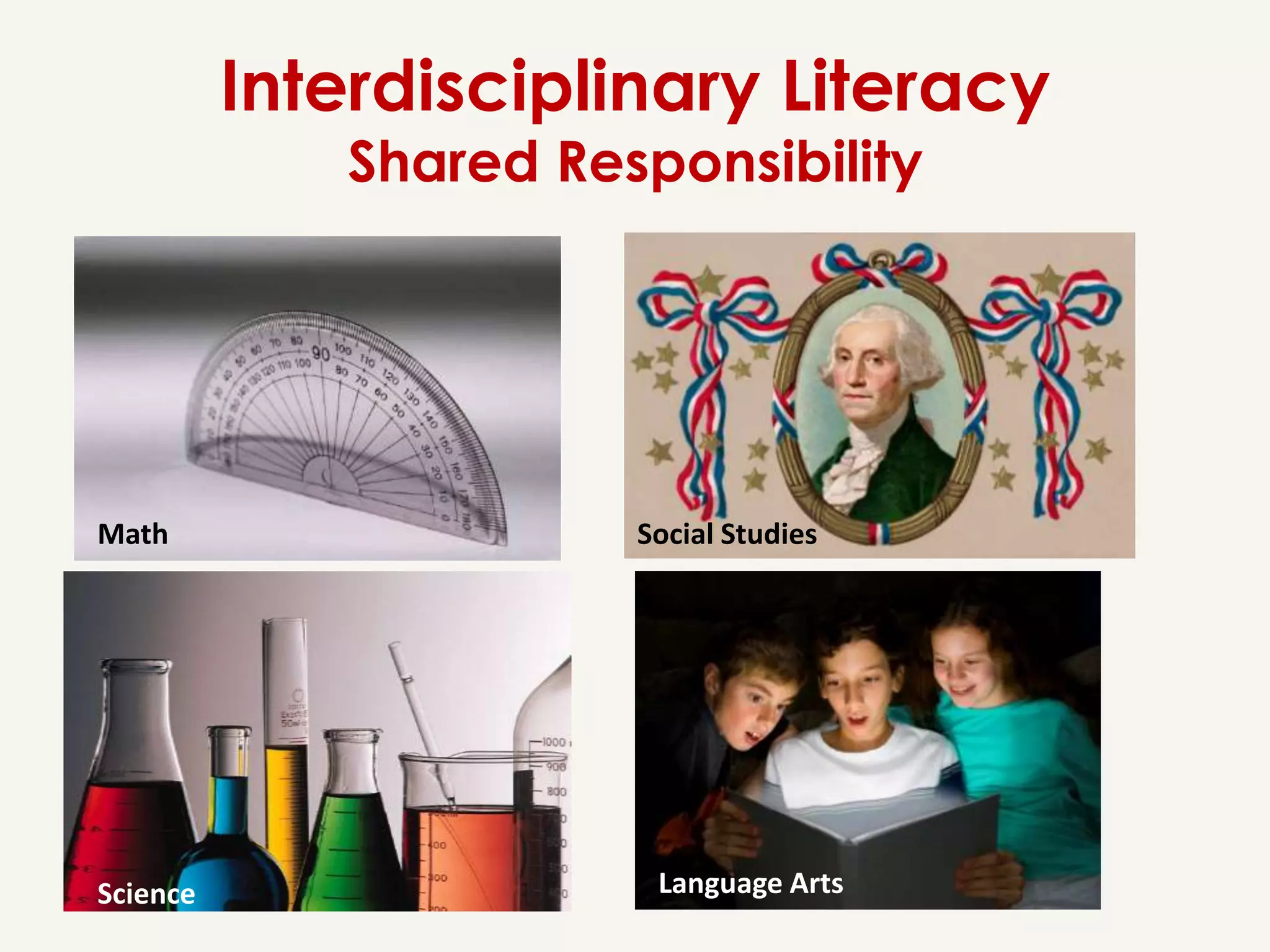
Interdisciplinary Literacy
             Shared Responsibility


Math                   Social Studies


Science                 Language Arts
Rigor
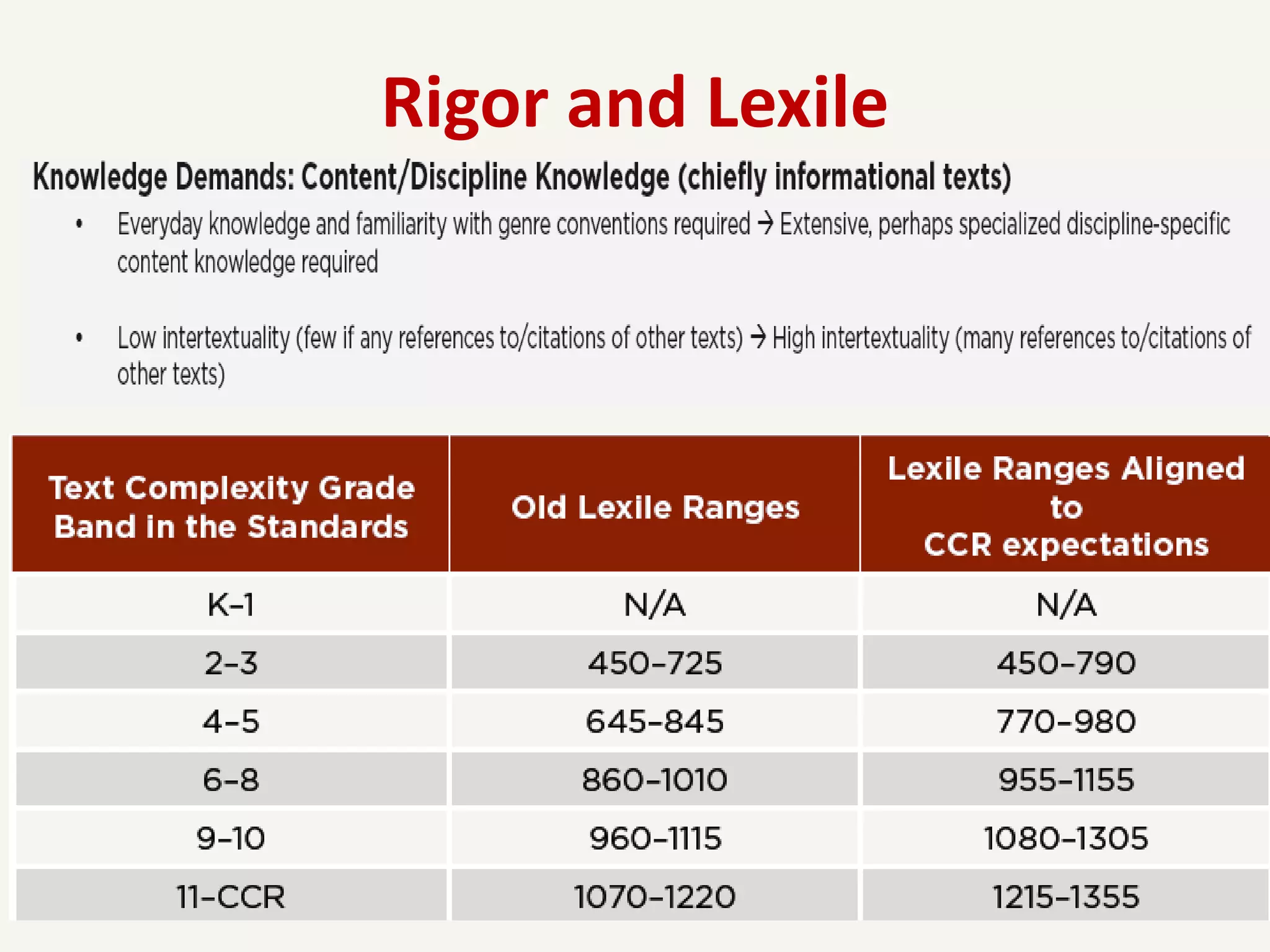
Rigor and Lexile
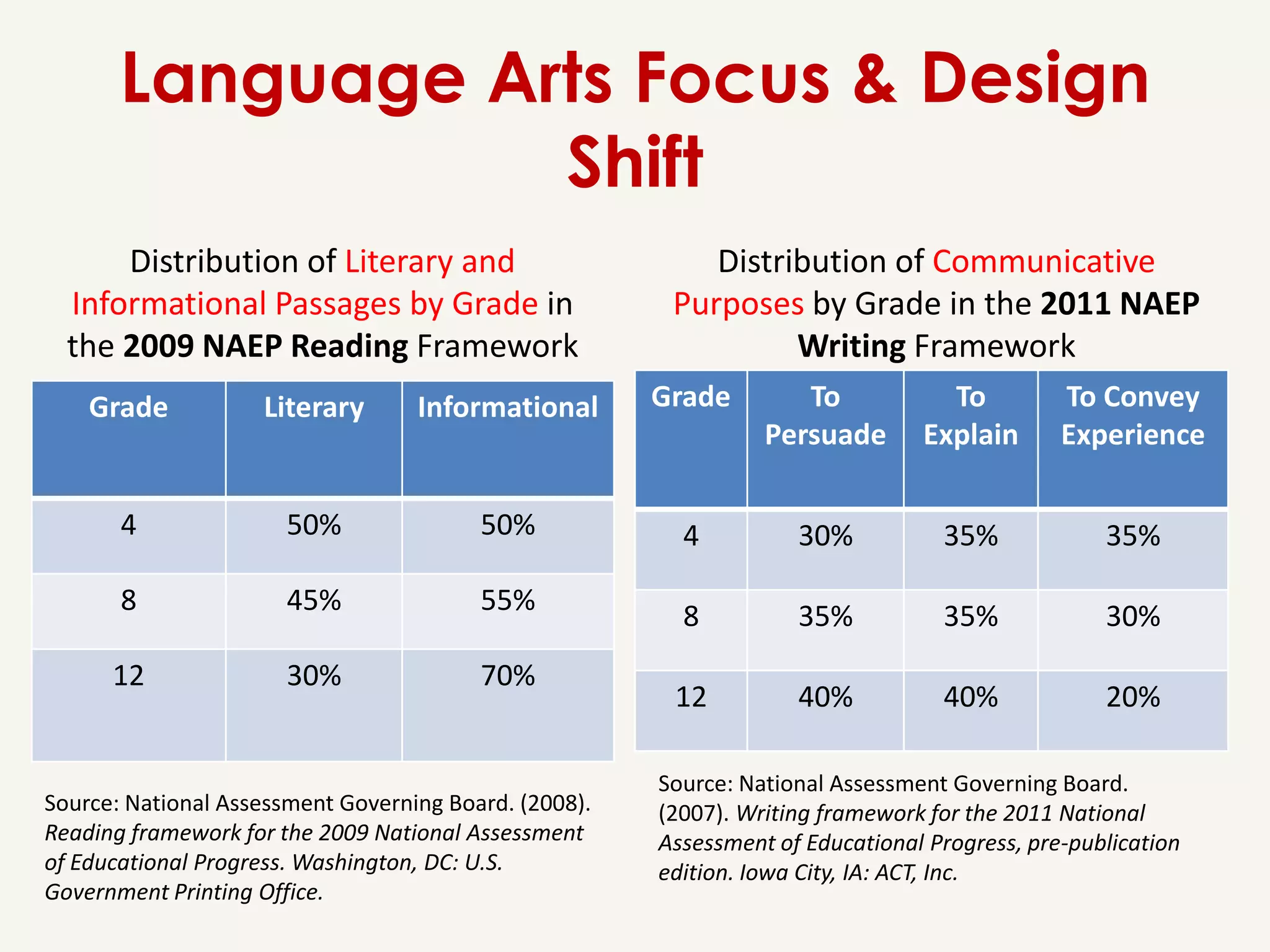
Language Arts Focus & Design
                  Shift
      Distribution of Literary and                         Distribution of Communicative
  Informational Passages by Grade in                    Purposes by Grade in the 2011 NAEP
  the 2009 NAEP Reading Framework                                Writing Framework
    Grade           Literary       Informational       Grade        To            To          To Convey
                                                                 Persuade       Explain       Experience

       4               50%               50%             4          30%           35%             35%

       8               45%               55%
                                                         8          35%           35%             30%
      12               30%               70%
                                                        12          40%           40%             20%

                                                       Source: National Assessment Governing Board.
Source: National Assessment Governing Board. (2008).   (2007). Writing framework for the 2011 National
Reading framework for the 2009 National Assessment     Assessment of Educational Progress, pre-publication
of Educational Progress. Washington, DC: U.S.          edition. Iowa City, IA: ACT, Inc.
Government Printing Office.
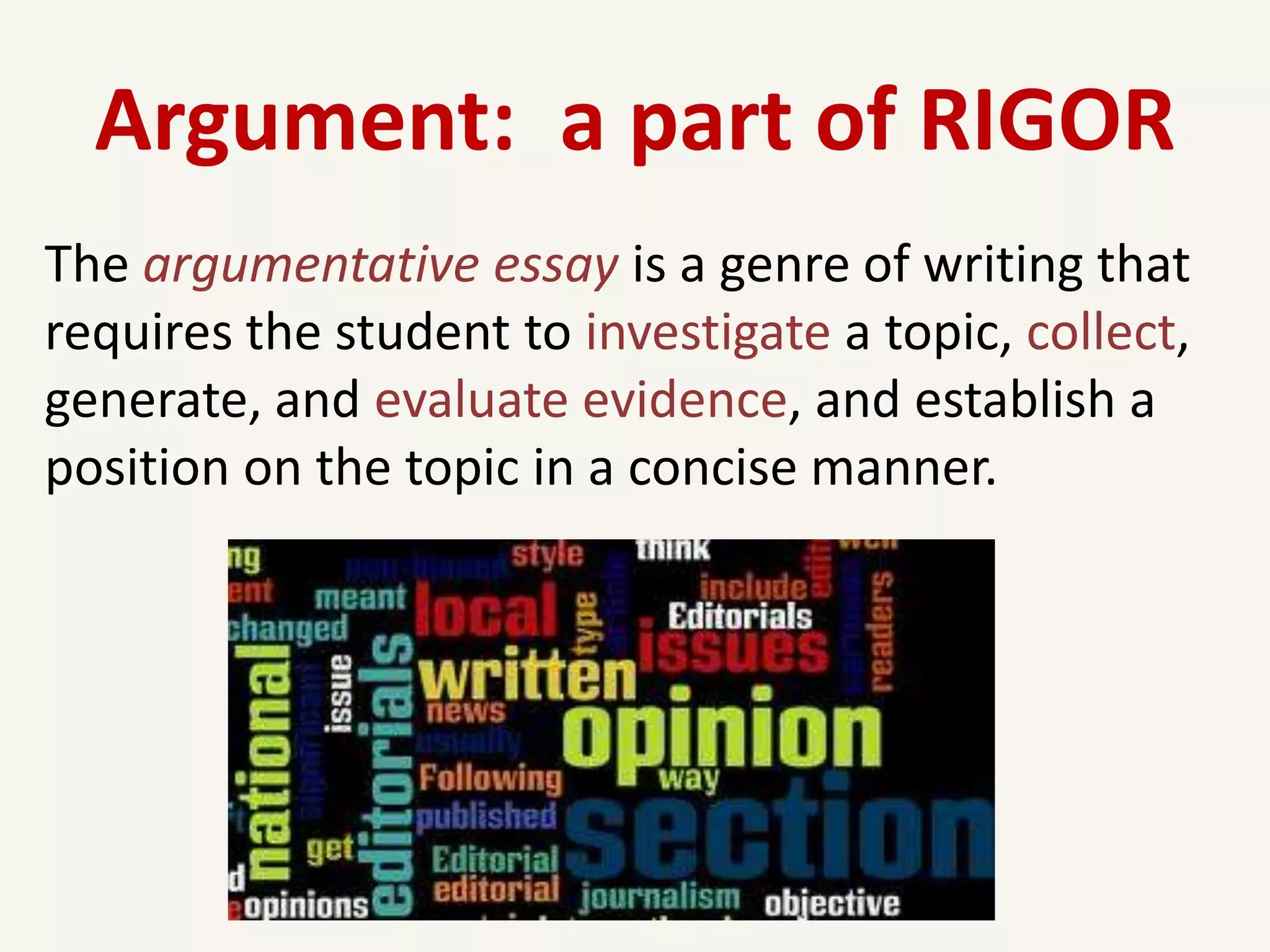
Argument: a part of RIGOR
The argumentative essay is a genre of writing that
requires the student to investigate a topic, collect,
generate, and evaluate evidence, and establish a
position on the topic in a concise manner.
Sample CCSS Performance Task
   Grade 3: Informational Texts


Students explain how the main idea that
Lincoln had “many faces” in Russell
Freedman’s Lincoln: A Photobiography is
supported by key details in the text.
[RI.3.2]
                PARCC Partnership for Assessment of Readiness of
                College and Careers
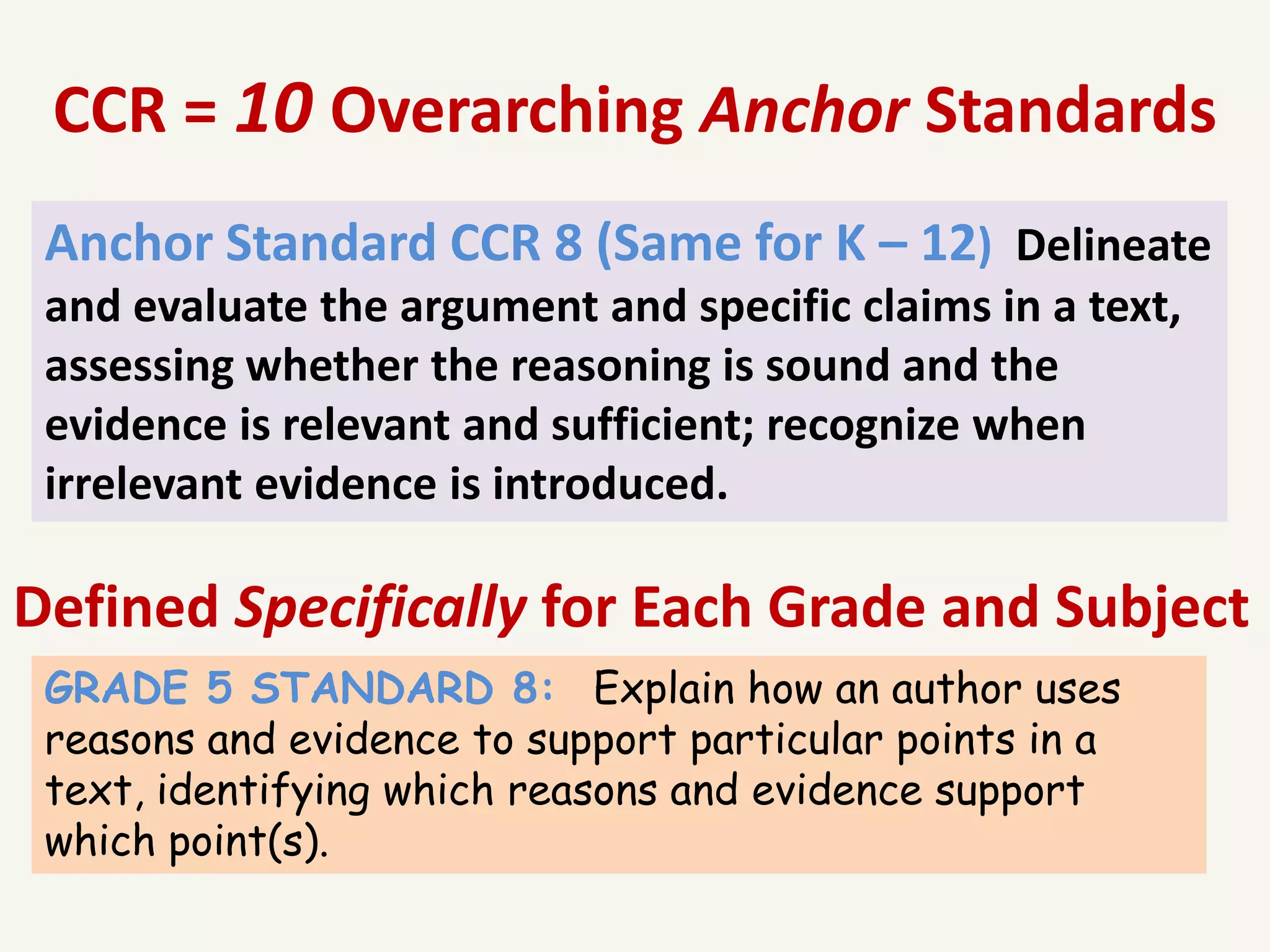
CCR = 10 Overarching Anchor Standards
 Anchor Standard CCR 8 (Same for K – 12) Delineate
 and evaluate the argument and specific claims in a text,
 assessing whether the reasoning is sound and the
 evidence is relevant and sufficient; recognize when
 irrelevant evidence is introduced.

Defined Specifically for Each Grade and Subject
 GRADE 5 STANDARD 8: Explain how an author uses
 reasons and evidence to support particular points in a
 text, identifying which reasons and evidence support
 which point(s).
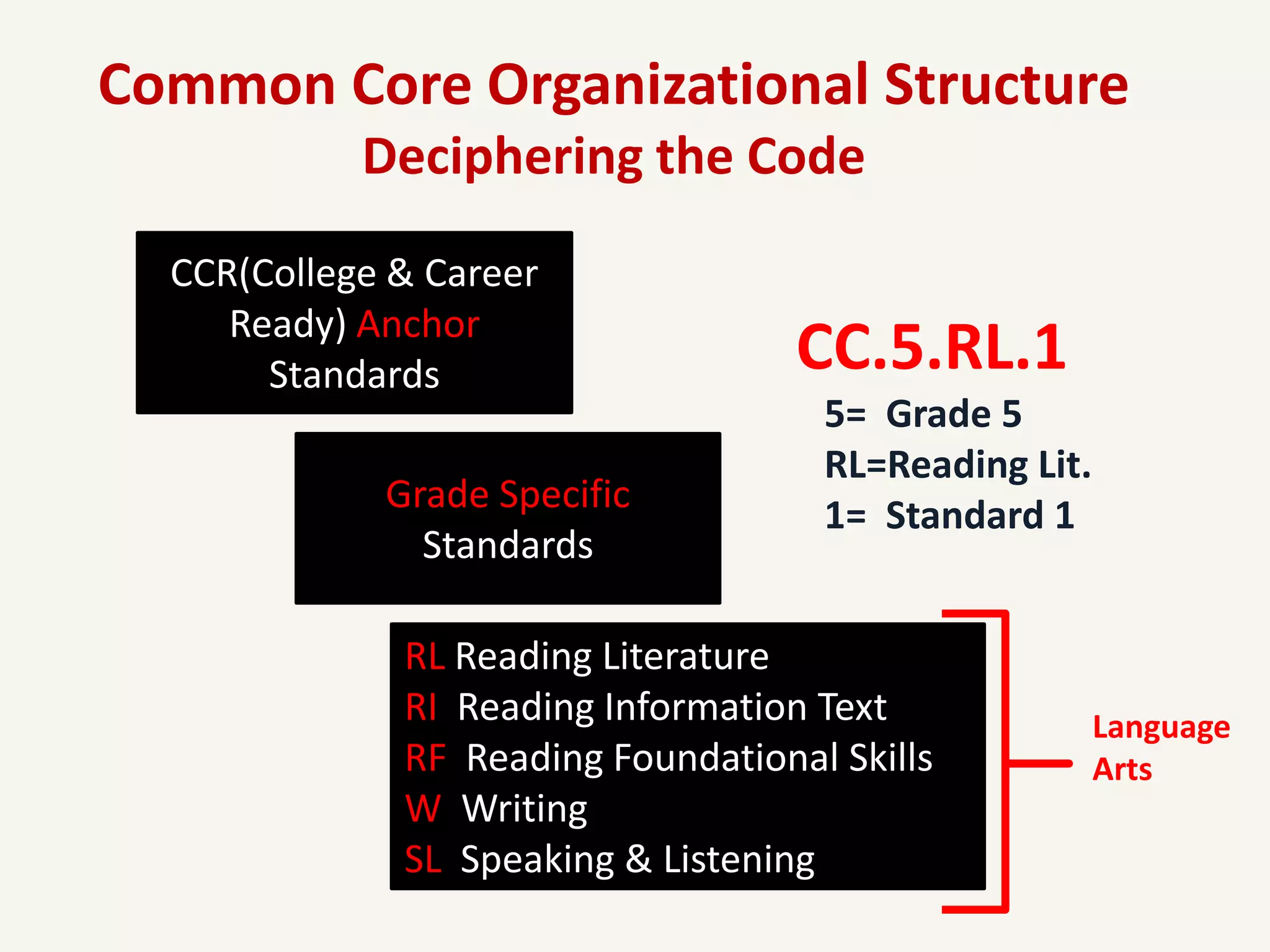
Common Core Organizational Structure
            Deciphering the Code
  CCR(College & Career
     Ready) Anchor
       Standards                    CC.5.RL.1
                                     5= Grade 5
                                     RL=Reading Lit.
             Grade Specific          1= Standard 1
               Standards

              RL Reading Literature
              RI Reading Information Text              Language
              RF Reading Foundational Skills           Arts
              W Writing
              SL Speaking & Listening
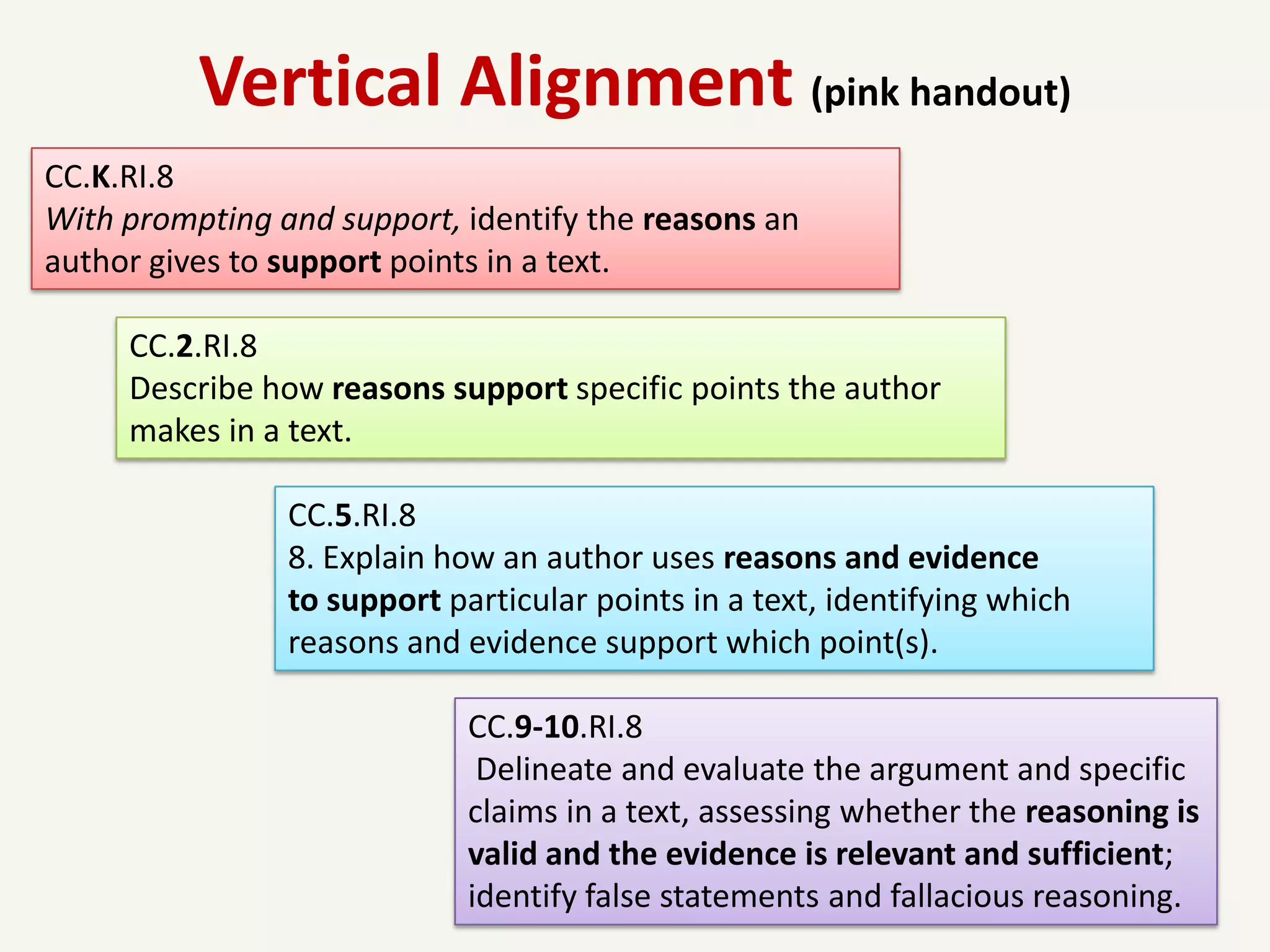
Vertical Alignment (pink handout)
CC.K.RI.8
With prompting and support, identify the reasons an
author gives to support points in a text.

     CC.2.RI.8
     Describe how reasons support specific points the author
     makes in a text.

                CC.5.RI.8
                8. Explain how an author uses reasons and evidence
                to support particular points in a text, identifying which
                reasons and evidence support which point(s).

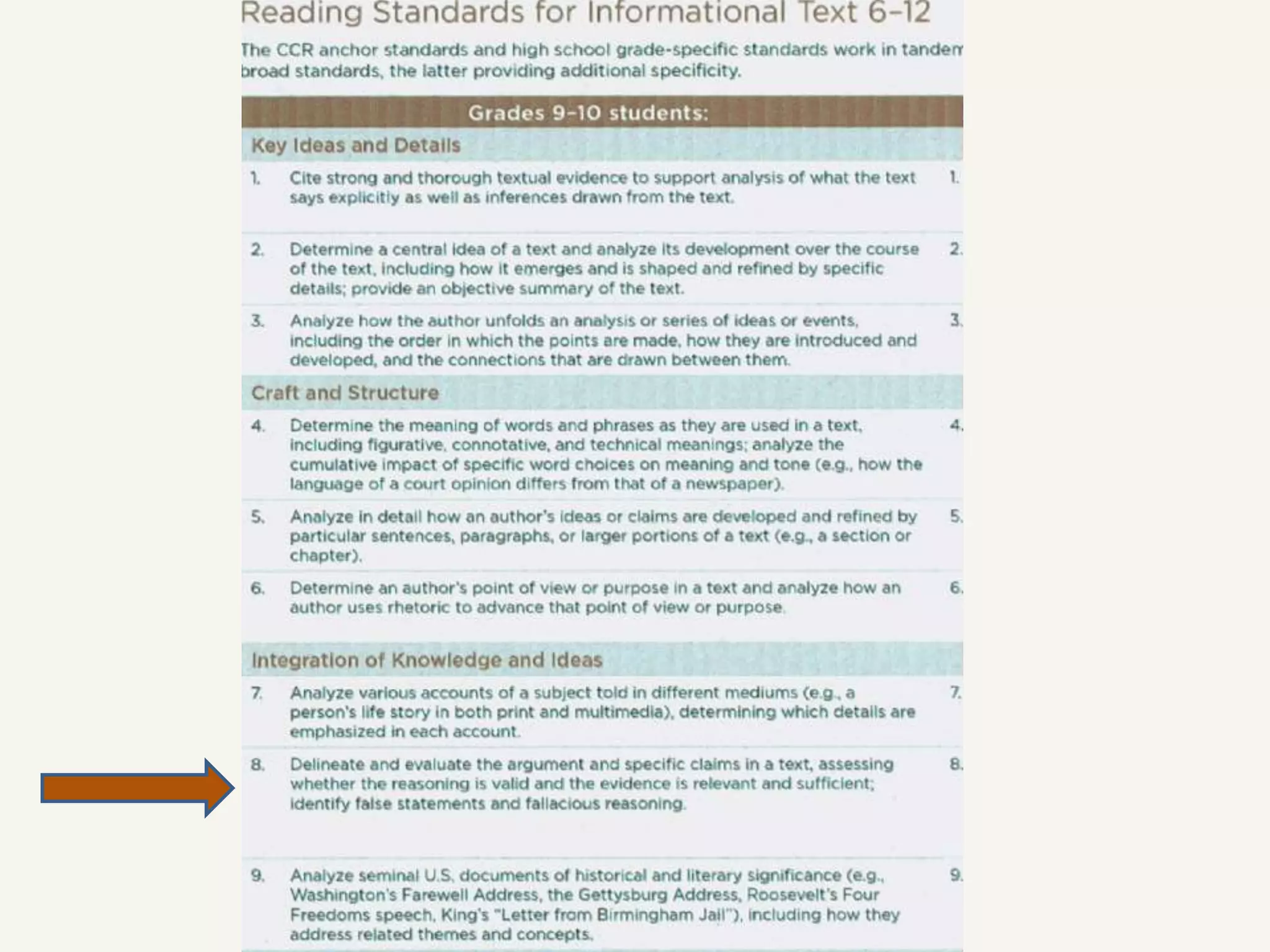
                             CC.9-10.RI.8
                              Delineate and evaluate the argument and specific
                             claims in a text, assessing whether the reasoning is
                             valid and the evidence is relevant and sufficient;
                             identify false statements and fallacious reasoning.
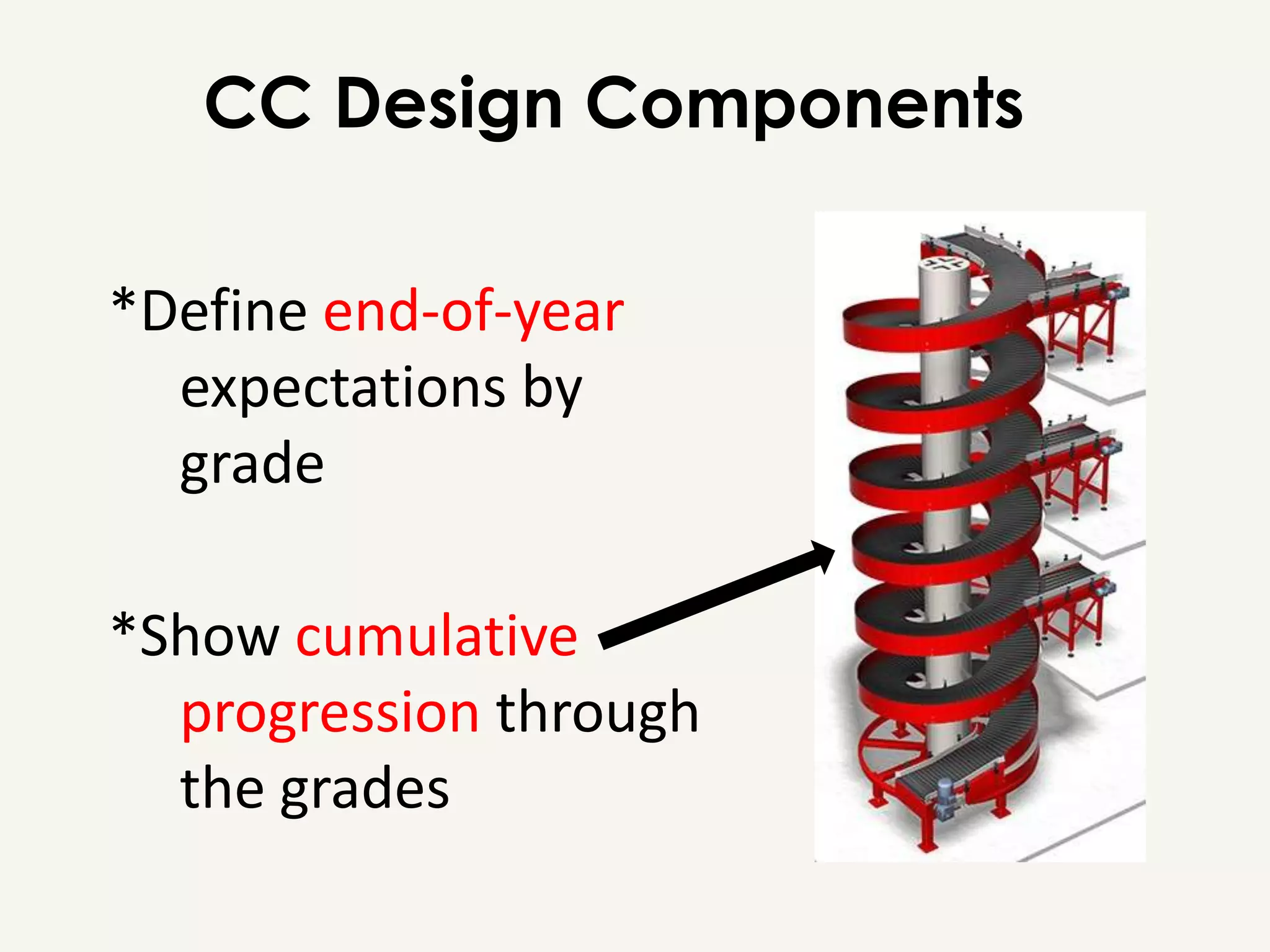
CC Design Components

*Define end-of-year
  expectations by
  grade

*Show cumulative
  progression through
  the grades
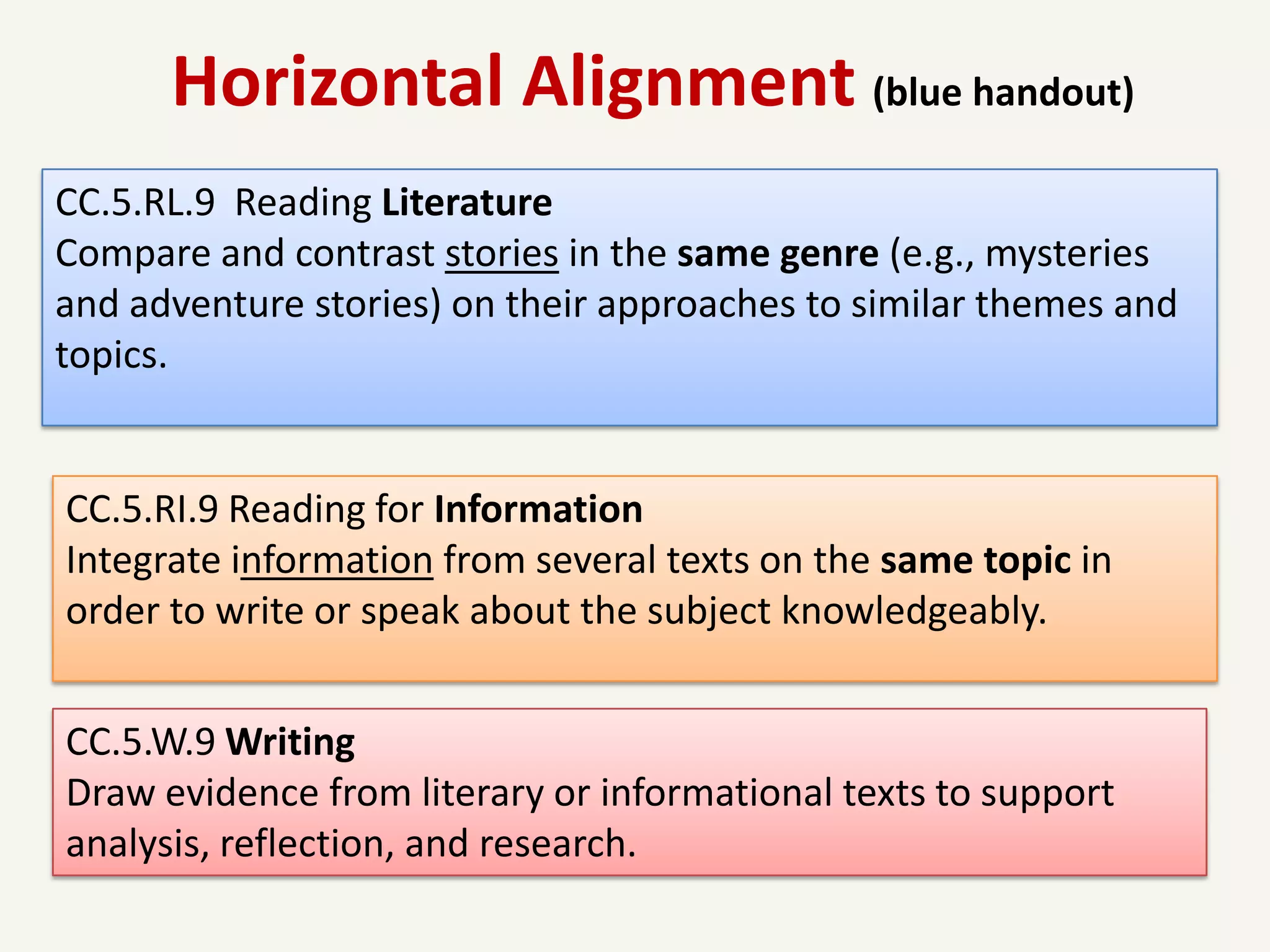
Horizontal Alignment (blue handout)
CC.5.RL.9 Reading Literature
Compare and contrast stories in the same genre (e.g., mysteries
and adventure stories) on their approaches to similar themes and
topics.


CC.5.RI.9 Reading for Information
Integrate information from several texts on the same topic in
order to write or speak about the subject knowledgeably.


CC.5.W.9 Writing
Draw evidence from literary or informational texts to support
analysis, reflection, and research.
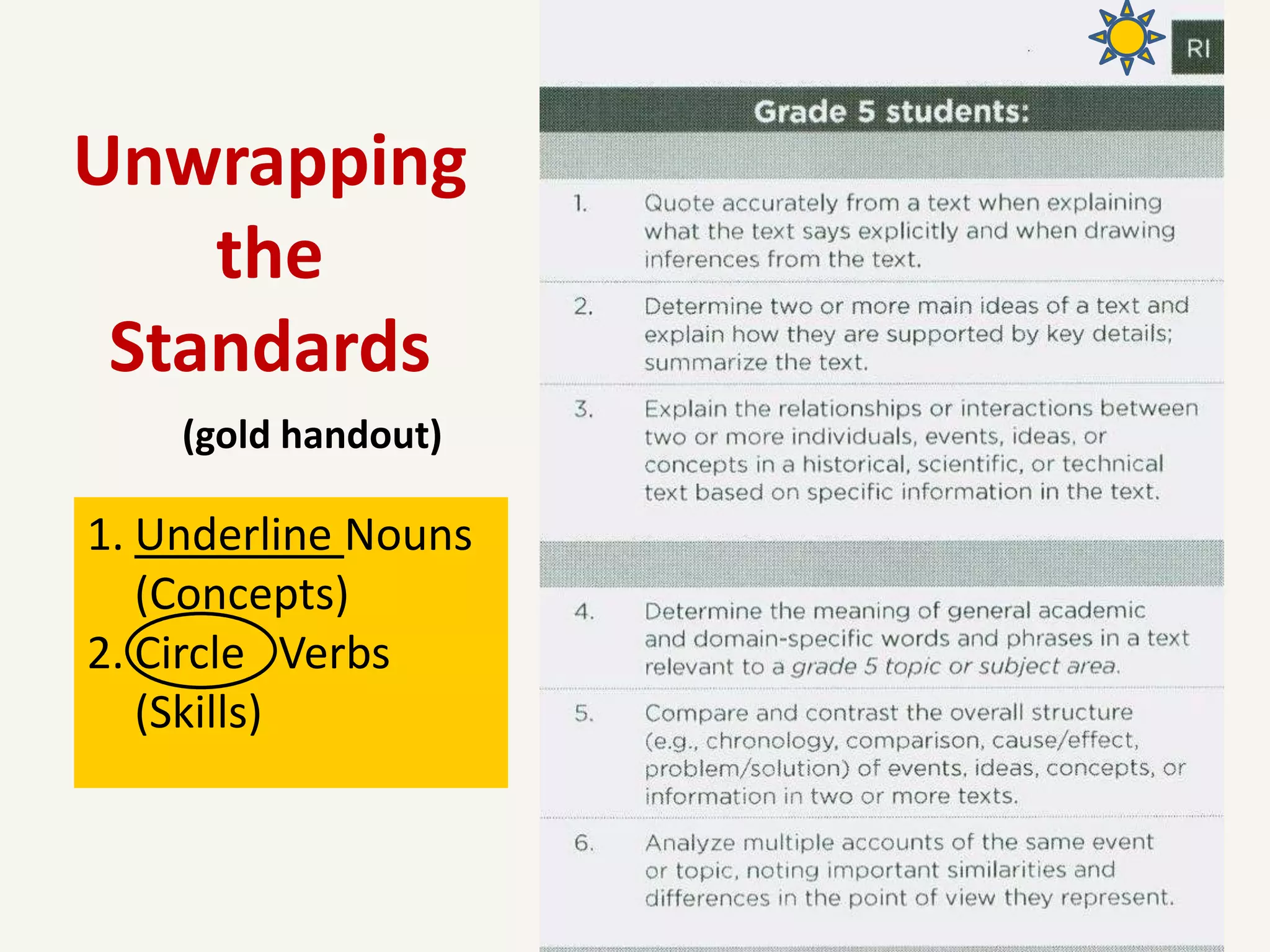
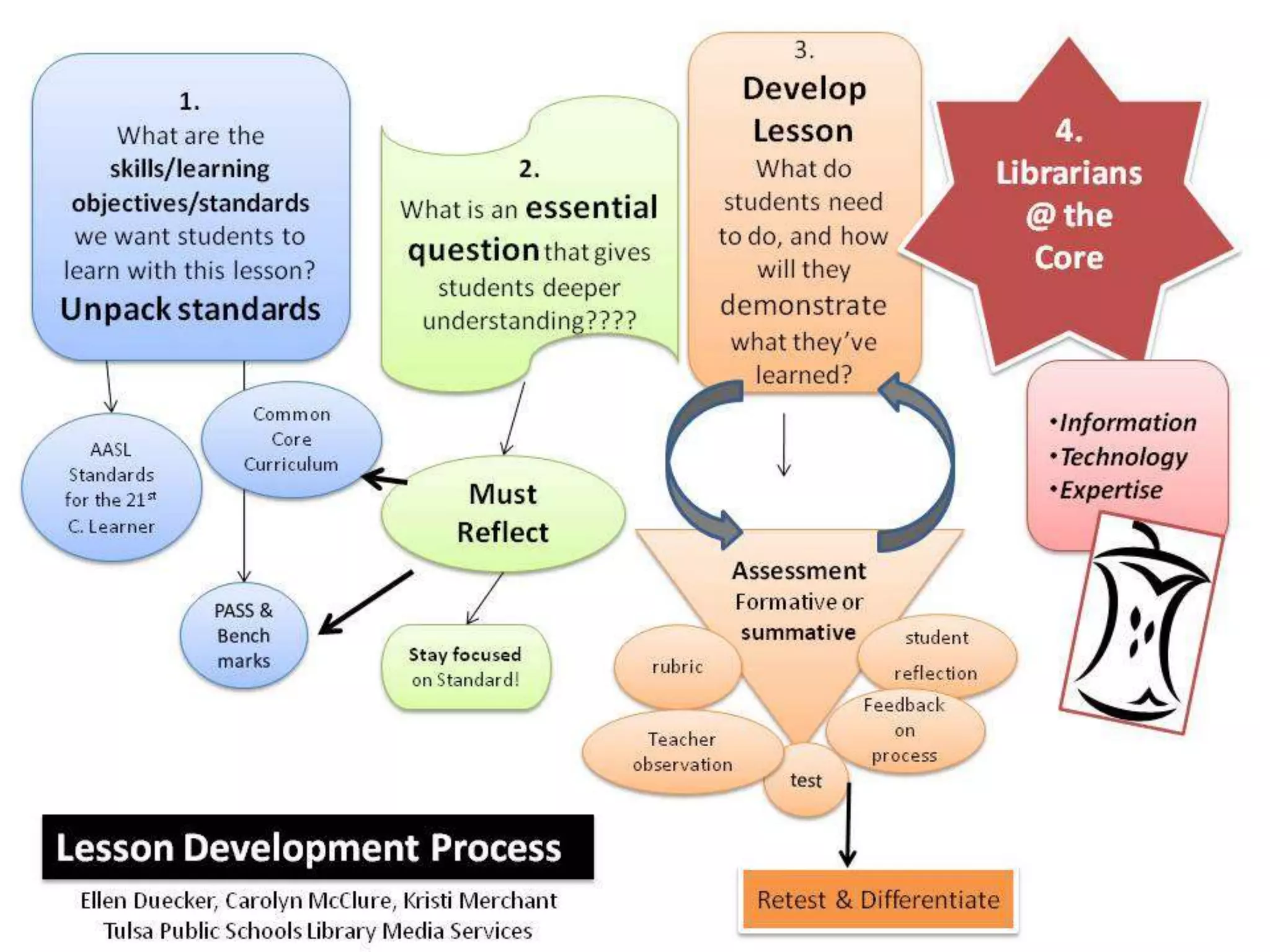
Unwrapping
    the
 Standards
    (gold handout)

1. Underline Nouns
   (Concepts)
2. Circle Verbs
   (Skills)
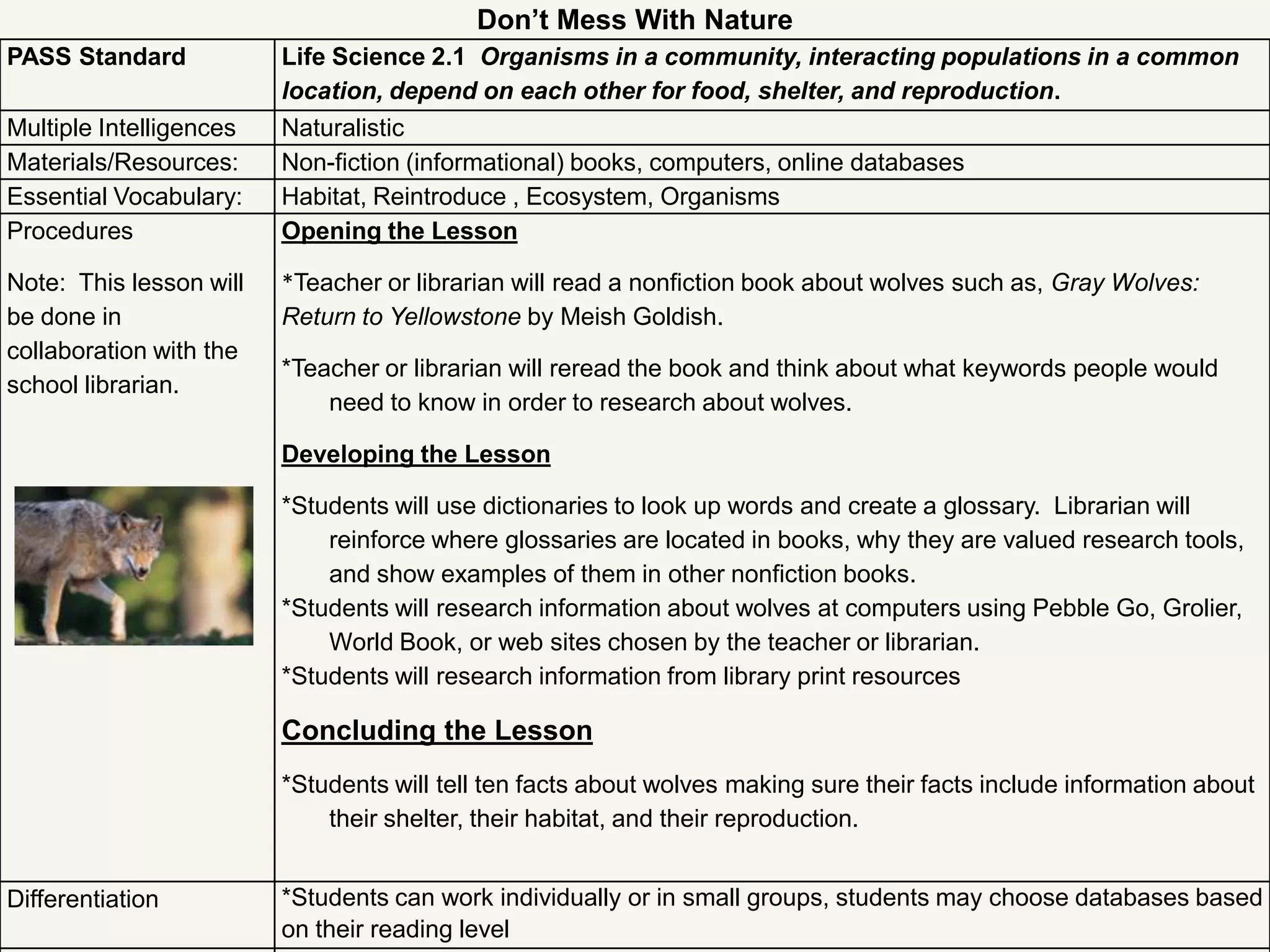
Don’t Mess With Nature
PASS Standard            Life Science 2.1 Organisms in a community, interacting populations in a common
                         location, depend on each other for food, shelter, and reproduction.
Multiple Intelligences   Naturalistic
Materials/Resources:     Non-fiction (informational) books, computers, online databases
Essential Vocabulary:    Habitat, Reintroduce , Ecosystem, Organisms
Procedures               Opening the Lesson

Note: This lesson will   *Teacher or librarian will read a nonfiction book about wolves such as, Gray Wolves:
be done in               Return to Yellowstone by Meish Goldish.
collaboration with the
                         *Teacher or librarian will reread the book and think about what keywords people would
school librarian.
                             need to know in order to research about wolves.

                         Developing the Lesson

                         *Students will use dictionaries to look up words and create a glossary. Librarian will
                             reinforce where glossaries are located in books, why they are valued research tools,
                             and show examples of them in other nonfiction books.
                         *Students will research information about wolves at computers using Pebble Go, Grolier,
                             World Book, or web sites chosen by the teacher or librarian.
                         *Students will research information from library print resources

                         Concluding the Lesson
                         *Students will tell ten facts about wolves making sure their facts include information about
                             their shelter, their habitat, and their reproduction.


Differentiation          *Students can work individually or in small groups, students may choose databases based
                         on their reading level
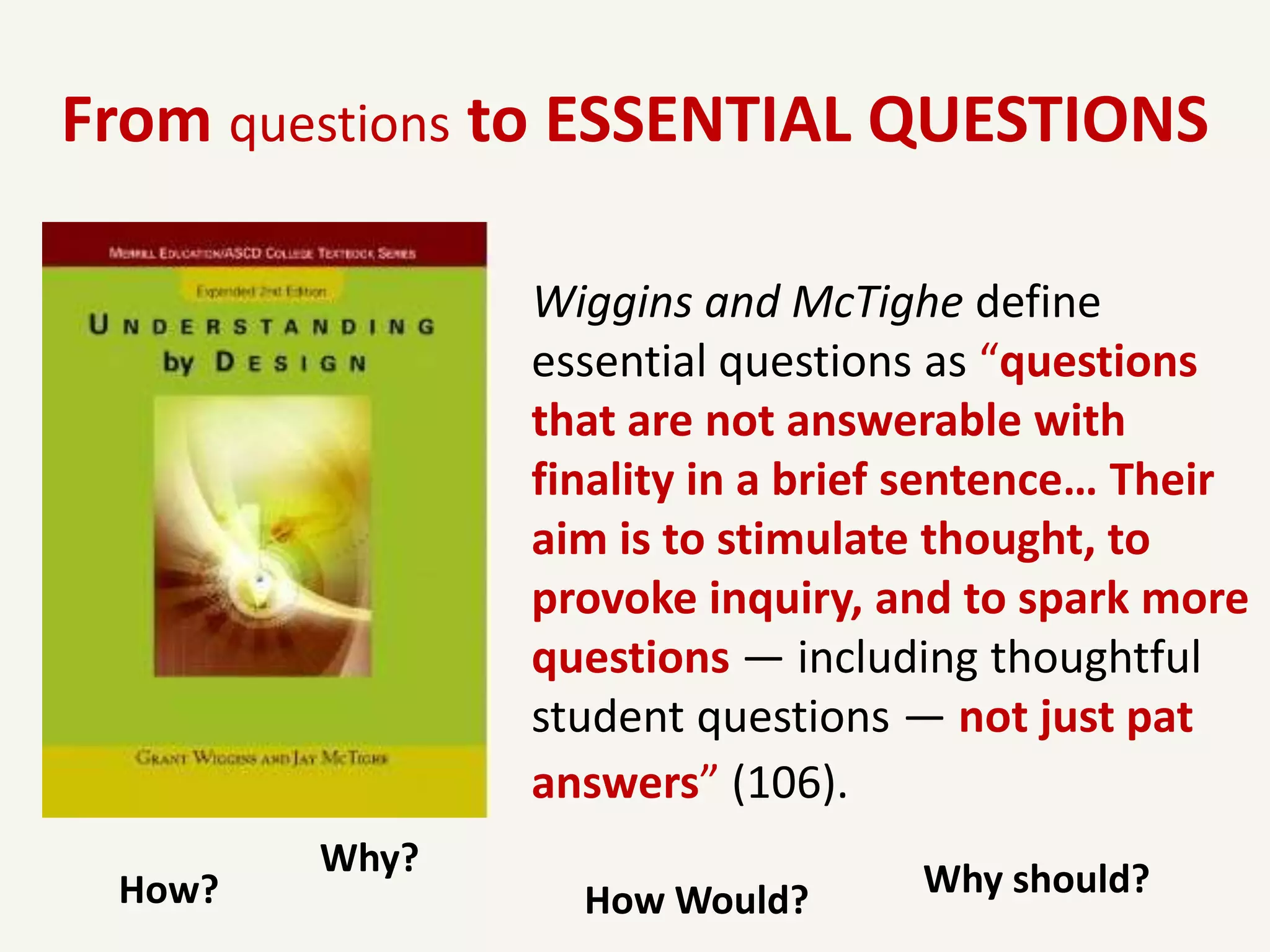
From questions to ESSENTIAL QUESTIONS

               Wiggins and McTighe define
               essential questions as “questions
               that are not answerable with
               finality in a brief sentence… Their
               aim is to stimulate thought, to
               provoke inquiry, and to spark more
               questions — including thoughtful
               student questions — not just pat
               answers” (106).
        Why?
 How?            How Would?       Why should?
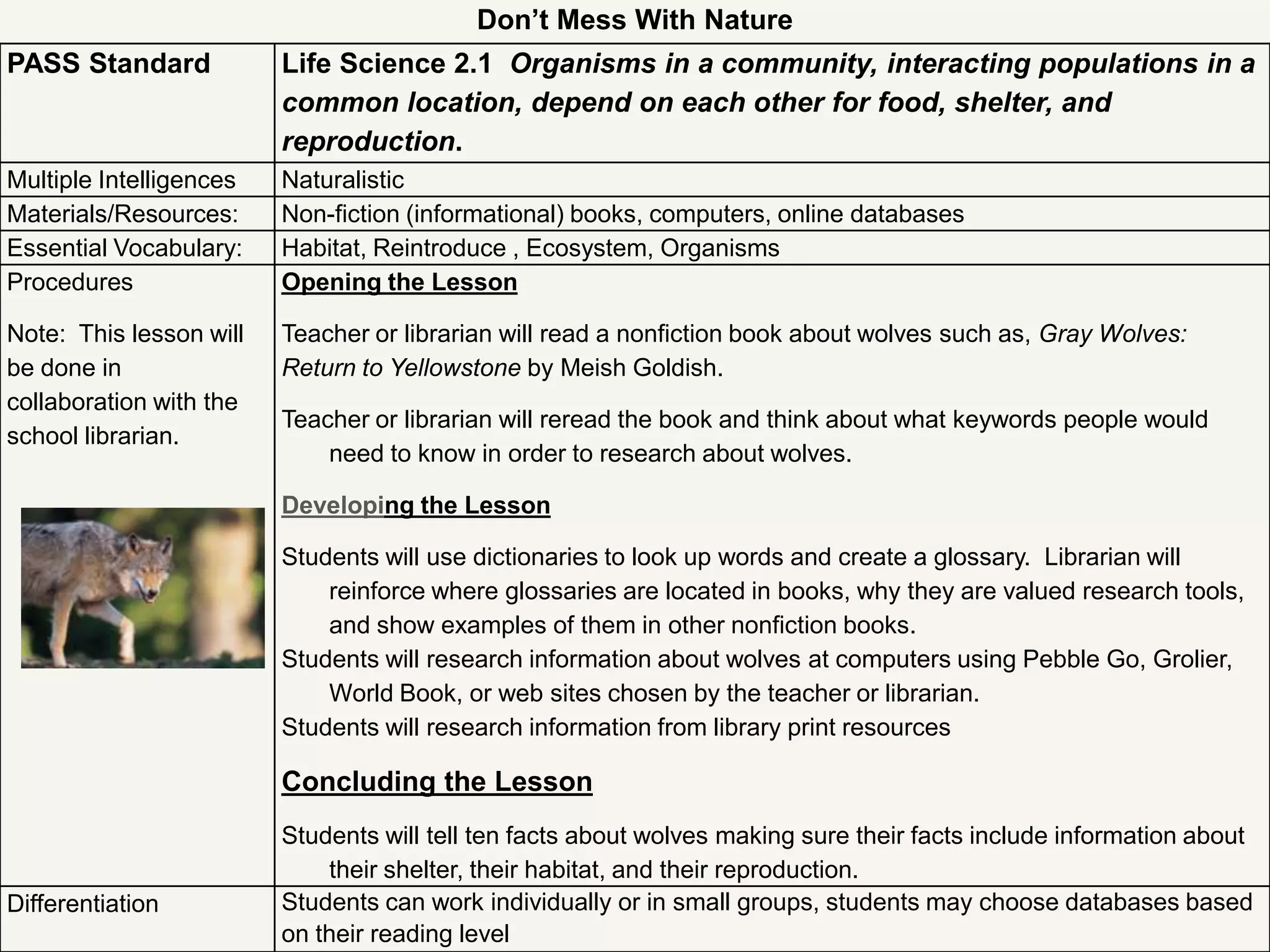
Don’t Mess With Nature
PASS Standard            Life Science 2.1 Organisms in a community, interacting populations in a
                         common location, depend on each other for food, shelter, and
                         reproduction.
Multiple Intelligences   Naturalistic
Materials/Resources:     Non-fiction (informational) books, computers, online databases
Essential Vocabulary:    Habitat, Reintroduce , Ecosystem, Organisms
Procedures               Opening the Lesson

Note: This lesson will   Teacher or librarian will read a nonfiction book about wolves such as, Gray Wolves:
be done in               Return to Yellowstone by Meish Goldish.
collaboration with the
                         Teacher or librarian will reread the book and think about what keywords people would
school librarian.
                             need to know in order to research about wolves.

                         Developing the Lesson

                         Students will use dictionaries to look up words and create a glossary. Librarian will
                             reinforce where glossaries are located in books, why they are valued research tools,
                             and show examples of them in other nonfiction books.
                         Students will research information about wolves at computers using Pebble Go, Grolier,
                             World Book, or web sites chosen by the teacher or librarian.
                         Students will research information from library print resources

                         Concluding the Lesson
                         Students will tell ten facts about wolves making sure their facts include information about
                             their shelter, their habitat, and their reproduction.
Differentiation          Students can work individually or in small groups, students may choose databases based
                         on their reading level
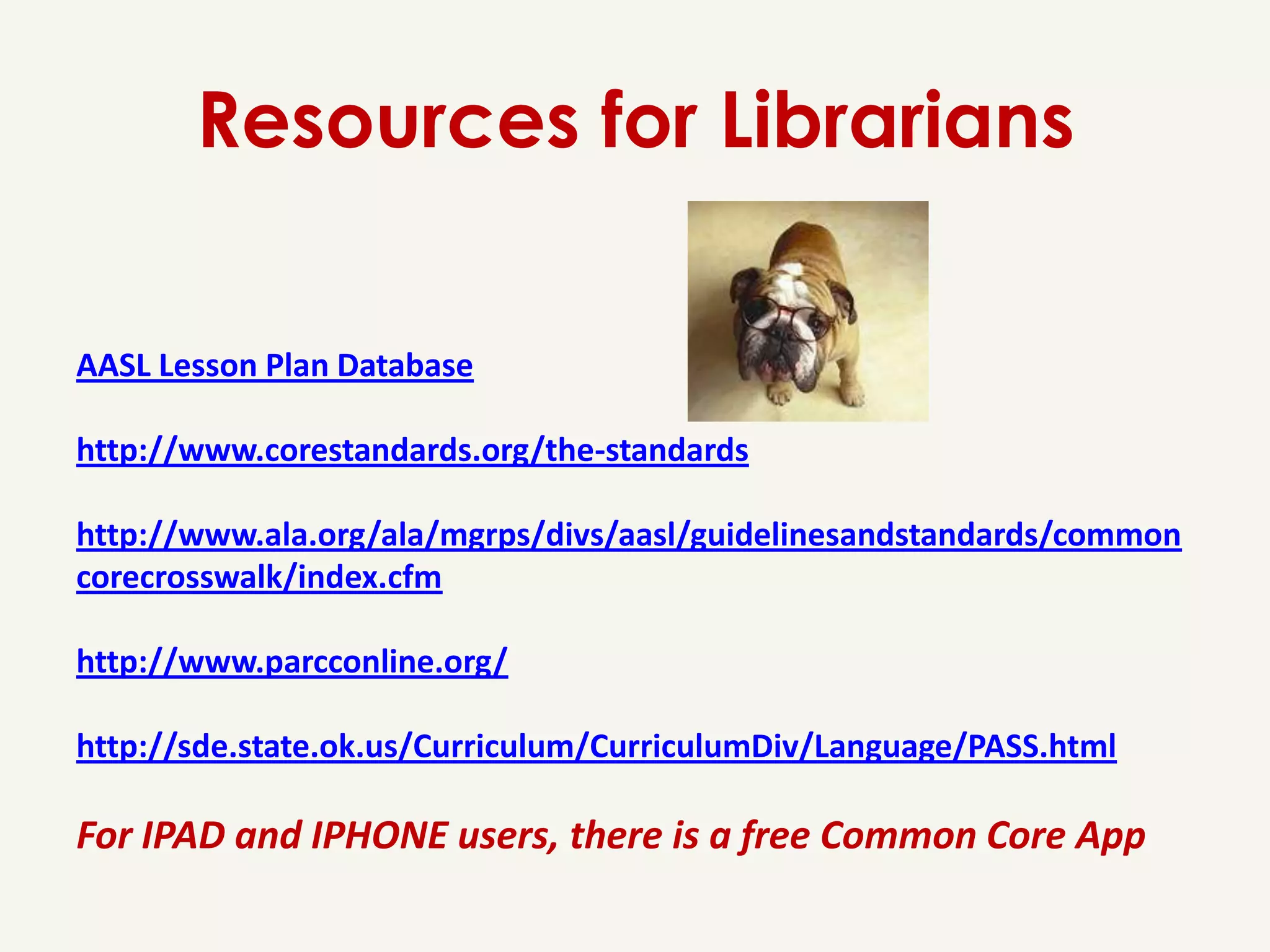
Resources for Librarians

AASL Lesson Plan Database

http://www.corestandards.org/the-standards

http://www.ala.org/ala/mgrps/divs/aasl/guidelinesandstandards/common
corecrosswalk/index.cfm

http://www.parcconline.org/

http://sde.state.ok.us/Curriculum/CurriculumDiv/Language/PASS.html

For IPAD and IPHONE users, there is a free Common Core App
Common Core: It’s OUR
    Playground!

Librarians @ the Core

  • 1.
    Librarians … @ theCore of Common Core !
  • 2.
    Outcomes Learn: •How CCSS Standardsare vertically and horizontally aligned and how they flow. •How to unwrap CCSS and understand their relationship to PASS. •How to bump up PASS lessons to CCSS higher level thinking and rigor.
  • 3.
    Reactions to thewords, “Common Core”
  • 4.
    Writing, rigor, READ, informationaltext, language arts, social studies, science, gather, analyze, evaluate, compare, argue, synthesize, research, internationally benchmarked, technology, literate, evidence, interdisciplinary, 2014 independent Common Core…It’s all about us!
  • 5.
    What is Common Core? Based on Research Aligned with & Evidence college & work expectations Benchmarked internationally INTEGRATED literacy skills in math, science, and social Rigorous! studies
  • 6.
    Common Core Standards: DoNOT tell teachers how to teach. Do NOT include all content students should learn. CCSS is meant to supplement state standards – not supplant them. Focus: PROCESS not CONTENT
  • 7.
    Interdisciplinary Literacy Shared Responsibility Math Social Studies Science Language Arts
  • 8.
  • 9.
  • 10.
    Language Arts Focus& Design Shift Distribution of Literary and Distribution of Communicative Informational Passages by Grade in Purposes by Grade in the 2011 NAEP the 2009 NAEP Reading Framework Writing Framework Grade Literary Informational Grade To To To Convey Persuade Explain Experience 4 50% 50% 4 30% 35% 35% 8 45% 55% 8 35% 35% 30% 12 30% 70% 12 40% 40% 20% Source: National Assessment Governing Board. Source: National Assessment Governing Board. (2008). (2007). Writing framework for the 2011 National Reading framework for the 2009 National Assessment Assessment of Educational Progress, pre-publication of Educational Progress. Washington, DC: U.S. edition. Iowa City, IA: ACT, Inc. Government Printing Office.
  • 11.
    Argument: a partof RIGOR The argumentative essay is a genre of writing that requires the student to investigate a topic, collect, generate, and evaluate evidence, and establish a position on the topic in a concise manner.
  • 12.
    Sample CCSS PerformanceTask Grade 3: Informational Texts Students explain how the main idea that Lincoln had “many faces” in Russell Freedman’s Lincoln: A Photobiography is supported by key details in the text. [RI.3.2] PARCC Partnership for Assessment of Readiness of College and Careers
  • 13.
    CCR = 10Overarching Anchor Standards Anchor Standard CCR 8 (Same for K – 12) Delineate and evaluate the argument and specific claims in a text, assessing whether the reasoning is sound and the evidence is relevant and sufficient; recognize when irrelevant evidence is introduced. Defined Specifically for Each Grade and Subject GRADE 5 STANDARD 8: Explain how an author uses reasons and evidence to support particular points in a text, identifying which reasons and evidence support which point(s).
  • 14.
    Common Core OrganizationalStructure Deciphering the Code CCR(College & Career Ready) Anchor Standards CC.5.RL.1 5= Grade 5 RL=Reading Lit. Grade Specific 1= Standard 1 Standards RL Reading Literature RI Reading Information Text Language RF Reading Foundational Skills Arts W Writing SL Speaking & Listening
  • 15.
    Vertical Alignment (pinkhandout) CC.K.RI.8 With prompting and support, identify the reasons an author gives to support points in a text. CC.2.RI.8 Describe how reasons support specific points the author makes in a text. CC.5.RI.8 8. Explain how an author uses reasons and evidence to support particular points in a text, identifying which reasons and evidence support which point(s). CC.9-10.RI.8 Delineate and evaluate the argument and specific claims in a text, assessing whether the reasoning is valid and the evidence is relevant and sufficient; identify false statements and fallacious reasoning.
  • 16.
    CC Design Components *Defineend-of-year expectations by grade *Show cumulative progression through the grades
  • 17.
    Horizontal Alignment (bluehandout) CC.5.RL.9 Reading Literature Compare and contrast stories in the same genre (e.g., mysteries and adventure stories) on their approaches to similar themes and topics. CC.5.RI.9 Reading for Information Integrate information from several texts on the same topic in order to write or speak about the subject knowledgeably. CC.5.W.9 Writing Draw evidence from literary or informational texts to support analysis, reflection, and research.
  • 18.
    Unwrapping the Standards (gold handout) 1. Underline Nouns (Concepts) 2. Circle Verbs (Skills)
  • 19.
    Don’t Mess WithNature PASS Standard Life Science 2.1 Organisms in a community, interacting populations in a common location, depend on each other for food, shelter, and reproduction. Multiple Intelligences Naturalistic Materials/Resources: Non-fiction (informational) books, computers, online databases Essential Vocabulary: Habitat, Reintroduce , Ecosystem, Organisms Procedures Opening the Lesson Note: This lesson will *Teacher or librarian will read a nonfiction book about wolves such as, Gray Wolves: be done in Return to Yellowstone by Meish Goldish. collaboration with the *Teacher or librarian will reread the book and think about what keywords people would school librarian. need to know in order to research about wolves. Developing the Lesson *Students will use dictionaries to look up words and create a glossary. Librarian will reinforce where glossaries are located in books, why they are valued research tools, and show examples of them in other nonfiction books. *Students will research information about wolves at computers using Pebble Go, Grolier, World Book, or web sites chosen by the teacher or librarian. *Students will research information from library print resources Concluding the Lesson *Students will tell ten facts about wolves making sure their facts include information about their shelter, their habitat, and their reproduction. Differentiation *Students can work individually or in small groups, students may choose databases based on their reading level
  • 20.
    From questions toESSENTIAL QUESTIONS Wiggins and McTighe define essential questions as “questions that are not answerable with finality in a brief sentence… Their aim is to stimulate thought, to provoke inquiry, and to spark more questions — including thoughtful student questions — not just pat answers” (106). Why? How? How Would? Why should?
  • 21.
    Don’t Mess WithNature PASS Standard Life Science 2.1 Organisms in a community, interacting populations in a common location, depend on each other for food, shelter, and reproduction. Multiple Intelligences Naturalistic Materials/Resources: Non-fiction (informational) books, computers, online databases Essential Vocabulary: Habitat, Reintroduce , Ecosystem, Organisms Procedures Opening the Lesson Note: This lesson will Teacher or librarian will read a nonfiction book about wolves such as, Gray Wolves: be done in Return to Yellowstone by Meish Goldish. collaboration with the Teacher or librarian will reread the book and think about what keywords people would school librarian. need to know in order to research about wolves. Developing the Lesson Students will use dictionaries to look up words and create a glossary. Librarian will reinforce where glossaries are located in books, why they are valued research tools, and show examples of them in other nonfiction books. Students will research information about wolves at computers using Pebble Go, Grolier, World Book, or web sites chosen by the teacher or librarian. Students will research information from library print resources Concluding the Lesson Students will tell ten facts about wolves making sure their facts include information about their shelter, their habitat, and their reproduction. Differentiation Students can work individually or in small groups, students may choose databases based on their reading level
  • 24.
    Resources for Librarians AASLLesson Plan Database http://www.corestandards.org/the-standards http://www.ala.org/ala/mgrps/divs/aasl/guidelinesandstandards/common corecrosswalk/index.cfm http://www.parcconline.org/ http://sde.state.ok.us/Curriculum/CurriculumDiv/Language/PASS.html For IPAD and IPHONE users, there is a free Common Core App
  • 25.
    Common Core: It’sOUR Playground!

Editor's Notes

  • #10 Have examples of anchor standards and grade specific standards at tables.
  • #25 Have examples of anchor standards and grade specific standards at tables.