NCTE presentation: Defining Purposes for Using Web 2.0 Tools in the Classroom Rick Beach, University of Minnesota,  [email_address] Handout on Google Docs:  http://tinyurl.com/yjbc2jc
Jeff Uteckt: Literacy Curriculum Models
NCTE Poll: 900 language arts teachers  Top three abilities for student success seek information and make critical judgments about the veracity of sources read and interpret many different kinds of texts, both in print and online  innovate and apply knowledge creatively
NCTE Poll: 900 language arts teachers  62% reject notion that basic language, reading, and writing skills must be mastered  before  critical 21st century literacy abilities can be cultivated
Acquiring and subscribing to/sharing information Social Bookmarking and sharing links/tags Sharing links in class Diigo groups  adding annotations to online literary texts for sharing responses to literature
Using Diigo for adding a sticky-note response
Uses of mapping in studying identity construction Visually portray performances according to three units of analysis:  Events   | Spaces   | Social worlds/systems Use maps to prompt interview reflections “ Pointing” prompts: talk about maps
Event as unit of analysis: People act and react to current and future acts to create an event or context  Utterances have consequences Uptake of speech acts or lack of action Events have boundaries People “in” the event  People/forces “outside” the event but still influencing the event  “ the elephant in the room”
Space as unit of analysis Spaces as gendered, raced, or classed  Gendered worlds as mediated by language use Thorne: children on playground space: practices not necessarily gendered Teacher: tells children to group up by “boys” and “girls” Playground space becomes gendered as a binary space
Social Worlds/Institutional Systems Social worlds/systems schooling, workplace/economic, family, health care, justice, government/political, media, etc.,  Driven by larger objects or outcomes  School: enhanced students’ literacy Workplace: higher profits
 
Using Maps to “Connect the Dots”: Food <--> health care Raising livestock 70% of water consumption in the West  21% of global gas emissions 1 gallon of gas to produce 1 pound of meat “ Grass-fed” cows produce 21 times the methane of grain-fed cows
Connecting the dots Agri-business/corn lobby    campaign donations    government farm policies    Manufactured food    lack of urban grocery stores with fresh vegetables/fruit    fast food restaurants/advertising    High fat food    obesity    increased health-care costs
Collaborative Construction of Knowledge: Wikis PBWorks (http://pbworks.com), Wikispaces (http://www.wikispaces.com), or Wetpaint (http://www.wetpaint.com)  Rhetoric and Composition  wikibook: http://en.wikibooks.org/wiki/Rhetoric_and_Composition
Virtual collaboration: Literary Worlds site http://www.literaryworlds.org (Rozema & Webb, 2008). Students ngage in synchronous chat about frequently taught texts such as  Brave New World, Things Fall Apart, Of Mice and Men, The Great Gatsby , and  1984 .
Creating multimodal texts: Digital comics Comic Life/Bitstrips Brent Eckoff, West Jr. High:  “ I had students to a rough storyboard of what they planned to create.  Some of the speech bubbles and text boxes they wrote were both surprising, and innovative.  The students then exported the Comic Life presentations as quicktime files, uploaded them to YouTube, and then embedded them on the class wiki.”
 
Culture-jamming/remixing Remix America (remix historical speeches/words with contemporary events)  Adbusters spoofs/parodies


Using VoiceThread for critical analysis of media representations Select a topic: female athletes Find Flickr images and import into VoiceThread Add voice or written comments about patterns of
Formulating arguments using online role-play/games
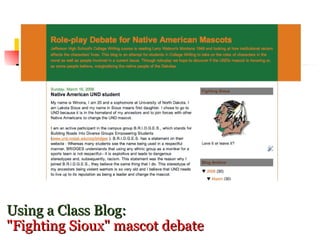
Using a Class Blog:  &quot;Fighting Sioux&quot; mascot debate
Issue: Internet policies Blocking of websites NRA site blocked Administrators accessing Facebook Determining if students are drinking  Violation of the state’s athletic code
Read Cory Doctorow’s  Little Brother 17-year-old Marcus, a computer hacker, takes on the Department of Homeland Security’s attempt to control society Issues of Internet privacy/control
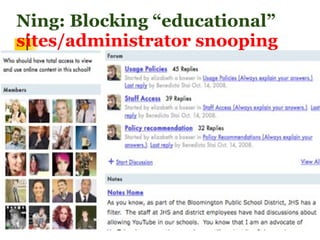
  Ning: Blocking “educational”  sites/administrator snooping
Ethos: EmoGirl: Critique of school  Internet policies I think the internet usage policies are ridiculous. The policies are almost impossible to find. I spent   half an hour trying to find   them and I'm a young, computer savvy person. 
“ Strict Father” cultural model: Charles Hammerstein The issue with sites like YouTube is that it is a helpful site when used correctly, but the ratio of students who would use it to the students who would abuse it would greatly favor the later of the two. R-rated sites are not ok because they usually contain information and content that may be considered offensive . T he internet policies are very clear, if your grandmother would not appreciate it, then you probably shouldn't be doing those kind of things at school.
Bubbl.us mapping to identify roles and relationships between roles
Students reflect on: Use of arguments Comfort in role Targeted audiences/alliances Who has power? Reasons: strategies Sense of potential change
Students reflected on the role-play: I think it was a valuable learning experience because we actually got to argue back and forth with other people.  If this had just been a writing assignment, it would have only been one-sided.  You can use persuasive arguments in a paper but you can’t have a back and forth conversation on it.  I really felt like it helped me get into someone else’s shoes and think like someone different from myself.  
Change-based assessment: Determining effectiveness Assess students on their use writing to  attempt to  affect change in  actual  audiences’ beliefs Framing of the status quo Their own and others’ beliefs Their sense of agency to make change Need for objective criteria Problem: teacher’s own preferred changes
Developing a Sense of Voice through Podcasting Book talks Spoken word poetry Readers’ theater productions Radio shows Skype interviews
Feedback and Self-reflection  Audio files as feedback to writing VoiceThread comments VideoAnt: annotations for video productions E-portfolios
VideoAnt: feedback to videos

NCTE literacy tools

  • 1.
    NCTE presentation: DefiningPurposes for Using Web 2.0 Tools in the Classroom Rick Beach, University of Minnesota, [email_address] Handout on Google Docs: http://tinyurl.com/yjbc2jc
  • 2.
    Jeff Uteckt: LiteracyCurriculum Models
  • 3.
    NCTE Poll: 900language arts teachers Top three abilities for student success seek information and make critical judgments about the veracity of sources read and interpret many different kinds of texts, both in print and online innovate and apply knowledge creatively
  • 4.
    NCTE Poll: 900language arts teachers 62% reject notion that basic language, reading, and writing skills must be mastered before critical 21st century literacy abilities can be cultivated
  • 5.
    Acquiring and subscribingto/sharing information Social Bookmarking and sharing links/tags Sharing links in class Diigo groups adding annotations to online literary texts for sharing responses to literature
  • 6.
    Using Diigo foradding a sticky-note response
  • 7.
    Uses of mappingin studying identity construction Visually portray performances according to three units of analysis: Events | Spaces | Social worlds/systems Use maps to prompt interview reflections “ Pointing” prompts: talk about maps
  • 8.
    Event as unitof analysis: People act and react to current and future acts to create an event or context Utterances have consequences Uptake of speech acts or lack of action Events have boundaries People “in” the event People/forces “outside” the event but still influencing the event “ the elephant in the room”
  • 9.
    Space as unitof analysis Spaces as gendered, raced, or classed Gendered worlds as mediated by language use Thorne: children on playground space: practices not necessarily gendered Teacher: tells children to group up by “boys” and “girls” Playground space becomes gendered as a binary space
  • 10.
    Social Worlds/Institutional SystemsSocial worlds/systems schooling, workplace/economic, family, health care, justice, government/political, media, etc., Driven by larger objects or outcomes School: enhanced students’ literacy Workplace: higher profits
  • 11.
  • 12.
    Using Maps to“Connect the Dots”: Food <--> health care Raising livestock 70% of water consumption in the West 21% of global gas emissions 1 gallon of gas to produce 1 pound of meat “ Grass-fed” cows produce 21 times the methane of grain-fed cows
  • 13.
    Connecting the dotsAgri-business/corn lobby  campaign donations  government farm policies  Manufactured food  lack of urban grocery stores with fresh vegetables/fruit  fast food restaurants/advertising  High fat food  obesity  increased health-care costs
  • 14.
    Collaborative Construction ofKnowledge: Wikis PBWorks (http://pbworks.com), Wikispaces (http://www.wikispaces.com), or Wetpaint (http://www.wetpaint.com) Rhetoric and Composition wikibook: http://en.wikibooks.org/wiki/Rhetoric_and_Composition
  • 15.
    Virtual collaboration: LiteraryWorlds site http://www.literaryworlds.org (Rozema & Webb, 2008). Students ngage in synchronous chat about frequently taught texts such as Brave New World, Things Fall Apart, Of Mice and Men, The Great Gatsby , and 1984 .
  • 16.
    Creating multimodal texts:Digital comics Comic Life/Bitstrips Brent Eckoff, West Jr. High: “ I had students to a rough storyboard of what they planned to create. Some of the speech bubbles and text boxes they wrote were both surprising, and innovative. The students then exported the Comic Life presentations as quicktime files, uploaded them to YouTube, and then embedded them on the class wiki.”
  • 17.
  • 18.
    Culture-jamming/remixing Remix America(remix historical speeches/words with contemporary events) Adbusters spoofs/parodies
  • 19.
  • 20.
  • 21.
  • 22.
  • 23.
  • 24.
  • 25.
    Using VoiceThread forcritical analysis of media representations Select a topic: female athletes Find Flickr images and import into VoiceThread Add voice or written comments about patterns of
  • 26.
    Formulating arguments usingonline role-play/games
  • 27.
    Using a ClassBlog: &quot;Fighting Sioux&quot; mascot debate
  • 28.
    Issue: Internet policiesBlocking of websites NRA site blocked Administrators accessing Facebook Determining if students are drinking Violation of the state’s athletic code
  • 29.
    Read Cory Doctorow’s Little Brother 17-year-old Marcus, a computer hacker, takes on the Department of Homeland Security’s attempt to control society Issues of Internet privacy/control
  • 30.
      Ning: Blocking“educational” sites/administrator snooping
  • 31.
    Ethos: EmoGirl: Critiqueof school Internet policies I think the internet usage policies are ridiculous. The policies are almost impossible to find. I spent half an hour trying to find them and I'm a young, computer savvy person. 
  • 32.
    “ Strict Father”cultural model: Charles Hammerstein The issue with sites like YouTube is that it is a helpful site when used correctly, but the ratio of students who would use it to the students who would abuse it would greatly favor the later of the two. R-rated sites are not ok because they usually contain information and content that may be considered offensive . T he internet policies are very clear, if your grandmother would not appreciate it, then you probably shouldn't be doing those kind of things at school.
  • 33.
    Bubbl.us mapping toidentify roles and relationships between roles
  • 34.
    Students reflect on:Use of arguments Comfort in role Targeted audiences/alliances Who has power? Reasons: strategies Sense of potential change
  • 35.
    Students reflected onthe role-play: I think it was a valuable learning experience because we actually got to argue back and forth with other people.  If this had just been a writing assignment, it would have only been one-sided.  You can use persuasive arguments in a paper but you can’t have a back and forth conversation on it.  I really felt like it helped me get into someone else’s shoes and think like someone different from myself.  
  • 36.
    Change-based assessment: Determiningeffectiveness Assess students on their use writing to attempt to affect change in actual audiences’ beliefs Framing of the status quo Their own and others’ beliefs Their sense of agency to make change Need for objective criteria Problem: teacher’s own preferred changes
  • 37.
    Developing a Senseof Voice through Podcasting Book talks Spoken word poetry Readers’ theater productions Radio shows Skype interviews
  • 38.
    Feedback and Self-reflection Audio files as feedback to writing VoiceThread comments VideoAnt: annotations for video productions E-portfolios
  • 39.