What Impels Students to Promote Change?: A Third-Generation Activity Theory Analysis of High School Students’ Online Role-play Designed to Teach Persuasive Writing Richard Beach, University of Minnesota, rbeach@umn.edu http://digitalwriting.pbwiki.com
Creating an online role-play: Students: Select an issue Formulate a primary argument Choose roles and conduct research Post arguments on a blog or online forum Step out of roles and reflect
Online role-play/resource sites Ink game: Michigan State University: First Year Composition Letters to the Next President  The Persuasive Games site Democracy A Force More Powerful  Peacemaker  The Our Courts project Debatepedia Debatemapper site Opposing Views
“Dialogic argumentation”/ “constructive controversy” Dialogic argumentation  explore alternative perspectives and solutions to address and solve problems, which requires students to attend to context, audience, and purpose Co nstructive controversy Engage in collaborative debate resulting in changing the status quo (Johnson & Johnson, 2009)
Engage in collaborative arguments: “rhetoric of transformation” ( JAAL , April) Formulate alternative arguments Test out different arguments "House": determine alternative diagnoses Find common ground to develop solutions
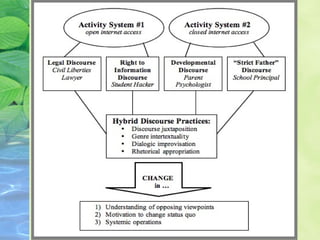
Arguments to change status quo systems  3rd Generation Activity Theory (AT):  Identify tensions and contradictions in status quo systems (health care, justice, law enforcement, schooling, government) Define reasons for these tensions and contradictions  Propose solutions for creating alternative systems
AT: tensions/contradictions: “runaway objects”: technological innovation
AT: Tensions: Competing systems  Internet/Web 2.0 system Free access in the home School system Internet use policies: Limit access Legal system State athletic codes Free speech/academic freedom
Tensions: School versus online learning (Leander; Collins & Halverson) Space/time in school (“just-in-case”) Linear, tangible, and divisible  Cover same, standardized content Need to protect students Space/time online (“just-in-time”) Fluid, layered, and simultaneous Individual/collaborative learning  Focus on communication/production
Learning theories:  Situated cognition (Gee, 2008) “ Projective identities” Connectivist” (Downes, 2007; Siemons, 2009)  Simulations: construct role, norms, or knowledge operating within or across simulated systems or communities (Edwards, Biesta, & Thorpe, 2009
Through online role-play, students learn to: construct a persona employ rhetorical appeals  support their position with reasons  identify and refute counter-arguments revise or modify one’s own positions
Double-voicing “h y brid discourses” (Kamberelis, 2001; Bakhtin,1981) “ Authoritative discourses” School discourses rooted in external  authority  “ I nternally persuasive discourses”
Advantages of online versus face-to-face role-play: participate over an extended time period incorporate use of images and video access to all students’ posts and comments review posts to reflect on and cite quotes draw on role-play material for use in their own writing
2008 study:   Students read Cory Doctorow’s  Little Brother   (2008) Modern version of  1984 Issues of Internet privacy/control 17-year-old Marcus, a computer hacker, takes on the Department of Homeland Security’s attempt to control society
  Using a Ning as the platform for online role-play:
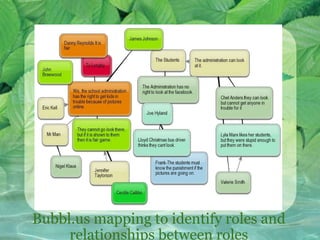
Bubbl.us mapping to identify roles and relationships between roles
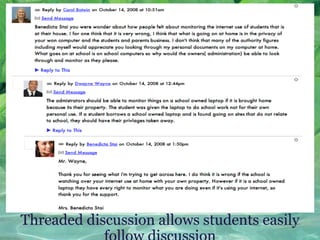
Threaded discussion allows students easily follow discussion
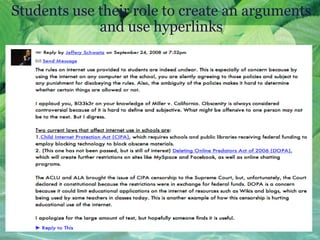
Students use their role to create an arguments and use hyperlinks
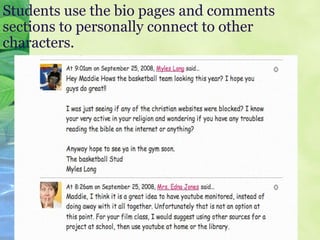
Students use the bio pages and comments sections to personally connect to other characters.
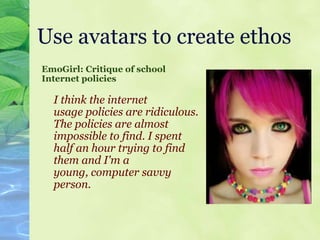
Use avatars to create ethos EmoGirl: Critique of school Internet policies I think the internet usage policies are ridiculous. The policies are almost  impossible to find. I spent   half an hour trying to find   them and I'm a young, computer savvy person.  
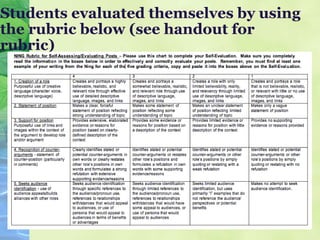
Students evaluated themselves by using the rubric below (see handout for rubric)
Students step out of roles and reflect on: Use of arguments Comfort in role Targeted audiences/alliances Who has power? Reasons: strategies Sense of potential change
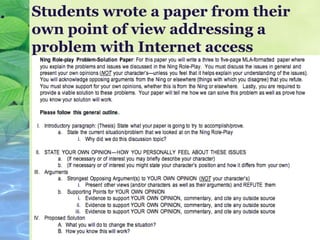
. Students wrote a paper from their own point of view addressing a problem with Internet access
Discourses: Con student access Students will access problematic/porn sites that will adversely influence them  (“Strict father” cultural model” (Lakoff))  Students are not mature enough to select appropriate sites  (De velopmental discourse)
“Strict Father” cultural model: Charles Hammerstein III The issue with sites like YouTube is that it is a helpful site when used correctly, but the ratio of students who would use it to the students who would abuse it would greatly favor the later of the two. R-rated sites are not ok because they usually contain information and content that may be considered offensive . T he internet policies are very clear, if your grandmother would not appreciate it, then you probably shouldn't be doing those kind of things at school.
Business discourse: Misuse of online access The Internet should be like a tunnel at school, with sites meant for education being the only thing accessible to students. There are people out there who want kids to learn in ways they want to and allow them to explore, and I can see where they are coming from. I urge supporters of this idea to ask themselves this question: does it really make sense to people out there to let kids use school property to check their fantasy football teams when they should be researching for their economics project?
Discourses:  Pro student access Schooling should be designed to foster critical thinking/access to information versus locking down students ( ed ucation discourse) Students live in a networked global economy (g l obalism discourse) Students need to be responsible for their own decisions/behavior (“ pe rmissive parent ”  cultural model (Lakoff) - students have a legal right to access information (l e gal discourse )
Legal discourse: ACLU lawyer The school blocking technologies are not effective and often over block information that could be useful to students. Government mandated Internet blocking is censorship .  Some content is blocked because it has opposing viewpoints which are contrary to local, political, or religious opinions. An example of this would be the blocking of sites with alternative views on things like AIDS prevention, birth control, and gun control. Blocking programs should not be implemented to prevent students from accessing material they are constitutionally entitled to.
Double-voicing: Challenging authoritative discourses “ Ye s, we would love to have kids enjoy school more, but the purpose of the Internet is to help with your education and make things easier” (P o licy Recommendation). Yes this aspect of school policies is true but how can we have an easier educational experience when we can’t find sites right away because the majority of them are being blocked without our knowledge.
Identifying tensions/contradictions: policies and practices We can’t get onto Nazi websites, but  Mein Kampft  is on display in the library.  I can understand that you can’t go on websites, but we can read this book, but we can’t go to a website that might have historical facts.
 
Value: Aware of multiple perspectives  So I think it [online role-play] did change me more than I thought it would. It surprised me how much my opinion had differed and I don’t know if it’s necessarily changed that much but that it’s more open to what other people are doing and so I don’t just classify the sort of liberal—you have to let the world be free—people as just morons.  T he idea that everyone has their own truth is really obnoxious, but I have more understanding of it now than I did before.
Motivation to enact change Even though the district policies are much more specific some are still hard to understand. The policies said things like obscene and offensive material are not allowed, but they never tell the reader what those are. The schools way of telling us what is inappropriate, is the administration blocking websites. They could tell us exactly what we can and cannot view and if they make it more obvious to the students, maybe they could unblock some of the websites and see if it helps the students stay out of trouble if we know the exact rules.
Meeting with school technology coordinator Those decisions [the individual site blocks] are a reflection of the people making them and the feedback they get from the community and parents.  They don’t want parents calling them about what their students are doing in school, so they are going to turn off everything except if it’s pretty clear.  It’s hard to make change in an organization with 8,000 students so you really need big groups of people to make change instead of just one person.
Achieving change in school’s Internet policies  District tech staff lifted the blocks on sites Allowed teachers access to YouTube  Fact that students’ efforts led to change: Enhanced sense of student agency Awareness of the influence of effective arguments
Value of collective activity I'm realizing that  a few students working together to create change on a subject they feel passionate about can actually make a difference , whether it be in the school or community.
Summary: Students: Exposed to multiple audiences and arguments on the Ning Sense of shared concern/need for change Aware of counter-arguments to refute Identified contradictions in systems Policies versus practices Employed collaborative argument to achieve change
Further research Analysis of how grappling with dialogic tensions leads to perspective-taking/change Analysis of avatar/role construction  Understanding of professional discourses Ability to voice positions distinct from own positions
Further research: Reading strategies Reading the rhetorical landscape/social hierarchies Value of mapping roles/relationships Recognizing shifts in positions Perspective-taking to gain identification with other roles Critically interpreting stances and discourses
Change-based assessment   Assess students  attempt to or actually use of literacy tool use  to achieve change in status quo systems (Beach, Campano, Edmiston, & Borgmann, 2010) Self-reflections: - What are those changes that I am trying to achieve—what are the purposes driving my uses of literacy tools? - How am I using literacy tools to achieve these changes?

Nrc2009onlineroleplay

  • 1.
    What Impels Studentsto Promote Change?: A Third-Generation Activity Theory Analysis of High School Students’ Online Role-play Designed to Teach Persuasive Writing Richard Beach, University of Minnesota, rbeach@umn.edu http://digitalwriting.pbwiki.com
  • 2.
    Creating an onlinerole-play: Students: Select an issue Formulate a primary argument Choose roles and conduct research Post arguments on a blog or online forum Step out of roles and reflect
  • 3.
    Online role-play/resource sitesInk game: Michigan State University: First Year Composition Letters to the Next President The Persuasive Games site Democracy A Force More Powerful Peacemaker The Our Courts project Debatepedia Debatemapper site Opposing Views
  • 4.
    “Dialogic argumentation”/ “constructivecontroversy” Dialogic argumentation explore alternative perspectives and solutions to address and solve problems, which requires students to attend to context, audience, and purpose Co nstructive controversy Engage in collaborative debate resulting in changing the status quo (Johnson & Johnson, 2009)
  • 5.
    Engage in collaborativearguments: “rhetoric of transformation” ( JAAL , April) Formulate alternative arguments Test out different arguments "House": determine alternative diagnoses Find common ground to develop solutions
  • 6.
    Arguments to changestatus quo systems 3rd Generation Activity Theory (AT): Identify tensions and contradictions in status quo systems (health care, justice, law enforcement, schooling, government) Define reasons for these tensions and contradictions Propose solutions for creating alternative systems
  • 7.
    AT: tensions/contradictions: “runawayobjects”: technological innovation
  • 8.
    AT: Tensions: Competingsystems Internet/Web 2.0 system Free access in the home School system Internet use policies: Limit access Legal system State athletic codes Free speech/academic freedom
  • 9.
    Tensions: School versusonline learning (Leander; Collins & Halverson) Space/time in school (“just-in-case”) Linear, tangible, and divisible Cover same, standardized content Need to protect students Space/time online (“just-in-time”) Fluid, layered, and simultaneous Individual/collaborative learning Focus on communication/production
  • 10.
    Learning theories: Situated cognition (Gee, 2008) “ Projective identities” Connectivist” (Downes, 2007; Siemons, 2009) Simulations: construct role, norms, or knowledge operating within or across simulated systems or communities (Edwards, Biesta, & Thorpe, 2009
  • 11.
    Through online role-play,students learn to: construct a persona employ rhetorical appeals support their position with reasons identify and refute counter-arguments revise or modify one’s own positions
  • 12.
    Double-voicing “h ybrid discourses” (Kamberelis, 2001; Bakhtin,1981) “ Authoritative discourses” School discourses rooted in external authority “ I nternally persuasive discourses”
  • 13.
    Advantages of onlineversus face-to-face role-play: participate over an extended time period incorporate use of images and video access to all students’ posts and comments review posts to reflect on and cite quotes draw on role-play material for use in their own writing
  • 14.
    2008 study: Students read Cory Doctorow’s Little Brother (2008) Modern version of 1984 Issues of Internet privacy/control 17-year-old Marcus, a computer hacker, takes on the Department of Homeland Security’s attempt to control society
  • 15.
      Using aNing as the platform for online role-play:
  • 16.
    Bubbl.us mapping toidentify roles and relationships between roles
  • 17.
    Threaded discussion allowsstudents easily follow discussion
  • 18.
    Students use theirrole to create an arguments and use hyperlinks
  • 19.
    Students use thebio pages and comments sections to personally connect to other characters.
  • 20.
    Use avatars tocreate ethos EmoGirl: Critique of school Internet policies I think the internet usage policies are ridiculous. The policies are almost  impossible to find. I spent half an hour trying to find them and I'm a young, computer savvy person.  
  • 21.
    Students evaluated themselvesby using the rubric below (see handout for rubric)
  • 22.
    Students step outof roles and reflect on: Use of arguments Comfort in role Targeted audiences/alliances Who has power? Reasons: strategies Sense of potential change
  • 23.
    . Students wrotea paper from their own point of view addressing a problem with Internet access
  • 24.
    Discourses: Con studentaccess Students will access problematic/porn sites that will adversely influence them (“Strict father” cultural model” (Lakoff)) Students are not mature enough to select appropriate sites (De velopmental discourse)
  • 25.
    “Strict Father” culturalmodel: Charles Hammerstein III The issue with sites like YouTube is that it is a helpful site when used correctly, but the ratio of students who would use it to the students who would abuse it would greatly favor the later of the two. R-rated sites are not ok because they usually contain information and content that may be considered offensive . T he internet policies are very clear, if your grandmother would not appreciate it, then you probably shouldn't be doing those kind of things at school.
  • 26.
    Business discourse: Misuseof online access The Internet should be like a tunnel at school, with sites meant for education being the only thing accessible to students. There are people out there who want kids to learn in ways they want to and allow them to explore, and I can see where they are coming from. I urge supporters of this idea to ask themselves this question: does it really make sense to people out there to let kids use school property to check their fantasy football teams when they should be researching for their economics project?
  • 27.
    Discourses: Prostudent access Schooling should be designed to foster critical thinking/access to information versus locking down students ( ed ucation discourse) Students live in a networked global economy (g l obalism discourse) Students need to be responsible for their own decisions/behavior (“ pe rmissive parent ” cultural model (Lakoff) - students have a legal right to access information (l e gal discourse )
  • 28.
    Legal discourse: ACLUlawyer The school blocking technologies are not effective and often over block information that could be useful to students. Government mandated Internet blocking is censorship . Some content is blocked because it has opposing viewpoints which are contrary to local, political, or religious opinions. An example of this would be the blocking of sites with alternative views on things like AIDS prevention, birth control, and gun control. Blocking programs should not be implemented to prevent students from accessing material they are constitutionally entitled to.
  • 29.
    Double-voicing: Challenging authoritativediscourses “ Ye s, we would love to have kids enjoy school more, but the purpose of the Internet is to help with your education and make things easier” (P o licy Recommendation). Yes this aspect of school policies is true but how can we have an easier educational experience when we can’t find sites right away because the majority of them are being blocked without our knowledge.
  • 30.
    Identifying tensions/contradictions: policiesand practices We can’t get onto Nazi websites, but Mein Kampft is on display in the library. I can understand that you can’t go on websites, but we can read this book, but we can’t go to a website that might have historical facts.
  • 31.
  • 32.
    Value: Aware ofmultiple perspectives So I think it [online role-play] did change me more than I thought it would. It surprised me how much my opinion had differed and I don’t know if it’s necessarily changed that much but that it’s more open to what other people are doing and so I don’t just classify the sort of liberal—you have to let the world be free—people as just morons. T he idea that everyone has their own truth is really obnoxious, but I have more understanding of it now than I did before.
  • 33.
    Motivation to enactchange Even though the district policies are much more specific some are still hard to understand. The policies said things like obscene and offensive material are not allowed, but they never tell the reader what those are. The schools way of telling us what is inappropriate, is the administration blocking websites. They could tell us exactly what we can and cannot view and if they make it more obvious to the students, maybe they could unblock some of the websites and see if it helps the students stay out of trouble if we know the exact rules.
  • 34.
    Meeting with schooltechnology coordinator Those decisions [the individual site blocks] are a reflection of the people making them and the feedback they get from the community and parents. They don’t want parents calling them about what their students are doing in school, so they are going to turn off everything except if it’s pretty clear. It’s hard to make change in an organization with 8,000 students so you really need big groups of people to make change instead of just one person.
  • 35.
    Achieving change inschool’s Internet policies District tech staff lifted the blocks on sites Allowed teachers access to YouTube Fact that students’ efforts led to change: Enhanced sense of student agency Awareness of the influence of effective arguments
  • 36.
    Value of collectiveactivity I'm realizing that a few students working together to create change on a subject they feel passionate about can actually make a difference , whether it be in the school or community.
  • 37.
    Summary: Students: Exposedto multiple audiences and arguments on the Ning Sense of shared concern/need for change Aware of counter-arguments to refute Identified contradictions in systems Policies versus practices Employed collaborative argument to achieve change
  • 38.
    Further research Analysisof how grappling with dialogic tensions leads to perspective-taking/change Analysis of avatar/role construction Understanding of professional discourses Ability to voice positions distinct from own positions
  • 39.
    Further research: Readingstrategies Reading the rhetorical landscape/social hierarchies Value of mapping roles/relationships Recognizing shifts in positions Perspective-taking to gain identification with other roles Critically interpreting stances and discourses
  • 40.
    Change-based assessment Assess students attempt to or actually use of literacy tool use to achieve change in status quo systems (Beach, Campano, Edmiston, & Borgmann, 2010) Self-reflections: - What are those changes that I am trying to achieve—what are the purposes driving my uses of literacy tools? - How am I using literacy tools to achieve these changes?