Teaching to Exceed the
English Language Arts
Common Core Standards

Richard Beach, University of Minnesota
Amanda Haertling Thein, University of Iowa
Online handout
http://tinyurl.com/cwndbp3
Resource website:
http://englishccss.pbworks.com
Strengths of the CCSS

   Not mandating content to be taught
    ◦ Versus the Profile of Learning
 Emphasis on informational
  texts/argumentative writing
 Connection to social studies and science
Limitations of the CCSS

   Formalist approach to reading/writing
    instruction
    ◦ Teaching structures of essay/literature
      versus responses/experiences
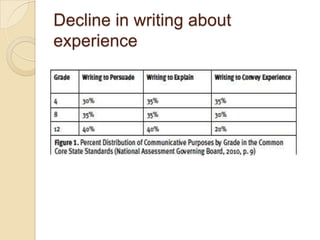
Decline in writing about
experience
Implemenation: Publishers use of
―Text-dependent questions‖
 ―The Standards strongly suggest that
  a majority of questions posed to
  children be based on the text under
  consideration…, not rely on students’
  different knowledge backgrounds.‖
 –Authors of the Common Core
  Standards in ELA/Literacy
Publisher’s ad:
 ―Give them informational and
  narrative books they can’t put down—
  with text-dependent questions for
  every title!
 Every book in the following sets
  comes with a Text-Dependent
  Comprehension Card to help students
  respond to 4 levels of text-dependent
  questions on new Common Core and
  state assessments. Saves prep time
Literature/informational texts
Prior knowledge:
   Before reading All Quiet on the Western
    Front, my honors-level sophomores read
    three pieces on morality and ethics, written
    by Pema Chödrön, Thomas Jefferson, and
    Machiavelli—all of whom propose certain
    ethical standards to live by. As we then read
    All Quiet, the moral dilemmas came into
    sharp focus as students considered how
    Erich Maria Remarque created his own
    ethical code. They read Taliban propaganda
    and then the Declaration of Independence.
    We looked at how people use that power,
    both legitimately and illegitimately.
Grade level standards based on
―progressions‖: Literature
 6th grade. Interpret the figurative and
  connotative meanings of words and
  phrases as they are used in a text.
 7th grade. Interpret the figurative and
  connotative meanings of words and
  phrases as they are used in a text and
  describe in detail a specific word choice
  and its impact on meaning and tone.
 8th grade. Explain the comparisons an
  author makes through metaphors,
  allusions, or analogies in a text and
  analyze how those comparisons
  contribute to meaning.
Literacy practice framework
Framing events
Constructing and enacting identities
Relating to and collaborating with others
Constructing texts or objects
Synthesizing and connecting texts
Critiquing and representing issues
Formulating effective arguments on
issues
Critiquing systems
 Re-designing/transforming systems
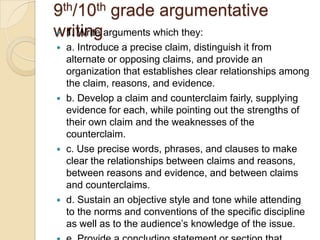
9 th/10th     grade argumentative
writingarguments which they:
 1. Write
   a. Introduce a precise claim, distinguish it from
    alternate or opposing claims, and provide an
    organization that establishes clear relationships among
    the claim, reasons, and evidence.
   b. Develop a claim and counterclaim fairly, supplying
    evidence for each, while pointing out the strengths of
    their own claim and the weaknesses of the
    counterclaim.
   c. Use precise words, phrases, and clauses to make
    clear the relationships between claims and reasons,
    between reasons and evidence, and between claims
    and counterclaims.
   d. Sustain an objective style and tone while attending
    to the norms and conventions of the specific discipline
    as well as to the audience’s knowledge of the issue.
Negotiating identities/adopting
perspectives: Online role-play
 Issue: Access to information on
  blocked websites
 Students adopt pro-con roles
    ◦   construct a persona
    ◦   employ rhetorical appeals
    ◦   support their position with reasons
    ◦   identify and refute counter-arguments
    ◦   revise or modify one’s own positions
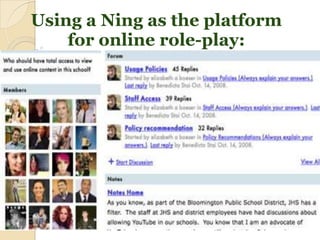
Using a Ning as the platform
    for online role-play:
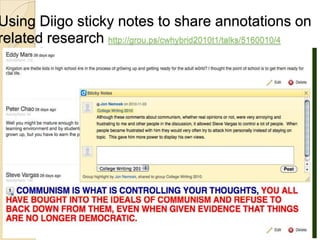
Using Diigo sticky notes to share annotations on
related research http://grou.ps/cwhybrid2010t1/talks/5160010/4
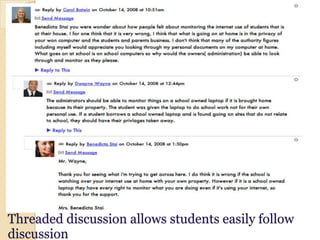
Threaded discussion allows students easily follow
discussion
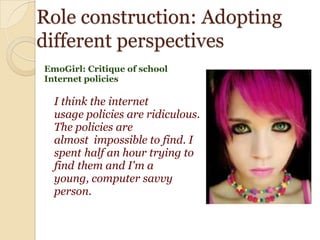
Role construction: Adopting
different perspectives
EmoGirl: Critique of school
Internet policies

  I think the internet
  usage policies are ridiculous.
  The policies are
  almost impossible to find. I
  spent half an hour trying to
  find them and I'm a
  young, computer savvy
  person.
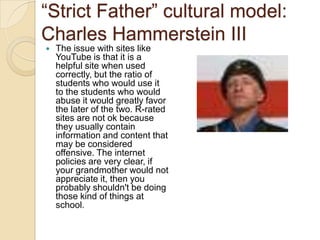
―Strict Father‖ cultural model:
Charles Hammerstein III
   The issue with sites like
    YouTube is that it is a
    helpful site when used
    correctly, but the ratio of
    students who would use it
    to the students who would
    abuse it would greatly favor
    the later of the two. R-rated
    sites are not ok because
    they usually contain
    information and content that
    may be considered
    offensive. The internet
    policies are very clear, if
    your grandmother would not
    appreciate it, then you
    probably shouldn't be doing
    those kind of things at
    school.
Issues from literature
Elizabeth Barniskis, Edina High
 School:
―Huck or Chuck?: Using Online Role-
Play and Ning to Negotiate Race in the
High School English Classroom ~
MCTE Journal‖
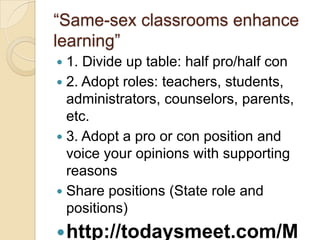
―Same-sex classrooms enhance
learning‖
 1. Divide up table: half pro/half con
 2. Adopt roles: teachers, students,
  administrators, counselors, parents,
  etc.
 3. Adopt a pro or con position and
  voice your opinions with supporting
  reasons
 Share positions (State role and
  positions)
 http://todaysmeet.com/M
Making sense of the CCSS, literacy
practices and:
LANGUAGE, GRAMMAR, A
ND USAGE
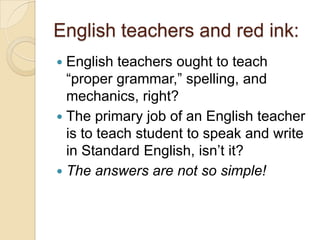
English teachers and red ink:
 English teachers ought to teach
  ―proper grammar,‖ spelling, and
  mechanics, right?
 The primary job of an English teacher
  is to teach student to speak and write
  in Standard English, isn’t it?
 The answers are not so simple!
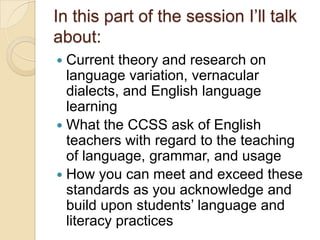
In this part of the session I’ll talk
about:
 Current theory and research on
  language variation, vernacular
  dialects, and English language
  learning
 What the CCSS ask of English
  teachers with regard to the teaching
  of language, grammar, and usage
 How you can meet and exceed these
  standards as you acknowledge and
  build upon students’ language and
  literacy practices
Direct instruction of traditional
school grammar
   Student learning through direction
    instruction of traditional school grammar
    has been extensively studied with
    absolutely clear results:
    ◦ The study of traditional school grammar (i.e.,
      the definition of parts of speech, the parsing
      of sentences, etc.) has no effect on raising
      the quality of student writing…In some cases
      a heavy emphasis on mechanics and usage
      (e.g. , marking every error) results in
      significant losses in overall quality.
    ◦ - Hillocks, 1984, p. 160
What do the CCSS call for?
   At first glance they seem at advocate
    for a traditional approach:
    ◦ Anchor standards state that students
      should ―demonstrate command of the
      conventions of standard English grammar
      and usage when writing or speaking.”
What do the CCSS call for?
   However, in the CCSS ―key points‖
    section they explain that:
    ◦ “The standards recognize that students must
      be able to use formal English in their writing
      and speaking but that they must also be able
      to make informed, skillful choices among the
      many ways to express themselves through
      language.”
   This caveat is also seen in standards
    that state that students should:
    ◦ “Apply knowledge of language to understand
      how language functions in different
      contexts, to make effective choices for
      meaning or style, and to more fully
In other words:
   While the CCSS place a high value
    on Standard English, they also
    suggest that students must be able to
    understand and use language
    variation within the English language
    as well as other languages that
    students might speak in their homes
    and communities across different
    academic and social contexts.
How does language variation
work?
 In order for students to understand
  how language functions, they need to
  consider how it varies and changes
 Example of English as spoken in
  U.S.:
    ◦ Regional differences; generational
      differences – how do they occur?
Is there one, correct, formal,
―standard‖ English?
 People often assume so
 Variations (AAVE, Chicano English, etc.)
  must then be informal or even improper
  or incorrect.
 People who see themselves as speaking
  standard English – typically those who
  are white and middle class – tend to
  hold negative views of people who
  speak vernacular Englishes.
 Teachers often have lower expectations
  of students who speak such variations.
These ideas have been widely
debunked by linguists and
literacy scholars.
Standard dialects are not linguistically
better by any objective measure; they are
socially preferred simply because they are
the language variations uses by those
who are most powerful and affluent in
society. In addition, although schools often
refer to Standard English as if it were a
single dialect, there are numerous
regional standard dialects.
- Godley, et. al., 2006
Do SE speakers actually speak
SE?
 James Gee (1996) argues that ALL
  English speakers (and speakers of
  any language) speak a range of
  informal variations of English that vary
  in their faithfulness to SE across
  social contexts.
 As a teacher you almost certainly
  speak a different variation of English
  in your classroom than you do at
  home with friends or family
Language as social practice -
Pennycook (2010)

   In no one really speaks standard
    forms of languages, than how do
    language actually function?
    ◦ Languages are not systems that are used
      more or less formally in various social
      contexts
    ◦ Instead, social contexts themselves drive
      language use and construction.
    ◦ We use language to achieve social goals
      – for instance to construct identities or
      build relationships.
Language as social practice -
Pennycook (2010)

 Language is not a system that is
  changed or distorted by social contexts,
  but shifts with social needs
 Example ―friend‖ and ―unfriend‖
    ◦ The construction and use of these terms
      developed within ―bundles‖ of social practices
      that are a necessary part of social networking
   Abbreviations such as ―lol‖ and ―btw‖
    ◦ Not simple formal or careless means of
      communication
    ◦ Logical and useful variations that developed
      as part of the social practice of texting
So why teach Standard English
at all?
 Students need to learn about the
  concept of SE, what it looks like, and
  its gatekeeping role in allowing so
  people access to power while denying
  it to others
 SE is part of ―codes of powers‖ that
  we should not deny any of our
  students from accessing and
  understanding (Delpit, 2006).
Delpit (2006)
   To act as if power does not exist is to
    ensure the power status quo remains
    the same. To imply to children…that
    is doesn‟t matter how you talk or how
    you write is to ensure their ultimate
    failure. I prefer to be honest with my
    students. I tell them that their
    language and cultural style is unique
    and wonderful but that there is a
    political power game that is also being
    played, and if they want to be in on
    that game there are certain games
―Englishes,‖ not English (Kirkland,
2010)

 Teachers should acknowledge and
  teach the power of SE
 The should also consider ways that
  other variations provide access to
  particular kinds of status and social
  power
 Example: working class girls (Jones, 2006)
    ◦ Used regional variation and discourse ―to
      shout back at a mainstream society that
      judged them harshly‖ (122)
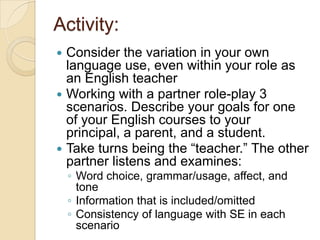
Activity:
 Consider the variation in your own
  language use, even within your role as
  an English teacher
 Working with a partner role-play 3
  scenarios. Describe your goals for one
  of your English courses to your
  principal, a parent, and a student.
 Take turns being the ―teacher.‖ The other
  partner listens and examines:
    ◦ Word choice, grammar/usage, affect, and
      tone
    ◦ Information that is included/omitted
    ◦ Consistency of language with SE in each
      scenario
Debrief:
 What did you notice about language
  variation in this activity?
 What social practices was your
  language linked to in each scenario?
 What kinds of social access might you
  gain through your use of language
  variation in each scenario?
How can we help students
understand language variation?
   Show students that SE is not a static
    system
    ◦ Close examination of language in
      Shakespeare – functional shifts such as
      using a word commonly used as a noun
      as a verb leading to changes in the word’s
      use in everyday speech.
    ◦ Show students the same poem written in
      Old English, Middle English, and Modern
      English.
How can we help students
understand language variation?
Some words or phrases become
linguistic fads; others fall into disuse or
“misuse.” Rules of taste change, and
the pronunciations, uses, conjugations,
and spellings of words are altered over
time to adjust to new contexts,
speakers, purposes, and audiences.
We call this adaptability „survival of the
fittest‟ when we discuss other kinds of
evolution; it is evidence of the
resilience of language and not a matter
for concern (Zuidema, 2005, p. 672).
Grammar vs. Usage (Zuidema,
2005):
 Grammar – internal patterns that a
  given language naturally follows
 Usage – rules of taste
 Confusion between the two leads
  people to see the English language
  as more rules oriented than it is.
  ◦ Examples: ―ain’t‖ or ending a sentence in
    a preposition. Neither are grammatically
    incorrect from a linguistic standpoint, on
    from the standpoint of particular tastes.
De-centering Standard
English
  Translating Tupac Shakur’s ―Just Me
   Against the World‖ from a variation of
   AAVE to SE
Though each passage…has the same
literal meaning, the original, non-Standard
English passage inevitably holds far more
emotional and rhetorical power…via
different translations of the same text, my
students experienced firsthand how
meaning can be list when we insist on a
rigid form of English for making meaning
Examining linguistic prejudice
   Wilson (2001) suggests asking
    students to look at ways that
    particular
    regional, racial, cultural, and
    generational variations of English are
    stigmatized, stereotyped and linked to
    particular identities in popular culture
    and media.
    ◦ Viewing sitcoms – how dialects delineate
      character types
    ◦ Record evidence of language prejudice in
      cartoons, newspapers or magazine
Students examining their own
variations
   Role playing activity in which students
    describe a car accident to parents,
    friends, and an insurance agent
    (Hagemann, 2001)
    ◦ Depending on the audience [students]
      chose different words, added/deleted
      particular details, used a different tone,
      etc. (p. 78).
   Ask students to list all of the
    variations they hear and speak in
    everyday life (―dinner table,‖ ―church,‖
    ―military,‖ ―school,‖ etc.) (Flynn, 2011).
Constructing and enacting
identities through language
variation:
   Helping students understand how
    identities are constructed through use
    of language as social practice.
    ◦ Challenge and rethink their status quo
      uses of language as they impact their
      ability to access particular kinds of power.
Seeing links between identity and
language in the classroom:
 Acknowledge and allow students to
  use home languages and variations in
  class whenever possible
 Choose texts that use non-standard
  dialects to provide students a means
  of exploring identity and language
Collaborating with others in
exploring language:
 Provides multiple perspectives on social
  practices related to language use
 Student-centered, dialogic discussion
  (Godley & Minnici, 2008) of language use:
    ◦ African American students identified nuances
      and variation in the use of AAVE across
      neighborhoods in their city.
    ◦ Emphasized distinct identities within an
      African American community rather than a
      linguistic identity constructed primarily in
      opposition to White identities (p. 336).
    ◦
Conducting ethnographies of
language use:
   Students collaborate in studying
    language oral and written language use
    as it is linked to
    roles, relationships, norms, beliefs, and
    social practices in a particular
    community.
    ◦   Athletic teams
    ◦   Sororities/fraternities
    ◦   Car body shop
    ◦   Church communities
   Students learn how language is used to
    establish shared knowledge and define
    identities within a group
Synthesizing and connecting
across languages and dialects:
Once your students learn to:
 ◦ Frame all language as inherently variable
 ◦ Understand language use as a social
   practices used to construct identities
 ◦ And, explore multiple perspectives on
   language use through collaborative
   discussion and inquiry…
 they will be ready to synthesize what
 they’ve learned and make connections that
 will lead them to acquisition on new
 language variations
Knowledge of home language or
variation can help students gain
proficiency in Standard English:
 Comparison or ―contrastive analysis‖
  (Godley & Minnici, 2008) of language
 Learning to notice and pay attention to
  features in their home language as they
  seek to understand particularities of SE
    ◦ Negation in AAVE or Southern U.S. dialects
      (―ain’t‖ vs. ―is not‖)
   Students learn to determine
    effectiveness of language choices for
    particular audiences
Key point:
   Students need to understand that you
    are not asking them to give up their
    home languages:
    ◦ Our goal as teachers should be ―expanding‖
      rather than ―erasing‖ a student’s linguistic
      repetoire (Hagemann, 2001).
   Students need to know about ―code-
    switching‖ (Depit, 2006) – using different
    languages, discourses, and variations in
    different contexts.
    ◦ Examples on code-switching can be found in
      literature (A Lesson Before Dying, To Kill a
      Mockingbird, etc.)
In sum:
   The CCSS for language and usage
    convey two key ideas:
    ◦ They ask that teachers help students gain
      proficiency in SE in both written and oral
      forms
    ◦ They ask that teachers ensure that students
      understand the contextual nature of language
      and usage and are prepared to communicate
      appropriately and effectively across social
      contexts
   Both of these standards can be met and
    exceeded by literacy practices that help
    students understand language variation
    and the role of SE within that variation.
Digital/media literacies
handout:

http://tinyurl.co
m/boemvof
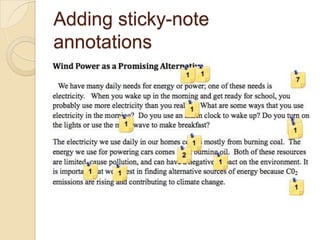
Using Diigo social bookmarking
for sharing annotations
1. Add Diigo to your iPad or computer
toolbar
2. Find an online text
3. Highlight sections of the text
4. Click on the icon to add a Sticky Note
response
5. Have other students add their responses
Diigo annotations: Pro-con
readings: benefits of energy from
wind power
   th
 7 grade students iMelanie
  Swandby’s
  ◦ Lighthouse School Community
    Charter School, Oakland, California
 Students posed questions for each
  other
  ◦ ―What does that mean, virtually
    free?‖
  ◦ What are some things that use
    energy or power?‖
Adding sticky-note
annotations
One student’s annotation: Pro
wind turbine essay
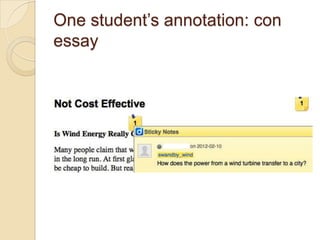
One student’s annotation: con
essay
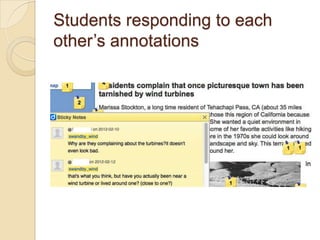
Students responding to each
other’s annotations
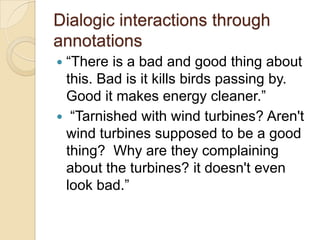
Dialogic interactions through
annotations
―There is a bad and good thing about
 this. Bad is it kills birds passing by.
 Good it makes energy cleaner.‖
 ―Tarnished with wind turbines? Aren't
 wind turbines supposed to be a good
 thing? Why are they complaining
 about the turbines? it doesn't even
 look bad.‖
Use of annotations for summary
writing
   I am perplexed in choosing if wind
    energy is a good courses or bad source.
    While, wind energy is a good source
    because it’s renewable and needs
    nothing more but construction, it can
    also cause irritation and attention of
    some people. Wind turbines are loud,
    noisy, and risky. Even though, it doesn’t
    cause any greenhouse gases in the air,
    wind turbines are harmful to wildlife and
    space. More birds die by getting hit by
    wind turbines which is very dangerous to
    our wildlife.
Digital concept mapping
 iPad apps: iBrainstorm, MindMeister
  for Ipad,, Sundry Notes, Idea Sketch,
  Total Recall, inShare, iMindMap
  MindNode, iThoughtsHD, Popplet Lite
   http://tinyurl.com/3o6a3wy
 Hierarchical/logical relationships between
  key concepts
5 th
   Grade Students: Popplet
Lite for Concept Mapping
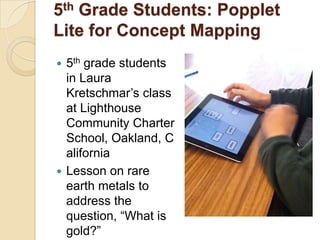
 5th grade students
  in Laura
  Kretschmar’s class
  at Lighthouse
  Community Charter
  School, Oakland, C
  alifornia
 Lesson on rare
  earth metals to
  address the
  question, ―What is
  gold?‖
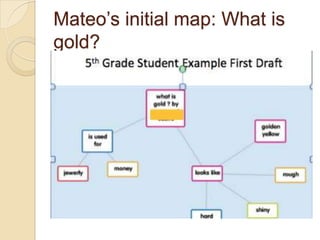
Mateo’s initial map: What is
gold?
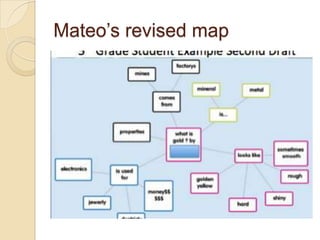
Mateo’s revised map
Speaking and listening
standards: Discussing to learn
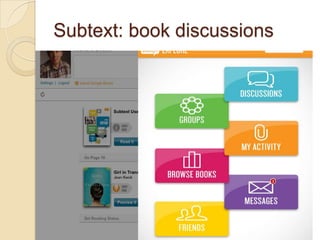
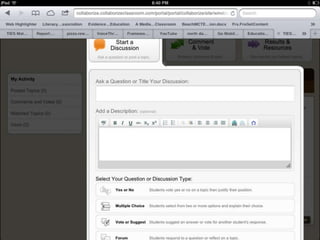
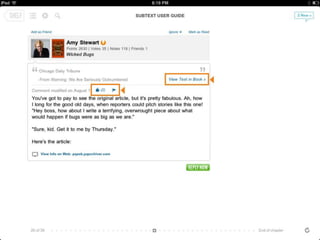
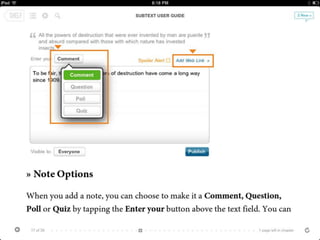
Subtext: book discussions
Images/audio/video to learn
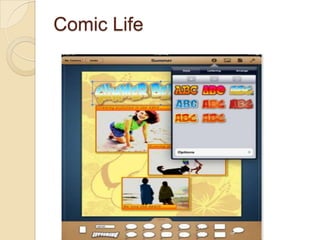
Comic Life
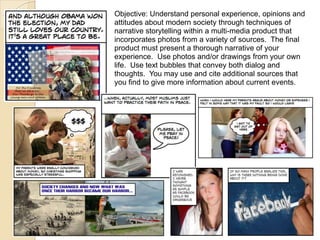
Objective: Understand personal experience, opinions and
attitudes about modern society through techniques of
narrative storytelling within a multi-media product that
incorporates photos from a variety of sources. The final
product must present a thorough narrative of your
experience. Use photos and/or drawings from your own
life. Use text bubbles that convey both dialog and
thoughts. You may use and cite additional sources that
you find to give more information about current events.
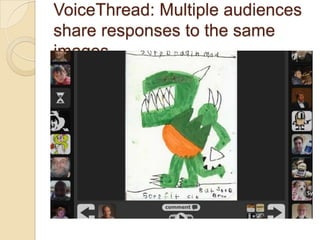
VoiceThread: Multiple audiences
share responses to the same
images
5th Graders: VoiceThread for
Studying Dinosaurs
   Extinction of the dinosaurs:
    ◦      supernova, volcanoes, or an asteroid.
    ◦ Volcanoes
      http://voicethread.com/share/2454743/
    ◦ Supernova
      http://voicethread.com/share/2544219/
    ◦ Asteriod
      http://voicethread.com/share/2545658/
Students ShowMe’s: Genetics:
dominant vs. recessive traits
   ―If a brown eyed and a blue eyed parent
    had a baby, what color eyes would the baby
    have?‖
       http://www.showme.com/sh/?h=ibbycYS
   Mother and father birds and baby bird
   http://www.showme.com/sh/?h=RNKspgu
   Pea plant genetics
   http://www.showme.com/sh/?h=GC6q3nM
Screencasting: Students or you
create how-to tutorials for peers
 VoiceThread, ExplainEverything,
  Screenchomp, ShowMe,
  Educreastions
 Snapguide http://tinyurl.com/ctkslx8
    ◦ Students:
Screencasting: feedback
 VoiceThread, ExplainEverything, Scre
  enchomp, ShowMe, Educreastions
 Video response to writing: Jing
    ◦ http://tinyurl.com/3kkw4am
   Speeches/drama: Formative
    Feedback for Learning
    http://formativefeedbackapp.blogspot.
    com
Publishing Multimodal Writing
 ePub: Mac Pages (soon to be
  on iPad Pages)
 Apple iBooks Author (requires
  OS Lion): iBooks
Tom’s Messenger
http://tinyurl.com/7v7klxw
My message on Tom’s
Messenger
Another message
Brainstorm: Digital tools/apps
 How could you use digital tools/apps
  to engage students in learning?
 Share:
    http://todaysmeet.com/MC
    TE
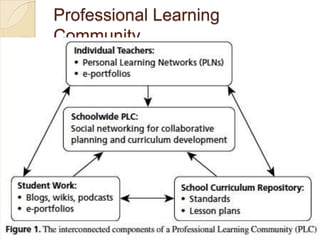
Professional Learning
Community

Mcte standards pp

  • 1.
    Teaching to Exceedthe English Language Arts Common Core Standards Richard Beach, University of Minnesota Amanda Haertling Thein, University of Iowa Online handout http://tinyurl.com/cwndbp3 Resource website: http://englishccss.pbworks.com
  • 2.
    Strengths of theCCSS  Not mandating content to be taught ◦ Versus the Profile of Learning  Emphasis on informational texts/argumentative writing  Connection to social studies and science
  • 3.
    Limitations of theCCSS  Formalist approach to reading/writing instruction ◦ Teaching structures of essay/literature versus responses/experiences
  • 4.
    Decline in writingabout experience
  • 5.
    Implemenation: Publishers useof ―Text-dependent questions‖  ―The Standards strongly suggest that a majority of questions posed to children be based on the text under consideration…, not rely on students’ different knowledge backgrounds.‖  –Authors of the Common Core Standards in ELA/Literacy
  • 6.
    Publisher’s ad:  ―Givethem informational and narrative books they can’t put down— with text-dependent questions for every title!  Every book in the following sets comes with a Text-Dependent Comprehension Card to help students respond to 4 levels of text-dependent questions on new Common Core and state assessments. Saves prep time
  • 7.
    Literature/informational texts Prior knowledge:  Before reading All Quiet on the Western Front, my honors-level sophomores read three pieces on morality and ethics, written by Pema Chödrön, Thomas Jefferson, and Machiavelli—all of whom propose certain ethical standards to live by. As we then read All Quiet, the moral dilemmas came into sharp focus as students considered how Erich Maria Remarque created his own ethical code. They read Taliban propaganda and then the Declaration of Independence. We looked at how people use that power, both legitimately and illegitimately.
  • 8.
    Grade level standardsbased on ―progressions‖: Literature  6th grade. Interpret the figurative and connotative meanings of words and phrases as they are used in a text.  7th grade. Interpret the figurative and connotative meanings of words and phrases as they are used in a text and describe in detail a specific word choice and its impact on meaning and tone.  8th grade. Explain the comparisons an author makes through metaphors, allusions, or analogies in a text and analyze how those comparisons contribute to meaning.
  • 9.
    Literacy practice framework Framingevents Constructing and enacting identities Relating to and collaborating with others Constructing texts or objects Synthesizing and connecting texts Critiquing and representing issues Formulating effective arguments on issues Critiquing systems Re-designing/transforming systems
  • 10.
    9 th/10th grade argumentative writingarguments which they:  1. Write  a. Introduce a precise claim, distinguish it from alternate or opposing claims, and provide an organization that establishes clear relationships among the claim, reasons, and evidence.  b. Develop a claim and counterclaim fairly, supplying evidence for each, while pointing out the strengths of their own claim and the weaknesses of the counterclaim.  c. Use precise words, phrases, and clauses to make clear the relationships between claims and reasons, between reasons and evidence, and between claims and counterclaims.  d. Sustain an objective style and tone while attending to the norms and conventions of the specific discipline as well as to the audience’s knowledge of the issue.
  • 11.
    Negotiating identities/adopting perspectives: Onlinerole-play  Issue: Access to information on blocked websites  Students adopt pro-con roles ◦ construct a persona ◦ employ rhetorical appeals ◦ support their position with reasons ◦ identify and refute counter-arguments ◦ revise or modify one’s own positions
  • 12.
    Using a Ningas the platform for online role-play:
  • 13.
    Using Diigo stickynotes to share annotations on related research http://grou.ps/cwhybrid2010t1/talks/5160010/4
  • 14.
    Threaded discussion allowsstudents easily follow discussion
  • 15.
    Role construction: Adopting differentperspectives EmoGirl: Critique of school Internet policies I think the internet usage policies are ridiculous. The policies are almost impossible to find. I spent half an hour trying to find them and I'm a young, computer savvy person.
  • 16.
    ―Strict Father‖ culturalmodel: Charles Hammerstein III  The issue with sites like YouTube is that it is a helpful site when used correctly, but the ratio of students who would use it to the students who would abuse it would greatly favor the later of the two. R-rated sites are not ok because they usually contain information and content that may be considered offensive. The internet policies are very clear, if your grandmother would not appreciate it, then you probably shouldn't be doing those kind of things at school.
  • 17.
    Issues from literature ElizabethBarniskis, Edina High School: ―Huck or Chuck?: Using Online Role- Play and Ning to Negotiate Race in the High School English Classroom ~ MCTE Journal‖
  • 18.
    ―Same-sex classrooms enhance learning‖ 1. Divide up table: half pro/half con  2. Adopt roles: teachers, students, administrators, counselors, parents, etc.  3. Adopt a pro or con position and voice your opinions with supporting reasons  Share positions (State role and positions)  http://todaysmeet.com/M
  • 19.
    Making sense ofthe CCSS, literacy practices and: LANGUAGE, GRAMMAR, A ND USAGE
  • 20.
    English teachers andred ink:  English teachers ought to teach ―proper grammar,‖ spelling, and mechanics, right?  The primary job of an English teacher is to teach student to speak and write in Standard English, isn’t it?  The answers are not so simple!
  • 21.
    In this partof the session I’ll talk about:  Current theory and research on language variation, vernacular dialects, and English language learning  What the CCSS ask of English teachers with regard to the teaching of language, grammar, and usage  How you can meet and exceed these standards as you acknowledge and build upon students’ language and literacy practices
  • 22.
    Direct instruction oftraditional school grammar  Student learning through direction instruction of traditional school grammar has been extensively studied with absolutely clear results: ◦ The study of traditional school grammar (i.e., the definition of parts of speech, the parsing of sentences, etc.) has no effect on raising the quality of student writing…In some cases a heavy emphasis on mechanics and usage (e.g. , marking every error) results in significant losses in overall quality. ◦ - Hillocks, 1984, p. 160
  • 23.
    What do theCCSS call for?  At first glance they seem at advocate for a traditional approach: ◦ Anchor standards state that students should ―demonstrate command of the conventions of standard English grammar and usage when writing or speaking.”
  • 24.
    What do theCCSS call for?  However, in the CCSS ―key points‖ section they explain that: ◦ “The standards recognize that students must be able to use formal English in their writing and speaking but that they must also be able to make informed, skillful choices among the many ways to express themselves through language.”  This caveat is also seen in standards that state that students should: ◦ “Apply knowledge of language to understand how language functions in different contexts, to make effective choices for meaning or style, and to more fully
  • 25.
    In other words:  While the CCSS place a high value on Standard English, they also suggest that students must be able to understand and use language variation within the English language as well as other languages that students might speak in their homes and communities across different academic and social contexts.
  • 26.
    How does languagevariation work?  In order for students to understand how language functions, they need to consider how it varies and changes  Example of English as spoken in U.S.: ◦ Regional differences; generational differences – how do they occur?
  • 27.
    Is there one,correct, formal, ―standard‖ English?  People often assume so  Variations (AAVE, Chicano English, etc.) must then be informal or even improper or incorrect.  People who see themselves as speaking standard English – typically those who are white and middle class – tend to hold negative views of people who speak vernacular Englishes.  Teachers often have lower expectations of students who speak such variations.
  • 28.
    These ideas havebeen widely debunked by linguists and literacy scholars. Standard dialects are not linguistically better by any objective measure; they are socially preferred simply because they are the language variations uses by those who are most powerful and affluent in society. In addition, although schools often refer to Standard English as if it were a single dialect, there are numerous regional standard dialects. - Godley, et. al., 2006
  • 29.
    Do SE speakersactually speak SE?  James Gee (1996) argues that ALL English speakers (and speakers of any language) speak a range of informal variations of English that vary in their faithfulness to SE across social contexts.  As a teacher you almost certainly speak a different variation of English in your classroom than you do at home with friends or family
  • 30.
    Language as socialpractice - Pennycook (2010)  In no one really speaks standard forms of languages, than how do language actually function? ◦ Languages are not systems that are used more or less formally in various social contexts ◦ Instead, social contexts themselves drive language use and construction. ◦ We use language to achieve social goals – for instance to construct identities or build relationships.
  • 31.
    Language as socialpractice - Pennycook (2010)  Language is not a system that is changed or distorted by social contexts, but shifts with social needs  Example ―friend‖ and ―unfriend‖ ◦ The construction and use of these terms developed within ―bundles‖ of social practices that are a necessary part of social networking  Abbreviations such as ―lol‖ and ―btw‖ ◦ Not simple formal or careless means of communication ◦ Logical and useful variations that developed as part of the social practice of texting
  • 32.
    So why teachStandard English at all?  Students need to learn about the concept of SE, what it looks like, and its gatekeeping role in allowing so people access to power while denying it to others  SE is part of ―codes of powers‖ that we should not deny any of our students from accessing and understanding (Delpit, 2006).
  • 33.
    Delpit (2006)  To act as if power does not exist is to ensure the power status quo remains the same. To imply to children…that is doesn‟t matter how you talk or how you write is to ensure their ultimate failure. I prefer to be honest with my students. I tell them that their language and cultural style is unique and wonderful but that there is a political power game that is also being played, and if they want to be in on that game there are certain games
  • 34.
    ―Englishes,‖ not English(Kirkland, 2010)  Teachers should acknowledge and teach the power of SE  The should also consider ways that other variations provide access to particular kinds of status and social power  Example: working class girls (Jones, 2006) ◦ Used regional variation and discourse ―to shout back at a mainstream society that judged them harshly‖ (122)
  • 35.
    Activity:  Consider thevariation in your own language use, even within your role as an English teacher  Working with a partner role-play 3 scenarios. Describe your goals for one of your English courses to your principal, a parent, and a student.  Take turns being the ―teacher.‖ The other partner listens and examines: ◦ Word choice, grammar/usage, affect, and tone ◦ Information that is included/omitted ◦ Consistency of language with SE in each scenario
  • 36.
    Debrief:  What didyou notice about language variation in this activity?  What social practices was your language linked to in each scenario?  What kinds of social access might you gain through your use of language variation in each scenario?
  • 37.
    How can wehelp students understand language variation?  Show students that SE is not a static system ◦ Close examination of language in Shakespeare – functional shifts such as using a word commonly used as a noun as a verb leading to changes in the word’s use in everyday speech. ◦ Show students the same poem written in Old English, Middle English, and Modern English.
  • 38.
    How can wehelp students understand language variation? Some words or phrases become linguistic fads; others fall into disuse or “misuse.” Rules of taste change, and the pronunciations, uses, conjugations, and spellings of words are altered over time to adjust to new contexts, speakers, purposes, and audiences. We call this adaptability „survival of the fittest‟ when we discuss other kinds of evolution; it is evidence of the resilience of language and not a matter for concern (Zuidema, 2005, p. 672).
  • 39.
    Grammar vs. Usage(Zuidema, 2005):  Grammar – internal patterns that a given language naturally follows  Usage – rules of taste  Confusion between the two leads people to see the English language as more rules oriented than it is. ◦ Examples: ―ain’t‖ or ending a sentence in a preposition. Neither are grammatically incorrect from a linguistic standpoint, on from the standpoint of particular tastes.
  • 40.
    De-centering Standard English  Translating Tupac Shakur’s ―Just Me Against the World‖ from a variation of AAVE to SE Though each passage…has the same literal meaning, the original, non-Standard English passage inevitably holds far more emotional and rhetorical power…via different translations of the same text, my students experienced firsthand how meaning can be list when we insist on a rigid form of English for making meaning
  • 41.
    Examining linguistic prejudice  Wilson (2001) suggests asking students to look at ways that particular regional, racial, cultural, and generational variations of English are stigmatized, stereotyped and linked to particular identities in popular culture and media. ◦ Viewing sitcoms – how dialects delineate character types ◦ Record evidence of language prejudice in cartoons, newspapers or magazine
  • 42.
    Students examining theirown variations  Role playing activity in which students describe a car accident to parents, friends, and an insurance agent (Hagemann, 2001) ◦ Depending on the audience [students] chose different words, added/deleted particular details, used a different tone, etc. (p. 78).  Ask students to list all of the variations they hear and speak in everyday life (―dinner table,‖ ―church,‖ ―military,‖ ―school,‖ etc.) (Flynn, 2011).
  • 43.
    Constructing and enacting identitiesthrough language variation:  Helping students understand how identities are constructed through use of language as social practice. ◦ Challenge and rethink their status quo uses of language as they impact their ability to access particular kinds of power.
  • 44.
    Seeing links betweenidentity and language in the classroom:  Acknowledge and allow students to use home languages and variations in class whenever possible  Choose texts that use non-standard dialects to provide students a means of exploring identity and language
  • 45.
    Collaborating with othersin exploring language:  Provides multiple perspectives on social practices related to language use  Student-centered, dialogic discussion (Godley & Minnici, 2008) of language use: ◦ African American students identified nuances and variation in the use of AAVE across neighborhoods in their city. ◦ Emphasized distinct identities within an African American community rather than a linguistic identity constructed primarily in opposition to White identities (p. 336). ◦
  • 46.
    Conducting ethnographies of languageuse:  Students collaborate in studying language oral and written language use as it is linked to roles, relationships, norms, beliefs, and social practices in a particular community. ◦ Athletic teams ◦ Sororities/fraternities ◦ Car body shop ◦ Church communities  Students learn how language is used to establish shared knowledge and define identities within a group
  • 47.
    Synthesizing and connecting acrosslanguages and dialects: Once your students learn to: ◦ Frame all language as inherently variable ◦ Understand language use as a social practices used to construct identities ◦ And, explore multiple perspectives on language use through collaborative discussion and inquiry… they will be ready to synthesize what they’ve learned and make connections that will lead them to acquisition on new language variations
  • 48.
    Knowledge of homelanguage or variation can help students gain proficiency in Standard English:  Comparison or ―contrastive analysis‖ (Godley & Minnici, 2008) of language  Learning to notice and pay attention to features in their home language as they seek to understand particularities of SE ◦ Negation in AAVE or Southern U.S. dialects (―ain’t‖ vs. ―is not‖)  Students learn to determine effectiveness of language choices for particular audiences
  • 49.
    Key point:  Students need to understand that you are not asking them to give up their home languages: ◦ Our goal as teachers should be ―expanding‖ rather than ―erasing‖ a student’s linguistic repetoire (Hagemann, 2001).  Students need to know about ―code- switching‖ (Depit, 2006) – using different languages, discourses, and variations in different contexts. ◦ Examples on code-switching can be found in literature (A Lesson Before Dying, To Kill a Mockingbird, etc.)
  • 50.
    In sum:  The CCSS for language and usage convey two key ideas: ◦ They ask that teachers help students gain proficiency in SE in both written and oral forms ◦ They ask that teachers ensure that students understand the contextual nature of language and usage and are prepared to communicate appropriately and effectively across social contexts  Both of these standards can be met and exceeded by literacy practices that help students understand language variation and the role of SE within that variation.
  • 51.
  • 53.
    Using Diigo socialbookmarking for sharing annotations 1. Add Diigo to your iPad or computer toolbar 2. Find an online text 3. Highlight sections of the text 4. Click on the icon to add a Sticky Note response 5. Have other students add their responses
  • 54.
    Diigo annotations: Pro-con readings:benefits of energy from wind power th  7 grade students iMelanie Swandby’s ◦ Lighthouse School Community Charter School, Oakland, California  Students posed questions for each other ◦ ―What does that mean, virtually free?‖ ◦ What are some things that use energy or power?‖
  • 55.
  • 56.
    One student’s annotation:Pro wind turbine essay
  • 57.
  • 58.
    Students responding toeach other’s annotations
  • 59.
    Dialogic interactions through annotations ―Thereis a bad and good thing about this. Bad is it kills birds passing by. Good it makes energy cleaner.‖  ―Tarnished with wind turbines? Aren't wind turbines supposed to be a good thing? Why are they complaining about the turbines? it doesn't even look bad.‖
  • 60.
    Use of annotationsfor summary writing  I am perplexed in choosing if wind energy is a good courses or bad source. While, wind energy is a good source because it’s renewable and needs nothing more but construction, it can also cause irritation and attention of some people. Wind turbines are loud, noisy, and risky. Even though, it doesn’t cause any greenhouse gases in the air, wind turbines are harmful to wildlife and space. More birds die by getting hit by wind turbines which is very dangerous to our wildlife.
  • 61.
    Digital concept mapping iPad apps: iBrainstorm, MindMeister for Ipad,, Sundry Notes, Idea Sketch, Total Recall, inShare, iMindMap MindNode, iThoughtsHD, Popplet Lite http://tinyurl.com/3o6a3wy  Hierarchical/logical relationships between key concepts
  • 62.
    5 th Grade Students: Popplet Lite for Concept Mapping  5th grade students in Laura Kretschmar’s class at Lighthouse Community Charter School, Oakland, C alifornia  Lesson on rare earth metals to address the question, ―What is gold?‖
  • 63.
  • 64.
  • 65.
  • 66.
  • 75.
  • 76.
  • 77.
    Objective: Understand personalexperience, opinions and attitudes about modern society through techniques of narrative storytelling within a multi-media product that incorporates photos from a variety of sources. The final product must present a thorough narrative of your experience. Use photos and/or drawings from your own life. Use text bubbles that convey both dialog and thoughts. You may use and cite additional sources that you find to give more information about current events.
  • 78.
    VoiceThread: Multiple audiences shareresponses to the same images
  • 79.
    5th Graders: VoiceThreadfor Studying Dinosaurs  Extinction of the dinosaurs: ◦ supernova, volcanoes, or an asteroid. ◦ Volcanoes http://voicethread.com/share/2454743/ ◦ Supernova http://voicethread.com/share/2544219/ ◦ Asteriod http://voicethread.com/share/2545658/
  • 80.
    Students ShowMe’s: Genetics: dominantvs. recessive traits  ―If a brown eyed and a blue eyed parent had a baby, what color eyes would the baby have?‖  http://www.showme.com/sh/?h=ibbycYS  Mother and father birds and baby bird  http://www.showme.com/sh/?h=RNKspgu  Pea plant genetics  http://www.showme.com/sh/?h=GC6q3nM
  • 81.
    Screencasting: Students oryou create how-to tutorials for peers  VoiceThread, ExplainEverything, Screenchomp, ShowMe, Educreastions  Snapguide http://tinyurl.com/ctkslx8 ◦ Students:
  • 82.
    Screencasting: feedback  VoiceThread,ExplainEverything, Scre enchomp, ShowMe, Educreastions  Video response to writing: Jing ◦ http://tinyurl.com/3kkw4am  Speeches/drama: Formative Feedback for Learning http://formativefeedbackapp.blogspot. com
  • 83.
    Publishing Multimodal Writing ePub: Mac Pages (soon to be on iPad Pages)  Apple iBooks Author (requires OS Lion): iBooks
  • 84.
  • 88.
    My message onTom’s Messenger
  • 89.
  • 90.
    Brainstorm: Digital tools/apps How could you use digital tools/apps to engage students in learning?  Share: http://todaysmeet.com/MC TE
  • 91.

Editor's Notes

  • #23 Read a longer section of the quote. Then explain that Hillock’s review of over 500 studies supports the inquiry-bases, literacy practices approach we advocate.
  • #30 Note that an audio-recording of your most formal teaching moments would quickly convince you that you do not speak perfect SE, even in this context. Standard English, like any standard form of any living language – is an abstract ideal or model for writing, but not something people actually speak.
  • #34 Read slide, then explain:Delpit is not suggesting that language variation somehow be eliminated, but instead that students be taught to code-switch; to learn effective us of SE as one of several equally valuable variations for use in accessing power structures.
  • #35 Shouting back to many forms – literally shouting at authority figures such as police. These were practices for survival. These girls would have had difficulty accessing power in their own community had they approached daily life through SE.
  • #41 Once students begin to understand how language variation works and that language is not static, they can begin to de-center Standard English.