
   What is MSDS?

   How Can I Access The
    MSDS?

   Important Information
    on MSDS

   Systems of Labeling
                            2
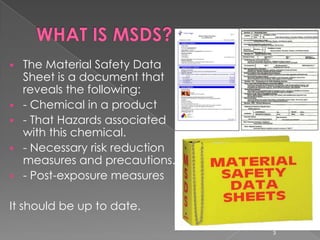
   The Material Safety Data
    Sheet is a document that
    reveals the following:
   - Chemical in a product
   - That Hazards associated
    with this chemical.
   - Necessary risk reduction
    measures and precautions.
   - Post-exposure measures

It should be up to date.

                                 3
   This is one of the tools in
    line with OSHA Right-To
    Know Policy OSHA 29 CFR
    1910.1200 on use of
    chemicals in the
    workplace, which also
    includes other items like:

   -Container labels
   -Safety signs, and
   -Safety training and Pre-
    tour meetings.

                                  4
   The manufacturer has a
    responsibility to provide this
    document on supplying a
    product.

    The employer has a responsibility
    to make this document available
    their employees.

   The employees have a
    responsibility to access these
    documents wherever they are
    located before proceeding on a
    job and abide by policies and
    procedures of the employer.

                                         5
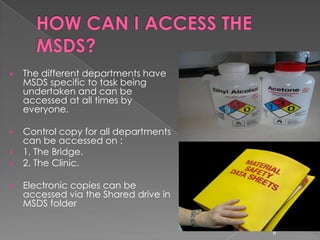
   The different departments have
    MSDS specific to task being
    undertaken and can be
    accessed at all times by
    everyone.

   Control copy for all departments
    can be accessed on :
   1. The Bridge.
   2. The Clinic.

   Electronic copies can be
    accessed via the Shared drive in
    MSDS folder


                                       6
   Product Information
   Chemical Components
   Exposure Limits
    ›   PEL (Permissible Exposure Limit)
    ›   STEL (Short-Term Exposure Limit)
    ›   TLV (Threshold Limit Value)
  Physical Properties
 Health Hazards
 Fire and Explosion Data
(Flash point and
   Flammability, including fire
   fighting requirements and
   procedures)
 Reactivity Information
(Chemical interactions)
                                           7
   Safe Handling Precautions/Instructions
   Exposure Control
(Engineering, PPE and Personal hygiene)
 Spills and Leaks Instructions/Precautions
 First Aid Measures
(Following post-exposure via
    inhalation, skin or eyes)
 Additional Information:
This includes it’s the following:
- Ecological/Environmental hazards
- Toxicology testing/reports
- Shipping Information
- Relevant Regulatory Bodies.


                                              8
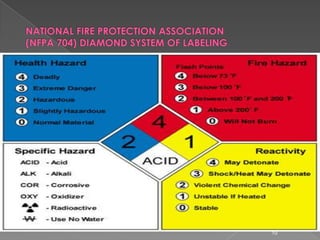
   The systems for identification of hazard
    includes:
   1. National Fire Protection Association (NFPA
    704) Diamond Labeling System

   2. Hazardous Materials Identification System
    (HMIS)
   These systems rely on colour coding and
    numerical rating to identify a hazard and
    communicate its severity.

   3. Uniform Laboratory Hazard Signage (ULHS)
    System
   This system identifies areas where the
    hazardous substances are used or stored using
    pictures and symbols.

                                                    9
10
11
12
13
14
15

Msds training

  • 2.
    What is MSDS?  How Can I Access The MSDS?  Important Information on MSDS  Systems of Labeling 2
  • 3.
    The Material Safety Data Sheet is a document that reveals the following:  - Chemical in a product  - That Hazards associated with this chemical.  - Necessary risk reduction measures and precautions.  - Post-exposure measures It should be up to date. 3
  • 4.
    This is one of the tools in line with OSHA Right-To Know Policy OSHA 29 CFR 1910.1200 on use of chemicals in the workplace, which also includes other items like:  -Container labels  -Safety signs, and  -Safety training and Pre- tour meetings. 4
  • 5.
    The manufacturer has a responsibility to provide this document on supplying a product.  The employer has a responsibility to make this document available their employees.  The employees have a responsibility to access these documents wherever they are located before proceeding on a job and abide by policies and procedures of the employer. 5
  • 6.
    The different departments have MSDS specific to task being undertaken and can be accessed at all times by everyone.  Control copy for all departments can be accessed on :  1. The Bridge.  2. The Clinic.  Electronic copies can be accessed via the Shared drive in MSDS folder 6
  • 7.
    Product Information  Chemical Components  Exposure Limits › PEL (Permissible Exposure Limit) › STEL (Short-Term Exposure Limit) › TLV (Threshold Limit Value)  Physical Properties  Health Hazards  Fire and Explosion Data (Flash point and Flammability, including fire fighting requirements and procedures)  Reactivity Information (Chemical interactions) 7
  • 8.
    Safe Handling Precautions/Instructions  Exposure Control (Engineering, PPE and Personal hygiene)  Spills and Leaks Instructions/Precautions  First Aid Measures (Following post-exposure via inhalation, skin or eyes)  Additional Information: This includes it’s the following: - Ecological/Environmental hazards - Toxicology testing/reports - Shipping Information - Relevant Regulatory Bodies. 8
  • 9.
    The systems for identification of hazard includes:  1. National Fire Protection Association (NFPA 704) Diamond Labeling System  2. Hazardous Materials Identification System (HMIS)  These systems rely on colour coding and numerical rating to identify a hazard and communicate its severity.  3. Uniform Laboratory Hazard Signage (ULHS) System  This system identifies areas where the hazardous substances are used or stored using pictures and symbols. 9
  • 10.
  • 11.
  • 12.
  • 13.
  • 14.
  • 15.