 Hazard Communication System
◦ OSHA estimates:
 7 million workplaces
 100 million employees
 945,000 hazardous chemical products
 All employees will be trained in the safe
use of all chemicals used in the
workplace!
 This training will be refreshed on a yearly
basis or when a new
 Chemical or process is introduced
9/18/2013jars inc.
 sds sheets will be kept in the store or on line
for all chemicals used in our operation and
updated on a regular basis to satisfy the
employees’ right to know
 Retraining will take place when a new
chemical or procedure is introduced
 any questions as to interpretation of sds
sheets may be directed to the safety manager
 An inventory shall be supplied upon request
9/18/2013jars inc.
 No new chemicals will be introduced into the
operation without an safety data sheet and
not without approval of the operator/ safety
manager.
 Use of consumer style products is highly
discouraged and may be construed as a
violation of safety standards according to
usage
9/18/2013jars inc.
 Chemicals shall kept in their original
container or properly labeled spray bottle.
 Read the label before use make sure the
chemical is designed for the task at hand.
 Any non-routine task will require a special
training session by a qualified person.
9/18/2013jars inc.
 Check labels for any personal protective
equipment needed!
 The use of unlabeled spray bottles is
PROHIBITED!
 labels will not be removed or defaced
9/18/2013jars inc.
 All chemicals shall be stored in a designated
place away from food prep areas ,intense
heat sources food containers or open flames.
 sds sheets for fire extinguishers and
compressed gases will be kept at the main
office.
9/18/2013jars inc.
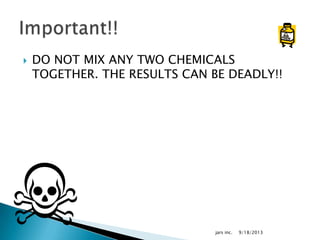
 DO NOT MIX ANY TWO CHEMICALS
TOGETHER. THE RESULTS CAN BE DEADLY!!
9/18/2013jars inc.
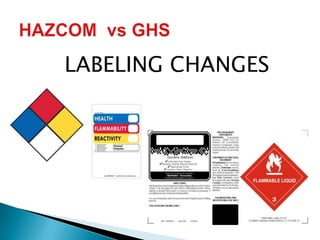
LABELING CHANGES
 Standards will be more pictogram based as
opposed to word based
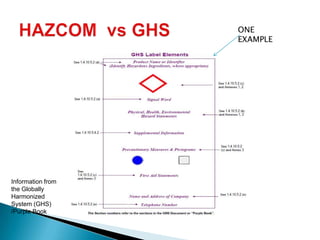
Information from
the Globally
Harmonized
System (GHS)
/Purple Book
ONE
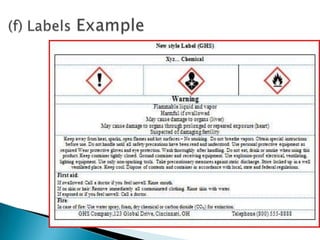
EXAMPLE
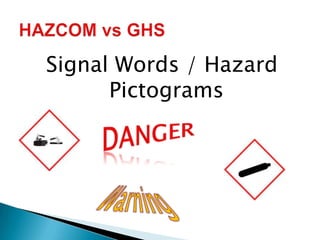
Signal Words / Hazard
Pictograms
 Signal Words
◦ The words “Danger” and “Warning” are being used as
signal words to emphasize the hazard and indicate the
relative level of the severity of the hazard as assigned by
a GHS hazard class and category
 Danger – For more “severe” hazards
 Warning – For less “severe” hazards
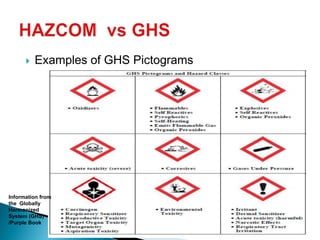
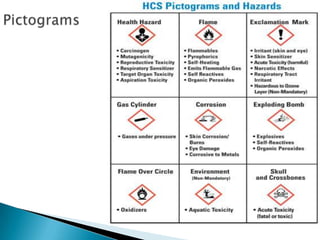
 Examples of GHS Pictograms
Information from
the Globally
Harmonized
System (GHS)
/Purple Book
 Hazard & Precautionary Statements
◦ Hazard statements have been standardized and given
phrases that describe the hazard(s) as found in the
hazard classification
◦ If there is more than one hazard, then the appropriate
hazard statement should be included for all identified
hazards
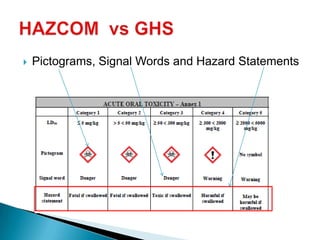
 Pictograms, Signal Words and Hazard Statements
Safety Data Sheets
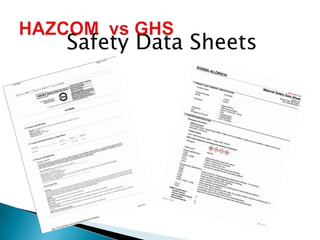
 Safety Data Sheets
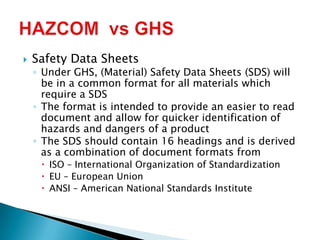
◦ Under GHS, (Material) Safety Data Sheets (SDS) will
be in a common format for all materials which
require a SDS
◦ The format is intended to provide an easier to read
document and allow for quicker identification of
hazards and dangers of a product
◦ The SDS should contain 16 headings and is derived
as a combination of document formats from
 ISO – International Organization of Standardization
 EU – European Union
 ANSI – American National Standards Institute
 Safety Data Sheets
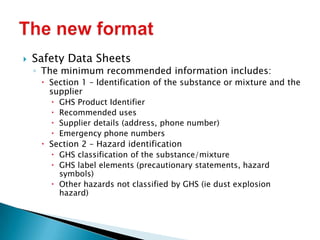
◦ The minimum recommended information includes:
 Section 1 – Identification of the substance or mixture and the
supplier
 GHS Product Identifier
 Recommended uses
 Supplier details (address, phone number)
 Emergency phone numbers
 Section 2 – Hazard identification
 GHS classification of the substance/mixture
 GHS label elements (precautionary statements, hazard
symbols)
 Other hazards not classified by GHS (ie dust explosion
hazard)
 Safety Data Sheets
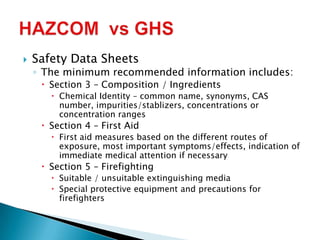
◦ The minimum recommended information includes:
 Section 3 – Composition / Ingredients
 Chemical Identity – common name, synonyms, CAS
number, impurities/stablizers, concentrations or
concentration ranges
 Section 4 – First Aid
 First aid measures based on the different routes of
exposure, most important symptoms/effects, indication of
immediate medical attention if necessary
 Section 5 – Firefighting
 Suitable / unsuitable extinguishing media
 Special protective equipment and precautions for
firefighters
 Safety Data Sheets
◦ The minimum recommended information includes:
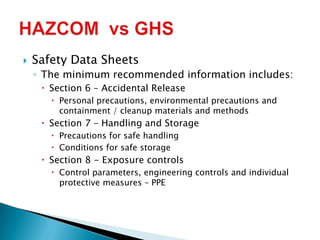
 Section 6 – Accidental Release
 Personal precautions, environmental precautions and
containment / cleanup materials and methods
 Section 7 – Handling and Storage
 Precautions for safe handling
 Conditions for safe storage
 Section 8 - Exposure controls
 Control parameters, engineering controls and individual
protective measures – PPE
 Safety Data Sheets
◦ The minimum recommended information includes:
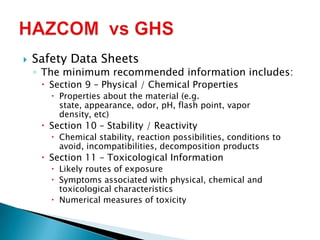
 Section 9 – Physical / Chemical Properties
 Properties about the material (e.g.
state, appearance, odor, pH, flash point, vapor
density, etc)
 Section 10 – Stability / Reactivity
 Chemical stability, reaction possibilities, conditions to
avoid, incompatibilities, decomposition products
 Section 11 – Toxicological Information
 Likely routes of exposure
 Symptoms associated with physical, chemical and
toxicological characteristics
 Numerical measures of toxicity
 Safety Data Sheets
◦ The minimum recommended information includes:
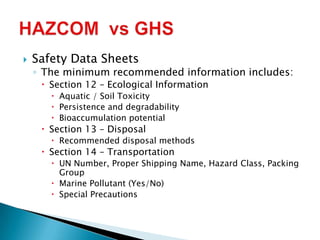
 Section 12 – Ecological Information
 Aquatic / Soil Toxicity
 Persistence and degradability
 Bioaccumulation potential
 Section 13 – Disposal
 Recommended disposal methods
 Section 14 – Transportation
 UN Number, Proper Shipping Name, Hazard Class, Packing
Group
 Marine Pollutant (Yes/No)
 Special Precautions
 Safety Data Sheets
◦ The minimum recommended information includes:
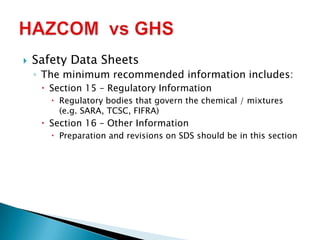
 Section 15 – Regulatory Information
 Regulatory bodies that govern the chemical / mixtures
(e.g. SARA, TCSC, FIFRA)
 Section 16 – Other Information
 Preparation and revisions on SDS should be in this section
 Safety Data Sheets
◦ With uniform data fields and common
terminology, information can easily be found on the
sheets
◦ Worker understanding of the dangers will also be easier
to define
 Training
◦ Under the current hazard communication
system, employers are required to train employees
on the hazard associated with products
◦ Right-to-Know stations must be provided
◦ GHS does not change this requirement and stresses
the importance of training for employees
◦ The GHS harmonization with labels / SDS
/terminology is intended to make training easier for
all
 GHS Reference
◦ A Guide to The Globally Harmonized System of
Classification and Labeling of Chemicals (GHS)
http://www.osha.gov/dsg/hazcom/ghsguideoct05.pdf
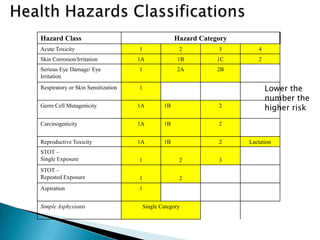
Hazard Class Hazard Category
Acute Toxicity 1 2 3 4
Skin Corrosion/Irritation 1A 1B 1C 2
Serious Eye Damage/ Eye
Irritation
1 2A 2B
Respiratory or Skin Sensitization 1
Germ Cell Mutagenicity 1A 1B 2
Carcinogenicity 1A 1B 2
Reproductive Toxicity 1A 1B 2 Lactation
STOT –
Single Exposure 1 2 3
STOT –
Repeated Exposure 1 2
Aspiration 1
Simple Asphyxiants Single Category
Lower the
number the
higher risk
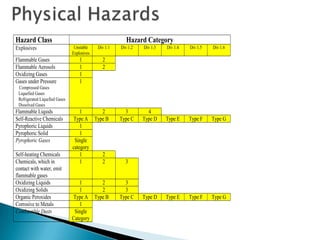
Hazard Class Hazard Category
Explosives Unstable
Explosives
Div 1.1 Div 1.2 Div 1.3 Div 1.4 Div 1.5 Div 1.6
Flammable Gases 1 2
Flammable Aerosols 1 2
Oxidizing Gases 1
Gases under Pressure
Compressed Gases
Liquefied Gases
Refrigerated Liquefied Gases
Dissolved Gases
1
Flammable Liquids 1 2 3 4
Self-Reactive Chemicals Type A Type B Type C Type D Type E Type F Type G
Pyrophoric Liquids 1
Pyrophoric Solid 1
Pyrophoric Gases Single
category
Self-heating Chemicals 1 2
Chemicals, which in
contact with water, emit
flammable gases
1 2 3
Oxidizing Liquids 1 2 3
Oxidizing Solids 1 2 3
Organic Peroxides Type A Type B Type C Type D Type E Type F Type G
Corrosive to Metals 1
Combustible Dusts Single
Category
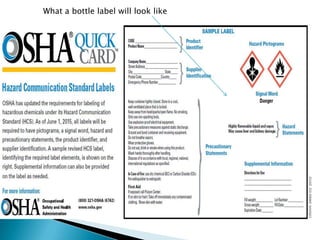
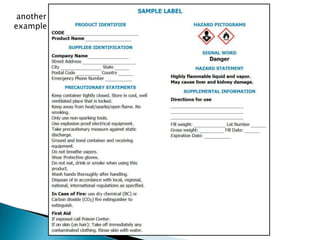
What a bottle label will look like
another
example
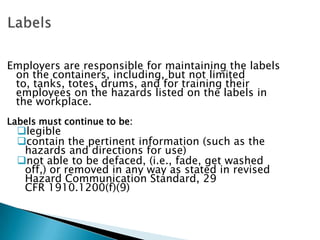
Employers are responsible for maintaining the labels
on the containers, including, but not limited
to, tanks, totes, drums, and for training their
employees on the hazards listed on the labels in
the workplace.
Labels must continue to be:
legible
contain the pertinent information (such as the
hazards and directions for use)
not able to be defaced, (i.e., fade, get washed
off,) or removed in any way as stated in revised
Hazard Communication Standard, 29
CFR 1910.1200(f)(9)
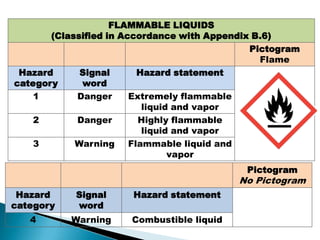
FLAMMABLE LIQUIDS
(Classified in Accordance with Appendix B.6)
Pictogram
Flame
Hazard
category
Signal
word
Hazard statement
1 Danger Extremely flammable
liquid and vapor
2 Danger Highly flammable
liquid and vapor
3 Warning Flammable liquid and
vapor
Pictogram
No Pictogram
Hazard
category
Signal
word
Hazard statement
4 Warning Combustible liquid
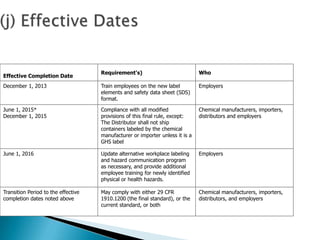
Effective Completion Date
Requirement's) Who
December 1, 2013 Train employees on the new label
elements and safety data sheet (SDS)
format.
Employers
June 1, 2015*
December 1, 2015
Compliance with all modified
provisions of this final rule, except:
The Distributor shall not ship
containers labeled by the chemical
manufacturer or importer unless it is a
GHS label
Chemical manufacturers, importers,
distributors and employers
June 1, 2016 Update alternative workplace labeling
and hazard communication program
as necessary, and provide additional
employee training for newly identified
physical or health hazards.
Employers
Transition Period to the effective
completion dates noted above
May comply with either 29 CFR
1910.1200 (the final standard), or the
current standard, or both
Chemical manufacturers, importers,
distributors, and employers
 After viewing this presentation please sign
and date the documentation sheet which
will be kept in your file.
 Thanks ,and work safely!!
9/18/2013jars inc.
 Questions? Call me
 740 353 0990
 Tony Layne
 if this is presented in a written form please
sign the following slide
 Signed by____________________________
 Date / /

New haz com presentation

  • 1.
     Hazard CommunicationSystem ◦ OSHA estimates:  7 million workplaces  100 million employees  945,000 hazardous chemical products
  • 2.
     All employeeswill be trained in the safe use of all chemicals used in the workplace!  This training will be refreshed on a yearly basis or when a new  Chemical or process is introduced 9/18/2013jars inc.
  • 3.
     sds sheetswill be kept in the store or on line for all chemicals used in our operation and updated on a regular basis to satisfy the employees’ right to know  Retraining will take place when a new chemical or procedure is introduced  any questions as to interpretation of sds sheets may be directed to the safety manager  An inventory shall be supplied upon request 9/18/2013jars inc.
  • 4.
     No newchemicals will be introduced into the operation without an safety data sheet and not without approval of the operator/ safety manager.  Use of consumer style products is highly discouraged and may be construed as a violation of safety standards according to usage 9/18/2013jars inc.
  • 5.
     Chemicals shallkept in their original container or properly labeled spray bottle.  Read the label before use make sure the chemical is designed for the task at hand.  Any non-routine task will require a special training session by a qualified person. 9/18/2013jars inc.
  • 6.
     Check labelsfor any personal protective equipment needed!  The use of unlabeled spray bottles is PROHIBITED!  labels will not be removed or defaced 9/18/2013jars inc.
  • 7.
     All chemicalsshall be stored in a designated place away from food prep areas ,intense heat sources food containers or open flames.  sds sheets for fire extinguishers and compressed gases will be kept at the main office. 9/18/2013jars inc.
  • 8.
     DO NOTMIX ANY TWO CHEMICALS TOGETHER. THE RESULTS CAN BE DEADLY!! 9/18/2013jars inc.
  • 9.
  • 10.
     Standards willbe more pictogram based as opposed to word based
  • 11.
  • 12.
    Signal Words /Hazard Pictograms
  • 13.
     Signal Words ◦The words “Danger” and “Warning” are being used as signal words to emphasize the hazard and indicate the relative level of the severity of the hazard as assigned by a GHS hazard class and category  Danger – For more “severe” hazards  Warning – For less “severe” hazards
  • 14.
     Examples ofGHS Pictograms Information from the Globally Harmonized System (GHS) /Purple Book
  • 15.
     Hazard &Precautionary Statements ◦ Hazard statements have been standardized and given phrases that describe the hazard(s) as found in the hazard classification ◦ If there is more than one hazard, then the appropriate hazard statement should be included for all identified hazards
  • 16.
     Pictograms, SignalWords and Hazard Statements
  • 17.
  • 18.
     Safety DataSheets ◦ Under GHS, (Material) Safety Data Sheets (SDS) will be in a common format for all materials which require a SDS ◦ The format is intended to provide an easier to read document and allow for quicker identification of hazards and dangers of a product ◦ The SDS should contain 16 headings and is derived as a combination of document formats from  ISO – International Organization of Standardization  EU – European Union  ANSI – American National Standards Institute
  • 19.
     Safety DataSheets ◦ The minimum recommended information includes:  Section 1 – Identification of the substance or mixture and the supplier  GHS Product Identifier  Recommended uses  Supplier details (address, phone number)  Emergency phone numbers  Section 2 – Hazard identification  GHS classification of the substance/mixture  GHS label elements (precautionary statements, hazard symbols)  Other hazards not classified by GHS (ie dust explosion hazard)
  • 20.
     Safety DataSheets ◦ The minimum recommended information includes:  Section 3 – Composition / Ingredients  Chemical Identity – common name, synonyms, CAS number, impurities/stablizers, concentrations or concentration ranges  Section 4 – First Aid  First aid measures based on the different routes of exposure, most important symptoms/effects, indication of immediate medical attention if necessary  Section 5 – Firefighting  Suitable / unsuitable extinguishing media  Special protective equipment and precautions for firefighters
  • 21.
     Safety DataSheets ◦ The minimum recommended information includes:  Section 6 – Accidental Release  Personal precautions, environmental precautions and containment / cleanup materials and methods  Section 7 – Handling and Storage  Precautions for safe handling  Conditions for safe storage  Section 8 - Exposure controls  Control parameters, engineering controls and individual protective measures – PPE
  • 22.
     Safety DataSheets ◦ The minimum recommended information includes:  Section 9 – Physical / Chemical Properties  Properties about the material (e.g. state, appearance, odor, pH, flash point, vapor density, etc)  Section 10 – Stability / Reactivity  Chemical stability, reaction possibilities, conditions to avoid, incompatibilities, decomposition products  Section 11 – Toxicological Information  Likely routes of exposure  Symptoms associated with physical, chemical and toxicological characteristics  Numerical measures of toxicity
  • 23.
     Safety DataSheets ◦ The minimum recommended information includes:  Section 12 – Ecological Information  Aquatic / Soil Toxicity  Persistence and degradability  Bioaccumulation potential  Section 13 – Disposal  Recommended disposal methods  Section 14 – Transportation  UN Number, Proper Shipping Name, Hazard Class, Packing Group  Marine Pollutant (Yes/No)  Special Precautions
  • 24.
     Safety DataSheets ◦ The minimum recommended information includes:  Section 15 – Regulatory Information  Regulatory bodies that govern the chemical / mixtures (e.g. SARA, TCSC, FIFRA)  Section 16 – Other Information  Preparation and revisions on SDS should be in this section
  • 25.
     Safety DataSheets ◦ With uniform data fields and common terminology, information can easily be found on the sheets ◦ Worker understanding of the dangers will also be easier to define
  • 26.
     Training ◦ Underthe current hazard communication system, employers are required to train employees on the hazard associated with products ◦ Right-to-Know stations must be provided ◦ GHS does not change this requirement and stresses the importance of training for employees ◦ The GHS harmonization with labels / SDS /terminology is intended to make training easier for all
  • 27.
     GHS Reference ◦A Guide to The Globally Harmonized System of Classification and Labeling of Chemicals (GHS) http://www.osha.gov/dsg/hazcom/ghsguideoct05.pdf
  • 28.
    Hazard Class HazardCategory Acute Toxicity 1 2 3 4 Skin Corrosion/Irritation 1A 1B 1C 2 Serious Eye Damage/ Eye Irritation 1 2A 2B Respiratory or Skin Sensitization 1 Germ Cell Mutagenicity 1A 1B 2 Carcinogenicity 1A 1B 2 Reproductive Toxicity 1A 1B 2 Lactation STOT – Single Exposure 1 2 3 STOT – Repeated Exposure 1 2 Aspiration 1 Simple Asphyxiants Single Category Lower the number the higher risk
  • 29.
    Hazard Class HazardCategory Explosives Unstable Explosives Div 1.1 Div 1.2 Div 1.3 Div 1.4 Div 1.5 Div 1.6 Flammable Gases 1 2 Flammable Aerosols 1 2 Oxidizing Gases 1 Gases under Pressure Compressed Gases Liquefied Gases Refrigerated Liquefied Gases Dissolved Gases 1 Flammable Liquids 1 2 3 4 Self-Reactive Chemicals Type A Type B Type C Type D Type E Type F Type G Pyrophoric Liquids 1 Pyrophoric Solid 1 Pyrophoric Gases Single category Self-heating Chemicals 1 2 Chemicals, which in contact with water, emit flammable gases 1 2 3 Oxidizing Liquids 1 2 3 Oxidizing Solids 1 2 3 Organic Peroxides Type A Type B Type C Type D Type E Type F Type G Corrosive to Metals 1 Combustible Dusts Single Category
  • 30.
    What a bottlelabel will look like
  • 33.
  • 34.
    Employers are responsiblefor maintaining the labels on the containers, including, but not limited to, tanks, totes, drums, and for training their employees on the hazards listed on the labels in the workplace. Labels must continue to be: legible contain the pertinent information (such as the hazards and directions for use) not able to be defaced, (i.e., fade, get washed off,) or removed in any way as stated in revised Hazard Communication Standard, 29 CFR 1910.1200(f)(9)
  • 35.
    FLAMMABLE LIQUIDS (Classified inAccordance with Appendix B.6) Pictogram Flame Hazard category Signal word Hazard statement 1 Danger Extremely flammable liquid and vapor 2 Danger Highly flammable liquid and vapor 3 Warning Flammable liquid and vapor Pictogram No Pictogram Hazard category Signal word Hazard statement 4 Warning Combustible liquid
  • 36.
    Effective Completion Date Requirement's)Who December 1, 2013 Train employees on the new label elements and safety data sheet (SDS) format. Employers June 1, 2015* December 1, 2015 Compliance with all modified provisions of this final rule, except: The Distributor shall not ship containers labeled by the chemical manufacturer or importer unless it is a GHS label Chemical manufacturers, importers, distributors and employers June 1, 2016 Update alternative workplace labeling and hazard communication program as necessary, and provide additional employee training for newly identified physical or health hazards. Employers Transition Period to the effective completion dates noted above May comply with either 29 CFR 1910.1200 (the final standard), or the current standard, or both Chemical manufacturers, importers, distributors, and employers
  • 37.
     After viewingthis presentation please sign and date the documentation sheet which will be kept in your file.  Thanks ,and work safely!! 9/18/2013jars inc.
  • 38.
     Questions? Callme  740 353 0990  Tony Layne  if this is presented in a written form please sign the following slide
  • 39.

Editor's Notes

  • #30 This table shows the hazard classes and categories OSHA adopted in its final rule.As with health hazards, OSHA tried to maintain the scope of Haz Com 1994 for physical hazards in Haz Com 2012. Therefore, you will notice this list also includes pyrophoric gases and combustible dusts. The definition for pyrophoric gas is contained in paragraph (c) and the label elements are presented in Appendix C.For combustible dust, we are treating as we always have. The definition for this hazard is provided in the Combustible Dust NEP (Directive CPL 03-000-008). Guidance on this hazard is provided using existing documents, including those on OSHA’s webpage. In addition there are a number of voluntary consensus standards (particularly those from NFPA) that address combustible dust.Deana will now talk about the hazard communication program and labels.
  • #37 In the final rule OSHA decided not to phase in compliance based on whether a product is a substance or a mixture. OSHA concluded that adequate information is available for classifiers to use to classify substances and mixtures.Therefore, under the revised standard, covered employers must complete all training regarding the new label elements and SDS format by December 1, 2013 since, employees will begin seeing the new style labels considerably earlier than the compliance date for labeling. All other provisions to be in effect by June 1, 2015, except: Distributors who are passing on manufacturer labels to customers shall ensure all labels are updated by December 1, 2015 ( these distributors have an extra six months) IF distributors are not passing along manufacturer labels they MUST comply with the June 1, 2015 date for labels.Employers will also be given an additional year (by June 1, 2016) to update their hazard communication programs or any other workplace signs, if applicable.You may be curious about, or get asked “Why did OSHA pick June 1, 2015 for an effective date for labels?” This is because it coincides with the EU date for classifying mixtures.