INTRODUCTION TO
MATERIAL SAFETY
DATA SHEETS
WHAT IS AN
1 of 25
MSDS
A Material Safety Data Sheet (MSDS) is a document that contains-
• Information on the potential health effects of exposure to chemicals
• Safe working procedures when handling chemical products
MSDSs-
• Are to be provided by Supplier’s with all deliveries
• MUST be Accessible to EVERYONE in the workplace
• Must be current
• Must be made available to attending physician in the event of exposure
SOME
2 of 25
DEFINITIONS
Auto ignition temperature: Lowest temperature at which it
spontaneously ignites in normal atmosphere without an
external source of ignition.
Flash point: Lowest temperature at which vapors of a
volatile material will ignite, given an ignition source.
SOME
3 of 25
DEFINITIONS CONT’D
Lethal Dose50 (LD50): The value of LD50 for a substance is the
dose required to kill half the members of a tested population.
TWA: An 8-hour Time-Weighted Average is the
concentration the average worker can be exposed during an
8-hour workday, day after day, without harmful effects.
SOMEABBREVIATIONS
SOME
4 of 25
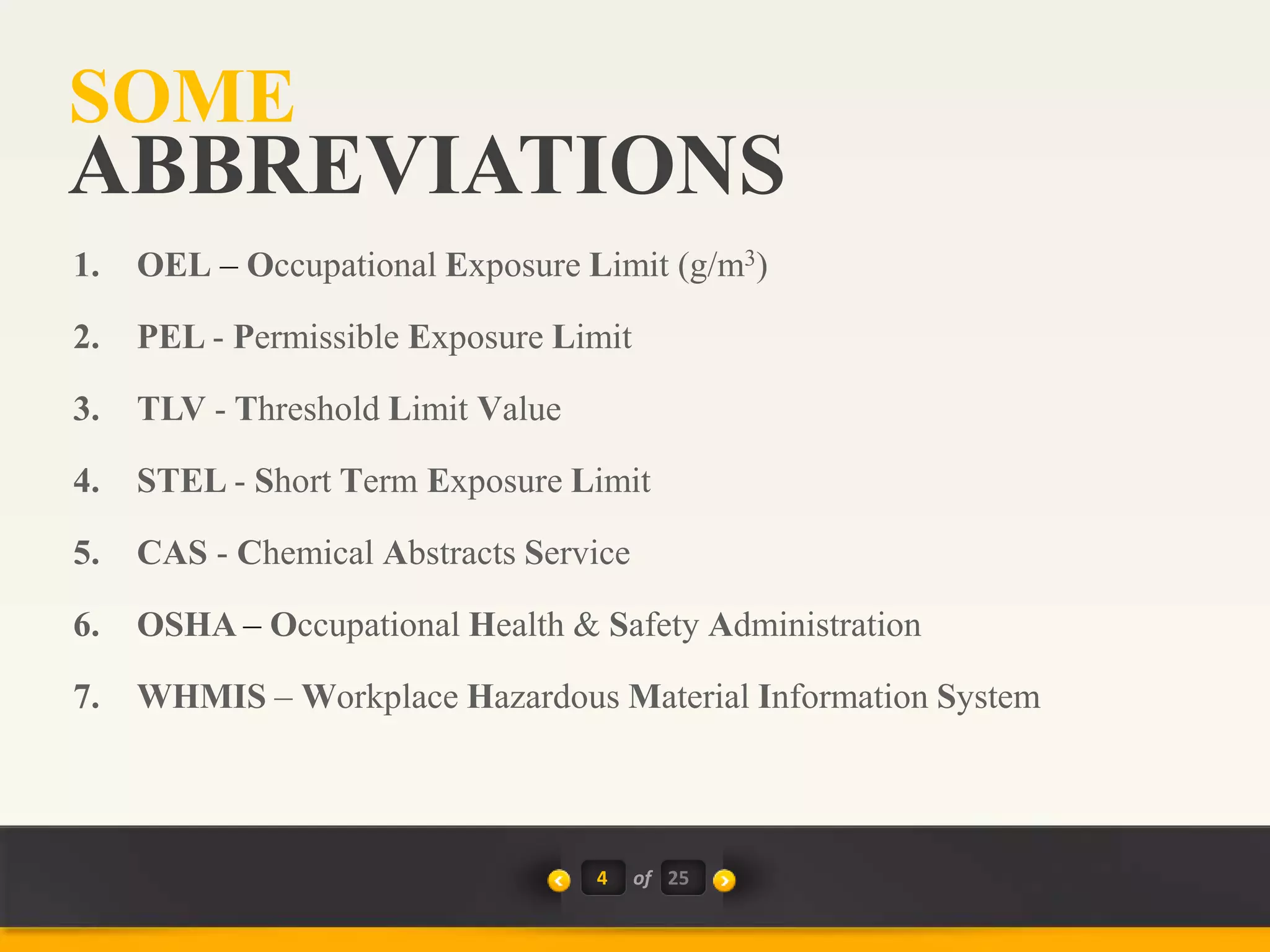
ABBREVIATIONS
1. OEL – Occupational Exposure Limit (g/m3)
2. PEL - Permissible Exposure Limit
3. TLV - Threshold Limit Value
4. STEL - Short Term Exposure Limit
5. CAS - Chemical Abstracts Service
6. OSHA – Occupational Health & Safety Administration
7. WHMIS – Workplace Hazardous Material Information System
SOMEPICTOGRAMS & SIGNS
SOME
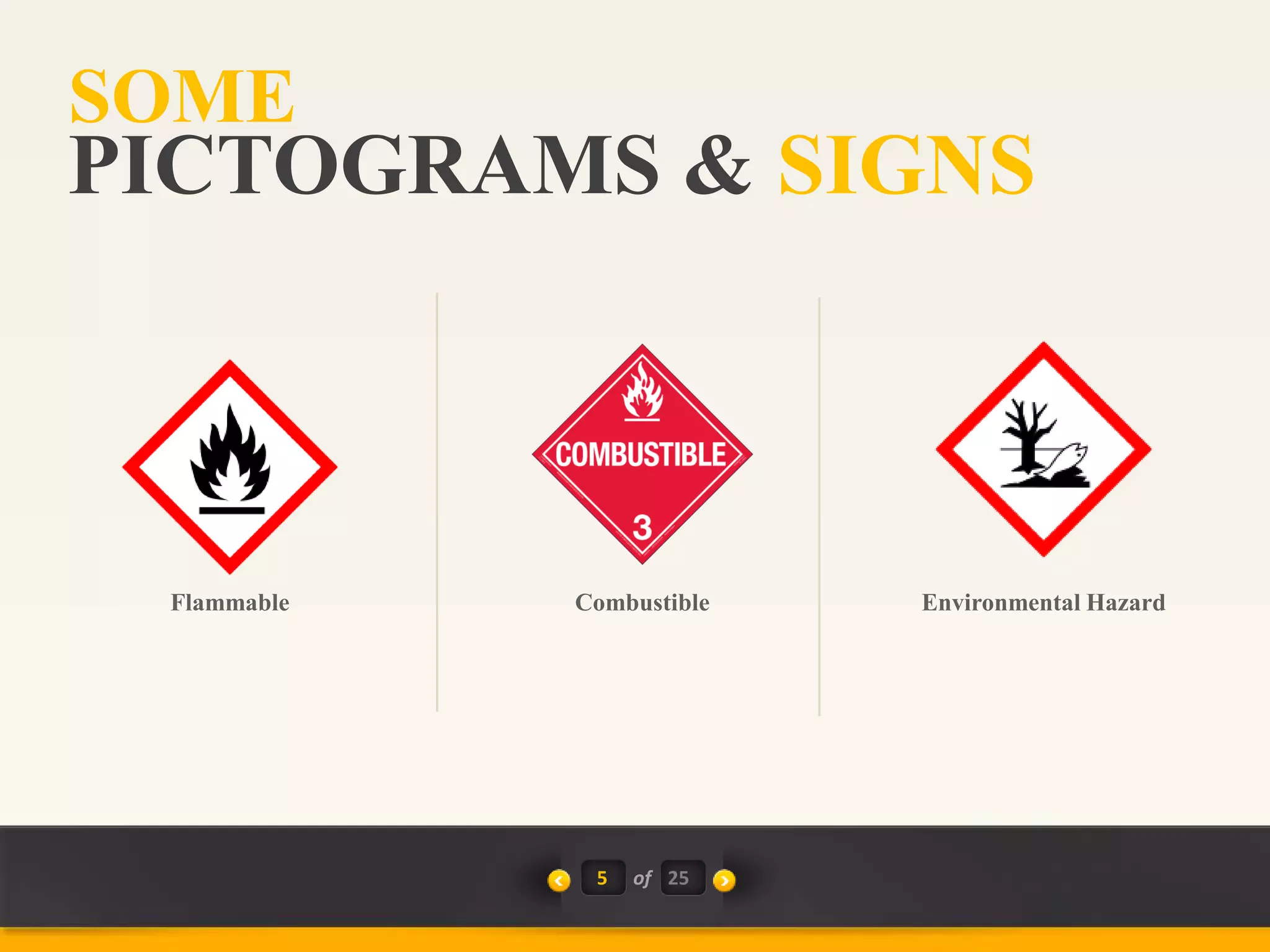
PICTOGRAMS & SIGNS
5 of 25
Flammable Combustible Environmental Hazard
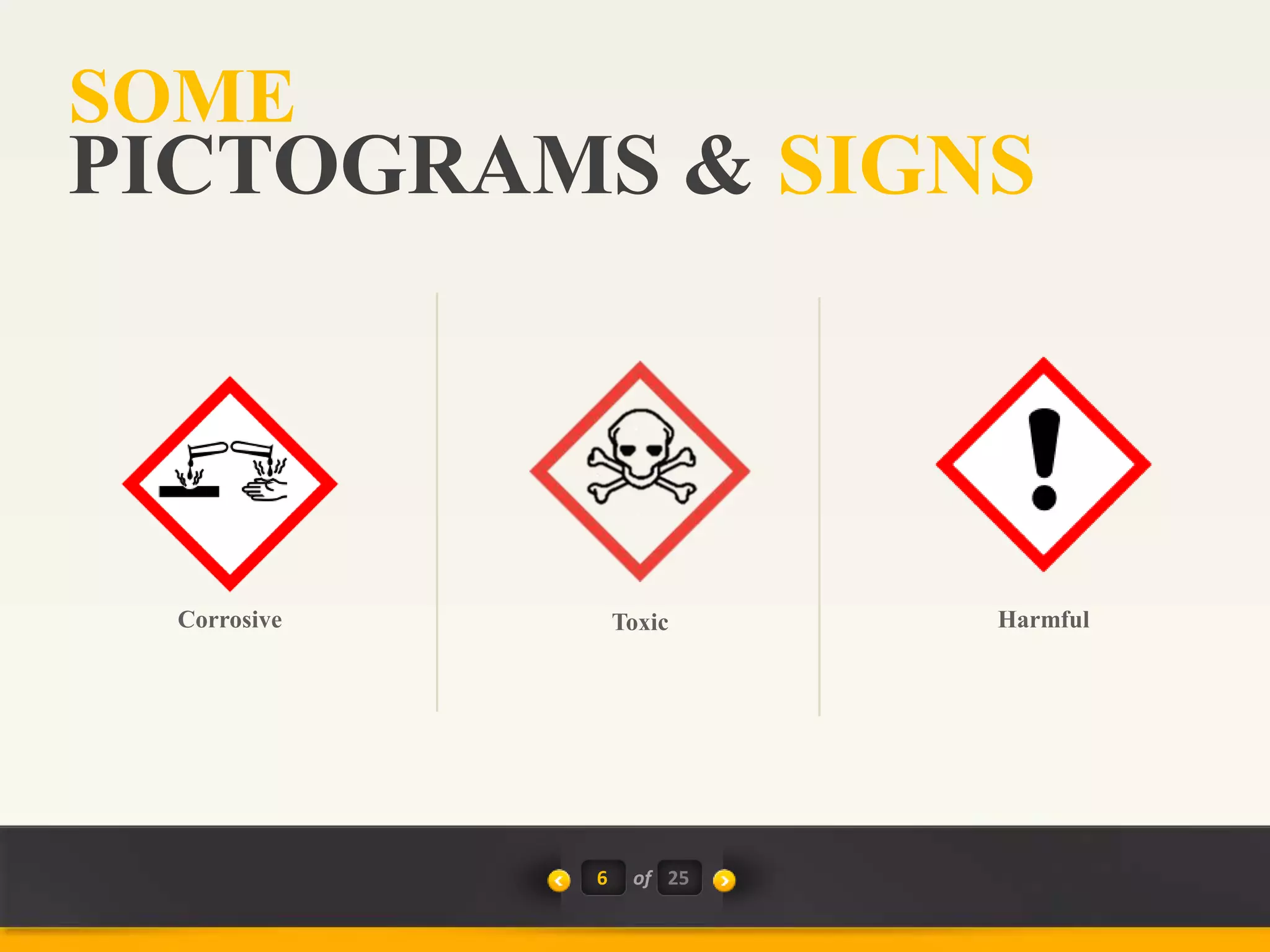
Harmful
SOME
6 of 25
Corrosive Toxic
PICTOGRAMS & SIGNS
SOME
7 of 25
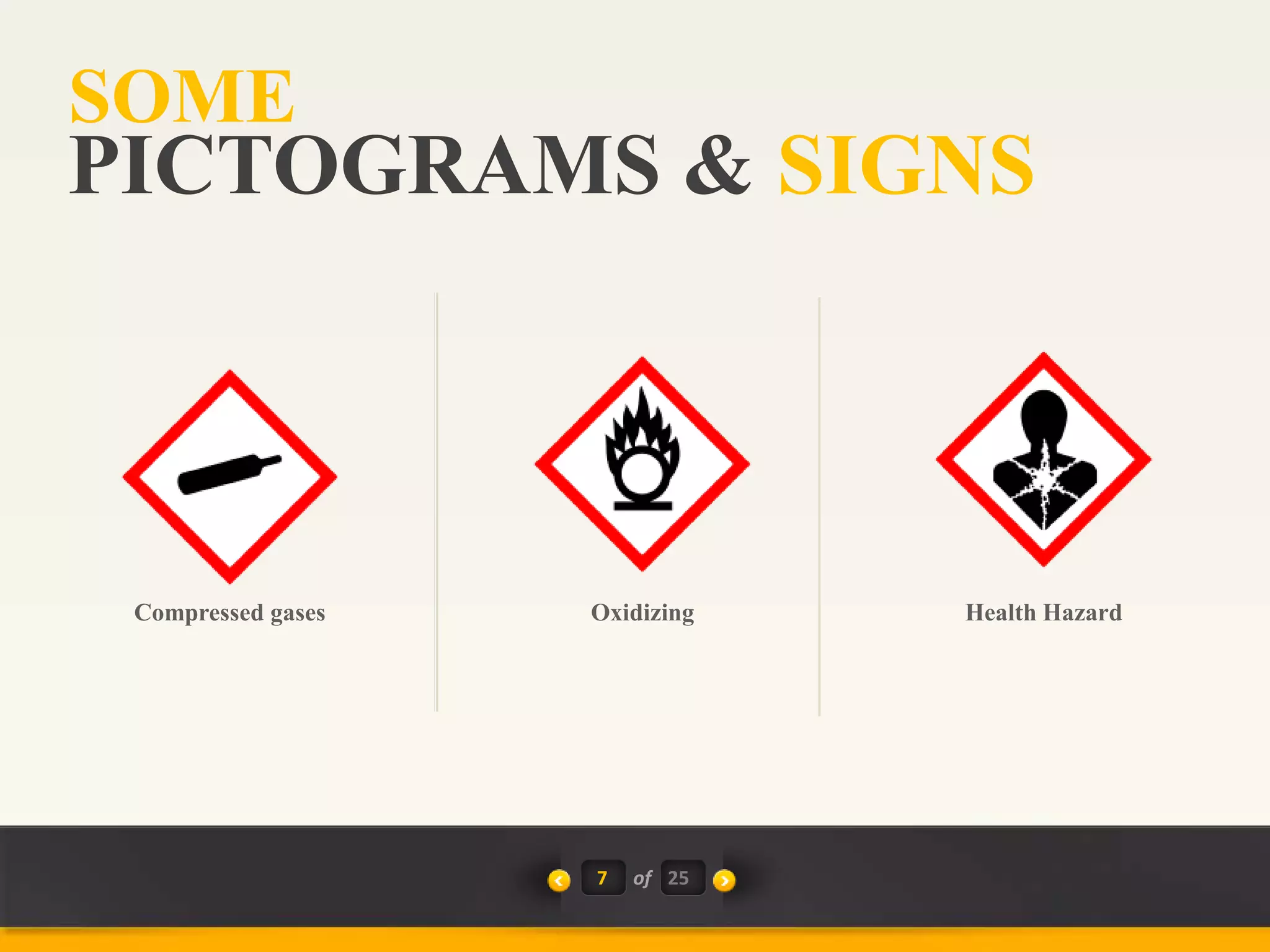
Compressed gases Oxidizing Health Hazard
PICTOGRAMS & SIGNS
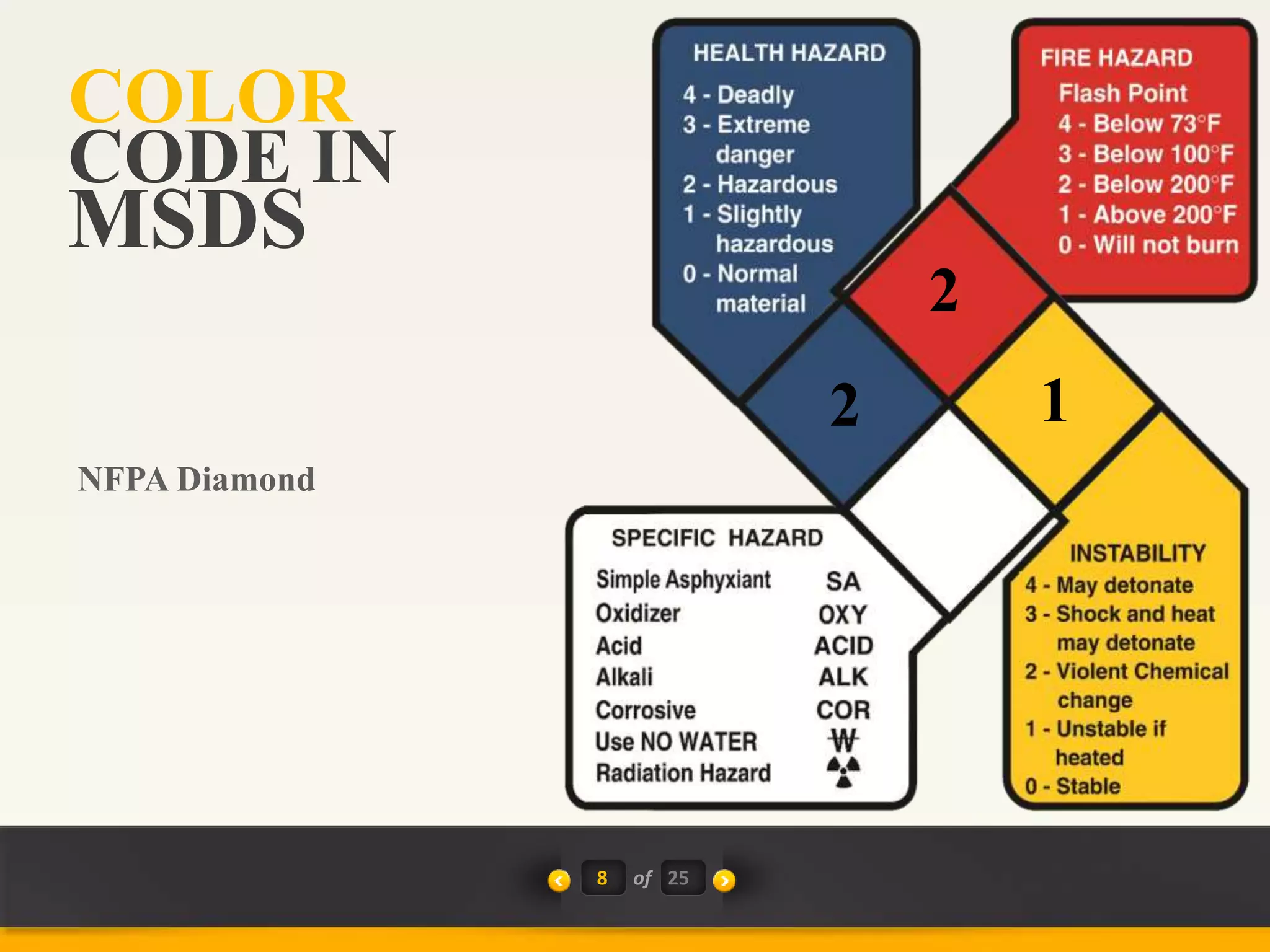
COLOR
8 of 25
MSDS
CODE IN
NFPA Diamond
2
2
1
READING THE
MSDS
9 of 25
 Product name and any other common names or synonyms by which
the substance is known.
 Name, address, phone number of the manufacturer, importer, or other
responsible party, and emergency phone number.
 Recommended use of the chemical and any restrictions on use.
MSDS Information: Section I
PRODUCT IDENTIFICATION
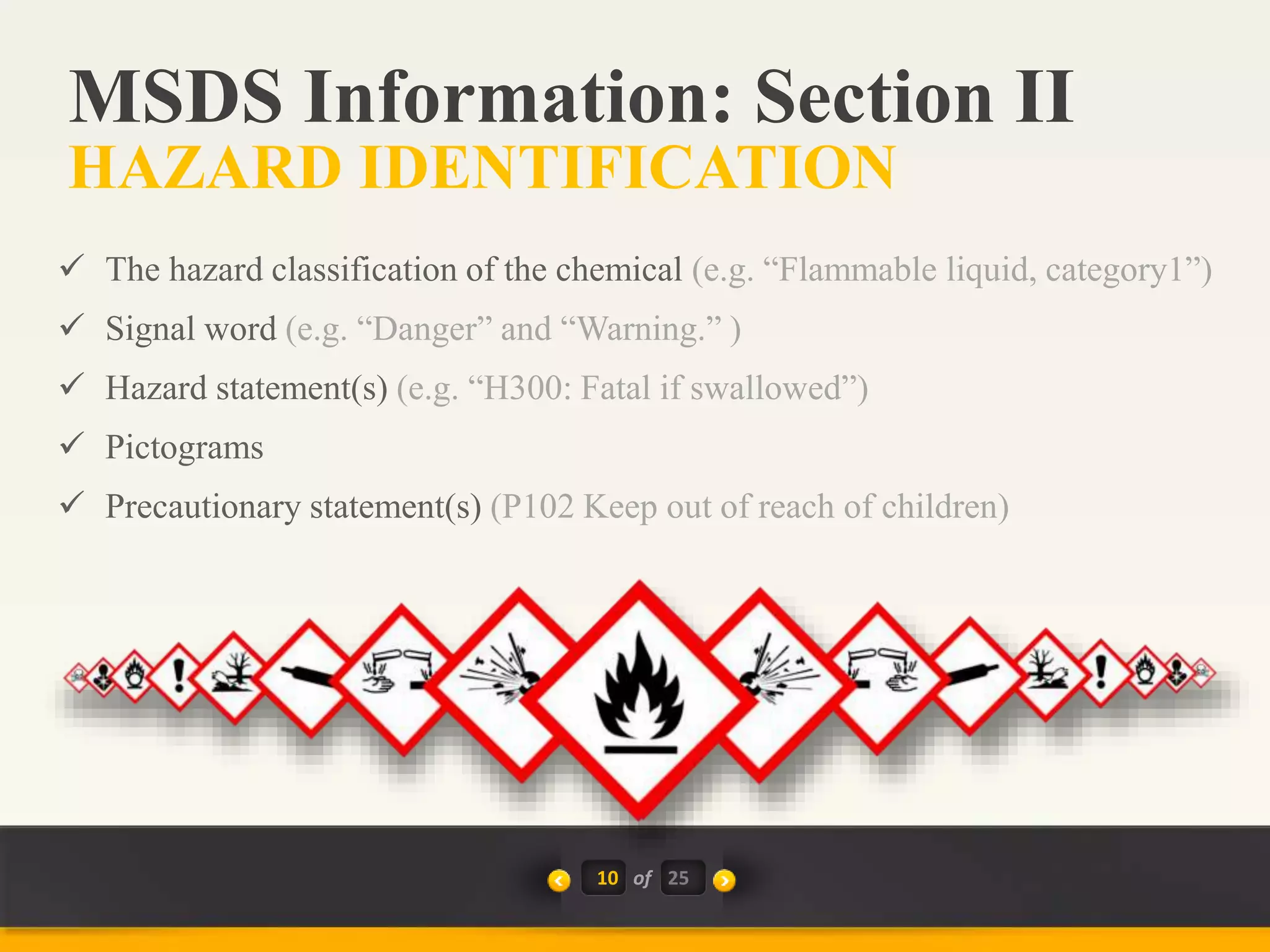
 The hazard classification of the chemical (e.g. “Flammable liquid, category1”)
 Signal word (e.g. “Danger” and “Warning.” )
 Hazard statement(s) (e.g. “H300: Fatal if swallowed”)
 Pictograms
 Precautionary statement(s) (P102 Keep out of reach of children)
10 of
MSDS Information: Section II
HAZARD IDENTIFICATION
25
11 of
Substances
 Chemical name, common name and synonyms.
 Chemical Abstracts Service (CAS) number.
Mixtures
 Same information required for substances.
 The chemical name and concentration
(i.e., exact percentage) of all
ingredients which are classified
as health hazards
MSDS Information: Section III
COMPOSITION/INFORMATION ON INGREDIENTES
25
12 of
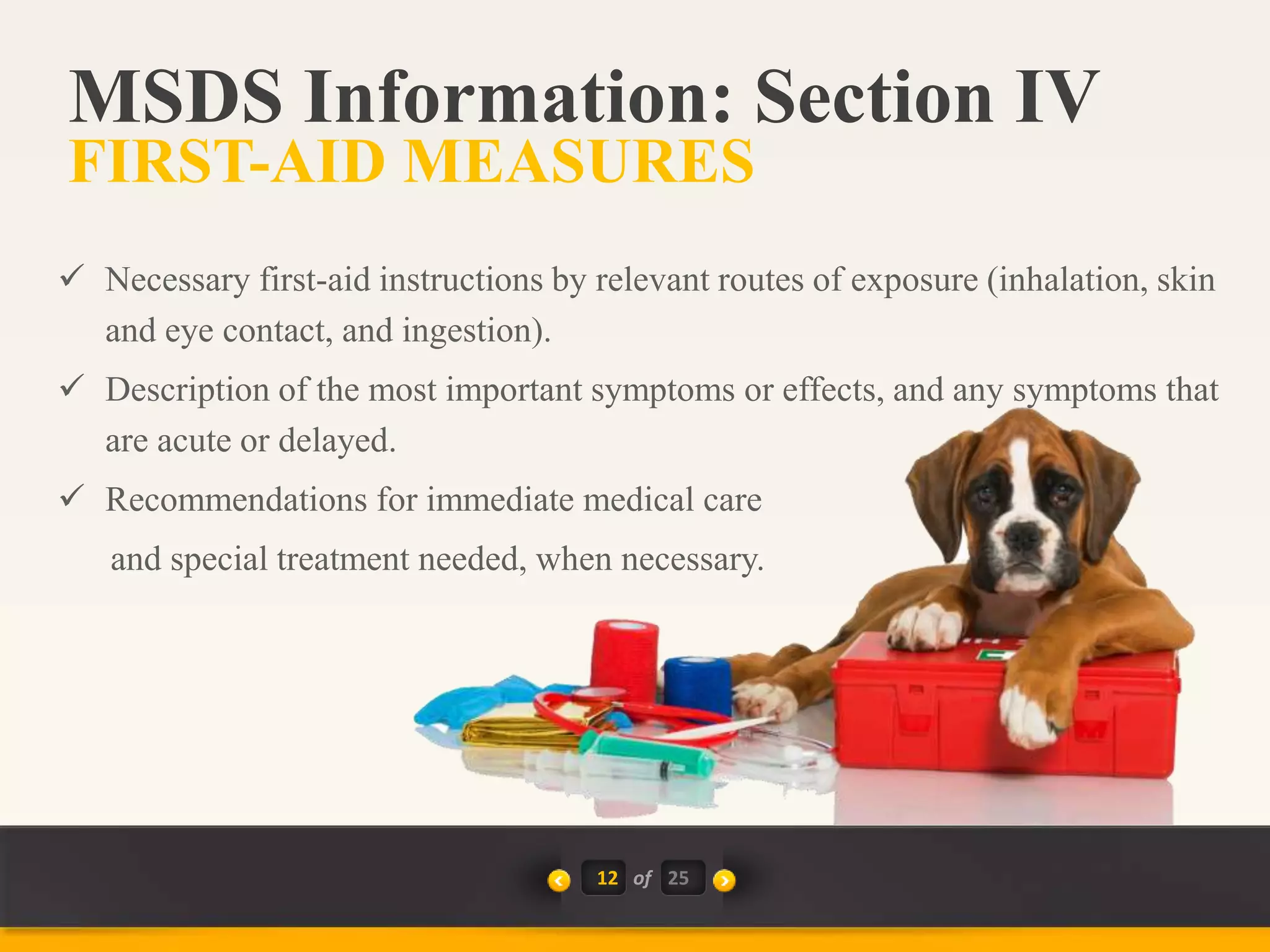
 Necessary first-aid instructions by relevant routes of exposure (inhalation, skin
and eye contact, and ingestion).
 Description of the most important symptoms or effects, and any symptoms that
are acute or delayed.
 Recommendations for immediate medical care
and special treatment needed, when necessary.
MSDS Information: Section IV
FIRST-AID MEASURES
25
13 of
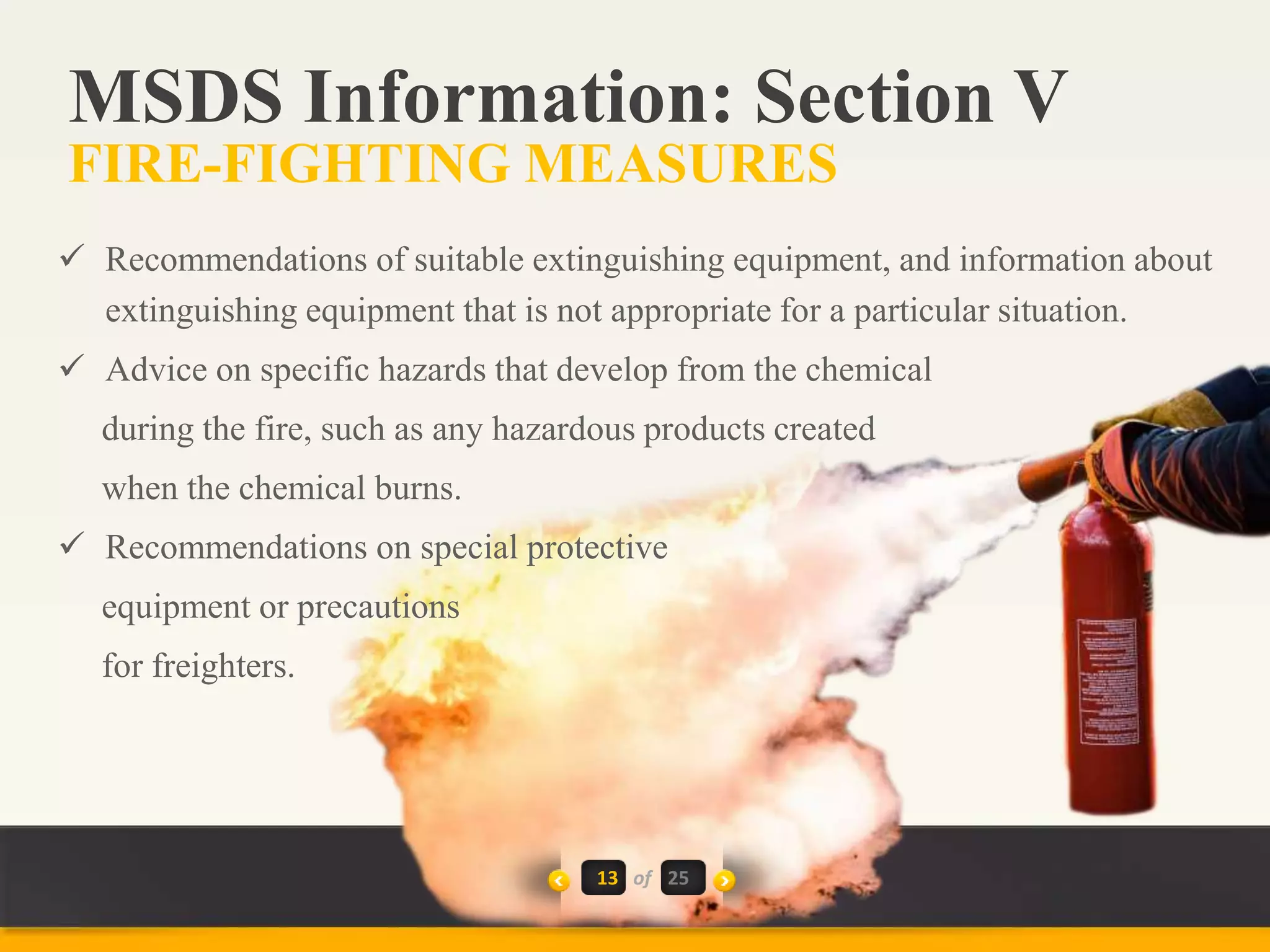
 Recommendations of suitable extinguishing equipment, and information about
extinguishing equipment that is not appropriate for a particular situation.
 Advice on specific hazards that develop from the chemical
during the fire, such as any hazardous products created
when the chemical burns.
 Recommendations on special protective
equipment or precautions
for freighters.
MSDS Information: Section V
FIRE-FIGHTING MEASURES
25
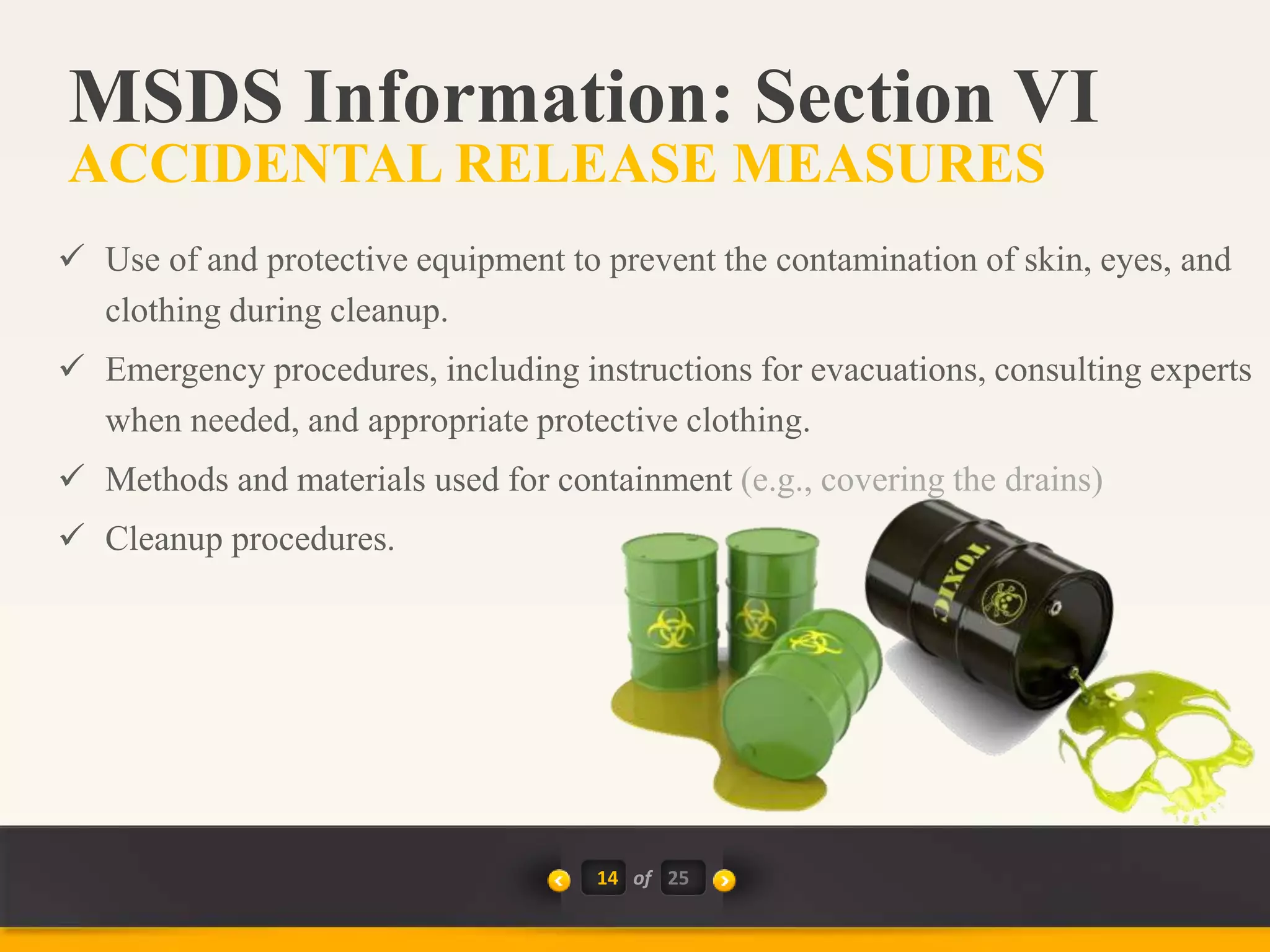
 Use of and protective equipment to prevent the contamination of skin, eyes, and
clothing during cleanup.
 Emergency procedures, including instructions for evacuations, consulting experts
when needed, and appropriate protective clothing.
 Methods and materials used for containment (e.g., covering the drains)
 Cleanup procedures.
14 of
MSDS Information: Section VI
ACCIDENTAL RELEASE MEASURES
25
15 of
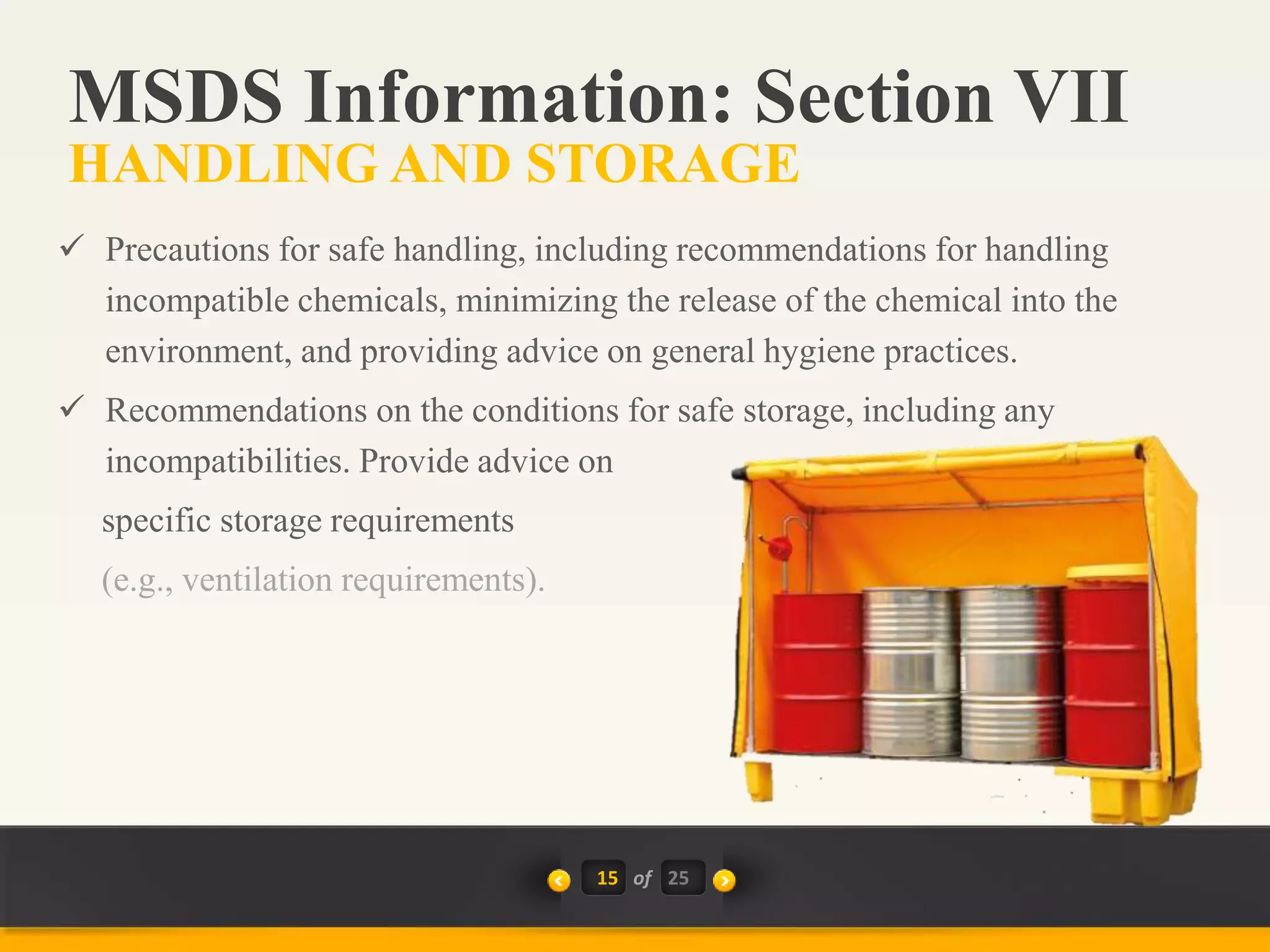
 Precautions for safe handling, including recommendations for handling
incompatible chemicals, minimizing the release of the chemical into the
environment, and providing advice on general hygiene practices.
 Recommendations on the conditions for safe storage, including any
incompatibilities. Provide advice on
specific storage requirements
(e.g., ventilation requirements).
MSDS Information: Section VII
HANDLING AND STORAGE
25
16 of
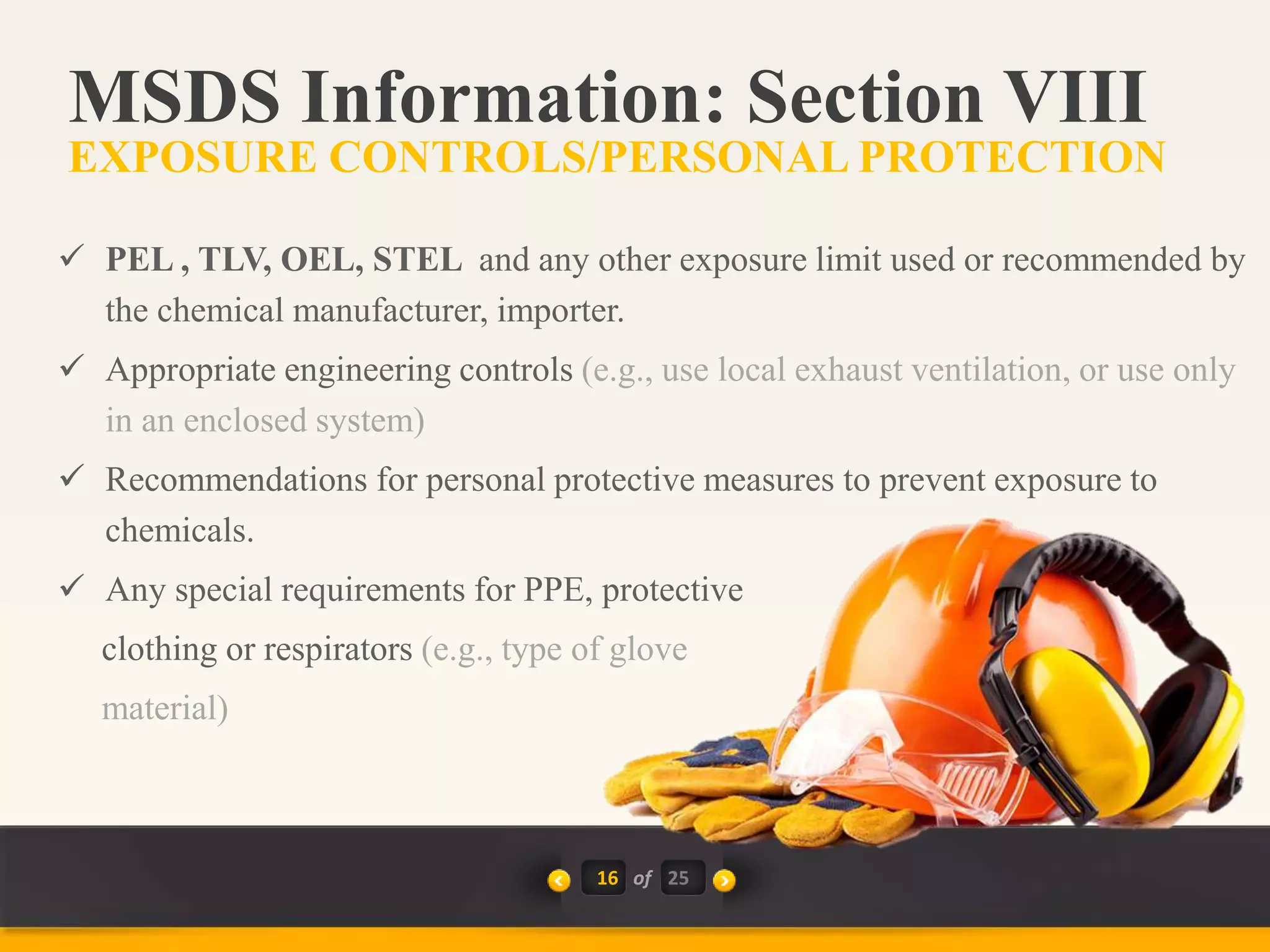
 PEL , TLV, OEL, STEL and any other exposure limit used or recommended by
the chemical manufacturer, importer.
 Appropriate engineering controls (e.g., use local exhaust ventilation, or use only
in an enclosed system)
 Recommendations for personal protective measures to prevent exposure to
chemicals.
 Any special requirements for PPE, protective
clothing or respirators (e.g., type of glove
material)
MSDS Information: Section VIII
EXPOSURE CONTROLS/PERSONAL PROTECTION
25
17 of
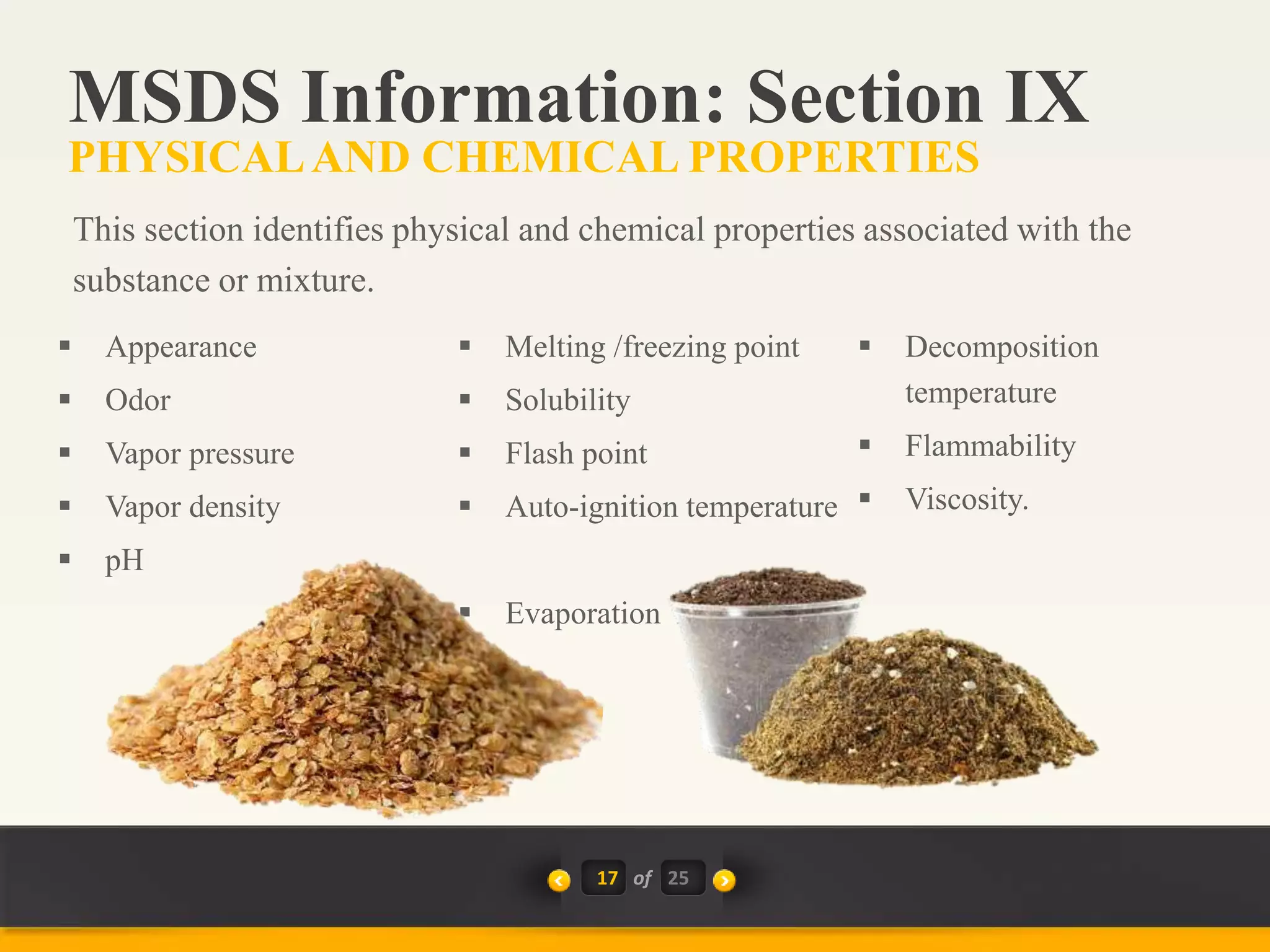
 Appearance
 Odor
 Vapor pressure
 Vapor density
 pH
 Melting /freezing point
 Solubility
 Flash point
 Auto-ignition temperature
 Evaporation rate;
 Decomposition
temperature
 Flammability
 Viscosity.
MSDS Information: Section IX
PHYSICALAND CHEMICAL PROPERTIES
This section identifies physical and chemical properties associated with the
substance or mixture.
25
18 of
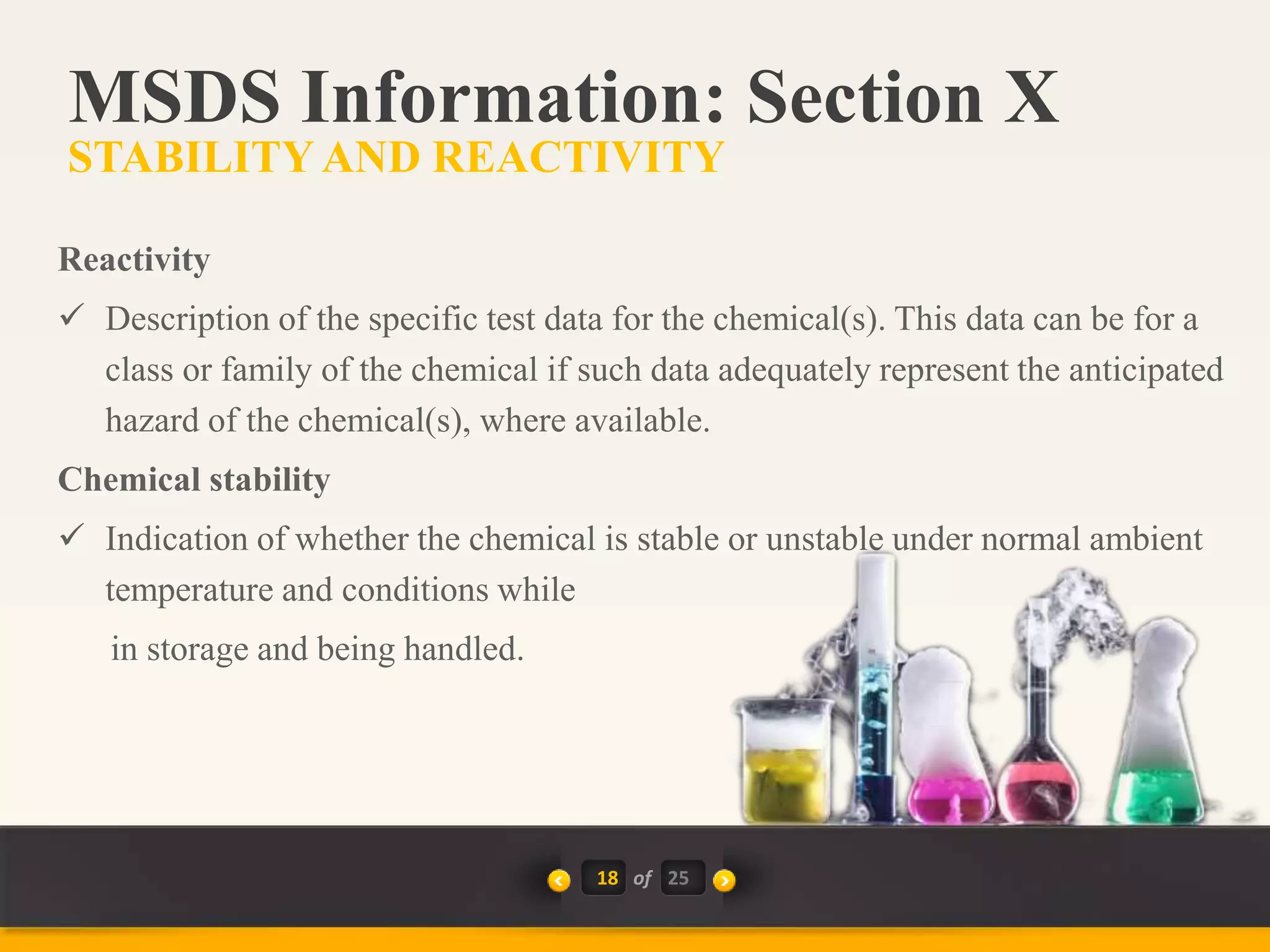
Reactivity
 Description of the specific test data for the chemical(s). This data can be for a
class or family of the chemical if such data adequately represent the anticipated
hazard of the chemical(s), where available.
Chemical stability
 Indication of whether the chemical is stable or unstable under normal ambient
temperature and conditions while
in storage and being handled.
MSDS Information: Section X
STABILITYAND REACTIVITY
25
19 of
 Description of the delayed, immediate, or chronic effects from short- and long-
term exposure.
 The numerical measures of toxicity (e.g., acute toxicity estimates such as the
LD50)
 Description of the symptoms. This description includes the symptoms associated
with exposure to the chemical including symptoms from the lowest to the most
severe exposure.
MSDS Information: Section XI
TOXICOLOGICAL INFORMATION
25
20 of
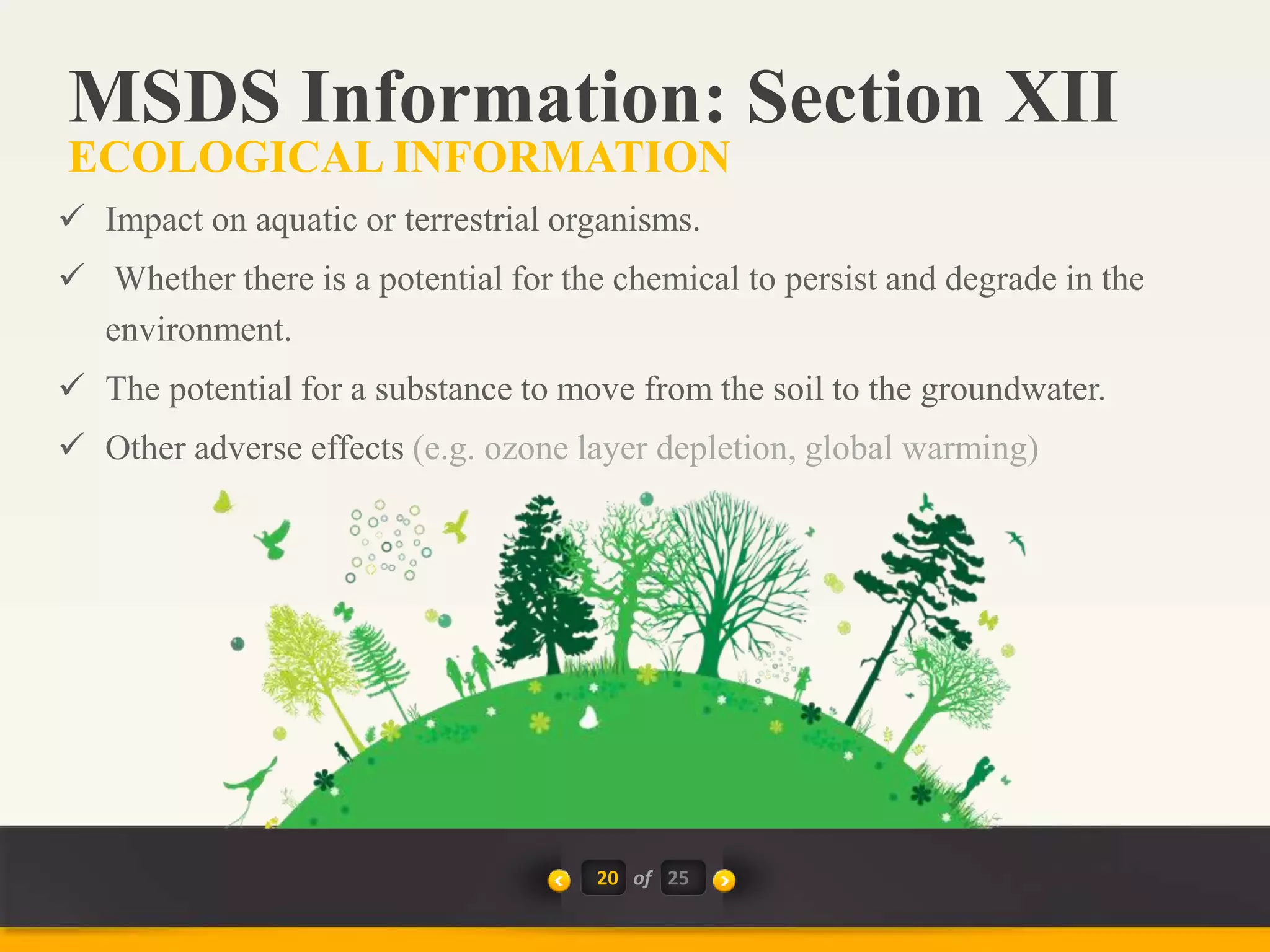
 Impact on aquatic or terrestrial organisms.
 Whether there is a potential for the chemical to persist and degrade in the
environment.
 The potential for a substance to move from the soil to the groundwater.
 Other adverse effects (e.g. ozone layer depletion, global warming)
MSDS Information: Section XII
ECOLOGICAL INFORMATION
25
21 of
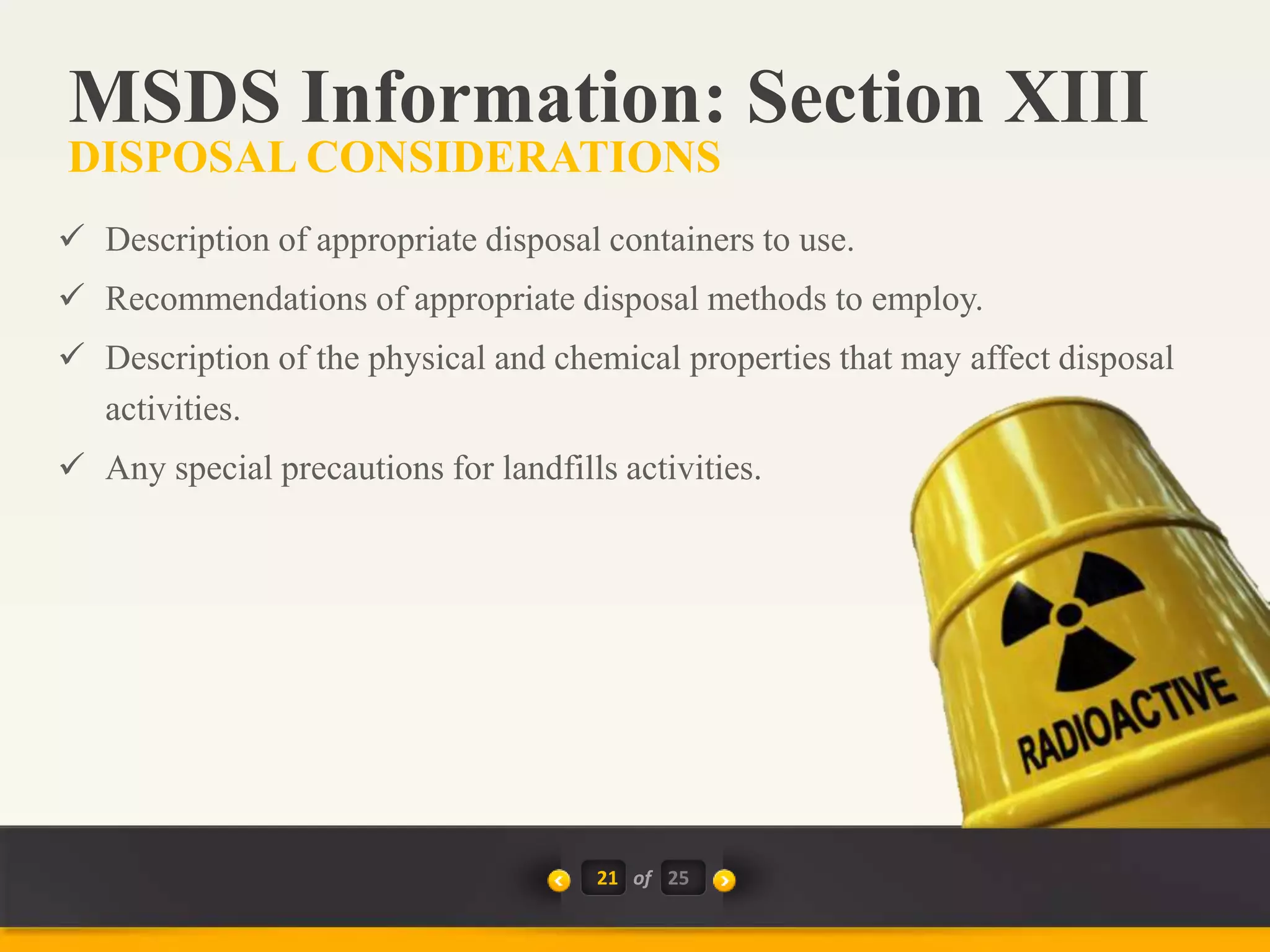
 Description of appropriate disposal containers to use.
 Recommendations of appropriate disposal methods to employ.
 Description of the physical and chemical properties that may affect disposal
activities.
 Any special precautions for landfills activities.
MSDS Information: Section XIII
DISPOSAL CONSIDERATIONS
25
22 of
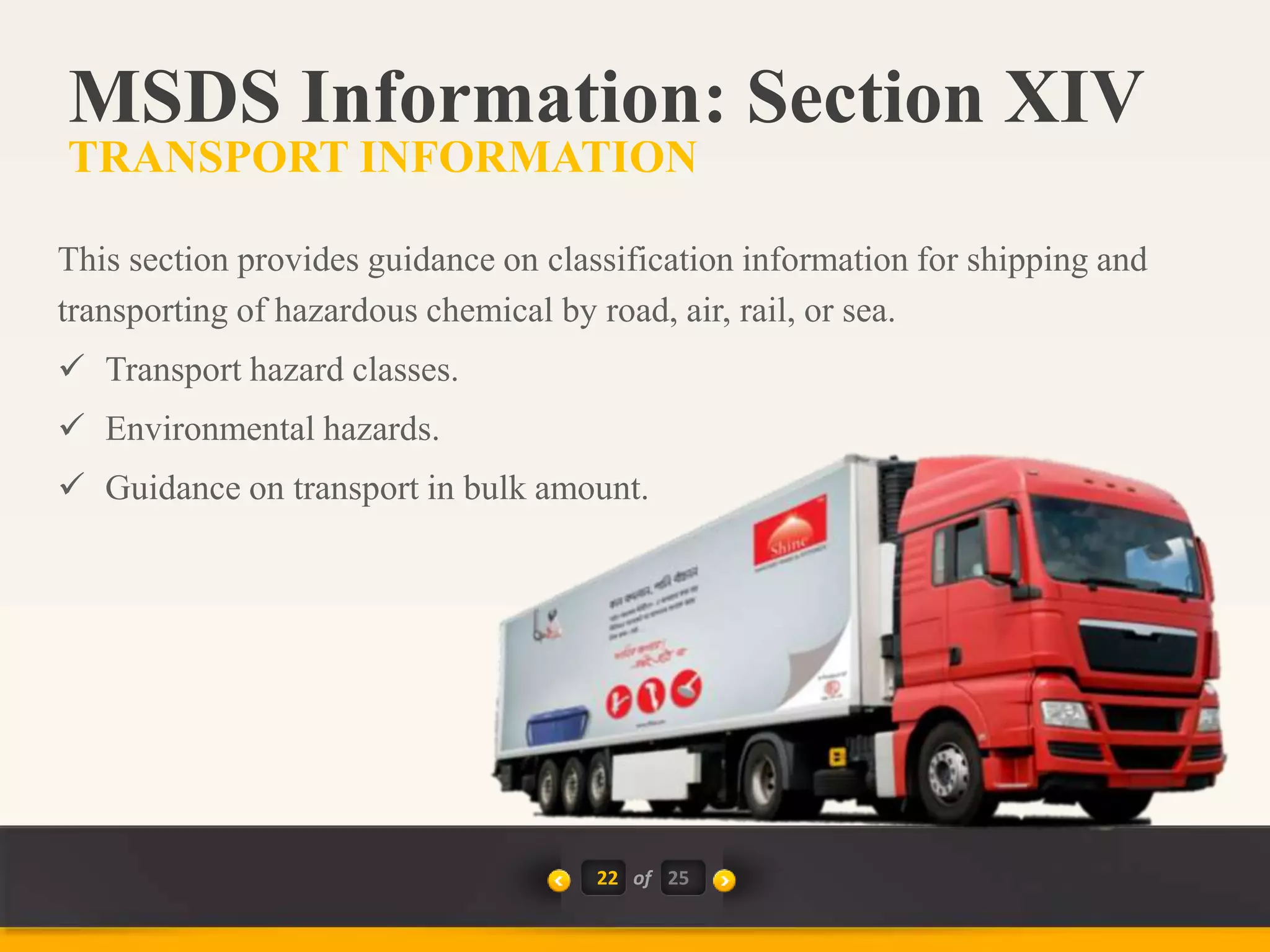
This section provides guidance on classification information for shipping and
transporting of hazardous chemical by road, air, rail, or sea.
 Transport hazard classes.
 Environmental hazards.
 Guidance on transport in bulk amount.
MSDS Information: Section XIV
TRANSPORT INFORMATION
25
23 of
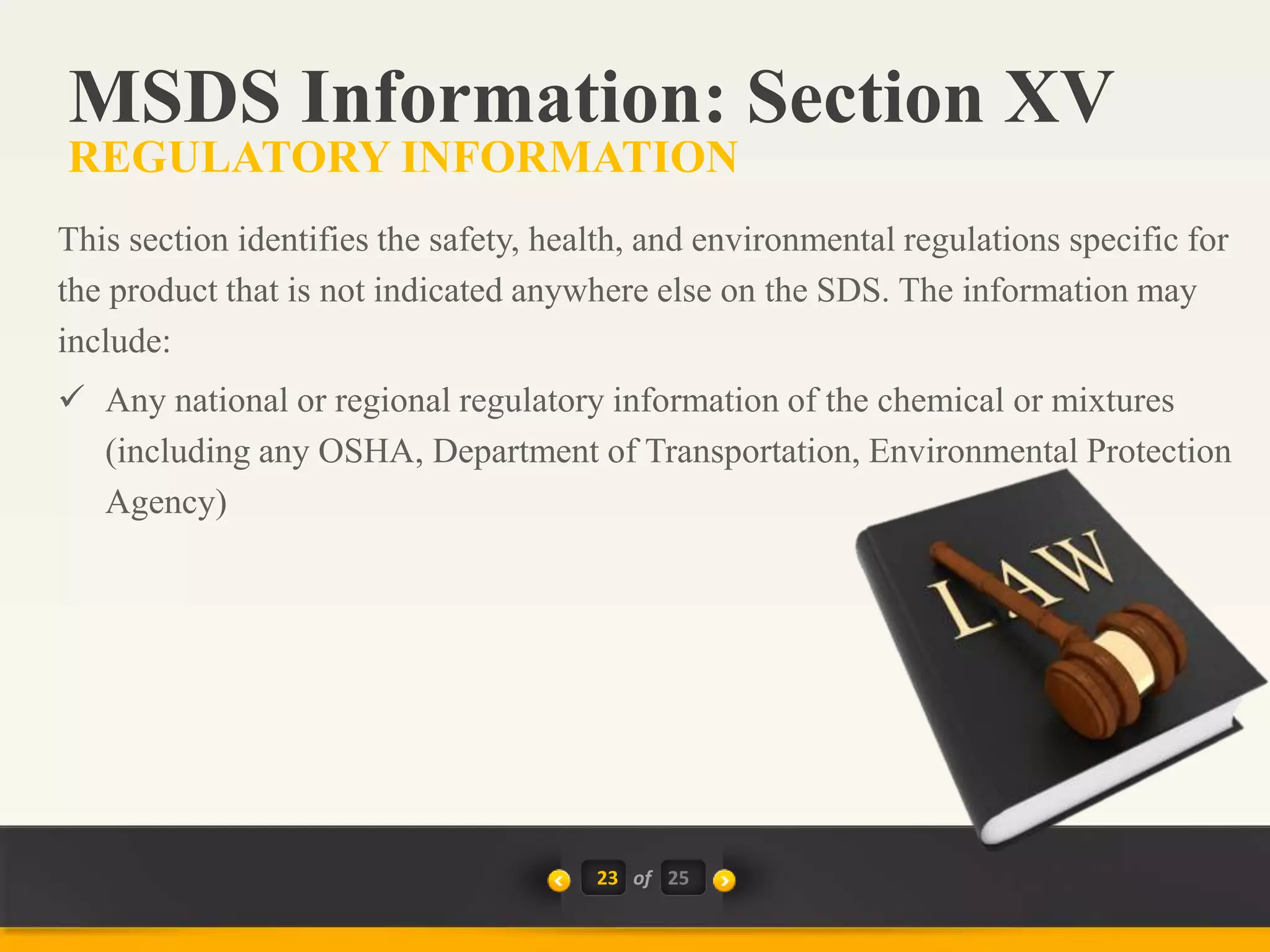
This section identifies the safety, health, and environmental regulations specific for
the product that is not indicated anywhere else on the SDS. The information may
include:
 Any national or regional regulatory information of the chemical or mixtures
(including any OSHA, Department of Transportation, Environmental Protection
Agency)
MSDS Information: Section XV
REGULATORY INFORMATION
25
24 of
 This section indicates when the SDS was prepared or when the last known
revision was made.
 The SDS may also state where the changes have been made to the previous
version.
 Other useful information also may be included here.
MSDS Information: Section XVI
OTHER INFORMATION
25
25 of
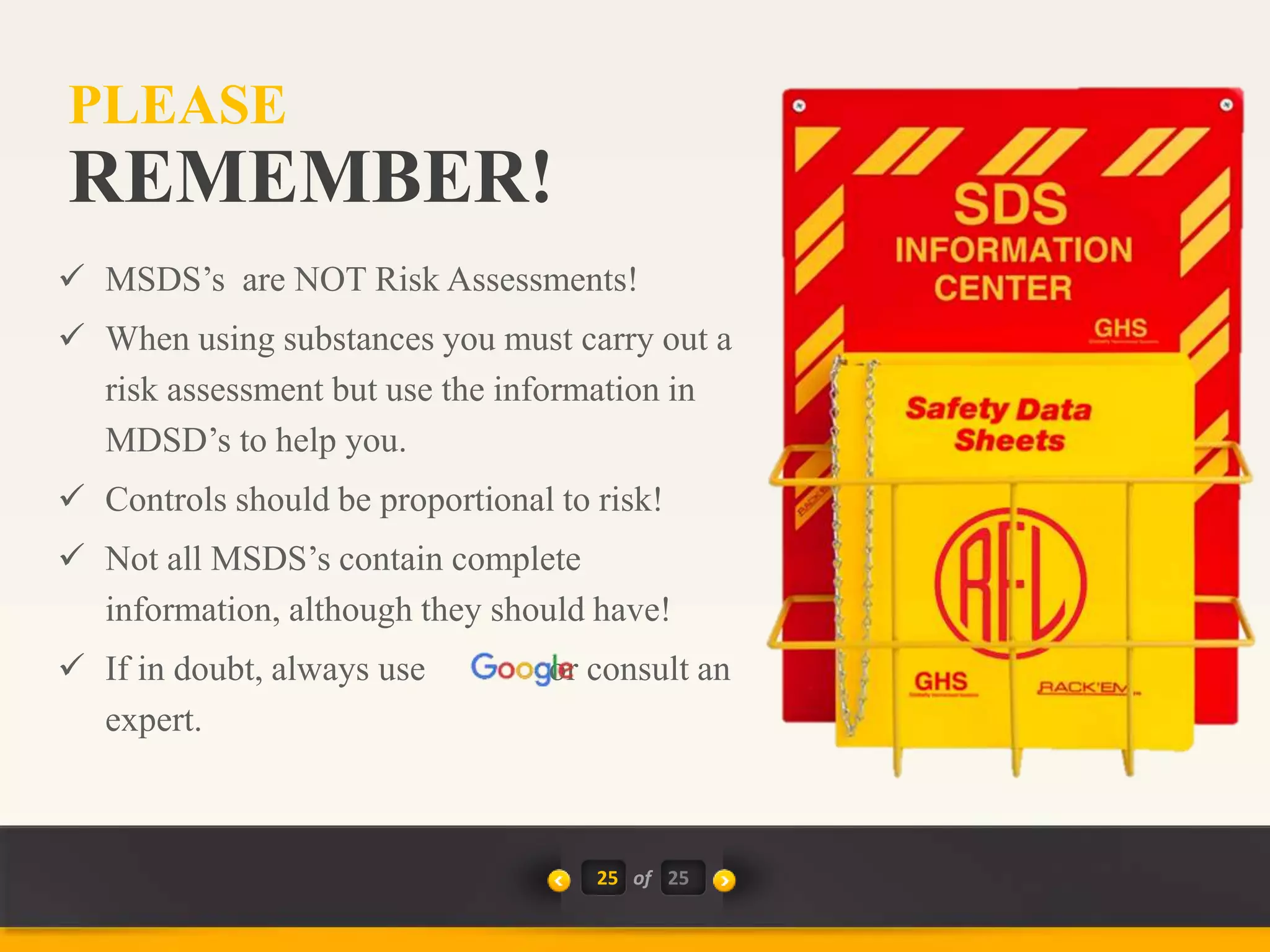
 MSDS’s are NOT Risk Assessments!
 When using substances you must carry out a
risk assessment but use the information in
MDSD’s to help you.
 Controls should be proportional to risk!
 Not all MSDS’s contain complete
information, although they should have!
 If in doubt, always use or consult an
expert.
REMEMBER!
PLEASE
25
THANK YOU
HAVE A NICE DAY!
HAVE
QUESTIONS?
Contact
A S H I Q U R R A H M A N
• Assistant Manager (EHS)
• ashiqurrahman.info
• +880 1992-660891

Introduction to MSDS

  • 1.
  • 2.
    WHAT IS AN 1of 25 MSDS A Material Safety Data Sheet (MSDS) is a document that contains- • Information on the potential health effects of exposure to chemicals • Safe working procedures when handling chemical products MSDSs- • Are to be provided by Supplier’s with all deliveries • MUST be Accessible to EVERYONE in the workplace • Must be current • Must be made available to attending physician in the event of exposure
  • 3.
    SOME 2 of 25 DEFINITIONS Autoignition temperature: Lowest temperature at which it spontaneously ignites in normal atmosphere without an external source of ignition. Flash point: Lowest temperature at which vapors of a volatile material will ignite, given an ignition source.
  • 4.
    SOME 3 of 25 DEFINITIONSCONT’D Lethal Dose50 (LD50): The value of LD50 for a substance is the dose required to kill half the members of a tested population. TWA: An 8-hour Time-Weighted Average is the concentration the average worker can be exposed during an 8-hour workday, day after day, without harmful effects.
  • 5.
  • 6.
    SOME 4 of 25 ABBREVIATIONS 1.OEL – Occupational Exposure Limit (g/m3) 2. PEL - Permissible Exposure Limit 3. TLV - Threshold Limit Value 4. STEL - Short Term Exposure Limit 5. CAS - Chemical Abstracts Service 6. OSHA – Occupational Health & Safety Administration 7. WHMIS – Workplace Hazardous Material Information System
  • 7.
  • 8.
    SOME PICTOGRAMS & SIGNS 5of 25 Flammable Combustible Environmental Hazard
  • 9.
    Harmful SOME 6 of 25 CorrosiveToxic PICTOGRAMS & SIGNS
  • 10.
    SOME 7 of 25 Compressedgases Oxidizing Health Hazard PICTOGRAMS & SIGNS
  • 11.
    COLOR 8 of 25 MSDS CODEIN NFPA Diamond 2 2 1
  • 12.
  • 13.
    9 of 25 Product name and any other common names or synonyms by which the substance is known.  Name, address, phone number of the manufacturer, importer, or other responsible party, and emergency phone number.  Recommended use of the chemical and any restrictions on use. MSDS Information: Section I PRODUCT IDENTIFICATION
  • 14.
     The hazardclassification of the chemical (e.g. “Flammable liquid, category1”)  Signal word (e.g. “Danger” and “Warning.” )  Hazard statement(s) (e.g. “H300: Fatal if swallowed”)  Pictograms  Precautionary statement(s) (P102 Keep out of reach of children) 10 of MSDS Information: Section II HAZARD IDENTIFICATION 25
  • 15.
    11 of Substances  Chemicalname, common name and synonyms.  Chemical Abstracts Service (CAS) number. Mixtures  Same information required for substances.  The chemical name and concentration (i.e., exact percentage) of all ingredients which are classified as health hazards MSDS Information: Section III COMPOSITION/INFORMATION ON INGREDIENTES 25
  • 16.
    12 of  Necessaryfirst-aid instructions by relevant routes of exposure (inhalation, skin and eye contact, and ingestion).  Description of the most important symptoms or effects, and any symptoms that are acute or delayed.  Recommendations for immediate medical care and special treatment needed, when necessary. MSDS Information: Section IV FIRST-AID MEASURES 25
  • 17.
    13 of  Recommendationsof suitable extinguishing equipment, and information about extinguishing equipment that is not appropriate for a particular situation.  Advice on specific hazards that develop from the chemical during the fire, such as any hazardous products created when the chemical burns.  Recommendations on special protective equipment or precautions for freighters. MSDS Information: Section V FIRE-FIGHTING MEASURES 25
  • 18.
     Use ofand protective equipment to prevent the contamination of skin, eyes, and clothing during cleanup.  Emergency procedures, including instructions for evacuations, consulting experts when needed, and appropriate protective clothing.  Methods and materials used for containment (e.g., covering the drains)  Cleanup procedures. 14 of MSDS Information: Section VI ACCIDENTAL RELEASE MEASURES 25
  • 19.
    15 of  Precautionsfor safe handling, including recommendations for handling incompatible chemicals, minimizing the release of the chemical into the environment, and providing advice on general hygiene practices.  Recommendations on the conditions for safe storage, including any incompatibilities. Provide advice on specific storage requirements (e.g., ventilation requirements). MSDS Information: Section VII HANDLING AND STORAGE 25
  • 20.
    16 of  PEL, TLV, OEL, STEL and any other exposure limit used or recommended by the chemical manufacturer, importer.  Appropriate engineering controls (e.g., use local exhaust ventilation, or use only in an enclosed system)  Recommendations for personal protective measures to prevent exposure to chemicals.  Any special requirements for PPE, protective clothing or respirators (e.g., type of glove material) MSDS Information: Section VIII EXPOSURE CONTROLS/PERSONAL PROTECTION 25
  • 21.
    17 of  Appearance Odor  Vapor pressure  Vapor density  pH  Melting /freezing point  Solubility  Flash point  Auto-ignition temperature  Evaporation rate;  Decomposition temperature  Flammability  Viscosity. MSDS Information: Section IX PHYSICALAND CHEMICAL PROPERTIES This section identifies physical and chemical properties associated with the substance or mixture. 25
  • 22.
    18 of Reactivity  Descriptionof the specific test data for the chemical(s). This data can be for a class or family of the chemical if such data adequately represent the anticipated hazard of the chemical(s), where available. Chemical stability  Indication of whether the chemical is stable or unstable under normal ambient temperature and conditions while in storage and being handled. MSDS Information: Section X STABILITYAND REACTIVITY 25
  • 23.
    19 of  Descriptionof the delayed, immediate, or chronic effects from short- and long- term exposure.  The numerical measures of toxicity (e.g., acute toxicity estimates such as the LD50)  Description of the symptoms. This description includes the symptoms associated with exposure to the chemical including symptoms from the lowest to the most severe exposure. MSDS Information: Section XI TOXICOLOGICAL INFORMATION 25
  • 24.
    20 of  Impacton aquatic or terrestrial organisms.  Whether there is a potential for the chemical to persist and degrade in the environment.  The potential for a substance to move from the soil to the groundwater.  Other adverse effects (e.g. ozone layer depletion, global warming) MSDS Information: Section XII ECOLOGICAL INFORMATION 25
  • 25.
    21 of  Descriptionof appropriate disposal containers to use.  Recommendations of appropriate disposal methods to employ.  Description of the physical and chemical properties that may affect disposal activities.  Any special precautions for landfills activities. MSDS Information: Section XIII DISPOSAL CONSIDERATIONS 25
  • 26.
    22 of This sectionprovides guidance on classification information for shipping and transporting of hazardous chemical by road, air, rail, or sea.  Transport hazard classes.  Environmental hazards.  Guidance on transport in bulk amount. MSDS Information: Section XIV TRANSPORT INFORMATION 25
  • 27.
    23 of This sectionidentifies the safety, health, and environmental regulations specific for the product that is not indicated anywhere else on the SDS. The information may include:  Any national or regional regulatory information of the chemical or mixtures (including any OSHA, Department of Transportation, Environmental Protection Agency) MSDS Information: Section XV REGULATORY INFORMATION 25
  • 28.
    24 of  Thissection indicates when the SDS was prepared or when the last known revision was made.  The SDS may also state where the changes have been made to the previous version.  Other useful information also may be included here. MSDS Information: Section XVI OTHER INFORMATION 25
  • 29.
    25 of  MSDS’sare NOT Risk Assessments!  When using substances you must carry out a risk assessment but use the information in MDSD’s to help you.  Controls should be proportional to risk!  Not all MSDS’s contain complete information, although they should have!  If in doubt, always use or consult an expert. REMEMBER! PLEASE 25
  • 30.
  • 31.
    HAVE QUESTIONS? Contact A S HI Q U R R A H M A N • Assistant Manager (EHS) • ashiqurrahman.info • +880 1992-660891

Editor's Notes

  • #9 Flammable: flash point below 37.8°C Combustible: flash point above 37.8°C
  • #12 NFPA diamond (code 704)
  • #14 CAS number is unique to each chemical
  • #15  Globally Harmonized System of Classification and Labeling of Chemicals (GHS)
  • #16 The concentration (exact percentages) of each ingredient must be specified except concentration ranges may be used in the following situations: ° A trade secret claim is made, ° There is batch-to-batch variation
  • #20 hygiene practices (e.g., eating, drinking, and smoking in work areas is prohibited).
  • #21 PEL - Permissible Exposure Limit TLV - Threshold Limit Value OEL - Occupational Exposer Limit STEL - Short Term Exposure Limit
  • #29 Section may include Abbreviations
  • #30 American Conference of Governmental Industrial Hygienists (ACGIH)