
Athlete’s Foot
Presentation.
ANUGOM Anthony Emeka
.
What is Athlete’s Foot?
 A common term for
different fungal
infections of the foot.
 The medical term is:
“Tinea Pedis”
referring to the
causative organism
and location of the
infection. This is a
ringworm fungus 2
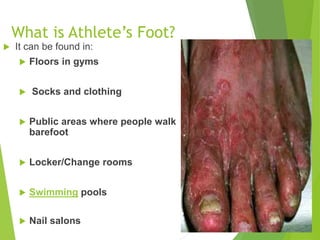
What is Athlete’s Foot?
 It can be found in:
 Floors in gyms
 Socks and clothing
 Public areas where people walk
barefoot
 Locker/Change rooms
 Swimming pools
 Nail salons 3
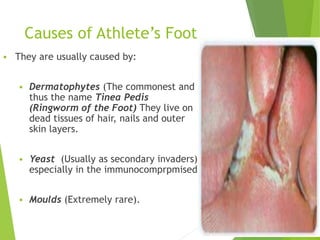
Causes of Athlete’s Foot
 They are usually caused by:
 Dermatophytes (The commonest and
thus the name Tinea Pedis
(Ringworm of the Foot) They live on
dead tissues of hair, nails and outer
skin layers.
 Yeast (Usually as secondary invaders)
especially in the immunocomprpmised
 Moulds (Extremely rare).
4
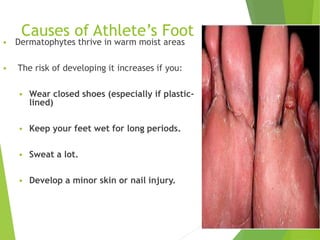
Causes of Athlete’s Foot
 Dermatophytes thrive in warm moist areas
 The risk of developing it increases if you:
 Wear closed shoes (especially if plastic-
lined)
 Keep your feet wet for long periods.
 Sweat a lot.
 Develop a minor skin or nail injury.
5
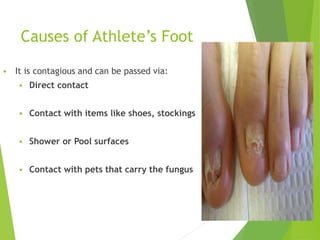
Causes of Athlete’s Foot
 It is contagious and can be passed via:
 Direct contact
 Contact with items like shoes, stockings
 Shower or Pool surfaces
 Contact with pets that carry the fungus
6
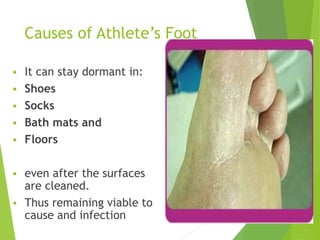
Causes of Athlete’s Foot
 It can stay dormant in:
 Shoes
 Socks
 Bath mats and
 Floors
 even after the surfaces
are cleaned.
 Thus remaining viable to
cause and infection 7
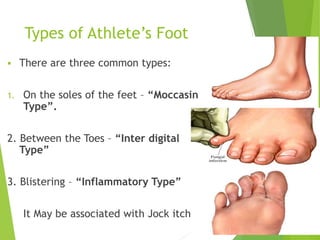
Types of Athlete’s Foot
 There are three common types:
1. On the soles of the feet – “Moccasin
Type”.
2. Between the Toes – “Inter digital
Type”
3. Blistering – “Inflammatory Type”
It May be associated with Jock itch. 8
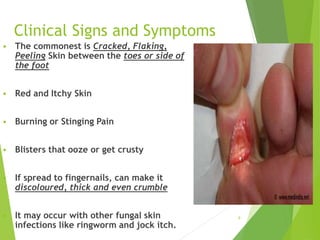
Clinical Signs and Symptoms
 The commonest is Cracked, Flaking,
Peeling Skin between the toes or side of
the foot
 Red and Itchy Skin
 Burning or Stinging Pain
 Blisters that ooze or get crusty
 If spread to fingernails, can make it
discoloured, thick and even crumble
 It may occur with other fungal skin
infections like ringworm and jock itch.
9
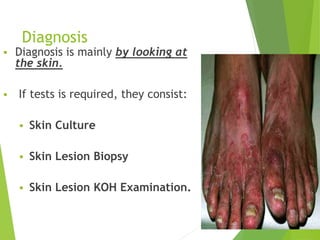
Diagnosis
 Diagnosis is mainly by looking at
the skin.
 If tests is required, they consist:
 Skin Culture
 Skin Lesion Biopsy
 Skin Lesion KOH Examination.
10
Treatment
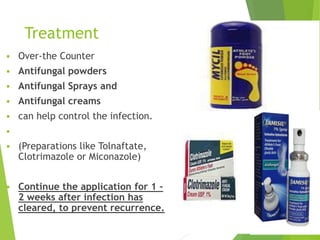
 Over-the Counter
 Antifungal powders
 Antifungal Sprays and
 Antifungal creams
 can help control the infection.

 (Preparations like Tolnaftate,
Clotrimazole or Miconazole)
 Continue the application for 1 –
2 weeks after infection has
cleared, to prevent recurrence.
11
Treatment
 Keep feet clean and dry (especially interdigital [in-
between the feet] )
 Thorough feet wash with soap and water
 Dry completely and carefully (Twice daily)
 Wear clean cotton socks
 Change socks as often as necessary to keep feet
dry.
Its responds well to self care, but may recur.
12
Treatment
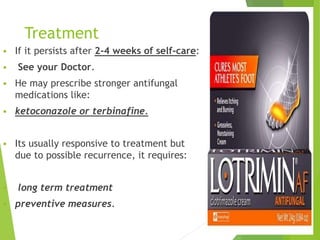
 If it persists after 2-4 weeks of self-care:
 See your Doctor.
 He may prescribe stronger antifungal
medications like:
 ketoconazole or terbinafine.
 Its usually responsive to treatment but
due to possible recurrence, it requires:
 long term treatment
 preventive measures.
13
Complications
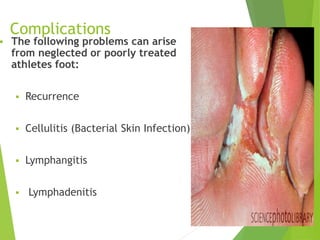
 The following problems can arise
from neglected or poorly treated
athletes foot:
 Recurrence
 Cellulitis (Bacterial Skin Infection)
 Lymphangitis
 Lymphadenitis
14
Prevention
 Dry feet thoroughly after bathing
or swimming
 Wear sandals or flip-flops at a
public shower or pool.
 Change socks often to keep feet
dry (At least once a day)
15
Prevention
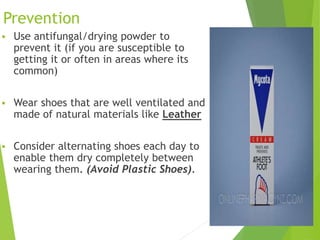
 Use antifungal/drying powder to
prevent it (if you are susceptible to
getting it or often in areas where its
common)
 Wear shoes that are well ventilated and
made of natural materials like Leather
 Consider alternating shoes each day to
enable them dry completely between
wearing them. (Avoid Plastic Shoes).
16
Questions
17
Credits
 http://www.ncbi.nlm.nih.gov/pubmedhealth/PMH0001878/
 http://www.medicinenet.com/athletes_foot/page2.htm
 http://www.health24.com/medical/Condition_centres/777-792-2215-
2222,21036.asp
 http://www.birminghamfootclinic.co.uk/footcomp_athletes.htm
18

Slides athletes footv2

  • 1.
  • 2.
    What is Athlete’sFoot?  A common term for different fungal infections of the foot.  The medical term is: “Tinea Pedis” referring to the causative organism and location of the infection. This is a ringworm fungus 2
  • 3.
    What is Athlete’sFoot?  It can be found in:  Floors in gyms  Socks and clothing  Public areas where people walk barefoot  Locker/Change rooms  Swimming pools  Nail salons 3
  • 4.
    Causes of Athlete’sFoot  They are usually caused by:  Dermatophytes (The commonest and thus the name Tinea Pedis (Ringworm of the Foot) They live on dead tissues of hair, nails and outer skin layers.  Yeast (Usually as secondary invaders) especially in the immunocomprpmised  Moulds (Extremely rare). 4
  • 5.
    Causes of Athlete’sFoot  Dermatophytes thrive in warm moist areas  The risk of developing it increases if you:  Wear closed shoes (especially if plastic- lined)  Keep your feet wet for long periods.  Sweat a lot.  Develop a minor skin or nail injury. 5
  • 6.
    Causes of Athlete’sFoot  It is contagious and can be passed via:  Direct contact  Contact with items like shoes, stockings  Shower or Pool surfaces  Contact with pets that carry the fungus 6
  • 7.
    Causes of Athlete’sFoot  It can stay dormant in:  Shoes  Socks  Bath mats and  Floors  even after the surfaces are cleaned.  Thus remaining viable to cause and infection 7
  • 8.
    Types of Athlete’sFoot  There are three common types: 1. On the soles of the feet – “Moccasin Type”. 2. Between the Toes – “Inter digital Type” 3. Blistering – “Inflammatory Type” It May be associated with Jock itch. 8
  • 9.
    Clinical Signs andSymptoms  The commonest is Cracked, Flaking, Peeling Skin between the toes or side of the foot  Red and Itchy Skin  Burning or Stinging Pain  Blisters that ooze or get crusty  If spread to fingernails, can make it discoloured, thick and even crumble  It may occur with other fungal skin infections like ringworm and jock itch. 9
  • 10.
    Diagnosis  Diagnosis ismainly by looking at the skin.  If tests is required, they consist:  Skin Culture  Skin Lesion Biopsy  Skin Lesion KOH Examination. 10
  • 11.
    Treatment  Over-the Counter Antifungal powders  Antifungal Sprays and  Antifungal creams  can help control the infection.   (Preparations like Tolnaftate, Clotrimazole or Miconazole)  Continue the application for 1 – 2 weeks after infection has cleared, to prevent recurrence. 11
  • 12.
    Treatment  Keep feetclean and dry (especially interdigital [in- between the feet] )  Thorough feet wash with soap and water  Dry completely and carefully (Twice daily)  Wear clean cotton socks  Change socks as often as necessary to keep feet dry. Its responds well to self care, but may recur. 12
  • 13.
    Treatment  If itpersists after 2-4 weeks of self-care:  See your Doctor.  He may prescribe stronger antifungal medications like:  ketoconazole or terbinafine.  Its usually responsive to treatment but due to possible recurrence, it requires:  long term treatment  preventive measures. 13
  • 14.
    Complications  The followingproblems can arise from neglected or poorly treated athletes foot:  Recurrence  Cellulitis (Bacterial Skin Infection)  Lymphangitis  Lymphadenitis 14
  • 15.
    Prevention  Dry feetthoroughly after bathing or swimming  Wear sandals or flip-flops at a public shower or pool.  Change socks often to keep feet dry (At least once a day) 15
  • 16.
    Prevention  Use antifungal/dryingpowder to prevent it (if you are susceptible to getting it or often in areas where its common)  Wear shoes that are well ventilated and made of natural materials like Leather  Consider alternating shoes each day to enable them dry completely between wearing them. (Avoid Plastic Shoes). 16
  • 17.
  • 18.
    Credits  http://www.ncbi.nlm.nih.gov/pubmedhealth/PMH0001878/  http://www.medicinenet.com/athletes_foot/page2.htm http://www.health24.com/medical/Condition_centres/777-792-2215- 2222,21036.asp  http://www.birminghamfootclinic.co.uk/footcomp_athletes.htm 18