RESUSCITATION TECHNIQUES IN
           PREGNANCY

                             BY
ANUGOM EMEKA   M B B C H , D I P. P H , A D V. D I P. O C C M E D , I G C N E B O S H
WELCOME & INTRODUCTIONS
   Logistics
 Emergency exits
 Restrooms


                          2
AGENDA


   Introduction
   Epidemiology
   Causes of Cardiac Arrest in Pregnancy
   Changes in Pregnancy
   Modifications To Resuscitation in Pregnancy
   Conclusion
   References
   Q&A


                                                  3
INTRODUCTION

   Various difficult situations may arise that lead to
    cardiac arrest.


   The skill of bystanders is paramount for outcome
    of survival.[1]


   Resuscitation will need to be modified in these
    situations depending on their peculiarities and
    reversible causes.


   Early recognition and proper management of
    Airway Breathing Circulation Disability and
    Exposure (ABCDE) is very important for
    survival.[2]


   Image: http://www.sundaymercury.net/news/midlands -news/2011/01/16/poor-maternity-care-blamed-for-deaths-of-21-
    west-midlands-babies-66331-27993368/                                                                              4
INTRODUCTION


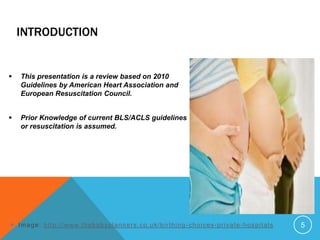
    This presentation is a review based on 2010
     Guidelines by American Heart Association and
     European Resuscitation Council.


    Prior Knowledge of current BLS/ACLS guidelines
     or resuscitation is assumed.


 I m a g e : h t t p : // www. t h e b a b yp l a n n e r s . c o . u k/ b i r t h i n g - c h o i c e s - p r i va t e - h o s p i t a l s   5
EPIDEMIOLOGY

 Maternal mortality is rare in
  developed nations, with a
  prevalence of 1:30,000
  maternities and a maternal
  mortality rate of 13.95 deaths
  per 100,000maternities in
  developing nations.[3,4,5]


 Image:
  http:// www.byregi on.net/c gibin/us ers /profiles.pl?s ubdomai n=bebebirth   6
CAUSES OF CARDIAC ARREST IN PREGNANCY


   The following can lead to cardiopulmonary
    collapse in pregnancy:


   Sepsis
   Cardiac disease
   Haemorrhage,
   Amniotic fluid embolism
   Ectopic pregnancy
   Pre-eclampsia and Eclampsia etc.[2,3,4]


 Image 2: http://www.sc ribd.com/doc /45492814/Resus citation -of-the-
  Pregnant -Pati ent                                                      7
CHANGES IN PREGNANCY


    There are increases in:
   - cardiac output
   - blood volume and
   - oxygen consumption,


   However with increase in uterine size up to
    20weeks gestational age, impinging on iliac
    and abdominal vessels this leads to
   - hypotension and
   - cardiac arrest.[3,4]


   Image 1: http://www.quantummetta.co.uk/?p=tab&s=courses&f=cpd
   Image 2: http://www.ebmedicine.net/topics.php?paction=showTopicSeg&topic_id=21&seg_id=345   8
MODIFICATIONS TO RESUSCITATION IN PREGNANCY


   In cardiopulmonary arrest certain modifications
    are made to the BLS/ACLS guidelines for the
    pregnant woman.[2,3,4,5]


   Image 1: http://www.sciencedirect.com/science/article/pii/S096880800627229X
   Image 2: http://www.dailymail.co.uk/health/article -2034160/Do-resuscitate-Theyre-fateful-words-   9
    meaning-doctors-wont-try-save-you-collapse-hospital.html
MODIFICATIONS TO RESUSCITATION IN PREGNANCY

     1. Ask for expert help immediately
     - To rule out and treat cause or
     - Decide on caesarean section if required.[3,4,5]


     2. Put in left lateral position at 15 to 30 degrees
      either on the rescuer’s knee or using a wedge
or
     Displace the uterus manually and gently left
      laterally while lying supine
(This enables better chest compression than when in
the left lateral tilt position)


to relieve obstruction on the iliac and abdominal
vessels .[3,4,5]

    Image 1 & 2: Stephen Morris,Mark Stacey ABC of Resuscitation:Resuscitation in pregnancy;BMJ 2003;327,1278   10
MODIFICATIONS TO RESUSCITATION IN PREGNANCY


   3. - Good ventilation with bag valve mask and
    high flow oxygen,
        - Suctioning to keep the airway clear.[3,4,5]


   4. IV Fluid bolus to correct:
   - hypotension or
   - hypovolaemia,
while monitoring the oxygen saturation.[3,4,5]




    Image 1: http://www.scienceandsensibility.org/?tag=midwife
    Image 2: http://drhem.com/2012/04/02/intern -report-5-20/
                                                                 11
MODIFICATIONS TO RESUSCITATION IN PREGNANCY


    5. Chest compressions are done slightly
     higher on the sternum as abdominal
     contents and diaphragm are elevated.


Use of AED if indicated is still under review
but is not discouraged if required.[3,4,5]


 I m a g e 1 : h t t p : / / www. s c i e n c e d i r e c t .c o m / sc i e n c e / a r t i c l e / p i i / S 0 3 0 0 9 5 7 2 1 2 0 0 2 9 8 5   12
MODIFICATIONS TO RESUSCITATION IN PREGNANCY


    6. Endotracheal intubation should be: - Done
     early and
    - By an expert
Because the upper airway narrows in third trimester
and so it gets more difficult to intubate,


    - Apply cricoid pressure to avoid aspiration that
     has a higher risk of occurrence in pregnant
     women due to gastro-esophageal sphincter
     insufficiency.[3,4]


 I m a g e : h t t p : // www. s c i e n c e d i r e c t . co m/ s ci e n c e / a r t i c l e /p i i / S 0 3 0 0 9 5 7 2 11 0 0 0 8 3 9   13
MODIFICATIONS TO RESUSCITATION IN PREGNANCY


    7. Manage all reversible causes as they present.


    If non-responsive to resuscitation

     Plan emergency caesarean section
    - within 4minutes of determining the cardiac arrest
     and
    - delivery of fetus within 5minutes of initiating
     resuscitation.

     Therapeutic hypothermia may also be used for
     comatose patients as indicated for regular non-
     pregnant patients.[3,4,]



    Image 1: http://www.sciencedirect.com/science/article/pii/S0300957211000839
    Image 2: http://circ.ahajournals.org/content/102/suppl_1/I -229.full
                                                                                  14
CONCLUSION

     Difficult situations may arise or lead to need
      for resuscitation.


     Modifications and consideration of
      reversible factors, including importance of
      making early decisions to
- initiate resuscitation
- invite expert and
- manage the patient accordingly
    is paramount to survival in these situations.


 Image: http://www.alsg.org/en/files/MOET_Ch3_CPR.pdf   15
CONCLUSION


   Mastery and awareness of the basic
    techniques and guidelines for BLS/ACLS by
    everyone is crucial to success in resuscitation
    in theses situations.


   Get Trained to save lives.


 Image: http://healthyhous tonkids .com/2011/07/how -to-choos e -bes t -
  infant-cpr-class -for/                                                    16
REFERENCES

   1. J.R Casal Codesido, y M.J. Vazquez Lima, 2007; Out-of Hospital Cardiopulmonary
    Resuscitation: Where are We now? Emergencias 2007;19:295-297.

   2. Australian Resuscitation Council; New Zealand Resuscitation Council, 2011; Guideline
    11.10 Resuscitation in Special Circumstances: 1-14

   3. Jasmeet Soar et al,2010, European Resuscitation Council Guidelines for 2010 Section 8.
    Cardiac arrest in special circumstances: Electrolyte abnormalities, poisoning, drowning,
    accidental hypothermia, hyperthermia, asthma,anaphylaxis, cardiac surgery, trauma,
    pregnancy, electrocution; Elsevier Ireland Ltd, Resuscitation 81(2010)1400-1433,
    doi:10.1016/j.resuscitation.2010.08.015

   4. Terry L. Vanden Hoek et al, 2010, Cardiac Arrest in Special Situations: 2010 American
    Heart Association Guidelines for Cardiopulmonary Resuscitation and Emergency
    Cardiovascular Care; Circulation.2010:122:S829-S861;
    doi:10.1161/CIRCULATIONAHA.110.971069; Online ISSN:1524-4539

   5. OGCCU, 2010, 11.1 Resuscitation in Late Pregnancy, Section B, Clinical Guidelines. King
    Edward Memorial Hospital Perth Western Australia. DPMS Ref: 5334

                                                                                               17
.


 I m a g e : h t t p : / / h a n d s o n b l o g . o r g / 2 0 11 / 0 1 / 2 6 / e i g h t - t i p s - f o r - w r i t i n g - t h e - p e r f e c t - t h a n k -   18
  you-note/
QUESTIONS


 I m a g e : h t t p : / / w w w. o p e n b k a u t o l o a n s . c o m / w p - c o n t e n t / u p l o a d s / 2 0 1 2 / 0 4 / q u e s t i o n -   19
  and-answers-bad-credit-car-financing.jpg

Resuscitation techniques in pregnancy

  • 1.
    RESUSCITATION TECHNIQUES IN PREGNANCY BY ANUGOM EMEKA M B B C H , D I P. P H , A D V. D I P. O C C M E D , I G C N E B O S H
  • 2.
    WELCOME & INTRODUCTIONS  Logistics  Emergency exits  Restrooms 2
  • 3.
    AGENDA  Introduction  Epidemiology  Causes of Cardiac Arrest in Pregnancy  Changes in Pregnancy  Modifications To Resuscitation in Pregnancy  Conclusion  References  Q&A 3
  • 4.
    INTRODUCTION  Various difficult situations may arise that lead to cardiac arrest.  The skill of bystanders is paramount for outcome of survival.[1]  Resuscitation will need to be modified in these situations depending on their peculiarities and reversible causes.  Early recognition and proper management of Airway Breathing Circulation Disability and Exposure (ABCDE) is very important for survival.[2]  Image: http://www.sundaymercury.net/news/midlands -news/2011/01/16/poor-maternity-care-blamed-for-deaths-of-21- west-midlands-babies-66331-27993368/ 4
  • 5.
    INTRODUCTION  This presentation is a review based on 2010 Guidelines by American Heart Association and European Resuscitation Council.  Prior Knowledge of current BLS/ACLS guidelines or resuscitation is assumed.  I m a g e : h t t p : // www. t h e b a b yp l a n n e r s . c o . u k/ b i r t h i n g - c h o i c e s - p r i va t e - h o s p i t a l s 5
  • 6.
    EPIDEMIOLOGY  Maternal mortalityis rare in developed nations, with a prevalence of 1:30,000 maternities and a maternal mortality rate of 13.95 deaths per 100,000maternities in developing nations.[3,4,5]  Image: http:// www.byregi on.net/c gibin/us ers /profiles.pl?s ubdomai n=bebebirth 6
  • 7.
    CAUSES OF CARDIACARREST IN PREGNANCY  The following can lead to cardiopulmonary collapse in pregnancy:  Sepsis  Cardiac disease  Haemorrhage,  Amniotic fluid embolism  Ectopic pregnancy  Pre-eclampsia and Eclampsia etc.[2,3,4]  Image 2: http://www.sc ribd.com/doc /45492814/Resus citation -of-the- Pregnant -Pati ent 7
  • 8.
    CHANGES IN PREGNANCY  There are increases in:  - cardiac output  - blood volume and  - oxygen consumption,  However with increase in uterine size up to 20weeks gestational age, impinging on iliac and abdominal vessels this leads to  - hypotension and  - cardiac arrest.[3,4]  Image 1: http://www.quantummetta.co.uk/?p=tab&s=courses&f=cpd  Image 2: http://www.ebmedicine.net/topics.php?paction=showTopicSeg&topic_id=21&seg_id=345 8
  • 9.
    MODIFICATIONS TO RESUSCITATIONIN PREGNANCY  In cardiopulmonary arrest certain modifications are made to the BLS/ACLS guidelines for the pregnant woman.[2,3,4,5]  Image 1: http://www.sciencedirect.com/science/article/pii/S096880800627229X  Image 2: http://www.dailymail.co.uk/health/article -2034160/Do-resuscitate-Theyre-fateful-words- 9 meaning-doctors-wont-try-save-you-collapse-hospital.html
  • 10.
    MODIFICATIONS TO RESUSCITATIONIN PREGNANCY  1. Ask for expert help immediately  - To rule out and treat cause or  - Decide on caesarean section if required.[3,4,5]  2. Put in left lateral position at 15 to 30 degrees either on the rescuer’s knee or using a wedge or  Displace the uterus manually and gently left laterally while lying supine (This enables better chest compression than when in the left lateral tilt position) to relieve obstruction on the iliac and abdominal vessels .[3,4,5]  Image 1 & 2: Stephen Morris,Mark Stacey ABC of Resuscitation:Resuscitation in pregnancy;BMJ 2003;327,1278 10
  • 11.
    MODIFICATIONS TO RESUSCITATIONIN PREGNANCY  3. - Good ventilation with bag valve mask and high flow oxygen,  - Suctioning to keep the airway clear.[3,4,5]  4. IV Fluid bolus to correct:  - hypotension or  - hypovolaemia, while monitoring the oxygen saturation.[3,4,5]   Image 1: http://www.scienceandsensibility.org/?tag=midwife Image 2: http://drhem.com/2012/04/02/intern -report-5-20/ 11
  • 12.
    MODIFICATIONS TO RESUSCITATIONIN PREGNANCY  5. Chest compressions are done slightly higher on the sternum as abdominal contents and diaphragm are elevated. Use of AED if indicated is still under review but is not discouraged if required.[3,4,5]  I m a g e 1 : h t t p : / / www. s c i e n c e d i r e c t .c o m / sc i e n c e / a r t i c l e / p i i / S 0 3 0 0 9 5 7 2 1 2 0 0 2 9 8 5 12
  • 13.
    MODIFICATIONS TO RESUSCITATIONIN PREGNANCY  6. Endotracheal intubation should be: - Done early and  - By an expert Because the upper airway narrows in third trimester and so it gets more difficult to intubate,  - Apply cricoid pressure to avoid aspiration that has a higher risk of occurrence in pregnant women due to gastro-esophageal sphincter insufficiency.[3,4]  I m a g e : h t t p : // www. s c i e n c e d i r e c t . co m/ s ci e n c e / a r t i c l e /p i i / S 0 3 0 0 9 5 7 2 11 0 0 0 8 3 9 13
  • 14.
    MODIFICATIONS TO RESUSCITATIONIN PREGNANCY  7. Manage all reversible causes as they present.  If non-responsive to resuscitation    Plan emergency caesarean section  - within 4minutes of determining the cardiac arrest and  - delivery of fetus within 5minutes of initiating resuscitation.    Therapeutic hypothermia may also be used for comatose patients as indicated for regular non- pregnant patients.[3,4,]   Image 1: http://www.sciencedirect.com/science/article/pii/S0300957211000839 Image 2: http://circ.ahajournals.org/content/102/suppl_1/I -229.full 14
  • 15.
    CONCLUSION  Difficult situations may arise or lead to need for resuscitation.  Modifications and consideration of reversible factors, including importance of making early decisions to - initiate resuscitation - invite expert and - manage the patient accordingly is paramount to survival in these situations.  Image: http://www.alsg.org/en/files/MOET_Ch3_CPR.pdf 15
  • 16.
    CONCLUSION  Mastery and awareness of the basic techniques and guidelines for BLS/ACLS by everyone is crucial to success in resuscitation in theses situations.  Get Trained to save lives.  Image: http://healthyhous tonkids .com/2011/07/how -to-choos e -bes t - infant-cpr-class -for/ 16
  • 17.
    REFERENCES  1. J.R Casal Codesido, y M.J. Vazquez Lima, 2007; Out-of Hospital Cardiopulmonary Resuscitation: Where are We now? Emergencias 2007;19:295-297.  2. Australian Resuscitation Council; New Zealand Resuscitation Council, 2011; Guideline 11.10 Resuscitation in Special Circumstances: 1-14  3. Jasmeet Soar et al,2010, European Resuscitation Council Guidelines for 2010 Section 8. Cardiac arrest in special circumstances: Electrolyte abnormalities, poisoning, drowning, accidental hypothermia, hyperthermia, asthma,anaphylaxis, cardiac surgery, trauma, pregnancy, electrocution; Elsevier Ireland Ltd, Resuscitation 81(2010)1400-1433, doi:10.1016/j.resuscitation.2010.08.015  4. Terry L. Vanden Hoek et al, 2010, Cardiac Arrest in Special Situations: 2010 American Heart Association Guidelines for Cardiopulmonary Resuscitation and Emergency Cardiovascular Care; Circulation.2010:122:S829-S861; doi:10.1161/CIRCULATIONAHA.110.971069; Online ISSN:1524-4539  5. OGCCU, 2010, 11.1 Resuscitation in Late Pregnancy, Section B, Clinical Guidelines. King Edward Memorial Hospital Perth Western Australia. DPMS Ref: 5334 17
  • 18.
    .  I ma g e : h t t p : / / h a n d s o n b l o g . o r g / 2 0 11 / 0 1 / 2 6 / e i g h t - t i p s - f o r - w r i t i n g - t h e - p e r f e c t - t h a n k - 18 you-note/
  • 19.
    QUESTIONS  I ma g e : h t t p : / / w w w. o p e n b k a u t o l o a n s . c o m / w p - c o n t e n t / u p l o a d s / 2 0 1 2 / 0 4 / q u e s t i o n - 19 and-answers-bad-credit-car-financing.jpg