Introduction
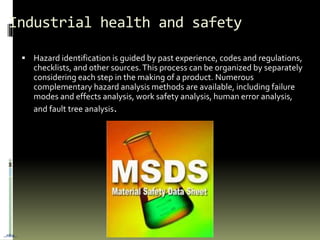
 MSDS is a document that contains information on the potential health
effect on exposure to chemical, or other potential dangerous substance
,and on safe working procedures when handling chemical products.
 It is essential starting point for development of a complete health and
safety program.
 It contains hazard evolutions on the uses, storage, handling and emergency
procedure related to that material.
 The MSDS contains much more information about the material than the
label and it is prepared by supplier.
 It is intended to tell what the hazards of the product are, how to use the
product safely, what to expect if the recommendations are not followed,
what to do if accidents occur, how to recognize symptoms of overexposure,
and what to do if such incidents occur.
…nba…
 In compliance with various international Standards each MSDS must
contain sixteen sections:
1. Product information: product identifier (scientific name, common name),
name of the manufacturer and supplier, addresses, emergency phone
numbers.
2. Composition / Information on Ingredients:
3. Hazards Identification: data on flammability, reactivity, chronic hazards,
4. First-Aid Measures: description of recommended first-aid measures in
case an incident occurs, for example, in case of ingestion or inhalation of
the substance, or in case of contact of the chemical product with eyes or
skin.
Introduction
…nba…
5. Fire Fighting Measures: recommended fire fighting apparatus, methods and
products, flash point of the substance, fire-fighting class, upper and lower
flammable limit , dangerous combustion products, recommendations for
preventing explosions and fires
6. Accidental Release Measures: measures to be taken in case of the accidental
release of the chemical substance or mixture into the environment: soil,
rivers, waterways, sources of potable and non potable water, see, etc.
7. Information on Recommended Handling and Storage Conditions:
recommended procedures for the handling, storage and usage of the
chemical substance or mixture
8. Exposure Controls / Personal Protection: this section often contains the
exposure limits per country (classified by form of exposure or overexposure),
as well as the personal protection equipment (PPE) recommended or
required by law (respiratory protection, skin protection, eye protection, face
mask, etc.)
Introduction
…nba…
9. Physical and Chemical Properties: product properties such as vapor
pressure, vapor density, specific weight, water solubility, appearance, odor
type, boiling point, pH value, viscosity, evaporation rate, freezing point.
10. Stability and Reactivity Data: information on the stability of the
substance, conditions to avoid, incompatibility with other substances or
materials, hazardous decomposition products, etc.
11.Toxicological Information: information on the acute and chronic toxicity
of the chemical substance, possibly data on the known carcinogenic
properties, or laboratory tests.
12. Ecological Information: information on the eco-toxicity of the chemical
product, analysis of its components, biodegradability in different
environments, etc.
Introduction
…nba…
13. Disposal Considerations: this section often contains references to local
legal requirements regarding the disposal of hazardous chemical products.
14.Transport Information: shipping name, hazard class, UN number,
package group.
15. Regulatory Information: classification of the substance according to SCA,
SARA, CERCLA, S- and R-Phrases.
16. Other Information: this section often presents a list of abbreviations used
in the MSDS, references to EU Directives en European or international
(ISO) standards, version management of the MSDS
Introduction
…nba…
 Employers must make sure that all controlled products have an up-to-date
(less than three years old) MSDS when they enter the workplace.
 The MSDS must be readily available to the workers who are exposed to the
controlled product, and to the health and safety committee.
 If an MSDS in English is not completely understood by non-native speakers,
the MSDS in question requires to be translated in the native tongue of the
personnel handling the hazardous materials.
 The employer has a duty to make an understandable MSDS for all
hazardous products.
 Also, according to the "downstream flow" principle, any importer, supplier,
or reseller of a product containing substances requiring the provision of an
MSDS, is under a legal obligation to provide the relevant safety sheets in
the language of the importing country, so often an MSDS translation will be
needed. In case of accidents, contamination or spillages, an MSDS can be
a life insurance for workers handling hazardous substances
Translation:
…nba…
Industrial health and safety
 An interdisciplinary field that focuses on preventing occupational illnesses
and injuries.The disciplines of engineering, epidemiology, toxicology,
medicine, psychology, and sociology provide the methods for study and
prevention.
 Tens of thousands of occupational hazards exist. Occupational hazards can
be organized in terms of plants and equipment, the physical work
environment, hazards of materials, and task demands. Significant
interactions occur between these categories. For example, equipment can
modify the work environment by producing noise, potentially hazardous
materials, or heat, but will be hazardous only if inappropriate procedures
are followed.
…nba…
Industrial health and safety
 Plant hazards are often associated with energy sources and
power transmission, processes at the point of operation,
vehicles and materials-handling systems, walking and
climbing surfaces, ingress-egress, and confined spaces.
Hazards in the physical work environment include vibration
and noise, thermal extremes, pressure extremes, and ionizing
or nonionizing radiation.
 Materials used in industrial processes vary greatly in nature
and form. Mists, vapors, gases, liquids, dusts, and fumes from
certain materials may be hazardous. Some materials pose fire
and explosion hazards. Others are chemically or biologically
active when they contact or enter the human body. Even
chemically inert materials can cause injuries or illness.
…nba…
Industrial health and safety
 The task performed by a worker can be hazardous. Lifting, pushing,
pulling, and other physical activity can cause injury when applied or
reactive forces, pressures, or torques exceed the tolerance of the
body. Repeated performance of manual tasks over prolonged
periods, excessive reaches, twisting motions, rapid movements, and
postures that concentrate forces can significantly increase the risk of
injury.Tasks that are stressful or monotonous can also contribute to
human error. Changes in work conditions requiring deviations from
ordinary routines, such as when equipment is being repaired, are
particularly likely to increase the chance of errors.
 A fundamental safety and health activity is to identify potential
hazards and then to analyze them in terms of severity and
probability.This process allows the cost of control measures to be
compared with expected loss reduction and helps justify choices
between control alternatives.
…nba…
Industrial health and safety
 Hazard identification is guided by past experience, codes and regulations,
checklists, and other sources.This process can be organized by separately
considering each step in the making of a product. Numerous
complementary hazard analysis methods are available, including failure
modes and effects analysis, work safety analysis, human error analysis,
and fault tree analysis.
…nba…
MATERIAL DATA SAFTY SHEETS

MATERIAL DATA SAFTY SHEETS

  • 2.
    Introduction  MSDS isa document that contains information on the potential health effect on exposure to chemical, or other potential dangerous substance ,and on safe working procedures when handling chemical products.  It is essential starting point for development of a complete health and safety program.  It contains hazard evolutions on the uses, storage, handling and emergency procedure related to that material.  The MSDS contains much more information about the material than the label and it is prepared by supplier.  It is intended to tell what the hazards of the product are, how to use the product safely, what to expect if the recommendations are not followed, what to do if accidents occur, how to recognize symptoms of overexposure, and what to do if such incidents occur. …nba…
  • 3.
     In compliancewith various international Standards each MSDS must contain sixteen sections: 1. Product information: product identifier (scientific name, common name), name of the manufacturer and supplier, addresses, emergency phone numbers. 2. Composition / Information on Ingredients: 3. Hazards Identification: data on flammability, reactivity, chronic hazards, 4. First-Aid Measures: description of recommended first-aid measures in case an incident occurs, for example, in case of ingestion or inhalation of the substance, or in case of contact of the chemical product with eyes or skin. Introduction …nba…
  • 4.
    5. Fire FightingMeasures: recommended fire fighting apparatus, methods and products, flash point of the substance, fire-fighting class, upper and lower flammable limit , dangerous combustion products, recommendations for preventing explosions and fires 6. Accidental Release Measures: measures to be taken in case of the accidental release of the chemical substance or mixture into the environment: soil, rivers, waterways, sources of potable and non potable water, see, etc. 7. Information on Recommended Handling and Storage Conditions: recommended procedures for the handling, storage and usage of the chemical substance or mixture 8. Exposure Controls / Personal Protection: this section often contains the exposure limits per country (classified by form of exposure or overexposure), as well as the personal protection equipment (PPE) recommended or required by law (respiratory protection, skin protection, eye protection, face mask, etc.) Introduction …nba…
  • 5.
    9. Physical andChemical Properties: product properties such as vapor pressure, vapor density, specific weight, water solubility, appearance, odor type, boiling point, pH value, viscosity, evaporation rate, freezing point. 10. Stability and Reactivity Data: information on the stability of the substance, conditions to avoid, incompatibility with other substances or materials, hazardous decomposition products, etc. 11.Toxicological Information: information on the acute and chronic toxicity of the chemical substance, possibly data on the known carcinogenic properties, or laboratory tests. 12. Ecological Information: information on the eco-toxicity of the chemical product, analysis of its components, biodegradability in different environments, etc. Introduction …nba…
  • 6.
    13. Disposal Considerations:this section often contains references to local legal requirements regarding the disposal of hazardous chemical products. 14.Transport Information: shipping name, hazard class, UN number, package group. 15. Regulatory Information: classification of the substance according to SCA, SARA, CERCLA, S- and R-Phrases. 16. Other Information: this section often presents a list of abbreviations used in the MSDS, references to EU Directives en European or international (ISO) standards, version management of the MSDS Introduction …nba…
  • 7.
     Employers mustmake sure that all controlled products have an up-to-date (less than three years old) MSDS when they enter the workplace.  The MSDS must be readily available to the workers who are exposed to the controlled product, and to the health and safety committee.  If an MSDS in English is not completely understood by non-native speakers, the MSDS in question requires to be translated in the native tongue of the personnel handling the hazardous materials.  The employer has a duty to make an understandable MSDS for all hazardous products.  Also, according to the "downstream flow" principle, any importer, supplier, or reseller of a product containing substances requiring the provision of an MSDS, is under a legal obligation to provide the relevant safety sheets in the language of the importing country, so often an MSDS translation will be needed. In case of accidents, contamination or spillages, an MSDS can be a life insurance for workers handling hazardous substances Translation: …nba…
  • 8.
    Industrial health andsafety  An interdisciplinary field that focuses on preventing occupational illnesses and injuries.The disciplines of engineering, epidemiology, toxicology, medicine, psychology, and sociology provide the methods for study and prevention.  Tens of thousands of occupational hazards exist. Occupational hazards can be organized in terms of plants and equipment, the physical work environment, hazards of materials, and task demands. Significant interactions occur between these categories. For example, equipment can modify the work environment by producing noise, potentially hazardous materials, or heat, but will be hazardous only if inappropriate procedures are followed. …nba…
  • 9.
    Industrial health andsafety  Plant hazards are often associated with energy sources and power transmission, processes at the point of operation, vehicles and materials-handling systems, walking and climbing surfaces, ingress-egress, and confined spaces. Hazards in the physical work environment include vibration and noise, thermal extremes, pressure extremes, and ionizing or nonionizing radiation.  Materials used in industrial processes vary greatly in nature and form. Mists, vapors, gases, liquids, dusts, and fumes from certain materials may be hazardous. Some materials pose fire and explosion hazards. Others are chemically or biologically active when they contact or enter the human body. Even chemically inert materials can cause injuries or illness. …nba…
  • 10.
    Industrial health andsafety  The task performed by a worker can be hazardous. Lifting, pushing, pulling, and other physical activity can cause injury when applied or reactive forces, pressures, or torques exceed the tolerance of the body. Repeated performance of manual tasks over prolonged periods, excessive reaches, twisting motions, rapid movements, and postures that concentrate forces can significantly increase the risk of injury.Tasks that are stressful or monotonous can also contribute to human error. Changes in work conditions requiring deviations from ordinary routines, such as when equipment is being repaired, are particularly likely to increase the chance of errors.  A fundamental safety and health activity is to identify potential hazards and then to analyze them in terms of severity and probability.This process allows the cost of control measures to be compared with expected loss reduction and helps justify choices between control alternatives. …nba…
  • 11.
    Industrial health andsafety  Hazard identification is guided by past experience, codes and regulations, checklists, and other sources.This process can be organized by separately considering each step in the making of a product. Numerous complementary hazard analysis methods are available, including failure modes and effects analysis, work safety analysis, human error analysis, and fault tree analysis. …nba…