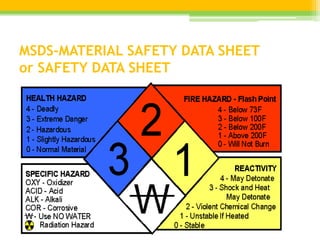
MSDS-MATERIAL SAFETY DATA SHEET
or SAFETY DATA SHEET
• A Material Safety Data Sheet (MSDS) is a
document that contains information on the
potential health effects of exposure to chemicals,
or other potentially dangerous substances, and
on safe working procedures when handling
chemical products.
History
• The earliest written material has been found in
the tombs of the Egyptians, either on the walls of
their tombs or on papyrus records.
• These date back over 4,000 years and include
the prescriptions of Imhotep, the first great
Egyptian physician.
Material Safety Data Sheets
• Include specific chemical identity and common
names
• Must provide information about:
▫ Physical and chemical characteristics
▫ Health effects
▫ Exposure limits
▫ Carcinogenicity (cancer-causing)
▫ Identification (name, address, and telephone number)
of the organization responsible for preparing the sheet
▫ Must be readily accessible to employees in their work
area
Who prepares and provides MSDSs?
• Manufacturers and importers of dangerous
goods and hazardous substances must:
• prepare an MSDS for each of their products
• provide the current MSDS to employers or
occupiers of premises where the product is used
or stored
• review and revise each MSDS as often as
necessary and at least every 5 years to make sure
that the information is accurate and up to date
Risk phrases - examples
• R1: Explosive when dry
• R2: Risk of explosion by shock, friction, fire
or other sources of ignition
• R3: Extreme risk of explosion by shock,
friction, fire or other sources of ignition
• R4: Forms very sensitive explosive metallic
compounds
• R5: Heating may cause an explosion
• R6: Explosive with or without contact with air
• R7: May cause fire
• R8: Contact with combustible material may
cause fire
• R9: Explosive when mixed with combustible
material
• R10: Flammable
• R11: Highly flammable
• R12: Extremely flammable
• R14: Reacts violently with water
• R15: Contact with water liberates extremely
flammable gases
 R20: Harmful by inhalation
 R21: Harmful in contact with skin
 R22: Harmful if swallowed
 R23: Toxic by inhalation
 R24: Toxic in contact with skin
 R25: Toxic if swallowed
 R26: Very toxic by inhalation
 R27: Very toxic in contact with skin
 R28: Very toxic if swallowed
 R29: Contact with water liberates toxic
gas.
 R30: Can become highly flammable in use
 R31: Contact with acids liberates toxic gas
 R32: Contact with acids liberates very
toxic gas
 Up to: -
 R66: Repeated exposure may cause skin
dryness or cracking
 R67: Vapours may cause drowsiness and
dizziness
 R68: Possible risk of irreversible effects
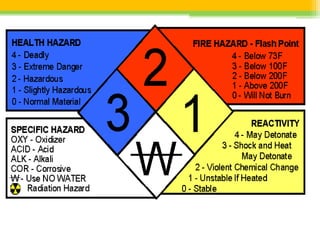
Types of hazards
• When you read an MSDS, you should keep in mind that there are three
main types of hazards which can be related to the use of a chemical product:
• - Health Hazards. For example, skin contact with strong acids
will cause burns.
• - Fire Hazards. For example, propane burns very easily and
may explode.
• - Reactivity Hazards. For example, mixing ammonia and
household bleach will result in the release of a harmful gas.
• In addition, international format MSDSs include information
on environmental hazards (hazards to the natural
environment).
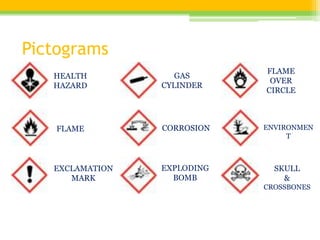
Pictograms
HEALTH
HAZARD
FLAME
EXCLAMATION
MARK
GAS
CYLINDER
CORROSION
EXPLODING
BOMB
FLAME
OVER
CIRCLE
ENVIRONMEN
T
SKULL
&
CROSSBONES
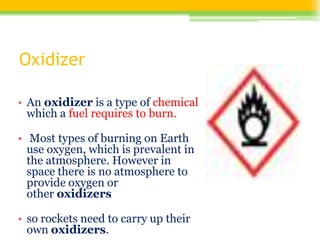
Oxidizer
• An oxidizer is a type of chemical
which a fuel requires to burn.
• Most types of burning on Earth
use oxygen, which is prevalent in
the atmosphere. However in
space there is no atmosphere to
provide oxygen or
other oxidizers
• so rockets need to carry up their
own oxidizers.
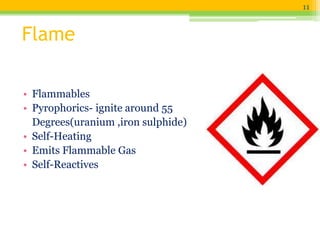
Flame
• Flammables
• Pyrophorics- ignite around 55
Degrees(uranium ,iron sulphide)
• Self-Heating
• Emits Flammable Gas
• Self-Reactives
11
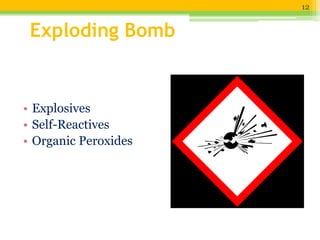
Exploding Bomb
• Explosives
• Self-Reactives
• Organic Peroxides
12
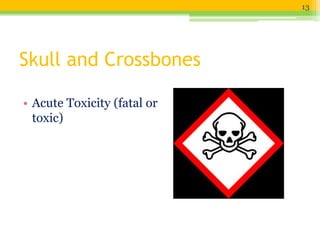
Skull and Crossbones
• Acute Toxicity (fatal or
toxic)
13
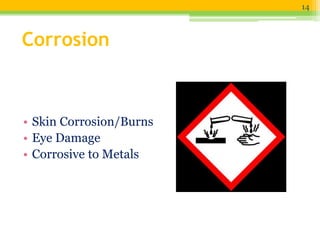
Corrosion
• Skin Corrosion/Burns
• Eye Damage
• Corrosive to Metals
14
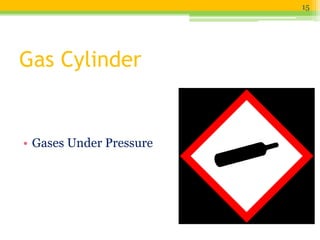
Gas Cylinder
• Gases Under Pressure
15
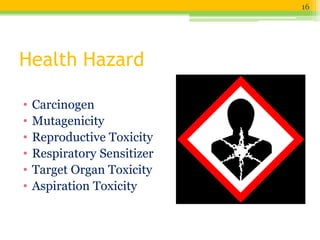
Health Hazard
• Carcinogen
• Mutagenicity
• Reproductive Toxicity
• Respiratory Sensitizer
• Target Organ Toxicity
• Aspiration Toxicity
16
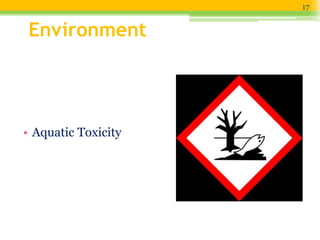
Environment
• Aquatic Toxicity
17
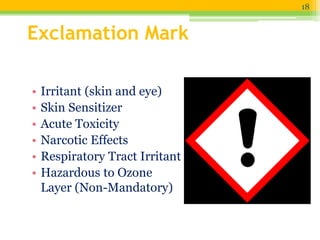
Exclamation Mark
• Irritant (skin and eye)
• Skin Sensitizer
• Acute Toxicity
• Narcotic Effects
• Respiratory Tract Irritant
• Hazardous to Ozone
Layer (Non-Mandatory)
18
First aid Measures
EYE Contact:
• Check for and remove any contact lenses.
Immediately flush eyes with plenty of water for
15 mins. Get medical attention immediately.
Skin Contact
• Immediately flush skin with plenty of water for
at least 15 mins while removing contaminated
clothing and shoes.
• Cover the irritated skin with emollient .
• Get medical attention immediately.
Inhalation
• Remove to fresh air.
• If not breathing give artificial breathing
Warning –it may be hazardous to person
providing the aide.
• If breathing is difficult ,give oxygen.
• Get medical attention immediately.
Ingestion
• If swallowed ,don’t induce vomiting unless
directed by the medical professional.
• Never give anything by mouth to an
unconscious person.
• Loosen tight clothing such as collar, tie belt or
waistband.
• Get medical attention immediately.
Need of MSDS and how to prepare.
• In 1993, the American National Standard for
Hazardous Industrial Chemicals – Material Safety
Data Sheets – Preparation, ANSI Z400.1 was
developed to address the need for a MSDS format that
was comprehensive, understandable and consistent.
• ANSI Z400.1-1993 introduced the standardized
16-section MSDS.
• Revisions were made to the Standard in 1998 and
2005. The 2005 revisions improve readability,
minimize redundancies and reorder the MSDS
sections
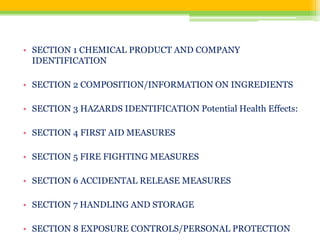
• SECTION 1 CHEMICAL PRODUCT AND COMPANY
IDENTIFICATION
• SECTION 2 COMPOSITION/INFORMATION ON INGREDIENTS
• SECTION 3 HAZARDS IDENTIFICATION Potential Health Effects:
• SECTION 4 FIRST AID MEASURES
• SECTION 5 FIRE FIGHTING MEASURES
• SECTION 6 ACCIDENTAL RELEASE MEASURES
• SECTION 7 HANDLING AND STORAGE
• SECTION 8 EXPOSURE CONTROLS/PERSONAL PROTECTION
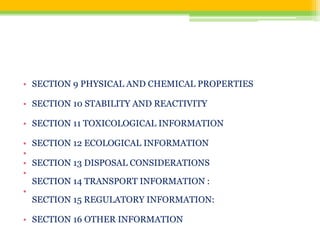
• SECTION 9 PHYSICAL AND CHEMICAL PROPERTIES
• SECTION 10 STABILITY AND REACTIVITY
• SECTION 11 TOXICOLOGICAL INFORMATION
• SECTION 12 ECOLOGICAL INFORMATION
•
• SECTION 13 DISPOSAL CONSIDERATIONS
•
SECTION 14 TRANSPORT INFORMATION :
•
SECTION 15 REGULATORY INFORMATION:
• SECTION 16 OTHER INFORMATION
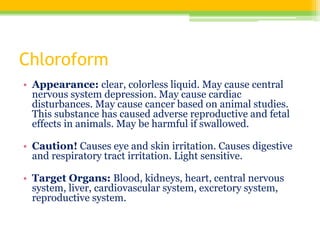
Chloroform
• Appearance: clear, colorless liquid. May cause central
nervous system depression. May cause cardiac
disturbances. May cause cancer based on animal studies.
This substance has caused adverse reproductive and fetal
effects in animals. May be harmful if swallowed.
• Caution! Causes eye and skin irritation. Causes digestive
and respiratory tract irritation. Light sensitive.
• Target Organs: Blood, kidneys, heart, central nervous
system, liver, cardiovascular system, excretory system,
reproductive system.
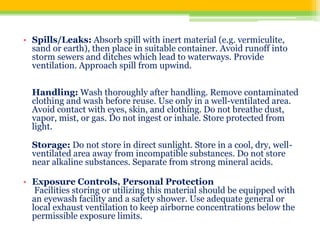
• Spills/Leaks: Absorb spill with inert material (e.g. vermiculite,
sand or earth), then place in suitable container. Avoid runoff into
storm sewers and ditches which lead to waterways. Provide
ventilation. Approach spill from upwind.
Handling: Wash thoroughly after handling. Remove contaminated
clothing and wash before reuse. Use only in a well-ventilated area.
Avoid contact with eyes, skin, and clothing. Do not breathe dust,
vapor, mist, or gas. Do not ingest or inhale. Store protected from
light.
Storage: Do not store in direct sunlight. Store in a cool, dry, well-
ventilated area away from incompatible substances. Do not store
near alkaline substances. Separate from strong mineral acids.
• Exposure Controls, Personal Protection
Facilities storing or utilizing this material should be equipped with
an eyewash facility and a safety shower. Use adequate general or
local exhaust ventilation to keep airborne concentrations below the
permissible exposure limits.
ETHIDIUM BROMIDE
• EMERGENCY OVERVIEW
• Appearance: dark purple crystalline powder.
Danger! Harmful in contact with skin and if
swallowed. May be fatal if inhaled. Causes eye, skin,
and respiratory tract irritation. Possible risks of
irreversible effects.
Target Organs: Respiratory system, eyes, skin.
• Accidental Release Measures
Spills/Leaks: Vacuum or sweep up material and place into a
suitable disposal container. Wear a self contained breathing
apparatus and appropriate personal protection.
• Avoid generating dusty conditions. Provide ventilation.
Evacuate unnecessary personnel. Do not let this chemical
enter the environment.
• Handling: Minimize dust generation and accumulation. Do
not get in eyes, on skin, or on clothing. Do not ingest or
inhale. Use only in a chemical fume hood.
• Storage: Store in a cool, dry place. Store in a tightly closed
container.
FOR FURTHER READING
• References :
• https://www.osha.gov/
• http://www.msdswriter.com/learn_writer.cfm
• https://fscimage.fishersci.com/msds/60703.htm
• EU STANDARDS
http://echa.europa.eu/regulations/reach/safety-data-
sheets;jsessionid=27759187C60ABF966CB4CF617CD78834.live2
• NIOSH (the U.S. National Institute for Occupational Safety and Health) and the Canadian
Centre for Occupational Health and Safety (CCOHS).
http://ccinfoweb.ccohs.ca/help/msds/msdsINTGUIDE.html
• 4,679 workers died on the job in 2014(US DATA)
• "No one should have to sacrifice their life for their livelihood, because a nation built on the
dignity of work must provide safe working conditions for its people."
Secretary of Labor Thomas E. Perez

MATERIAL SAFETY DATA SHEET or SAFETY DATA SHEET

  • 1.
    MSDS-MATERIAL SAFETY DATASHEET or SAFETY DATA SHEET
  • 2.
    • A MaterialSafety Data Sheet (MSDS) is a document that contains information on the potential health effects of exposure to chemicals, or other potentially dangerous substances, and on safe working procedures when handling chemical products.
  • 3.
    History • The earliestwritten material has been found in the tombs of the Egyptians, either on the walls of their tombs or on papyrus records. • These date back over 4,000 years and include the prescriptions of Imhotep, the first great Egyptian physician.
  • 4.
    Material Safety DataSheets • Include specific chemical identity and common names • Must provide information about: ▫ Physical and chemical characteristics ▫ Health effects ▫ Exposure limits ▫ Carcinogenicity (cancer-causing) ▫ Identification (name, address, and telephone number) of the organization responsible for preparing the sheet ▫ Must be readily accessible to employees in their work area
  • 5.
    Who prepares andprovides MSDSs? • Manufacturers and importers of dangerous goods and hazardous substances must: • prepare an MSDS for each of their products • provide the current MSDS to employers or occupiers of premises where the product is used or stored • review and revise each MSDS as often as necessary and at least every 5 years to make sure that the information is accurate and up to date
  • 6.
    Risk phrases -examples • R1: Explosive when dry • R2: Risk of explosion by shock, friction, fire or other sources of ignition • R3: Extreme risk of explosion by shock, friction, fire or other sources of ignition • R4: Forms very sensitive explosive metallic compounds • R5: Heating may cause an explosion • R6: Explosive with or without contact with air • R7: May cause fire • R8: Contact with combustible material may cause fire • R9: Explosive when mixed with combustible material • R10: Flammable • R11: Highly flammable • R12: Extremely flammable • R14: Reacts violently with water • R15: Contact with water liberates extremely flammable gases  R20: Harmful by inhalation  R21: Harmful in contact with skin  R22: Harmful if swallowed  R23: Toxic by inhalation  R24: Toxic in contact with skin  R25: Toxic if swallowed  R26: Very toxic by inhalation  R27: Very toxic in contact with skin  R28: Very toxic if swallowed  R29: Contact with water liberates toxic gas.  R30: Can become highly flammable in use  R31: Contact with acids liberates toxic gas  R32: Contact with acids liberates very toxic gas  Up to: -  R66: Repeated exposure may cause skin dryness or cracking  R67: Vapours may cause drowsiness and dizziness  R68: Possible risk of irreversible effects
  • 7.
    Types of hazards •When you read an MSDS, you should keep in mind that there are three main types of hazards which can be related to the use of a chemical product: • - Health Hazards. For example, skin contact with strong acids will cause burns. • - Fire Hazards. For example, propane burns very easily and may explode. • - Reactivity Hazards. For example, mixing ammonia and household bleach will result in the release of a harmful gas. • In addition, international format MSDSs include information on environmental hazards (hazards to the natural environment).
  • 9.
  • 10.
    Oxidizer • An oxidizeris a type of chemical which a fuel requires to burn. • Most types of burning on Earth use oxygen, which is prevalent in the atmosphere. However in space there is no atmosphere to provide oxygen or other oxidizers • so rockets need to carry up their own oxidizers.
  • 11.
    Flame • Flammables • Pyrophorics-ignite around 55 Degrees(uranium ,iron sulphide) • Self-Heating • Emits Flammable Gas • Self-Reactives 11
  • 12.
    Exploding Bomb • Explosives •Self-Reactives • Organic Peroxides 12
  • 13.
    Skull and Crossbones •Acute Toxicity (fatal or toxic) 13
  • 14.
    Corrosion • Skin Corrosion/Burns •Eye Damage • Corrosive to Metals 14
  • 15.
    Gas Cylinder • GasesUnder Pressure 15
  • 16.
    Health Hazard • Carcinogen •Mutagenicity • Reproductive Toxicity • Respiratory Sensitizer • Target Organ Toxicity • Aspiration Toxicity 16
  • 17.
  • 18.
    Exclamation Mark • Irritant(skin and eye) • Skin Sensitizer • Acute Toxicity • Narcotic Effects • Respiratory Tract Irritant • Hazardous to Ozone Layer (Non-Mandatory) 18
  • 19.
    First aid Measures EYEContact: • Check for and remove any contact lenses. Immediately flush eyes with plenty of water for 15 mins. Get medical attention immediately.
  • 20.
    Skin Contact • Immediatelyflush skin with plenty of water for at least 15 mins while removing contaminated clothing and shoes. • Cover the irritated skin with emollient . • Get medical attention immediately.
  • 21.
    Inhalation • Remove tofresh air. • If not breathing give artificial breathing Warning –it may be hazardous to person providing the aide. • If breathing is difficult ,give oxygen. • Get medical attention immediately.
  • 22.
    Ingestion • If swallowed,don’t induce vomiting unless directed by the medical professional. • Never give anything by mouth to an unconscious person. • Loosen tight clothing such as collar, tie belt or waistband. • Get medical attention immediately.
  • 23.
    Need of MSDSand how to prepare. • In 1993, the American National Standard for Hazardous Industrial Chemicals – Material Safety Data Sheets – Preparation, ANSI Z400.1 was developed to address the need for a MSDS format that was comprehensive, understandable and consistent. • ANSI Z400.1-1993 introduced the standardized 16-section MSDS. • Revisions were made to the Standard in 1998 and 2005. The 2005 revisions improve readability, minimize redundancies and reorder the MSDS sections
  • 24.
    • SECTION 1CHEMICAL PRODUCT AND COMPANY IDENTIFICATION • SECTION 2 COMPOSITION/INFORMATION ON INGREDIENTS • SECTION 3 HAZARDS IDENTIFICATION Potential Health Effects: • SECTION 4 FIRST AID MEASURES • SECTION 5 FIRE FIGHTING MEASURES • SECTION 6 ACCIDENTAL RELEASE MEASURES • SECTION 7 HANDLING AND STORAGE • SECTION 8 EXPOSURE CONTROLS/PERSONAL PROTECTION
  • 25.
    • SECTION 9PHYSICAL AND CHEMICAL PROPERTIES • SECTION 10 STABILITY AND REACTIVITY • SECTION 11 TOXICOLOGICAL INFORMATION • SECTION 12 ECOLOGICAL INFORMATION • • SECTION 13 DISPOSAL CONSIDERATIONS • SECTION 14 TRANSPORT INFORMATION : • SECTION 15 REGULATORY INFORMATION: • SECTION 16 OTHER INFORMATION
  • 26.
    Chloroform • Appearance: clear,colorless liquid. May cause central nervous system depression. May cause cardiac disturbances. May cause cancer based on animal studies. This substance has caused adverse reproductive and fetal effects in animals. May be harmful if swallowed. • Caution! Causes eye and skin irritation. Causes digestive and respiratory tract irritation. Light sensitive. • Target Organs: Blood, kidneys, heart, central nervous system, liver, cardiovascular system, excretory system, reproductive system.
  • 27.
    • Spills/Leaks: Absorbspill with inert material (e.g. vermiculite, sand or earth), then place in suitable container. Avoid runoff into storm sewers and ditches which lead to waterways. Provide ventilation. Approach spill from upwind. Handling: Wash thoroughly after handling. Remove contaminated clothing and wash before reuse. Use only in a well-ventilated area. Avoid contact with eyes, skin, and clothing. Do not breathe dust, vapor, mist, or gas. Do not ingest or inhale. Store protected from light. Storage: Do not store in direct sunlight. Store in a cool, dry, well- ventilated area away from incompatible substances. Do not store near alkaline substances. Separate from strong mineral acids. • Exposure Controls, Personal Protection Facilities storing or utilizing this material should be equipped with an eyewash facility and a safety shower. Use adequate general or local exhaust ventilation to keep airborne concentrations below the permissible exposure limits.
  • 28.
    ETHIDIUM BROMIDE • EMERGENCYOVERVIEW • Appearance: dark purple crystalline powder. Danger! Harmful in contact with skin and if swallowed. May be fatal if inhaled. Causes eye, skin, and respiratory tract irritation. Possible risks of irreversible effects. Target Organs: Respiratory system, eyes, skin.
  • 29.
    • Accidental ReleaseMeasures Spills/Leaks: Vacuum or sweep up material and place into a suitable disposal container. Wear a self contained breathing apparatus and appropriate personal protection. • Avoid generating dusty conditions. Provide ventilation. Evacuate unnecessary personnel. Do not let this chemical enter the environment. • Handling: Minimize dust generation and accumulation. Do not get in eyes, on skin, or on clothing. Do not ingest or inhale. Use only in a chemical fume hood. • Storage: Store in a cool, dry place. Store in a tightly closed container.
  • 30.
    FOR FURTHER READING •References : • https://www.osha.gov/ • http://www.msdswriter.com/learn_writer.cfm • https://fscimage.fishersci.com/msds/60703.htm • EU STANDARDS http://echa.europa.eu/regulations/reach/safety-data- sheets;jsessionid=27759187C60ABF966CB4CF617CD78834.live2 • NIOSH (the U.S. National Institute for Occupational Safety and Health) and the Canadian Centre for Occupational Health and Safety (CCOHS). http://ccinfoweb.ccohs.ca/help/msds/msdsINTGUIDE.html • 4,679 workers died on the job in 2014(US DATA) • "No one should have to sacrifice their life for their livelihood, because a nation built on the dignity of work must provide safe working conditions for its people." Secretary of Labor Thomas E. Perez

Editor's Notes

  • #3  Occupational Safety and Health Administration (OSHA) Hazard Communication Standard
  • #12 Pyrophoric chemicals are liquids and solids that will ignite spontaneously in air at about 130 degrees F. Titanium dichloride and phosphorus are example of pyrophoric solids; tributylaluminum and related compounds are examples of pyrophoric liquids. From Wikipedia on organic peroxides: In polymer chemistry Organic peroxides find numerous applications, often involving similar chemistry. Thus, peroxides serve as accelerators, activators, cross-linking agents, curing and vulcanization agents, hardeners, polymerisation initiators, and promoters. Drying oils, as found in many paints and varnishes function via the formation of hydroperoxides. Methyl ethyl ketone peroxide, benzoyl peroxide and to a smaller degree acetone peroxide are used as initiators for radical polymerization of some resins, e.g. polyester and silicone, often encountered when making fiberglass.
  • #13 Self-reactive Substances What are unstable chemicals? Unstable or self-reactive substances are chemicals which have the potential to vigorously polymerize, decompose, condense, or become self-reactive under conditions of shock, pressure, temperature, light, or contact with another material. Major types of highly reactive chemicals are explosives, peroxides, water-reactives, and pyrophorics. What should I do when handling unstable chemicals? • Always wear safety goggles, closed toe shoes, and gloves • Handle under a hood if the reaction has the potential of creating gases • If there is a chance of explosion, use barriers or other forms of isolation methods • For some heat sensitive materials, temperature should be controlled. • Date all containers when received or opened
  • #15 Acids have better warning properties than bases. Acids will burn quickly, the victim will seek water, FAST. Caustics, poor warning properties: slippery feeling, break down proteins in the skin.
  • #18 Straightforward. Dead fish, dead tree.
  • #19 Exclamation mark is for the weaker end. Irritant (Skin Irritation Category 2 and Eye Irritation Category 2A), Dermal Sensitizer (Category 1), Acute Toxicity (Category 4, harmful), Target Organ Toxicity/ STOT Category 3 = narcotic effects, respiratory irritation
  • #24 In 1993, the American National Standard for Hazardous Industrial Chemicals – Material Safety Data Sheets – Preparation, ANSI Z400.1 was developed to address the need for a MSDS format that was comprehensive, understandable and consistent. ANSI Z400.1-1993 introduced the standardized 16-section MSDS. Revisions were made to the Standard in 1998 and 2005. The 2005 revisions improve readability, minimize redundancies and reorder the MSDS sections