
CONSULTING MSDS HAZCOM
Material Safety Data Sheet
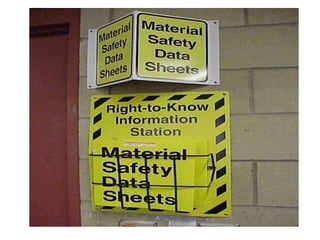
Material Safety Data Sheet A MSDS is a document which discusses all the information of the material related to its Identification, Hazards, Handling/Storage  Requirement, First Aid Measures and Disposal Information.  The document also gives necessary details of the material including its Chemical/Physical Properties and Reactivity
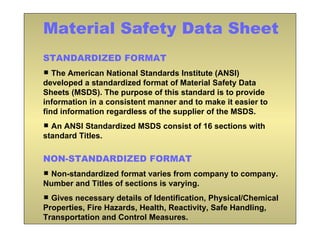
Material Safety Data Sheet STANDARDIZED FORMAT The American National Standards Institute (ANSI) developed a standardized format of Material Safety Data Sheets (MSDS). The purpose of this standard is to provide information in a consistent manner and to make it easier to find information regardless of the supplier of the MSDS.  An ANSI Standardized MSDS consist of 16 sections with standard Titles. NON-STANDARDIZED FORMAT Non-standardized format varies from company to company. Number and Titles of sections is varying.  Gives necessary details of Identification, Physical/Chemical Properties, Fire Hazards, Health, Reactivity, Safe Handling, Transportation and Control Measures.
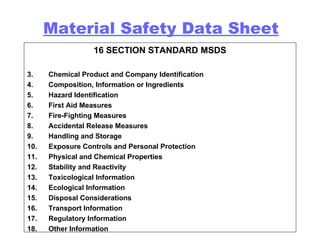
16 SECTION STANDARD MSDS Chemical Product and Company Identification Composition, Information or Ingredients Hazard Identification First Aid Measures Fire-Fighting Measures Accidental Release Measures Handling and Storage Exposure Controls and Personal Protection Physical and Chemical Properties Stability and Reactivity Toxicological Information Ecological Information Disposal Considerations Transport Information Regulatory Information Other Information Material Safety Data Sheet
 
 
Material Safety Data Sheet Section 1: Chemical Product and Company Identification This section links the chemical name on the label to the MSDS. The MSDS also lists the name, address and the phone number of the company, manufacturer or distributor who provides the chemical. Standard
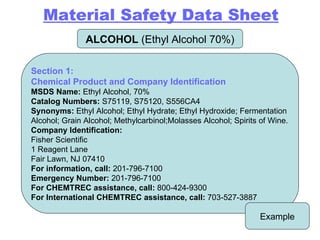
ALCOHOL  (Ethyl Alcohol 70%) Section 1: Chemical Product and Company Identification MSDS Name:  Ethyl Alcohol, 70% Catalog Numbers:  S75119, S75120, S556CA4 Synonyms:  Ethyl Alcohol; Ethyl Hydrate; Ethyl Hydroxide; Fermentation  Alcohol; Grain Alcohol; Methylcarbinol;Molasses Alcohol; Spirits of Wine. Company Identification: Fisher Scientific 1 Reagent Lane Fair Lawn, NJ 07410 For information, call:  201-796-7100 Emergency Number:  201-796-7100 For CHEMTREC assistance, call:  800-424-9300 For International CHEMTREC assistance, call:  703-527-3887 Example Material Safety Data Sheet
Section 2: Composition, Information or Ingredients This section identify all the hazardous ingredients of the material. This section may also include OSHA Permissible Exposure Limits (PELs) and ACGIH (American Conference of Governmental Industrial Hygienists) Threshold Limit Values (TLVs). Material Safety Data Sheet Standard
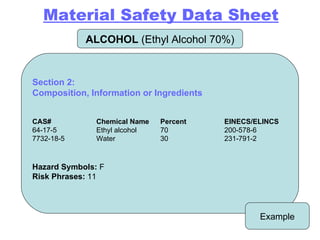
ALCOHOL  (Ethyl Alcohol 70%) Section 2: Composition, Information or Ingredients CAS#  Chemical Name  Percent  EINECS/ELINCS 64-17-5  Ethyl alcohol  70  200-578-6 7732-18-5  Water  30  231-791-2 Hazard Symbols:  F Risk Phrases:  11 Example Material Safety Data Sheet
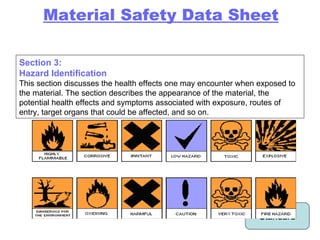
Section 3: Hazard Identification This section discusses the health effects one may encounter when exposed to the material. The section describes the appearance of the material, the potential health effects and symptoms associated with exposure, routes of entry, target organs that could be affected, and so on. Standard Material Safety Data Sheet
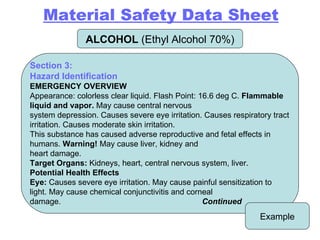
ALCOHOL  (Ethyl Alcohol 70%) Example Section 3: Hazard Identification EMERGENCY OVERVIEW Appearance: colorless clear liquid. Flash Point: 16.6 deg C.  Flammable liquid and vapor.  May cause central nervous system depression. Causes severe eye irritation. Causes respiratory tract irritation. Causes moderate skin irritation. This substance has caused adverse reproductive and fetal effects in humans.  Warning!  May cause liver, kidney and heart damage. Target Organs:  Kidneys, heart, central nervous system, liver. Potential Health Effects Eye:  Causes severe eye irritation. May cause painful sensitization to light. May cause chemical conjunctivitis and corneal damage.  Continued Material Safety Data Sheet
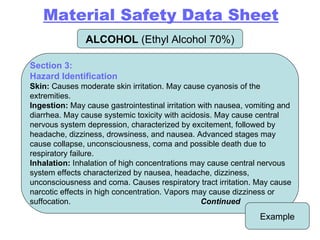
ALCOHOL  (Ethyl Alcohol 70%) Example Section 3: Hazard Identification Skin:  Causes moderate skin irritation. May cause cyanosis of the extremities. Ingestion:  May cause gastrointestinal irritation with nausea, vomiting and diarrhea. May cause systemic toxicity with acidosis. May cause central nervous system depression, characterized by excitement, followed by headache, dizziness, drowsiness, and nausea. Advanced stages may cause collapse, unconsciousness, coma and possible death due to respiratory failure. Inhalation:  Inhalation of high concentrations may cause central nervous system effects characterized by nausea, headache, dizziness, unconsciousness and coma. Causes respiratory tract irritation. May cause narcotic effects in high concentration. Vapors may cause dizziness or suffocation.  Continued Material Safety Data Sheet
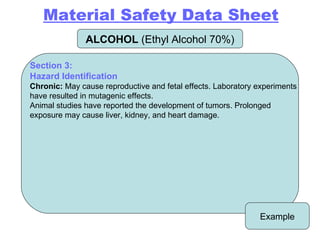
ALCOHOL  (Ethyl Alcohol 70%) Example Section 3: Hazard Identification Chronic:  May cause reproductive and fetal effects. Laboratory experiments have resulted in mutagenic effects.  Animal studies have reported the development of tumors. Prolonged exposure may cause liver, kidney, and heart damage. Material Safety Data Sheet
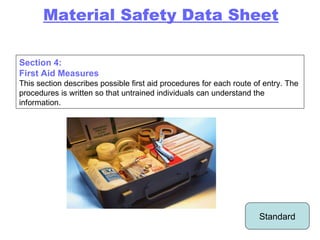
Section 4: First Aid Measures This section describes possible first aid procedures for each route of entry. The procedures is written so that untrained individuals can understand the information. Standard Material Safety Data Sheet
ALCOHOL  (Ethyl Alcohol 70%) Example Section 4: First Aid Measures Eyes:  Immediately flush eyes with plenty of water for at least 15 minutes, occasionally lifting the upper and lower eyelids. Get medical aid. Gently lift eyelids and flush continuously with water. Skin:  Get medical aid. Flush skin with plenty of water for at least 15 minutes while removing contaminated clothing and shoes. Wash clothing before reuse. Flush skin with plenty of soap and water. Ingestion:  Do NOT induce vomiting. If victim is conscious and alert, give 2-4 cupfuls of milk or water. Never give anything by mouth to an unconscious person. Get medical aid. Inhalation:  Remove from exposure and move to fresh air immediately. If not breathing, give artificial respiration. If Continued Material Safety Data Sheet
ALCOHOL  (Ethyl Alcohol 70%) Example Section 4: First Aid Measures breathing is difficult, give oxygen. Get medical aid. Do NOT use mouth-to-mouth resuscitation. Notes to Physician:  Treat symptomatically and supportively. Persons with skin or eye disorders or liver, kidney, chronic respiratory diseases, or central and peripheral nervous system diseases may be at increased risk from exposure to this substance. Antidote:  Replace fluid and electrolytes. Material Safety Data Sheet
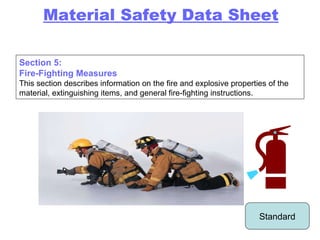
Section 5: Fire-Fighting Measures This section describes information on the fire and explosive properties of the material, extinguishing items, and general fire-fighting instructions. Standard Material Safety Data Sheet
ALCOHOL  (Ethyl Alcohol 70%) Example Section 5: Fire-Fighting Measures General Information:  Containers can build up pressure if exposed to heat and/or fire. As in any fire, wear a self-contained breathing apparatus in pressure-demand, MSHA/NIOSH (approved or equivalent), and full protective gear. Vapors may form an explosive mixture with air. Vapors can travel to a source of ignition and flash back. Will burn if involved in a fire. Flammable Liquid. Can release vapors that form explosive mixtures at temperatures above the flashpoint. Use water spray to keep fire-exposed containers cool. Containers may explode in the heat of a fire. Extinguishing Media:  For small fires, use dry chemical, carbon dioxide, water spray or alcohol-resistant foam. For large fires, use water spray, fog, or alcohol-resistant foam. Use water spray to cool fire-exposed containers. Water may be ineffective. Do NOT use water jet directly. Continued Material Safety Data Sheet
ALCOHOL  (Ethyl Alcohol 70%) Example Section 5: Fire-Fighting Measures Flash Point:  16.6 deg C ( 61.88 deg F) Auto Ignition Temperature:  363 deg C ( 685.40 deg F) Explosion Limits, Lower: 3.3 vol % Upper:  19.0 vol % NFPA Rating:  (estimated) Health: 2; Flammability: 3; Instability: 0 Material Safety Data Sheet
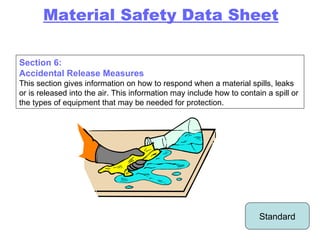
Section 6: Accidental Release Measures This section gives information on how to respond when a material spills, leaks or is released into the air. This information may include how to contain a spill or the types of equipment that may be needed for protection. Standard Material Safety Data Sheet
ALCOHOL  (Ethyl Alcohol 70%) Example Section 6: Accidental Release Measures General Information:  Use proper personal protective equipment as indicated in Section 8. Spills/Leaks:  Absorb spill with inert material (e.g. vermiculite, sand or earth), then place in suitable container. Remove all sources of ignition. Use a spark-proof tool. Provide ventilation. A vapor suppressing foam may be used to reduce vapors. Material Safety Data Sheet
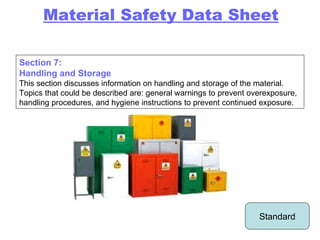
Section 7: Handling and Storage This section discusses information on handling and storage of the material. Topics that could be described are: general warnings to prevent overexposure, handling procedures, and hygiene instructions to prevent continued exposure. Standard Material Safety Data Sheet
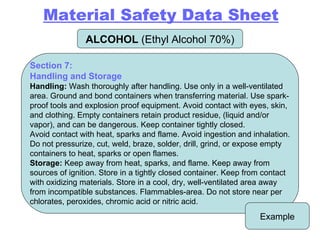
ALCOHOL  (Ethyl Alcohol 70%) Example Section 7: Handling and Storage   Handling:  Wash thoroughly after handling. Use only in a well-ventilated area. Ground and bond containers when transferring material. Use spark-proof tools and explosion proof equipment. Avoid contact with eyes, skin, and clothing. Empty containers retain product residue, (liquid and/or vapor), and can be dangerous. Keep container tightly closed. Avoid contact with heat, sparks and flame. Avoid ingestion and inhalation. Do not pressurize, cut, weld, braze, solder, drill, grind, or expose empty containers to heat, sparks or open flames. Storage:  Keep away from heat, sparks, and flame. Keep away from sources of ignition. Store in a tightly closed container. Keep from contact with oxidizing materials. Store in a cool, dry, well-ventilated area away from incompatible substances. Flammables-area. Do not store near per chlorates, peroxides, chromic acid or nitric acid. Material Safety Data Sheet
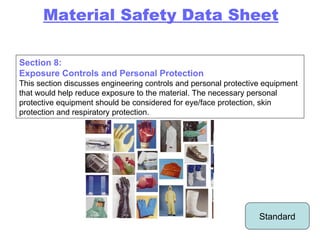
Section 8: Exposure Controls and Personal Protection This section discusses engineering controls and personal protective equipment that would help reduce exposure to the material. The necessary personal protective equipment should be considered for eye/face protection, skin protection and respiratory protection. Standard Material Safety Data Sheet
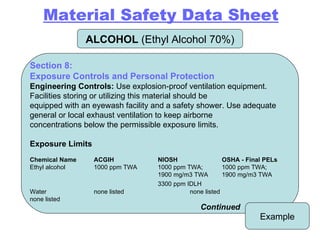
ALCOHOL  (Ethyl Alcohol 70%) Example Section 8: Exposure Controls and Personal Protection Engineering Controls:  Use explosion-proof ventilation equipment. Facilities storing or utilizing this material should be equipped with an eyewash facility and a safety shower. Use adequate general or local exhaust ventilation to keep airborne concentrations below the permissible exposure limits. Exposure Limits Chemical Name  ACGIH  NIOSH  OSHA - Final PELs Ethyl alcohol  1000 ppm TWA  1000 ppm TWA;  1000 ppm TWA;  1900 mg/m3 TWA  1900 mg/m3 TWA  3300 ppm IDLH   Water  none listed  none listed  none listed Continued Material Safety Data Sheet
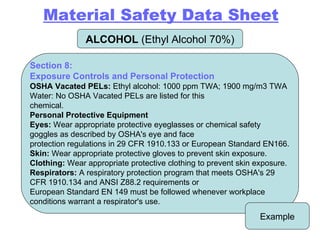
ALCOHOL  (Ethyl Alcohol 70%) Example Section 8: Exposure Controls and Personal Protection OSHA Vacated PELs:  Ethyl alcohol: 1000 ppm TWA; 1900 mg/m3 TWA Water: No OSHA Vacated PELs are listed for this chemical. Personal Protective Equipment Eyes:  Wear appropriate protective eyeglasses or chemical safety goggles as described by OSHA's eye and face protection regulations in 29 CFR 1910.133 or European Standard EN166. Skin:  Wear appropriate protective gloves to prevent skin exposure. Clothing:  Wear appropriate protective clothing to prevent skin exposure. Respirators:  A respiratory protection program that meets OSHA's 29 CFR 1910.134 and ANSI Z88.2 requirements or European Standard EN 149 must be followed whenever workplace conditions warrant a respirator's use. Material Safety Data Sheet
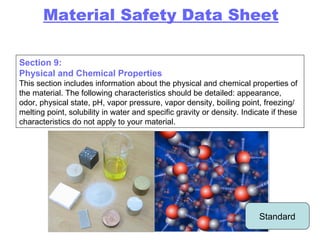
Section 9: Physical and Chemical Properties This section includes information about the physical and chemical properties of the material. The following characteristics should be detailed: appearance, odor, physical state, pH, vapor pressure, vapor density, boiling point, freezing/melting point, solubility in water and specific gravity or density. Indicate if these characteristics do not apply to your material. Material Safety Data Sheet Standard
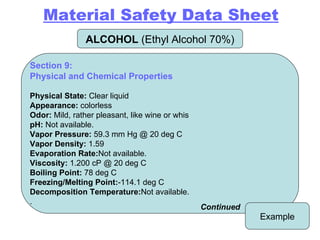
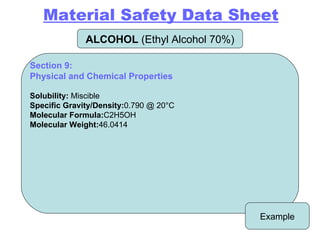
ALCOHOL  (Ethyl Alcohol 70%) Example Section 9: Physical and Chemical Properties Physical State:  Clear liquid Appearance:  colorless Odor:  Mild, rather pleasant, like wine or whis pH:  Not available. Vapor Pressure:  59.3 mm Hg @ 20 deg C Vapor Density:  1.59 Evaporation Rate: Not available. Viscosity:  1.200 cP @ 20 deg C Boiling Point:  78 deg C Freezing/Melting Point: -114.1 deg C Decomposition Temperature: Not available. . Continued Material Safety Data Sheet
ALCOHOL  (Ethyl Alcohol 70%) Example Section 9: Physical and Chemical Properties Solubility:  Miscible  Specific Gravity/Density: 0.790 @ 20°C Molecular Formula: C2H5OH Molecular Weight: 46.0414 Material Safety Data Sheet
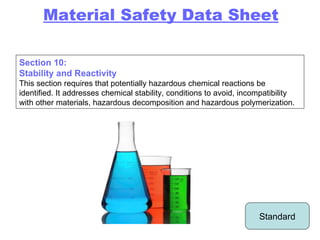
Standard Material Safety Data Sheet Section 10: Stability and Reactivity This section requires that potentially hazardous chemical reactions be identified. It addresses chemical stability, conditions to avoid, incompatibility with other materials, hazardous decomposition and hazardous polymerization.
ALCOHOL  (Ethyl Alcohol 70%) Example Section 10: Stability and Reactivity Chemical Stability:  Stable under normal temperatures and pressures. Conditions to Avoid:  Incompatible materials, ignition sources, excess heat, oxidizers. Incompatibilities with Other Materials:  Strong oxidizing agents, acids, alkali metals, ammonia, hydrazine, peroxides, sodium, acid anhydrides, calcium hypochlorite, chromyl chloride, nitrosyl perchlorate, bromine pentafluoride, perchloric acid, silver nitrate, mercuric nitrate, potassium-tert-butoxide, magnesium perchlorate, acid chlorides, platinum, uranium hexafluoride, silver oxide, iodine heptafluoride, acetyl bromide, disulfuryl difluoride, tetrachlorosilane + water, acetyl chloride, permanganic acid, ruthenium (VIII) oxide, uranyl perchlorate, potassium dioxide. Continued Material Safety Data Sheet
ALCOHOL  (Ethyl Alcohol 70%) Example Section 10: Stability and Reactivity Hazardous Decomposition Products:  Carbon monoxide, irritating and toxic fumes and gases, carbon dioxide. Hazardous Polymerization:  Will not occur. . Material Safety Data Sheet
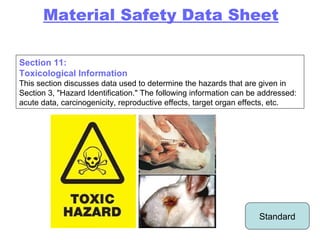
Section 11: Toxicological Information This section discusses data used to determine the hazards that are given in Section 3, "Hazard Identification." The following information can be addressed: acute data, carcinogenicity, reproductive effects, target organ effects, etc. Standard Material Safety Data Sheet
ALCOHOL  (Ethyl Alcohol 70%) Example Section 11: Toxicological Information RTECS#:CAS#  64-17-5: KQ6300000 LD50/LC50: Draize test, rabbit, eye: 500 mg Severe; Draize test, rabbit, eye: 500 mg/24H Mild; Draize test, rabbit, skin: 20 mg/24H Moderate; Inhalation, mouse: LC50 = 39 gm/m3/4H; Inhalation, rat: LC50 = 20000 ppm/10H; Oral, mouse: LD50 = 3450 mg/kg; Oral, rabbit: LD50 = 6300 mg/kg; Oral, rat: LD50 = 9000 mg/kg; Oral, rat: LD50 = 7060 mg/kg; CAS# 7732-18-5: Oral, rat: LD50 = >90 mL/kg; Continued Material Safety Data Sheet
ALCOHOL  (Ethyl Alcohol 70%) Example Section 11: Toxicological Information Carcinogenicity: CAS# 64-17-5: ACGIH:  A4 - Not Classifiable as a Human Carcinogen CAS# 7732-18-5: Not listed by ACGIH, IARC, NIOSH, NTP, or OSHA. Epidemiology:  Ethanol has been shown to produce fetotoxicity in the embry o or fetus of laboratory animals. Prenatal exposure to ethanol is associated with a distinct pattern of co ngenital malformations that have collecetively been termed the "fetal alcohol syndrome". Continued Material Safety Data Sheet
ALCOHOL  (Ethyl Alcohol 70%) Example Section 11: Toxicological Information Teratogenicity:  Oral, Human - woman: TDLo = 41 gm/kg (female 41 week(s) after conception) Effects on Newborn - Apgar score (human only) and Effects on Newborn - other neonatal measures or effects and Effects on Newborn - drug dependence. Reproductive Effects:  Intrauterine, Human - woman: TDLo = 200 mg/kg (female 5 day(s) pre-mating) Fertility - female fertility index (e.g. # females pregnant per # sperm positive females; # females pregnant per # females mated). Neurotoxicity:  No information available. Mutagenicity:  DNA Inhibition: Human, Lymphocyte = 220 mmol/L.; Cytogenetic Analysis: Human, Lymphocyte = 1160 Continued Material Safety Data Sheet
ALCOHOL  (Ethyl Alcohol 70%) Example Section 11: Toxicological Information Cytogenetic Analysis: Human, Fibroblast = 12000 ppm.; Cytogenetic Analysis: Human, Leukocyte = 1 pph/72H (Continuous).; Sister Chromatid Exchange: Human, Lymphocyte = 500 ppm/72H (Continuous). Other Studies:  Standard Draize Test(Skin, rabbit) = 20 mg/24H (Moderate) S tandard Draize Test: Administration into the eye (rabbit) = 500 mg (Severe). Material Safety Data Sheet
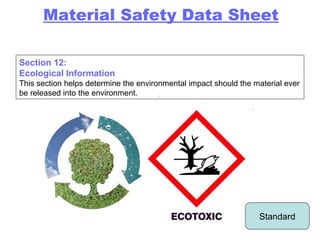
Material Safety Data Sheet Section 12: Ecological Information This section helps determine the environmental impact should the material ever be released into the environment. Standard
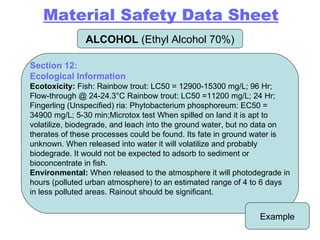
ALCOHOL  (Ethyl Alcohol 70%) Example Section 12: Ecological Information   Ecotoxicity:  Fish: Rainbow trout: LC50 = 12900-15300 mg/L; 96 Hr; Flow-through @ 24-24.3°C Rainbow trout: LC50 =11200 mg/L; 24 Hr; Fingerling (Unspecified) ria: Phytobacterium phosphoreum: EC50 = 34900 mg/L; 5-30 min;Microtox test When spilled on land it is apt to volatilize, biodegrade, and leach into the ground water, but no data on therates of these processes could be found. Its fate in ground water is unknown. When released into water it will volatilize and probably biodegrade. It would not be expected to adsorb to sediment or bioconcentrate in fish. Environmental:  When released to the atmosphere it will photodegrade in hours (polluted urban atmosphere) to an estimated range of 4 to 6 days in less polluted areas. Rainout should be significant. Material Safety Data Sheet
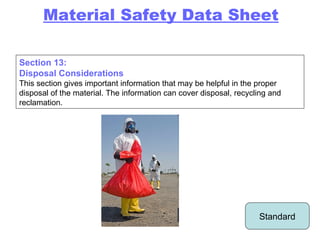
Section 13: Disposal Considerations This section gives important information that may be helpful in the proper disposal of the material. The information can cover disposal, recycling and reclamation. Standard Material Safety Data Sheet
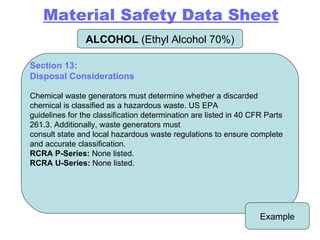
ALCOHOL  (Ethyl Alcohol 70%) Example Section 13: Disposal Considerations   Chemical waste generators must determine whether a discarded chemical is classified as a hazardous waste. US EPA guidelines for the classification determination are listed in 40 CFR Parts 261.3. Additionally, waste generators must consult state and local hazardous waste regulations to ensure complete and accurate classification. RCRA P-Series:  None listed. RCRA U-Series:  None listed. Material Safety Data Sheet
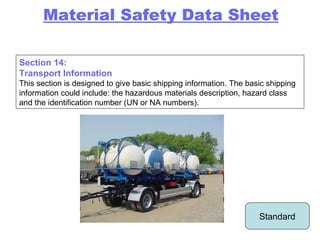
Section 14: Transport Information This section is designed to give basic shipping information. The basic shipping information could include: the hazardous materials description, hazard class and the identification number (UN or NA numbers). Standard Material Safety Data Sheet
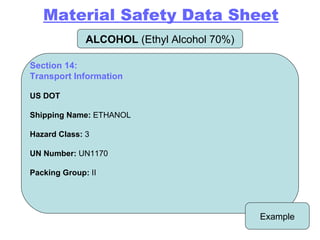
ALCOHOL  (Ethyl Alcohol 70%) Example Section 14: Transport Information US DOT  Shipping Name:  ETHANOL  Hazard Class:  3 UN Number:  UN1170 Packing Group:  II Material Safety Data Sheet
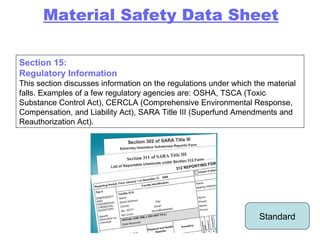
Section 15: Regulatory Information This section discusses information on the regulations under which the material falls. Examples of a few regulatory agencies are: OSHA, TSCA (Toxic Substance Control Act), CERCLA (Comprehensive Environmental Response, Compensation, and Liability Act), SARA Title III (Superfund Amendments and Reauthorization Act). Standard Material Safety Data Sheet
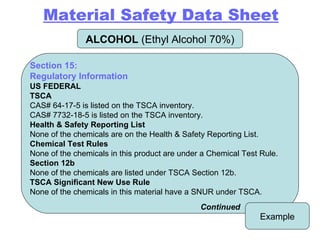
ALCOHOL  (Ethyl Alcohol 70%) Example Section 15: Regulatory Information US FEDERAL TSCA CAS# 64-17-5 is listed on the TSCA inventory. CAS# 7732-18-5 is listed on the TSCA inventory. Health & Safety Reporting List None of the chemicals are on the Health & Safety Reporting List. Chemical Test Rules None of the chemicals in this product are under a Chemical Test Rule. Section 12b None of the chemicals are listed under TSCA Section 12b. TSCA Significant New Use Rule None of the chemicals in this material have a SNUR under TSCA. Continued Material Safety Data Sheet
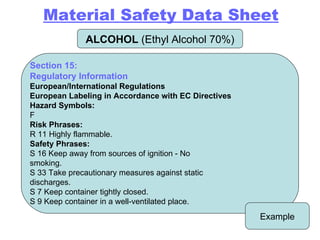
ALCOHOL  (Ethyl Alcohol 70%) Example Section 15: Regulatory Information European/International Regulations European Labeling in Accordance with EC Directives Hazard Symbols: F Risk Phrases: R 11 Highly flammable. Safety Phrases: S 16 Keep away from sources of ignition - No smoking. S 33 Take precautionary measures against static discharges. S 7 Keep container tightly closed. S 9 Keep container in a well-ventilated place. Material Safety Data Sheet
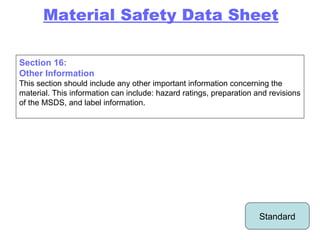
Section 16: Other Information This section should include any other important information concerning the material. This information can include: hazard ratings, preparation and revisions of the MSDS, and label information.  Standard Material Safety Data Sheet
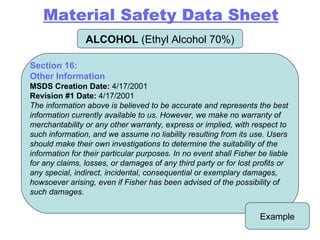
ALCOHOL  (Ethyl Alcohol 70%) Example Section 16: Other Information MSDS Creation Date:  4/17/2001 Revision #1 Date:  4/17/2001 The information above is believed to be accurate and represents the best information currently available to us. However, we make no warranty of merchantability or any other warranty, express or implied, with respect to such information, and we assume no liability resulting from its use. Users should make their own investigations to determine the suitability of the information for their particular purposes. In no event shall Fisher be liable for any claims, losses, or damages of any third party or for lost profits or any special, indirect, incidental, consequential or exemplary damages, howsoever arising, even if Fisher has been advised of the possibility of such damages. Material Safety Data Sheet
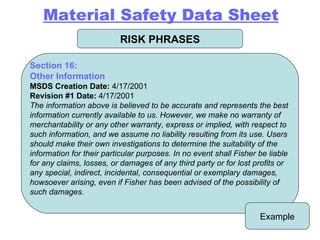
RISK PHRASES Example Section 16: Other Information MSDS Creation Date:  4/17/2001 Revision #1 Date:  4/17/2001 The information above is believed to be accurate and represents the best information currently available to us. However, we make no warranty of merchantability or any other warranty, express or implied, with respect to such information, and we assume no liability resulting from its use. Users should make their own investigations to determine the suitability of the information for their particular purposes. In no event shall Fisher be liable for any claims, losses, or damages of any third party or for lost profits or any special, indirect, incidental, consequential or exemplary damages, howsoever arising, even if Fisher has been advised of the possibility of such damages. Material Safety Data Sheet
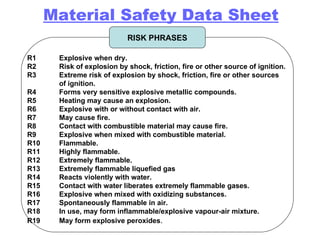
R1  Explosive when dry.  R2  Risk of explosion by shock, friction, fire or other source of ignition.  R3  Extreme risk of explosion by shock, friction, fire or other sources  of ignition.  R4  Forms very sensitive explosive metallic compounds.  R5  Heating may cause an explosion.  R6  Explosive with or without contact with air.  R7  May cause fire.  R8  Contact with combustible material may cause fire.  R9  Explosive when mixed with combustible material.  R10  Flammable.  R11  Highly flammable.  R12  Extremely flammable.  R13  Extremely flammable liquefied gas  R14  Reacts violently with water.  R15  Contact with water liberates extremely flammable gases.  R16  Explosive when mixed with oxidizing substances.  R17  Spontaneously flammable in air.  R18  In use, may form inflammable/explosive vapour-air mixture.  R19  May form explosive peroxides .  Material Safety Data Sheet RISK PHRASES
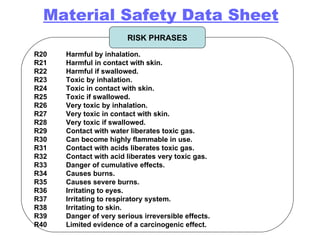
R20  Harmful by inhalation.  R21  Harmful in contact with skin.  R22  Harmful if swallowed.  R23  Toxic by inhalation.  R24  Toxic in contact with skin.  R25  Toxic if swallowed.  R26  Very toxic by inhalation.  R27  Very toxic in contact with skin.  R28  Very toxic if swallowed.  R29  Contact with water liberates toxic gas.  R30  Can become highly flammable in use.  R31  Contact with acids liberates toxic gas.  R32  Contact with acid liberates very toxic gas.  R33  Danger of cumulative effects.  R34  Causes burns.  R35  Causes severe burns.  R36  Irritating to eyes.  R37  Irritating to respiratory system.  R38  Irritating to skin.  R39 Danger of very serious irreversible effects.  R40  Limited evidence of a carcinogenic effect.   RISK PHRASES Material Safety Data Sheet
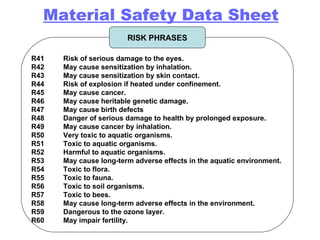
R41 Risk of serious damage to the eyes.  R42  May cause sensitization by inhalation.  R43  May cause sensitization by skin contact.  R44  Risk of explosion if heated under confinement.  R45  May cause cancer.  R46  May cause heritable genetic damage.  R47  May cause birth defects  R48  Danger of serious damage to health by prolonged exposure.  R49  May cause cancer by inhalation.  R50  Very toxic to aquatic organisms.  R51  Toxic to aquatic organisms.  R52  Harmful to aquatic organisms.  R53  May cause long-term adverse effects in the aquatic environment.  R54  Toxic to flora.  R55  Toxic to fauna.  R56  Toxic to soil organisms.  R57  Toxic to bees.  R58  May cause long-term adverse effects in the environment.  R59  Dangerous to the ozone layer.  R60  May impair fertility.  RISK PHRASES Material Safety Data Sheet
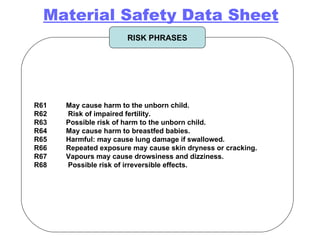
R61  May cause harm to the unborn child.  R62  Risk of impaired fertility.  R63  Possible risk of harm to the unborn child.  R64  May cause harm to breastfed babies.  R65  Harmful: may cause lung damage if swallowed.  R66  Repeated exposure may cause skin dryness or cracking.  R67  Vapours may cause drowsiness and dizziness.  R68  Possible risk of irreversible effects.   RISK PHRASES Material Safety Data Sheet
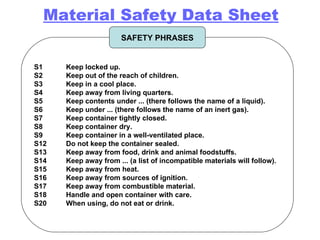
S1  Keep locked up.  S2  Keep out of the reach of children.  S3  Keep in a cool place.  S4  Keep away from living quarters.  S5  Keep contents under ... (there follows the name of a liquid).  S6  Keep under ... (there follows the name of an inert gas).  S7  Keep container tightly closed.  S8  Keep container dry.  S9  Keep container in a well-ventilated place.  S12  Do not keep the container sealed.  S13  Keep away from food, drink and animal foodstuffs.  S14  Keep away from ... (a list of incompatible materials will follow).  S15  Keep away from heat.  S16  Keep away from sources of ignition.  S17  Keep away from combustible material.  S18  Handle and open container with care.  S20  When using, do not eat or drink.   SAFETY PHRASES Material Safety Data Sheet
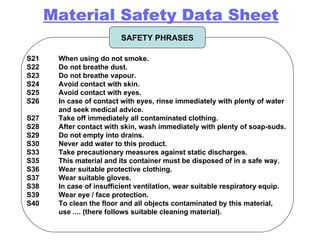
S21  When using do not smoke.  S22  Do not breathe dust.  S23  Do not breathe vapour.  S24  Avoid contact with skin.  S25  Avoid contact with eyes.  S26  In case of contact with eyes, rinse immediately with plenty of water  and seek medical advice.  S27  Take off immediately all contaminated clothing.  S28  After contact with skin, wash immediately with plenty of soap-suds.  S29  Do not empty into drains.  S30  Never add water to this product.  S33  Take precautionary measures against static discharges.  S35  This material and its container must be disposed of in a safe way.  S36 Wear suitable protective clothing.  S37  Wear suitable gloves.  S38  In case of insufficient ventilation, wear suitable respiratory equip.  S39  Wear eye / face protection.  S40  To clean the floor and all objects contaminated by this material,  use .... (there follows suitable cleaning material).   SAFETY PHRASES Material Safety Data Sheet
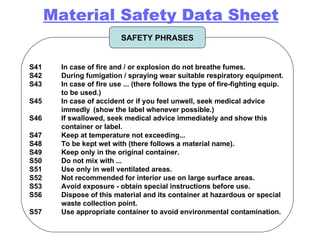
S41  In case of fire and / or explosion do not breathe fumes.  S42 During fumigation / spraying wear suitable respiratory equipment.  S43  In case of fire use ... (there follows the type of fire-fighting equip. to be used.)  S45  In case of accident or if you feel unwell, seek medical advice immedly (show the label whenever possible.)  S46  If swallowed, seek medical advice immediately and show this  container or label.  S47  Keep at temperature not exceeding...  S48  To be kept wet with (there follows a material name).  S49  Keep only in the original container.  S50  Do not mix with ...  S51  Use only in well ventilated areas.  S52  Not recommended for interior use on large surface areas.  S53  Avoid exposure - obtain special instructions before use.  S56  Dispose of this material and its container at hazardous or special  waste collection point.  S57  Use appropriate container to avoid environmental contamination.  SAFETY PHRASES Material Safety Data Sheet
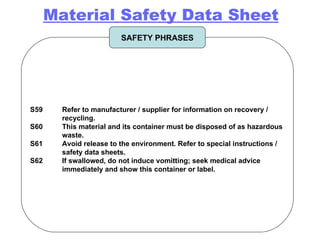
S59  Refer to manufacturer / supplier for information on recovery /  recycling.  S60  This material and its container must be disposed of as hazardous  waste.  S61  Avoid release to the environment. Refer to special instructions /  safety data sheets.  S62  If swallowed, do not induce vomitting; seek medical advice  immediately and show this container or label.   SAFETY PHRASES Material Safety Data Sheet
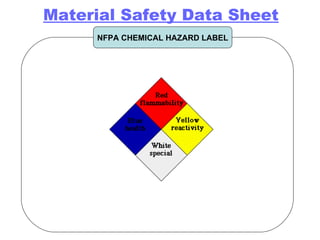
NFPA CHEMICAL HAZARD LABEL Material Safety Data Sheet
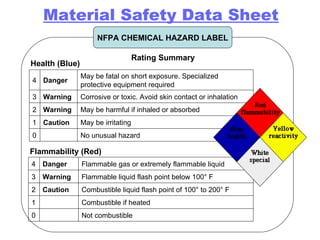
NFPA CHEMICAL HAZARD LABEL Material Safety Data Sheet Health (Blue)   Flammability (Red)   Rating Summary 4 Danger May be fatal on short exposure. Specialized protective equipment required 3 Warning Corrosive or toxic. Avoid skin contact or inhalation 2 Warning May be harmful if inhaled or absorbed 1 Caution May be irritating 0 No unusual hazard 4 Danger Flammable gas or extremely flammable liquid 3 Warning Flammable liquid flash point below 100° F 2 Caution Combustible liquid flash point of 100° to 200° F 1 Combustible if heated 0 Not combustible
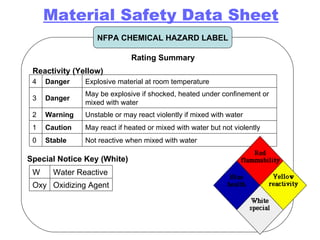
NFPA CHEMICAL HAZARD LABEL Material Safety Data Sheet Rating Summary Reactivity (Yellow)   Special Notice Key (White)   4 Danger Explosive material at room temperature 3 Danger May be explosive if shocked, heated under confinement or mixed with water 2 Warning Unstable or may react violently if mixed with water 1 Caution May react if heated or mixed with water but not violently 0 Stable Not reactive when mixed with water W Water Reactive Oxy Oxidizing Agent
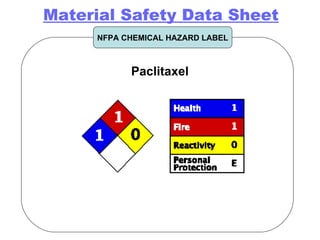
NFPA CHEMICAL HAZARD LABEL Material Safety Data Sheet Paclitaxel
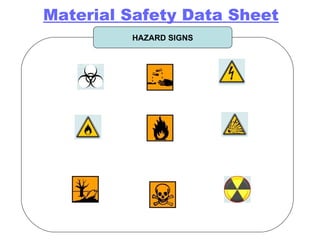
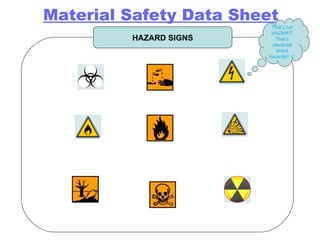
HAZARD SIGNS Material Safety Data Sheet
HAZARD SIGNS Material Safety Data Sheet That’s not HAZMAT! That’s electrical shock hazards!!  
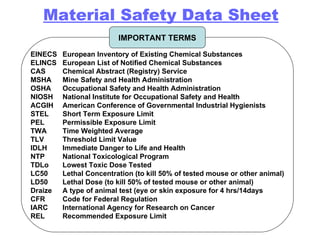
EINECS European Inventory of Existing Chemical Substances ELINCS European List of Notified Chemical Substances CAS Chemical Abstract (Registry) Service MSHA Mine Safety and Health Administration OSHA Occupational Safety and Health Administration NIOSH National Institute for Occupational Safety and Health ACGIH American Conference of Governmental Industrial Hygienists STEL Short Term Exposure Limit PEL Permissible Exposure Limit TWA Time Weighted Average TLV Threshold Limit Value IDLH Immediate Danger to Life and Health NTP National Toxicological Program TDLo Lowest Toxic Dose Tested LC50 Lethal Concentration (to kill 50% of tested mouse or other animal) LD50 Lethal Dose (to kill 50% of tested mouse or other animal) Draize  A type of animal test (eye or skin exposure for 4 hrs/14days CFR Code for Federal Regulation IARC International Agency for Research on Cancer REL Recommended Exposure Limit IMPORTANT TERMS Material Safety Data Sheet
Thank You Material Safety Data Sheet Health, Safety  & Environment Office  By:  Nadeem Baig HSE OFFICER ZAYED MILITARY HOSPITAL ABU DHABI – U.A.E. If you have any queries, please contact  Email:  [email_address] LinkedIn:  http://ae.linkedin.com/pub/nadeem-baig/14/68a/515

Consulting MSDS

  • 1.
  • 2.
  • 3.
    Material Safety DataSheet A MSDS is a document which discusses all the information of the material related to its Identification, Hazards, Handling/Storage Requirement, First Aid Measures and Disposal Information. The document also gives necessary details of the material including its Chemical/Physical Properties and Reactivity
  • 4.
    Material Safety DataSheet STANDARDIZED FORMAT The American National Standards Institute (ANSI) developed a standardized format of Material Safety Data Sheets (MSDS). The purpose of this standard is to provide information in a consistent manner and to make it easier to find information regardless of the supplier of the MSDS. An ANSI Standardized MSDS consist of 16 sections with standard Titles. NON-STANDARDIZED FORMAT Non-standardized format varies from company to company. Number and Titles of sections is varying. Gives necessary details of Identification, Physical/Chemical Properties, Fire Hazards, Health, Reactivity, Safe Handling, Transportation and Control Measures.
  • 5.
    16 SECTION STANDARDMSDS Chemical Product and Company Identification Composition, Information or Ingredients Hazard Identification First Aid Measures Fire-Fighting Measures Accidental Release Measures Handling and Storage Exposure Controls and Personal Protection Physical and Chemical Properties Stability and Reactivity Toxicological Information Ecological Information Disposal Considerations Transport Information Regulatory Information Other Information Material Safety Data Sheet
  • 6.
  • 7.
  • 8.
    Material Safety DataSheet Section 1: Chemical Product and Company Identification This section links the chemical name on the label to the MSDS. The MSDS also lists the name, address and the phone number of the company, manufacturer or distributor who provides the chemical. Standard
  • 9.
    ALCOHOL (EthylAlcohol 70%) Section 1: Chemical Product and Company Identification MSDS Name: Ethyl Alcohol, 70% Catalog Numbers: S75119, S75120, S556CA4 Synonyms: Ethyl Alcohol; Ethyl Hydrate; Ethyl Hydroxide; Fermentation Alcohol; Grain Alcohol; Methylcarbinol;Molasses Alcohol; Spirits of Wine. Company Identification: Fisher Scientific 1 Reagent Lane Fair Lawn, NJ 07410 For information, call: 201-796-7100 Emergency Number: 201-796-7100 For CHEMTREC assistance, call: 800-424-9300 For International CHEMTREC assistance, call: 703-527-3887 Example Material Safety Data Sheet
  • 10.
    Section 2: Composition,Information or Ingredients This section identify all the hazardous ingredients of the material. This section may also include OSHA Permissible Exposure Limits (PELs) and ACGIH (American Conference of Governmental Industrial Hygienists) Threshold Limit Values (TLVs). Material Safety Data Sheet Standard
  • 11.
    ALCOHOL (EthylAlcohol 70%) Section 2: Composition, Information or Ingredients CAS# Chemical Name Percent EINECS/ELINCS 64-17-5 Ethyl alcohol 70 200-578-6 7732-18-5 Water 30 231-791-2 Hazard Symbols: F Risk Phrases: 11 Example Material Safety Data Sheet
  • 12.
    Section 3: HazardIdentification This section discusses the health effects one may encounter when exposed to the material. The section describes the appearance of the material, the potential health effects and symptoms associated with exposure, routes of entry, target organs that could be affected, and so on. Standard Material Safety Data Sheet
  • 13.
    ALCOHOL (EthylAlcohol 70%) Example Section 3: Hazard Identification EMERGENCY OVERVIEW Appearance: colorless clear liquid. Flash Point: 16.6 deg C. Flammable liquid and vapor. May cause central nervous system depression. Causes severe eye irritation. Causes respiratory tract irritation. Causes moderate skin irritation. This substance has caused adverse reproductive and fetal effects in humans. Warning! May cause liver, kidney and heart damage. Target Organs: Kidneys, heart, central nervous system, liver. Potential Health Effects Eye: Causes severe eye irritation. May cause painful sensitization to light. May cause chemical conjunctivitis and corneal damage. Continued Material Safety Data Sheet
  • 14.
    ALCOHOL (EthylAlcohol 70%) Example Section 3: Hazard Identification Skin: Causes moderate skin irritation. May cause cyanosis of the extremities. Ingestion: May cause gastrointestinal irritation with nausea, vomiting and diarrhea. May cause systemic toxicity with acidosis. May cause central nervous system depression, characterized by excitement, followed by headache, dizziness, drowsiness, and nausea. Advanced stages may cause collapse, unconsciousness, coma and possible death due to respiratory failure. Inhalation: Inhalation of high concentrations may cause central nervous system effects characterized by nausea, headache, dizziness, unconsciousness and coma. Causes respiratory tract irritation. May cause narcotic effects in high concentration. Vapors may cause dizziness or suffocation. Continued Material Safety Data Sheet
  • 15.
    ALCOHOL (EthylAlcohol 70%) Example Section 3: Hazard Identification Chronic: May cause reproductive and fetal effects. Laboratory experiments have resulted in mutagenic effects. Animal studies have reported the development of tumors. Prolonged exposure may cause liver, kidney, and heart damage. Material Safety Data Sheet
  • 16.
    Section 4: FirstAid Measures This section describes possible first aid procedures for each route of entry. The procedures is written so that untrained individuals can understand the information. Standard Material Safety Data Sheet
  • 17.
    ALCOHOL (EthylAlcohol 70%) Example Section 4: First Aid Measures Eyes: Immediately flush eyes with plenty of water for at least 15 minutes, occasionally lifting the upper and lower eyelids. Get medical aid. Gently lift eyelids and flush continuously with water. Skin: Get medical aid. Flush skin with plenty of water for at least 15 minutes while removing contaminated clothing and shoes. Wash clothing before reuse. Flush skin with plenty of soap and water. Ingestion: Do NOT induce vomiting. If victim is conscious and alert, give 2-4 cupfuls of milk or water. Never give anything by mouth to an unconscious person. Get medical aid. Inhalation: Remove from exposure and move to fresh air immediately. If not breathing, give artificial respiration. If Continued Material Safety Data Sheet
  • 18.
    ALCOHOL (EthylAlcohol 70%) Example Section 4: First Aid Measures breathing is difficult, give oxygen. Get medical aid. Do NOT use mouth-to-mouth resuscitation. Notes to Physician: Treat symptomatically and supportively. Persons with skin or eye disorders or liver, kidney, chronic respiratory diseases, or central and peripheral nervous system diseases may be at increased risk from exposure to this substance. Antidote: Replace fluid and electrolytes. Material Safety Data Sheet
  • 19.
    Section 5: Fire-FightingMeasures This section describes information on the fire and explosive properties of the material, extinguishing items, and general fire-fighting instructions. Standard Material Safety Data Sheet
  • 20.
    ALCOHOL (EthylAlcohol 70%) Example Section 5: Fire-Fighting Measures General Information: Containers can build up pressure if exposed to heat and/or fire. As in any fire, wear a self-contained breathing apparatus in pressure-demand, MSHA/NIOSH (approved or equivalent), and full protective gear. Vapors may form an explosive mixture with air. Vapors can travel to a source of ignition and flash back. Will burn if involved in a fire. Flammable Liquid. Can release vapors that form explosive mixtures at temperatures above the flashpoint. Use water spray to keep fire-exposed containers cool. Containers may explode in the heat of a fire. Extinguishing Media: For small fires, use dry chemical, carbon dioxide, water spray or alcohol-resistant foam. For large fires, use water spray, fog, or alcohol-resistant foam. Use water spray to cool fire-exposed containers. Water may be ineffective. Do NOT use water jet directly. Continued Material Safety Data Sheet
  • 21.
    ALCOHOL (EthylAlcohol 70%) Example Section 5: Fire-Fighting Measures Flash Point: 16.6 deg C ( 61.88 deg F) Auto Ignition Temperature: 363 deg C ( 685.40 deg F) Explosion Limits, Lower: 3.3 vol % Upper: 19.0 vol % NFPA Rating: (estimated) Health: 2; Flammability: 3; Instability: 0 Material Safety Data Sheet
  • 22.
    Section 6: AccidentalRelease Measures This section gives information on how to respond when a material spills, leaks or is released into the air. This information may include how to contain a spill or the types of equipment that may be needed for protection. Standard Material Safety Data Sheet
  • 23.
    ALCOHOL (EthylAlcohol 70%) Example Section 6: Accidental Release Measures General Information: Use proper personal protective equipment as indicated in Section 8. Spills/Leaks: Absorb spill with inert material (e.g. vermiculite, sand or earth), then place in suitable container. Remove all sources of ignition. Use a spark-proof tool. Provide ventilation. A vapor suppressing foam may be used to reduce vapors. Material Safety Data Sheet
  • 24.
    Section 7: Handlingand Storage This section discusses information on handling and storage of the material. Topics that could be described are: general warnings to prevent overexposure, handling procedures, and hygiene instructions to prevent continued exposure. Standard Material Safety Data Sheet
  • 25.
    ALCOHOL (EthylAlcohol 70%) Example Section 7: Handling and Storage Handling: Wash thoroughly after handling. Use only in a well-ventilated area. Ground and bond containers when transferring material. Use spark-proof tools and explosion proof equipment. Avoid contact with eyes, skin, and clothing. Empty containers retain product residue, (liquid and/or vapor), and can be dangerous. Keep container tightly closed. Avoid contact with heat, sparks and flame. Avoid ingestion and inhalation. Do not pressurize, cut, weld, braze, solder, drill, grind, or expose empty containers to heat, sparks or open flames. Storage: Keep away from heat, sparks, and flame. Keep away from sources of ignition. Store in a tightly closed container. Keep from contact with oxidizing materials. Store in a cool, dry, well-ventilated area away from incompatible substances. Flammables-area. Do not store near per chlorates, peroxides, chromic acid or nitric acid. Material Safety Data Sheet
  • 26.
    Section 8: ExposureControls and Personal Protection This section discusses engineering controls and personal protective equipment that would help reduce exposure to the material. The necessary personal protective equipment should be considered for eye/face protection, skin protection and respiratory protection. Standard Material Safety Data Sheet
  • 27.
    ALCOHOL (EthylAlcohol 70%) Example Section 8: Exposure Controls and Personal Protection Engineering Controls: Use explosion-proof ventilation equipment. Facilities storing or utilizing this material should be equipped with an eyewash facility and a safety shower. Use adequate general or local exhaust ventilation to keep airborne concentrations below the permissible exposure limits. Exposure Limits Chemical Name ACGIH NIOSH OSHA - Final PELs Ethyl alcohol 1000 ppm TWA 1000 ppm TWA; 1000 ppm TWA; 1900 mg/m3 TWA 1900 mg/m3 TWA 3300 ppm IDLH Water none listed none listed none listed Continued Material Safety Data Sheet
  • 28.
    ALCOHOL (EthylAlcohol 70%) Example Section 8: Exposure Controls and Personal Protection OSHA Vacated PELs: Ethyl alcohol: 1000 ppm TWA; 1900 mg/m3 TWA Water: No OSHA Vacated PELs are listed for this chemical. Personal Protective Equipment Eyes: Wear appropriate protective eyeglasses or chemical safety goggles as described by OSHA's eye and face protection regulations in 29 CFR 1910.133 or European Standard EN166. Skin: Wear appropriate protective gloves to prevent skin exposure. Clothing: Wear appropriate protective clothing to prevent skin exposure. Respirators: A respiratory protection program that meets OSHA's 29 CFR 1910.134 and ANSI Z88.2 requirements or European Standard EN 149 must be followed whenever workplace conditions warrant a respirator's use. Material Safety Data Sheet
  • 29.
    Section 9: Physicaland Chemical Properties This section includes information about the physical and chemical properties of the material. The following characteristics should be detailed: appearance, odor, physical state, pH, vapor pressure, vapor density, boiling point, freezing/melting point, solubility in water and specific gravity or density. Indicate if these characteristics do not apply to your material. Material Safety Data Sheet Standard
  • 30.
    ALCOHOL (EthylAlcohol 70%) Example Section 9: Physical and Chemical Properties Physical State: Clear liquid Appearance: colorless Odor: Mild, rather pleasant, like wine or whis pH: Not available. Vapor Pressure: 59.3 mm Hg @ 20 deg C Vapor Density: 1.59 Evaporation Rate: Not available. Viscosity: 1.200 cP @ 20 deg C Boiling Point: 78 deg C Freezing/Melting Point: -114.1 deg C Decomposition Temperature: Not available. . Continued Material Safety Data Sheet
  • 31.
    ALCOHOL (EthylAlcohol 70%) Example Section 9: Physical and Chemical Properties Solubility: Miscible Specific Gravity/Density: 0.790 @ 20°C Molecular Formula: C2H5OH Molecular Weight: 46.0414 Material Safety Data Sheet
  • 32.
    Standard Material SafetyData Sheet Section 10: Stability and Reactivity This section requires that potentially hazardous chemical reactions be identified. It addresses chemical stability, conditions to avoid, incompatibility with other materials, hazardous decomposition and hazardous polymerization.
  • 33.
    ALCOHOL (EthylAlcohol 70%) Example Section 10: Stability and Reactivity Chemical Stability: Stable under normal temperatures and pressures. Conditions to Avoid: Incompatible materials, ignition sources, excess heat, oxidizers. Incompatibilities with Other Materials: Strong oxidizing agents, acids, alkali metals, ammonia, hydrazine, peroxides, sodium, acid anhydrides, calcium hypochlorite, chromyl chloride, nitrosyl perchlorate, bromine pentafluoride, perchloric acid, silver nitrate, mercuric nitrate, potassium-tert-butoxide, magnesium perchlorate, acid chlorides, platinum, uranium hexafluoride, silver oxide, iodine heptafluoride, acetyl bromide, disulfuryl difluoride, tetrachlorosilane + water, acetyl chloride, permanganic acid, ruthenium (VIII) oxide, uranyl perchlorate, potassium dioxide. Continued Material Safety Data Sheet
  • 34.
    ALCOHOL (EthylAlcohol 70%) Example Section 10: Stability and Reactivity Hazardous Decomposition Products: Carbon monoxide, irritating and toxic fumes and gases, carbon dioxide. Hazardous Polymerization: Will not occur. . Material Safety Data Sheet
  • 35.
    Section 11: ToxicologicalInformation This section discusses data used to determine the hazards that are given in Section 3, "Hazard Identification." The following information can be addressed: acute data, carcinogenicity, reproductive effects, target organ effects, etc. Standard Material Safety Data Sheet
  • 36.
    ALCOHOL (EthylAlcohol 70%) Example Section 11: Toxicological Information RTECS#:CAS# 64-17-5: KQ6300000 LD50/LC50: Draize test, rabbit, eye: 500 mg Severe; Draize test, rabbit, eye: 500 mg/24H Mild; Draize test, rabbit, skin: 20 mg/24H Moderate; Inhalation, mouse: LC50 = 39 gm/m3/4H; Inhalation, rat: LC50 = 20000 ppm/10H; Oral, mouse: LD50 = 3450 mg/kg; Oral, rabbit: LD50 = 6300 mg/kg; Oral, rat: LD50 = 9000 mg/kg; Oral, rat: LD50 = 7060 mg/kg; CAS# 7732-18-5: Oral, rat: LD50 = >90 mL/kg; Continued Material Safety Data Sheet
  • 37.
    ALCOHOL (EthylAlcohol 70%) Example Section 11: Toxicological Information Carcinogenicity: CAS# 64-17-5: ACGIH: A4 - Not Classifiable as a Human Carcinogen CAS# 7732-18-5: Not listed by ACGIH, IARC, NIOSH, NTP, or OSHA. Epidemiology: Ethanol has been shown to produce fetotoxicity in the embry o or fetus of laboratory animals. Prenatal exposure to ethanol is associated with a distinct pattern of co ngenital malformations that have collecetively been termed the "fetal alcohol syndrome". Continued Material Safety Data Sheet
  • 38.
    ALCOHOL (EthylAlcohol 70%) Example Section 11: Toxicological Information Teratogenicity: Oral, Human - woman: TDLo = 41 gm/kg (female 41 week(s) after conception) Effects on Newborn - Apgar score (human only) and Effects on Newborn - other neonatal measures or effects and Effects on Newborn - drug dependence. Reproductive Effects: Intrauterine, Human - woman: TDLo = 200 mg/kg (female 5 day(s) pre-mating) Fertility - female fertility index (e.g. # females pregnant per # sperm positive females; # females pregnant per # females mated). Neurotoxicity: No information available. Mutagenicity: DNA Inhibition: Human, Lymphocyte = 220 mmol/L.; Cytogenetic Analysis: Human, Lymphocyte = 1160 Continued Material Safety Data Sheet
  • 39.
    ALCOHOL (EthylAlcohol 70%) Example Section 11: Toxicological Information Cytogenetic Analysis: Human, Fibroblast = 12000 ppm.; Cytogenetic Analysis: Human, Leukocyte = 1 pph/72H (Continuous).; Sister Chromatid Exchange: Human, Lymphocyte = 500 ppm/72H (Continuous). Other Studies: Standard Draize Test(Skin, rabbit) = 20 mg/24H (Moderate) S tandard Draize Test: Administration into the eye (rabbit) = 500 mg (Severe). Material Safety Data Sheet
  • 40.
    Material Safety DataSheet Section 12: Ecological Information This section helps determine the environmental impact should the material ever be released into the environment. Standard
  • 41.
    ALCOHOL (EthylAlcohol 70%) Example Section 12: Ecological Information Ecotoxicity: Fish: Rainbow trout: LC50 = 12900-15300 mg/L; 96 Hr; Flow-through @ 24-24.3°C Rainbow trout: LC50 =11200 mg/L; 24 Hr; Fingerling (Unspecified) ria: Phytobacterium phosphoreum: EC50 = 34900 mg/L; 5-30 min;Microtox test When spilled on land it is apt to volatilize, biodegrade, and leach into the ground water, but no data on therates of these processes could be found. Its fate in ground water is unknown. When released into water it will volatilize and probably biodegrade. It would not be expected to adsorb to sediment or bioconcentrate in fish. Environmental: When released to the atmosphere it will photodegrade in hours (polluted urban atmosphere) to an estimated range of 4 to 6 days in less polluted areas. Rainout should be significant. Material Safety Data Sheet
  • 42.
    Section 13: DisposalConsiderations This section gives important information that may be helpful in the proper disposal of the material. The information can cover disposal, recycling and reclamation. Standard Material Safety Data Sheet
  • 43.
    ALCOHOL (EthylAlcohol 70%) Example Section 13: Disposal Considerations Chemical waste generators must determine whether a discarded chemical is classified as a hazardous waste. US EPA guidelines for the classification determination are listed in 40 CFR Parts 261.3. Additionally, waste generators must consult state and local hazardous waste regulations to ensure complete and accurate classification. RCRA P-Series: None listed. RCRA U-Series: None listed. Material Safety Data Sheet
  • 44.
    Section 14: TransportInformation This section is designed to give basic shipping information. The basic shipping information could include: the hazardous materials description, hazard class and the identification number (UN or NA numbers). Standard Material Safety Data Sheet
  • 45.
    ALCOHOL (EthylAlcohol 70%) Example Section 14: Transport Information US DOT Shipping Name: ETHANOL Hazard Class: 3 UN Number: UN1170 Packing Group: II Material Safety Data Sheet
  • 46.
    Section 15: RegulatoryInformation This section discusses information on the regulations under which the material falls. Examples of a few regulatory agencies are: OSHA, TSCA (Toxic Substance Control Act), CERCLA (Comprehensive Environmental Response, Compensation, and Liability Act), SARA Title III (Superfund Amendments and Reauthorization Act). Standard Material Safety Data Sheet
  • 47.
    ALCOHOL (EthylAlcohol 70%) Example Section 15: Regulatory Information US FEDERAL TSCA CAS# 64-17-5 is listed on the TSCA inventory. CAS# 7732-18-5 is listed on the TSCA inventory. Health & Safety Reporting List None of the chemicals are on the Health & Safety Reporting List. Chemical Test Rules None of the chemicals in this product are under a Chemical Test Rule. Section 12b None of the chemicals are listed under TSCA Section 12b. TSCA Significant New Use Rule None of the chemicals in this material have a SNUR under TSCA. Continued Material Safety Data Sheet
  • 48.
    ALCOHOL (EthylAlcohol 70%) Example Section 15: Regulatory Information European/International Regulations European Labeling in Accordance with EC Directives Hazard Symbols: F Risk Phrases: R 11 Highly flammable. Safety Phrases: S 16 Keep away from sources of ignition - No smoking. S 33 Take precautionary measures against static discharges. S 7 Keep container tightly closed. S 9 Keep container in a well-ventilated place. Material Safety Data Sheet
  • 49.
    Section 16: OtherInformation This section should include any other important information concerning the material. This information can include: hazard ratings, preparation and revisions of the MSDS, and label information. Standard Material Safety Data Sheet
  • 50.
    ALCOHOL (EthylAlcohol 70%) Example Section 16: Other Information MSDS Creation Date: 4/17/2001 Revision #1 Date: 4/17/2001 The information above is believed to be accurate and represents the best information currently available to us. However, we make no warranty of merchantability or any other warranty, express or implied, with respect to such information, and we assume no liability resulting from its use. Users should make their own investigations to determine the suitability of the information for their particular purposes. In no event shall Fisher be liable for any claims, losses, or damages of any third party or for lost profits or any special, indirect, incidental, consequential or exemplary damages, howsoever arising, even if Fisher has been advised of the possibility of such damages. Material Safety Data Sheet
  • 51.
    RISK PHRASES ExampleSection 16: Other Information MSDS Creation Date: 4/17/2001 Revision #1 Date: 4/17/2001 The information above is believed to be accurate and represents the best information currently available to us. However, we make no warranty of merchantability or any other warranty, express or implied, with respect to such information, and we assume no liability resulting from its use. Users should make their own investigations to determine the suitability of the information for their particular purposes. In no event shall Fisher be liable for any claims, losses, or damages of any third party or for lost profits or any special, indirect, incidental, consequential or exemplary damages, howsoever arising, even if Fisher has been advised of the possibility of such damages. Material Safety Data Sheet
  • 52.
    R1 Explosivewhen dry. R2 Risk of explosion by shock, friction, fire or other source of ignition. R3 Extreme risk of explosion by shock, friction, fire or other sources of ignition. R4 Forms very sensitive explosive metallic compounds. R5 Heating may cause an explosion. R6 Explosive with or without contact with air. R7 May cause fire. R8 Contact with combustible material may cause fire. R9 Explosive when mixed with combustible material. R10 Flammable. R11 Highly flammable. R12 Extremely flammable. R13 Extremely flammable liquefied gas R14 Reacts violently with water. R15 Contact with water liberates extremely flammable gases. R16 Explosive when mixed with oxidizing substances. R17 Spontaneously flammable in air. R18 In use, may form inflammable/explosive vapour-air mixture. R19 May form explosive peroxides . Material Safety Data Sheet RISK PHRASES
  • 53.
    R20 Harmfulby inhalation. R21 Harmful in contact with skin. R22 Harmful if swallowed. R23 Toxic by inhalation. R24 Toxic in contact with skin. R25 Toxic if swallowed. R26 Very toxic by inhalation. R27 Very toxic in contact with skin. R28 Very toxic if swallowed. R29 Contact with water liberates toxic gas. R30 Can become highly flammable in use. R31 Contact with acids liberates toxic gas. R32 Contact with acid liberates very toxic gas. R33 Danger of cumulative effects. R34 Causes burns. R35 Causes severe burns. R36 Irritating to eyes. R37 Irritating to respiratory system. R38 Irritating to skin. R39 Danger of very serious irreversible effects. R40 Limited evidence of a carcinogenic effect. RISK PHRASES Material Safety Data Sheet
  • 54.
    R41 Risk ofserious damage to the eyes. R42 May cause sensitization by inhalation. R43 May cause sensitization by skin contact. R44 Risk of explosion if heated under confinement. R45 May cause cancer. R46 May cause heritable genetic damage. R47 May cause birth defects R48 Danger of serious damage to health by prolonged exposure. R49 May cause cancer by inhalation. R50 Very toxic to aquatic organisms. R51 Toxic to aquatic organisms. R52 Harmful to aquatic organisms. R53 May cause long-term adverse effects in the aquatic environment. R54 Toxic to flora. R55 Toxic to fauna. R56 Toxic to soil organisms. R57 Toxic to bees. R58 May cause long-term adverse effects in the environment. R59 Dangerous to the ozone layer. R60 May impair fertility. RISK PHRASES Material Safety Data Sheet
  • 55.
    R61 Maycause harm to the unborn child. R62 Risk of impaired fertility. R63 Possible risk of harm to the unborn child. R64 May cause harm to breastfed babies. R65 Harmful: may cause lung damage if swallowed. R66 Repeated exposure may cause skin dryness or cracking. R67 Vapours may cause drowsiness and dizziness. R68 Possible risk of irreversible effects. RISK PHRASES Material Safety Data Sheet
  • 56.
    S1 Keeplocked up. S2 Keep out of the reach of children. S3 Keep in a cool place. S4 Keep away from living quarters. S5 Keep contents under ... (there follows the name of a liquid). S6 Keep under ... (there follows the name of an inert gas). S7 Keep container tightly closed. S8 Keep container dry. S9 Keep container in a well-ventilated place. S12 Do not keep the container sealed. S13 Keep away from food, drink and animal foodstuffs. S14 Keep away from ... (a list of incompatible materials will follow). S15 Keep away from heat. S16 Keep away from sources of ignition. S17 Keep away from combustible material. S18 Handle and open container with care. S20 When using, do not eat or drink. SAFETY PHRASES Material Safety Data Sheet
  • 57.
    S21 Whenusing do not smoke. S22 Do not breathe dust. S23 Do not breathe vapour. S24 Avoid contact with skin. S25 Avoid contact with eyes. S26 In case of contact with eyes, rinse immediately with plenty of water and seek medical advice. S27 Take off immediately all contaminated clothing. S28 After contact with skin, wash immediately with plenty of soap-suds. S29 Do not empty into drains. S30 Never add water to this product. S33 Take precautionary measures against static discharges. S35 This material and its container must be disposed of in a safe way. S36 Wear suitable protective clothing. S37 Wear suitable gloves. S38 In case of insufficient ventilation, wear suitable respiratory equip. S39 Wear eye / face protection. S40 To clean the floor and all objects contaminated by this material, use .... (there follows suitable cleaning material). SAFETY PHRASES Material Safety Data Sheet
  • 58.
    S41 Incase of fire and / or explosion do not breathe fumes. S42 During fumigation / spraying wear suitable respiratory equipment. S43 In case of fire use ... (there follows the type of fire-fighting equip. to be used.) S45 In case of accident or if you feel unwell, seek medical advice immedly (show the label whenever possible.) S46 If swallowed, seek medical advice immediately and show this container or label. S47 Keep at temperature not exceeding... S48 To be kept wet with (there follows a material name). S49 Keep only in the original container. S50 Do not mix with ... S51 Use only in well ventilated areas. S52 Not recommended for interior use on large surface areas. S53 Avoid exposure - obtain special instructions before use. S56 Dispose of this material and its container at hazardous or special waste collection point. S57 Use appropriate container to avoid environmental contamination. SAFETY PHRASES Material Safety Data Sheet
  • 59.
    S59 Referto manufacturer / supplier for information on recovery / recycling. S60 This material and its container must be disposed of as hazardous waste. S61 Avoid release to the environment. Refer to special instructions / safety data sheets. S62 If swallowed, do not induce vomitting; seek medical advice immediately and show this container or label. SAFETY PHRASES Material Safety Data Sheet
  • 60.
    NFPA CHEMICAL HAZARDLABEL Material Safety Data Sheet
  • 61.
    NFPA CHEMICAL HAZARDLABEL Material Safety Data Sheet Health (Blue) Flammability (Red) Rating Summary 4 Danger May be fatal on short exposure. Specialized protective equipment required 3 Warning Corrosive or toxic. Avoid skin contact or inhalation 2 Warning May be harmful if inhaled or absorbed 1 Caution May be irritating 0 No unusual hazard 4 Danger Flammable gas or extremely flammable liquid 3 Warning Flammable liquid flash point below 100° F 2 Caution Combustible liquid flash point of 100° to 200° F 1 Combustible if heated 0 Not combustible
  • 62.
    NFPA CHEMICAL HAZARDLABEL Material Safety Data Sheet Rating Summary Reactivity (Yellow) Special Notice Key (White) 4 Danger Explosive material at room temperature 3 Danger May be explosive if shocked, heated under confinement or mixed with water 2 Warning Unstable or may react violently if mixed with water 1 Caution May react if heated or mixed with water but not violently 0 Stable Not reactive when mixed with water W Water Reactive Oxy Oxidizing Agent
  • 63.
    NFPA CHEMICAL HAZARDLABEL Material Safety Data Sheet Paclitaxel
  • 64.
    HAZARD SIGNS MaterialSafety Data Sheet
  • 65.
    HAZARD SIGNS MaterialSafety Data Sheet That’s not HAZMAT! That’s electrical shock hazards!! 
  • 66.
    EINECS European Inventoryof Existing Chemical Substances ELINCS European List of Notified Chemical Substances CAS Chemical Abstract (Registry) Service MSHA Mine Safety and Health Administration OSHA Occupational Safety and Health Administration NIOSH National Institute for Occupational Safety and Health ACGIH American Conference of Governmental Industrial Hygienists STEL Short Term Exposure Limit PEL Permissible Exposure Limit TWA Time Weighted Average TLV Threshold Limit Value IDLH Immediate Danger to Life and Health NTP National Toxicological Program TDLo Lowest Toxic Dose Tested LC50 Lethal Concentration (to kill 50% of tested mouse or other animal) LD50 Lethal Dose (to kill 50% of tested mouse or other animal) Draize A type of animal test (eye or skin exposure for 4 hrs/14days CFR Code for Federal Regulation IARC International Agency for Research on Cancer REL Recommended Exposure Limit IMPORTANT TERMS Material Safety Data Sheet
  • 67.
    Thank You MaterialSafety Data Sheet Health, Safety & Environment Office By: Nadeem Baig HSE OFFICER ZAYED MILITARY HOSPITAL ABU DHABI – U.A.E. If you have any queries, please contact Email: [email_address] LinkedIn: http://ae.linkedin.com/pub/nadeem-baig/14/68a/515