Welcome to
Plant Cell Inclusions: Ergastic substances, Hydathodes,
Cavities, Lithocysts & Laticifers
By
N.Sannigrahi, Associate Professor, Department of Botany,
Nistarini College, Purulia, 723101(W.B) India
The non-living cell inclusions produced as a result
of the metabolic activity of the cell are known as
ergastic substances or cell inclusions. These are
found in cytoplasm, vacuoles and cell walls and are
grouped into three broad categories-Reserve
materials, Secondary materials and Excretory
materials.
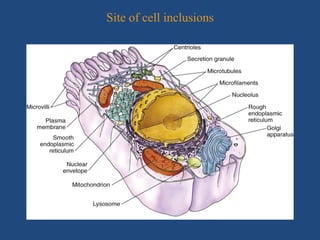
Site of cell inclusions
PROPERITIES OF CELL INCLUSIONS
• Cell inclusions are non-living substances present in
the plant cells
• They are called ergastic substances or ergastic bodies
• They may be present in soluble or insoluble state
either organic or inorganic in nature as told earlier
• They are present in components or sub-components
of cell
• They are the raw materials or products of cellular
metabolism
• They may be exported or expelled from the cell.
CLASSIFICATION
• Ergastic substances-either organic or inorganic in nature
present in cytoplasm or vacuole have wide importance like 1.
food products-starch & Aleuronic grains, 2. Waste products
like crystals, 3. other substances like rubber, mucilage, tannins,
latex, alkaloids etc are broadly classified under three
categories-
• A. Reserve materials-Carbohydrates, Nitrogenous materials ,
Fats & oils
• B. Secretory materials-Present in sacs or glands being
Enzymes, Nectar, coloring matter, vitamin, Hormones.
• C. Excretory materials-Metabolic by-products like alkaloids,
tannins, latex, mineral crystals including raphides, styloides,
prismatic crystals etc.
METABOLITES-TYPES
• PRIMARY METABOLITES
• Chlorophyll, Amino acids, Nucleotides, Simple-CHOs,
Membrane lipids
• Found throughout the plant kingdom
• Important roles in growth & development like
photosynthesis, respiration, solute transport, translocation,
nutrient assimilation, differentiation
• SECONDARY METABOLITES
• restricted distribution in plants particularly either in one
species or taxonomically related species extend
ecological, protective, pollination or agent for plant-plant
competition by giving color, pungencies & odors
RESERVE MATERIALS
• To make new protoplasm and cellular activities, autotrophs
stored reserve materials as Carbohydrates, Proteins, Oils &
fats
• CARBOHYDRATES:
• Monosaccharide-glucose(Grapes) or fructose(Homey0
• Oligosaccharides- Sucrose(Cane sugar) or Raffinose on
hydrolysis produce sugar
• Polysaccharides- Inulin ( Tuber of Dahlia, Helianthus)
• Starch-Insoluble polysaccharides in storage organs like
rhizomes, endosperm, corns, tubers, cotyledons like oryza,
Ipomoea, Avena
• Cellulose-Insoluble as in Spinach and leafy vegetables
• Pectin- Rich in galacturonic acid, rhamnose, arabinose and
galactose
PROTEINS & FATS
• PROTEINS
• Storage Proteins in aleurone grains, either amorphous
(Wheat endosperm)or crystalline (fruit of Capsicum),
bounded by protenaceous membranes, seeds , embryo,
endosperms.
• Protein matrix containing a crystalloid (outer layer of
endosperm of wheat)
• Protein matrix with globoid
• Protein matrix with crystalloid or globoid.
• OILS & FATS: Abundant in endosperm and perisperm of
plant parts produced by elaioplast or spherosomes,
volatile oil in Rose, wax, cutin & suberin as protective
layers.
SECRETORY MATERIALS
• Produced during plant metabolism & perform
specific role .Includes coloring matter, enzymes &
nectar
• Coloring matter- Xanthophylls imparts orange to
yellow color while anthocynin imparts red, blue,
violet or pink color , brings pollination , fruit
dispersal and others
• Enzymes- Catalyse, Lipase, protease, invertase &
Diastase
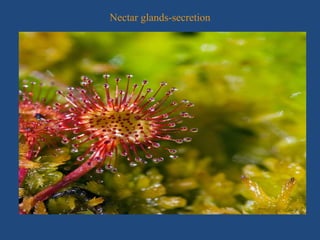
• Nectar- Nectaries consisting of glucose, fructose
& sucrose affect pollination by entomogenous
flowers
Nectar glands-secretion
EXCRETORY MATERIALS
• By-products of plant metabolism stored in dead cells,
disposed off via leaves, fruits, seeds, barks etc.They are-
• Alkaloids-Quinine in cinchona barks, morphine in Poppy
seeds,, atropine in Atropa belladona,
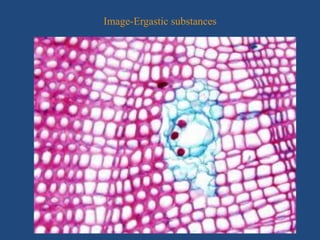
• Crystals-Crystal contains cells are called idioblasts
originate within vacuoles-
• Calcium oxalate crystal in Citrus, Vicia, Begonia ; sphere
crystal called sphaeraphide in Datura, Nerium etc
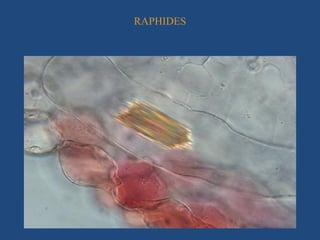
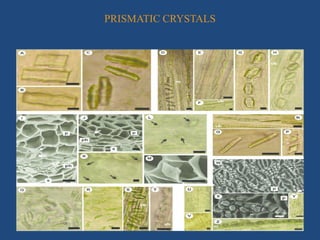
• Raphides-Needle shaped with pointed tips found in
Impatiens, Colocasia
• Styloides-elongated prismatic crystals in members of
Liliaceae & Agavaceae
• Rosette crystals-In the members of Apiaceae
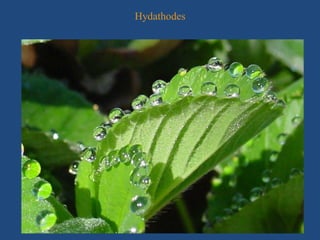
• Hydathodes-Specialized pores present in the leaf margin
to exude drops of water( guttation) in some angiosperm
herbs like mustard. Grasses and members of
Saxifragraceae.
Hydathodes
RAPHIDES
PLANTS SOURCE: TAXONOMICALLY
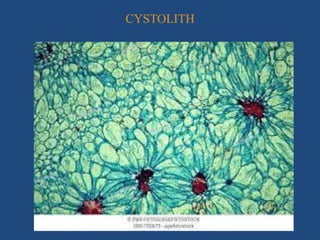
• Crystals of Calcium carbonate –Cystolith found in parenchyma
, epidermal cells ( Lithocysts) in Ficus leaves, trichomes or
hairs( Humulus lupulus) leaves of Acanthaceae, Cucurbitaceae
& Urticaceae.The leaves of Mormordica contains double
cystolith, Calcium carbonate containing crystals appear grape
like clusters with a stalk attached to the cell wall from where it
hangs into the cell lumen, having large nucleus and dense
cytoplasm.
• Crystal Sand: Small prismatic crystals found in Atropa
belladona of Solanaceae.
• Essential oils-The odoriferous glands in flowers, leaves, fruits
as found in oil of Peppermint from Mentha piperita, clove oil
from Eugenia caryophylla, Eucalyptus oil from Eucalyptus
globoulus, attract vectors to bring pollination and dispersal of
seeds & fruits.
Image-Ergastic substances
CYSTOLITH
Glycosides, Gum, Latex-Source
• Glycosides-Composed of glucose and other substances like
sinigrin- sulpher containing glycoside in Brassica nigra,
digitogenin as in Digitalis purpurea.
• Gum-exudes from the barks of Acacia arabica, A.modesta,
cellulose of cell wall undergoes decomposition forms gum,
naturally but response to injuries to heal up the wounds, used
in medicine, confectionary, sizing and finishing materials in
industry(Sing & Jain, 1996)
• Latex- Special group of cells –laticifers present in the families
of Asclepiadaceae, Apocynaceae, Moraceae & Euphorbiaceae,
colorless, milky white-yellow or orange consists of
carbohydrates, alkaloids, organic acids, oils, resins, rubber,
styarch etc. Papain, an enzyme present in Carica papaya, latex
of opium rich in alkaloid, natural rubber from Hevea
brasiliensis
PRISMATIC CRYSTALS
ORGANIC ACIDS, RESINS, SILICA BODIES------
• Organic acids-during metabolism, leaves and fruits produced
different organic acids like tartaric acid in tamarind, malic acid
in apple, citric acid in citrus etc
• Resin-Solid or liquid, brittle in nature with complex chemical
composition, produced from secretory cells surrounding the
resin ducts; coniferous trees rich in resin, Canada balsam
obtained from conifer Abies balsama.
• Silica bodies-Composed of silicon dioxide found in the
epidermal cells of Poaceae & Cyperaceae
• Tannins-Non-nitrogenous phenol derivatives present in the cell
sap; yellow , red or brown in color appear granules in cell;
found in seed coats, in unripe fruits, leaves of the infected
tissues; present in the periderm & heart wood making hard and
impervious; used in medicine, leather, dye and other
industries.
CONCLUSION
• Thus, several chemical compounds occur as non-living
inclusions in the cytoplasm and these inclusions remain
dispersed either cell-sap or in cytoplasm. Apparently, the
ergastic substances seems to be appeared as not so important
as far as the structural attributes of the plants but they play also
vey important role for the welfare of the human civilization.
The different industrial products are derived using the ergastic
materials as the raw materials. A number of life saving drugs
are derived using this components as the welfare of the human
beings. This, the ergastic substances are very important to
plants for its morphological and physiological attributes and it
plays a very important role in the welfare of human
civilization.
Maintain physical distance to avoid COVID19.Thanks a lot to
stay with---------

Plant Ergastic Substances and Cell Inclusions

  • 1.
    Welcome to Plant CellInclusions: Ergastic substances, Hydathodes, Cavities, Lithocysts & Laticifers By N.Sannigrahi, Associate Professor, Department of Botany, Nistarini College, Purulia, 723101(W.B) India The non-living cell inclusions produced as a result of the metabolic activity of the cell are known as ergastic substances or cell inclusions. These are found in cytoplasm, vacuoles and cell walls and are grouped into three broad categories-Reserve materials, Secondary materials and Excretory materials.
  • 2.
    Site of cellinclusions
  • 3.
    PROPERITIES OF CELLINCLUSIONS • Cell inclusions are non-living substances present in the plant cells • They are called ergastic substances or ergastic bodies • They may be present in soluble or insoluble state either organic or inorganic in nature as told earlier • They are present in components or sub-components of cell • They are the raw materials or products of cellular metabolism • They may be exported or expelled from the cell.
  • 4.
    CLASSIFICATION • Ergastic substances-eitherorganic or inorganic in nature present in cytoplasm or vacuole have wide importance like 1. food products-starch & Aleuronic grains, 2. Waste products like crystals, 3. other substances like rubber, mucilage, tannins, latex, alkaloids etc are broadly classified under three categories- • A. Reserve materials-Carbohydrates, Nitrogenous materials , Fats & oils • B. Secretory materials-Present in sacs or glands being Enzymes, Nectar, coloring matter, vitamin, Hormones. • C. Excretory materials-Metabolic by-products like alkaloids, tannins, latex, mineral crystals including raphides, styloides, prismatic crystals etc.
  • 5.
    METABOLITES-TYPES • PRIMARY METABOLITES •Chlorophyll, Amino acids, Nucleotides, Simple-CHOs, Membrane lipids • Found throughout the plant kingdom • Important roles in growth & development like photosynthesis, respiration, solute transport, translocation, nutrient assimilation, differentiation • SECONDARY METABOLITES • restricted distribution in plants particularly either in one species or taxonomically related species extend ecological, protective, pollination or agent for plant-plant competition by giving color, pungencies & odors
  • 6.
    RESERVE MATERIALS • Tomake new protoplasm and cellular activities, autotrophs stored reserve materials as Carbohydrates, Proteins, Oils & fats • CARBOHYDRATES: • Monosaccharide-glucose(Grapes) or fructose(Homey0 • Oligosaccharides- Sucrose(Cane sugar) or Raffinose on hydrolysis produce sugar • Polysaccharides- Inulin ( Tuber of Dahlia, Helianthus) • Starch-Insoluble polysaccharides in storage organs like rhizomes, endosperm, corns, tubers, cotyledons like oryza, Ipomoea, Avena • Cellulose-Insoluble as in Spinach and leafy vegetables • Pectin- Rich in galacturonic acid, rhamnose, arabinose and galactose
  • 7.
    PROTEINS & FATS •PROTEINS • Storage Proteins in aleurone grains, either amorphous (Wheat endosperm)or crystalline (fruit of Capsicum), bounded by protenaceous membranes, seeds , embryo, endosperms. • Protein matrix containing a crystalloid (outer layer of endosperm of wheat) • Protein matrix with globoid • Protein matrix with crystalloid or globoid. • OILS & FATS: Abundant in endosperm and perisperm of plant parts produced by elaioplast or spherosomes, volatile oil in Rose, wax, cutin & suberin as protective layers.
  • 8.
    SECRETORY MATERIALS • Producedduring plant metabolism & perform specific role .Includes coloring matter, enzymes & nectar • Coloring matter- Xanthophylls imparts orange to yellow color while anthocynin imparts red, blue, violet or pink color , brings pollination , fruit dispersal and others • Enzymes- Catalyse, Lipase, protease, invertase & Diastase • Nectar- Nectaries consisting of glucose, fructose & sucrose affect pollination by entomogenous flowers
  • 9.
  • 10.
    EXCRETORY MATERIALS • By-productsof plant metabolism stored in dead cells, disposed off via leaves, fruits, seeds, barks etc.They are- • Alkaloids-Quinine in cinchona barks, morphine in Poppy seeds,, atropine in Atropa belladona, • Crystals-Crystal contains cells are called idioblasts originate within vacuoles- • Calcium oxalate crystal in Citrus, Vicia, Begonia ; sphere crystal called sphaeraphide in Datura, Nerium etc • Raphides-Needle shaped with pointed tips found in Impatiens, Colocasia • Styloides-elongated prismatic crystals in members of Liliaceae & Agavaceae • Rosette crystals-In the members of Apiaceae • Hydathodes-Specialized pores present in the leaf margin to exude drops of water( guttation) in some angiosperm herbs like mustard. Grasses and members of Saxifragraceae.
  • 11.
  • 12.
  • 13.
    PLANTS SOURCE: TAXONOMICALLY •Crystals of Calcium carbonate –Cystolith found in parenchyma , epidermal cells ( Lithocysts) in Ficus leaves, trichomes or hairs( Humulus lupulus) leaves of Acanthaceae, Cucurbitaceae & Urticaceae.The leaves of Mormordica contains double cystolith, Calcium carbonate containing crystals appear grape like clusters with a stalk attached to the cell wall from where it hangs into the cell lumen, having large nucleus and dense cytoplasm. • Crystal Sand: Small prismatic crystals found in Atropa belladona of Solanaceae. • Essential oils-The odoriferous glands in flowers, leaves, fruits as found in oil of Peppermint from Mentha piperita, clove oil from Eugenia caryophylla, Eucalyptus oil from Eucalyptus globoulus, attract vectors to bring pollination and dispersal of seeds & fruits.
  • 14.
  • 15.
  • 16.
    Glycosides, Gum, Latex-Source •Glycosides-Composed of glucose and other substances like sinigrin- sulpher containing glycoside in Brassica nigra, digitogenin as in Digitalis purpurea. • Gum-exudes from the barks of Acacia arabica, A.modesta, cellulose of cell wall undergoes decomposition forms gum, naturally but response to injuries to heal up the wounds, used in medicine, confectionary, sizing and finishing materials in industry(Sing & Jain, 1996) • Latex- Special group of cells –laticifers present in the families of Asclepiadaceae, Apocynaceae, Moraceae & Euphorbiaceae, colorless, milky white-yellow or orange consists of carbohydrates, alkaloids, organic acids, oils, resins, rubber, styarch etc. Papain, an enzyme present in Carica papaya, latex of opium rich in alkaloid, natural rubber from Hevea brasiliensis
  • 17.
  • 18.
    ORGANIC ACIDS, RESINS,SILICA BODIES------ • Organic acids-during metabolism, leaves and fruits produced different organic acids like tartaric acid in tamarind, malic acid in apple, citric acid in citrus etc • Resin-Solid or liquid, brittle in nature with complex chemical composition, produced from secretory cells surrounding the resin ducts; coniferous trees rich in resin, Canada balsam obtained from conifer Abies balsama. • Silica bodies-Composed of silicon dioxide found in the epidermal cells of Poaceae & Cyperaceae • Tannins-Non-nitrogenous phenol derivatives present in the cell sap; yellow , red or brown in color appear granules in cell; found in seed coats, in unripe fruits, leaves of the infected tissues; present in the periderm & heart wood making hard and impervious; used in medicine, leather, dye and other industries.
  • 19.
    CONCLUSION • Thus, severalchemical compounds occur as non-living inclusions in the cytoplasm and these inclusions remain dispersed either cell-sap or in cytoplasm. Apparently, the ergastic substances seems to be appeared as not so important as far as the structural attributes of the plants but they play also vey important role for the welfare of the human civilization. The different industrial products are derived using the ergastic materials as the raw materials. A number of life saving drugs are derived using this components as the welfare of the human beings. This, the ergastic substances are very important to plants for its morphological and physiological attributes and it plays a very important role in the welfare of human civilization.
  • 20.
    Maintain physical distanceto avoid COVID19.Thanks a lot to stay with---------