JIGNASA-STUDENT STUDY PROJECT 2022-23
PLASTIC WASTE MANAGEMENT METHODS -WEALTH FROM WASTE
Department of Chemistry
Government Degree College, Rangasaipet, Warangal.
Warangal Dist.
Submitted by: Under the supervision of
Ch. Likhita, BSc., (BZC) II year. Dr. Ch. Sudhakar
P.Sindhu Bhavana, BSc., (BZC) II year Assistant Professor of Chemistry
M. Jayaprakash, BSc., (BZC), II year.
Ch. Aditya, BSc., (BZC), II year.
B.Aishwarya, BSc., (BZC), II year.
AIMS AND OBJECTIVES:
To learn and understand, what is plastic and plastic waste.
To learn and understand about the importance of plastic waste management.
To learn and understand about some eco-friendly plastic waste management
methods.
METHODOLOGY:
We have gathered information about the plastic waste management and its
importance from various open educational resources. Three types of plastic waste
management methods are presented in this project.
They are
ANALYSIS OF DATA:
SOME TERMS-EXPLANATION:
PLASTIC:
Plastics are synthetic polymers that may be shaped when soft and then hardened to
retain the given shape.
The daily life has been easier and colourful by the discovery and varied
applications of polymers. The use of polymers in the manufacture of plastic
buckets, cups and saucers, children’s toys, packaging bags, synthetic clothing
materials, automobile tyres, gears and seals, electrical insulating materials and
machine parts has completely revolutionised the daily life as well as the industrial
scenario. Indeed, the polymers are the backbone of four major industries viz.
plastics, elastomers, fibres and paints and varnishes.
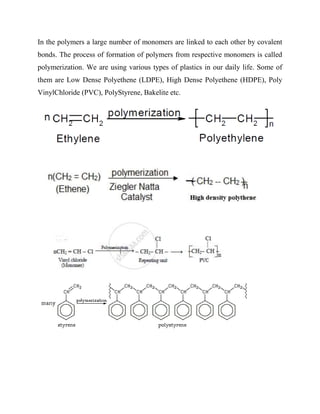
In the polymers a large number of monomers are linked to each other by covalent
bonds. The process of formation of polymers from respective monomers is called
polymerization. We are using various types of plastics in our daily life. Some of
them are Low Dense Polyethene (LDPE), High Dense Polyethene (HDPE), Poly
VinylChloride (PVC), PolyStyrene, Bakelite etc.
PLASTIC WASTE:
Plastic waste, or plastic pollution, is 'the accumulation of plastic objects (e.g.:
plastic bottles and much more) in the Earth's environment that adversely affects
wildlife, wildlife habitat, and humans. It is a non-biodegradable waste.
The accumulation of plastic objects in the earth's environment that adversely
affects environment.
PLASTIC WASTE MANAGEMENT (PMW):
The initiative aims to establish environment-friendly plastic waste disposal
solutions. In the process it seeks to ban the use of plastic bags and plastic products,
and reduce plastic littering across the globe.
INTRODUCTION :
Plastic products have become an integral part of our daily life due to its broad
range of application. Plastics are used extensively in almost all human activities such
as packaging films, wrapping materials, shopping and garbage bags, fluid
containers, clothing, toys, household and industrial products, and building
materials, healthcare, electricity and thermal insulation, the manufacture of domestic
and technological items, and so on. Plastic’s utility is predicted to rise even more as a
result of its remarkable features such as high tensile strength, shock resistance,
resistance to microbial growth, opacity as well as visibility, chemical resistance, and
feather weight.
On an average, production of plastic globally crosses 150 million tonnes per year.
It is estimated that approximately 70% of plastic packaging products are converted
into plastic waste in a short span. Approximately 9.4 million tonnes per year plastic
waste is generated in the our country, which amounts to 26,000 tonnes per day2
. Of
this, about 60% is recycled, most of it by the informal sector. While the recycling
rate in India is considerably higher than the global average of 20%3
, there is still
over 9,400 tonnes of plastic waste which is either landfilled or ends up polluting
streams or groundwater resources.
Most plastic polymers used today are made synthetically from fossil fuel.
Polymerization is the processes by which specific molecules are combined together
through chemical reactions to form long chain structures, several thousand
monomers long. The final products are produced by the application of pressure and
heat to form the desired molded shapes. The finished plastic products contains not
only polymers but also mixed plastics with many different materials such as filler,
lubricants, stabilizer, catalysts, and coloring materials. These additions are used to
improve the performance and economic value of the products. Broadly, plastics are
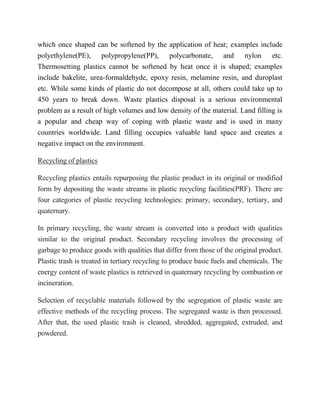
classified into thermoplastics and thermosetting plastics. Thermoplastics are those
which once shaped can be softened by the application of heat; examples include
polyethylene(PE), polypropylene(PP), polycarbonate, and nylon etc.
Thermosetting plastics cannot be softened by heat once it is shaped; examples
include bakelite, urea-formaldehyde, epoxy resin, melamine resin, and duroplast
etc. While some kinds of plastic do not decompose at all, others could take up to
450 years to break down. Waste plastics disposal is a serious environmental
problem as a result of high volumes and low density of the material. Land filling is
a popular and cheap way of coping with plastic waste and is used in many
countries worldwide. Land filling occupies valuable land space and creates a
negative impact on the environment.
Recycling of plastics
Recycling plastics entails repurposing the plastic product in its original or modified
form by depositing the waste streams in plastic recycling facilities(PRF). There are
four categories of plastic recycling technologies: primary, secondary, tertiary, and
quaternary.
In primary recycling, the waste stream is converted into a product with qualities
similar to the original product. Secondary recycling involves the processing of
garbage to produce goods with qualities that differ from those of the original product.
Plastic trash is treated in tertiary recycling to produce basic fuels and chemicals. The
energy content of waste plastics is retrieved in quaternary recycling by combustion or
incineration.
Selection of recyclable materials followed by the segregation of plastic waste are
effective methods of the recycling process. The segregated waste is then processed.
After that, the used plastic trash is cleaned, shredded, aggregated, extruded, and
powdered.
• Groundwater and soil pollution
Plastic is a material made to last forever, and due to the same chemical
composition, plastic cannot biodegrade; it breaks down into smaller and smaller
pieces5. When buried in a landfill, plastic lies untreated for years. In the process,
toxic chemicals from plastics drain out and seep into groundwater, flowing
downstream into lakes and rivers. The seeping of plastic also causes soil pollution
and have now started resulting in presence of micro plastics in soil.
• Terrestrial plastic pollution
There are also terrestrial aspects to plastic pollution. Drainage systems become
clogged with plastic bags, films, and other items, causing flooding. Land birds,
such as the reintroduced California condor, have been found with plastic in
their stomachs, and animals that normally feed in waste dumps—for instance, the
sacred cows of India—have had intestinal blockages from plastic packaging. The
mass of plastic is not greater than that of other major components of waste, but it
takes up a disproportionately large volume. As waste dumps expand in residential
areas, the scavenging poor are often found living near or even on piles of residual
plastics. In addition, wind-transported microplastic fibres and particles have been
detected in many parts of the world, including the snow deposited high
atop mountains, on Arctic beaches and sea ice, and in Antarctica. These
microplastics can change the physical structure of earth and limit its capacity to
hold water. That can affect plants by reducing root growth and nutrient uptake
results in low crop yield. Chemical additives in plastics that leach into the soil can
also impact food value chains and lead to health implications.
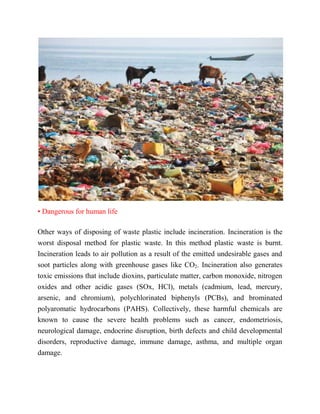
• Dangerous for human life
Other ways of disposing of waste plastic include incineration. Incineration is the
worst disposal method for plastic waste. In this method plastic waste is burnt.
Incineration leads to air pollution as a result of the emitted undesirable gases and
soot particles along with greenhouse gases like CO2. Incineration also generates
toxic emissions that include dioxins, particulate matter, carbon monoxide, nitrogen
oxides and other acidic gases (SOx, HCl), metals (cadmium, lead, mercury,
arsenic, and chromium), polychlorinated biphenyls (PCBs), and brominated
polyaromatic hydrocarbons (PAHS). Collectively, these harmful chemicals are
known to cause the severe health problems such as cancer, endometriosis,
neurological damage, endocrine disruption, birth defects and child developmental
disorders, reproductive damage, immune damage, asthma, and multiple organ
damage.
1. 6
Material Economics. (2018). The Circular Economy – a Powerful Force for Climate
Mitigation. Material Economics. https://materialeconomics.com/publications/the-circular-
economy-a-powerful-force-for-climate-mitigation-1 []
2. 7
Tangri, N. V. (2021). Waste Incinerators Undermine Clean Energy Goals. Earth
ArXiv. https://doi.org/10.31223/X5VK5X []
3. 8
The New School Tishman Environment and Design Center (2019). U.S. Solid Waste
Incinerators: An Industry in Decline. https://grist.org/wp-content/uploads/2020/07/1ad71-
cr_gaiareportfinal_05.21.pdf []
4. 9
Azoulay, D., Villa, P., Arellano, Y., Gordon, M. F., Moon, D., Miller, K. A., & Thompson,
K. (2019). Plastic & Health: The Hidden Costs of a Plastic Planet.
CIEL. https://www.ciel.org/reports/plastic-health-the-hidden-costs-of-a-plastic-planet-
february-2019/ []
• Pollution in Oceans
Since the ocean is downstream from nearly every terrestrial location, it is the
receiving body for much of the plastic waste generated on land. Several million
tons of debris end up in the world’s oceans every year, and much of it is
improperly discarded plastic litter. It estimated that at least 5.25 trillion
individual plastic particles weighing roughly 244,000 metric tons (269,000
short tons) were floating on or near the surface. 44 percent of plastic debris in
rivers and oceans, and on shorelines, was made up of bags, bottles, and items
related to takeout meals.
The increased presence of plastic on the ocean surface has resulted in more serious
problems. Since most of the plastic debris that reaches the ocean remains floating
for years as it does not decompose quickly, it leads to the dropping of oxygen level
in the water, severely affecting the survival of marine species. Materials like
plastic are non-degradable which means they will not be absorbed and recycled.
When oceanic creatures and even birds consume plastic inadvertently, they choke
on it which causes a steady decline in their population.
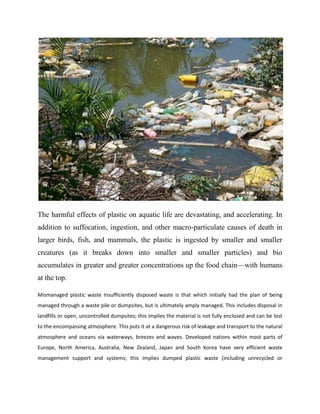
The harmful effects of plastic on aquatic life are devastating, and accelerating. In
addition to suffocation, ingestion, and other macro-particulate causes of death in
larger birds, fish, and mammals, the plastic is ingested by smaller and smaller
creatures (as it breaks down into smaller and smaller particles) and bio
accumulates in greater and greater concentrations up the food chain—with humans
at the top.
Mismanaged plastic waste Insufficiently disposed waste is that which initially had the plan of being
managed through a waste pile or dumpsites, but is ultimately amply managed. This includes disposal in
landfills or open, uncontrolled dumpsites; this implies the material is not fully enclosed and can be lost
to the encompassing atmosphere. This puts it at a dangerous risk of leakage and transport to the natural
atmosphere and oceans via waterways, breezes and waves. Developed nations within most parts of
Europe, North America, Australia, New Zealand, Japan and South Korea have very efficient waste
management support and systems; this implies dumped plastic waste (including unrecycled or
unincinerated) is stored in secure, contained landfills. Across such nations, almost no plastic waste is
regarded as partially managed. [3]
Across many low-to-middle-income income nations, insufficiently managed waste can be substantially
high; in fact, across many countries in South Asia and Sub-Saharan Africa, a staggering 80-90 per cent of
plastic waste is insufficiently managed, and consequently, holds a dangerous prospect of polluting
streams and oceans.
MANAGEMENT OF PLASTIC GARBAGE
Recycling, landfilling, and incineration are the most common traditional methods for
managing plastic garbage. However, because this plastic garbage is non-
biodegradable, it poses waste management issues. To safeguard the environment, the
most important issue is the effective and efficient management of the massive
volume of trash generated around the world. Sustainable plastic waste management is
a major issue that is attracting all environmental concerns.
RECYCLING OF PLASTICS
Recycling plastics entails repurposing the plastic product in its original or modified
form by depositing the waste streams in plastic recycling facilities(PRF). There are
four categories of plastic recycling technologies: primary, secondary, tertiary, and
quaternary.
In primary recycling, the waste stream is converted into a product with qualities
similar to the original product. Secondary recycling involves the processing of
garbage to produce goods with qualities that differ from those of the original product.
Plastic trash is treated in tertiary recycling to produce basic fuels and chemicals. The
energy content of waste plastics is retrieved in quaternary recycling by combustion or
incineration.
Selection of recyclable materials followed by the segregation of plastic waste are
effective methods of the recycling process. The segregated waste is then processed.
After that, the used plastic trash is cleaned, shredded, aggregated, extruded, and
powdered.
Technologies for Plastic Waste Management (PWM): It has been observed that
disposal of plastic waste is a serious concern due to improper collection and
segregation system. However, a few technologies have been developed to
minimize its adverse effect on the environment.
It is worth to note that before adopting any technology, it is necessary to segregate
plastic waste from municipal and others solid waste. The descriptions of
technologies are mentioned below;
Utilization of Plastic Waste in Road Construction:
This waste plastic can be partially mixed with material use for road construction.
In conventional road making process bitumen is used as binder. Such bitumen can
be modified with waste plastic pieces. This waste plastic modified bitumen mix
shows better binding property, stability, density and more resistant to water.
Worldwide use of waste material in road construction is being increasingly
encouraged so as to reduce environmental impact. The use of this innovative
technology will strengthen the road construction and increase the road life as well
as will help to utilization of waste plastic material. Plastic roads would be a
blessing for hot and extremely humid climate, where temperatures normally cross
50°C and abundant rains create damage, leaving most of the roads with big
potholes.
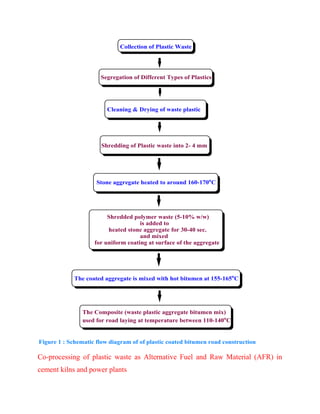
Figure 1 : Schematic flow diagram of of plastic coated bitumen road construction
Collection of Plastic Waste
Segregation of Different Types of Plastics
Cleaning & Drying of waste plastic
Shredding of Plastic waste into 2- 4 mm
Stone aggregate heated to around 160-170o
C
Shredded polymer waste (5-10% w/w)
is added to
heated stone aggregate for 30-40 sec.
and mixed
for uniform coating at surface of the aggregate
The coated aggregate is mixed with hot bitumen at 155-165o
C
The Composite (waste plastic aggregate bitumen mix)
used for road laying at temperature between 110-140o
C
Co-processing of plastic waste as Alternative Fuel and Raw Material (AFR) in
cement kilns and power plants
Cement kilns are specialised kilns used in cement production and generally use
coal as a fuel. Waste materials (including plastic waste) are used as a fuel for co-
processing in these kilns and are referred to as “alternate fuels and raw materials”
(AFR). Cement kilns are energy intensive, but they have an inherent advantage
when it comes to co-processing as they are operated at high temperatures (around
1400’C and above) as the high temperature destroys the waste and leaves no
residue behind. Therefore the Co-processing of Plastic Waste in Cement Kilns by
using plastic waste to burn as fuel during the heating stage of clinker is a more
environmentally friendly and sustainable method of waste disposal as compared to
land filling and incineration because of reduced emissions and no residue after the
treatment. Promoting this approach is a win-win for the planet that is choking on
plastic waste. By converting plastic to energy, these cement kilns, keep the waste
out of landfills and oceans while allowing cement plants to move away from
burning coal, a significant contributor to global warming. As plastic waste has
material and energy value, the cement kiln co-processing option provides this
option of gainfully utilising wastes as resources in cement manufacture without
impacting emissions or product quality.
Waste material
primary collection
&
segregation
Secondary segregation
of waste to separate
recyclable part
Recyclable plastic waste
Non-recyclable
plastic waste
Composting
Organic manure
Non-compostible
Reject
Bailed material
Transportation to cement plant
for co-processing of
plastic waste in cement
Figure 2 : Schematic flow diagram of Co-processing of plastic waste in cement
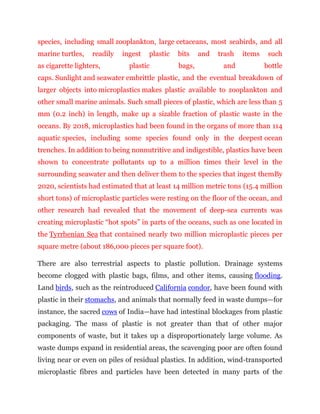
Conversion of plastic waste into liquid RDF (Oil) :
Conversion of plastic waste into liquid RDF (Oil) : Firstly, plastic waste is
segregated mechanically from municipal solid waste (MSW). This method is not
full-proof, as alongwith plastic waste, other lighter material is also segregated.
Therefore, the segregated plastic waste is again sent through conveyor belt fixed
with optical segregation device for 100% source segregation of plastic waste.
Then, the mixed plastic waste is converted into the more useable i.e. Liquid RDF
through catalytic pyrolysis. The process is termed random De-polymerization as
the degradation of bonds to break down into monomers occurs randomly. This
process is utilized for the degradation of plastic to lower hydrocarbons. The
random De-polymerization is carried out in a specially designed Reactor, in
absence of oxygen and in the presence of certain catalytic additives. The maximum
reaction temperature is 350°C. The entire feed material is converted into either of
the products: Liquid RDF, gases and some sludge. There is no effluent generated in
the process and the unused hot air from the reactor is released through chimney.
Steps involved in conversion of plastic waste into liquid fuel RDF (Fuel)
Waste Plastic to Fluel Technology
Mechanical segregation of plastic waste
from mixed MSW dumpyard/storage
Transportation of segregated plastic waste
through conveyor belt for optical segregation
Optical segregation of plastic waste (only HD, LD, PP
and multilayer packagings except PVC
Shredding of plastic waste and dislodging dust and impurities
Transportation of segregated (100% plastic waste) into feeding hopper (reactor)
Feeding of plastic waste into reactor for random depolymerization
in presence of catalytic additives
Collection of liquid RDF (Fuel)
Collection of rejects
and
solid waste
Figure 3: Schematic flow diagram of conversion of plastic waste into liquid RDF (Oil)
In the ocean, plastic pollution can kill marine mammals directly through
entanglement in objects such as fishing gear, but it can also kill through
ingestion, by being mistaken for food. Studies have found that all kinds of
species, including small zooplankton, large cetaceans, most seabirds, and all
marine turtles, readily ingest plastic bits and trash items such
as cigarette lighters, plastic bags, and bottle
caps. Sunlight and seawater embrittle plastic, and the eventual breakdown of
larger objects into microplastics makes plastic available to zooplankton and
other small marine animals. Such small pieces of plastic, which are less than 5
mm (0.2 inch) in length, make up a sizable fraction of plastic waste in the
oceans. By 2018, microplastics had been found in the organs of more than 114
aquatic species, including some species found only in the deepest ocean
trenches. In addition to being nonnutritive and indigestible, plastics have been
shown to concentrate pollutants up to a million times their level in the
surrounding seawater and then deliver them to the species that ingest themBy
2020, scientists had estimated that at least 14 million metric tons (15.4 million
short tons) of microplastic particles were resting on the floor of the ocean, and
other research had revealed that the movement of deep-sea currents was
creating microplastic “hot spots” in parts of the oceans, such as one located in
the Tyrrhenian Sea that contained nearly two million microplastic pieces per
square metre (about 186,000 pieces per square foot).
There are also terrestrial aspects to plastic pollution. Drainage systems
become clogged with plastic bags, films, and other items, causing flooding.
Land birds, such as the reintroduced California condor, have been found with
plastic in their stomachs, and animals that normally feed in waste dumps—for
instance, the sacred cows of India—have had intestinal blockages from plastic
packaging. The mass of plastic is not greater than that of other major
components of waste, but it takes up a disproportionately large volume. As
waste dumps expand in residential areas, the scavenging poor are often found
living near or even on piles of residual plastics. In addition, wind-transported
microplastic fibres and particles have been detected in many parts of the
world, including the snow deposited high atop mountains, on Arctic beaches
and sea ice, and in Antarctica.
• Pollution in Oceans
The increased presence of plastic on the ocean surface has resulted in more serious
problems. Since most of the plastic debris that reaches the ocean remains floating
for years as it does not decompose quickly, it leads to the dropping of oxygen level
in the water, severely affecting the survival of marine species. Materials like
plastic are non-degradable which means they will not be absorbed and recycled.
When oceanic creatures and even birds consume plastic inadvertently, they choke
on it which causes a steady decline in their population. The harmful effects of
plastic on aquatic life are devastating, and accelerating. In addition to suffocation,
ingestion, and other macro-particulate causes of death in larger birds, fish, and
mammals, the plastic is ingested by smaller and smaller creatures (as it breaks
down into smaller and smaller particles) and bio accumulates in greater and greater
concentrations up the food chain—with humans at the top.
mechanical compaction and reuse, and also chemical recycling. Products from
mechanical recycling have a low quality and a poor esthetic property that affects
their market value. Beyond these techniques, researchers have recently found ways
of producing liquid fuels from waste plastics through pyrolysis-based processes.
Unfortunately, the process is energy intensive, and there is an ongoing debate as to
whether it takes more energy to produce the fuel than there is in the fuel itself.
A very small amount of total plastic production (less than 10%) is effectively
recycled; the remaining plastic is sent to landfills, where it is destined to remain
entombed in limbo for hundreds of thousands of years, or to incinerators, where its
toxic compounds are spewed throughout the atmosphere to be accumulated in
biotic forms throughout the surrounding ecosystems
• Pollution in Oceans
The increased presence of plastic on the ocean surface has resulted in more serious
problems. Since most of the plastic debris that reaches the ocean remains floating
for years as it does not decompose quickly, it leads to the dropping of oxygen level
in the water, severely affecting the survival of marine species. Materials like
plastic are non-degradable which means they will not be absorbed and recycled.
When oceanic creatures and even birds consume plastic inadvertently, they choke
on it which causes a steady decline in their population. The harmful effects of
plastic on aquatic life are devastating, and accelerating. In addition to suffocation,
ingestion, and other macro-particulate causes of death in larger birds, fish, and
mammals, the plastic is ingested by smaller and smaller creatures (as it breaks
down into smaller and smaller particles) and bio accumulates in greater and greater
concentrations up the food chain—with humans at the top.
Even plankton, the tiniest creatures in our oceans, are eating micro plastics and
absorbing their hazardous chemicals. The tiny, broken down pieces of plastic are
displacing the algae needed to sustain larger sea life who feed on them. Some
important facts about Plastic:
1. Plastics are made from oil with a highly polluting production process. Plastics
just do not dissolve; they break down into micro-particles that circulate in the
environment. A single water bottle can take up to 1000 years to break down.
2. Asia is the world leader in plastic pollution. The Philippines alone dumped over
1 billion pounds of plastics into our oceans. That is over 118,000 trucks worth. In
30 Years there is likely to be more plastic in our oceans than fish.
3. 83% of our drinking water contains plastic. Studies show that consuming plastic
could lead to cancer, effects on hormone levels, and heart damage. Plastics have
been found in the blood of even new born babies
4. Over 600 marine species are affected by plastics. Nearly 45000 marine animals
have ingested plastics and 80% were injured or killed. Plastics can pierce animals
from inside or cause starvation, entanglement, loss of body parts and suffocation.
5. As plastics travel with ocean currents, an island of trash called the “Great pacific
Garbage Patch” has been created. There are now many islands of trash in our seas.
Plastics are everywhere in our environment, and they are the subject of serious
public concern.
However, because this plastic garbage is non-biodegradable, it poses waste management issues.
To safeguard the environment, the most important issue is the effective and efficient management
of the massive volume of trash generated around the world. Sustainable plastic waste
management is a major issue that is attracting all environmental concerns.
Plastic waste and its management strategies for environmental
sustainability
Sustainable plastic waste management is a major issue that is attracting all
environmental concerns. To safeguard the environment, the most important issue is
the effective and efficient management of the massive volume of trash generated
around the world.
Plastics are used extensively in almost all human activities, including manufacturing,
farming, furnishings, healthcare, electricity and thermal insulation, the manufacture
of domestic and technological items, pipes, and so on. Plastic’s utility is predicted to
rise even more as a result of its remarkable features such as high tensile strength,
shock resistance, resistance to microbial growth, opacity as well as visibility,
chemical resistance, and feather weight. However, because this plastic garbage is
non-biodegradable, it poses waste management issues.
Management of plastic garbage
Plastic waste management strategies are required for the proper management of
plastic trash in an environmentally friendly manner, which may aid in the proper use
of plastic material. The solution to this problem rests in the three R’s: reduce, reuse,
and recycle.
Mismanagement of plastic trash may pose environmental concerns, such as
destroying the beauty of the city and clogging drains if littered, causing air pollution
when burned, and interfering with waste production plants when garbage is coupled
with plastic materials. Recycling, landfilling, and incineration are the most common
traditional methods for managing plastic garbage.
Recycling of plastics
Recycling plastics entails repurposing the plastic product in its original or modified
form by depositing the waste streams in plastic recycling facilities(PRF). There are
four categories of plastic recycling technologies: primary, secondary, tertiary, and
quaternary.
In primary recycling, the waste stream is converted into a product with qualities
similar to the original product. Secondary recycling involves the processing of
garbage to produce goods with qualities that differ from those of the original product.
Plastic trash is treated in tertiary recycling to produce basic fuels and chemicals. The
energy content of waste plastics is retrieved in quaternary recycling by combustion or
incineration.
Selection of recyclable materials followed by the segregation of plastic waste are
effective methods of the recycling process. The segregated waste is then processed.
After that, the used plastic trash is cleaned, shredded, aggregated, extruded, and
powdered.
Landfilling
Waste is left in earth pits to decompose in this practice, although sanitary landfill
space is becoming increasingly scarce. A properly managed landfill site has the
advantage of limiting damage to the ecosystem rather than the consequences of
collecting and disposing, but the long-term concerns of water and soil pollution must
be overlooked.
Incineration
Plastic waste is burned in this process, however, this may release harmful elements
into the sky. Incomplete combustion of PVC, for example, produces harmful
compounds such as dioxins; burning plastics emits CO2, which is a major cause of
global warming. As a result, this approach of plastic waste disposal is typically
abandoned because the cost of treatment of the gases is frequently greater than the
energy recovered. However, incinerators can help to alleviate this issue to some
extent.
Apart from the traditional methods of Recycling plastic, RDF and SRF methods are
used to manage plastic garbage.
Refuse derived fuel (RDF)
Refuse derived fuel (RDF) is made from household and commercial garbage, which
includes both biodegradable materials and plastics. Non-combustible materials like
glass & metals are eliminated, and the remaining material is shredded. Refuse-
derived fuel is being used to generate power at recovery plants, many of which are
located in Europe, and generate power and water heating for municipal heating
systems.
Solid recovered fuel (SRF)
Solid recovered fuel (SRF) is an elevated alternative source of energy made mostly
from commercial waste such as paper, cardboard, wood, textiles, and plastic.
Solid salvaged fuel has been subjected to further processing in order to improve its
quality and value. It has a higher heating value than RDF and has been used in places
like cement kilns.
Conclusion:
As we all know, we use plastic in some form or another in our daily lives, such as
kitchen utensils, stationery goods, debit/credit cards, bags, electronic and electrical
equipment, and so on. As a result, plastic waste management has become a major
worry and priority in today’s world. Many advances in recycling plastic wastes have
been made to facilitate this management, as indicated above; nevertheless, we must
not contaminate the environment when recycling and using recycled items. We can
also consider biodegradable plastics, which can be manufactured from
agricultural/animal resources such as cornstarch, soy protein polyester blends,
cellulose, triglycerides, collagen, and casein, to help alleviate this problem of
sustainable waste management.
PLASTIC WASTE MANAGEMENT ISSUES, SOLUTIONS &
CASE STUDIES
Plastic products have become an integral part of our daily life as a result of which
the polymer is produced at a massive scale worldwide. On an average, production
of plastic globally crosses 150 Million tonnes per year. Its broad range of
application is in packaging films, wrapping materials, shopping and garbage bags,
fluid containers, clothing, toys, household and industrial products, and building
materials.
It is estimated that approximately 70% of plastic packaging products are converted
into plastic waste in a short span. Approximately 9.4 million TPA plastic waste is
generated in the country, which amounts to 26,000 TPD2
. Of this, about 60% is
recycled, most of it by the informal sector. While the recycling rate in India is
considerably higher than the global average of 20%3
, there is still over 9,400
tonnes of plastic waste which is either landfilled or ends up polluting streams or
groundwater resources. While some kinds of plastic do not decompose at all,
others could take up to 450 years to break down.
Once plastic is discarded after its utility is over, it is known as plastic waste. It is a
fact that plastic waste never degrades, and remain on landscape for several years.
Mostly, plastic waste is recyclable but recycled products are more harmful to the
environment as this contains additives and colors. The recycling of a virgin plastic
material can be done 2-3 times only, because after every recycling, the plastic
material deteriorates due to thermal pressure and its life span is reduced. Hence
recycling is not a safe and permanent solution for plastic waste disposal. It has
been observed that disposal of plastic waste is a serious concern due to improper
collection and segregation system.
Only 60% of the plastic produced is recycled, balance 9400 Tonnes of plastic is
left unattended in environment causing land, air and water pollution. 70% of
Plastics packaging products are converted into plastic waste in a short span
1.1Harmful Effects of Plastics
Plastic is versatile, lightweight, flexible, moisture resistant, strong, and relatively
inexpensive4 . Those are the attractive qualities that lead us, around the world, to
such a voracious appetite and overconsumption of plastic goods. However, durable
and very slow to degrade, plastic materials that are used in the production of so
many products, ultimately, become waste. Our tremendous attraction to plastic,
coupled with an undeniable behavioral propensity of increasingly over-consuming,
discarding, littering and thus polluting, has become a combination of lethal nature.
The disposal of plastics is one of the least recognized and most highly problematic
areas of plastic’s ecological impact. Ironically, one of plastic’s most desirable
traits: its durability and resistance to decomposition, is also the source of one of its
greatest liabilities when it comes to the disposal of plastics. Natural organisms
have a very difficult time breaking down the synthetic chemical bonds in plastic,
creating the tremendous problem of the material’s persistence. A very small
amount of total plastic production (less than 10%) is effectively recycled; the
remaining plastic is sent to landfills, where it is destined to remain entombed in
limbo for hundreds of thousands of years, or to incinerators, where its toxic
compounds are spewed throughout the atmosphere to be accumulated in biotic
forms throughout the surrounding ecosystems
• Groundwater and soil pollution
Plastic is a material made to last forever, and due to the same chemical
composition, plastic cannot biodegrade; it breaks down into smaller and smaller
pieces5 . When buried in a landfill, plastic lies untreated for years. In the process,
toxic chemicals from plastics drain out and seep into groundwater, flowing
downstream into lakes and rivers. The seeping of plastic also causes soil pollution
and have now started resulting in presence of micro plastics in soil.
• Pollution in Oceans
The increased presence of plastic on the ocean surface has resulted in more serious
problems. Since most of the plastic debris that reaches the ocean remains floating
for years as it does not decompose quickly, it leads to the dropping of oxygen level
in the water, severely affecting the survival of marine species. Materials like
plastic are non-degradable which means they will not be absorbed and recycled.
When oceanic creatures and even birds consume plastic inadvertently, they choke
on it which causes a steady decline in their population. The harmful effects of
plastic on aquatic life are devastating, and accelerating. In addition to suffocation,
ingestion, and other macro-particulate causes of death in larger birds, fish, and
mammals, the plastic is ingested by smaller and smaller creatures (as it breaks
down into smaller and smaller particles) and bio accumulates in greater and greater
concentrations up the food chain—with humans at the top.
Even plankton, the tiniest creatures in our oceans, are eating micro plastics and
absorbing their hazardous chemicals. The tiny, broken down pieces of plastic are
displacing the algae needed to sustain larger sea life who feed on them. Some
important facts about Plastic:
1. Plastics are made from oil with a highly polluting production process. Plastics
just do not dissolve; they break down into micro-particles that circulate in the
environment. A single water bottle can take up to 1000 years to break down.
2. Asia is the world leader in plastic pollution. The Philippines alone dumped over
1 billion pounds of plastics into our oceans. That is over 118,000 trucks worth. In
30 Years there is likely to be more plastic in our oceans than fish.
3. 83% of our drinking water contains plastic. Studies show that consuming plastic
could lead to cancer, effects on hormone levels, and heart damage. Plastics have
been found in the blood of even new born babies
4. Over 600 marine species are affected by plastics. Nearly 45000 marine animals
have ingested plastics and 80% were injured or killed. Plastics can pierce animals
from inside or cause starvation, entanglement, loss of body parts and suffocation.
5. As plastics travel with ocean currents, an island of trash called the “Great pacific
Garbage Patch” has been created. There are now many islands of trash in our seas.
• Dangerous for human life
Burning of plastic results into formation of a class of flame retardants called as
Halogens. Collectively, these harmful chemicals are known to cause the following
severe health problems: cancer, endometriosis, neurological damage, endocrine
disruption, birth defects and child developmental disorders, reproductive damage,
immune damage, asthma, and multiple organ damage.
2. PLASTIC WASTE GENERATION IN INDIA
According to the reports for year 2017-18, Central Pollution Control Board
(CPCB) has estimated that India generates approximately 9.4 Million tonnes per
annum plastic waste, (which amounts to 26,000 tonnes of waste per day), and out
of this approximately 5.6 Million tonnes per annum plastic waste is recycled (i.e.
15,600 tonnes of waste per day) and 3.8 Million tonnes per annum plastic waste is
left uncollected or littered (9,400 tonnes of waste per day)6 .
Out of the 60% of recycled plastic7 :
• 70% is recycled at registered facilities
• 20% is recycled by Unorganized Sector
• 10% of the plastic is recycled at home.
While these stats are 38% higher than the global average of 20%, there is no
comprehensive methods in place for plastic waste management. Additionally, there
is a constant increase in plastics waste generation. One of the major reasons for this
is that 50% of plastic is discarded as waste after single use. This also adds to
increase in the carbon footprint since single use of plastic products increase the
demand for virgin plastic products
3. PLASTIC WASTE MANAGEMENT
3.1 Types of Plastics
The Society of the Plastics Industry, Inc. (SPI) introduced its resin identification
coding system in 1988 at the urging of recyclers around the country. The seven
types of plastic include:
1. Polyethylene Terephthalate (PETE or PET)
2. High-Density Polyethylene (HDPE) Figure: Types of Plastic
3. Polyvinyl Chloride (PVC)
4. Low-Density Polyethylene (LDPE)
5. Polypropylene (PP)
6. Polystyrene or Styrofoam (PS)
7. Miscellaneous plastics (includes: polycarbonate, polylactide, acrylic,
acrylonitrile butadiene, styrene, fiberglass, and nylon
Plastics are generally categorized into two types8 :
• Thermoplastics: Thermoplastics or Thermo-softening plastics are the plastics
which soften on heating and can be molded into desired shape such as PET, HDPE,
LDPE, PP, PVC, PS etc.
• Thermosets: Thermoset or thermosetting plastics strengthen on heating, but
cannot be remolded or recycled such as Sheet Molding Compounds (SMC), Fiber
Reinforced Plastic (FRP), Bakelite etc. are the examples of the same.
Nowadays, an alternate to petro-based plastic carrybags/films has been introduced
i.e. compostable plastics (100% bio-based)carry-bags/films conforming IS/ISO:
17088.The Plastic Waste Management (PWM) Rules 2016 also encourage the use
of compostable carry-bags and products by exempting minimum thickness criteria
of 50μm.Further, as per provision 4 (h) of PWM Rules, 2016, the manufacturers or
sellers of compostable plastic carry bags shall obtain a certificate from the Central
Pollution Control Board (CPCB) before marketing or selling their products. The
manufacturers/sellers of compostable carrybags/products are required to apply to
CPCB asper Standard Operating Procedure (SOP) available on CPCB’s Website9 .
3.2 Plastic Waste Management (PWM Rules), 2016 10
The Government of India notified Plastic Waste Management (PWM) Rules, 2016
on 18thMarch, 2016, superseding Plastic Waste (Management & Handling) Rules,
2011. These rules were further amended and named as ‘Plastic Waste Management
(Amendment) Rules, 2018
Salient features of Plastic Waste Management (PWM Rules), 2016
• These rules shall apply to every Waste Generator, Local Body, Gram Panchayat,
Manufacturer, Importer, Producer and Brand Owner.
• Carry bags made of virgin or recycled plastic, shall not be less than fifty microns
in thickness. The provision of thickness shall not be applicable to carry bags made
up of Compostable plastic, complying IS/ISO: 17088.
• Waste Generators including institutional generators, event organizers shall not
litter the plastic waste, shall segregate waste and handover to authorized agency
and shall pay user fee as prescribed by ULB and spot fine in case of violation.
• Local Bodies shall encourage use of plastic waste for road construction or energy
recovery or waste to oil or co-processing in cement kilns etc. It shall be responsible
for development and setting up of infrastructure for segregation, collection,
storage, transportation, processing and disposal of the plastic waste either on its
own or by engaging agencies or producers
• Gram Panchayat either on its own or by engaging an agency shall set up,
operationalize and coordinate for waste management in the rural area under their
control and for performing the associated functions, namely, ensuring segregation,
collection, storage, transportation, plastic waste and channelization of recyclable
plastic waste fraction to recyclers having valid registration; ensuring that no
damage is caused to the environment during this process; creating awareness
among all stakeholders about their responsibilities; and ensuring that open burning
of plastic waste does not take place
• Producer, Importers and Brand Owners need to work out modalities for waste
collection system for collecting back the plastic waste within a period of six
months in consultation with local authority/State Urban Development Department
and implement with two years thereafter.
• State Pollution Control Board (SPCB)/ Pollution Control Committee (PCC) shall
be the authority for enforcement of the provisions of PWM Rules, 2016, relating to
registration, manufacture of plastic products and multi-layered packaging,
processing and disposal of plastic wastes.
• Concerned Secretary-in-charge of Urban Development of the State or a Union
Territory and concerned Gram Panchayat in the rural area of the State or a Union
Territory shall be the authority for enforcement of the provisions of PWM Rules,
Rules relating to waste management by waste generator, use of plastic carry bags,
plastic sheets or like, covers made of plastic sheets and multilayered packaging.
• District Magistrate or Deputy Commissioner shall provide the assistance to
SPCBs/PCCs, Secretary-in- Charge, Urban Development Department and Gram
Panchayat under his jurisdiction, whenever required for enforcement of provisions
of PWM Rules, 2016.
3.3 Reduce, Reuse, Recycle, and Recovery
Plastic bags are popular with consumers and retailers as they are a functional,
lightweight, strong, cheap, and hygienic way to transport food and other
products11. Most of these go to landfill and garbage heaps after they are used, and
some are recycled. Once littered, plastic bags can find their way on to our streets,
parks and into our waterways. Although plastic bags make up only a small
percentage of all litter, the impact of these bags is nevertheless significant. Plastic
bags create visual pollution problems and can have harmful effects on aquatic and
terrestrial animals. Plastic bags are particularly noticeable components of the litter
stream due to their size and can take a long time to fully break down. Many carry
bags end up as unsightly litter in trees, streets, parks and gardens which, besides
being ugly, can kill birds, small mammals and other creatures. Bags that make it to
the ocean may be eaten by sea turtles and marine mammals, who mistake them for
jellyfish, with disastrous consequences. In developed countries billion bags are
thrown away every year, most of which are used only once before disposal. The
biggest problem with plastic bags is that they do not readily break down in the
environment. It has been found that, the average plastic carrier bag is used for five
minutes, but takes 500 years to decompose.
3.3.1 Reduce
Plastic, of course, is uniquely problematic because it’s non-biodegradable and
therefore sticks around for a lot longer than the other forms of waste. Few small
steps in day to day life would help to keep plastics a possible out of the waste
stream. Some of these steps may include:
1. Discourage the use of disposal plastics
Ninety percent of the plastic items in our daily lives are used once and then
abandoned: grocery bags, plastic wrap, disposable cutlery, straws, coffee-cup lids.
Take note of how often we rely on these products and replace them with reusable
versions. It only takes a few times of bringing our own bags to the store, silverware
to the office, or travel mug to office tea areas before it becomes habit.
2. Minimize Buying Water
Each year, close to 20 billion plastic bottles are thrown in the trash. Making a habit
of using reusable bottle in the bag, use of water from office, home and work areas
where the quality of the water can be trusted
3. Minimize use of Plastics Cutlery Making a habit of using metal utensils instead
of plastic cutlery would help saving a lot of plastics that is thrown in thrash every
year.
4. Purchase item Secondhand The newer items comes with lot of packaging
materials instead try to use secondhand materials until it is very necessary
5. Support a bag Tax or Ban Support legislations and by laws which put taxes on
ban of single use plastics
Snapshot of Public-Private initiatives to REDUCE single use plastic bags and
Styrofoam products The table12 below is organized by continent and country,
summarizing examples of retailers, Municipalities and other public-private
cooperation instituted to reduce the use of plastic bags and Styrofoam without the
implementation of a policy measure. The column “Features” overviews the
initiative and the measures implemented as well as the impact, as per the
information available.
3.3.2 Reuse
Reuse is a step up from recycling. It diverts plastic and takes pressure off the
recycling services. In fact, reuse is the middle-man between reduce and recycle,
and some would be surprised at how many opportunities for reuse there really are.
One can reuse plastic-produce bags for sandwiches, plastic grocery bags for small
trash bags, and re-use plastic silverware. Most people skip this step and go directly
to recycling, but reusing plastics can reduce the demand for new plastics to be
created. For instance, since refillable plastic containers can be reused for many
times, container reuse can lead to a substantial reduction in the demand for
disposable plastic and reduced use of materials and energy, with the consequent
reduced environmental impacts.
3.3.3 Recycle
Recycling and re-utilization of waste plastics have several advantages. It leads to a
reduction of the use of virgin materials and of the use of energy, thus also a
reduction of carbon dioxide emissions. Benefits of Recycling:
• Reduces Environmental Pollution
• Energy savings : 40 - 100 MJ/kg (depends on the polymer)
• Economic Benefits
• Reduces demand for virgin polymer
• Preferred to Land Filling
• Generates Employment
• Reduces depletion of Fossil fuel reserves
Difficulties in Recycling:
• Hard to separate from non-plastics (no ‘magnet’ equivalent)
• Differing composition of plastic resins means they are largely incompatible
• Degradation of polymer chains on recycling
• Recycled polymer is of lower quality than virgin polymer
• Most waste plastics films specially thin plastics films have limited market value,
therefore effort is not spent in collecting them • Identification of reuse and
recycling opportunities • Markets for Plastics; Lack of Infrastructure • Low value
of recovered Plastics • Subsidies for recycling program
A number of factors can complicate the practice of plastics recycling, such as the
collection of the plastics waste, separation of different types of plastics, cleaning of
the waste and possible pollution of the plastics. A further complicating factor is the
low value nature of most of the products that can be manufactured from recycled
plastics. Reusing plastic is preferable to recycling as it uses less energy and fewer
resources, however recycling plastic takes less energy than making plastic from
raw materials. It has been observed, to reduce bad effects of waste plastics, it is
better to recycle and re-utilize waste plastics in environment-friendly manners. In
addition to reducing the amount of plastics waste requiring disposal, recycling and
reuse of plastic can have several other advantages, such as:
• Conservation of non-renewable fossil fuels – Plastic production uses 8% of the
world’s oil production, 4% as feedstock and 4% during manufacture • Reduced
consumption of energy • Reduced amounts of solid waste going to landfill •
Reduced emissions of carbon-dioxide (CO2), nitrogen-oxides (NOx) and Sulphur-
dioxide (SO2).
Segregation of waste at source is also a very important step in managing plastic
waste generated. There are several cities which are excelling in this. In addition to
segregation of waste at source, some cities have set up segregation centers in the
entire city to facilitate secondary segregation of plastic waste into 25- 27 categories
and assist in recycling of plastic. A number of recycling techniques of the plastics
have been collected which can be adopted by the municipality in dealing the issue
of plastic waste. It includes technology like
1. Mechanical Recycling 2. Feedstock Recycling 3. Plastic to Road
Construction 4. Plastic to Toilet / Pavement Blocks 5. Recycling of Multi-
layered plastic
3.3.3.1 Mechanical Recycling
Techniques for Sorting and Separation of Plastic Waste:
1. Air Classifier (also known as a Zig Zag Separator): A technique used for
Separating of light films or contaminating paper/foil, or for separating fine
dust from reclaimed material such as plastic flake or other granular
materials. It is usually used after Granulation or Dry Cleaning Operations
and is very effective.
2. Air Tabling: A density concentration technique in which particles of mixed
sizes, shapes, and densities are separated from each other due to the differential
settling in an upward airflow with controllable velocity and under the influence
of a vibrating action.
3. Ballistic Separator: It is designed to separate solid waste at the inlet,
depending on size, density & shape
4. Dry and Wet Gravity Separation (or Sink Float Tank): In this technique,
different types of plastics are separated based on their density. The heavier
plastic fractions sink to the bottom of the tank whilst the lighter fractions float
to the surface. It is used in the recycling of plastic bottles and their caps. Mostly
the lids and caps of these bottles are made from colored HDPE plastic and the
bottles from PET plastic. Within the Sink-Float Tank the HDPE floats, whilst
PET sinks.
5. Froth Flotation: It is an intensive rinsing process with the addition of either
fluid or steam and it has the ability to extract large volumes of fluid making it
an effective choice for recycling. Friction Separation dissolves and separates
impurities sticking to the product, utilizing a high level of rotation and friction.
Often used to clean mixed plastics and for highly contaminated films. This
technique is an ideal choice for soiled plastics to be treated in the recycling
process.
6. Electrostatic Separation (or Triboelectric Separation): In this techniques,
electrostatically charged particles are passed through a tribocyclone, and
negatively charged particles gravitate towards the positively charged plate and
viceversa, thereby classifying 3 or more resins at once. Apart from the
techniques mentioned above, there are sensor based separation technologies
also available for plastic waste:
1. Plastic Color Sorting:
In this technique, ultra-violet light is used in combination with excellent digital
camera technology to identify materials as small as 0.04mm.This range of
plastics colour sorting machines cover material throughputs of 300-1800 kgs/hr.
The machine throughputs are dependent upon material type and quantity of
contamination. The sorting accuracy is typically up to 99.99%.
2. Near Infrared (NIR)
When materials are illuminated they mostly reflect light in the near infrared
wavelength spectrum. The NIR sensor can distinguish between different
materials based on the way they reflect light. This uses optical sorting to
positively identify different resins. It is usually used for whole bottles & jugs
and requires a minimum particle size of 50mm
Extrusion & Palletisation
Plastics extrusion is a high-volume manufacturing process in which raw plastic
is melted and formed into a continuous profile. Extrusion produces items such
as pipe/tubing, rods, fencing window frames, plastic films and sheeting,
thermoplastic coatings and wire insulation. This process starts by feeding
plastic material (pellets, granules, flakes or powders) from a hopper into the
barrel of the extruder. The material is gradually melted by the mechanical
energy generated by turning screws and by heaters arranged along the barrel.
The molten polymer is then forced into a die, which shapes the polymer into a
shape that hardens during cooling.
3.3.3.2 Feedstock Recycling
a) Depolymerisation
The process De-polymerization is degradation of bonds to break down into
monomers. This process is utilized for the degradation of plastic to lower
hydrocarbons. Chemical Depolymerisation has successfully been employed to
recover monomers from PET, polyamides such as nylons and polyurethanes. It
has the ability to return a recovered resin to virgin resin-like quality, and the
potential to recover a valuable feedstock from products that are economically
challenging to recycle. The Depolymerization is carried out in a specially
designed Reactor, in absence of oxygen and in the presence of certain catalytic
additives. The maximum reaction temperature is 350°C. The entire feed
material is converted into either of the products: Liquid RDF, gases and solids.
The solids can be reused as fuel in cement industries while the gas is reused in
the system as a fuel. The unused hot Air from the reactor is released through
chimney.
b) Plastic to Fuel (Pyrolytic Conversion Technologies)
A new generation of conversion technology, specifically designed to manage
non-recyclable plastics, has been developed, and commercial scale facilities that
use pyrolysis technology to convert plastics into oil and fuel are being
established in Europe and Asia. Pyrolysis is the thermal decomposition of
materials at elevated temperatures in an inert atmosphere. The benefits
presented by plastic to fuel (PTF) technologies are two-fold: (1) Transforming
non-recyclable plastics into a valuable commodity (2) Creating a reliable source
of alternative energy from an abundant, no/low cost feedstock.
Steps in pyrolysis to convert scrap plastic to fuel sources:
• Segregation and Pre-treatment: Plastic waste (only HD, LD, PP and multilayer
packaging except PVC) is segregated and pretreated. The pretreatment could be
as minor as size reduction or as involved as cleaning and moisture removal.
• Conversion: Pyrolytic processes are used to convert the plastic to gas. It is
undertaken in close reactor vessel where waste plastics is heated at high
temperatures to convert it into vapour state. The catalyst is added whereby the
pyrolysis requires less energy and results in the formation of more branched
hydrocarbons. The gas generated in the process is reused as fuel in the process
thus making the process economically viable and also help in minimizing air
pollution.
• Distillation: The gas is collected in condensation chamber and is converted in
the form of liquid fuel. The oil has properties similar to low density oil (LDO)
and can be safely used as an alternative to LDO in industries thus conserving
the already depleting natural resources
• Acid removal process: Acids that form in the breakdown are required to be
removed as they can be corrosive to the plastic to fuel systems as well as the
engines that will consume the fuel.
• Separation / final blending / refining: As per the end-use. Fuel yield estimates
will be different and yields will vary from batch to batch depending on the
quality of the feedstock being used. The more contamination and non-resin
materials present, the less the fuel yield will be. Higher presence of PS, PP and
LLDPE, will result in higher yield.
c) Plasma Pyrolysis Technology (PPT):
Plasma Pyrolysis is a state of the art technology, which integrates the thermo-
chemical properties of plasma with the pyrolysis process. The intense and
versatile heat generation capabilities of Plasma Pyrolysis technology enable it
to dispose of all types of plastic waste including polymeric, biomedical and
hazardous waste in a safe and reliable manner. Pyrolysis is the thermal
disintegration of carbonaceous material in oxygen-starved atmosphere. In
Plasma Pyrolysis, firstly the plastics waste is fed into the primary chamber at
8500°C through a feeder. The waste material dissociates into carbon monoxide,
hydrogen, methane, higher hydrocarbons etc. Induced draft fan drains the
pyrolysis gases as well as plastics waste into the secondary chamber where
these gases are combusted in the presence of excess air. The inflammable gases
are ignited with high voltage spark. The secondary chamber temperature is
maintained at 10500 °C. The hydrocarbon, CO and hydrogen are combusted
into safe carbon dioxide and water.
The process conditions are maintained such that it eliminates the possibility of
formation of toxic dioxins and furans molecules (in case of chlorinated waste).
The conversion of organic waste into non-toxic gases (CO2, H2O) is more than
99%. The extreme conditions of plasma kill stable bacteria such as bacillus
stereothermophilus and bacillus subtilis immediately.
3.3.3.3 Plastic to Road Construction
The implementation of plastics in roads opens a new option for recycling post-
consumer plastics. Plastic roads are made entirely of plastic or of composites of
plastic with other materials. The types of plastic that can be used for
construction of roads are Polystyrene (PS) (Hard packaging, cartons, plates,
vending cups etc.); Polypropylene (PP) (ketchup bottles, yogurt cups etc.);
Polyethylene (PE) (both high and low density) (plastic bags, water bottle,
shampoo bottle etc.). Please note that Poly Vinyl Chloride (PVC) sheets or Flux
sheets should not be used.
a) Methodology
The waste plastic has to be collected, segregated, cleaned and then shredded as
shown in Figure below. The shredded waste plastic shall pass through 4.75 mm
sieve and be retained on 1 mm. This also indicates indirectly that the size of the
shredded plastic should normally be 2-3 mm for better spread and coating the
aggregate.
• Types of Bitumen
The three classifications of bitumen used in the construction of roads are
mentioned below: Bitumen 80/100: The characteristics of this grade confirm to
that of S 90grade of IS-73-1992. This is the softest of all grades available in
India. This is suitable for low volume roads and is still widely used in the
country. Bitumen 60/70: This grade is harder than 80/100 and can withstand
higher traffic loads. The characteristics of this grade confirm to that of S 65
grade of IS – 73- 1992. It is presently used mainly in construction of National
Highways & State Highways. Bitumen 30/40: This is the hardest of all the
grades and can withstand very heavy traffic loads. The characteristics of this
grade confirm to that of S 35 grade of IS-73-1992. Bitumen 30/40 is used in
specialized applications like airport runways and also in very heavy traffic
volume roads in coastal cities of the country. The Bitumen to Plastic ratio shall
be 10:1.
b) Plastics as a ‘binder’
Waste plastic is shredded into required size and mixed with hot stone (150 to
170 °C) with uniform mixing. When heated to around 150 to 170 °C, plastic
melts and spreads over the stone aggregate in its molten state, giving a thin
coating at the surface and acting as a binder. The points to note here are:
• Plastics cannot be melted separately to use for coating. On contact with the
surface of the hot stone the plastic gel softens and coats over the aggregate. It is
important to note that the size of the shredded plastic should be less than the
surface area of the aggregate to get uniform coating, otherwise the binding will
not be effective.
• The waste plastic when heated to temperature more than 250 °C may
decompose producing gaseous products which results in air pollution, hence the
temperature during heating shall be maintained between 150 to 170 °C. It is to
be ensured that plastic is boiling and not burning.
• Interaction between Plastic Aggregate and Bitumen When the aggregate
temperature is around 150 to 170 °C the coated plastic is in a molten state and
over this, hot bitumen at 160 °C is added. The added bitumen spreads over the
aggregate. At this temperature both the coated plastic and bitumen are in the
liquid state, capable of easy diffusion at the interphase. This process is further
helped by the increase in the contact area (increased surface area). Waste
polymers namely PE, PP and PS are hydrocarbons with long chains. The
bitumen is a complex mixture of asphaltenes and maltenes which are also long
chain hydro carbon. When bitumen is mixed with plastic coated aggregate a
portion of bitumen diffuses through the plastic layer and binds with aggregate.
The plastic layer has already bonded strongly with aggregate. During this
process three dimensional internal cross linked network structure results
between polymer molecules and bitumen constitutes. Therefore the bond
becomes stronger and the removal of bonded bitumen becomes difficult. Below
figure illustrates the plastic aggregate bitumen interaction for the plastic waste
coated aggregate bitumen mix.
• Types of Process
The two processes for manufacturing bituminous mixes using waste plastic are
dry and wet process. In the dry process, the processed waste plastic is added
after shredding into the hot aggregates and is recommended for isolated works;
while in the wet process, processed waste plastic in the form of powder is added
in the hot bitumen.
i. Mini Hot Mix Plant
The stone aggregate mix (as per specification) is transferred to the mix cylinder
where it is heated to 165 °C (as per the IRC specification) and then it is
transferred to the mixing puddler
The temperature can be monitored using IR thermometer, while transferring the
hot aggregate into the puddler, calculated quantity of shredded plastics is
sprayed over the hot aggregate within 30 seconds. The sprayed plastic films
melts and gets coated over the aggregate thus forming an oily coating.
Similarly, the bitumen is to be heated to a maximum of 160 °C (HRS
Specification) in a separate chamber and kept ready (The temperature should be
monitored to have good binding and to prevent weak bonding). At the mixing
puddler, the hot bitumen is added over the plastic coated aggregate and the
resulted mix is used for road construction as shown in figure. The road laying
temperature is between 110°C to 120°C. The roller used is a one with 8-ton
capacity
ii. Central Mixing Plant (CMP)
The Central Mixing Plant technique includes three material types:
Materials I– The hoppers are filled with necessary ggregates as per the mix
formula
Materials II– Plastic films (thickness not more than 60microns) to be cut to a
size less than 4 X 4 mm. It should not exceed this size.
Materials III– Bitumen of type 60/70 or 80/100 to be used In Central Mixing,
the stone is heated and at the same time the plastics films get melted over the
heated stone and gets coated. Slowly the plastics coated aggregate moves
forward where this polymer coated aggregate mix is mixed with bitumen.
Overall the process consists the following steps
1. The aggregate materials are transferred to the cylinder through the conveyer
belt.
2. The shredded plastic is sprayed over the aggregate while it is moving in the
conveyer belt.
• The spraying is done by manual labors standing up on both side of the
conveyer belt of the central mixing plant. While one person adds the shredded
plastics on the conveyer belt, in the meantime another person keeps another
bucket full of plastics ready so that the addition of plastics is continuous and
done quantitatively.
• The amount of plastic to be added is calculated as follows: - In the CMP, at
the control room the addition of bitumen is monitored. - The amount of bitumen
sprayed per minute inside the cylinder is to be checked. For example, If the
bitumen quantity per minute is 10Kg, the plastic need to be added is 1Kg. (i.e. a
bucket can be used which can hold 1 Kg at a time). - Hence, the shredded
plastics taken in the bucket are sprayed with a speed of 1Kg/min.
• As the plastic is added over the aggregate, the mix (aggregate and plastics)
moves into the cylinder.
3. The polymer coated aggregate bitumen mix is then transferred to the dipper.
Salient features/ Advantages of CMP Process 1. Easy process without any
new machinery or industry involvement 2. Use of lesser percentage of
bitumen and thus savings on bitumen 3. No evolution of any toxic gases like
dioxin 4. Mixing of the plastics over the aggregate is uniform and better
distribution takes place in Central Mixing Plant 5. The coating is better when
the mixing of bitumen is being carried out: a. Inside the Cylinder b. During
loading in the dipper. c. During transferring the mix in the paver d. During
the spreading of the mix by the paver
c) Performance Evaluation of Polymer Coated Bitumen Roads
The Central Pollution Control Board has prepared a performance evaluation
report (Programme Objective Series: PROBES/122/2008-2009) titled
Performance Evaluation of Polymer Coated Bitumen Built Roads to evaluate
the performance of certain roads Consolidated test results Monitoring of test
roads were carried out using structural evaluation, functional evaluation and
conditional evaluation studies.
The results obtained for these roads mentioned in the table below helped to
conclude that these roads are performing very well in spite of their age. Under
the similar conditions most of the bitumen roads are not performing well at all.
These roads have not developed even small cracking and a pothole. The roads
were distributed over the different localities of Tamil Nadu exposed to various
environmental conditions like temperature, rainfall, etc., yet roads are
performing well.
d) Advantages of Plastic Bitumen Road
• Presence of plastic increases the binding capacity better bonding of the
mixture, making the roads more resistant to external conditions such as extreme
heat (UV radiation), etc., and makes roads stronger with increased Marshall
Stability Value • Bitumen film is often stripped off the aggregates because of
the penetration of water, which results in pothole formation. This is accelerated
during the movement of vehicle. When polymer is coated over aggregate, the
coating reduces its affinity for water due to non-wetting nature of the polymer
and this resists the penetration of water, thereby reducing pothole formation
during rain
• Making roads with plastic mixture reduces the cost and frequency of
maintenance. • The cost incurred in construction of a Bitumenplastic road is
significantly lesser than that of an only Bitumen road • Salt deposition on the
pores of stone which results in road degradation, is also prevented •
Consumption of bitumen decreases by around 10%. For 1km x 3.75m road, 1
tonne of plastic (10 lakh carry bags) is used and 1 tonne of bitumen is saved 14
e) Cost Comparison between Plain bitumen road and Plastic Bitumen
Road
Cost Comparison implies Rs. 6.3 lakhs can be saved when constructing plastic
bitumen road of 1 km length by 3.75 m width. *The data has been compiled
from Padma Shri. Dr. R Vasudevan who is also called as the ‘Plastic Man of
India’.
3.3.3.4 Plastic to Toilet (Plastone)15/ Pavement Blocks
According to the research conducted by Dr. R.Vasudevan, Dr. A. Ramalinga
Chandra Sekar and Mr B. Sundarakannan from Thiagarajar College of
Engineering, Madurai, Plastone is a material prepared using waste plastics
available in the solid waste of the particular area which can be segregated and used
as binder with the stone aggregate. This prefabricated Plastone can be used in the
construction of structure of the Toilet Blocks (Individual Household Latrines) and
is an effective substitute for bricks and cement blocks. This process can also be
done in situ and no external industry is involved. This process results in not only in
the reduction of the cost of construction of IHHL, but also in the easy disposal of
solid waste available in the village. In a nut shell the research aim is to provide the
technology of using Plastone in the construction of toilets at a cheaper cost and as
well as a method for the easily disposal of waste plastics.
Novelty involved in the Product
• A new technique using waste plastics as a binder – new technique • Structural
blocks manufactured using solid waste materials and waste plastics • First
technology to utilize multi layered films of waste plastics • Special properties of
Plastone block with high compression strengths, malleability and ductility
Utility:
• Construction of IHHL at low cost using Plastone and achieving hygienic
sanitation • Solution for easy disposal of waste plastics
Scalability: • Plastone, the product outcome has been very handy and important
structural material which solves the problem of disposal of waste plastics •
Plastone can consume all filmy waste plastics both mono layered and multi layered
packaging covers • Plastone blocks are made without using bitumen, sand, cement
and water, instead is made up of waste plastics and other waste materials only.
Cost Analysis:
A comparative cost analysis between the toilet structures constructed using
traditional method and using Plastone blocks is mentioned below. (Assuming for
construction of 4ft X 4ft X 7ft – Toilet structure) • Using Plastone Block – Rs
7556.00 • Total number of Plastone blocks required of size 2ftX 1ft for the
construction of toilet structure is 49 blocks • Amount of waste plastics required is
156.00 Kgs • Amount of Aggregate required is 294.00 Kgs
• Using traditional method (Cement Wall Structure): Thus, the cost of IHHL
construction with Plastone structures around 30% of the cost of cement wall
structure, when compared with traditional methods.
Plastic to Pavement Blocks
In addition to the Toilet blocks, the ‘Plastone block technology’ can be used for
construction of Pavement blocks. The Plastone blocks are made from mixture of
waste plastics and stones and have been found to be five times stronger than the
cement concrete block and is able to withstand more pressure and resist percolation
of water. It has many advantages over the conventional blocks made of cement.
Each Plastone block consumes 300 plastic carry bags and four to six PET bottles. It
weighs light and has high transverse strength. These blocks can be used for
flooring especially outdoor, in raising compound walls and lining of canals
Case Study: Hyderabad- Use of Plastic Pavement Block
India’s first dog park is not just a haven for dog lovers, but also a glimmer of hope
for environmentalists fighting for a plastic-free world. In a first, the 4,000 sq. ft.
pavement right outside the park has been constructed out of 1,500 recycled plastic
tiles. Installed by GHMC and Hyderabad-based start-up Bamboo House India,
these tiles are an eco-friendly alternative that offers a practical solution to the
growing menace of plastic. “Urban cities today are plagued with the problem of
waste-management and as social entrepreneurs we consider it as an opportunity to
produce sustainable yet profitable products,” says Prashant Lingam, cofounder
Bamboo House India. These tiles are a smart investment option for the government
as they do not have to be replaced every six months thus saving a lot of money.
These tiles are strong, long-lasting and comparatively cheap too, he points out.
Currently installed on a pilot basis, each tile weighs up to 300 grams and is made
out of 600 polybags. Besides being fire-proof and damage-free, these have been
designed for percolation of water and thereby ensure better ground water table
recharge. GHMC West Zone Commissioner Harichandana says the civic body had
been looking for solutions to deal with waste in general and wants very little trash
to end up in its dumpyards. With these tiles we are not only getting a cost cut, but
also ensuring that our environment is not negatively affected. This project is
picking up and we are soon going to see several pavements like these across
Hyderabad,” she says. The figure shows one such recycled footpath. Interestingly,
this is not the only eco-friendly installation by Bamboo House India. Only two
months ago, the parking shelter at Miyapur Metro Station was replaced by a unique
house made completely out of recycled plastic waste. But why chose plastic over
conventional steel shelters? “Because they are cheaper and cooler,” avers Prashant.
Bamboo House India produced and installed one plastic house for just Rs 1.5 lakh
whereas a regular steel shelter would have cost twice. And because they used
‘trash’ like tetra packs, bottle caps and poly bags as raw materials, they ended up
producing a heat-proof, water- proof, fire-proof and damage-free house at a
minimum cost. Not only this, Hyderabad has made Recycle Bins out of Plastic Pet
Bottles, Plastic Bags, Shampoo Bottles & Toothpaste Packets. Each Bin consists of
30kgs of Plastic. In total, there are 775 no of bins installed in one zone and 23,500
Kgs of Total Amount of Plastic Waste has been used
3.3.3.5 Recycling of multilayered plastic
As per the CPCB and Plastic Waste Management Rules 2016, ‘multi layered
packaging means any material used or to be used for packaging and having at least
one layer of plastic as the main ingredients in combination with one or more layers
of materials such as paper, paper board, polymeric materials, metalized layers or
aluminum foil, either in the form of a laminate or co-extruded structure. Fruit
juices and wines can be kept for extended periods of time at room temperature in
containers made from paper, aluminum foil and polyethylene film. Laminated foil
with paper on the inside is used for packaging tea and sweets. This kind of foil is
three times as waterproof as standard foil even in hot climates: the paper absorbs
moisture while the foil itself protects the contents against other negative elements.
Most companies prefer multi layered packaging because it is light, reduces
shipping volume, doesn’t take up much space on a shelf, and is graphics friendly.
Multi layered packaging waste has found mention in the Plastic Waste
Management Rules, 2016 and its amendment in 2018. • No one shall manufacture
multi layered packaging unless they obtain a registration from the State Pollution
Control Board • Manufacture and use of multi layered plastic which is non-
recyclable or non-energy recoverable or with no alternate fuel, should be phased
out in two years’ time • Extended Producer Responsibility: Primary responsibility
for collection of used multilayered plastic sachet or pouches or packaging is of
Producers, Importers and Brand owners who introduce the products containing
multilayered plastic in the market Tertiary Recycling is most preferred option till
the industry finds an alternative to Multi layered packaging since separating the
individual layers is difficult and costly. Pyrolysis and gasification are two key
technologies currently used for tertiary recycling of multi-layered packaging waste.
If Tertiary recycling not possible, Quaternary Recycling, i.e. the process for
recovering energy from waste plastics by incineration may also be considered to
recycle multi-layered plastics.
3.3.3.6 Styrofoam and Tetra Pak a) Styrofoam (Extruded polystyrene foam)
Plastic with recycling symbol of #6, Styrofoam is the trademarked name of
Expanded Polystyrene (EPS). It is commonly used in food, insulating materials,
and shipping packaging. EPS is cheap to produce, lightweight, and recyclable, yet
most Materials Recovery Facilities still do not accept it as part of the recycling
program and is impossible to degrade naturally over time, making it a big problem
for landfills16.
Recycling of Styrofoam:
Recyclers have found ways to compact the material to a more manageable size.
Balers take foam packaging and compress it, reducing the bulk somewhat. Another
method is to use limonene, a natural solvent made from orange peels. Limonene
dissolves and concentrates EPS and can itself be reused. The chemical causes the
EPS foam to “melt” without heat, reducing it to 5% of its original size. Thermal
compaction uses heat to reduce chopped EPS to a concentrated brick that’s easier
to ship. When it is burned in municipal incinerators, polystyrene yields nothing but
carbon dioxide and water vapor. It’s a good fuel for waste-to-energy plants that
capture the heat and turn it to useful purposes.
Benefits of recycling Styrofoam:
• Recycled EPS product that looks like wood and can be used for park benches and
fence posts. The material costs less than hardwood and can be used instead of
woods such as mahogany and teak, which are harvested from rainforests
• Making polystyrene requires petroleum, which is a non-renewable resource. So,
recycling polystyrene reduces the amount of oil needed for the manufacturing
process. • Recycled EPS would lead to reduction of litter both on land and in the
sea • Recycling consumer polystyrene also prevents the material from being burned
in backyard fires. Polystyrene can produce toxic chemicals when burned unless
efficient incinerators are used.
b) Tetra Pak
Snapshot of countries that have introduced regulations on Styrofoam products The
table17 below highlights a snapshot of few countries that have introduced
regulations on Styrofoam products:
It is multinational food packaging and processing company of Swedish origin. The
company offers packaging, filling machines and processing for dairy, beverages,
cheese, ice-cream and prepared food, ncluding distribution tools like accumulators,
cap applicators, conveyors, crate packers, film wrappers, line controllers and straw
applicators. It has 6 layers of packaging. Tetra Pak was founded by Ruben Rausing
and built on Erik Wallenberg’s innovation, a tetrahedron shaped plastic-coated
paper carton, from which the company name was derived. Tetra Pak products have
been identified as solid waste problem by many NGOs and environmental groups.
Unlike aluminum cans or glass bottles, it cannot be recycled in municipal recycling
facilities. However, since aseptic packages contain different layers of plastic and
aluminium in addition to raw paper, they cannot be recycled as “normal” paper
waste, but need to go to special recycling units for separation of the different
materials, or if not recycled, can end up in landfills18. Products of Tetra Pak can
be handled and recycled just like multi-layered plastics
Case Study: Go Green Initiative of Tetra Pak
Tetra Pak India has come up with ‘Go Green’ initiative thereby encouraging
recycling of cartons. It has partnered with McCann Health India for its campaign
‘Cartons le aao, classroom banao’ (bring cartons and build a classroom), which
encourages consumers to adopt green practices by depositing used paper-based
Tetra Pak cartons for recycling at collection centres. Such cartons can be used to
make desks, notepads, exam pads and even roofing sheets for the less privileged.
The initiative is in line with its efforts to raise awareness and encourage recycling
of used cartons and a part of its on-going flagship programme ‘Go green with Tetra
Pak.’ Since the beginning of the Go green campaign in 2010, 1.8 million cartons
have already been collected and recycled and 250 school desks have been provided
to schools for the lesser privileged through this campaign. The campaign is a
multi-city one and the first leg in Mumbai has been undertaken in collaboration
with retail chains Reliance Fresh, Reliance Smart and Sahakari Bhandar and with
NGO RUR Greenlife, a Mumbai-based environment organisation at the forefront
of promoting recycling. To take the campaign message to Mumbaikars across the
city, Tetra Pak has also tied up with the Dabbawala association as part of the
campaign.
Case Study: Conversion of PET bottle waste into textile products
A Petro- Chemical company has taken an initiative to collect the PET bottle waste
from all over India and convert it into textile products. It has tied up with 150
vendors in India to provide PET bottle bales for processing into textile products.
The company is installing RVM (Reverse Vending Machines) at various locations
such as Malls, Exhibition Centres, School/ Colleges and Temples/ Pilgrimage
Places, for collection of PET bottle waste and creating awareness among citizens to
use the PET bottles responsibly. These collected bottles are recycled and used to
make fabrics for bags, T-shirts and garments in composition with natural fibres like
cotton, wool etc. The company uses 4 R model which includes the concept of
‘Replace’ along with the existing 3R model (Reduce, Reuse and Recycle). It has
replaced natural raw materials with used PET bottles and for every 8000 PET
bottles recycled, one full barrel of Oil is saved. The wet colouring process in the
product of Polyester staple fibre into dry one with no Pollution. Elimination of wet
dyeing from process also eliminates all the associated pollution. The process of
using dry dyeing is an advantage to environment. Henceforth, every bag or T shirt
made from PET bottles: 1. Reduces the usage of water by 1400 Litres 2. Redeems
8 waste PET bottle from the land-fill 3. Reduces pesticide usage by over 50% 4.
Reduces carbon foot-print by 32% This eco-friendly process of conversion of PET
bottles to bags/textile products is based on zero waste concept, uses renewable
energy, prevents sewage pollution, reduces consumption of bags and creates green
environment. Reverse Vending Machine (RVM): Machine specification •
Dimension in Inch:72” (H) x 38” (W) x 32” (D) • Dimension in Ft: 6 Ft ( Height) x
3.1 Ft (Width) x 2.66 Ft (Breath) • External 17” Led Screen for coupon
management and branding. • Dual cylinder hydraulic compression. • 220 V Single
Phase Motor, 50 HZ, 1.5 kW • Internal coupon printer. • Collection bin with
capacity to collect 15kg of crushed plastic • Sensors to detect bottles with auto stop
functionality • Wi-Fi/3G network operations with remote software access. •
Galvanized sheets with carbon steel load bearing components
3.3.4 Recovery
Another alternative is recovering the energy stored in residual material. That
means turning waste into fuel for manufacturing processes or equipment
designed to produce energy. Various mechanical, biological and caloric systems
and technologies can convert, reprocess or break up wastes into new materials
or energy.
3.3.4.1 Plastic to Alternate Fuel (Co-processing of Plastic Waste as Alternate
Fuel and Raw Material (AFR) in cement Kilns and Power Plants)
Co-processing refers to use of waste materials in industrial processes such as
cement and power stations or any other large combustion plants. Coprocessing
indicate substitution of primary fuel and raw material by waste, and/or material
from waste. Waste material such as plastic waste used for coprocessing are
referred to as alternative fuels and raw material (AFR). Co-processing of plastic
waste offers advantages for cement industry as well as for the Municipal
Authorities responsible for waste management. On other hand, cement
producers or power plants can save fossil fuel and raw material consumption,
contributing more eco-efficient production. In addition, one of the advantages
of recovery method is to eliminate the need to invest on other plastic waste
practices and to secure land filling. The schematic flow diagram of the process
is shown in Figure below and protocol for Co-Processing of Plastic Waste is
given in the table below
Protocol for Co-processing of plastic waste: Table
Case Study: Plastic to Alternate Fuel (Co-Processing of Plastics Waste in
Cement Kiln-
ACC Cement Limited (Gagal Cement Works) Company Details: ACC Limited
is India’s foremost manufacturer of cement and concrete. ACC’s operations are
spread throughout the country with 16 modern cement factories, more than 40
Ready mix concrete plants. Since inception in 1936, the company has been a
trendsetter and important benchmark for the cement industry in many areas of
cement and concrete technology. ACC has a unique track record of innovative
research, product development and specialized consultancy services. The
company’s various manufacturing units are backed by a central technology
support services center - the only one of its kind in the Indian cement industry.
Gagal Cement Works is one of cement plants in ACC Group. Green Soldiers
from Gagal Cement works launched first project titled ‘Making Gagal Plastic
Free’. Segregation is the essence of effective waste management and hence, a
workshop was organized for the stakeholders. All colony and local village
residents were invited for a discussion on the strategy. Green Soldiers team was
trained on the ways to segregate the plastic waste. The Green Soldiers team
collected about 53 Tonnes of plastic waste, which was successfully co-
processed in Gagal cement kiln.
Project Details: The plastic waste collected from the villages, colony and plant
premises were weighed at the weighbridge each week after the collection drive.
The drive started with collection of 50 kgs/week, which is presently recording
approximately 2 Tonnes of collection per week. This gave a clear indication
that the stakeholders were increasingly becoming more aware about segregation
and concerned about their environment. Result of the Project and Replication
Potential: • Co-processing of waste at cement kiln is the best disposal option
than conventional options of landfilling and incineration. It also substitutes
fossil fuel. • The initiative can be replicated across other industries and
companies countrywide, as well as at a global level. The beauty of the initiative
is that, keeping the ideas intact, the projects can easily be moulded to suit the
climate, topography and biodiversity of any area across the world. Our natural
resources are getting scarce by the minute and alternate fuels such as bio-
charcoal / plastic are an excellent way to alleviate this paucity of nonrenewable
energy sources
3.3.4.2 Waste Incineration
Waste incineration, or controlled burning, is typically considered as a disposal
method, because it is usually applied as a method of reducing the volume of
miscellaneous municipal waste. However, incineration of plastics can also be
seen as recovery method, as plastics could replace the application of other oil
based fuels.
4. Way Forward
4.1 Ten step Roadmap for Governments19 Given the broad range of possible
actions to curb single-use plastics and their mixed impact, UN Environment has
drawn up a 10-step roadmap for governments that are looking to adopt similar
measures or improve on current ones. The steps are based on the experiences of
60 countries around the globe:
1. Target the most problematic single-use plastics by conducting a baseline
assessment to identify the most problematic single-use plastics, as well as the
current causes, extent and impacts of their mismanagement. 2. Consider the best
actions to tackle the problem (e.g. through regulatory, economic, awareness,
voluntary actions), given the country’s socio-economic standing and
considering their appropriateness in addressing the specific problems identified.
3. Assess the potential social, economic and environmental impacts (positive
and negative) of the preferred short-listed instruments/actions, by considering
how will the poor be affected, or what impact will the preferred course of action
have on different sectors and industries. 4. Identify and engage key stakeholder
groups – retailers, consumers, industry representatives, local government,
manufacturers, civil society, environmental groups, and tourism associations –
to ensure broad buy-in. Evidence-based studies are also necessary to defeat
opposition from the plastics industry. 5. Raise public awareness about the harm
caused by single-used plastics, by clearly explaining the decision and any
punitive measures that will follow. 6. Promote alternatives. Before the ban or
levy comes into force, the availability of alternatives need to be assessed, hence
the government may: • Ensure that the preconditions for their uptake in the
market are in place. • Provide economic incentives to encourage the uptake of
eco-friendly and fit-for-purpose alternatives that do not cause more harm. •
Support can include tax rebates, research and development funds, technology
incubation, public-private partnerships, and support to projects that recycle
single-use items and turn waste into a resource that can be used again. • Reduce
or abolish taxes on the import of materials used to make alternatives. 7. Provide
incentives to industry by introducing tax rebates or other conditions to support
its transition. Governments will face resistance from the plastics industry,
including importers and distributors of plastic packaging. Give them time to
adapt. 8. Use revenues collected from taxes or levies on single-use plastics to
maximize the public good, thereby supporting environmental projects or
boosting local recycling with the funds and creating jobs in the plastic recycling
sector with seed funding. 9. Enforce the measure chosen effectively, by making
sure that there is clear allocation of roles and responsibilities. 10. Monitor and
adjust the chosen measure if necessary and update the public on progress.
4.2 Adoption of ‘Circular Economy’
A circular economy20 aims to eliminate waste, not just from recycling
processes, but throughout the lifecycles of products and packaging. A circular
economy aims to maximize value and eliminate waste by improving the design
of materials, products and business models. A circular economy goes beyond
recycling. The goal is not just to design for better end-of-life recovery, but to
minimize the use of raw materials and energy through a restorative system.
In a circular economy, the value of products and materials is maintained for as
long as possible. Waste is minimized and resources are kept within the
economy when a product has reached the end of its life, to be used again to
create further value.
4.3 Extended Producer’s Responsibilities (EPR)
In addition to the responsibilities of Producer’s, Plastic Waste Management
Rules, 2016 defines the Extended Producer’s Responsibility (EPR), as
responsibility of a producer for the environmentally sound management of the
product until the end of its life. Rule 9 of the Plastic Waste Management Rules,
2016 (PWMR, 2016), sets out modalities for implementation of EPR under the
ambit of the rules. The producers are required to set out modalities for waste
collection system based on Extended Producers Responsibility and involving
State Urban Development Departments, either individually or collectively,
through their own distribution channel or through the local body concerned. In
this regard, below mentioned models suggesting producers’ responsibilities may
be considered to improve recycling:
Model-1:
State/ ULB to introduce ‘Buy back Depository Mechanism’ with a predefined
buy back price printed on plastic products, so that consumers will receive a
specified amount while returning the used products. The manufacturers/
producers of these plastic products need to set up collection centres with reverse
vending or crushing machines and recycling units of adequate capacity to
collect such used plastic products/packaging and recycle these. This model not
only incentivises consumers to not litter plastic products/ packaging post
consumption but also encourages retailers/producers to recycle more. Following
are some of the ways in which this model may be implemented: • The ‘Deposit
Return schemes’ operating in Germany, England, etc. suggest a model wherein
the consumer has to pay an additional deposit as part of the price of the product,
and deposit is returned to the consumer on return of the product to the retailer. •
The consumers may also use the “reverse vending machines” which weigh and
scan the plastic product to match against a list of acceptable shapes and sizes. If
it matches the list, the product would go down a chute for either recycling or
shredding, and the machine hands the consumer a voucher to be encashed at
any of the store. The machines could be located at strategic places, such as
malls, hotels, multiplexes, shops, public places, etc. to make these easily
accessible by citizens and encourage them to use the same. • As a part of EPR,
the producers can sign agreements with the retailers to return the plastic
product/ packaging, as received from the consumer for recycling purpose. The
barcode on these products/ packaging may be used for tracking.
Model-2:
A national Framework on EPR is proposed where the
producers/importers/brand owner is required to contribute to the EPR corpus
fund at the central level. This may be an escrow account managed by a Board
where government, private and other stakeholders including
producers/importer/brand owner can become members. The amount to be
contributed by each of the producers/ importer/ brand owner will be decided
based on the amount of plastic being introduced into the market by the
producers/ importer/ brand owner. Under the National Framework of EPR,
funding will be provided to 3 entities, one is the ULB, second is the
assembler/recycler and the third is through SPCB for conducting IEC Activities.
• A committee will be constituted at the central level for overall monitoring the
implementation of the EPR. • The State Level Advisory Boards (SLABs)
constituted under the Solid Waste Management Rules 2016 at the state level
will manage the process of appraising the proposals submitted by the ULBs and
disbursement of funds to the ULBs, recyclers and for IEC activity. •
Representative of producers/ importer/ brand owner to be part of SLABs. • The
proposal of ULBs will be compulsorily for the management of plastic waste •
Funds will be provided for a pre-defined set of items like weighing machines,
bailing units, backward/ forwards integration of the recycling units to
recyclers/assemblers. • Funds can be allocated by SLABs to the SPCB for the
IEC activities. SPCBs can appoint selected agencies for conducting these
activities. A systematic implementation schedule can be prepared by SPCB and
based on the schedule they can conduct IEC Activities. • A monitoring
mechanism will be established for timely implementation of projects/ allotment
of predefined items to recyclers/assemblers.
Model-3:
The basic framework of the system will perform as follows: • Targets will be
assigned to producers based on the plastic put out by them in the market •
Producers will not be required to recycle their own plastics, but will be required
to ensure that an equivalent amount of plastic is being recycled/ reused • An
instrument called ‘Plastic Credit’ is proposed to be introduced which is and will
be evidence of recycling or recovery. • Plastic Credit will be issued by
accredited processors in exchange of financial transactions to producers (or
PROs) • The funds generated by the processors will incentivize the collection
and segregation systems (through ULBs) and the recycling industries to
increase capacity and capability to ensure environmentally sound end of life
management of plastic waste • Producers will be at liberty to engage
individually (through buy back or deposit refund schemes) or collectively
(through registered PROs) will the ULBS, processors and the inform sector •
They system aims to create a marketplace for plastic credits which can be
traded
PLASTIC CREDIT
• A producer is not required to recycle their own packaging, but to ensure that
an equivalent amount of packaging waste has been recovered and recycled to
meet their obligation. • Producers are mandated to acquire evidence of recycling
or recovery {Plastic Credit} from properly accredited processors (recyclers,
W2E, plant operators, cement co-processors, users utilizing plastic in road) or
exporters • Producers and processors/ exporters may exchange plastic credits
for a financial transaction at a price and other terms as negotiated between
them. • The producers can exchange credits from processors that have been
specifically accredited for this purpose by CPCB. The accredited processors
therefore receive additional funding for every tonne of packaging waste they
reprocess and have an incentive to acquire further tonnage, thereby driving up
recovery rates
• The system is designed to ensure funding may be directed to remove
bottlenecks in the material recovery chain through market corrections. Market
would correct itself and guide funding to sources such as material collection,
sorting, reprocessing or supporting end use markets. Hence, businesses will
have incentive to support long term investments to support their efforts.
Jignasa -II.docx

Jignasa -II.docx

  • 1.
    JIGNASA-STUDENT STUDY PROJECT2022-23 PLASTIC WASTE MANAGEMENT METHODS -WEALTH FROM WASTE Department of Chemistry Government Degree College, Rangasaipet, Warangal. Warangal Dist. Submitted by: Under the supervision of Ch. Likhita, BSc., (BZC) II year. Dr. Ch. Sudhakar P.Sindhu Bhavana, BSc., (BZC) II year Assistant Professor of Chemistry M. Jayaprakash, BSc., (BZC), II year. Ch. Aditya, BSc., (BZC), II year. B.Aishwarya, BSc., (BZC), II year.
  • 2.
    AIMS AND OBJECTIVES: Tolearn and understand, what is plastic and plastic waste. To learn and understand about the importance of plastic waste management. To learn and understand about some eco-friendly plastic waste management methods. METHODOLOGY: We have gathered information about the plastic waste management and its importance from various open educational resources. Three types of plastic waste management methods are presented in this project. They are ANALYSIS OF DATA: SOME TERMS-EXPLANATION: PLASTIC: Plastics are synthetic polymers that may be shaped when soft and then hardened to retain the given shape. The daily life has been easier and colourful by the discovery and varied applications of polymers. The use of polymers in the manufacture of plastic buckets, cups and saucers, children’s toys, packaging bags, synthetic clothing materials, automobile tyres, gears and seals, electrical insulating materials and machine parts has completely revolutionised the daily life as well as the industrial scenario. Indeed, the polymers are the backbone of four major industries viz. plastics, elastomers, fibres and paints and varnishes.
  • 3.
    In the polymersa large number of monomers are linked to each other by covalent bonds. The process of formation of polymers from respective monomers is called polymerization. We are using various types of plastics in our daily life. Some of them are Low Dense Polyethene (LDPE), High Dense Polyethene (HDPE), Poly VinylChloride (PVC), PolyStyrene, Bakelite etc.
  • 4.
    PLASTIC WASTE: Plastic waste,or plastic pollution, is 'the accumulation of plastic objects (e.g.: plastic bottles and much more) in the Earth's environment that adversely affects wildlife, wildlife habitat, and humans. It is a non-biodegradable waste. The accumulation of plastic objects in the earth's environment that adversely affects environment. PLASTIC WASTE MANAGEMENT (PMW): The initiative aims to establish environment-friendly plastic waste disposal solutions. In the process it seeks to ban the use of plastic bags and plastic products, and reduce plastic littering across the globe.
  • 5.
    INTRODUCTION : Plastic productshave become an integral part of our daily life due to its broad range of application. Plastics are used extensively in almost all human activities such as packaging films, wrapping materials, shopping and garbage bags, fluid containers, clothing, toys, household and industrial products, and building materials, healthcare, electricity and thermal insulation, the manufacture of domestic and technological items, and so on. Plastic’s utility is predicted to rise even more as a result of its remarkable features such as high tensile strength, shock resistance, resistance to microbial growth, opacity as well as visibility, chemical resistance, and feather weight. On an average, production of plastic globally crosses 150 million tonnes per year. It is estimated that approximately 70% of plastic packaging products are converted into plastic waste in a short span. Approximately 9.4 million tonnes per year plastic waste is generated in the our country, which amounts to 26,000 tonnes per day2 . Of this, about 60% is recycled, most of it by the informal sector. While the recycling rate in India is considerably higher than the global average of 20%3 , there is still over 9,400 tonnes of plastic waste which is either landfilled or ends up polluting streams or groundwater resources. Most plastic polymers used today are made synthetically from fossil fuel. Polymerization is the processes by which specific molecules are combined together through chemical reactions to form long chain structures, several thousand monomers long. The final products are produced by the application of pressure and heat to form the desired molded shapes. The finished plastic products contains not only polymers but also mixed plastics with many different materials such as filler, lubricants, stabilizer, catalysts, and coloring materials. These additions are used to improve the performance and economic value of the products. Broadly, plastics are classified into thermoplastics and thermosetting plastics. Thermoplastics are those
  • 6.
    which once shapedcan be softened by the application of heat; examples include polyethylene(PE), polypropylene(PP), polycarbonate, and nylon etc. Thermosetting plastics cannot be softened by heat once it is shaped; examples include bakelite, urea-formaldehyde, epoxy resin, melamine resin, and duroplast etc. While some kinds of plastic do not decompose at all, others could take up to 450 years to break down. Waste plastics disposal is a serious environmental problem as a result of high volumes and low density of the material. Land filling is a popular and cheap way of coping with plastic waste and is used in many countries worldwide. Land filling occupies valuable land space and creates a negative impact on the environment. Recycling of plastics Recycling plastics entails repurposing the plastic product in its original or modified form by depositing the waste streams in plastic recycling facilities(PRF). There are four categories of plastic recycling technologies: primary, secondary, tertiary, and quaternary. In primary recycling, the waste stream is converted into a product with qualities similar to the original product. Secondary recycling involves the processing of garbage to produce goods with qualities that differ from those of the original product. Plastic trash is treated in tertiary recycling to produce basic fuels and chemicals. The energy content of waste plastics is retrieved in quaternary recycling by combustion or incineration. Selection of recyclable materials followed by the segregation of plastic waste are effective methods of the recycling process. The segregated waste is then processed. After that, the used plastic trash is cleaned, shredded, aggregated, extruded, and powdered.
  • 7.
    • Groundwater andsoil pollution Plastic is a material made to last forever, and due to the same chemical composition, plastic cannot biodegrade; it breaks down into smaller and smaller pieces5. When buried in a landfill, plastic lies untreated for years. In the process, toxic chemicals from plastics drain out and seep into groundwater, flowing downstream into lakes and rivers. The seeping of plastic also causes soil pollution and have now started resulting in presence of micro plastics in soil. • Terrestrial plastic pollution
  • 8.
    There are alsoterrestrial aspects to plastic pollution. Drainage systems become clogged with plastic bags, films, and other items, causing flooding. Land birds, such as the reintroduced California condor, have been found with plastic in their stomachs, and animals that normally feed in waste dumps—for instance, the sacred cows of India—have had intestinal blockages from plastic packaging. The mass of plastic is not greater than that of other major components of waste, but it takes up a disproportionately large volume. As waste dumps expand in residential areas, the scavenging poor are often found living near or even on piles of residual plastics. In addition, wind-transported microplastic fibres and particles have been detected in many parts of the world, including the snow deposited high atop mountains, on Arctic beaches and sea ice, and in Antarctica. These microplastics can change the physical structure of earth and limit its capacity to hold water. That can affect plants by reducing root growth and nutrient uptake results in low crop yield. Chemical additives in plastics that leach into the soil can also impact food value chains and lead to health implications.
  • 9.
    • Dangerous forhuman life Other ways of disposing of waste plastic include incineration. Incineration is the worst disposal method for plastic waste. In this method plastic waste is burnt. Incineration leads to air pollution as a result of the emitted undesirable gases and soot particles along with greenhouse gases like CO2. Incineration also generates toxic emissions that include dioxins, particulate matter, carbon monoxide, nitrogen oxides and other acidic gases (SOx, HCl), metals (cadmium, lead, mercury, arsenic, and chromium), polychlorinated biphenyls (PCBs), and brominated polyaromatic hydrocarbons (PAHS). Collectively, these harmful chemicals are known to cause the severe health problems such as cancer, endometriosis, neurological damage, endocrine disruption, birth defects and child developmental disorders, reproductive damage, immune damage, asthma, and multiple organ damage.
  • 10.
    1. 6 Material Economics.(2018). The Circular Economy – a Powerful Force for Climate Mitigation. Material Economics. https://materialeconomics.com/publications/the-circular- economy-a-powerful-force-for-climate-mitigation-1 [] 2. 7 Tangri, N. V. (2021). Waste Incinerators Undermine Clean Energy Goals. Earth ArXiv. https://doi.org/10.31223/X5VK5X [] 3. 8 The New School Tishman Environment and Design Center (2019). U.S. Solid Waste Incinerators: An Industry in Decline. https://grist.org/wp-content/uploads/2020/07/1ad71- cr_gaiareportfinal_05.21.pdf [] 4. 9 Azoulay, D., Villa, P., Arellano, Y., Gordon, M. F., Moon, D., Miller, K. A., & Thompson, K. (2019). Plastic & Health: The Hidden Costs of a Plastic Planet. CIEL. https://www.ciel.org/reports/plastic-health-the-hidden-costs-of-a-plastic-planet- february-2019/ [] • Pollution in Oceans Since the ocean is downstream from nearly every terrestrial location, it is the receiving body for much of the plastic waste generated on land. Several million
  • 11.
    tons of debrisend up in the world’s oceans every year, and much of it is improperly discarded plastic litter. It estimated that at least 5.25 trillion individual plastic particles weighing roughly 244,000 metric tons (269,000 short tons) were floating on or near the surface. 44 percent of plastic debris in rivers and oceans, and on shorelines, was made up of bags, bottles, and items related to takeout meals. The increased presence of plastic on the ocean surface has resulted in more serious problems. Since most of the plastic debris that reaches the ocean remains floating for years as it does not decompose quickly, it leads to the dropping of oxygen level in the water, severely affecting the survival of marine species. Materials like plastic are non-degradable which means they will not be absorbed and recycled. When oceanic creatures and even birds consume plastic inadvertently, they choke on it which causes a steady decline in their population.
  • 12.
    The harmful effectsof plastic on aquatic life are devastating, and accelerating. In addition to suffocation, ingestion, and other macro-particulate causes of death in larger birds, fish, and mammals, the plastic is ingested by smaller and smaller creatures (as it breaks down into smaller and smaller particles) and bio accumulates in greater and greater concentrations up the food chain—with humans at the top. Mismanaged plastic waste Insufficiently disposed waste is that which initially had the plan of being managed through a waste pile or dumpsites, but is ultimately amply managed. This includes disposal in landfills or open, uncontrolled dumpsites; this implies the material is not fully enclosed and can be lost to the encompassing atmosphere. This puts it at a dangerous risk of leakage and transport to the natural atmosphere and oceans via waterways, breezes and waves. Developed nations within most parts of Europe, North America, Australia, New Zealand, Japan and South Korea have very efficient waste management support and systems; this implies dumped plastic waste (including unrecycled or
  • 13.
    unincinerated) is storedin secure, contained landfills. Across such nations, almost no plastic waste is regarded as partially managed. [3] Across many low-to-middle-income income nations, insufficiently managed waste can be substantially high; in fact, across many countries in South Asia and Sub-Saharan Africa, a staggering 80-90 per cent of plastic waste is insufficiently managed, and consequently, holds a dangerous prospect of polluting streams and oceans. MANAGEMENT OF PLASTIC GARBAGE Recycling, landfilling, and incineration are the most common traditional methods for managing plastic garbage. However, because this plastic garbage is non- biodegradable, it poses waste management issues. To safeguard the environment, the most important issue is the effective and efficient management of the massive volume of trash generated around the world. Sustainable plastic waste management is a major issue that is attracting all environmental concerns. RECYCLING OF PLASTICS Recycling plastics entails repurposing the plastic product in its original or modified form by depositing the waste streams in plastic recycling facilities(PRF). There are four categories of plastic recycling technologies: primary, secondary, tertiary, and quaternary. In primary recycling, the waste stream is converted into a product with qualities similar to the original product. Secondary recycling involves the processing of garbage to produce goods with qualities that differ from those of the original product. Plastic trash is treated in tertiary recycling to produce basic fuels and chemicals. The energy content of waste plastics is retrieved in quaternary recycling by combustion or incineration. Selection of recyclable materials followed by the segregation of plastic waste are effective methods of the recycling process. The segregated waste is then processed.
  • 14.
    After that, theused plastic trash is cleaned, shredded, aggregated, extruded, and powdered. Technologies for Plastic Waste Management (PWM): It has been observed that disposal of plastic waste is a serious concern due to improper collection and segregation system. However, a few technologies have been developed to minimize its adverse effect on the environment. It is worth to note that before adopting any technology, it is necessary to segregate plastic waste from municipal and others solid waste. The descriptions of technologies are mentioned below; Utilization of Plastic Waste in Road Construction: This waste plastic can be partially mixed with material use for road construction. In conventional road making process bitumen is used as binder. Such bitumen can be modified with waste plastic pieces. This waste plastic modified bitumen mix shows better binding property, stability, density and more resistant to water. Worldwide use of waste material in road construction is being increasingly encouraged so as to reduce environmental impact. The use of this innovative technology will strengthen the road construction and increase the road life as well as will help to utilization of waste plastic material. Plastic roads would be a blessing for hot and extremely humid climate, where temperatures normally cross
  • 15.
    50°C and abundantrains create damage, leaving most of the roads with big potholes.
  • 16.
    Figure 1 :Schematic flow diagram of of plastic coated bitumen road construction Collection of Plastic Waste Segregation of Different Types of Plastics Cleaning & Drying of waste plastic Shredding of Plastic waste into 2- 4 mm Stone aggregate heated to around 160-170o C Shredded polymer waste (5-10% w/w) is added to heated stone aggregate for 30-40 sec. and mixed for uniform coating at surface of the aggregate The coated aggregate is mixed with hot bitumen at 155-165o C The Composite (waste plastic aggregate bitumen mix) used for road laying at temperature between 110-140o C Co-processing of plastic waste as Alternative Fuel and Raw Material (AFR) in cement kilns and power plants
  • 17.
    Cement kilns arespecialised kilns used in cement production and generally use coal as a fuel. Waste materials (including plastic waste) are used as a fuel for co- processing in these kilns and are referred to as “alternate fuels and raw materials” (AFR). Cement kilns are energy intensive, but they have an inherent advantage when it comes to co-processing as they are operated at high temperatures (around 1400’C and above) as the high temperature destroys the waste and leaves no residue behind. Therefore the Co-processing of Plastic Waste in Cement Kilns by using plastic waste to burn as fuel during the heating stage of clinker is a more environmentally friendly and sustainable method of waste disposal as compared to land filling and incineration because of reduced emissions and no residue after the treatment. Promoting this approach is a win-win for the planet that is choking on plastic waste. By converting plastic to energy, these cement kilns, keep the waste out of landfills and oceans while allowing cement plants to move away from burning coal, a significant contributor to global warming. As plastic waste has material and energy value, the cement kiln co-processing option provides this option of gainfully utilising wastes as resources in cement manufacture without impacting emissions or product quality.
  • 18.
    Waste material primary collection & segregation Secondarysegregation of waste to separate recyclable part Recyclable plastic waste Non-recyclable plastic waste Composting Organic manure Non-compostible Reject Bailed material Transportation to cement plant for co-processing of plastic waste in cement Figure 2 : Schematic flow diagram of Co-processing of plastic waste in cement Conversion of plastic waste into liquid RDF (Oil) : Conversion of plastic waste into liquid RDF (Oil) : Firstly, plastic waste is segregated mechanically from municipal solid waste (MSW). This method is not full-proof, as alongwith plastic waste, other lighter material is also segregated. Therefore, the segregated plastic waste is again sent through conveyor belt fixed with optical segregation device for 100% source segregation of plastic waste. Then, the mixed plastic waste is converted into the more useable i.e. Liquid RDF through catalytic pyrolysis. The process is termed random De-polymerization as the degradation of bonds to break down into monomers occurs randomly. This process is utilized for the degradation of plastic to lower hydrocarbons. The random De-polymerization is carried out in a specially designed Reactor, in absence of oxygen and in the presence of certain catalytic additives. The maximum reaction temperature is 350°C. The entire feed material is converted into either of
  • 19.
    the products: LiquidRDF, gases and some sludge. There is no effluent generated in the process and the unused hot air from the reactor is released through chimney. Steps involved in conversion of plastic waste into liquid fuel RDF (Fuel)
  • 20.
    Waste Plastic toFluel Technology
  • 21.
    Mechanical segregation ofplastic waste from mixed MSW dumpyard/storage Transportation of segregated plastic waste through conveyor belt for optical segregation Optical segregation of plastic waste (only HD, LD, PP and multilayer packagings except PVC Shredding of plastic waste and dislodging dust and impurities Transportation of segregated (100% plastic waste) into feeding hopper (reactor) Feeding of plastic waste into reactor for random depolymerization in presence of catalytic additives Collection of liquid RDF (Fuel) Collection of rejects and solid waste Figure 3: Schematic flow diagram of conversion of plastic waste into liquid RDF (Oil) In the ocean, plastic pollution can kill marine mammals directly through entanglement in objects such as fishing gear, but it can also kill through ingestion, by being mistaken for food. Studies have found that all kinds of
  • 22.
    species, including smallzooplankton, large cetaceans, most seabirds, and all marine turtles, readily ingest plastic bits and trash items such as cigarette lighters, plastic bags, and bottle caps. Sunlight and seawater embrittle plastic, and the eventual breakdown of larger objects into microplastics makes plastic available to zooplankton and other small marine animals. Such small pieces of plastic, which are less than 5 mm (0.2 inch) in length, make up a sizable fraction of plastic waste in the oceans. By 2018, microplastics had been found in the organs of more than 114 aquatic species, including some species found only in the deepest ocean trenches. In addition to being nonnutritive and indigestible, plastics have been shown to concentrate pollutants up to a million times their level in the surrounding seawater and then deliver them to the species that ingest themBy 2020, scientists had estimated that at least 14 million metric tons (15.4 million short tons) of microplastic particles were resting on the floor of the ocean, and other research had revealed that the movement of deep-sea currents was creating microplastic “hot spots” in parts of the oceans, such as one located in the Tyrrhenian Sea that contained nearly two million microplastic pieces per square metre (about 186,000 pieces per square foot). There are also terrestrial aspects to plastic pollution. Drainage systems become clogged with plastic bags, films, and other items, causing flooding. Land birds, such as the reintroduced California condor, have been found with plastic in their stomachs, and animals that normally feed in waste dumps—for instance, the sacred cows of India—have had intestinal blockages from plastic packaging. The mass of plastic is not greater than that of other major components of waste, but it takes up a disproportionately large volume. As waste dumps expand in residential areas, the scavenging poor are often found living near or even on piles of residual plastics. In addition, wind-transported microplastic fibres and particles have been detected in many parts of the
  • 23.
    world, including thesnow deposited high atop mountains, on Arctic beaches and sea ice, and in Antarctica. • Pollution in Oceans The increased presence of plastic on the ocean surface has resulted in more serious problems. Since most of the plastic debris that reaches the ocean remains floating for years as it does not decompose quickly, it leads to the dropping of oxygen level in the water, severely affecting the survival of marine species. Materials like plastic are non-degradable which means they will not be absorbed and recycled. When oceanic creatures and even birds consume plastic inadvertently, they choke on it which causes a steady decline in their population. The harmful effects of plastic on aquatic life are devastating, and accelerating. In addition to suffocation, ingestion, and other macro-particulate causes of death in larger birds, fish, and mammals, the plastic is ingested by smaller and smaller creatures (as it breaks down into smaller and smaller particles) and bio accumulates in greater and greater concentrations up the food chain—with humans at the top. mechanical compaction and reuse, and also chemical recycling. Products from mechanical recycling have a low quality and a poor esthetic property that affects their market value. Beyond these techniques, researchers have recently found ways of producing liquid fuels from waste plastics through pyrolysis-based processes. Unfortunately, the process is energy intensive, and there is an ongoing debate as to whether it takes more energy to produce the fuel than there is in the fuel itself. A very small amount of total plastic production (less than 10%) is effectively recycled; the remaining plastic is sent to landfills, where it is destined to remain entombed in limbo for hundreds of thousands of years, or to incinerators, where its toxic compounds are spewed throughout the atmosphere to be accumulated in biotic forms throughout the surrounding ecosystems
  • 24.
    • Pollution inOceans The increased presence of plastic on the ocean surface has resulted in more serious problems. Since most of the plastic debris that reaches the ocean remains floating for years as it does not decompose quickly, it leads to the dropping of oxygen level in the water, severely affecting the survival of marine species. Materials like plastic are non-degradable which means they will not be absorbed and recycled. When oceanic creatures and even birds consume plastic inadvertently, they choke on it which causes a steady decline in their population. The harmful effects of plastic on aquatic life are devastating, and accelerating. In addition to suffocation, ingestion, and other macro-particulate causes of death in larger birds, fish, and mammals, the plastic is ingested by smaller and smaller creatures (as it breaks down into smaller and smaller particles) and bio accumulates in greater and greater concentrations up the food chain—with humans at the top. Even plankton, the tiniest creatures in our oceans, are eating micro plastics and absorbing their hazardous chemicals. The tiny, broken down pieces of plastic are displacing the algae needed to sustain larger sea life who feed on them. Some important facts about Plastic: 1. Plastics are made from oil with a highly polluting production process. Plastics just do not dissolve; they break down into micro-particles that circulate in the environment. A single water bottle can take up to 1000 years to break down. 2. Asia is the world leader in plastic pollution. The Philippines alone dumped over 1 billion pounds of plastics into our oceans. That is over 118,000 trucks worth. In 30 Years there is likely to be more plastic in our oceans than fish.
  • 25.
    3. 83% ofour drinking water contains plastic. Studies show that consuming plastic could lead to cancer, effects on hormone levels, and heart damage. Plastics have been found in the blood of even new born babies 4. Over 600 marine species are affected by plastics. Nearly 45000 marine animals have ingested plastics and 80% were injured or killed. Plastics can pierce animals from inside or cause starvation, entanglement, loss of body parts and suffocation. 5. As plastics travel with ocean currents, an island of trash called the “Great pacific Garbage Patch” has been created. There are now many islands of trash in our seas. Plastics are everywhere in our environment, and they are the subject of serious public concern. However, because this plastic garbage is non-biodegradable, it poses waste management issues. To safeguard the environment, the most important issue is the effective and efficient management of the massive volume of trash generated around the world. Sustainable plastic waste management is a major issue that is attracting all environmental concerns. Plastic waste and its management strategies for environmental sustainability Sustainable plastic waste management is a major issue that is attracting all environmental concerns. To safeguard the environment, the most important issue is the effective and efficient management of the massive volume of trash generated around the world.
  • 26.
    Plastics are usedextensively in almost all human activities, including manufacturing, farming, furnishings, healthcare, electricity and thermal insulation, the manufacture of domestic and technological items, pipes, and so on. Plastic’s utility is predicted to rise even more as a result of its remarkable features such as high tensile strength, shock resistance, resistance to microbial growth, opacity as well as visibility, chemical resistance, and feather weight. However, because this plastic garbage is non-biodegradable, it poses waste management issues. Management of plastic garbage Plastic waste management strategies are required for the proper management of plastic trash in an environmentally friendly manner, which may aid in the proper use of plastic material. The solution to this problem rests in the three R’s: reduce, reuse, and recycle. Mismanagement of plastic trash may pose environmental concerns, such as destroying the beauty of the city and clogging drains if littered, causing air pollution when burned, and interfering with waste production plants when garbage is coupled with plastic materials. Recycling, landfilling, and incineration are the most common traditional methods for managing plastic garbage. Recycling of plastics Recycling plastics entails repurposing the plastic product in its original or modified form by depositing the waste streams in plastic recycling facilities(PRF). There are four categories of plastic recycling technologies: primary, secondary, tertiary, and quaternary. In primary recycling, the waste stream is converted into a product with qualities similar to the original product. Secondary recycling involves the processing of
  • 27.
    garbage to producegoods with qualities that differ from those of the original product. Plastic trash is treated in tertiary recycling to produce basic fuels and chemicals. The energy content of waste plastics is retrieved in quaternary recycling by combustion or incineration. Selection of recyclable materials followed by the segregation of plastic waste are effective methods of the recycling process. The segregated waste is then processed. After that, the used plastic trash is cleaned, shredded, aggregated, extruded, and powdered. Landfilling Waste is left in earth pits to decompose in this practice, although sanitary landfill space is becoming increasingly scarce. A properly managed landfill site has the advantage of limiting damage to the ecosystem rather than the consequences of collecting and disposing, but the long-term concerns of water and soil pollution must be overlooked. Incineration Plastic waste is burned in this process, however, this may release harmful elements into the sky. Incomplete combustion of PVC, for example, produces harmful compounds such as dioxins; burning plastics emits CO2, which is a major cause of global warming. As a result, this approach of plastic waste disposal is typically abandoned because the cost of treatment of the gases is frequently greater than the energy recovered. However, incinerators can help to alleviate this issue to some extent. Apart from the traditional methods of Recycling plastic, RDF and SRF methods are used to manage plastic garbage.
  • 28.
    Refuse derived fuel(RDF) Refuse derived fuel (RDF) is made from household and commercial garbage, which includes both biodegradable materials and plastics. Non-combustible materials like glass & metals are eliminated, and the remaining material is shredded. Refuse- derived fuel is being used to generate power at recovery plants, many of which are located in Europe, and generate power and water heating for municipal heating systems. Solid recovered fuel (SRF) Solid recovered fuel (SRF) is an elevated alternative source of energy made mostly from commercial waste such as paper, cardboard, wood, textiles, and plastic. Solid salvaged fuel has been subjected to further processing in order to improve its quality and value. It has a higher heating value than RDF and has been used in places like cement kilns. Conclusion: As we all know, we use plastic in some form or another in our daily lives, such as kitchen utensils, stationery goods, debit/credit cards, bags, electronic and electrical equipment, and so on. As a result, plastic waste management has become a major worry and priority in today’s world. Many advances in recycling plastic wastes have been made to facilitate this management, as indicated above; nevertheless, we must not contaminate the environment when recycling and using recycled items. We can also consider biodegradable plastics, which can be manufactured from agricultural/animal resources such as cornstarch, soy protein polyester blends, cellulose, triglycerides, collagen, and casein, to help alleviate this problem of sustainable waste management.
  • 29.
    PLASTIC WASTE MANAGEMENTISSUES, SOLUTIONS & CASE STUDIES Plastic products have become an integral part of our daily life as a result of which the polymer is produced at a massive scale worldwide. On an average, production of plastic globally crosses 150 Million tonnes per year. Its broad range of application is in packaging films, wrapping materials, shopping and garbage bags, fluid containers, clothing, toys, household and industrial products, and building materials. It is estimated that approximately 70% of plastic packaging products are converted into plastic waste in a short span. Approximately 9.4 million TPA plastic waste is generated in the country, which amounts to 26,000 TPD2 . Of this, about 60% is recycled, most of it by the informal sector. While the recycling rate in India is considerably higher than the global average of 20%3 , there is still over 9,400 tonnes of plastic waste which is either landfilled or ends up polluting streams or groundwater resources. While some kinds of plastic do not decompose at all, others could take up to 450 years to break down. Once plastic is discarded after its utility is over, it is known as plastic waste. It is a fact that plastic waste never degrades, and remain on landscape for several years. Mostly, plastic waste is recyclable but recycled products are more harmful to the environment as this contains additives and colors. The recycling of a virgin plastic material can be done 2-3 times only, because after every recycling, the plastic material deteriorates due to thermal pressure and its life span is reduced. Hence recycling is not a safe and permanent solution for plastic waste disposal. It has been observed that disposal of plastic waste is a serious concern due to improper collection and segregation system.
  • 30.
    Only 60% ofthe plastic produced is recycled, balance 9400 Tonnes of plastic is left unattended in environment causing land, air and water pollution. 70% of Plastics packaging products are converted into plastic waste in a short span 1.1Harmful Effects of Plastics Plastic is versatile, lightweight, flexible, moisture resistant, strong, and relatively inexpensive4 . Those are the attractive qualities that lead us, around the world, to such a voracious appetite and overconsumption of plastic goods. However, durable and very slow to degrade, plastic materials that are used in the production of so many products, ultimately, become waste. Our tremendous attraction to plastic, coupled with an undeniable behavioral propensity of increasingly over-consuming, discarding, littering and thus polluting, has become a combination of lethal nature. The disposal of plastics is one of the least recognized and most highly problematic areas of plastic’s ecological impact. Ironically, one of plastic’s most desirable traits: its durability and resistance to decomposition, is also the source of one of its greatest liabilities when it comes to the disposal of plastics. Natural organisms have a very difficult time breaking down the synthetic chemical bonds in plastic, creating the tremendous problem of the material’s persistence. A very small amount of total plastic production (less than 10%) is effectively recycled; the remaining plastic is sent to landfills, where it is destined to remain entombed in limbo for hundreds of thousands of years, or to incinerators, where its toxic compounds are spewed throughout the atmosphere to be accumulated in biotic forms throughout the surrounding ecosystems • Groundwater and soil pollution Plastic is a material made to last forever, and due to the same chemical composition, plastic cannot biodegrade; it breaks down into smaller and smaller
  • 31.
    pieces5 . Whenburied in a landfill, plastic lies untreated for years. In the process, toxic chemicals from plastics drain out and seep into groundwater, flowing downstream into lakes and rivers. The seeping of plastic also causes soil pollution and have now started resulting in presence of micro plastics in soil. • Pollution in Oceans The increased presence of plastic on the ocean surface has resulted in more serious problems. Since most of the plastic debris that reaches the ocean remains floating for years as it does not decompose quickly, it leads to the dropping of oxygen level in the water, severely affecting the survival of marine species. Materials like plastic are non-degradable which means they will not be absorbed and recycled. When oceanic creatures and even birds consume plastic inadvertently, they choke on it which causes a steady decline in their population. The harmful effects of plastic on aquatic life are devastating, and accelerating. In addition to suffocation, ingestion, and other macro-particulate causes of death in larger birds, fish, and mammals, the plastic is ingested by smaller and smaller creatures (as it breaks down into smaller and smaller particles) and bio accumulates in greater and greater concentrations up the food chain—with humans at the top. Even plankton, the tiniest creatures in our oceans, are eating micro plastics and absorbing their hazardous chemicals. The tiny, broken down pieces of plastic are displacing the algae needed to sustain larger sea life who feed on them. Some important facts about Plastic: 1. Plastics are made from oil with a highly polluting production process. Plastics just do not dissolve; they break down into micro-particles that circulate in the environment. A single water bottle can take up to 1000 years to break down.
  • 32.
    2. Asia isthe world leader in plastic pollution. The Philippines alone dumped over 1 billion pounds of plastics into our oceans. That is over 118,000 trucks worth. In 30 Years there is likely to be more plastic in our oceans than fish. 3. 83% of our drinking water contains plastic. Studies show that consuming plastic could lead to cancer, effects on hormone levels, and heart damage. Plastics have been found in the blood of even new born babies 4. Over 600 marine species are affected by plastics. Nearly 45000 marine animals have ingested plastics and 80% were injured or killed. Plastics can pierce animals from inside or cause starvation, entanglement, loss of body parts and suffocation. 5. As plastics travel with ocean currents, an island of trash called the “Great pacific Garbage Patch” has been created. There are now many islands of trash in our seas. • Dangerous for human life Burning of plastic results into formation of a class of flame retardants called as Halogens. Collectively, these harmful chemicals are known to cause the following severe health problems: cancer, endometriosis, neurological damage, endocrine disruption, birth defects and child developmental disorders, reproductive damage, immune damage, asthma, and multiple organ damage. 2. PLASTIC WASTE GENERATION IN INDIA According to the reports for year 2017-18, Central Pollution Control Board (CPCB) has estimated that India generates approximately 9.4 Million tonnes per annum plastic waste, (which amounts to 26,000 tonnes of waste per day), and out of this approximately 5.6 Million tonnes per annum plastic waste is recycled (i.e. 15,600 tonnes of waste per day) and 3.8 Million tonnes per annum plastic waste is left uncollected or littered (9,400 tonnes of waste per day)6 .
  • 33.
    Out of the60% of recycled plastic7 : • 70% is recycled at registered facilities • 20% is recycled by Unorganized Sector • 10% of the plastic is recycled at home. While these stats are 38% higher than the global average of 20%, there is no comprehensive methods in place for plastic waste management. Additionally, there is a constant increase in plastics waste generation. One of the major reasons for this is that 50% of plastic is discarded as waste after single use. This also adds to increase in the carbon footprint since single use of plastic products increase the demand for virgin plastic products 3. PLASTIC WASTE MANAGEMENT 3.1 Types of Plastics The Society of the Plastics Industry, Inc. (SPI) introduced its resin identification coding system in 1988 at the urging of recyclers around the country. The seven types of plastic include: 1. Polyethylene Terephthalate (PETE or PET) 2. High-Density Polyethylene (HDPE) Figure: Types of Plastic 3. Polyvinyl Chloride (PVC) 4. Low-Density Polyethylene (LDPE) 5. Polypropylene (PP) 6. Polystyrene or Styrofoam (PS)
  • 34.
    7. Miscellaneous plastics(includes: polycarbonate, polylactide, acrylic, acrylonitrile butadiene, styrene, fiberglass, and nylon Plastics are generally categorized into two types8 : • Thermoplastics: Thermoplastics or Thermo-softening plastics are the plastics which soften on heating and can be molded into desired shape such as PET, HDPE, LDPE, PP, PVC, PS etc. • Thermosets: Thermoset or thermosetting plastics strengthen on heating, but cannot be remolded or recycled such as Sheet Molding Compounds (SMC), Fiber Reinforced Plastic (FRP), Bakelite etc. are the examples of the same. Nowadays, an alternate to petro-based plastic carrybags/films has been introduced i.e. compostable plastics (100% bio-based)carry-bags/films conforming IS/ISO: 17088.The Plastic Waste Management (PWM) Rules 2016 also encourage the use of compostable carry-bags and products by exempting minimum thickness criteria of 50μm.Further, as per provision 4 (h) of PWM Rules, 2016, the manufacturers or sellers of compostable plastic carry bags shall obtain a certificate from the Central Pollution Control Board (CPCB) before marketing or selling their products. The manufacturers/sellers of compostable carrybags/products are required to apply to CPCB asper Standard Operating Procedure (SOP) available on CPCB’s Website9 . 3.2 Plastic Waste Management (PWM Rules), 2016 10 The Government of India notified Plastic Waste Management (PWM) Rules, 2016 on 18thMarch, 2016, superseding Plastic Waste (Management & Handling) Rules, 2011. These rules were further amended and named as ‘Plastic Waste Management (Amendment) Rules, 2018 Salient features of Plastic Waste Management (PWM Rules), 2016
  • 35.
    • These rulesshall apply to every Waste Generator, Local Body, Gram Panchayat, Manufacturer, Importer, Producer and Brand Owner. • Carry bags made of virgin or recycled plastic, shall not be less than fifty microns in thickness. The provision of thickness shall not be applicable to carry bags made up of Compostable plastic, complying IS/ISO: 17088. • Waste Generators including institutional generators, event organizers shall not litter the plastic waste, shall segregate waste and handover to authorized agency and shall pay user fee as prescribed by ULB and spot fine in case of violation. • Local Bodies shall encourage use of plastic waste for road construction or energy recovery or waste to oil or co-processing in cement kilns etc. It shall be responsible for development and setting up of infrastructure for segregation, collection, storage, transportation, processing and disposal of the plastic waste either on its own or by engaging agencies or producers • Gram Panchayat either on its own or by engaging an agency shall set up, operationalize and coordinate for waste management in the rural area under their control and for performing the associated functions, namely, ensuring segregation, collection, storage, transportation, plastic waste and channelization of recyclable plastic waste fraction to recyclers having valid registration; ensuring that no damage is caused to the environment during this process; creating awareness among all stakeholders about their responsibilities; and ensuring that open burning of plastic waste does not take place • Producer, Importers and Brand Owners need to work out modalities for waste collection system for collecting back the plastic waste within a period of six months in consultation with local authority/State Urban Development Department and implement with two years thereafter.
  • 36.
    • State PollutionControl Board (SPCB)/ Pollution Control Committee (PCC) shall be the authority for enforcement of the provisions of PWM Rules, 2016, relating to registration, manufacture of plastic products and multi-layered packaging, processing and disposal of plastic wastes. • Concerned Secretary-in-charge of Urban Development of the State or a Union Territory and concerned Gram Panchayat in the rural area of the State or a Union Territory shall be the authority for enforcement of the provisions of PWM Rules, Rules relating to waste management by waste generator, use of plastic carry bags, plastic sheets or like, covers made of plastic sheets and multilayered packaging. • District Magistrate or Deputy Commissioner shall provide the assistance to SPCBs/PCCs, Secretary-in- Charge, Urban Development Department and Gram Panchayat under his jurisdiction, whenever required for enforcement of provisions of PWM Rules, 2016. 3.3 Reduce, Reuse, Recycle, and Recovery Plastic bags are popular with consumers and retailers as they are a functional, lightweight, strong, cheap, and hygienic way to transport food and other products11. Most of these go to landfill and garbage heaps after they are used, and some are recycled. Once littered, plastic bags can find their way on to our streets, parks and into our waterways. Although plastic bags make up only a small percentage of all litter, the impact of these bags is nevertheless significant. Plastic bags create visual pollution problems and can have harmful effects on aquatic and terrestrial animals. Plastic bags are particularly noticeable components of the litter stream due to their size and can take a long time to fully break down. Many carry bags end up as unsightly litter in trees, streets, parks and gardens which, besides being ugly, can kill birds, small mammals and other creatures. Bags that make it to
  • 37.
    the ocean maybe eaten by sea turtles and marine mammals, who mistake them for jellyfish, with disastrous consequences. In developed countries billion bags are thrown away every year, most of which are used only once before disposal. The biggest problem with plastic bags is that they do not readily break down in the environment. It has been found that, the average plastic carrier bag is used for five minutes, but takes 500 years to decompose. 3.3.1 Reduce Plastic, of course, is uniquely problematic because it’s non-biodegradable and therefore sticks around for a lot longer than the other forms of waste. Few small steps in day to day life would help to keep plastics a possible out of the waste stream. Some of these steps may include: 1. Discourage the use of disposal plastics Ninety percent of the plastic items in our daily lives are used once and then abandoned: grocery bags, plastic wrap, disposable cutlery, straws, coffee-cup lids. Take note of how often we rely on these products and replace them with reusable versions. It only takes a few times of bringing our own bags to the store, silverware to the office, or travel mug to office tea areas before it becomes habit. 2. Minimize Buying Water Each year, close to 20 billion plastic bottles are thrown in the trash. Making a habit of using reusable bottle in the bag, use of water from office, home and work areas where the quality of the water can be trusted 3. Minimize use of Plastics Cutlery Making a habit of using metal utensils instead of plastic cutlery would help saving a lot of plastics that is thrown in thrash every year.
  • 38.
    4. Purchase itemSecondhand The newer items comes with lot of packaging materials instead try to use secondhand materials until it is very necessary 5. Support a bag Tax or Ban Support legislations and by laws which put taxes on ban of single use plastics Snapshot of Public-Private initiatives to REDUCE single use plastic bags and Styrofoam products The table12 below is organized by continent and country, summarizing examples of retailers, Municipalities and other public-private cooperation instituted to reduce the use of plastic bags and Styrofoam without the implementation of a policy measure. The column “Features” overviews the initiative and the measures implemented as well as the impact, as per the information available. 3.3.2 Reuse Reuse is a step up from recycling. It diverts plastic and takes pressure off the recycling services. In fact, reuse is the middle-man between reduce and recycle, and some would be surprised at how many opportunities for reuse there really are. One can reuse plastic-produce bags for sandwiches, plastic grocery bags for small trash bags, and re-use plastic silverware. Most people skip this step and go directly to recycling, but reusing plastics can reduce the demand for new plastics to be created. For instance, since refillable plastic containers can be reused for many times, container reuse can lead to a substantial reduction in the demand for disposable plastic and reduced use of materials and energy, with the consequent reduced environmental impacts. 3.3.3 Recycle
  • 39.
    Recycling and re-utilizationof waste plastics have several advantages. It leads to a reduction of the use of virgin materials and of the use of energy, thus also a reduction of carbon dioxide emissions. Benefits of Recycling: • Reduces Environmental Pollution • Energy savings : 40 - 100 MJ/kg (depends on the polymer) • Economic Benefits • Reduces demand for virgin polymer • Preferred to Land Filling • Generates Employment • Reduces depletion of Fossil fuel reserves Difficulties in Recycling: • Hard to separate from non-plastics (no ‘magnet’ equivalent) • Differing composition of plastic resins means they are largely incompatible • Degradation of polymer chains on recycling • Recycled polymer is of lower quality than virgin polymer • Most waste plastics films specially thin plastics films have limited market value, therefore effort is not spent in collecting them • Identification of reuse and recycling opportunities • Markets for Plastics; Lack of Infrastructure • Low value of recovered Plastics • Subsidies for recycling program A number of factors can complicate the practice of plastics recycling, such as the collection of the plastics waste, separation of different types of plastics, cleaning of
  • 40.
    the waste andpossible pollution of the plastics. A further complicating factor is the low value nature of most of the products that can be manufactured from recycled plastics. Reusing plastic is preferable to recycling as it uses less energy and fewer resources, however recycling plastic takes less energy than making plastic from raw materials. It has been observed, to reduce bad effects of waste plastics, it is better to recycle and re-utilize waste plastics in environment-friendly manners. In addition to reducing the amount of plastics waste requiring disposal, recycling and reuse of plastic can have several other advantages, such as: • Conservation of non-renewable fossil fuels – Plastic production uses 8% of the world’s oil production, 4% as feedstock and 4% during manufacture • Reduced consumption of energy • Reduced amounts of solid waste going to landfill • Reduced emissions of carbon-dioxide (CO2), nitrogen-oxides (NOx) and Sulphur- dioxide (SO2). Segregation of waste at source is also a very important step in managing plastic waste generated. There are several cities which are excelling in this. In addition to segregation of waste at source, some cities have set up segregation centers in the entire city to facilitate secondary segregation of plastic waste into 25- 27 categories and assist in recycling of plastic. A number of recycling techniques of the plastics have been collected which can be adopted by the municipality in dealing the issue of plastic waste. It includes technology like 1. Mechanical Recycling 2. Feedstock Recycling 3. Plastic to Road Construction 4. Plastic to Toilet / Pavement Blocks 5. Recycling of Multi- layered plastic 3.3.3.1 Mechanical Recycling Techniques for Sorting and Separation of Plastic Waste:
  • 41.
    1. Air Classifier(also known as a Zig Zag Separator): A technique used for Separating of light films or contaminating paper/foil, or for separating fine dust from reclaimed material such as plastic flake or other granular materials. It is usually used after Granulation or Dry Cleaning Operations and is very effective. 2. Air Tabling: A density concentration technique in which particles of mixed sizes, shapes, and densities are separated from each other due to the differential settling in an upward airflow with controllable velocity and under the influence of a vibrating action. 3. Ballistic Separator: It is designed to separate solid waste at the inlet, depending on size, density & shape 4. Dry and Wet Gravity Separation (or Sink Float Tank): In this technique, different types of plastics are separated based on their density. The heavier plastic fractions sink to the bottom of the tank whilst the lighter fractions float to the surface. It is used in the recycling of plastic bottles and their caps. Mostly the lids and caps of these bottles are made from colored HDPE plastic and the bottles from PET plastic. Within the Sink-Float Tank the HDPE floats, whilst PET sinks. 5. Froth Flotation: It is an intensive rinsing process with the addition of either fluid or steam and it has the ability to extract large volumes of fluid making it an effective choice for recycling. Friction Separation dissolves and separates impurities sticking to the product, utilizing a high level of rotation and friction. Often used to clean mixed plastics and for highly contaminated films. This technique is an ideal choice for soiled plastics to be treated in the recycling process.
  • 42.
    6. Electrostatic Separation(or Triboelectric Separation): In this techniques, electrostatically charged particles are passed through a tribocyclone, and negatively charged particles gravitate towards the positively charged plate and viceversa, thereby classifying 3 or more resins at once. Apart from the techniques mentioned above, there are sensor based separation technologies also available for plastic waste: 1. Plastic Color Sorting: In this technique, ultra-violet light is used in combination with excellent digital camera technology to identify materials as small as 0.04mm.This range of plastics colour sorting machines cover material throughputs of 300-1800 kgs/hr. The machine throughputs are dependent upon material type and quantity of contamination. The sorting accuracy is typically up to 99.99%. 2. Near Infrared (NIR) When materials are illuminated they mostly reflect light in the near infrared wavelength spectrum. The NIR sensor can distinguish between different materials based on the way they reflect light. This uses optical sorting to positively identify different resins. It is usually used for whole bottles & jugs and requires a minimum particle size of 50mm Extrusion & Palletisation Plastics extrusion is a high-volume manufacturing process in which raw plastic is melted and formed into a continuous profile. Extrusion produces items such as pipe/tubing, rods, fencing window frames, plastic films and sheeting, thermoplastic coatings and wire insulation. This process starts by feeding plastic material (pellets, granules, flakes or powders) from a hopper into the
  • 43.
    barrel of theextruder. The material is gradually melted by the mechanical energy generated by turning screws and by heaters arranged along the barrel. The molten polymer is then forced into a die, which shapes the polymer into a shape that hardens during cooling. 3.3.3.2 Feedstock Recycling a) Depolymerisation The process De-polymerization is degradation of bonds to break down into monomers. This process is utilized for the degradation of plastic to lower hydrocarbons. Chemical Depolymerisation has successfully been employed to recover monomers from PET, polyamides such as nylons and polyurethanes. It has the ability to return a recovered resin to virgin resin-like quality, and the potential to recover a valuable feedstock from products that are economically challenging to recycle. The Depolymerization is carried out in a specially designed Reactor, in absence of oxygen and in the presence of certain catalytic additives. The maximum reaction temperature is 350°C. The entire feed material is converted into either of the products: Liquid RDF, gases and solids. The solids can be reused as fuel in cement industries while the gas is reused in the system as a fuel. The unused hot Air from the reactor is released through chimney. b) Plastic to Fuel (Pyrolytic Conversion Technologies) A new generation of conversion technology, specifically designed to manage non-recyclable plastics, has been developed, and commercial scale facilities that use pyrolysis technology to convert plastics into oil and fuel are being established in Europe and Asia. Pyrolysis is the thermal decomposition of materials at elevated temperatures in an inert atmosphere. The benefits
  • 44.
    presented by plasticto fuel (PTF) technologies are two-fold: (1) Transforming non-recyclable plastics into a valuable commodity (2) Creating a reliable source of alternative energy from an abundant, no/low cost feedstock. Steps in pyrolysis to convert scrap plastic to fuel sources: • Segregation and Pre-treatment: Plastic waste (only HD, LD, PP and multilayer packaging except PVC) is segregated and pretreated. The pretreatment could be as minor as size reduction or as involved as cleaning and moisture removal. • Conversion: Pyrolytic processes are used to convert the plastic to gas. It is undertaken in close reactor vessel where waste plastics is heated at high temperatures to convert it into vapour state. The catalyst is added whereby the pyrolysis requires less energy and results in the formation of more branched hydrocarbons. The gas generated in the process is reused as fuel in the process thus making the process economically viable and also help in minimizing air pollution. • Distillation: The gas is collected in condensation chamber and is converted in the form of liquid fuel. The oil has properties similar to low density oil (LDO) and can be safely used as an alternative to LDO in industries thus conserving the already depleting natural resources • Acid removal process: Acids that form in the breakdown are required to be removed as they can be corrosive to the plastic to fuel systems as well as the engines that will consume the fuel. • Separation / final blending / refining: As per the end-use. Fuel yield estimates will be different and yields will vary from batch to batch depending on the quality of the feedstock being used. The more contamination and non-resin
  • 45.
    materials present, theless the fuel yield will be. Higher presence of PS, PP and LLDPE, will result in higher yield. c) Plasma Pyrolysis Technology (PPT): Plasma Pyrolysis is a state of the art technology, which integrates the thermo- chemical properties of plasma with the pyrolysis process. The intense and versatile heat generation capabilities of Plasma Pyrolysis technology enable it to dispose of all types of plastic waste including polymeric, biomedical and hazardous waste in a safe and reliable manner. Pyrolysis is the thermal disintegration of carbonaceous material in oxygen-starved atmosphere. In Plasma Pyrolysis, firstly the plastics waste is fed into the primary chamber at 8500°C through a feeder. The waste material dissociates into carbon monoxide, hydrogen, methane, higher hydrocarbons etc. Induced draft fan drains the pyrolysis gases as well as plastics waste into the secondary chamber where these gases are combusted in the presence of excess air. The inflammable gases are ignited with high voltage spark. The secondary chamber temperature is maintained at 10500 °C. The hydrocarbon, CO and hydrogen are combusted into safe carbon dioxide and water. The process conditions are maintained such that it eliminates the possibility of formation of toxic dioxins and furans molecules (in case of chlorinated waste). The conversion of organic waste into non-toxic gases (CO2, H2O) is more than 99%. The extreme conditions of plasma kill stable bacteria such as bacillus stereothermophilus and bacillus subtilis immediately. 3.3.3.3 Plastic to Road Construction The implementation of plastics in roads opens a new option for recycling post- consumer plastics. Plastic roads are made entirely of plastic or of composites of
  • 46.
    plastic with othermaterials. The types of plastic that can be used for construction of roads are Polystyrene (PS) (Hard packaging, cartons, plates, vending cups etc.); Polypropylene (PP) (ketchup bottles, yogurt cups etc.); Polyethylene (PE) (both high and low density) (plastic bags, water bottle, shampoo bottle etc.). Please note that Poly Vinyl Chloride (PVC) sheets or Flux sheets should not be used. a) Methodology The waste plastic has to be collected, segregated, cleaned and then shredded as shown in Figure below. The shredded waste plastic shall pass through 4.75 mm sieve and be retained on 1 mm. This also indicates indirectly that the size of the shredded plastic should normally be 2-3 mm for better spread and coating the aggregate. • Types of Bitumen The three classifications of bitumen used in the construction of roads are mentioned below: Bitumen 80/100: The characteristics of this grade confirm to that of S 90grade of IS-73-1992. This is the softest of all grades available in India. This is suitable for low volume roads and is still widely used in the country. Bitumen 60/70: This grade is harder than 80/100 and can withstand higher traffic loads. The characteristics of this grade confirm to that of S 65 grade of IS – 73- 1992. It is presently used mainly in construction of National Highways & State Highways. Bitumen 30/40: This is the hardest of all the grades and can withstand very heavy traffic loads. The characteristics of this grade confirm to that of S 35 grade of IS-73-1992. Bitumen 30/40 is used in specialized applications like airport runways and also in very heavy traffic
  • 47.
    volume roads incoastal cities of the country. The Bitumen to Plastic ratio shall be 10:1. b) Plastics as a ‘binder’ Waste plastic is shredded into required size and mixed with hot stone (150 to 170 °C) with uniform mixing. When heated to around 150 to 170 °C, plastic melts and spreads over the stone aggregate in its molten state, giving a thin coating at the surface and acting as a binder. The points to note here are: • Plastics cannot be melted separately to use for coating. On contact with the surface of the hot stone the plastic gel softens and coats over the aggregate. It is important to note that the size of the shredded plastic should be less than the surface area of the aggregate to get uniform coating, otherwise the binding will not be effective. • The waste plastic when heated to temperature more than 250 °C may decompose producing gaseous products which results in air pollution, hence the temperature during heating shall be maintained between 150 to 170 °C. It is to be ensured that plastic is boiling and not burning. • Interaction between Plastic Aggregate and Bitumen When the aggregate temperature is around 150 to 170 °C the coated plastic is in a molten state and over this, hot bitumen at 160 °C is added. The added bitumen spreads over the aggregate. At this temperature both the coated plastic and bitumen are in the liquid state, capable of easy diffusion at the interphase. This process is further helped by the increase in the contact area (increased surface area). Waste polymers namely PE, PP and PS are hydrocarbons with long chains. The bitumen is a complex mixture of asphaltenes and maltenes which are also long chain hydro carbon. When bitumen is mixed with plastic coated aggregate a
  • 48.
    portion of bitumendiffuses through the plastic layer and binds with aggregate. The plastic layer has already bonded strongly with aggregate. During this process three dimensional internal cross linked network structure results between polymer molecules and bitumen constitutes. Therefore the bond becomes stronger and the removal of bonded bitumen becomes difficult. Below figure illustrates the plastic aggregate bitumen interaction for the plastic waste coated aggregate bitumen mix. • Types of Process The two processes for manufacturing bituminous mixes using waste plastic are dry and wet process. In the dry process, the processed waste plastic is added after shredding into the hot aggregates and is recommended for isolated works; while in the wet process, processed waste plastic in the form of powder is added in the hot bitumen. i. Mini Hot Mix Plant The stone aggregate mix (as per specification) is transferred to the mix cylinder where it is heated to 165 °C (as per the IRC specification) and then it is transferred to the mixing puddler The temperature can be monitored using IR thermometer, while transferring the hot aggregate into the puddler, calculated quantity of shredded plastics is sprayed over the hot aggregate within 30 seconds. The sprayed plastic films melts and gets coated over the aggregate thus forming an oily coating. Similarly, the bitumen is to be heated to a maximum of 160 °C (HRS Specification) in a separate chamber and kept ready (The temperature should be monitored to have good binding and to prevent weak bonding). At the mixing puddler, the hot bitumen is added over the plastic coated aggregate and the
  • 49.
    resulted mix isused for road construction as shown in figure. The road laying temperature is between 110°C to 120°C. The roller used is a one with 8-ton capacity ii. Central Mixing Plant (CMP) The Central Mixing Plant technique includes three material types: Materials I– The hoppers are filled with necessary ggregates as per the mix formula Materials II– Plastic films (thickness not more than 60microns) to be cut to a size less than 4 X 4 mm. It should not exceed this size. Materials III– Bitumen of type 60/70 or 80/100 to be used In Central Mixing, the stone is heated and at the same time the plastics films get melted over the heated stone and gets coated. Slowly the plastics coated aggregate moves forward where this polymer coated aggregate mix is mixed with bitumen. Overall the process consists the following steps 1. The aggregate materials are transferred to the cylinder through the conveyer belt. 2. The shredded plastic is sprayed over the aggregate while it is moving in the conveyer belt. • The spraying is done by manual labors standing up on both side of the conveyer belt of the central mixing plant. While one person adds the shredded plastics on the conveyer belt, in the meantime another person keeps another bucket full of plastics ready so that the addition of plastics is continuous and done quantitatively.
  • 50.
    • The amountof plastic to be added is calculated as follows: - In the CMP, at the control room the addition of bitumen is monitored. - The amount of bitumen sprayed per minute inside the cylinder is to be checked. For example, If the bitumen quantity per minute is 10Kg, the plastic need to be added is 1Kg. (i.e. a bucket can be used which can hold 1 Kg at a time). - Hence, the shredded plastics taken in the bucket are sprayed with a speed of 1Kg/min. • As the plastic is added over the aggregate, the mix (aggregate and plastics) moves into the cylinder. 3. The polymer coated aggregate bitumen mix is then transferred to the dipper. Salient features/ Advantages of CMP Process 1. Easy process without any new machinery or industry involvement 2. Use of lesser percentage of bitumen and thus savings on bitumen 3. No evolution of any toxic gases like dioxin 4. Mixing of the plastics over the aggregate is uniform and better distribution takes place in Central Mixing Plant 5. The coating is better when the mixing of bitumen is being carried out: a. Inside the Cylinder b. During loading in the dipper. c. During transferring the mix in the paver d. During the spreading of the mix by the paver c) Performance Evaluation of Polymer Coated Bitumen Roads The Central Pollution Control Board has prepared a performance evaluation report (Programme Objective Series: PROBES/122/2008-2009) titled Performance Evaluation of Polymer Coated Bitumen Built Roads to evaluate the performance of certain roads Consolidated test results Monitoring of test roads were carried out using structural evaluation, functional evaluation and conditional evaluation studies.
  • 51.
    The results obtainedfor these roads mentioned in the table below helped to conclude that these roads are performing very well in spite of their age. Under the similar conditions most of the bitumen roads are not performing well at all. These roads have not developed even small cracking and a pothole. The roads were distributed over the different localities of Tamil Nadu exposed to various environmental conditions like temperature, rainfall, etc., yet roads are performing well. d) Advantages of Plastic Bitumen Road • Presence of plastic increases the binding capacity better bonding of the mixture, making the roads more resistant to external conditions such as extreme heat (UV radiation), etc., and makes roads stronger with increased Marshall Stability Value • Bitumen film is often stripped off the aggregates because of the penetration of water, which results in pothole formation. This is accelerated during the movement of vehicle. When polymer is coated over aggregate, the coating reduces its affinity for water due to non-wetting nature of the polymer and this resists the penetration of water, thereby reducing pothole formation during rain • Making roads with plastic mixture reduces the cost and frequency of maintenance. • The cost incurred in construction of a Bitumenplastic road is significantly lesser than that of an only Bitumen road • Salt deposition on the pores of stone which results in road degradation, is also prevented • Consumption of bitumen decreases by around 10%. For 1km x 3.75m road, 1 tonne of plastic (10 lakh carry bags) is used and 1 tonne of bitumen is saved 14 e) Cost Comparison between Plain bitumen road and Plastic Bitumen Road
  • 52.
    Cost Comparison impliesRs. 6.3 lakhs can be saved when constructing plastic bitumen road of 1 km length by 3.75 m width. *The data has been compiled from Padma Shri. Dr. R Vasudevan who is also called as the ‘Plastic Man of India’. 3.3.3.4 Plastic to Toilet (Plastone)15/ Pavement Blocks According to the research conducted by Dr. R.Vasudevan, Dr. A. Ramalinga Chandra Sekar and Mr B. Sundarakannan from Thiagarajar College of Engineering, Madurai, Plastone is a material prepared using waste plastics available in the solid waste of the particular area which can be segregated and used as binder with the stone aggregate. This prefabricated Plastone can be used in the construction of structure of the Toilet Blocks (Individual Household Latrines) and is an effective substitute for bricks and cement blocks. This process can also be done in situ and no external industry is involved. This process results in not only in the reduction of the cost of construction of IHHL, but also in the easy disposal of solid waste available in the village. In a nut shell the research aim is to provide the technology of using Plastone in the construction of toilets at a cheaper cost and as well as a method for the easily disposal of waste plastics. Novelty involved in the Product • A new technique using waste plastics as a binder – new technique • Structural blocks manufactured using solid waste materials and waste plastics • First technology to utilize multi layered films of waste plastics • Special properties of Plastone block with high compression strengths, malleability and ductility Utility:
  • 53.
    • Construction ofIHHL at low cost using Plastone and achieving hygienic sanitation • Solution for easy disposal of waste plastics Scalability: • Plastone, the product outcome has been very handy and important structural material which solves the problem of disposal of waste plastics • Plastone can consume all filmy waste plastics both mono layered and multi layered packaging covers • Plastone blocks are made without using bitumen, sand, cement and water, instead is made up of waste plastics and other waste materials only. Cost Analysis: A comparative cost analysis between the toilet structures constructed using traditional method and using Plastone blocks is mentioned below. (Assuming for construction of 4ft X 4ft X 7ft – Toilet structure) • Using Plastone Block – Rs 7556.00 • Total number of Plastone blocks required of size 2ftX 1ft for the construction of toilet structure is 49 blocks • Amount of waste plastics required is 156.00 Kgs • Amount of Aggregate required is 294.00 Kgs • Using traditional method (Cement Wall Structure): Thus, the cost of IHHL construction with Plastone structures around 30% of the cost of cement wall structure, when compared with traditional methods. Plastic to Pavement Blocks In addition to the Toilet blocks, the ‘Plastone block technology’ can be used for construction of Pavement blocks. The Plastone blocks are made from mixture of waste plastics and stones and have been found to be five times stronger than the cement concrete block and is able to withstand more pressure and resist percolation of water. It has many advantages over the conventional blocks made of cement. Each Plastone block consumes 300 plastic carry bags and four to six PET bottles. It
  • 54.
    weighs light andhas high transverse strength. These blocks can be used for flooring especially outdoor, in raising compound walls and lining of canals Case Study: Hyderabad- Use of Plastic Pavement Block India’s first dog park is not just a haven for dog lovers, but also a glimmer of hope for environmentalists fighting for a plastic-free world. In a first, the 4,000 sq. ft. pavement right outside the park has been constructed out of 1,500 recycled plastic tiles. Installed by GHMC and Hyderabad-based start-up Bamboo House India, these tiles are an eco-friendly alternative that offers a practical solution to the growing menace of plastic. “Urban cities today are plagued with the problem of waste-management and as social entrepreneurs we consider it as an opportunity to produce sustainable yet profitable products,” says Prashant Lingam, cofounder Bamboo House India. These tiles are a smart investment option for the government as they do not have to be replaced every six months thus saving a lot of money. These tiles are strong, long-lasting and comparatively cheap too, he points out. Currently installed on a pilot basis, each tile weighs up to 300 grams and is made out of 600 polybags. Besides being fire-proof and damage-free, these have been designed for percolation of water and thereby ensure better ground water table recharge. GHMC West Zone Commissioner Harichandana says the civic body had been looking for solutions to deal with waste in general and wants very little trash to end up in its dumpyards. With these tiles we are not only getting a cost cut, but also ensuring that our environment is not negatively affected. This project is picking up and we are soon going to see several pavements like these across Hyderabad,” she says. The figure shows one such recycled footpath. Interestingly, this is not the only eco-friendly installation by Bamboo House India. Only two months ago, the parking shelter at Miyapur Metro Station was replaced by a unique house made completely out of recycled plastic waste. But why chose plastic over
  • 55.
    conventional steel shelters?“Because they are cheaper and cooler,” avers Prashant. Bamboo House India produced and installed one plastic house for just Rs 1.5 lakh whereas a regular steel shelter would have cost twice. And because they used ‘trash’ like tetra packs, bottle caps and poly bags as raw materials, they ended up producing a heat-proof, water- proof, fire-proof and damage-free house at a minimum cost. Not only this, Hyderabad has made Recycle Bins out of Plastic Pet Bottles, Plastic Bags, Shampoo Bottles & Toothpaste Packets. Each Bin consists of 30kgs of Plastic. In total, there are 775 no of bins installed in one zone and 23,500 Kgs of Total Amount of Plastic Waste has been used 3.3.3.5 Recycling of multilayered plastic As per the CPCB and Plastic Waste Management Rules 2016, ‘multi layered packaging means any material used or to be used for packaging and having at least one layer of plastic as the main ingredients in combination with one or more layers of materials such as paper, paper board, polymeric materials, metalized layers or aluminum foil, either in the form of a laminate or co-extruded structure. Fruit juices and wines can be kept for extended periods of time at room temperature in containers made from paper, aluminum foil and polyethylene film. Laminated foil with paper on the inside is used for packaging tea and sweets. This kind of foil is three times as waterproof as standard foil even in hot climates: the paper absorbs moisture while the foil itself protects the contents against other negative elements. Most companies prefer multi layered packaging because it is light, reduces shipping volume, doesn’t take up much space on a shelf, and is graphics friendly. Multi layered packaging waste has found mention in the Plastic Waste Management Rules, 2016 and its amendment in 2018. • No one shall manufacture multi layered packaging unless they obtain a registration from the State Pollution Control Board • Manufacture and use of multi layered plastic which is non-
  • 56.
    recyclable or non-energyrecoverable or with no alternate fuel, should be phased out in two years’ time • Extended Producer Responsibility: Primary responsibility for collection of used multilayered plastic sachet or pouches or packaging is of Producers, Importers and Brand owners who introduce the products containing multilayered plastic in the market Tertiary Recycling is most preferred option till the industry finds an alternative to Multi layered packaging since separating the individual layers is difficult and costly. Pyrolysis and gasification are two key technologies currently used for tertiary recycling of multi-layered packaging waste. If Tertiary recycling not possible, Quaternary Recycling, i.e. the process for recovering energy from waste plastics by incineration may also be considered to recycle multi-layered plastics. 3.3.3.6 Styrofoam and Tetra Pak a) Styrofoam (Extruded polystyrene foam) Plastic with recycling symbol of #6, Styrofoam is the trademarked name of Expanded Polystyrene (EPS). It is commonly used in food, insulating materials, and shipping packaging. EPS is cheap to produce, lightweight, and recyclable, yet most Materials Recovery Facilities still do not accept it as part of the recycling program and is impossible to degrade naturally over time, making it a big problem for landfills16. Recycling of Styrofoam: Recyclers have found ways to compact the material to a more manageable size. Balers take foam packaging and compress it, reducing the bulk somewhat. Another method is to use limonene, a natural solvent made from orange peels. Limonene dissolves and concentrates EPS and can itself be reused. The chemical causes the EPS foam to “melt” without heat, reducing it to 5% of its original size. Thermal compaction uses heat to reduce chopped EPS to a concentrated brick that’s easier
  • 57.
    to ship. Whenit is burned in municipal incinerators, polystyrene yields nothing but carbon dioxide and water vapor. It’s a good fuel for waste-to-energy plants that capture the heat and turn it to useful purposes. Benefits of recycling Styrofoam: • Recycled EPS product that looks like wood and can be used for park benches and fence posts. The material costs less than hardwood and can be used instead of woods such as mahogany and teak, which are harvested from rainforests • Making polystyrene requires petroleum, which is a non-renewable resource. So, recycling polystyrene reduces the amount of oil needed for the manufacturing process. • Recycled EPS would lead to reduction of litter both on land and in the sea • Recycling consumer polystyrene also prevents the material from being burned in backyard fires. Polystyrene can produce toxic chemicals when burned unless efficient incinerators are used. b) Tetra Pak Snapshot of countries that have introduced regulations on Styrofoam products The table17 below highlights a snapshot of few countries that have introduced regulations on Styrofoam products: It is multinational food packaging and processing company of Swedish origin. The company offers packaging, filling machines and processing for dairy, beverages, cheese, ice-cream and prepared food, ncluding distribution tools like accumulators, cap applicators, conveyors, crate packers, film wrappers, line controllers and straw applicators. It has 6 layers of packaging. Tetra Pak was founded by Ruben Rausing and built on Erik Wallenberg’s innovation, a tetrahedron shaped plastic-coated paper carton, from which the company name was derived. Tetra Pak products have
  • 58.
    been identified assolid waste problem by many NGOs and environmental groups. Unlike aluminum cans or glass bottles, it cannot be recycled in municipal recycling facilities. However, since aseptic packages contain different layers of plastic and aluminium in addition to raw paper, they cannot be recycled as “normal” paper waste, but need to go to special recycling units for separation of the different materials, or if not recycled, can end up in landfills18. Products of Tetra Pak can be handled and recycled just like multi-layered plastics Case Study: Go Green Initiative of Tetra Pak Tetra Pak India has come up with ‘Go Green’ initiative thereby encouraging recycling of cartons. It has partnered with McCann Health India for its campaign ‘Cartons le aao, classroom banao’ (bring cartons and build a classroom), which encourages consumers to adopt green practices by depositing used paper-based Tetra Pak cartons for recycling at collection centres. Such cartons can be used to make desks, notepads, exam pads and even roofing sheets for the less privileged. The initiative is in line with its efforts to raise awareness and encourage recycling of used cartons and a part of its on-going flagship programme ‘Go green with Tetra Pak.’ Since the beginning of the Go green campaign in 2010, 1.8 million cartons have already been collected and recycled and 250 school desks have been provided to schools for the lesser privileged through this campaign. The campaign is a multi-city one and the first leg in Mumbai has been undertaken in collaboration with retail chains Reliance Fresh, Reliance Smart and Sahakari Bhandar and with NGO RUR Greenlife, a Mumbai-based environment organisation at the forefront of promoting recycling. To take the campaign message to Mumbaikars across the city, Tetra Pak has also tied up with the Dabbawala association as part of the campaign.
  • 59.
    Case Study: Conversionof PET bottle waste into textile products A Petro- Chemical company has taken an initiative to collect the PET bottle waste from all over India and convert it into textile products. It has tied up with 150 vendors in India to provide PET bottle bales for processing into textile products. The company is installing RVM (Reverse Vending Machines) at various locations such as Malls, Exhibition Centres, School/ Colleges and Temples/ Pilgrimage Places, for collection of PET bottle waste and creating awareness among citizens to use the PET bottles responsibly. These collected bottles are recycled and used to make fabrics for bags, T-shirts and garments in composition with natural fibres like cotton, wool etc. The company uses 4 R model which includes the concept of ‘Replace’ along with the existing 3R model (Reduce, Reuse and Recycle). It has replaced natural raw materials with used PET bottles and for every 8000 PET bottles recycled, one full barrel of Oil is saved. The wet colouring process in the product of Polyester staple fibre into dry one with no Pollution. Elimination of wet dyeing from process also eliminates all the associated pollution. The process of using dry dyeing is an advantage to environment. Henceforth, every bag or T shirt made from PET bottles: 1. Reduces the usage of water by 1400 Litres 2. Redeems 8 waste PET bottle from the land-fill 3. Reduces pesticide usage by over 50% 4. Reduces carbon foot-print by 32% This eco-friendly process of conversion of PET bottles to bags/textile products is based on zero waste concept, uses renewable energy, prevents sewage pollution, reduces consumption of bags and creates green environment. Reverse Vending Machine (RVM): Machine specification • Dimension in Inch:72” (H) x 38” (W) x 32” (D) • Dimension in Ft: 6 Ft ( Height) x 3.1 Ft (Width) x 2.66 Ft (Breath) • External 17” Led Screen for coupon management and branding. • Dual cylinder hydraulic compression. • 220 V Single Phase Motor, 50 HZ, 1.5 kW • Internal coupon printer. • Collection bin with
  • 60.
    capacity to collect15kg of crushed plastic • Sensors to detect bottles with auto stop functionality • Wi-Fi/3G network operations with remote software access. • Galvanized sheets with carbon steel load bearing components 3.3.4 Recovery Another alternative is recovering the energy stored in residual material. That means turning waste into fuel for manufacturing processes or equipment designed to produce energy. Various mechanical, biological and caloric systems and technologies can convert, reprocess or break up wastes into new materials or energy. 3.3.4.1 Plastic to Alternate Fuel (Co-processing of Plastic Waste as Alternate Fuel and Raw Material (AFR) in cement Kilns and Power Plants) Co-processing refers to use of waste materials in industrial processes such as cement and power stations or any other large combustion plants. Coprocessing indicate substitution of primary fuel and raw material by waste, and/or material from waste. Waste material such as plastic waste used for coprocessing are referred to as alternative fuels and raw material (AFR). Co-processing of plastic waste offers advantages for cement industry as well as for the Municipal Authorities responsible for waste management. On other hand, cement producers or power plants can save fossil fuel and raw material consumption, contributing more eco-efficient production. In addition, one of the advantages of recovery method is to eliminate the need to invest on other plastic waste practices and to secure land filling. The schematic flow diagram of the process is shown in Figure below and protocol for Co-Processing of Plastic Waste is given in the table below Protocol for Co-processing of plastic waste: Table
  • 61.
    Case Study: Plasticto Alternate Fuel (Co-Processing of Plastics Waste in Cement Kiln- ACC Cement Limited (Gagal Cement Works) Company Details: ACC Limited is India’s foremost manufacturer of cement and concrete. ACC’s operations are spread throughout the country with 16 modern cement factories, more than 40 Ready mix concrete plants. Since inception in 1936, the company has been a trendsetter and important benchmark for the cement industry in many areas of cement and concrete technology. ACC has a unique track record of innovative research, product development and specialized consultancy services. The company’s various manufacturing units are backed by a central technology support services center - the only one of its kind in the Indian cement industry. Gagal Cement Works is one of cement plants in ACC Group. Green Soldiers from Gagal Cement works launched first project titled ‘Making Gagal Plastic Free’. Segregation is the essence of effective waste management and hence, a workshop was organized for the stakeholders. All colony and local village residents were invited for a discussion on the strategy. Green Soldiers team was trained on the ways to segregate the plastic waste. The Green Soldiers team collected about 53 Tonnes of plastic waste, which was successfully co- processed in Gagal cement kiln. Project Details: The plastic waste collected from the villages, colony and plant premises were weighed at the weighbridge each week after the collection drive. The drive started with collection of 50 kgs/week, which is presently recording approximately 2 Tonnes of collection per week. This gave a clear indication that the stakeholders were increasingly becoming more aware about segregation and concerned about their environment. Result of the Project and Replication Potential: • Co-processing of waste at cement kiln is the best disposal option
  • 62.
    than conventional optionsof landfilling and incineration. It also substitutes fossil fuel. • The initiative can be replicated across other industries and companies countrywide, as well as at a global level. The beauty of the initiative is that, keeping the ideas intact, the projects can easily be moulded to suit the climate, topography and biodiversity of any area across the world. Our natural resources are getting scarce by the minute and alternate fuels such as bio- charcoal / plastic are an excellent way to alleviate this paucity of nonrenewable energy sources 3.3.4.2 Waste Incineration Waste incineration, or controlled burning, is typically considered as a disposal method, because it is usually applied as a method of reducing the volume of miscellaneous municipal waste. However, incineration of plastics can also be seen as recovery method, as plastics could replace the application of other oil based fuels. 4. Way Forward 4.1 Ten step Roadmap for Governments19 Given the broad range of possible actions to curb single-use plastics and their mixed impact, UN Environment has drawn up a 10-step roadmap for governments that are looking to adopt similar measures or improve on current ones. The steps are based on the experiences of 60 countries around the globe: 1. Target the most problematic single-use plastics by conducting a baseline assessment to identify the most problematic single-use plastics, as well as the current causes, extent and impacts of their mismanagement. 2. Consider the best actions to tackle the problem (e.g. through regulatory, economic, awareness,
  • 63.
    voluntary actions), giventhe country’s socio-economic standing and considering their appropriateness in addressing the specific problems identified. 3. Assess the potential social, economic and environmental impacts (positive and negative) of the preferred short-listed instruments/actions, by considering how will the poor be affected, or what impact will the preferred course of action have on different sectors and industries. 4. Identify and engage key stakeholder groups – retailers, consumers, industry representatives, local government, manufacturers, civil society, environmental groups, and tourism associations – to ensure broad buy-in. Evidence-based studies are also necessary to defeat opposition from the plastics industry. 5. Raise public awareness about the harm caused by single-used plastics, by clearly explaining the decision and any punitive measures that will follow. 6. Promote alternatives. Before the ban or levy comes into force, the availability of alternatives need to be assessed, hence the government may: • Ensure that the preconditions for their uptake in the market are in place. • Provide economic incentives to encourage the uptake of eco-friendly and fit-for-purpose alternatives that do not cause more harm. • Support can include tax rebates, research and development funds, technology incubation, public-private partnerships, and support to projects that recycle single-use items and turn waste into a resource that can be used again. • Reduce or abolish taxes on the import of materials used to make alternatives. 7. Provide incentives to industry by introducing tax rebates or other conditions to support its transition. Governments will face resistance from the plastics industry, including importers and distributors of plastic packaging. Give them time to adapt. 8. Use revenues collected from taxes or levies on single-use plastics to maximize the public good, thereby supporting environmental projects or boosting local recycling with the funds and creating jobs in the plastic recycling sector with seed funding. 9. Enforce the measure chosen effectively, by making
  • 64.
    sure that thereis clear allocation of roles and responsibilities. 10. Monitor and adjust the chosen measure if necessary and update the public on progress. 4.2 Adoption of ‘Circular Economy’ A circular economy20 aims to eliminate waste, not just from recycling processes, but throughout the lifecycles of products and packaging. A circular economy aims to maximize value and eliminate waste by improving the design of materials, products and business models. A circular economy goes beyond recycling. The goal is not just to design for better end-of-life recovery, but to minimize the use of raw materials and energy through a restorative system. In a circular economy, the value of products and materials is maintained for as long as possible. Waste is minimized and resources are kept within the economy when a product has reached the end of its life, to be used again to create further value. 4.3 Extended Producer’s Responsibilities (EPR) In addition to the responsibilities of Producer’s, Plastic Waste Management Rules, 2016 defines the Extended Producer’s Responsibility (EPR), as responsibility of a producer for the environmentally sound management of the product until the end of its life. Rule 9 of the Plastic Waste Management Rules, 2016 (PWMR, 2016), sets out modalities for implementation of EPR under the ambit of the rules. The producers are required to set out modalities for waste collection system based on Extended Producers Responsibility and involving State Urban Development Departments, either individually or collectively, through their own distribution channel or through the local body concerned. In this regard, below mentioned models suggesting producers’ responsibilities may be considered to improve recycling:
  • 65.
    Model-1: State/ ULB tointroduce ‘Buy back Depository Mechanism’ with a predefined buy back price printed on plastic products, so that consumers will receive a specified amount while returning the used products. The manufacturers/ producers of these plastic products need to set up collection centres with reverse vending or crushing machines and recycling units of adequate capacity to collect such used plastic products/packaging and recycle these. This model not only incentivises consumers to not litter plastic products/ packaging post consumption but also encourages retailers/producers to recycle more. Following are some of the ways in which this model may be implemented: • The ‘Deposit Return schemes’ operating in Germany, England, etc. suggest a model wherein the consumer has to pay an additional deposit as part of the price of the product, and deposit is returned to the consumer on return of the product to the retailer. • The consumers may also use the “reverse vending machines” which weigh and scan the plastic product to match against a list of acceptable shapes and sizes. If it matches the list, the product would go down a chute for either recycling or shredding, and the machine hands the consumer a voucher to be encashed at any of the store. The machines could be located at strategic places, such as malls, hotels, multiplexes, shops, public places, etc. to make these easily accessible by citizens and encourage them to use the same. • As a part of EPR, the producers can sign agreements with the retailers to return the plastic product/ packaging, as received from the consumer for recycling purpose. The barcode on these products/ packaging may be used for tracking. Model-2:
  • 66.
    A national Frameworkon EPR is proposed where the producers/importers/brand owner is required to contribute to the EPR corpus fund at the central level. This may be an escrow account managed by a Board where government, private and other stakeholders including producers/importer/brand owner can become members. The amount to be contributed by each of the producers/ importer/ brand owner will be decided based on the amount of plastic being introduced into the market by the producers/ importer/ brand owner. Under the National Framework of EPR, funding will be provided to 3 entities, one is the ULB, second is the assembler/recycler and the third is through SPCB for conducting IEC Activities. • A committee will be constituted at the central level for overall monitoring the implementation of the EPR. • The State Level Advisory Boards (SLABs) constituted under the Solid Waste Management Rules 2016 at the state level will manage the process of appraising the proposals submitted by the ULBs and disbursement of funds to the ULBs, recyclers and for IEC activity. • Representative of producers/ importer/ brand owner to be part of SLABs. • The proposal of ULBs will be compulsorily for the management of plastic waste • Funds will be provided for a pre-defined set of items like weighing machines, bailing units, backward/ forwards integration of the recycling units to recyclers/assemblers. • Funds can be allocated by SLABs to the SPCB for the IEC activities. SPCBs can appoint selected agencies for conducting these activities. A systematic implementation schedule can be prepared by SPCB and based on the schedule they can conduct IEC Activities. • A monitoring mechanism will be established for timely implementation of projects/ allotment of predefined items to recyclers/assemblers. Model-3:
  • 67.
    The basic frameworkof the system will perform as follows: • Targets will be assigned to producers based on the plastic put out by them in the market • Producers will not be required to recycle their own plastics, but will be required to ensure that an equivalent amount of plastic is being recycled/ reused • An instrument called ‘Plastic Credit’ is proposed to be introduced which is and will be evidence of recycling or recovery. • Plastic Credit will be issued by accredited processors in exchange of financial transactions to producers (or PROs) • The funds generated by the processors will incentivize the collection and segregation systems (through ULBs) and the recycling industries to increase capacity and capability to ensure environmentally sound end of life management of plastic waste • Producers will be at liberty to engage individually (through buy back or deposit refund schemes) or collectively (through registered PROs) will the ULBS, processors and the inform sector • They system aims to create a marketplace for plastic credits which can be traded PLASTIC CREDIT • A producer is not required to recycle their own packaging, but to ensure that an equivalent amount of packaging waste has been recovered and recycled to meet their obligation. • Producers are mandated to acquire evidence of recycling or recovery {Plastic Credit} from properly accredited processors (recyclers, W2E, plant operators, cement co-processors, users utilizing plastic in road) or exporters • Producers and processors/ exporters may exchange plastic credits for a financial transaction at a price and other terms as negotiated between them. • The producers can exchange credits from processors that have been specifically accredited for this purpose by CPCB. The accredited processors therefore receive additional funding for every tonne of packaging waste they
  • 68.
    reprocess and havean incentive to acquire further tonnage, thereby driving up recovery rates • The system is designed to ensure funding may be directed to remove bottlenecks in the material recovery chain through market corrections. Market would correct itself and guide funding to sources such as material collection, sorting, reprocessing or supporting end use markets. Hence, businesses will have incentive to support long term investments to support their efforts.