Employment Interview
Prepared by:
Orlando A. Pistan, MAEd-GC
Psychology Instructor
Employment Interview
An interview consisting of a conversation
between a job applicant and a representative
of an employer which is conducted to assess
whether the applicant should be hired.
Interviews are one of the most popularly used
devices for employee selection.
Also known as preliminary screening: utilized
to eliminate unsuitable or unqualified
candidates from the selection process.
Types of Interview
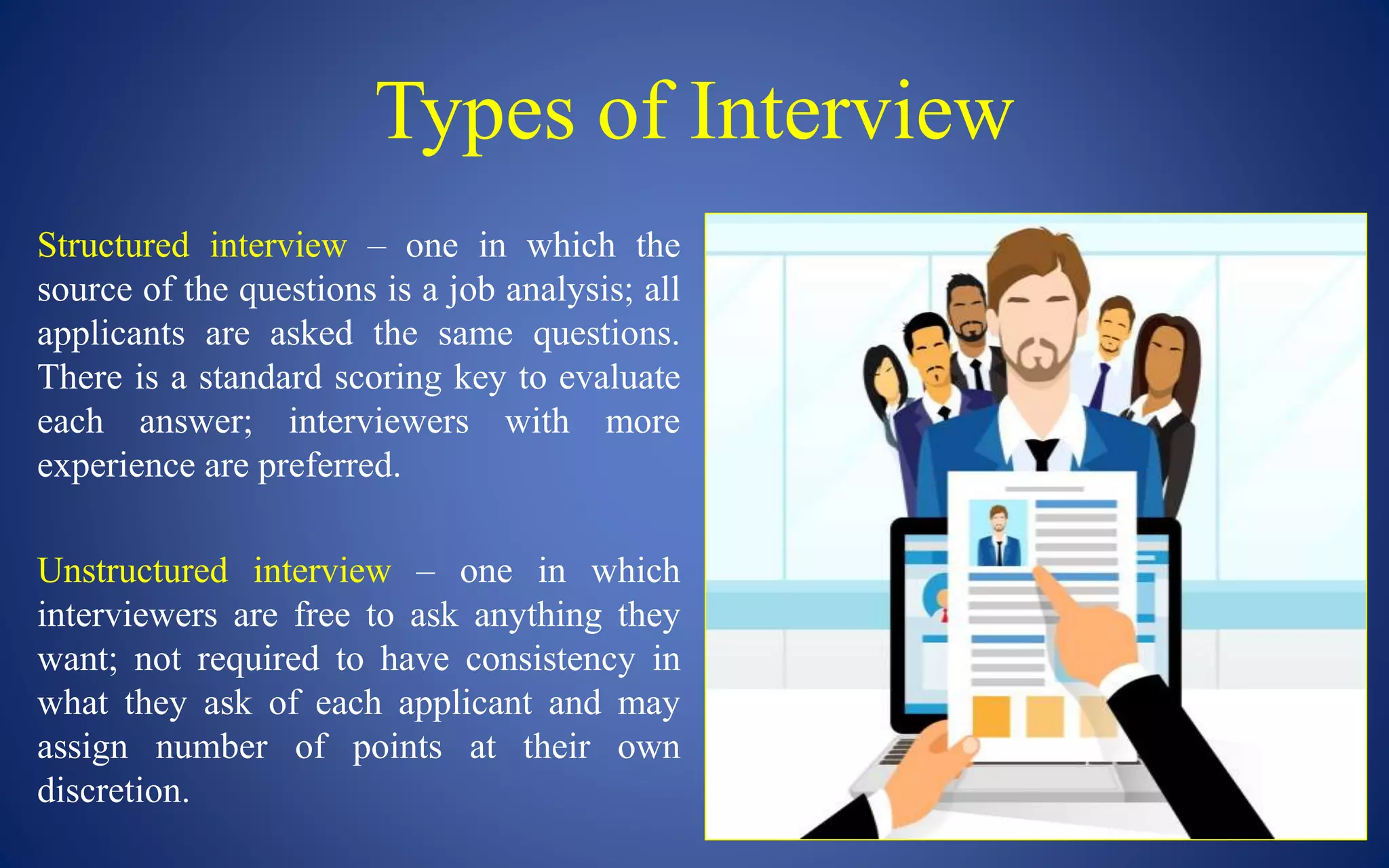
Structured interview – one in which the
source of the questions is a job analysis; all
applicants are asked the same questions.
There is a standard scoring key to evaluate
each answer; interviewers with more
experience are preferred.
Unstructured interview – one in which
interviewers are free to ask anything they
want; not required to have consistency in
what they ask of each applicant and may
assign number of points at their own
discretion.
Styles of Interview
1. One-on-one interview
2. Serial interviews
3. Panel/Round interviews
4. Group interviews
5. Face-to-face interviews
6. Telephone interviews
7. Video conference interviews
8. Written interviews
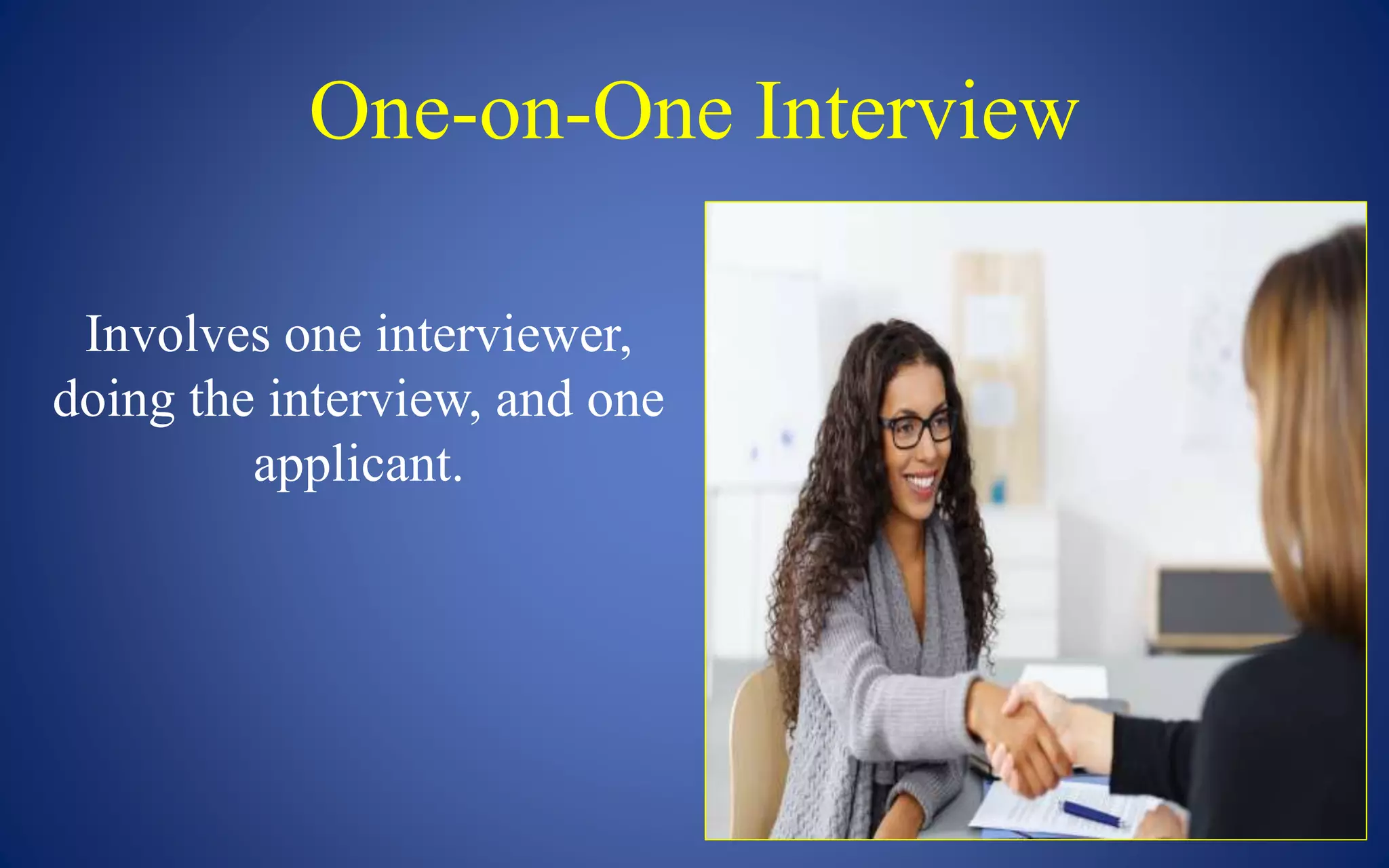
One-on-One Interview
Involves one interviewer,
doing the interview, and one
applicant.
Serial Interview
Involves a series of single
interviews.
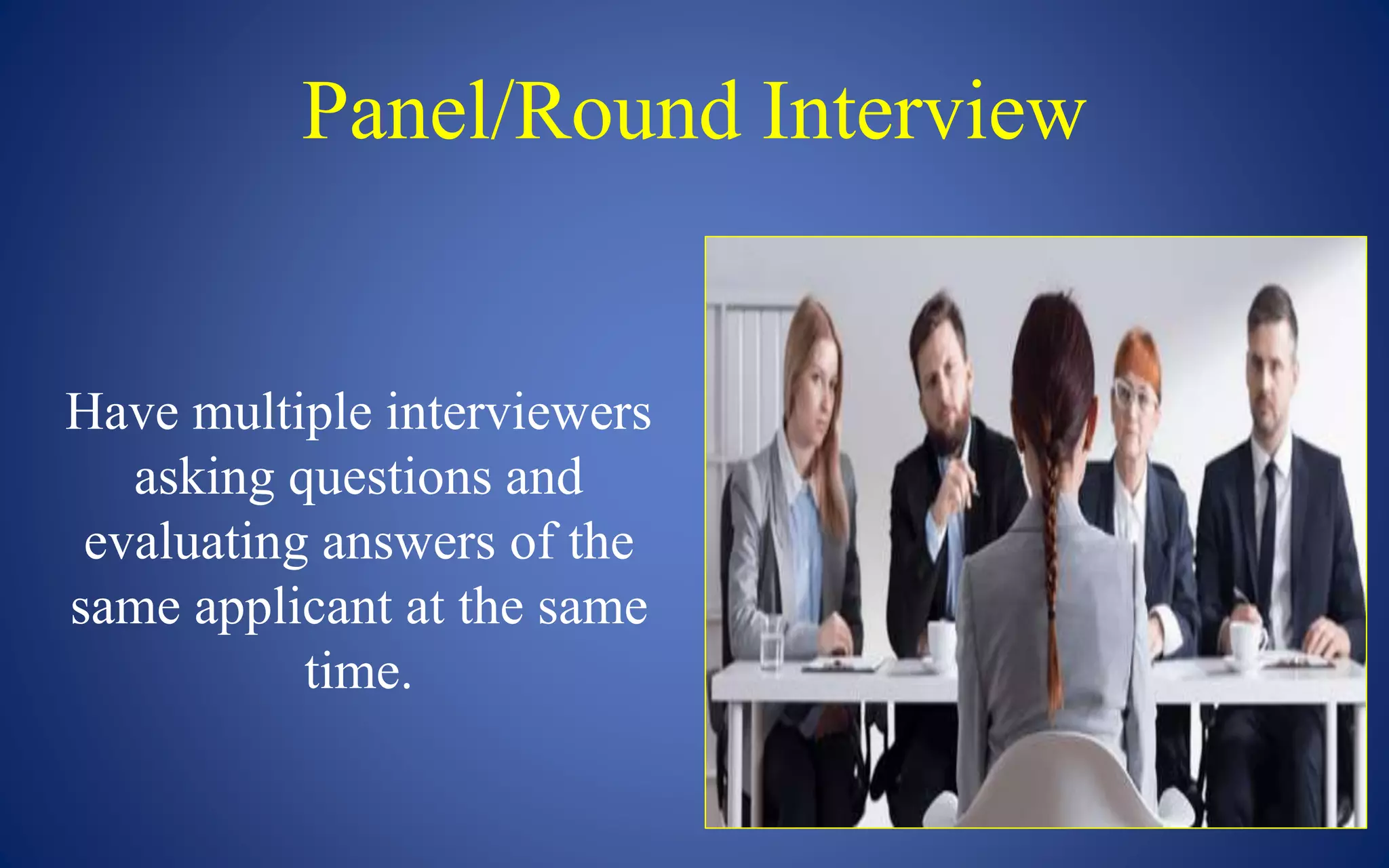
Panel/Round Interview
Have multiple interviewers
asking questions and
evaluating answers of the
same applicant at the same
time.
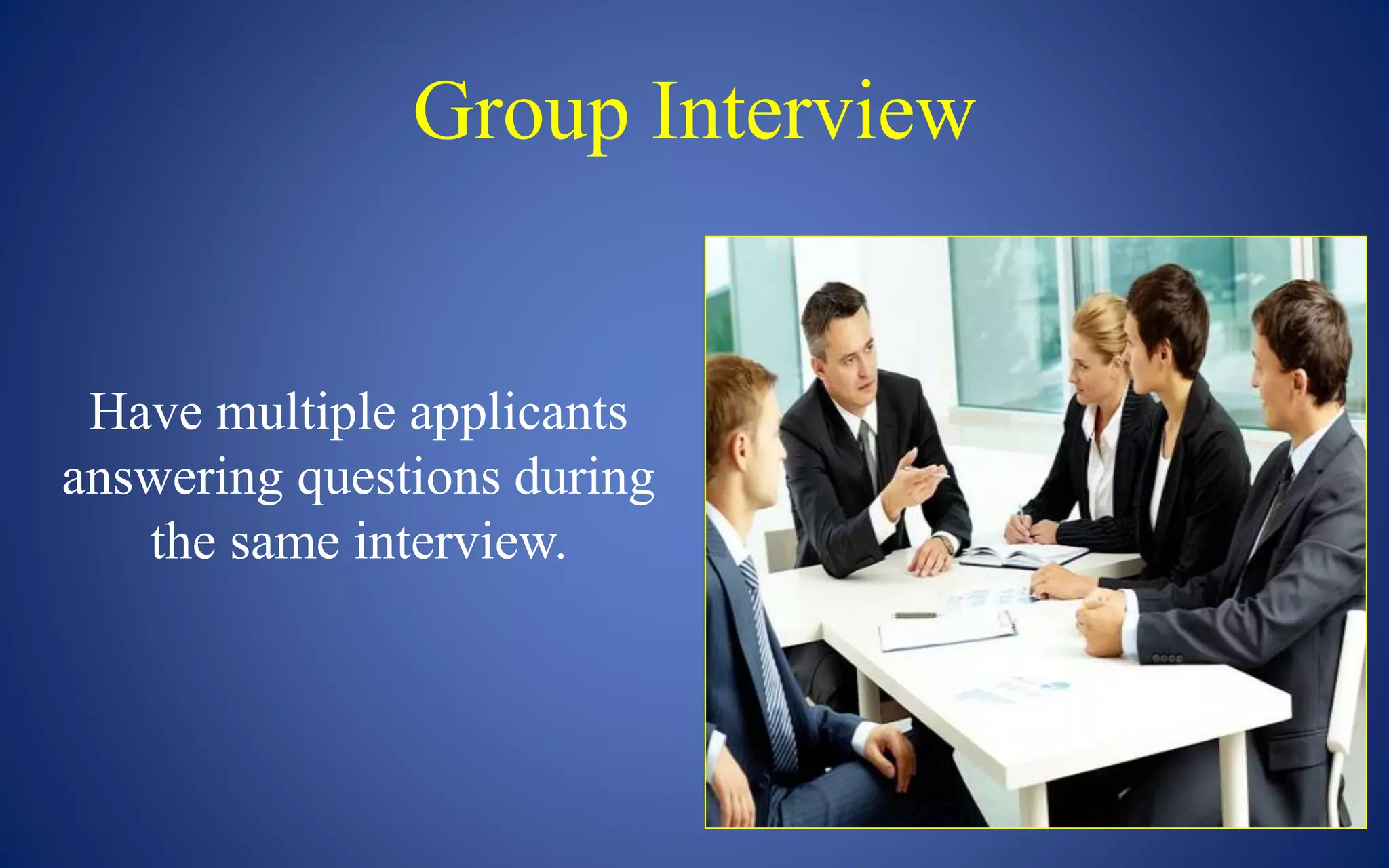
Group Interview
Have multiple applicants
answering questions during
the same interview.
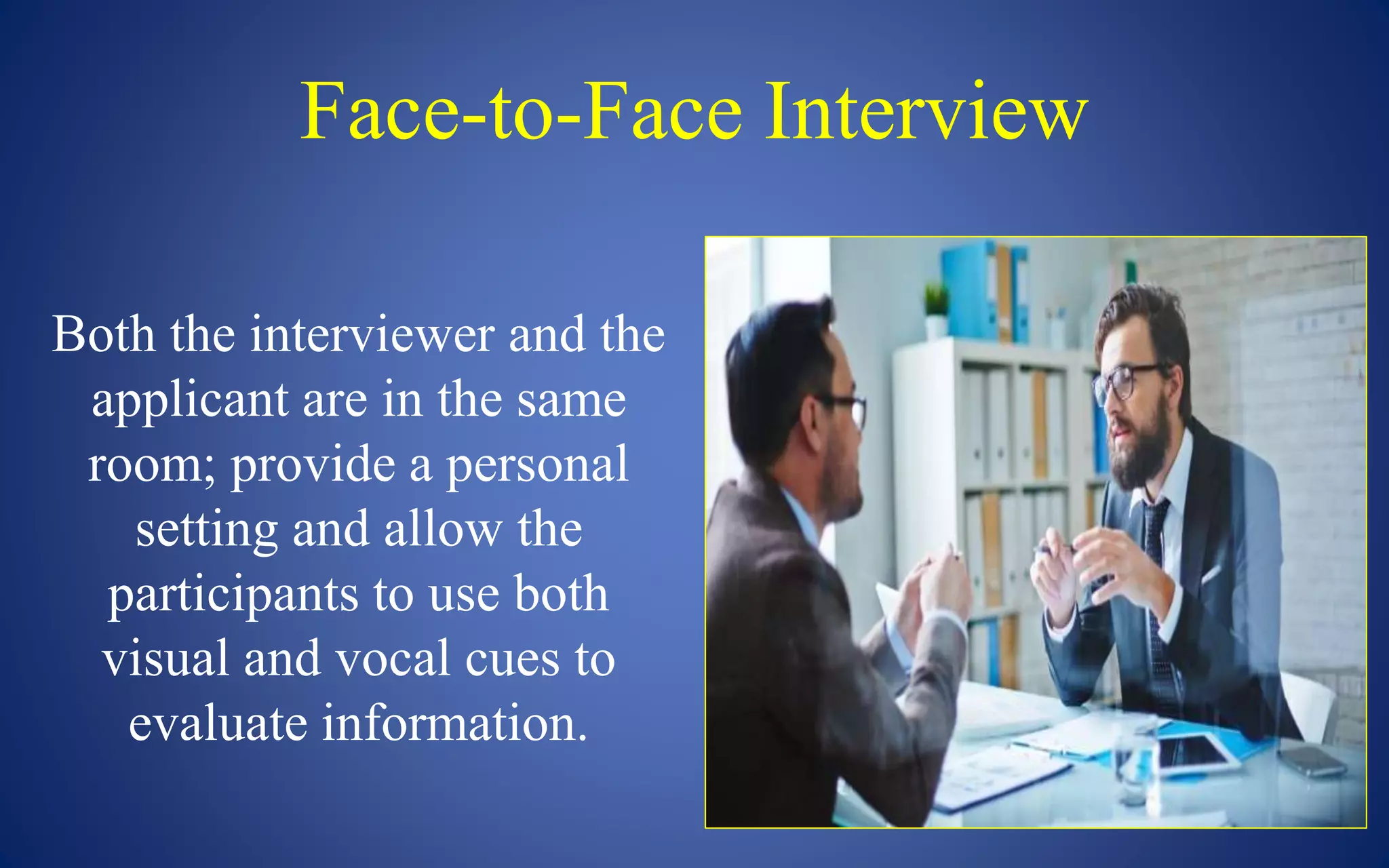
Face-to-Face Interview
Both the interviewer and the
applicant are in the same
room; provide a personal
setting and allow the
participants to use both
visual and vocal cues to
evaluate information.
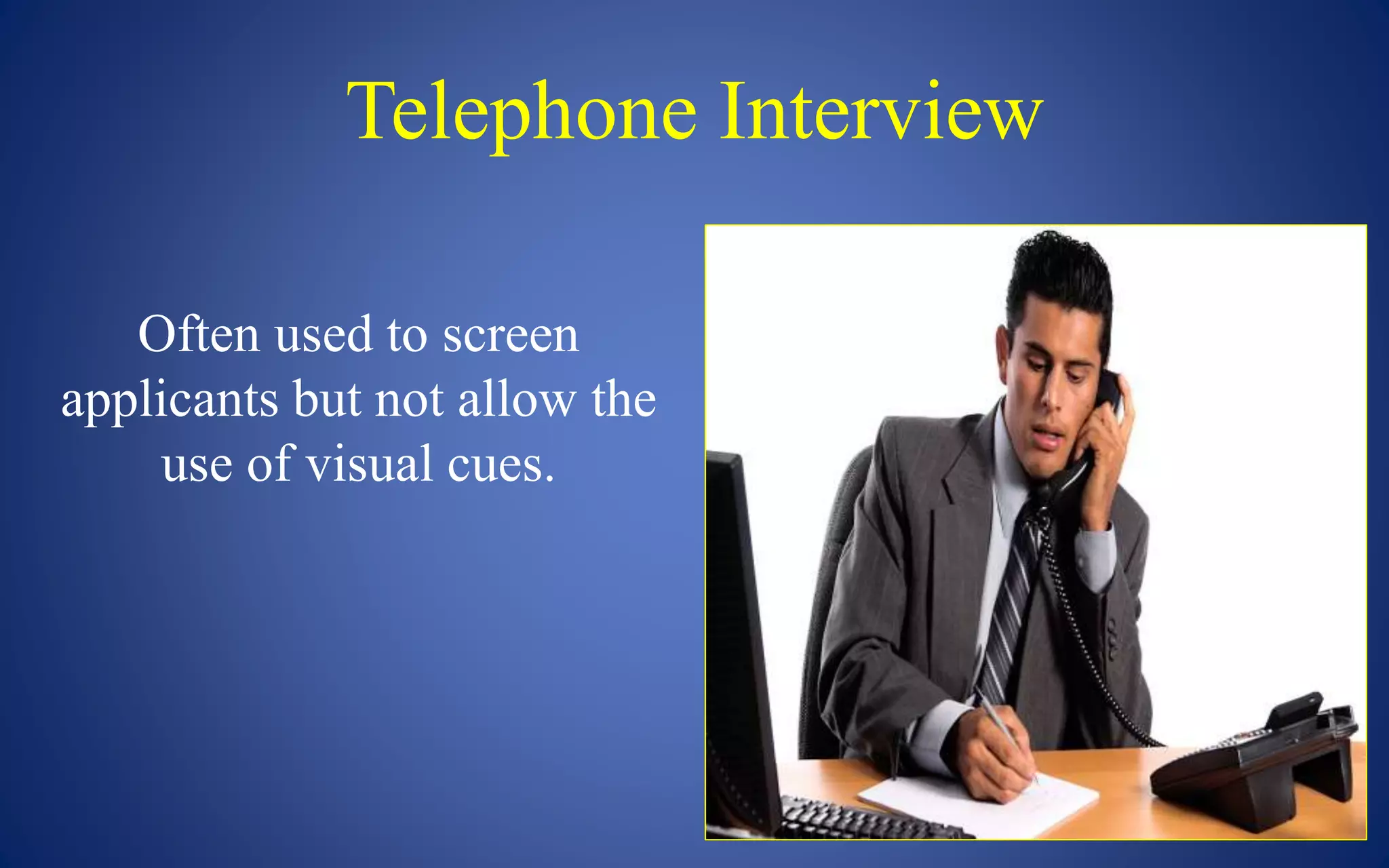
Telephone Interview
Often used to screen
applicants but not allow the
use of visual cues.
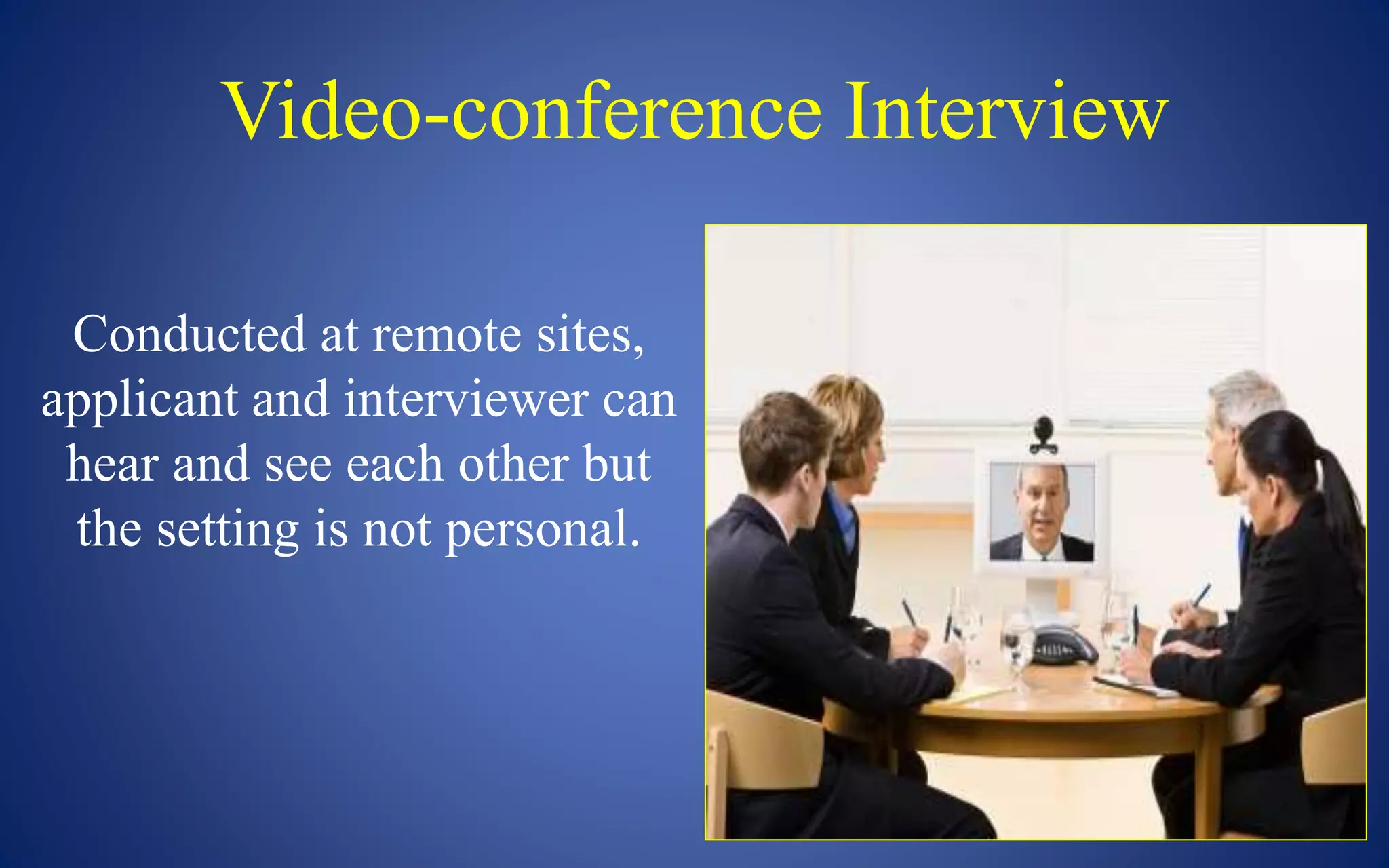
Video-conference Interview
Conducted at remote sites,
applicant and interviewer can
hear and see each other but
the setting is not personal.
Written Interview
Involves the applicant
answering a series of written
questions and then sending
the answers back through
regular mail and through
email.
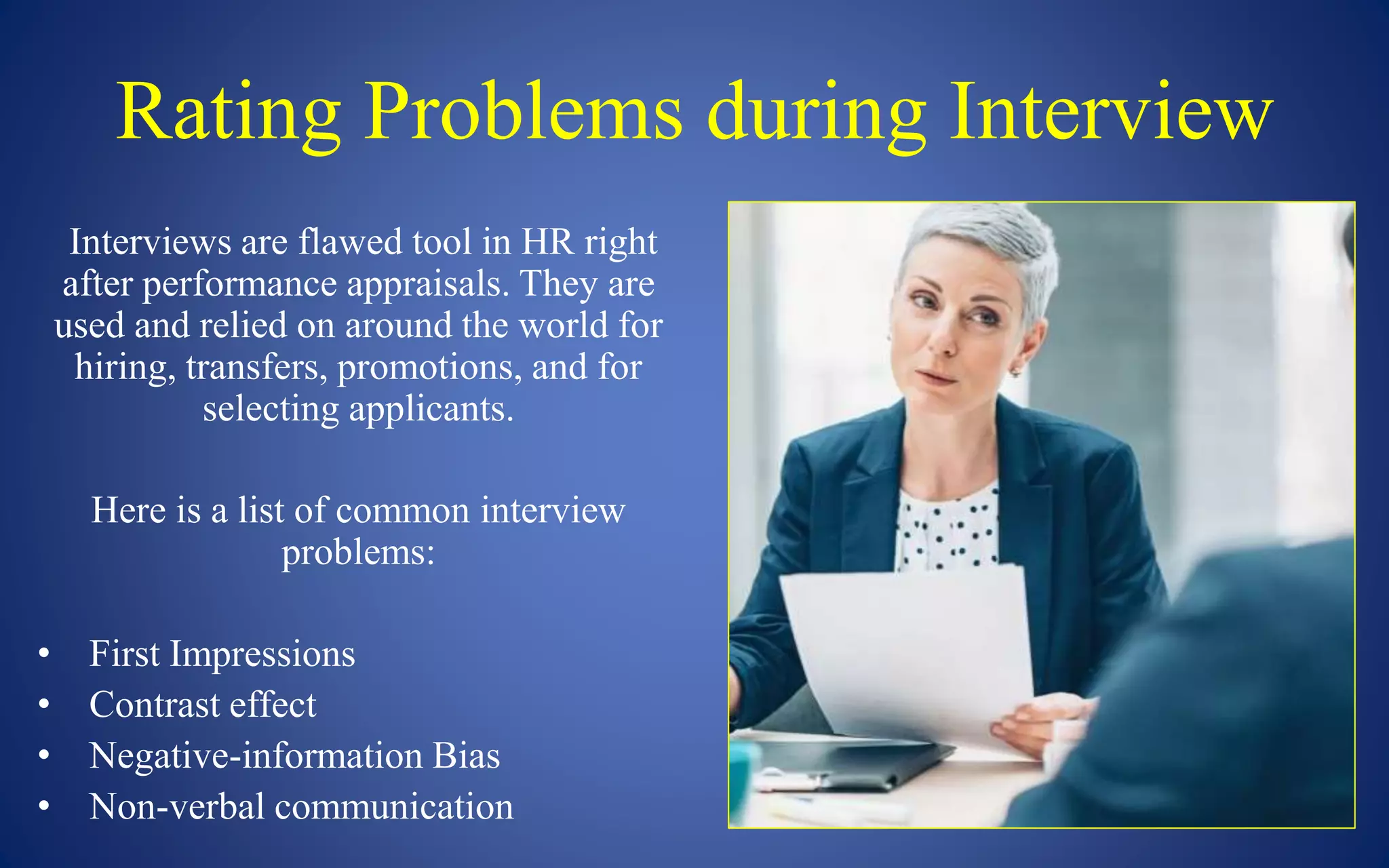
Rating Problems during Interview
Interviews are flawed tool in HR right
after performance appraisals. They are
used and relied on around the world for
hiring, transfers, promotions, and for
selecting applicants.
Here is a list of common interview
problems:
• First Impressions
• Contrast effect
• Negative-information Bias
• Non-verbal communication
First Impressions
Indicates that information
presented prior to the interview or
early in the interview carries more
weight than does information
presented later in the interviewer;
more pronounced in unstructured
interviews.
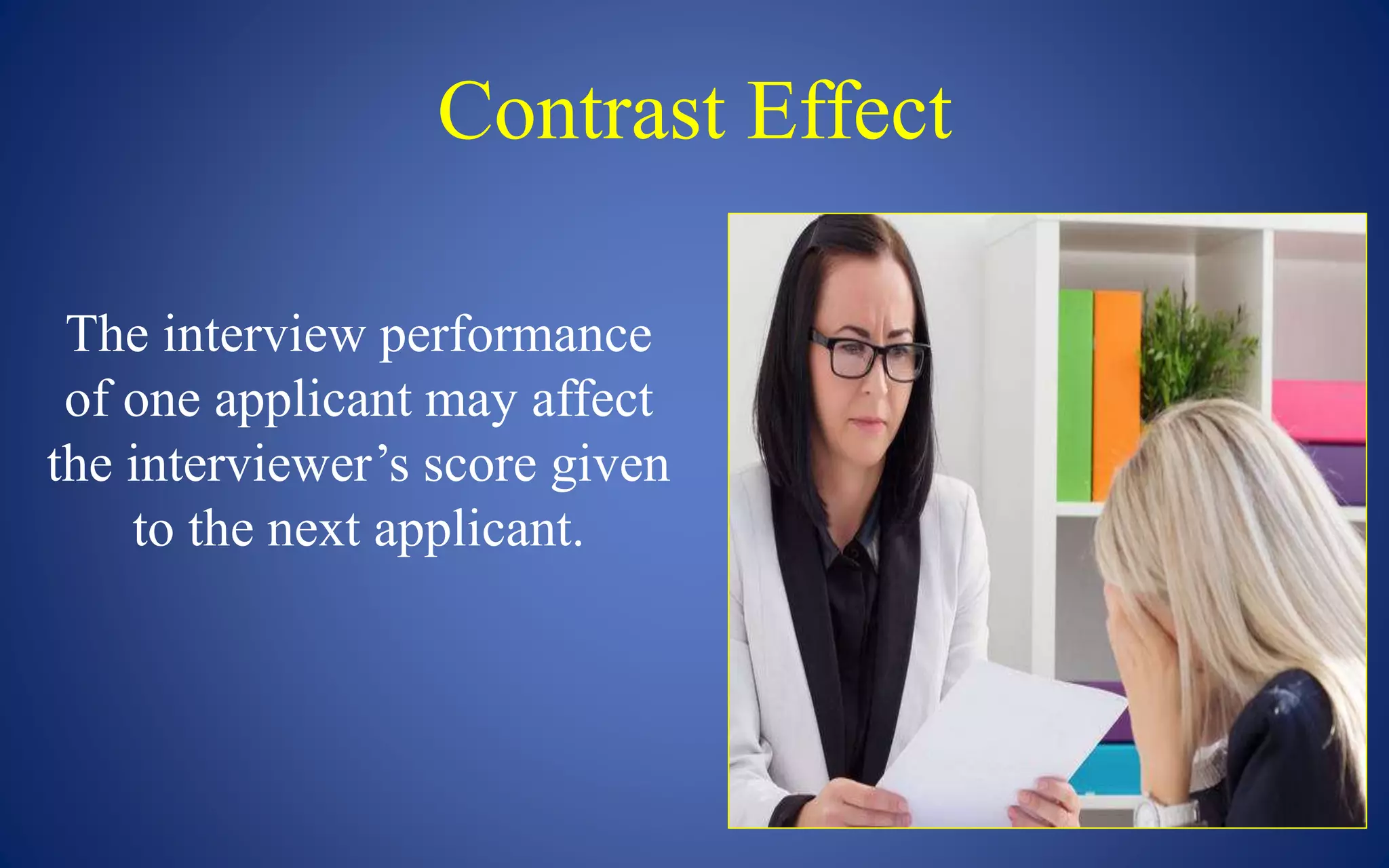
Contrast Effect
The interview performance
of one applicant may affect
the interviewer’s score given
to the next applicant.
Negative Information Bias
Occur only when the
interviewers aren’t aware of
the job requirements; weighs
more heavily than positive
information.
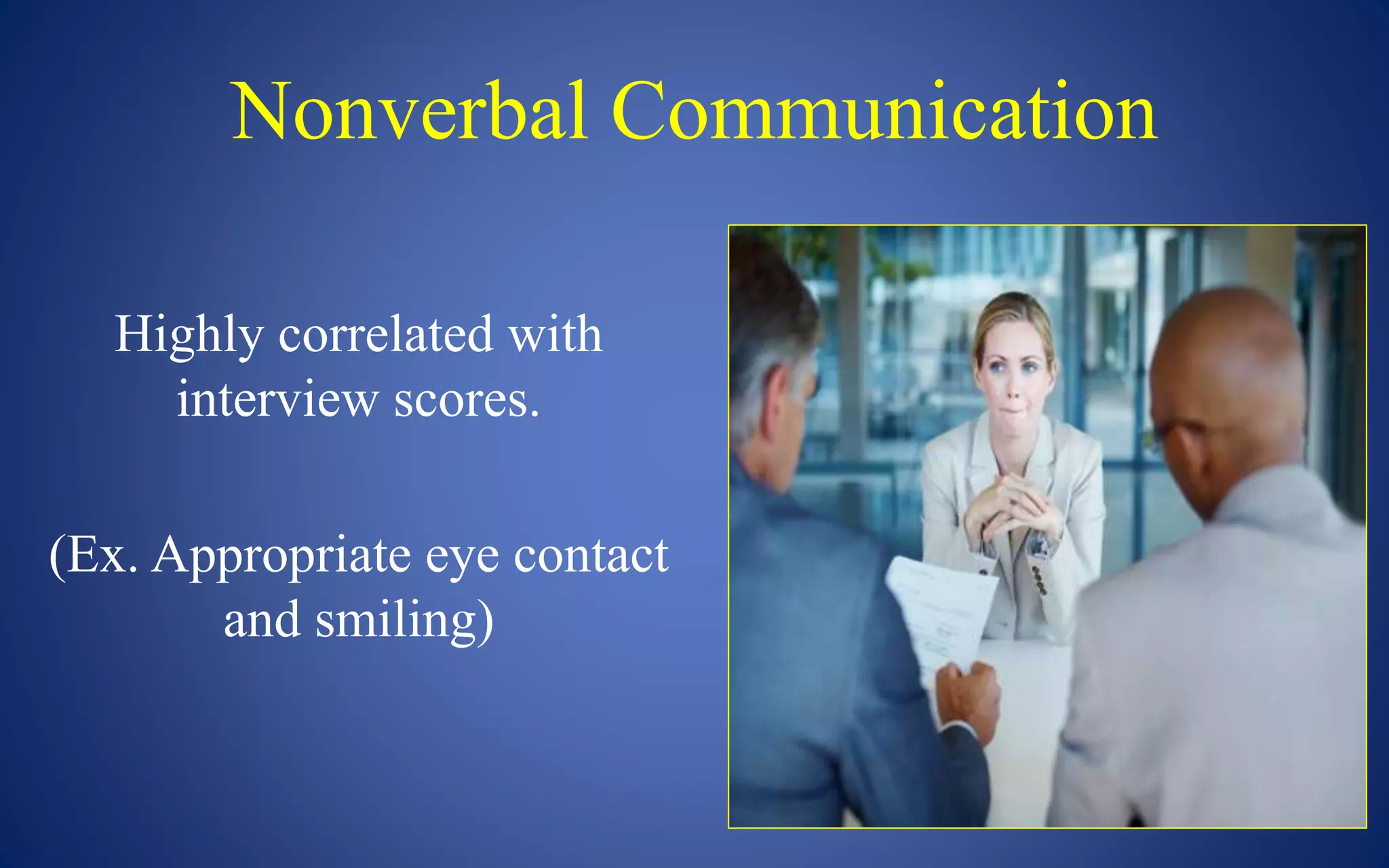
Nonverbal Communication
Highly correlated with
interview scores.
(Ex. Appropriate eye contact
and smiling)
Employment Interview
Thank you for paying
attention.

Employment Interview

  • 1.
    Employment Interview Prepared by: OrlandoA. Pistan, MAEd-GC Psychology Instructor
  • 2.
    Employment Interview An interviewconsisting of a conversation between a job applicant and a representative of an employer which is conducted to assess whether the applicant should be hired. Interviews are one of the most popularly used devices for employee selection. Also known as preliminary screening: utilized to eliminate unsuitable or unqualified candidates from the selection process.
  • 3.
    Types of Interview Structuredinterview – one in which the source of the questions is a job analysis; all applicants are asked the same questions. There is a standard scoring key to evaluate each answer; interviewers with more experience are preferred. Unstructured interview – one in which interviewers are free to ask anything they want; not required to have consistency in what they ask of each applicant and may assign number of points at their own discretion.
  • 4.
    Styles of Interview 1.One-on-one interview 2. Serial interviews 3. Panel/Round interviews 4. Group interviews 5. Face-to-face interviews 6. Telephone interviews 7. Video conference interviews 8. Written interviews
  • 5.
    One-on-One Interview Involves oneinterviewer, doing the interview, and one applicant.
  • 6.
    Serial Interview Involves aseries of single interviews.
  • 7.
    Panel/Round Interview Have multipleinterviewers asking questions and evaluating answers of the same applicant at the same time.
  • 8.
    Group Interview Have multipleapplicants answering questions during the same interview.
  • 9.
    Face-to-Face Interview Both theinterviewer and the applicant are in the same room; provide a personal setting and allow the participants to use both visual and vocal cues to evaluate information.
  • 10.
    Telephone Interview Often usedto screen applicants but not allow the use of visual cues.
  • 11.
    Video-conference Interview Conducted atremote sites, applicant and interviewer can hear and see each other but the setting is not personal.
  • 12.
    Written Interview Involves theapplicant answering a series of written questions and then sending the answers back through regular mail and through email.
  • 13.
    Rating Problems duringInterview Interviews are flawed tool in HR right after performance appraisals. They are used and relied on around the world for hiring, transfers, promotions, and for selecting applicants. Here is a list of common interview problems: • First Impressions • Contrast effect • Negative-information Bias • Non-verbal communication
  • 14.
    First Impressions Indicates thatinformation presented prior to the interview or early in the interview carries more weight than does information presented later in the interviewer; more pronounced in unstructured interviews.
  • 15.
    Contrast Effect The interviewperformance of one applicant may affect the interviewer’s score given to the next applicant.
  • 16.
    Negative Information Bias Occuronly when the interviewers aren’t aware of the job requirements; weighs more heavily than positive information.
  • 17.
    Nonverbal Communication Highly correlatedwith interview scores. (Ex. Appropriate eye contact and smiling)
  • 18.
    Employment Interview Thank youfor paying attention.