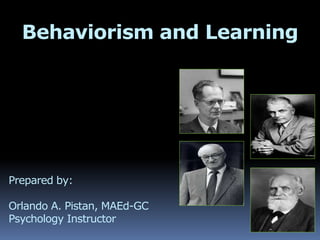
Behaviorism and Learning
Prepared by:
Orlando A. Pistan, MAEd-GC
Psychology Instructor
Behaviorism
The behaviorist movement
began in 1913 when John
Watson wrote an article
entitled 'Psychology as the
behaviorist views it,' which
set out a number of
underlying assumptions
regarding methodology
and behavioral analysis:
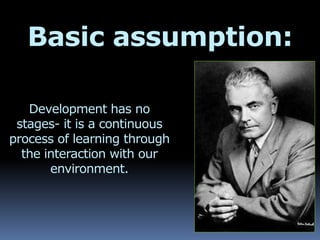
Basic assumption:
Development has no
stages- it is a continuous
process of learning through
the interaction with our
environment.
Famous Experiments:
Classical Conditioning
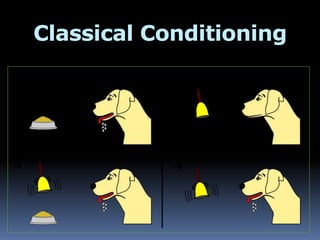
Proposed by Ivan Pavlov.
People learn by associating
neutral stimulus with a
second non-neutral stimulus.
Classical Conditioning
1. (UCS) Unconditioned stimulus – elicits natural
response or unconditioned response, (UCR).
2. (NS) Neutral stimulus– no effect on an
organism.
3. Pairing or conditioning.
4. (NS) Neutral stimulus becomes (CS) Conditioned
stimulus.
Classical Conditioning
Operant Conditioning
Proposed by Burhuss
Frederic Skinner.
Individuals learn through the
consequences of their
behavior.
Operant Conditioning
1. Consequence – the result of a behavior.
2. Reinforcement – a consequence that increases
the probability of a behavior being repeated.
(Strengthens behavior).
3. Punishment – a consequence that decrease the
likelihood of a behavior being repeated.
(Weakens behavior).
Operant Conditioning
Social Learning theory/ Cognitive
Learning theory / Observational
Learning theory
Proposed by Albert Bandura.
People learn through the
observation of a social
model.
Social Learning theory/ Cognitive
Learning theory / Observational
Learning theory
1. Model – can be a real person, or mass media,
who is being observed by an organism.
2. Encoding – paying attention and retention.
3. Imitation – a new behavior which is the product
of learning.
Social Learning theory/ Cognitive
Learning theory / Observational
Learning theory
Behaviorism and Learning
Thank you for
paying attention.

Behaviorism