MOTIVATION
Alisha Talwar
“ A G R E A T M A N I S
O N E W H O C A N
M A K E A S M A L L M A N
F E E L G R E A T , A N D
P E R F O R M G R E A T . ”
INTRODUCTION
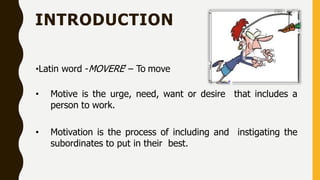
•Latin word -MOVERE’ – To move
• Motive is the urge, need, want or desire that includes a
person to work.
• Motivation is the process of including and instigating the
subordinates to put in their best.
MOTIVATION
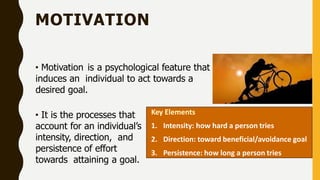
• Motivation is a psychological feature that
induces an individual to act towards a
desired goal.
• It is the processes that
account for an individual’s
intensity, direction, and
persistence of effort
towards attaining a goal.
Key Elements
1. Intensity: how hard a person tries
2. Direction: toward beneficial/avoidance goal
3. Persistence: how long a person tries
DEFINITION
• Motivation means a process of stimulating people to action
to accomplish desired goals.
-W.G.Scott
• Motivation is a process that starts with a physiological or
psychological deficiency or need that activates a behaviour or
a drive that is aimed at a goal or incentive.
-F.Luthens
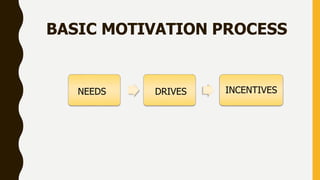
NEEDS DRIVES INCENTIVES
BASIC MOTIVATION PROCESS
MOTIVATION PROCESS
Need
• Either physiological or psychological imbalance
Drives
•Set up to alleviate needs.
•Action oriented
•Providing an energizing thrust toward reaching an incentive
•Ex: Hunger/thirst drive
Incentive
• Anything that alleviate & reduce a drive
NATURE & CHARACTERISTICS
• Component of directing
• Psychological aspect
• Goals directed
• Continuous process
• Integrated
• Positive or negative
• Complex and Dynamic process
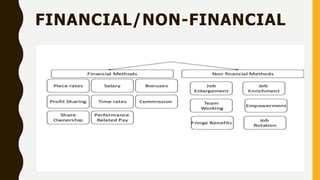
• Financial or non-financial
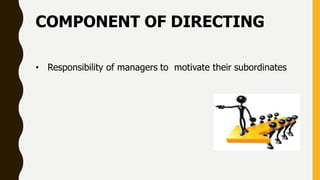
COMPONENT OF DIRECTING
• Responsibility of managers to motivate their subordinates
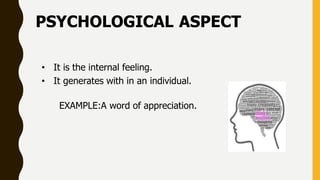
PSYCHOLOGICAL ASPECT
• It is the internal feeling.
• It generates with in an individual.
EXAMPLE:A word of appreciation.
GOALS DIRECTED
• It generates goal-directed behaviour.
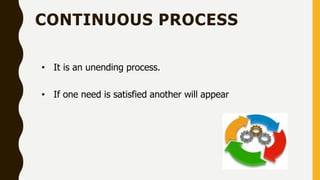
CONTINUOUS PROCESS
• It is an unending process.
• If one need is satisfied another will appear
INTEGRATED
• A person is either to be motivated or not.
• A person cannot be partly motivated.
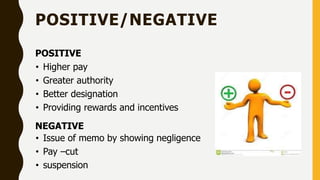
POSITIVE/NEGATIVE
POSITIVE
• Higher pay
• Greater authority
• Better designation
• Providing rewards and incentives
NEGATIVE
• Issue of memo by showing negligence
• Pay –cut
• suspension
FINANCIAL/NON-FINANCIAL
THEORIES OF
MOTIVATION
CONTENT
THEORIES
CONTENT THEORIES
•Determine what it is that motivates people at work.
• Identify the needs/drives that people have and how these
needs are prioritized.
• Referred as ‘static’ because they incorporate only one or few
points in time and are either past- present time oriented.
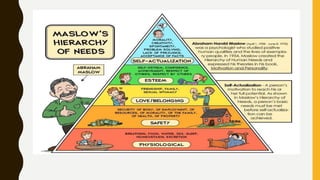
MASLOW’S HIERARCHY OF
NEED
• Proposed by Abraham Maslow
• Human behaviour is goal-directed.
• Motivation cause goal-directed behaviour.
• It is through motivation that needs can be handled and
tackled purposely.
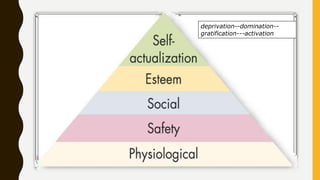
deprivation--domination--
gratification---activation
PHYSIOLOGICAL NEEDS
• Are the physical requirements for human survival.
• If these requirements are not met, the human body cannot
function properly and will ultimately fail.
• Examples: Hunger, Thirst, Sleep, Sex etc
SAFETY AND SECURITY
Safety and security needs include:
• Personal security
• Financial security
• Health and well-being
• Safety net against accidents/illness and their adverse
impacts
SOCIAL NEEDS
• This involves emotionally based relationships like friendship,
intimacy, family etc.
• Humans need to feel a sense of belonging and acceptance
• They need to love and be loved by others.
• In the absence of these elements, many people become
susceptible to loneliness, social anxiety, and clinical
depression.
•This need for belonging depending on the strength of the peer
pressure
ESTEEM NEEDS
• All humans have a need to be respected and to
have self-esteem and self respect.
• There can be two versions of esteem needs, a lower one and
a higher one.
• The lower one is the need for the respect of others, the need
for status, recognition, fame, prestige, and attention.
• The higher one is the need for self-respect, the need for
strength, competence, mastery, self-confidence, independence
and freedom.
SELF-ACTUALIZATION
• This level of need pertains to what a person’s full potential is
and realizing that potential.
• Maslow describes this desire as the desire to become more
and more what one is, to become everything that one is
capable of becoming.
CRITICISM
• Maslow's theory is a theory of human behavior in general
rather than work behavior
• Little evidence has been found for the ranking of needs
that Maslow described, or even for the existence of a
definite hierarchy at all. (Wahba, M. A., & Bridwell, L.
G.,1976)
•Needs are not independent to one another, they overlaps
(Kenrick, D.T., et.al,2010)
CONTD…
• The position and value of sex on the pyramid is in the
physiological needs category along with food and breathing; it
lists sex solely from an individualistic perspective, it forgets the
emotional, familial and evolutionary aspects of the same.
(Kenrick, D.T., et.al,2010)
• Needs are interactive, dynamic system anchored in the
ability to make social connections.( Steve Denning, 2012)
THE HERZBERG’S MOTIVATION-
HYGIENE THEORY
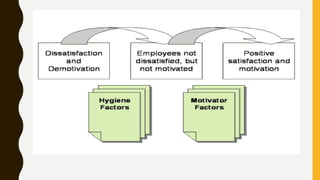
• Herzberg’s Motivation-Hygiene Theory is given by Fredrick
• According to Hertzberg, Motivation is a two stage process.
–The opposite of Satisfaction is No Satisfaction.
–The opposite of Dissatisfaction is No Dissatisfaction.
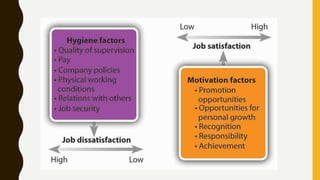
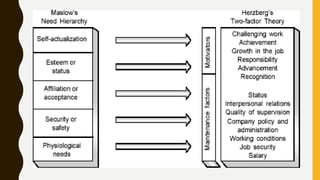
HYGIENE FACTORS
•Preventive and environmental in nature
•Roughly equivalent to Maslow's lower level needs
•It prevents dissatisfaction, but they do not lead to satisfaction
•It cannot motivate
MOTIVATORS
•Factors that motivate people on the job
•Roughly equivalent to Maslow's higher needs
FACTORS FOR
DISSATISFACTION
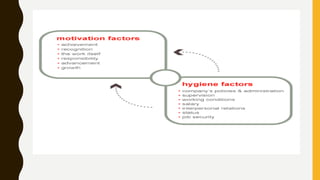
• Company Policies
• Supervision
• Relationship with Supervisor and Peers
• Work conditions
• Salary/Perks
• Status
• Security
FACTORS FOR SATISFACTION
• Growth opportunity
• The work itself
• Achievement
• Responsibility
• Recognition
• Advancement
IMPLICATIONS
• Many organisations try to motivate employees with hygiene
factors like salary.
• Hygiene factors are necessary for employee retention, but it
cannot motivate talented employees to stay with organisations
for long.
CRITICISMS
•The theory appears to be bound to the critical incident method
• The reliability of the data could have been negatively
impacted by ego-defensiveness on the part of the employee
• The value of the factors differed as a function of the
occupational level of the employee
•Ignores the part played by individual differences among
employees(Gaziel, 1986).
CONTD…
• It is more of an job satisfaction theory than of a motivation
theory
•Two factors are not actually distinct. Factors overlapped as
• sources of satisfaction and dissatisfaction
(K Aswathappa, 2005)
MCGREGOR'S THEORY X AND
THEORY Y
• Douglas McGregor proposed X-Y theory.
• McGregor's ideas suggest that there are two fundamental
approaches to managing people.
• Theory X and Theory Y have to do with the perceptions
managers hold on their employees, not the way they
generally behave.
• It is attitude not attributes.
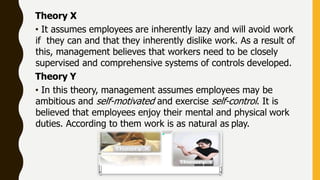
Theory X
• It assumes employees are inherently lazy and will avoid work
if they can and that they inherently dislike work. As a result of
this, management believes that workers need to be closely
supervised and comprehensive systems of controls developed.
Theory Y
• In this theory, management assumes employees may be
ambitious and self-motivated and exercise self-control. It is
believed that employees enjoy their mental and physical work
duties. According to them work is as natural as play.
SIGNIFICANCE
• Theory remains a valid basic principle from which to
develop positive management style and techniques.
• Remains central to organizational development, and to
improving organizational culture.
• A simple reminder of the natural rules for managing people,
which under the pressure of day-to-day business are all too
easily forgotten.
• Theory X might be more suitable in some crisis situations
but less appropriate in more routine and formalized
situations. In India Theory X may still be useful at the lower
levels of organisation.
MCCLELLAND’S NEEDS THEORY
• Proposed by a psychologist David McClelland
• Individual are acquired over a period of time and gets
molded with one’s experience of the life. McClelland’s Needs
Theory is sometimes referred to as Three
• Need theory or Learned Needs Theory.
CONTD…
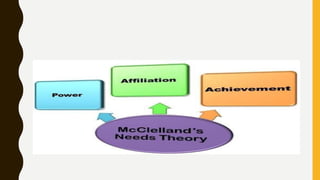
• Model that attempts to explain 3 motivational needs
• Need for achievement (n-Ach): The drive to excel, to
achieve in relation to a set of standards, to strive to
succeed.
• Need for power (n-Pow): The need to make others
behave in a way that they would not have behaved
otherwise.
•Need for affiliation (n-Aff): The desire for friendly and
close interpersonal relationships.
ALDERFER’S ERG THEORY
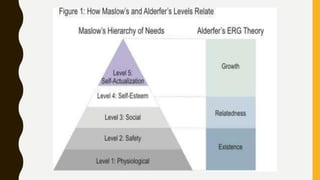
• Alderfer’s ERG Theory is the extension of Maslow’s Needs
Hierarchy, wherein the Maslow’s five needs are categorized
into three categories, Viz. Existence Needs, Relatedness
Needs, and Growth Needs.
CONTD…
Existence Needs
– Comprises of all those needs that relate to the physiological
and safety aspects of human beings and are a prerequisite for
the survival.
– Thus, both the physiological and safety needs of Maslow are
grouped into one category because of their same nature and a
similar impact on the behavior of an individual.
CONTD…
Relatedness Needs
–Refer to the social needs, that an individual seeks to
establish relationships with those for whom he cares.
–These needs cover the Maslow’s social needs and a part of
esteem needs, derived from the relationship with other
people.
CONTD..
Growth Needs
–The growth needs cover Maslow’s self-actualization needs
as well as a part of esteem needs which are internal to
the individual, such as a feeling of being unique,
personnel growth, etc.
–Thus, growth needs are those needs that influence an
individual to explore his maximum potential in the existing
environment
PROCESS
THEORIES
PROCESS THEORY
•Deal with the “process” of motivation, on how motivation
occurs
• Concerned with cognitive antecedents that go into
motivation or effort and with way they relate to one another
VROOM’S EXPECTANCY
THEORY
• Proposed by Victor. H. Vroom
• Based on the assumption that an individual’s behavior results
from the choices made by him with respect to the alternative
course of action, which is related to the psychological events
occurring simultaneously with the behavior.
• This means an individual selects a certain behavior over the
other behaviors with an expectation of getting results, the
one desired for.
CONTD…
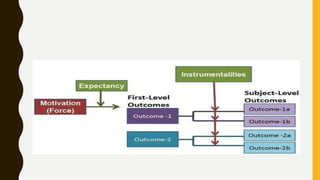
• This theory is built around the concept of valence,
instrumentality, and Expectancy and, therefore, is often
called as VIE theory.
• The algebraic representation of Vroom’s Expectancy theory is:
• Motivation (force) = ∑Valence x Expectancy
CONTD…
• Expectancy – a person’s belief that more effort will result in
success. If you work harder, it will result in better
performance.
• Instrumentality- the person’s belief that there is a
connection between activity and goal. If you perform well,
you will get reward.
• Valence – the degree to which a person values the reward,
the results of success.
IMPLICATIONS
• Everyone has a unique combination of valences,
instrumentalities, and expectancies. Thus vroom theory
indicates only the conceptual determinants of motivation and
how they are related, not the what motivates the employees of
an organisation.
• Vroom model does not directly contribute much to the
techniques of motivating personnel in an organisation.
(F.Luthens,1995)
ADAM’S EQUITY THEORY
• The Adam’s Equity Theory posits that people maintain a
fair relationship between the performance and rewards in
comparison to others.
• Proposed by John Stacey Adams
• Based on the following assumptions:
• Individuals make contributions (inputs) for which
they certain rewards (outcome)
CONTD..
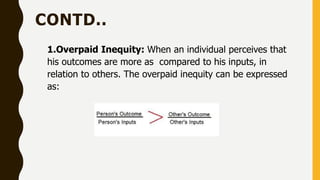
1.Overpaid Inequity: When an individual perceives that
his outcomes are more as compared to his inputs, in
relation to others. The overpaid inequity can be expressed
as:
CONTD..
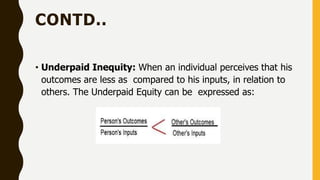
• Underpaid Inequity: When an individual perceives that his
outcomes are less as compared to his inputs, in relation to
others. The Underpaid Equity can be expressed as:
CONTD…
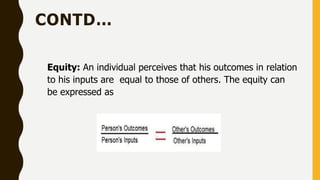
Equity: An individual perceives that his outcomes in relation
to his inputs are equal to those of others. The equity can
be expressed as
CONTD…
• Adam’s equity theory shows the level of motivation among
the individuals in the working environment.
• An individual is said to be highly motivated if he perceives to
be treated fairly. While the feelings of de-motivation arise, if
an individual perceives to be treated unfairly in the
organization
GOAL SETTING THEORY,
EDWIN A LOCKE (1968)
• Goal setting involves establishing SMART goals.
• People are aware of what is expected from them.
• On a personal level, setting goals helps people work
towards their own objectives.
• Goals are a form of motivation that sets the standard for
self-satisfaction with performance.
• It is considered an “open” theory, so as new discoveries
are made it is modified.
CONTD..
• Create a positive context for feedback.
• Use constructive and positive language.
• Focus on behaviours and strategies.
• Tailor feedback to the needs of the individuals.
• Make feedback a two-way communication process.
CONTD..
• Employees’ participation in goal is not always desirable.
• Participation of setting goal, however, makes goal more
acceptable and leads to more involvement.
• goal setting theory has certain eventualities such as:
CONTD..
a. Self-efficiency- Self-efficiency is the individual’s self-
confidence and faith that he has potential of performing the
task.
b. Higher the level of self-efficiency, greater will be the efforts put
in by the individual when they face challenging tasks.
c. While, lower the level of self-efficiency, less will be the efforts
put in by the individual or he might even quit while meeting
challenges.
CONTD..
b. Goal commitment- Goal setting theory assumes that the
individual is committed to the goal and will not leave the goal.
The goal commitment is dependent on the following factors:
• Goals are made open, known and broadcasted.
• Goals should be set-self by individual rather than designated.
• Individual’s set goals should be consistent with the
organizational goals and vision.
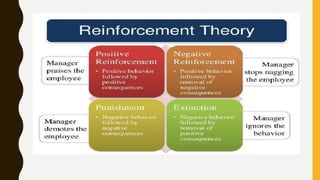
REINFORCEMENT THEORY
• This theory is based on the concepts of operand conditioning
developed by B.F. Skinner.
• It argues that the behavior of people is largely determined
by its consequence.
• Those actions that tend to have positive or pleasant
consequences tend to be repeated more often in future, while
those actions that tend to have repeated negative or
unpleasant consequences are less likely to be repeated
again.
CONTD…
1. Positive Reinforcement: A method of strengthening
behavior with rewards or positive outcomes after a desired
behavior is performed.
2. Avoidance / Negative reinforcement: Used to
strengthen behavior by avoiding unpleasant consequences
that would result if the behavior was not performed.
CONTD..
3. Punishment: Used to weaken undesired behaviors by
using negative outcomes or unpleasant consequence when the
behaviour is performed.
4.Extinction: Used to weaken undesired behaviors by
simply ignoring or not reinforcing that behavior.
SIGNIFICANCE
• Performance = motivation X ability X situational
factors
• More motivated the employees, more the performance
• Motivation is important in getting and retaining people.
Motivation tools act as the glue that links individuals to
organizational goals
• Employee motivation is directly linked to business profits,
and the more self-motivated your employees are, the more
differentiated and successful you will be as a business.
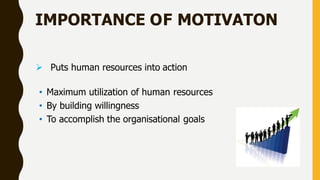
IMPORTANCE OF MOTIVATON
 Puts human resources into action
• Maximum utilization of human resources
• By building willingness
• To accomplish the organisational goals
CONTD..
 Improves level of efficiency of employees
• Increase in productivity,
• Reducing cost of operations,
• Improving overall efficiency.
CONTD…
 Leads to achievement of organizational goals
• There is best possible utilization of resources
• There is a co-operative work environment
• The employees are goal- directed and they act in a
purposive
CONTD…
 Builds friendly relationship
• Effective co-operation
• Inter -personal relationships
 Leads to stability of work force
• Employees will remain loyal to the
enterprise
 Reduction in labour turnover
• Here the management will fulfil all the
genuine needs of the employees
IMPORTANCE TO AN
INDIVIDUAL
• Motivation will help him to achieve his personal goals.
• If an individual is motivated, he will have job
satisfaction.
CONTD..
• Motivation will help in self- development of individual.
• An individual would always gain by working with a dynamic
team.
TYPES OF
MOTIVATION
Intrinsically
Motivated.
Extrinsically
Motivated.
EXTRINSIC MOTIVATION
 Extrinsic motivation means that the individual's motivational
stimuli are coming from outside.
 Extrinsic motivation is external in nature.
• Examples
• Employee of the month award
• Benefit package
• Bonuses
• Organized activities
INTRINSIC MOTIVATION
 Intrinsic motivation means that the individual's motivational stimuli
are coming from within.
• Examples
• Acceptance
• Curiosity
• Honor
• Independence
CONTD..
• Acceptance: We all need to feel that we, as well as our decisions, are
accepted by our co-workers.
• Curiosity: We all have the desire to be in the know.
• Honor: We all need to respect the rules and to be ethical.
• Independence: We all need to feel we are unique.
• Order: We all need to be organized.
• Power: We all have the desire to be able to have influence.
• Social contact: We all need to have some social interactions.
• Social Status: We all have the desire to feel important.
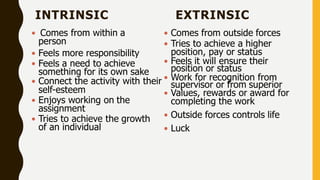
INTRINSIC
 Comes from within a
person
 Feels more responsibility
 Feels a need to achieve
something for its own sake
 Connect the activity with their
self-esteem
 Enjoys working on the
assignment
 Tries to achieve the growth
of an individual
EXTRINSIC
 Comes from outside forces
 Tries to achieve a higher
position, pay or status
 Feels it will ensure their
position or status
 Work for recognition from
supervisor or from superior
 Values, rewards or award for
completing the work
 Outside forces controls life
 Luck
ROLE & FUNCTION OF MANAGER
IN CREATING MOTIVATING
CLIMATE
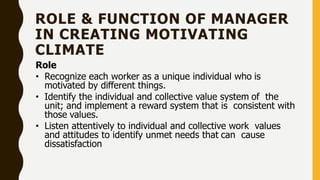
Role
• Recognize each worker as a unique individual who is
motivated by different things.
• Identify the individual and collective value system of the
unit; and implement a reward system that is consistent with
those values.
• Listen attentively to individual and collective work values
and attitudes to identify unmet needs that can cause
dissatisfaction
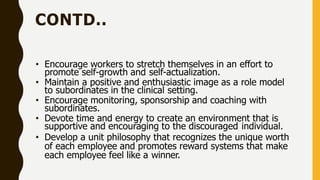
CONTD..
• Encourage workers to stretch themselves in an effort to
promote self-growth and self-actualization.
• Maintain a positive and enthusiastic image as a role model
to subordinates in the clinical setting.
• Encourage monitoring, sponsorship and coaching with
subordinates.
• Devote time and energy to create an environment that is
supportive and encouraging to the discouraged individual.
• Develop a unit philosophy that recognizes the unique worth
of each employee and promotes reward systems that make
each employee feel like a winner.
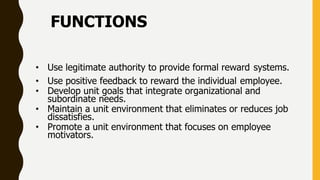
FUNCTIONS
• Use legitimate authority to provide formal reward systems.
• Use positive feedback to reward the individual employee.
• Develop unit goals that integrate organizational and
subordinate needs.
• Maintain a unit environment that eliminates or reduces job
dissatisfies.
• Promote a unit environment that focuses on employee
motivators.
CONTD…
• Create the tension necessary to maintain productivity
while encouraging subordinate job satisfaction.
• Clearly communicate expectations to subordinates.
• Demonstrate and communicate sincere respect, concern,
trust and a sense of belonging to subordinates.
• Assign work duties commensurate with employee‟s
abilities and post performance to foster a sense of
accomplishment in subordinates.
• Identify achievement, affiliation or power needs of
subordinates and develop appropriate motivational
strategies to meet those needs.
REFERENCES
• Wahba, M. A., & Bridwell, L. G. (1976). Maslow reconsidered: A review of research on
the need hierarchy theory. Organizational Behavior and Human Performance, 15(2),
212–240. doi: 10.1016/0030- 5073(76)90038-6
• Steve Denning, What Maslow Missed, 2012,
http://www.forbes.com/sites/stevedenning/2012/03/29/what-maslow-missed/
• Kenrick, D.T., Griskevicius, V., Neuberg, S.L., & Schaller, M. (2010). Renovating the
pyramid of needs: Contemporary extensions built upon ancient foundations.
Perspectives on Psychological Science, http:// www.csom.umn.edu/assets/144040.pdf
• A.H. Maslow, A Theory of Human Motivation, Psychological Review 50(4) (1943):370-
96
• Alderfer, Clayton P., An Empirical Test of a New Theory of Human Needs;
Organizational Behaviour and Human Performance, volume 4, issue 2, pp. 142–175,
May 1969
REFERENCES
• Alderfer, C. P. (1969). An empirical test of a new theory of human
needs. Organizational Behavior and Human Performance, 4, 142–175.
• Herzberg, F., Mausner, B., & Snyderman, B. (1959). The motivation to
work. New
• York: John Wiley and Sons;
• Herzberg, F. (1965). The motivation to work among Finnish supervisors.
Personnel Psychology, 18, 393–402.
• Porter, L. W., & Lawler, E. E. (1968). Managerial attitudes and
performance.
• Homewood, IL: Irwin; Vroom, V. H. (1964). Work and motivation. New
York: Wiley.
REFERENCES
• K Aswathappa, Human Resource And Personnel Management,
Tata McGraw-Hill Education, 2005
• Gaziel, H. (1986). Correlates of job satisfaction: A study of
the two factor theory in an educational setting. The Journal
of Psychology, 120(6), 613-626.
• Adams, J.S. 1965. Inequity in social exchange. Adv. Exp. Soc.
Psychol. 62:335-343.
Motivation

Motivation

  • 1.
  • 2.
    “ A GR E A T M A N I S O N E W H O C A N M A K E A S M A L L M A N F E E L G R E A T , A N D P E R F O R M G R E A T . ”
  • 3.
    INTRODUCTION •Latin word -MOVERE’– To move • Motive is the urge, need, want or desire that includes a person to work. • Motivation is the process of including and instigating the subordinates to put in their best.
  • 4.
    MOTIVATION • Motivation isa psychological feature that induces an individual to act towards a desired goal. • It is the processes that account for an individual’s intensity, direction, and persistence of effort towards attaining a goal. Key Elements 1. Intensity: how hard a person tries 2. Direction: toward beneficial/avoidance goal 3. Persistence: how long a person tries
  • 5.
    DEFINITION • Motivation meansa process of stimulating people to action to accomplish desired goals. -W.G.Scott • Motivation is a process that starts with a physiological or psychological deficiency or need that activates a behaviour or a drive that is aimed at a goal or incentive. -F.Luthens
  • 6.
  • 7.
    MOTIVATION PROCESS Need • Eitherphysiological or psychological imbalance Drives •Set up to alleviate needs. •Action oriented •Providing an energizing thrust toward reaching an incentive •Ex: Hunger/thirst drive Incentive • Anything that alleviate & reduce a drive
  • 8.
    NATURE & CHARACTERISTICS •Component of directing • Psychological aspect • Goals directed • Continuous process • Integrated • Positive or negative • Complex and Dynamic process • Financial or non-financial
  • 9.
    COMPONENT OF DIRECTING •Responsibility of managers to motivate their subordinates
  • 10.
    PSYCHOLOGICAL ASPECT • Itis the internal feeling. • It generates with in an individual. EXAMPLE:A word of appreciation.
  • 11.
    GOALS DIRECTED • Itgenerates goal-directed behaviour.
  • 12.
    CONTINUOUS PROCESS • Itis an unending process. • If one need is satisfied another will appear
  • 13.
    INTEGRATED • A personis either to be motivated or not. • A person cannot be partly motivated.
  • 14.
    POSITIVE/NEGATIVE POSITIVE • Higher pay •Greater authority • Better designation • Providing rewards and incentives NEGATIVE • Issue of memo by showing negligence • Pay –cut • suspension
  • 15.
  • 16.
  • 17.
  • 18.
    CONTENT THEORIES •Determine whatit is that motivates people at work. • Identify the needs/drives that people have and how these needs are prioritized. • Referred as ‘static’ because they incorporate only one or few points in time and are either past- present time oriented.
  • 19.
    MASLOW’S HIERARCHY OF NEED •Proposed by Abraham Maslow • Human behaviour is goal-directed. • Motivation cause goal-directed behaviour. • It is through motivation that needs can be handled and tackled purposely.
  • 21.
  • 22.
    PHYSIOLOGICAL NEEDS • Arethe physical requirements for human survival. • If these requirements are not met, the human body cannot function properly and will ultimately fail. • Examples: Hunger, Thirst, Sleep, Sex etc
  • 23.
    SAFETY AND SECURITY Safetyand security needs include: • Personal security • Financial security • Health and well-being • Safety net against accidents/illness and their adverse impacts
  • 24.
    SOCIAL NEEDS • Thisinvolves emotionally based relationships like friendship, intimacy, family etc. • Humans need to feel a sense of belonging and acceptance • They need to love and be loved by others. • In the absence of these elements, many people become susceptible to loneliness, social anxiety, and clinical depression. •This need for belonging depending on the strength of the peer pressure
  • 25.
    ESTEEM NEEDS • Allhumans have a need to be respected and to have self-esteem and self respect. • There can be two versions of esteem needs, a lower one and a higher one. • The lower one is the need for the respect of others, the need for status, recognition, fame, prestige, and attention. • The higher one is the need for self-respect, the need for strength, competence, mastery, self-confidence, independence and freedom.
  • 26.
    SELF-ACTUALIZATION • This levelof need pertains to what a person’s full potential is and realizing that potential. • Maslow describes this desire as the desire to become more and more what one is, to become everything that one is capable of becoming.
  • 27.
    CRITICISM • Maslow's theoryis a theory of human behavior in general rather than work behavior • Little evidence has been found for the ranking of needs that Maslow described, or even for the existence of a definite hierarchy at all. (Wahba, M. A., & Bridwell, L. G.,1976) •Needs are not independent to one another, they overlaps (Kenrick, D.T., et.al,2010)
  • 28.
    CONTD… • The positionand value of sex on the pyramid is in the physiological needs category along with food and breathing; it lists sex solely from an individualistic perspective, it forgets the emotional, familial and evolutionary aspects of the same. (Kenrick, D.T., et.al,2010) • Needs are interactive, dynamic system anchored in the ability to make social connections.( Steve Denning, 2012)
  • 29.
    THE HERZBERG’S MOTIVATION- HYGIENETHEORY • Herzberg’s Motivation-Hygiene Theory is given by Fredrick • According to Hertzberg, Motivation is a two stage process. –The opposite of Satisfaction is No Satisfaction. –The opposite of Dissatisfaction is No Dissatisfaction.
  • 32.
    HYGIENE FACTORS •Preventive andenvironmental in nature •Roughly equivalent to Maslow's lower level needs •It prevents dissatisfaction, but they do not lead to satisfaction •It cannot motivate
  • 33.
    MOTIVATORS •Factors that motivatepeople on the job •Roughly equivalent to Maslow's higher needs
  • 35.
    FACTORS FOR DISSATISFACTION • CompanyPolicies • Supervision • Relationship with Supervisor and Peers • Work conditions • Salary/Perks • Status • Security
  • 36.
    FACTORS FOR SATISFACTION •Growth opportunity • The work itself • Achievement • Responsibility • Recognition • Advancement
  • 38.
    IMPLICATIONS • Many organisationstry to motivate employees with hygiene factors like salary. • Hygiene factors are necessary for employee retention, but it cannot motivate talented employees to stay with organisations for long.
  • 39.
    CRITICISMS •The theory appearsto be bound to the critical incident method • The reliability of the data could have been negatively impacted by ego-defensiveness on the part of the employee • The value of the factors differed as a function of the occupational level of the employee •Ignores the part played by individual differences among employees(Gaziel, 1986).
  • 40.
    CONTD… • It ismore of an job satisfaction theory than of a motivation theory •Two factors are not actually distinct. Factors overlapped as • sources of satisfaction and dissatisfaction (K Aswathappa, 2005)
  • 41.
    MCGREGOR'S THEORY XAND THEORY Y • Douglas McGregor proposed X-Y theory. • McGregor's ideas suggest that there are two fundamental approaches to managing people. • Theory X and Theory Y have to do with the perceptions managers hold on their employees, not the way they generally behave. • It is attitude not attributes.
  • 42.
    Theory X • Itassumes employees are inherently lazy and will avoid work if they can and that they inherently dislike work. As a result of this, management believes that workers need to be closely supervised and comprehensive systems of controls developed. Theory Y • In this theory, management assumes employees may be ambitious and self-motivated and exercise self-control. It is believed that employees enjoy their mental and physical work duties. According to them work is as natural as play.
  • 43.
    SIGNIFICANCE • Theory remainsa valid basic principle from which to develop positive management style and techniques. • Remains central to organizational development, and to improving organizational culture. • A simple reminder of the natural rules for managing people, which under the pressure of day-to-day business are all too easily forgotten. • Theory X might be more suitable in some crisis situations but less appropriate in more routine and formalized situations. In India Theory X may still be useful at the lower levels of organisation.
  • 44.
    MCCLELLAND’S NEEDS THEORY •Proposed by a psychologist David McClelland • Individual are acquired over a period of time and gets molded with one’s experience of the life. McClelland’s Needs Theory is sometimes referred to as Three • Need theory or Learned Needs Theory.
  • 46.
    CONTD… • Model thatattempts to explain 3 motivational needs • Need for achievement (n-Ach): The drive to excel, to achieve in relation to a set of standards, to strive to succeed. • Need for power (n-Pow): The need to make others behave in a way that they would not have behaved otherwise. •Need for affiliation (n-Aff): The desire for friendly and close interpersonal relationships.
  • 47.
    ALDERFER’S ERG THEORY •Alderfer’s ERG Theory is the extension of Maslow’s Needs Hierarchy, wherein the Maslow’s five needs are categorized into three categories, Viz. Existence Needs, Relatedness Needs, and Growth Needs.
  • 48.
    CONTD… Existence Needs – Comprisesof all those needs that relate to the physiological and safety aspects of human beings and are a prerequisite for the survival. – Thus, both the physiological and safety needs of Maslow are grouped into one category because of their same nature and a similar impact on the behavior of an individual.
  • 49.
    CONTD… Relatedness Needs –Refer tothe social needs, that an individual seeks to establish relationships with those for whom he cares. –These needs cover the Maslow’s social needs and a part of esteem needs, derived from the relationship with other people.
  • 50.
    CONTD.. Growth Needs –The growthneeds cover Maslow’s self-actualization needs as well as a part of esteem needs which are internal to the individual, such as a feeling of being unique, personnel growth, etc. –Thus, growth needs are those needs that influence an individual to explore his maximum potential in the existing environment
  • 52.
  • 53.
    PROCESS THEORY •Deal withthe “process” of motivation, on how motivation occurs • Concerned with cognitive antecedents that go into motivation or effort and with way they relate to one another
  • 54.
    VROOM’S EXPECTANCY THEORY • Proposedby Victor. H. Vroom • Based on the assumption that an individual’s behavior results from the choices made by him with respect to the alternative course of action, which is related to the psychological events occurring simultaneously with the behavior. • This means an individual selects a certain behavior over the other behaviors with an expectation of getting results, the one desired for.
  • 55.
    CONTD… • This theoryis built around the concept of valence, instrumentality, and Expectancy and, therefore, is often called as VIE theory. • The algebraic representation of Vroom’s Expectancy theory is: • Motivation (force) = ∑Valence x Expectancy
  • 56.
    CONTD… • Expectancy –a person’s belief that more effort will result in success. If you work harder, it will result in better performance. • Instrumentality- the person’s belief that there is a connection between activity and goal. If you perform well, you will get reward. • Valence – the degree to which a person values the reward, the results of success.
  • 58.
    IMPLICATIONS • Everyone hasa unique combination of valences, instrumentalities, and expectancies. Thus vroom theory indicates only the conceptual determinants of motivation and how they are related, not the what motivates the employees of an organisation. • Vroom model does not directly contribute much to the techniques of motivating personnel in an organisation. (F.Luthens,1995)
  • 59.
    ADAM’S EQUITY THEORY •The Adam’s Equity Theory posits that people maintain a fair relationship between the performance and rewards in comparison to others. • Proposed by John Stacey Adams • Based on the following assumptions: • Individuals make contributions (inputs) for which they certain rewards (outcome)
  • 60.
    CONTD.. 1.Overpaid Inequity: Whenan individual perceives that his outcomes are more as compared to his inputs, in relation to others. The overpaid inequity can be expressed as:
  • 61.
    CONTD.. • Underpaid Inequity:When an individual perceives that his outcomes are less as compared to his inputs, in relation to others. The Underpaid Equity can be expressed as:
  • 62.
    CONTD… Equity: An individualperceives that his outcomes in relation to his inputs are equal to those of others. The equity can be expressed as
  • 63.
    CONTD… • Adam’s equitytheory shows the level of motivation among the individuals in the working environment. • An individual is said to be highly motivated if he perceives to be treated fairly. While the feelings of de-motivation arise, if an individual perceives to be treated unfairly in the organization
  • 64.
    GOAL SETTING THEORY, EDWINA LOCKE (1968) • Goal setting involves establishing SMART goals. • People are aware of what is expected from them. • On a personal level, setting goals helps people work towards their own objectives. • Goals are a form of motivation that sets the standard for self-satisfaction with performance. • It is considered an “open” theory, so as new discoveries are made it is modified.
  • 65.
    CONTD.. • Create apositive context for feedback. • Use constructive and positive language. • Focus on behaviours and strategies. • Tailor feedback to the needs of the individuals. • Make feedback a two-way communication process.
  • 66.
    CONTD.. • Employees’ participationin goal is not always desirable. • Participation of setting goal, however, makes goal more acceptable and leads to more involvement. • goal setting theory has certain eventualities such as:
  • 67.
    CONTD.. a. Self-efficiency- Self-efficiencyis the individual’s self- confidence and faith that he has potential of performing the task. b. Higher the level of self-efficiency, greater will be the efforts put in by the individual when they face challenging tasks. c. While, lower the level of self-efficiency, less will be the efforts put in by the individual or he might even quit while meeting challenges.
  • 68.
    CONTD.. b. Goal commitment-Goal setting theory assumes that the individual is committed to the goal and will not leave the goal. The goal commitment is dependent on the following factors: • Goals are made open, known and broadcasted. • Goals should be set-self by individual rather than designated. • Individual’s set goals should be consistent with the organizational goals and vision.
  • 69.
    REINFORCEMENT THEORY • Thistheory is based on the concepts of operand conditioning developed by B.F. Skinner. • It argues that the behavior of people is largely determined by its consequence. • Those actions that tend to have positive or pleasant consequences tend to be repeated more often in future, while those actions that tend to have repeated negative or unpleasant consequences are less likely to be repeated again.
  • 71.
    CONTD… 1. Positive Reinforcement:A method of strengthening behavior with rewards or positive outcomes after a desired behavior is performed. 2. Avoidance / Negative reinforcement: Used to strengthen behavior by avoiding unpleasant consequences that would result if the behavior was not performed.
  • 72.
    CONTD.. 3. Punishment: Usedto weaken undesired behaviors by using negative outcomes or unpleasant consequence when the behaviour is performed. 4.Extinction: Used to weaken undesired behaviors by simply ignoring or not reinforcing that behavior.
  • 73.
    SIGNIFICANCE • Performance =motivation X ability X situational factors • More motivated the employees, more the performance • Motivation is important in getting and retaining people. Motivation tools act as the glue that links individuals to organizational goals • Employee motivation is directly linked to business profits, and the more self-motivated your employees are, the more differentiated and successful you will be as a business.
  • 74.
    IMPORTANCE OF MOTIVATON Puts human resources into action • Maximum utilization of human resources • By building willingness • To accomplish the organisational goals
  • 75.
    CONTD..  Improves levelof efficiency of employees • Increase in productivity, • Reducing cost of operations, • Improving overall efficiency.
  • 76.
    CONTD…  Leads toachievement of organizational goals • There is best possible utilization of resources • There is a co-operative work environment • The employees are goal- directed and they act in a purposive
  • 77.
    CONTD…  Builds friendlyrelationship • Effective co-operation • Inter -personal relationships  Leads to stability of work force • Employees will remain loyal to the enterprise  Reduction in labour turnover • Here the management will fulfil all the genuine needs of the employees
  • 78.
    IMPORTANCE TO AN INDIVIDUAL •Motivation will help him to achieve his personal goals. • If an individual is motivated, he will have job satisfaction.
  • 79.
    CONTD.. • Motivation willhelp in self- development of individual. • An individual would always gain by working with a dynamic team.
  • 80.
  • 81.
  • 82.
    EXTRINSIC MOTIVATION  Extrinsicmotivation means that the individual's motivational stimuli are coming from outside.  Extrinsic motivation is external in nature. • Examples • Employee of the month award • Benefit package • Bonuses • Organized activities
  • 83.
    INTRINSIC MOTIVATION  Intrinsicmotivation means that the individual's motivational stimuli are coming from within. • Examples • Acceptance • Curiosity • Honor • Independence
  • 84.
    CONTD.. • Acceptance: Weall need to feel that we, as well as our decisions, are accepted by our co-workers. • Curiosity: We all have the desire to be in the know. • Honor: We all need to respect the rules and to be ethical. • Independence: We all need to feel we are unique. • Order: We all need to be organized. • Power: We all have the desire to be able to have influence. • Social contact: We all need to have some social interactions. • Social Status: We all have the desire to feel important.
  • 85.
    INTRINSIC  Comes fromwithin a person  Feels more responsibility  Feels a need to achieve something for its own sake  Connect the activity with their self-esteem  Enjoys working on the assignment  Tries to achieve the growth of an individual EXTRINSIC  Comes from outside forces  Tries to achieve a higher position, pay or status  Feels it will ensure their position or status  Work for recognition from supervisor or from superior  Values, rewards or award for completing the work  Outside forces controls life  Luck
  • 86.
    ROLE & FUNCTIONOF MANAGER IN CREATING MOTIVATING CLIMATE Role • Recognize each worker as a unique individual who is motivated by different things. • Identify the individual and collective value system of the unit; and implement a reward system that is consistent with those values. • Listen attentively to individual and collective work values and attitudes to identify unmet needs that can cause dissatisfaction
  • 87.
    CONTD.. • Encourage workersto stretch themselves in an effort to promote self-growth and self-actualization. • Maintain a positive and enthusiastic image as a role model to subordinates in the clinical setting. • Encourage monitoring, sponsorship and coaching with subordinates. • Devote time and energy to create an environment that is supportive and encouraging to the discouraged individual. • Develop a unit philosophy that recognizes the unique worth of each employee and promotes reward systems that make each employee feel like a winner.
  • 88.
    FUNCTIONS • Use legitimateauthority to provide formal reward systems. • Use positive feedback to reward the individual employee. • Develop unit goals that integrate organizational and subordinate needs. • Maintain a unit environment that eliminates or reduces job dissatisfies. • Promote a unit environment that focuses on employee motivators.
  • 89.
    CONTD… • Create thetension necessary to maintain productivity while encouraging subordinate job satisfaction. • Clearly communicate expectations to subordinates. • Demonstrate and communicate sincere respect, concern, trust and a sense of belonging to subordinates. • Assign work duties commensurate with employee‟s abilities and post performance to foster a sense of accomplishment in subordinates. • Identify achievement, affiliation or power needs of subordinates and develop appropriate motivational strategies to meet those needs.
  • 90.
    REFERENCES • Wahba, M.A., & Bridwell, L. G. (1976). Maslow reconsidered: A review of research on the need hierarchy theory. Organizational Behavior and Human Performance, 15(2), 212–240. doi: 10.1016/0030- 5073(76)90038-6 • Steve Denning, What Maslow Missed, 2012, http://www.forbes.com/sites/stevedenning/2012/03/29/what-maslow-missed/ • Kenrick, D.T., Griskevicius, V., Neuberg, S.L., & Schaller, M. (2010). Renovating the pyramid of needs: Contemporary extensions built upon ancient foundations. Perspectives on Psychological Science, http:// www.csom.umn.edu/assets/144040.pdf • A.H. Maslow, A Theory of Human Motivation, Psychological Review 50(4) (1943):370- 96 • Alderfer, Clayton P., An Empirical Test of a New Theory of Human Needs; Organizational Behaviour and Human Performance, volume 4, issue 2, pp. 142–175, May 1969
  • 91.
    REFERENCES • Alderfer, C.P. (1969). An empirical test of a new theory of human needs. Organizational Behavior and Human Performance, 4, 142–175. • Herzberg, F., Mausner, B., & Snyderman, B. (1959). The motivation to work. New • York: John Wiley and Sons; • Herzberg, F. (1965). The motivation to work among Finnish supervisors. Personnel Psychology, 18, 393–402. • Porter, L. W., & Lawler, E. E. (1968). Managerial attitudes and performance. • Homewood, IL: Irwin; Vroom, V. H. (1964). Work and motivation. New York: Wiley.
  • 92.
    REFERENCES • K Aswathappa,Human Resource And Personnel Management, Tata McGraw-Hill Education, 2005 • Gaziel, H. (1986). Correlates of job satisfaction: A study of the two factor theory in an educational setting. The Journal of Psychology, 120(6), 613-626. • Adams, J.S. 1965. Inequity in social exchange. Adv. Exp. Soc. Psychol. 62:335-343.