

Motivation
MS. PREETI BHASKAR
ASSISTANT PROFESSOR
ICFAI BUSINESS SCHOOL , DEHRADUN
Content
• Meaning of Motivation
• Primary and Secondary Motives
• Motivation and Productivity
• Motivation process
• Theories of Motivation
Definition
“Motivation means a process of
stimulating people to action to
accomplished desired goals”
William G. Scout
Features of Motivation
Motivation is an internal feeling, that is, it defines the
psychological state of a person. It is a continuous process and
we should make sure that it is not disturbed. A person should be
encouraged completely. Motivation consists of three interacting
and dependent elements −
• Needs − The requirements or deficiency which is created
whenever there is physiological imbalance.
• Drives − The various camps or events organized to motivate
the employees and give them new opportunities.
• Incentives − Employees need to be rewarded for their nice
work in order to keep them encouraged.
Primary motives are essential for survival.
They must be satisfied first before we can
take up any other activity. Primary motives
come to action when the physiological
balance of the body is upset. This balance is
called homeostasis.
Primary Motives
http://www.psychologydiscussion.net/notes/psychology-notes/motivation-psychology-
notes/classification-of-motives-primary-and-secondary/1979
Cont.
• When an organism experiences hunger or thirst, certain biological changes
occur in the body. Once the hunger/thirst is fulfilled, the physiological balance
or homeostasis is restored. Respiratory drive is the drive for air or oxygen. If
oxygen supply is not there even for a moment, it may result in brain damage,
loss of memory and loss of control on one’s body.
• Sleep drive occurs usually at regular intervals for a person. Lack of sleep or
inadequate sleep over long periods can result in confusion, attention deficit,
muscle tremors and increased sensitivity to pain. The metabolism rate drops
during sleep regenerating energy.
• Drive for elimination of wastes: When the bladder or intestine becomes
distended with waste material, they cause pressure and discomfort. The person
becomes restless until the waste materials are eliminated and pressure relieved.
Sex drive is considered a biological drive since it is dependent on physiological
conditions. Unlike hunger and thirst, sex is not essential for survival of the
individual but is necessary for the survival of the species.
Social/Learned/Secondary Motives:
Human life has not only just biological aspect but also social
aspect. Hence human behaviour is activated by the following social
motives.
1. Achievement motives
2. Affiliation motives
3. Aggression motives
4. Power motives
5. Curiosity motives.
These are called social motives since they develop as a result of
relationships with people.
http://www.psychologydiscussion.net/notes/psychology-notes/motivation-psychology-
notes/classification-of-motives-primary-and-secondary/1979
Cont.
1. Achievement motives:
They refer to a drive towards some standards of excellence. People with high-level achievement
motives prefer tasks that would promise success and are moderately difficult. David C McClelland
has found that while high achievers tend to succeed, low achievers tend to avoid failures. High
achievers challenge failures and work harder while low achievers accept failures and go for less
difficult tasks. High achievers prefer personal responsibility and like to get feedback about their
works. Children whose parents have accepted their independence tend to become high achievers,
while those of overprotective parents tend to become low achievers. Children learn by copying the
behaviour of their parents and other important people in their lives who serve as models. The parental
expectations also develop achievement motivation in children.
2. Affiliation motives:
Man cannot exist in isolation. The need to be with other people is known as affiliation need. This
need is revealed through one’s attraction to others through friendship, sociability or group
membership. They make more local phone calls, visits and seek approvals of others.
Need to rely on others which is called dependency motive is one form of the need for affiliation.
When little children are frightened, they seek others to comfort them. This kind of experience in early
life makes one seek the friendly company of others when faced with anxiety and fear.
Cont.
3. Aggression motives:
Intense frustrations after high expectations, verbal and nonverbal insults, fear and anxiety can
trigger aggression. Television and cinema depicting violence can make youngsters model
themselves to aggressive behaviour. Psychoanalysts maintain that each individual, as part of his
biological inheritance, possesses destructive death urges as well as constructive life urges. In most
of us, a favourable balance exists between life and death urges so that kindness triumphs over
cruelty. Social learning (modeling), classical conditioning and instrument conditioning are the
ways in which hostile aggression may be learned.
4. Power motives:
Social power is defined as the ability of an individual to produce intended effect on the behaviour
or emotions of other people. Persons with power motives will be concerned with having impact,
influence and reputation. They exercise their power by joining political parties, voluntary
organizations, and associating themselves with prominent and popular men. They select jobs
which have an impact on others and dominate weaker sections of the society. They often try to
convince others, play more competitive sports and tend to drink more.
5. Curiosity Motives:
Almost all individuals have a desire to have some standing position among the people of his
society or group. Nobody likes to be considered inferior. Efforts to achieve a rank in the hierarchy
of the group are present not just in human beings, but even among birds and animals, e.g.
‘pecking order’ among hens.
Importance of Motivation
Helps in satisfying needs of the Employees
Change the negative attitude to Positive attitude
Reduce labor turnover
Reduce absenteeism
Helps in introducing changes
Improves level of efficiency of employees
Creating friendly and supportive relationship
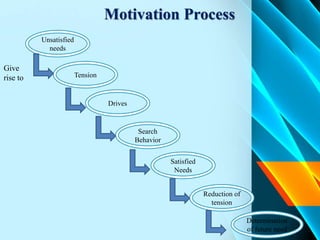
Motivation Process
Determination
of future need
Unsatisfied
needs
Tension
Satisfied
Needs
Search
Behavior
Drives
Reduction of
tension
Give
rise to
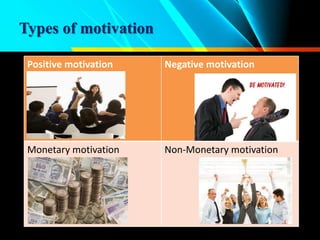
Types of motivation
Positive motivation Negative motivation
Monetary motivation Non-Monetary motivation
Management - Chapter 14
13
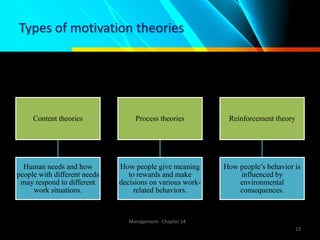
Types of motivation theories
Content theories
Human needs and how
people with different needs
may respond to different
work situations.
Process theories
How people give meaning
to rewards and make
decisions on various work-
related behaviors.
Reinforcement theory
How people’s behavior is
influenced by
environmental
consequences.
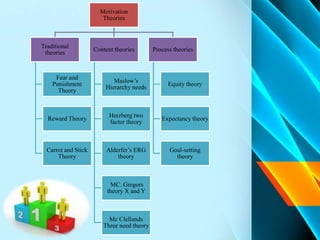
Motivation
Theories
Traditional
theories
Fear and
Punishment
Theory
Reward Theory
Carrot and Stick
Theory
Content theories
Maslow’s
Hierarchy needs
Herzberg two
factor theory
Alderfer’s ERG
theory
MC. Gregors
theory X and Y
Mc Clellands
Three need theory
Process theories
Equity theory
Expectancy theory
Goal-setting
theory
Fear and Punishment Theory
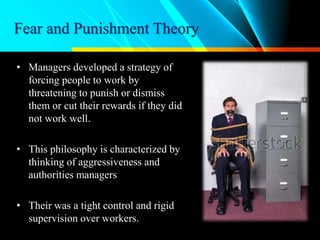
• Managers developed a strategy of
forcing people to work by
threatening to punish or dismiss
them or cut their rewards if they did
not work well.
• This philosophy is characterized by
thinking of aggressiveness and
authorities managers
• Their was a tight control and rigid
supervision over workers.
Reward Theory
• This theory tried to establish a
direct relationship between
efforts and rewards.
• Bases of Piece rate system of
wages
• Based on the standard manager
should decide on degree of
rewards and penalties
Carrot and Stick Theory
• This theory suggest a combination of both rewards and penalties for motivation
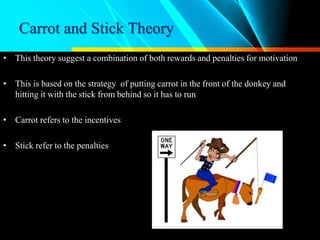
• This is based on the strategy of putting carrot in the front of the donkey and
hitting it with the stick from behind so it has to run
• Carrot refers to the incentives
• Stick refer to the penalties
Maslow’s Theory of Motivation
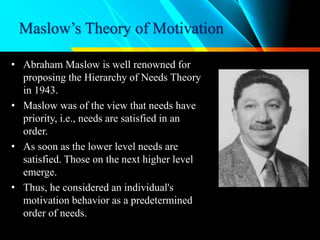
• Abraham Maslow is well renowned for
proposing the Hierarchy of Needs Theory
in 1943.
• Maslow was of the view that needs have
priority, i.e., needs are satisfied in an
order.
• As soon as the lower level needs are
satisfied. Those on the next higher level
emerge.
• Thus, he considered an individual's
motivation behavior as a predetermined
order of needs.
Abraham Maslow
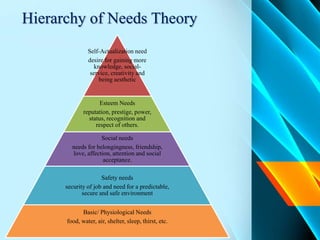
Hierarchy of Needs Theory
Self-Actualization need
desire for gaining more
knowledge, social-
service, creativity and
being aesthetic
Esteem Needs
reputation, prestige, power,
status, recognition and
respect of others.
Social needs
needs for belongingness, friendship,
love, affection, attention and social
acceptance.
Safety needs
security of job and need for a predictable,
secure and safe environment
Basic/ Physiological Needs
food, water, air, shelter, sleep, thirst, etc.
• Physiological needs- These are the basic needs of air, water, food, clothing and shelter. In other words,
physiological needs are the needs for basic amenities of life.
• Safety needs- Safety needs include physical, environmental and emotional safety and protection. For
instance- Job security, financial security, protection from animals, family security, health security, etc.
• Social needs- These needs emerge from society. Man is a social animal. These needs become important.
Social needs include the need for love, affection, care, belongingness, and friendship.
• Esteem needs- Esteem needs are of two types: internal esteem needs (self- respect, confidence,
competence, achievement and freedom) and external esteem needs (recognition, power, status, attention
and admiration).
• Self-actualization need- This include the urge to become what you are capable of becoming / what you
have the potential to become. It includes the need for growth and self-contentment. It also includes desire
for gaining more knowledge, social- service, creativity and being aesthetic. The self- actualization needs
are never fully satiable. As an individual grows psychologically, opportunities keep cropping up to
continue growing
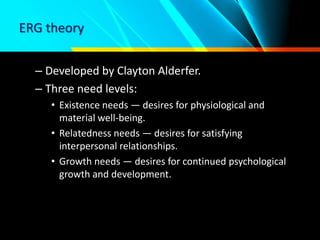
ERG theory
– Developed by Clayton Alderfer.
– Three need levels:
• Existence needs — desires for physiological and
material well-being.
• Relatedness needs — desires for satisfying
interpersonal relationships.
• Growth needs — desires for continued psychological
growth and development.
Herzberg’s Two-Factor Theory
• In 1959, Frederick Herzberg,
a behavioral scientist
proposed a two-factor theory
or the motivator-hygiene
theory.
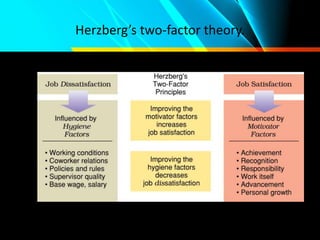
• According to Herzberg, there
are some job factors that
result in satisfaction while
there are other job factors that
prevent dissatisfaction.
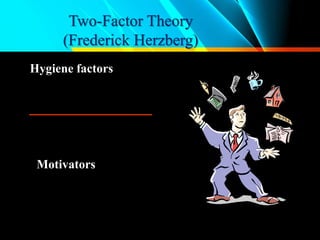
Two-Factor Theory
(Frederick Herzberg)
Hygiene factors
Motivators
Hygiene factors
Hygiene factors are those job factors which are essential for
existence of motivation at workplace.
These do not lead to positive satisfaction for long-term. But if these
factors are absent / if these factors are non-existant at workplace,
then they lead to dissatisfaction.
Hygiene factors are also called as dissatisfies or maintenance
factors as they are required to avoid dissatisfaction. These factors
describe the job environment / scenario.
Hygiene factors
• Company policy and administration
• Technical aspects of supervision
• Interpersonal aspects of supervision
• Interpersonal relations with peers and subordinates
• Working conditions
• Salary
• Status
• Job security
Motivational factors
The motivational factors yield positive satisfaction. These
factors motivate the employees for a superior performance.
These factors are called satisfiers.
These are factors involved in performing the job. Employees
find these factors intrinsically rewarding.
The motivators symbolized the psychological needs that
were perceived as an additional benefit.
• Recognition- The employees should be praised and recognized for their
accomplishments by the managers.
• Sense of achievement- The employees must have a sense of achievement. This
depends on the job. There must be a fruit of some sort in the job.
• Growth and promotional opportunities- There must be growth and advancement
opportunities in an organization to motivate the employees to perform well.
• Responsibility- The employees must hold themselves responsible for the work. The
managers should give them ownership of the work. They should minimize control
but retain accountability.
• Meaningfulness of the work- The work itself should be meaningful, interesting and
challenging for the employee to perform and to get motivated.
Herzberg’s two-factor theory.
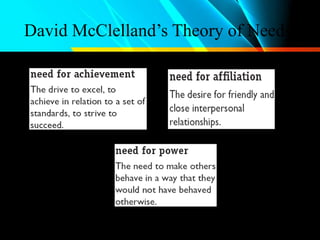
David McClelland’s Theory of Needs,
CONT.
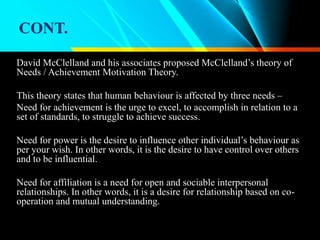
David McClelland and his associates proposed McClelland’s theory of
Needs / Achievement Motivation Theory.
This theory states that human behaviour is affected by three needs –
Need for achievement is the urge to excel, to accomplish in relation to a
set of standards, to struggle to achieve success.
Need for power is the desire to influence other individual’s behaviour as
per your wish. In other words, it is the desire to have control over others
and to be influential.
Need for affiliation is a need for open and sociable interpersonal
relationships. In other words, it is a desire for relationship based on co-
operation and mutual understanding.
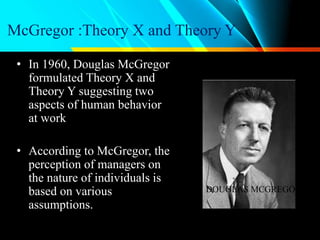
McGregor :Theory X and Theory Y
• In 1960, Douglas McGregor
formulated Theory X and
Theory Y suggesting two
aspects of human behavior
at work
• According to McGregor, the
perception of managers on
the nature of individuals is
based on various
assumptions.
DOUGLAS MCGREGOR
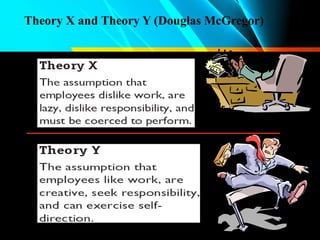
Theory X and Theory Y (Douglas McGregor)
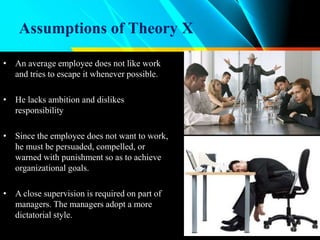
Assumptions of Theory X
• An average employee does not like work
and tries to escape it whenever possible.
• He lacks ambition and dislikes
responsibility
• Since the employee does not want to work,
he must be persuaded, compelled, or
warned with punishment so as to achieve
organizational goals.
• A close supervision is required on part of
managers. The managers adopt a more
dictatorial style.
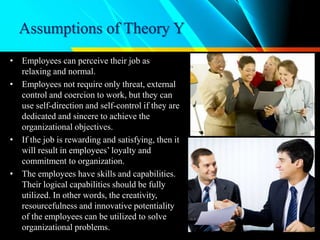
Assumptions of Theory Y
• Employees can perceive their job as
relaxing and normal.
• Employees not require only threat, external
control and coercion to work, but they can
use self-direction and self-control if they are
dedicated and sincere to achieve the
organizational objectives.
• If the job is rewarding and satisfying, then it
will result in employees’ loyalty and
commitment to organization.
• The employees have skills and capabilities.
Their logical capabilities should be fully
utilized. In other words, the creativity,
resourcefulness and innovative potentiality
of the employees can be utilized to solve
organizational problems.
The Effect of Motivation on Employee
Productivity
Motivated employees are inclined to be more productive than non-motivated employees.
Most businesses make some pains to motivate workers but this is normally easier said than
done. Employees are all individuals with different like’s dislikes and needs, and different things
will motivate each.
1. Motivated Employees Are More Productive : If employee will satisfied and happy then he/she
will do his /her work in a very impressive way, and then the result will be good, on the other
hand motivated employee will motivate other employees in office.
2. Decision-making and practical Expectations : It is important to engage employees in the
decision-making process, but create realistic expectations in the process.
3. Job Description, Work Environment and Flexibility : Employee doing the right job for his
personality and skill set, and performing well at the job greatly increases employee motivation
and satisfaction. A safe and non-threatening work environment is necessary to maintain a high
level of employee motivation. Flexible human resource policies, flexible time, work from home,
childcare also be liable to have happier and more motivated workers.
4. Pay and Benefits : Keeping employees motivated with good benefits is easy. Where to draw the
line at generous benefits that motivate all employees, versus raises and larger salaries to retain
and attract the best workers and keep them happy and motivated to be working for you, are
more difficult.
5. Company Culture : Creating a positive and employee-friendly company culture is a great
motivational tool.
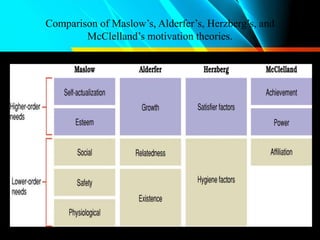
Comparison of Maslow’s, Alderfer’s, Herzberg’s, and
McClelland’s motivation theories.
Process theories of motivation
– People make choices to work hard or not.
– Choices are based on:
• Individual preferences.
• Available rewards.
• Possible work outcomes
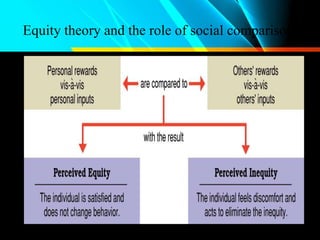
Equity theory
– Developed by J. Stacy Adams.
– When people believe that they have been treated
unfairly in comparison to others, they try to
eliminate the discomfort and restore a perceived
sense of equity to the situation.
• Perceived inequity.
• Perceived equity.
Equity theory and the role of social comparison.
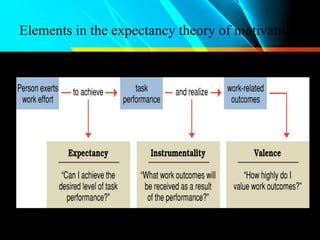
Expectancy theory
– Developed by Victor Vroom.
– Key expectancy theory variables:
• Expectancy — belief that working hard will result in
desired level of performance.
• Instrumentality — belief that successful performance will
be followed by rewards.
• Valence — value a person assigns to rewards and other
work related outcomes.
Elements in the expectancy theory of motivation.
Goal-setting theory
– Developed by Edwin Locke.
– Properly set and well-managed task goals can be highly
motivating.
– Motivational effects of task goals:
• Provide direction to people in their work.
• Clarify performance expectations.
• Establish a frame of reference for feedback.
• Provide a foundation for behavioral self-management.
Key issues and principles in the goal-setting
process:
– Set specific goals.
– Set challenging goals.
– Build goal acceptance and commitment.
– Clarify goal priorities.
– Provide feedback on goal accomplishment.
– Reward goal accomplishment.
Cont.
 Goal-setting theory
– Participation in goal setting …
• Unlocks the motivational potential of goal setting.
• Management by objectives (MBO) promotes
participation.
• When participation is not possible, workers will
respond positively if supervisory trust and support
exist.
Motivation

Motivation

  • 1.
    Motivation MS. PREETI BHASKAR ASSISTANTPROFESSOR ICFAI BUSINESS SCHOOL , DEHRADUN
  • 2.
    Content • Meaning ofMotivation • Primary and Secondary Motives • Motivation and Productivity • Motivation process • Theories of Motivation
  • 3.
    Definition “Motivation means aprocess of stimulating people to action to accomplished desired goals” William G. Scout
  • 4.
    Features of Motivation Motivationis an internal feeling, that is, it defines the psychological state of a person. It is a continuous process and we should make sure that it is not disturbed. A person should be encouraged completely. Motivation consists of three interacting and dependent elements − • Needs − The requirements or deficiency which is created whenever there is physiological imbalance. • Drives − The various camps or events organized to motivate the employees and give them new opportunities. • Incentives − Employees need to be rewarded for their nice work in order to keep them encouraged.
  • 5.
    Primary motives areessential for survival. They must be satisfied first before we can take up any other activity. Primary motives come to action when the physiological balance of the body is upset. This balance is called homeostasis. Primary Motives http://www.psychologydiscussion.net/notes/psychology-notes/motivation-psychology- notes/classification-of-motives-primary-and-secondary/1979
  • 6.
    Cont. • When anorganism experiences hunger or thirst, certain biological changes occur in the body. Once the hunger/thirst is fulfilled, the physiological balance or homeostasis is restored. Respiratory drive is the drive for air or oxygen. If oxygen supply is not there even for a moment, it may result in brain damage, loss of memory and loss of control on one’s body. • Sleep drive occurs usually at regular intervals for a person. Lack of sleep or inadequate sleep over long periods can result in confusion, attention deficit, muscle tremors and increased sensitivity to pain. The metabolism rate drops during sleep regenerating energy. • Drive for elimination of wastes: When the bladder or intestine becomes distended with waste material, they cause pressure and discomfort. The person becomes restless until the waste materials are eliminated and pressure relieved. Sex drive is considered a biological drive since it is dependent on physiological conditions. Unlike hunger and thirst, sex is not essential for survival of the individual but is necessary for the survival of the species.
  • 7.
    Social/Learned/Secondary Motives: Human lifehas not only just biological aspect but also social aspect. Hence human behaviour is activated by the following social motives. 1. Achievement motives 2. Affiliation motives 3. Aggression motives 4. Power motives 5. Curiosity motives. These are called social motives since they develop as a result of relationships with people. http://www.psychologydiscussion.net/notes/psychology-notes/motivation-psychology- notes/classification-of-motives-primary-and-secondary/1979
  • 8.
    Cont. 1. Achievement motives: Theyrefer to a drive towards some standards of excellence. People with high-level achievement motives prefer tasks that would promise success and are moderately difficult. David C McClelland has found that while high achievers tend to succeed, low achievers tend to avoid failures. High achievers challenge failures and work harder while low achievers accept failures and go for less difficult tasks. High achievers prefer personal responsibility and like to get feedback about their works. Children whose parents have accepted their independence tend to become high achievers, while those of overprotective parents tend to become low achievers. Children learn by copying the behaviour of their parents and other important people in their lives who serve as models. The parental expectations also develop achievement motivation in children. 2. Affiliation motives: Man cannot exist in isolation. The need to be with other people is known as affiliation need. This need is revealed through one’s attraction to others through friendship, sociability or group membership. They make more local phone calls, visits and seek approvals of others. Need to rely on others which is called dependency motive is one form of the need for affiliation. When little children are frightened, they seek others to comfort them. This kind of experience in early life makes one seek the friendly company of others when faced with anxiety and fear.
  • 9.
    Cont. 3. Aggression motives: Intensefrustrations after high expectations, verbal and nonverbal insults, fear and anxiety can trigger aggression. Television and cinema depicting violence can make youngsters model themselves to aggressive behaviour. Psychoanalysts maintain that each individual, as part of his biological inheritance, possesses destructive death urges as well as constructive life urges. In most of us, a favourable balance exists between life and death urges so that kindness triumphs over cruelty. Social learning (modeling), classical conditioning and instrument conditioning are the ways in which hostile aggression may be learned. 4. Power motives: Social power is defined as the ability of an individual to produce intended effect on the behaviour or emotions of other people. Persons with power motives will be concerned with having impact, influence and reputation. They exercise their power by joining political parties, voluntary organizations, and associating themselves with prominent and popular men. They select jobs which have an impact on others and dominate weaker sections of the society. They often try to convince others, play more competitive sports and tend to drink more. 5. Curiosity Motives: Almost all individuals have a desire to have some standing position among the people of his society or group. Nobody likes to be considered inferior. Efforts to achieve a rank in the hierarchy of the group are present not just in human beings, but even among birds and animals, e.g. ‘pecking order’ among hens.
  • 10.
    Importance of Motivation Helpsin satisfying needs of the Employees Change the negative attitude to Positive attitude Reduce labor turnover Reduce absenteeism Helps in introducing changes Improves level of efficiency of employees Creating friendly and supportive relationship
  • 11.
    Motivation Process Determination of futureneed Unsatisfied needs Tension Satisfied Needs Search Behavior Drives Reduction of tension Give rise to
  • 12.
    Types of motivation Positivemotivation Negative motivation Monetary motivation Non-Monetary motivation
  • 13.
    Management - Chapter14 13 Types of motivation theories Content theories Human needs and how people with different needs may respond to different work situations. Process theories How people give meaning to rewards and make decisions on various work- related behaviors. Reinforcement theory How people’s behavior is influenced by environmental consequences.
  • 14.
    Motivation Theories Traditional theories Fear and Punishment Theory Reward Theory Carrotand Stick Theory Content theories Maslow’s Hierarchy needs Herzberg two factor theory Alderfer’s ERG theory MC. Gregors theory X and Y Mc Clellands Three need theory Process theories Equity theory Expectancy theory Goal-setting theory
  • 15.
    Fear and PunishmentTheory • Managers developed a strategy of forcing people to work by threatening to punish or dismiss them or cut their rewards if they did not work well. • This philosophy is characterized by thinking of aggressiveness and authorities managers • Their was a tight control and rigid supervision over workers.
  • 16.
    Reward Theory • Thistheory tried to establish a direct relationship between efforts and rewards. • Bases of Piece rate system of wages • Based on the standard manager should decide on degree of rewards and penalties
  • 17.
    Carrot and StickTheory • This theory suggest a combination of both rewards and penalties for motivation • This is based on the strategy of putting carrot in the front of the donkey and hitting it with the stick from behind so it has to run • Carrot refers to the incentives • Stick refer to the penalties
  • 18.
    Maslow’s Theory ofMotivation • Abraham Maslow is well renowned for proposing the Hierarchy of Needs Theory in 1943. • Maslow was of the view that needs have priority, i.e., needs are satisfied in an order. • As soon as the lower level needs are satisfied. Those on the next higher level emerge. • Thus, he considered an individual's motivation behavior as a predetermined order of needs. Abraham Maslow
  • 19.
    Hierarchy of NeedsTheory Self-Actualization need desire for gaining more knowledge, social- service, creativity and being aesthetic Esteem Needs reputation, prestige, power, status, recognition and respect of others. Social needs needs for belongingness, friendship, love, affection, attention and social acceptance. Safety needs security of job and need for a predictable, secure and safe environment Basic/ Physiological Needs food, water, air, shelter, sleep, thirst, etc.
  • 20.
    • Physiological needs-These are the basic needs of air, water, food, clothing and shelter. In other words, physiological needs are the needs for basic amenities of life. • Safety needs- Safety needs include physical, environmental and emotional safety and protection. For instance- Job security, financial security, protection from animals, family security, health security, etc. • Social needs- These needs emerge from society. Man is a social animal. These needs become important. Social needs include the need for love, affection, care, belongingness, and friendship. • Esteem needs- Esteem needs are of two types: internal esteem needs (self- respect, confidence, competence, achievement and freedom) and external esteem needs (recognition, power, status, attention and admiration). • Self-actualization need- This include the urge to become what you are capable of becoming / what you have the potential to become. It includes the need for growth and self-contentment. It also includes desire for gaining more knowledge, social- service, creativity and being aesthetic. The self- actualization needs are never fully satiable. As an individual grows psychologically, opportunities keep cropping up to continue growing
  • 21.
    ERG theory – Developedby Clayton Alderfer. – Three need levels: • Existence needs — desires for physiological and material well-being. • Relatedness needs — desires for satisfying interpersonal relationships. • Growth needs — desires for continued psychological growth and development.
  • 22.
    Herzberg’s Two-Factor Theory •In 1959, Frederick Herzberg, a behavioral scientist proposed a two-factor theory or the motivator-hygiene theory. • According to Herzberg, there are some job factors that result in satisfaction while there are other job factors that prevent dissatisfaction.
  • 23.
  • 24.
    Hygiene factors Hygiene factorsare those job factors which are essential for existence of motivation at workplace. These do not lead to positive satisfaction for long-term. But if these factors are absent / if these factors are non-existant at workplace, then they lead to dissatisfaction. Hygiene factors are also called as dissatisfies or maintenance factors as they are required to avoid dissatisfaction. These factors describe the job environment / scenario.
  • 25.
    Hygiene factors • Companypolicy and administration • Technical aspects of supervision • Interpersonal aspects of supervision • Interpersonal relations with peers and subordinates • Working conditions • Salary • Status • Job security
  • 26.
    Motivational factors The motivationalfactors yield positive satisfaction. These factors motivate the employees for a superior performance. These factors are called satisfiers. These are factors involved in performing the job. Employees find these factors intrinsically rewarding. The motivators symbolized the psychological needs that were perceived as an additional benefit.
  • 27.
    • Recognition- Theemployees should be praised and recognized for their accomplishments by the managers. • Sense of achievement- The employees must have a sense of achievement. This depends on the job. There must be a fruit of some sort in the job. • Growth and promotional opportunities- There must be growth and advancement opportunities in an organization to motivate the employees to perform well. • Responsibility- The employees must hold themselves responsible for the work. The managers should give them ownership of the work. They should minimize control but retain accountability. • Meaningfulness of the work- The work itself should be meaningful, interesting and challenging for the employee to perform and to get motivated.
  • 28.
  • 29.
  • 30.
    CONT. David McClelland andhis associates proposed McClelland’s theory of Needs / Achievement Motivation Theory. This theory states that human behaviour is affected by three needs – Need for achievement is the urge to excel, to accomplish in relation to a set of standards, to struggle to achieve success. Need for power is the desire to influence other individual’s behaviour as per your wish. In other words, it is the desire to have control over others and to be influential. Need for affiliation is a need for open and sociable interpersonal relationships. In other words, it is a desire for relationship based on co- operation and mutual understanding.
  • 31.
    McGregor :Theory Xand Theory Y • In 1960, Douglas McGregor formulated Theory X and Theory Y suggesting two aspects of human behavior at work • According to McGregor, the perception of managers on the nature of individuals is based on various assumptions. DOUGLAS MCGREGOR
  • 32.
    Theory X andTheory Y (Douglas McGregor)
  • 33.
    Assumptions of TheoryX • An average employee does not like work and tries to escape it whenever possible. • He lacks ambition and dislikes responsibility • Since the employee does not want to work, he must be persuaded, compelled, or warned with punishment so as to achieve organizational goals. • A close supervision is required on part of managers. The managers adopt a more dictatorial style.
  • 34.
    Assumptions of TheoryY • Employees can perceive their job as relaxing and normal. • Employees not require only threat, external control and coercion to work, but they can use self-direction and self-control if they are dedicated and sincere to achieve the organizational objectives. • If the job is rewarding and satisfying, then it will result in employees’ loyalty and commitment to organization. • The employees have skills and capabilities. Their logical capabilities should be fully utilized. In other words, the creativity, resourcefulness and innovative potentiality of the employees can be utilized to solve organizational problems.
  • 35.
    The Effect ofMotivation on Employee Productivity Motivated employees are inclined to be more productive than non-motivated employees. Most businesses make some pains to motivate workers but this is normally easier said than done. Employees are all individuals with different like’s dislikes and needs, and different things will motivate each. 1. Motivated Employees Are More Productive : If employee will satisfied and happy then he/she will do his /her work in a very impressive way, and then the result will be good, on the other hand motivated employee will motivate other employees in office. 2. Decision-making and practical Expectations : It is important to engage employees in the decision-making process, but create realistic expectations in the process. 3. Job Description, Work Environment and Flexibility : Employee doing the right job for his personality and skill set, and performing well at the job greatly increases employee motivation and satisfaction. A safe and non-threatening work environment is necessary to maintain a high level of employee motivation. Flexible human resource policies, flexible time, work from home, childcare also be liable to have happier and more motivated workers. 4. Pay and Benefits : Keeping employees motivated with good benefits is easy. Where to draw the line at generous benefits that motivate all employees, versus raises and larger salaries to retain and attract the best workers and keep them happy and motivated to be working for you, are more difficult. 5. Company Culture : Creating a positive and employee-friendly company culture is a great motivational tool.
  • 36.
    Comparison of Maslow’s,Alderfer’s, Herzberg’s, and McClelland’s motivation theories.
  • 37.
    Process theories ofmotivation – People make choices to work hard or not. – Choices are based on: • Individual preferences. • Available rewards. • Possible work outcomes
  • 38.
    Equity theory – Developedby J. Stacy Adams. – When people believe that they have been treated unfairly in comparison to others, they try to eliminate the discomfort and restore a perceived sense of equity to the situation. • Perceived inequity. • Perceived equity.
  • 39.
    Equity theory andthe role of social comparison.
  • 40.
    Expectancy theory – Developedby Victor Vroom. – Key expectancy theory variables: • Expectancy — belief that working hard will result in desired level of performance. • Instrumentality — belief that successful performance will be followed by rewards. • Valence — value a person assigns to rewards and other work related outcomes.
  • 41.
    Elements in theexpectancy theory of motivation.
  • 42.
    Goal-setting theory – Developedby Edwin Locke. – Properly set and well-managed task goals can be highly motivating. – Motivational effects of task goals: • Provide direction to people in their work. • Clarify performance expectations. • Establish a frame of reference for feedback. • Provide a foundation for behavioral self-management.
  • 43.
    Key issues andprinciples in the goal-setting process: – Set specific goals. – Set challenging goals. – Build goal acceptance and commitment. – Clarify goal priorities. – Provide feedback on goal accomplishment. – Reward goal accomplishment.
  • 44.
    Cont.  Goal-setting theory –Participation in goal setting … • Unlocks the motivational potential of goal setting. • Management by objectives (MBO) promotes participation. • When participation is not possible, workers will respond positively if supervisory trust and support exist.