MOTIVATION
For Physiotherapy and Nursing students
CONTENTS
• Definitions.
• Motivation cycle.
• Types of motives.
• Classification of motivation.
• Theories of motivation.
Definitions
• “Motive” a Latin word meaning—to move. That is it can be
considered as the mover of behaviour. Several hundred
words are there like “wants”, “desire”, “need”, “drive”, “goal”,
“aim”, “ambition”, give equal meaning to motivation with
slight difference.
• Motivation is the internal state of an organism causing it to
strive toward a goal, which is often aroused by external
stimuli.
• According to Fisher, A motive is an inclination or impulsion to
action plus some degree of orientation or direction.
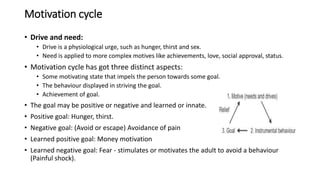
Motivation cycle
• Drive and need:
• Drive is a physiological urge, such as hunger, thirst and sex.
• Need is applied to more complex motives like achievements, love, social approval, status.
• Motivation cycle has got three distinct aspects:
• Some motivating state that impels the person towards some goal.
• The behaviour displayed in striving the goal.
• Achievement of goal.
• The goal may be positive or negative and learned or innate.
• Positive goal: Hunger, thirst.
• Negative goal: (Avoid or escape) Avoidance of pain
• Learned positive goal: Money motivation
• Learned negative goal: Fear - stimulates or motivates the adult to avoid a behaviour
(Painful shock).
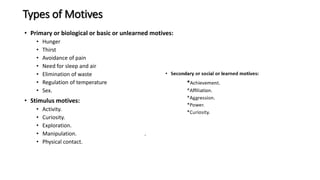
Types of Motives
• Primary or biological or basic or unlearned motives:
• Hunger
• Thirst
• Avoidance of pain
• Need for sleep and air
• Elimination of waste
• Regulation of temperature
• Sex.
• Stimulus motives:
• Activity.
• Curiosity.
• Exploration.
• Manipulation. .
• Physical contact.
Types of Motivation
• Natural motivation or Intrinsic motivation:
• Refers to taking some action for the sake of enjoyment or the satisfaction
that you receive.
• When you act based on intrinsic motivation, you are doing it because it is
fun, you enjoy it or you find its pleasurable.
• Unnatural or extrinsic motivation:
• Refers to taking some action in order to obtain a reward or outcome.
• Instead of doing it for fun, people who are extrinsically motivated act based
on what they receive as result, they are only concerned with resulting
rewards.
Theories of Motivation.
• Instinct theory.
• Drive reduction theory.
• Expectancy or incentive theory
• Maslow’s theory of motivation.
• McClelland’s theory.
• Arousal theory.
• ERG theory.
• Instinct theory: Behaviour is driven by unlearned, genetically encoded
behaviour patterns. The Behaviour is guided by the these instincts.
• Drive-reduction theory: Behaviour is guided by the drives that arises in a
individual. A drive is said to be a state of arousal that energizes and directs
behaviour in order to fulfil a need.
• Expectancy or Incentive theory: Individuals are not only motivated and
driven from within, they are also pulled into action by external factors or
incentives.
• McClelland’s theory of motivation: According to him, we need three things
but we differ in degree to which these needs influence or behaviour.
• Three things are: Achievement, Affiliation and Power.
• Arousal theory: People are motivated to behave in ways that maintain
their optimal level of arousal so as to feel comfortable. Arousal is reflected
in increased activity and Physiological measure such as Muscle tension,
Brain activity etc.,
Maslow’s Hierarchy of Needs.
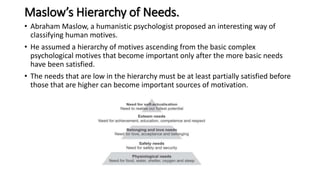
• Abraham Maslow, a humanistic psychologist proposed an interesting way of
classifying human motives.
• He assumed a hierarchy of motives ascending from the basic complex
psychological motives that become important only after the more basic needs
have been satisfied.
• The needs that are low in the hierarchy must be at least partially satisfied before
those that are higher can become important sources of motivation.
THANK YOU..!

MOTIVATION- Psychology.pptx

  • 1.
  • 2.
    CONTENTS • Definitions. • Motivationcycle. • Types of motives. • Classification of motivation. • Theories of motivation.
  • 3.
    Definitions • “Motive” aLatin word meaning—to move. That is it can be considered as the mover of behaviour. Several hundred words are there like “wants”, “desire”, “need”, “drive”, “goal”, “aim”, “ambition”, give equal meaning to motivation with slight difference. • Motivation is the internal state of an organism causing it to strive toward a goal, which is often aroused by external stimuli. • According to Fisher, A motive is an inclination or impulsion to action plus some degree of orientation or direction.
  • 4.
    Motivation cycle • Driveand need: • Drive is a physiological urge, such as hunger, thirst and sex. • Need is applied to more complex motives like achievements, love, social approval, status. • Motivation cycle has got three distinct aspects: • Some motivating state that impels the person towards some goal. • The behaviour displayed in striving the goal. • Achievement of goal. • The goal may be positive or negative and learned or innate. • Positive goal: Hunger, thirst. • Negative goal: (Avoid or escape) Avoidance of pain • Learned positive goal: Money motivation • Learned negative goal: Fear - stimulates or motivates the adult to avoid a behaviour (Painful shock).
  • 5.
    Types of Motives •Primary or biological or basic or unlearned motives: • Hunger • Thirst • Avoidance of pain • Need for sleep and air • Elimination of waste • Regulation of temperature • Sex. • Stimulus motives: • Activity. • Curiosity. • Exploration. • Manipulation. . • Physical contact.
  • 6.
    Types of Motivation •Natural motivation or Intrinsic motivation: • Refers to taking some action for the sake of enjoyment or the satisfaction that you receive. • When you act based on intrinsic motivation, you are doing it because it is fun, you enjoy it or you find its pleasurable. • Unnatural or extrinsic motivation: • Refers to taking some action in order to obtain a reward or outcome. • Instead of doing it for fun, people who are extrinsically motivated act based on what they receive as result, they are only concerned with resulting rewards.
  • 7.
    Theories of Motivation. •Instinct theory. • Drive reduction theory. • Expectancy or incentive theory • Maslow’s theory of motivation. • McClelland’s theory. • Arousal theory. • ERG theory.
  • 8.
    • Instinct theory:Behaviour is driven by unlearned, genetically encoded behaviour patterns. The Behaviour is guided by the these instincts. • Drive-reduction theory: Behaviour is guided by the drives that arises in a individual. A drive is said to be a state of arousal that energizes and directs behaviour in order to fulfil a need. • Expectancy or Incentive theory: Individuals are not only motivated and driven from within, they are also pulled into action by external factors or incentives. • McClelland’s theory of motivation: According to him, we need three things but we differ in degree to which these needs influence or behaviour. • Three things are: Achievement, Affiliation and Power. • Arousal theory: People are motivated to behave in ways that maintain their optimal level of arousal so as to feel comfortable. Arousal is reflected in increased activity and Physiological measure such as Muscle tension, Brain activity etc.,
  • 9.
    Maslow’s Hierarchy ofNeeds. • Abraham Maslow, a humanistic psychologist proposed an interesting way of classifying human motives. • He assumed a hierarchy of motives ascending from the basic complex psychological motives that become important only after the more basic needs have been satisfied. • The needs that are low in the hierarchy must be at least partially satisfied before those that are higher can become important sources of motivation.
  • 10.

Editor's Notes

  • #7 Talking to your sister because you enjoy company. Person works in company in order to receive paycheck while other maybe working for the same inorder to receive health benefits.