MOTIVATION
PREPARED AND PRESENTED
BY
ASARE, RICHARD OPOKU
COLLEGE OF NURSING, NTOTROSO
AHAFO REGION, GHANA
asareor@gmail.com ©2022 1
Introduction
•Understanding motivation gives us many
valuable insights into human nature.
•It explains why goals are set, we strive for
achievement and power, why we have desires
for psychological intimacy and biological sex,
why we experience emotions like fear, anger,
and compassion.
asareor@gmail.com ©2022 2
•Learning about motivation is valuable because it helps
us understand where motivation comes from, why it
changes, what increases and decreases it, what
aspects of it can and cannot be changed, and helps us
answer the question of why some types of motivation
are more beneficial than others.
•Motivation reflects something unique about each one
of us and allows us to gain valued outcomes like
improved performance, enhanced wellbeing, personal
growth, or a sense of purpose.
asareor@gmail.com ©2022 3
•Motivation is a pathway to change our way
of thinking, feeling, and behaving (Souders,
2019).
•Motivation is the process that initiates,
guides, and maintains goal-oriented
behaviours.
•It is what causes a person to act, whether it
is getting a glass of water to reduce thirst or
reading a book to gain knowledge.
asareor@gmail.com ©2022 4
•Motivation involves the biological, emotional,
social, and cognitive forces that activate
behaviour.
•In everyday usage, the term “motivation” is
frequently used to describe why a person does
something.
•It is the driving force behind human actions
(Cherry, 2022).
asareor@gmail.com ©2022 5
•Motivation does not just refer to the factors
that activate behaviours; it also involves the
factors that direct and maintain these goal-
directed actions (though such motives are
rarely directly observable).
•As a result, we often have to infer the
reasons why people do the things that they
do based on observable behaviours (Nevid,
2013). asareor@gmail.com ©2022 6
•What exactly lies behind the motivations for
why we act?
•There are different theories of motivation,
including drive theory, instinct theory, and
humanistic theory (such as Maslow’s
hierarchy of needs) among others.
•The reality is that there are many different
forces that guide and direct our motivations.
asareor@gmail.com ©2022 7
Theories of Motivation
asareor@gmail.com ©2022 8
Instinct Theory of Motivation
•The instinct theory of motivation suggests that
behaviours are motivated by instincts, which are
fixed and inborn patterns of behaviour.
•Such instincts might include biological instincts that
are important for an organism’s survival such as fear,
cleanliness, and love.
•For example, a newly born baby when put to the
breast immediately starts sucking the mother due to
innate characteristics to feeding.
asareor@gmail.com ©2022 9
Drive Theory of Motivation
•According to the drive theory of motivation,
people have basic biological drives and that
behaviours are motivated by the need to fulfill
these drives.
•In other words, people are motivated to take
certain actions in order to reduce the internal
tension that is caused by unmet needs.
•For example, you might be motivated to drink a
glass of water in order to reduce the internal state
of thirst. asareor@gmail.com ©2022 10
•The drive theory is based on the concept
of homeostasis, or the idea that the body
actively works to maintain a certain state
of balance or equilibrium.
•This theory is useful in explaining
behaviours that have a strong biological or
physiological component, such as hunger
or thirst.
asareor@gmail.com ©2022 11
•The problem with the drive theory of
motivation is that these behaviours are
not always motivated purely by drive,
or the state of tension or arousal
caused by biological or physiological
needs.
•For example, people often eat even
when they are not really hungry.
asareor@gmail.com ©2022 12
Arousal Theory
•The arousal theory of motivation suggests
that people take certain actions to either
decrease or increase levels of arousal.
•In this case, we are motivated to maintain
an optimal level of arousal, although this
level can vary based on the individual or the
situation.
asareor@gmail.com ©2022 13
•When arousal levels get too low, for
example, a person might watch an
exciting movie or go for a jog.
•When arousal levels get too high, on
the other hand, a person would
probably look for ways to relax, such
as meditating or reading a book.
asareor@gmail.com ©2022 14
Incentive Theory
•The incentive theory suggests that people are
motivated to do things because of external
rewards.
•For example, you might be motivated to go to
work each day for the monetary reward of
being paid.
asareor@gmail.com ©2022 15
•Behavioural learning concepts such as
association and reinforcement play an
important role in this theory of
motivation.
•This theory shares some similarities with
the behaviourist concept of operant
conditioning.
asareor@gmail.com ©2022 16
•In operant conditioning, behaviours are
learned by forming associations with
outcomes.
•Reinforcement strengthens a behaviour
while punishment weakens it.
•While incentive theory is similar, it instead
proposes that people intentionally pursue
certain courses of action in order to gain
rewards.
asareor@gmail.com ©2022 17
•The greater the perceived rewards, the more
strongly people are motivated to pursue
those reinforcements.
•Incentives can arise from outside (extrinsic)
or inside (intrinsic) an individual.
•Intrinsic motivation is when you engage in a
behaviour because you find it rewarding for
your own sake, rather than from the desire
for an external reward.
asareor@gmail.com ©2022 18
Expectancy Theory
•The expectancy theory of motivation suggests that when
we are thinking about the future, we formulate different
expectations about what we think will happen.
•When we predict that there will most likely be a positive
outcome, we believe that we are able to make that
possible future a reality.
•This leads people to feel more motivated to pursue those
likely outcomes.
•The theory proposes that motivations consist of three key
elements:
asareor@gmail.com ©2022 19
1)Valence: the value people place on the
potential outcome (results).
2)Instrumentality: whether people believe
that they have a role to play in the
predicted outcome.
3)Expectancy: the belief that one has the
capabilities to produce the outcome.
asareor@gmail.com ©2022 20
Humanistic Theory
•Humanistic theories of motivation are based
on the idea that people also have strong
cognitive reasons to perform various
actions.
•This is famously illustrated in Abraham
Maslow’s hierarchy of needs, which
describes various levels of needs and
motivations. asareor@gmail.com ©2022 21
•Maslow’s hierarchy suggests that people
are motivated to fulfill basic needs before
moving on to other, more advanced needs.
•For example, people are first motivated to
fulfill basic biological needs for food and
shelter, then to progress through higher
needs like safety, love, and esteem.
asareor@gmail.com ©2022 22
•Once these needs have been met, the
primary motivator becomes the need for
self-actualization, or the desire to fulfill
one's individual potential.
•Maslow was interested in learning about
what makes people happy and the things
that they do to achieve that aim, rather
than focusing on problematic behaviours.
asareor@gmail.com ©2022 23
Maslow’s Hierarchy of Needs Theory
•Abraham Maslow’s hierarchy of needs is one of the
best-known theories of motivation.
•Maslow's theory states that our actions are
motivated by certain physiological and psychological
needs that progress from basic to complex.
•This hierarchy suggests that people are motivated to
fulfill basic needs before moving on to other, more
advanced needs.
asareor@gmail.com ©2022 24
•As a humanist, Maslow believed that people
have an inborn desire to be self-actualized, that
is, to be all they can be.
•To achieve this ultimate goal, however, a
number of more basic needs must be met.
•This includes the need for food, safety, love, and
self-esteem.
•Maslow believed that these needs are similar to
instincts and play a major role in motivating
behaviour. asareor@gmail.com ©2022 25
•There are five different levels of Maslow’s hierarchy of
needs, starting at the lowest level known as physiological
needs.
1) Physiological Needs
•The physiological needs include those that are vital to
survival. Some examples of physiological needs include:
 Food
 Water
 Breathing
 Homeostasis
asareor@gmail.com ©2022 26
•In addition to the basic requirements of
nutrition, air, and temperature
regulation, physiological needs also
include shelter and clothing.
•Maslow included sexual reproduction
in this level of the hierarchy as well,
since it is essential to the survival and
propagation of the species.
asareor@gmail.com ©2022 27
2) Security and Safety Needs
•At the second level of Maslow’s hierarchy, the needs
start to become a bit more complex.
•At this level, the needs for security and safety
become primary.
•People want control and order in their lives. Some
of the basic security and safety needs include:
 Financial security
 Health and wellness
 Safety against accidents and injury
asareor@gmail.com ©2022 28
•Finding a job, obtaining health insurance
and health care, contributing money to a
savings account, and moving to a safer
neighborhood are all examples of actions
motivated by security and safety needs.
•Together, the safety and physiological levels
of Maslow’s hierarchy of needs make up
what is often referred to as “basic needs.”
asareor@gmail.com ©2022 29
3) Social Needs
•The social needs in Maslow’s hierarchy include love,
acceptance, and belonging. At this level, the need for
emotional relationships drives human behaviour.
•Some of the things that satisfy this need include:
 Friendships
 Romantic attachments
 Family relationships
 Social groups
 Community groups
 Churches and religious organizations
asareor@gmail.com ©2022 30
•In order to avoid loneliness, depression,
and anxiety, it is important for people
to feel loved and accepted by others.
•Personal relationships with friends,
family, and lovers play an important
role, as does involvement in groups—
such as religious groups, sports teams,
book clubs, and other group activities.
asareor@gmail.com ©2022 31
4)Esteem Needs
•At the fourth level in Maslow’s
hierarchy is the need for appreciation
and respect.
•Once the needs at the bottom three
levels have been satisfied, the esteem
needs begin to play a more prominent
role in motivating behaviour.
asareor@gmail.com ©2022 32
•At this level, it becomes increasingly
important to gain the respect and
appreciation of others.
•People have a need to accomplish things,
then have their efforts recognized.
•In addition to the need for feelings of
accomplishment and prestige, esteem needs
include such things as self-esteem and
personal worth. asareor@gmail.com ©2022 33
•People need to sense that they are
valued by others and feel that they are
making a contribution to the world.
•Participation in professional activities,
academic accomplishments, athletic or
team participation, and personal
hobbies can all play a role in fulfilling
the esteem needs.
asareor@gmail.com ©2022 34
•People who are able to satisfy esteem needs by
achieving good self-esteem and the recognition
of others tend to feel confident in their abilities.
•Conversely, those who lack self-esteem and the
respect of others can develop feelings of
inferiority.
•Together, the esteem and social levels make up
what is known as the “psychological needs” of
the hierarchy.
asareor@gmail.com ©2022 35
5)Self-Actualization Needs
•At the very peak of Maslow’s hierarchy
are the self-actualization needs.
•Self-actualizing people are self-aware,
concerned with personal growth, less
concerned with the opinions of others,
and interested in fulfilling their
potential. asareor@gmail.com ©2022 36
•“What a man can be, he must be,” Maslow
explained, referring to the need people have to
achieve their full potential as human beings.
•Maslow’s said of self-actualization:
•“It may be loosely described as the full use and
exploitation of talents, capabilities, potentialities,
etc. Such people seem to be fulfilling themselves
and to be doing the best that they are capable of
doing. They are people who have developed or are
developing to the full stature of which they capable.”
asareor@gmail.com ©2022 37
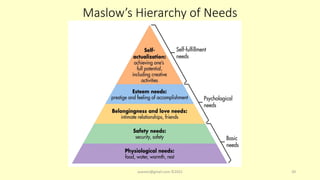
•Maslow’s hierarchy of needs is often displayed
as a pyramid.
•The lowest levels of the pyramid of needs are
made up of the most basic needs while the
most complex needs are at the top.
•Once lower-level needs have been met, people
can move on to the next level of needs.
•As people progress up the pyramid, needs
become increasingly psychological and social.
asareor@gmail.com ©2022 38
Maslow’s Hierarchy of Needs
asareor@gmail.com ©2022 39
Different Types of Needs
•Maslow’s hierarchy of needs can be separated into two
types of needs: deficiency needs and growth needs.
•Deficiency needs: Physiological, security, social, and
esteem needs are deficiency needs, which arise due to
deprivation. Satisfying these lower-level needs is
important to avoid unpleasant feelings or consequences.
•Growth needs: Maslow called the needs at the top of the
pyramid growth needs. These needs do not stem from a
lack of something, but rather from a desire to grow as a
person.
asareor@gmail.com ©2022 40
•While the theory is generally portrayed as a
fairly rigid hierarchy, Maslow noted that the
order in which these needs are fulfilled does not
always follow this standard progression.
•For example, he noted that for some individuals,
the need for self-esteem is more important than
the need for love.
•For others, the need for creative fulfillment may
supersede even the most basic needs.
asareor@gmail.com ©2022 41
Types of Motivation
asareor@gmail.com ©2022 42
•Basically, there two different types of motivation which
are frequently described as being either extrinsic or
intrinsic:
•Extrinsic motivations are those that arise from outside of
the individual and often involve rewards such as trophies,
money, social recognition, or praise.
•Intrinsic motivations are those that arise from within the
individual, such as doing a complicated crossword puzzle
purely for the personal gratification of solving a problem.
•Below are some of the basic tenets of intrinsic and
extrinsic motivations:
asareor@gmail.com ©2022 43
Intrinsic Motivation
•Working because you enjoy the job
•Studying because you find the subject
interesting
•Tackling a new project because you love a
challenge
•Tidying your house because a clean home
keeps you calm
asareor@gmail.com ©2022 44
Extrinsic Motivation
•Going to work to get paid
•Studying to get a good grade
•Working hard to get a raise or recognition
from your boss
•Tidying your house to avoid feeling
embarrassed when company comes over
asareor@gmail.com ©2022 45
Components of Motivation
•There are three major components of motivation:
activation, persistence, and intensity.
1) Activation involves the decision to initiate a behaviour,
such as enrolling in a nursing program.
2) Persistence is the continued effort toward a goal even
though obstacles may exist.
•An example of persistence would be taking more courses
in nursing in order to earn a diploma/degree although it
requires a significant investment of time, energy, and
resources. asareor@gmail.com ©2022 46
3)Intensity can be seen in the concentration and
vigor that goes into pursuing a goal.
•For example, one student might coast by without
much effort, while another student will study
regularly, participate in discussions, and take
advantage of research opportunities outside of
class.
•The first student lacks intensity, while the second
pursues their educational goals with greater
intensity. asareor@gmail.com ©2022 47
Uses of Motivation
•There are many different uses for
motivation.
•It serves as a guiding force for all human
behaviour, but understanding how it
works and the factors that may impact it
can be important in a number of ways.
•Understanding motivation can:
asareor@gmail.com ©2022 48
a)Help improve the efficiency of people as they
work toward goals.
b)Help people take action.
c) Encourage people to engage in health-
oriented behaviours.
d)Help people avoid unhealthy or maladaptive
behaviours such as risk-taking and addiction.
e)Help people feel more in control of their lives.
f) Improve overall well-being and happiness.
asareor@gmail.com ©2022 49
END OF LECTURE
asareor@yahoo.com © 2022
50
THANKYOU FORYOUR ATTENTION

MOTIVATION.pdf

  • 1.
    MOTIVATION PREPARED AND PRESENTED BY ASARE,RICHARD OPOKU COLLEGE OF NURSING, NTOTROSO AHAFO REGION, GHANA asareor@gmail.com ©2022 1
  • 2.
    Introduction •Understanding motivation givesus many valuable insights into human nature. •It explains why goals are set, we strive for achievement and power, why we have desires for psychological intimacy and biological sex, why we experience emotions like fear, anger, and compassion. asareor@gmail.com ©2022 2
  • 3.
    •Learning about motivationis valuable because it helps us understand where motivation comes from, why it changes, what increases and decreases it, what aspects of it can and cannot be changed, and helps us answer the question of why some types of motivation are more beneficial than others. •Motivation reflects something unique about each one of us and allows us to gain valued outcomes like improved performance, enhanced wellbeing, personal growth, or a sense of purpose. asareor@gmail.com ©2022 3
  • 4.
    •Motivation is apathway to change our way of thinking, feeling, and behaving (Souders, 2019). •Motivation is the process that initiates, guides, and maintains goal-oriented behaviours. •It is what causes a person to act, whether it is getting a glass of water to reduce thirst or reading a book to gain knowledge. asareor@gmail.com ©2022 4
  • 5.
    •Motivation involves thebiological, emotional, social, and cognitive forces that activate behaviour. •In everyday usage, the term “motivation” is frequently used to describe why a person does something. •It is the driving force behind human actions (Cherry, 2022). asareor@gmail.com ©2022 5
  • 6.
    •Motivation does notjust refer to the factors that activate behaviours; it also involves the factors that direct and maintain these goal- directed actions (though such motives are rarely directly observable). •As a result, we often have to infer the reasons why people do the things that they do based on observable behaviours (Nevid, 2013). asareor@gmail.com ©2022 6
  • 7.
    •What exactly liesbehind the motivations for why we act? •There are different theories of motivation, including drive theory, instinct theory, and humanistic theory (such as Maslow’s hierarchy of needs) among others. •The reality is that there are many different forces that guide and direct our motivations. asareor@gmail.com ©2022 7
  • 8.
  • 9.
    Instinct Theory ofMotivation •The instinct theory of motivation suggests that behaviours are motivated by instincts, which are fixed and inborn patterns of behaviour. •Such instincts might include biological instincts that are important for an organism’s survival such as fear, cleanliness, and love. •For example, a newly born baby when put to the breast immediately starts sucking the mother due to innate characteristics to feeding. asareor@gmail.com ©2022 9
  • 10.
    Drive Theory ofMotivation •According to the drive theory of motivation, people have basic biological drives and that behaviours are motivated by the need to fulfill these drives. •In other words, people are motivated to take certain actions in order to reduce the internal tension that is caused by unmet needs. •For example, you might be motivated to drink a glass of water in order to reduce the internal state of thirst. asareor@gmail.com ©2022 10
  • 11.
    •The drive theoryis based on the concept of homeostasis, or the idea that the body actively works to maintain a certain state of balance or equilibrium. •This theory is useful in explaining behaviours that have a strong biological or physiological component, such as hunger or thirst. asareor@gmail.com ©2022 11
  • 12.
    •The problem withthe drive theory of motivation is that these behaviours are not always motivated purely by drive, or the state of tension or arousal caused by biological or physiological needs. •For example, people often eat even when they are not really hungry. asareor@gmail.com ©2022 12
  • 13.
    Arousal Theory •The arousaltheory of motivation suggests that people take certain actions to either decrease or increase levels of arousal. •In this case, we are motivated to maintain an optimal level of arousal, although this level can vary based on the individual or the situation. asareor@gmail.com ©2022 13
  • 14.
    •When arousal levelsget too low, for example, a person might watch an exciting movie or go for a jog. •When arousal levels get too high, on the other hand, a person would probably look for ways to relax, such as meditating or reading a book. asareor@gmail.com ©2022 14
  • 15.
    Incentive Theory •The incentivetheory suggests that people are motivated to do things because of external rewards. •For example, you might be motivated to go to work each day for the monetary reward of being paid. asareor@gmail.com ©2022 15
  • 16.
    •Behavioural learning conceptssuch as association and reinforcement play an important role in this theory of motivation. •This theory shares some similarities with the behaviourist concept of operant conditioning. asareor@gmail.com ©2022 16
  • 17.
    •In operant conditioning,behaviours are learned by forming associations with outcomes. •Reinforcement strengthens a behaviour while punishment weakens it. •While incentive theory is similar, it instead proposes that people intentionally pursue certain courses of action in order to gain rewards. asareor@gmail.com ©2022 17
  • 18.
    •The greater theperceived rewards, the more strongly people are motivated to pursue those reinforcements. •Incentives can arise from outside (extrinsic) or inside (intrinsic) an individual. •Intrinsic motivation is when you engage in a behaviour because you find it rewarding for your own sake, rather than from the desire for an external reward. asareor@gmail.com ©2022 18
  • 19.
    Expectancy Theory •The expectancytheory of motivation suggests that when we are thinking about the future, we formulate different expectations about what we think will happen. •When we predict that there will most likely be a positive outcome, we believe that we are able to make that possible future a reality. •This leads people to feel more motivated to pursue those likely outcomes. •The theory proposes that motivations consist of three key elements: asareor@gmail.com ©2022 19
  • 20.
    1)Valence: the valuepeople place on the potential outcome (results). 2)Instrumentality: whether people believe that they have a role to play in the predicted outcome. 3)Expectancy: the belief that one has the capabilities to produce the outcome. asareor@gmail.com ©2022 20
  • 21.
    Humanistic Theory •Humanistic theoriesof motivation are based on the idea that people also have strong cognitive reasons to perform various actions. •This is famously illustrated in Abraham Maslow’s hierarchy of needs, which describes various levels of needs and motivations. asareor@gmail.com ©2022 21
  • 22.
    •Maslow’s hierarchy suggeststhat people are motivated to fulfill basic needs before moving on to other, more advanced needs. •For example, people are first motivated to fulfill basic biological needs for food and shelter, then to progress through higher needs like safety, love, and esteem. asareor@gmail.com ©2022 22
  • 23.
    •Once these needshave been met, the primary motivator becomes the need for self-actualization, or the desire to fulfill one's individual potential. •Maslow was interested in learning about what makes people happy and the things that they do to achieve that aim, rather than focusing on problematic behaviours. asareor@gmail.com ©2022 23
  • 24.
    Maslow’s Hierarchy ofNeeds Theory •Abraham Maslow’s hierarchy of needs is one of the best-known theories of motivation. •Maslow's theory states that our actions are motivated by certain physiological and psychological needs that progress from basic to complex. •This hierarchy suggests that people are motivated to fulfill basic needs before moving on to other, more advanced needs. asareor@gmail.com ©2022 24
  • 25.
    •As a humanist,Maslow believed that people have an inborn desire to be self-actualized, that is, to be all they can be. •To achieve this ultimate goal, however, a number of more basic needs must be met. •This includes the need for food, safety, love, and self-esteem. •Maslow believed that these needs are similar to instincts and play a major role in motivating behaviour. asareor@gmail.com ©2022 25
  • 26.
    •There are fivedifferent levels of Maslow’s hierarchy of needs, starting at the lowest level known as physiological needs. 1) Physiological Needs •The physiological needs include those that are vital to survival. Some examples of physiological needs include:  Food  Water  Breathing  Homeostasis asareor@gmail.com ©2022 26
  • 27.
    •In addition tothe basic requirements of nutrition, air, and temperature regulation, physiological needs also include shelter and clothing. •Maslow included sexual reproduction in this level of the hierarchy as well, since it is essential to the survival and propagation of the species. asareor@gmail.com ©2022 27
  • 28.
    2) Security andSafety Needs •At the second level of Maslow’s hierarchy, the needs start to become a bit more complex. •At this level, the needs for security and safety become primary. •People want control and order in their lives. Some of the basic security and safety needs include:  Financial security  Health and wellness  Safety against accidents and injury asareor@gmail.com ©2022 28
  • 29.
    •Finding a job,obtaining health insurance and health care, contributing money to a savings account, and moving to a safer neighborhood are all examples of actions motivated by security and safety needs. •Together, the safety and physiological levels of Maslow’s hierarchy of needs make up what is often referred to as “basic needs.” asareor@gmail.com ©2022 29
  • 30.
    3) Social Needs •Thesocial needs in Maslow’s hierarchy include love, acceptance, and belonging. At this level, the need for emotional relationships drives human behaviour. •Some of the things that satisfy this need include:  Friendships  Romantic attachments  Family relationships  Social groups  Community groups  Churches and religious organizations asareor@gmail.com ©2022 30
  • 31.
    •In order toavoid loneliness, depression, and anxiety, it is important for people to feel loved and accepted by others. •Personal relationships with friends, family, and lovers play an important role, as does involvement in groups— such as religious groups, sports teams, book clubs, and other group activities. asareor@gmail.com ©2022 31
  • 32.
    4)Esteem Needs •At thefourth level in Maslow’s hierarchy is the need for appreciation and respect. •Once the needs at the bottom three levels have been satisfied, the esteem needs begin to play a more prominent role in motivating behaviour. asareor@gmail.com ©2022 32
  • 33.
    •At this level,it becomes increasingly important to gain the respect and appreciation of others. •People have a need to accomplish things, then have their efforts recognized. •In addition to the need for feelings of accomplishment and prestige, esteem needs include such things as self-esteem and personal worth. asareor@gmail.com ©2022 33
  • 34.
    •People need tosense that they are valued by others and feel that they are making a contribution to the world. •Participation in professional activities, academic accomplishments, athletic or team participation, and personal hobbies can all play a role in fulfilling the esteem needs. asareor@gmail.com ©2022 34
  • 35.
    •People who areable to satisfy esteem needs by achieving good self-esteem and the recognition of others tend to feel confident in their abilities. •Conversely, those who lack self-esteem and the respect of others can develop feelings of inferiority. •Together, the esteem and social levels make up what is known as the “psychological needs” of the hierarchy. asareor@gmail.com ©2022 35
  • 36.
    5)Self-Actualization Needs •At thevery peak of Maslow’s hierarchy are the self-actualization needs. •Self-actualizing people are self-aware, concerned with personal growth, less concerned with the opinions of others, and interested in fulfilling their potential. asareor@gmail.com ©2022 36
  • 37.
    •“What a mancan be, he must be,” Maslow explained, referring to the need people have to achieve their full potential as human beings. •Maslow’s said of self-actualization: •“It may be loosely described as the full use and exploitation of talents, capabilities, potentialities, etc. Such people seem to be fulfilling themselves and to be doing the best that they are capable of doing. They are people who have developed or are developing to the full stature of which they capable.” asareor@gmail.com ©2022 37
  • 38.
    •Maslow’s hierarchy ofneeds is often displayed as a pyramid. •The lowest levels of the pyramid of needs are made up of the most basic needs while the most complex needs are at the top. •Once lower-level needs have been met, people can move on to the next level of needs. •As people progress up the pyramid, needs become increasingly psychological and social. asareor@gmail.com ©2022 38
  • 39.
    Maslow’s Hierarchy ofNeeds asareor@gmail.com ©2022 39
  • 40.
    Different Types ofNeeds •Maslow’s hierarchy of needs can be separated into two types of needs: deficiency needs and growth needs. •Deficiency needs: Physiological, security, social, and esteem needs are deficiency needs, which arise due to deprivation. Satisfying these lower-level needs is important to avoid unpleasant feelings or consequences. •Growth needs: Maslow called the needs at the top of the pyramid growth needs. These needs do not stem from a lack of something, but rather from a desire to grow as a person. asareor@gmail.com ©2022 40
  • 41.
    •While the theoryis generally portrayed as a fairly rigid hierarchy, Maslow noted that the order in which these needs are fulfilled does not always follow this standard progression. •For example, he noted that for some individuals, the need for self-esteem is more important than the need for love. •For others, the need for creative fulfillment may supersede even the most basic needs. asareor@gmail.com ©2022 41
  • 42.
  • 43.
    •Basically, there twodifferent types of motivation which are frequently described as being either extrinsic or intrinsic: •Extrinsic motivations are those that arise from outside of the individual and often involve rewards such as trophies, money, social recognition, or praise. •Intrinsic motivations are those that arise from within the individual, such as doing a complicated crossword puzzle purely for the personal gratification of solving a problem. •Below are some of the basic tenets of intrinsic and extrinsic motivations: asareor@gmail.com ©2022 43
  • 44.
    Intrinsic Motivation •Working becauseyou enjoy the job •Studying because you find the subject interesting •Tackling a new project because you love a challenge •Tidying your house because a clean home keeps you calm asareor@gmail.com ©2022 44
  • 45.
    Extrinsic Motivation •Going towork to get paid •Studying to get a good grade •Working hard to get a raise or recognition from your boss •Tidying your house to avoid feeling embarrassed when company comes over asareor@gmail.com ©2022 45
  • 46.
    Components of Motivation •Thereare three major components of motivation: activation, persistence, and intensity. 1) Activation involves the decision to initiate a behaviour, such as enrolling in a nursing program. 2) Persistence is the continued effort toward a goal even though obstacles may exist. •An example of persistence would be taking more courses in nursing in order to earn a diploma/degree although it requires a significant investment of time, energy, and resources. asareor@gmail.com ©2022 46
  • 47.
    3)Intensity can beseen in the concentration and vigor that goes into pursuing a goal. •For example, one student might coast by without much effort, while another student will study regularly, participate in discussions, and take advantage of research opportunities outside of class. •The first student lacks intensity, while the second pursues their educational goals with greater intensity. asareor@gmail.com ©2022 47
  • 48.
    Uses of Motivation •Thereare many different uses for motivation. •It serves as a guiding force for all human behaviour, but understanding how it works and the factors that may impact it can be important in a number of ways. •Understanding motivation can: asareor@gmail.com ©2022 48
  • 49.
    a)Help improve theefficiency of people as they work toward goals. b)Help people take action. c) Encourage people to engage in health- oriented behaviours. d)Help people avoid unhealthy or maladaptive behaviours such as risk-taking and addiction. e)Help people feel more in control of their lives. f) Improve overall well-being and happiness. asareor@gmail.com ©2022 49
  • 50.
    END OF LECTURE asareor@yahoo.com© 2022 50 THANKYOU FORYOUR ATTENTION