







YOGESH RAGHUWANSHI
Introduction Motivation is the result of processes ,internal or external to the individual, that arouse enthusiasm and persistence to pursue a certain course of action. Motivation represents an unsatisfied need which creates a state of tension or disequilibrium, causing the individual to make a goal oriented  pattern towards restoring a state of equilibrium by satisfying the need.
Nature of Motivation It refers to the set of forces that causes people to behave in certain ways. It is the inner feeling which energizes a  person to work more. The emotions or desires of a person prompt him for doing a particular work. There are unsatisfied needs of a person which disturbs his equilibrium. A person moves to fulfill his unsatisfied needs by conditioning his energies and attain the state of equilibrium.
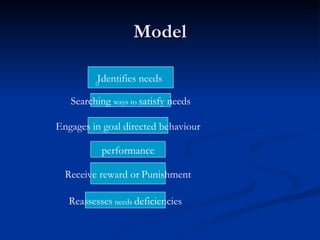
Model Identifies needs   Reassesses  needs  deficiencies Engages in goal directed behaviour Searching  ways to  satisfy needs performance Receive reward or   Punishment
Types of Motivation There are 2 types of Motivation Monetary Motivation Non Monetary motivation
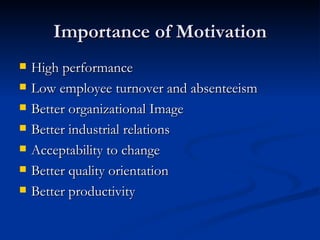
Importance of Motivation High performance Low employee turnover and absenteeism Better organizational Image Better industrial relations Acceptability to change Better quality orientation Better productivity
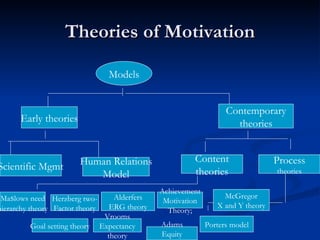
Theories of Motivation Models Early theories Contemporary theories Human Relations Model Scientific Mgmt Content theories Process theories Ma s lows need hierarchy theory Herzberg two- Factor theory Alderfers ERG theory Achievement Motivation Theory; Porters model Adams Equity theory Vrooms Expectancy theory Goal setting theory McGregor X and Y theory
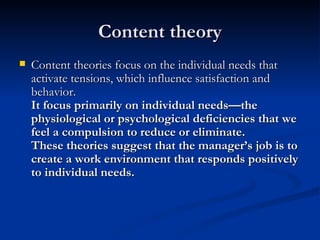
Content theory Content theories focus on the individual needs that activate tensions, which influence satisfaction and behavior. It focus primarily on individual needs—the physiological or psychological deficiencies that we feel a compulsion to reduce or eliminate.    These theories suggest that the manager’s job is to create a work environment that responds positively to individual needs.
Process theories describe the process through which needs are translated into behavior. They attempt to identify the variables that go into motivation and their relationship with each other.  focus on the thought or cognitive processes that take place within the minds of people and that act to influence their behavior.  A process approach probes further to identify how this need leads the person to behave in particular ways relative to available rewards and work opportunities  
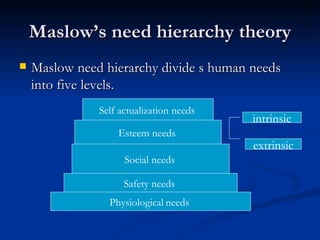
Maslow’s need hierarchy theory Maslow need hierarchy divide s human needs into five levels. Physiological   needs  Safety needs  Social needs   Esteem needs   Self actualization needs   intrinsic extrinsic
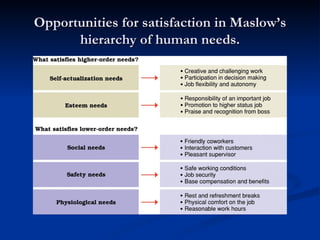
Physiological needs: These are the basic human needs including food,clothing,shelter and other necessities of life. Once these are satisfied they no longer motivate the man. Safety needs: These includes economic security, protection from physical dangers. Social needs. Need for love, affection, emotional needs,warmth,and friendship. Self esteem. Ego or self esteem, self respect, self confidence, recognition. Self actualization needs: desire for personal achievement or mission of his life.
This theory indicates There are 5 levels of need All  these needs are arranged in a hierarchy. Once a need or a certain order of need is satisfied it is no longer a motivating factor. Once one level of need is satisfied, the next level will emerge as the depressed need seeking to be satisfied. The physiological and security needs are finite but the needs of higher order are infinite and are likely to be dominant in persons at higher levels in the organization. Maslow suggests that various levels are interdependent and overlapping.
Criticism  Researchers have proved that there is lack of hierarchical structure of needs as suggested by Maslow. Some people may be deprived of lower level needs but strive for self actualization. There is lack of direct cause and effect relationship between need and behavior. Sometimes peoples are not aware of their own needs. Measurement of satisfaction of needs is not possible.
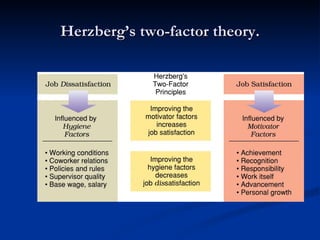
Herzberg 2 factor theory Motivation Hygiene theory Herzberg conducted a a motivational study on 200 accountants and engineers and concluded: There are certain factors that tend to be consistently related to job satisfaction( Motivational factor) and on the other hand there are certain factors which are consistently related to job dissatisfaction. (Hygiene factors)
Herzberg’s two-factor theory.
Hygiene Factors: They are extrinsic in nature and do not motivate people. If these factors are present they don’t motivate but if absent leads to dissatisfaction. There are 10 maintenance or hygiene factors:
Company policy or Administration Technical supervision Interpersonal relationship with supervisor Interpersonal relationship with peers Interpersonal relationship with subordinates Salary Job security Personal life Working conditions Status.
Motivation factors They are intrinsic in nature These factors have a positive effect on job satisfaction and often results in increase in output.  They enhances morale,satisfaction,efficiency and productivity. If these factors are present they motivate but if absent does not leads to dissatisfaction.
There are 6 motivational factors Achievement Advancement Growth Recognition Work itself Responsibility
Critical analysis of Herzberg theory Any improvement in Hygiene factors do not motivate workers but their reduction below a certain level will dissatisfy them. The model is not applicable in all conditiions.There is mixing up of both the factors in a job, which cannot be separated as intrinsic and extrinsic. This theory was limited to the engineers and  accountants. The effect of hygiene and motivational factors may totally be reverse on some other categories of people.
The scope of this theory is narrow as only 200 respondents were interviewed and method of data collection and interview was not appropriate as they were asked to report exceptionally good or exceptionally bad job experience. This theory does not emphasis much on pay, status or interpersonal relationships which are generally held as great motivators.
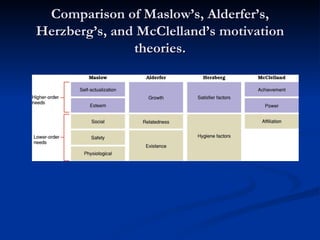
Comparison of Maslow and Herzberg Maintenance factors of Herzberg are identical to Lower level needs of Maslow.Higher level need of Maslow is equivalent to Motivation factors of Herzberg.
Opportunities for satisfaction in Maslow’s hierarchy of human needs.
Alderfers ERG theory ERG theory Developed by Clayton Alderfer. Three need levels: Existence needs  — desires for  physiological and material well-being. (Related to Maslow’s Physiological and Social) Relatedness needs  — desires for  satisfying interpersonal relationships. (Maslow's social and extrinsic self esteem like status, recognition and attention) Growth needs  — desires for  continued psychological growth and development. (Maslow’s intrinsic self esteem like advancement, self respect,achievemnt and self actualization.
ERG theory Any/all needs can influence behavior at one time. Frustration-regression principle. An already satisfied lower-level need becomes reactivated when a higher-level need is frustrated.
Evaluation Alderfer advocated three need patterns of an individual as against five steps proposed by Maslow. Alderfer recommended that all the need may be operative at any one time.If gratification of higher need is stifled,the desire to satisfy lower level need may increase.
Mc clelland’s Need theory/Achievement motivation theory He found that People who acquire a certain need behave differently from others. There are  3 types of need Need for Achievement:  “ n Ach” Need for Power  “n Pow” Need for Affiliation “n Aff”
Need for Achievement   (nAch) Desire to do something better or more efficiently, to solve problems, or to master complex tasks. People high in (nAch) prefer work that: Involves individual responsibility for results. Involves achievable but challenging goals. Provides feedback on performance.
Need for Power (nPower) Desire to control other persons, to influence their behavior, or to be responsible for other people. Personal power versus social power. People high in (nPower) prefer work that: Involves control over other persons. Has an impact on people and events. Brings public recognition and attention.
Need for Affiliation (nAff) Desire to establish and maintain friendly and warm relations with other persons. People high in (nAff) prefer work that: Involves interpersonal relationships. Provides for companionship Brings social approval.
Comparison of Maslow’s, Alderfer’s, Herzberg’s, and McClelland’s motivation theories.
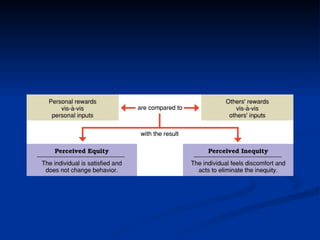
Adam’s equity theory Equity theory Developed by J. Stacy Adams. W hen people believe that they have been treated unfairly in comparison to others, they try to eliminate the discomfort and restore a perceived sense of equity to the situation.  Perceived inequity. Perceived equity.
 
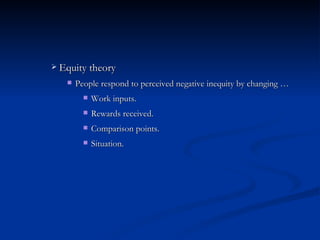
Equity theory People respond to perceived negative inequity by changing  … Work inputs. Rewards received. Comparison points. Situation.
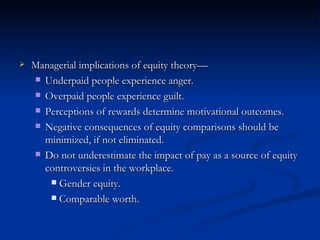
Managerial implications of equity theory — Underpaid people experience anger. Overpaid people experience guilt. Perceptions of rewards determine motivational outcomes. Negative consequences of equity comparisons should be minimized, if not eliminated. Do not underestimate the impact of pay as a source of equity controversies in the workplace.  Gender equity. Comparable worth.
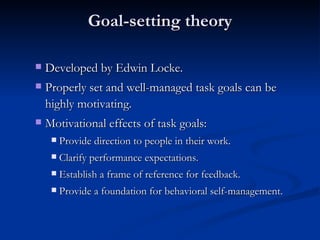
Goal-setting theory Developed by Edwin Locke. Properly set and well-managed task goals can be highly motivating. Motivational effects of task goals: Provide direction to people in their work. Clarify performance expectations. Establish a frame of reference for feedback. Provide a foundation for behavioral self-management.
Key issues and principles in the goal-setting process: Set specific goals. Set challenging goals. Build goal acceptance and commitment. Clarify goal priorities. Provide feedback on goal accomplishment. Reward goal accomplishment.
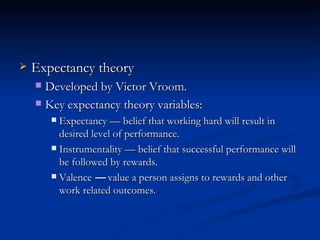
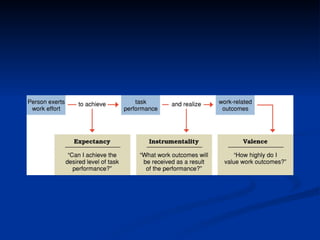
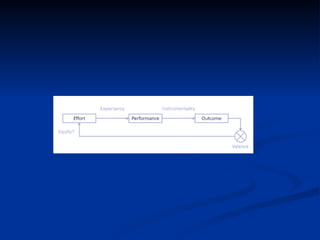
Expectancy theory Developed by Victor Vroom. Key expectancy theory variables: Expectancy  —  belief that working hard will result in desired level of performance. Instrumentality  —  belief that successful performance will be followed by rewards. Valence  —  value a person assigns to rewards and other work related outcomes.
 
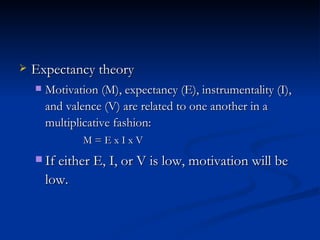
Expectancy theory Motivation (M), expectancy (E), instrumentality (I), and valence (V) are related to one another in a multiplicative fashion: M = E x I x V If either E, I, or V is low, motivation will be low.
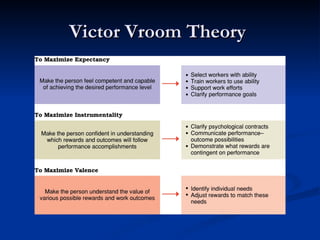
Victor Vroom Theory
 
Efforts-Performance relationship-It is related to the probability  perceived by  individual that exerting a given amount of efforts will lead to performance (Expectancy) . Performance-Reward Relationship. The degree to which the individual believes that performing a particular level will lead to attainment of desired outcome (instrumentality) Reward- personal goal Relationship-The degree to which an organizational reward will satisfy individual needs and its attractiveness for the individual valence)
Expectancy is the belief that increased effort will lead to increased performance i.e. if I work harder then this will be better. This is affected by such things as:  Having the right resources available (e.g. raw materials, time)  Having the right skills to do the job  Having the necessary support to get the job done (e.g. supervisor support, or correct information on the job)
Instrumentality is the belief that if you perform well that a valued outcome will be received i.e. if I do a good job, there is something in it for me. This is affected by such things as:  Clear understanding of the relationship between performance and outcomes – e.g. the rules of the reward ‘game’  Trust in the people who will take the decisions on who gets what outcome  Transparency of the process that decides who gets what outcome
Valence is the importance that the individual places upon the expected outcome. For example, if I am mainly motivated by money, I might not value offers of additional time off.
Lyman W. Porter and Edward E. Lawler developed a more complete version of motivation depending upon expectancy theory. This model is more comprehensive as it includes various aspects. This is a multivariate model which explain the relationship that exists between job attitudes and job performance. The assumptions are: Individual behavior is determined by a combination of factors that exists in the individual and are presented in the environment.
Individuals are considered to be rationale people who make conscious and logical decisions about their behavior when they interact with other people in the organization. Every individual have different needs,desires,and their goals are of varied nature. On the basis of their expectations, individuals decide between alternate behaviours.The outcome of the efforts is related to the pattern of behaviors an individual display.
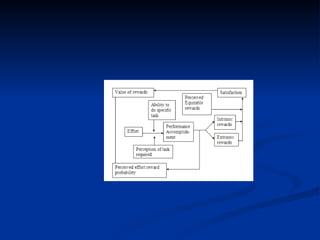
Actual performance in a job is primarily determined by the effort spent. But it is also affected by the person’s ability to do the job and also by individual’s perception of what the required task is. So performance is the responsible factor that leads to intrinsic as well as extrinsic rewards. These rewards, along with the equity of individual leads to satisfaction. Hence, satisfaction of the individual depends upon the fairness of the reward


Motivation theory

  • 1.
  • 2.
    Introduction Motivation isthe result of processes ,internal or external to the individual, that arouse enthusiasm and persistence to pursue a certain course of action. Motivation represents an unsatisfied need which creates a state of tension or disequilibrium, causing the individual to make a goal oriented pattern towards restoring a state of equilibrium by satisfying the need.
  • 3.
    Nature of MotivationIt refers to the set of forces that causes people to behave in certain ways. It is the inner feeling which energizes a person to work more. The emotions or desires of a person prompt him for doing a particular work. There are unsatisfied needs of a person which disturbs his equilibrium. A person moves to fulfill his unsatisfied needs by conditioning his energies and attain the state of equilibrium.
  • 4.
    Model Identifies needs Reassesses needs deficiencies Engages in goal directed behaviour Searching ways to satisfy needs performance Receive reward or Punishment
  • 5.
    Types of MotivationThere are 2 types of Motivation Monetary Motivation Non Monetary motivation
  • 6.
    Importance of MotivationHigh performance Low employee turnover and absenteeism Better organizational Image Better industrial relations Acceptability to change Better quality orientation Better productivity
  • 7.
    Theories of MotivationModels Early theories Contemporary theories Human Relations Model Scientific Mgmt Content theories Process theories Ma s lows need hierarchy theory Herzberg two- Factor theory Alderfers ERG theory Achievement Motivation Theory; Porters model Adams Equity theory Vrooms Expectancy theory Goal setting theory McGregor X and Y theory
  • 8.
    Content theory Contenttheories focus on the individual needs that activate tensions, which influence satisfaction and behavior. It focus primarily on individual needs—the physiological or psychological deficiencies that we feel a compulsion to reduce or eliminate.   These theories suggest that the manager’s job is to create a work environment that responds positively to individual needs.
  • 9.
    Process theories describethe process through which needs are translated into behavior. They attempt to identify the variables that go into motivation and their relationship with each other. focus on the thought or cognitive processes that take place within the minds of people and that act to influence their behavior. A process approach probes further to identify how this need leads the person to behave in particular ways relative to available rewards and work opportunities  
  • 10.
    Maslow’s need hierarchytheory Maslow need hierarchy divide s human needs into five levels. Physiological needs Safety needs Social needs Esteem needs Self actualization needs intrinsic extrinsic
  • 11.
    Physiological needs: Theseare the basic human needs including food,clothing,shelter and other necessities of life. Once these are satisfied they no longer motivate the man. Safety needs: These includes economic security, protection from physical dangers. Social needs. Need for love, affection, emotional needs,warmth,and friendship. Self esteem. Ego or self esteem, self respect, self confidence, recognition. Self actualization needs: desire for personal achievement or mission of his life.
  • 12.
    This theory indicatesThere are 5 levels of need All these needs are arranged in a hierarchy. Once a need or a certain order of need is satisfied it is no longer a motivating factor. Once one level of need is satisfied, the next level will emerge as the depressed need seeking to be satisfied. The physiological and security needs are finite but the needs of higher order are infinite and are likely to be dominant in persons at higher levels in the organization. Maslow suggests that various levels are interdependent and overlapping.
  • 13.
    Criticism Researchershave proved that there is lack of hierarchical structure of needs as suggested by Maslow. Some people may be deprived of lower level needs but strive for self actualization. There is lack of direct cause and effect relationship between need and behavior. Sometimes peoples are not aware of their own needs. Measurement of satisfaction of needs is not possible.
  • 14.
    Herzberg 2 factortheory Motivation Hygiene theory Herzberg conducted a a motivational study on 200 accountants and engineers and concluded: There are certain factors that tend to be consistently related to job satisfaction( Motivational factor) and on the other hand there are certain factors which are consistently related to job dissatisfaction. (Hygiene factors)
  • 15.
  • 16.
    Hygiene Factors: Theyare extrinsic in nature and do not motivate people. If these factors are present they don’t motivate but if absent leads to dissatisfaction. There are 10 maintenance or hygiene factors:
  • 17.
    Company policy orAdministration Technical supervision Interpersonal relationship with supervisor Interpersonal relationship with peers Interpersonal relationship with subordinates Salary Job security Personal life Working conditions Status.
  • 18.
    Motivation factors Theyare intrinsic in nature These factors have a positive effect on job satisfaction and often results in increase in output. They enhances morale,satisfaction,efficiency and productivity. If these factors are present they motivate but if absent does not leads to dissatisfaction.
  • 19.
    There are 6motivational factors Achievement Advancement Growth Recognition Work itself Responsibility
  • 20.
    Critical analysis ofHerzberg theory Any improvement in Hygiene factors do not motivate workers but their reduction below a certain level will dissatisfy them. The model is not applicable in all conditiions.There is mixing up of both the factors in a job, which cannot be separated as intrinsic and extrinsic. This theory was limited to the engineers and accountants. The effect of hygiene and motivational factors may totally be reverse on some other categories of people.
  • 21.
    The scope ofthis theory is narrow as only 200 respondents were interviewed and method of data collection and interview was not appropriate as they were asked to report exceptionally good or exceptionally bad job experience. This theory does not emphasis much on pay, status or interpersonal relationships which are generally held as great motivators.
  • 22.
    Comparison of Maslowand Herzberg Maintenance factors of Herzberg are identical to Lower level needs of Maslow.Higher level need of Maslow is equivalent to Motivation factors of Herzberg.
  • 23.
    Opportunities for satisfactionin Maslow’s hierarchy of human needs.
  • 24.
    Alderfers ERG theoryERG theory Developed by Clayton Alderfer. Three need levels: Existence needs — desires for physiological and material well-being. (Related to Maslow’s Physiological and Social) Relatedness needs — desires for satisfying interpersonal relationships. (Maslow's social and extrinsic self esteem like status, recognition and attention) Growth needs — desires for continued psychological growth and development. (Maslow’s intrinsic self esteem like advancement, self respect,achievemnt and self actualization.
  • 25.
    ERG theory Any/allneeds can influence behavior at one time. Frustration-regression principle. An already satisfied lower-level need becomes reactivated when a higher-level need is frustrated.
  • 26.
    Evaluation Alderfer advocatedthree need patterns of an individual as against five steps proposed by Maslow. Alderfer recommended that all the need may be operative at any one time.If gratification of higher need is stifled,the desire to satisfy lower level need may increase.
  • 27.
    Mc clelland’s Needtheory/Achievement motivation theory He found that People who acquire a certain need behave differently from others. There are 3 types of need Need for Achievement: “ n Ach” Need for Power “n Pow” Need for Affiliation “n Aff”
  • 28.
    Need for Achievement (nAch) Desire to do something better or more efficiently, to solve problems, or to master complex tasks. People high in (nAch) prefer work that: Involves individual responsibility for results. Involves achievable but challenging goals. Provides feedback on performance.
  • 29.
    Need for Power(nPower) Desire to control other persons, to influence their behavior, or to be responsible for other people. Personal power versus social power. People high in (nPower) prefer work that: Involves control over other persons. Has an impact on people and events. Brings public recognition and attention.
  • 30.
    Need for Affiliation(nAff) Desire to establish and maintain friendly and warm relations with other persons. People high in (nAff) prefer work that: Involves interpersonal relationships. Provides for companionship Brings social approval.
  • 31.
    Comparison of Maslow’s,Alderfer’s, Herzberg’s, and McClelland’s motivation theories.
  • 32.
    Adam’s equity theoryEquity theory Developed by J. Stacy Adams. W hen people believe that they have been treated unfairly in comparison to others, they try to eliminate the discomfort and restore a perceived sense of equity to the situation. Perceived inequity. Perceived equity.
  • 33.
  • 34.
    Equity theory Peoplerespond to perceived negative inequity by changing … Work inputs. Rewards received. Comparison points. Situation.
  • 35.
    Managerial implications ofequity theory — Underpaid people experience anger. Overpaid people experience guilt. Perceptions of rewards determine motivational outcomes. Negative consequences of equity comparisons should be minimized, if not eliminated. Do not underestimate the impact of pay as a source of equity controversies in the workplace. Gender equity. Comparable worth.
  • 36.
    Goal-setting theory Developedby Edwin Locke. Properly set and well-managed task goals can be highly motivating. Motivational effects of task goals: Provide direction to people in their work. Clarify performance expectations. Establish a frame of reference for feedback. Provide a foundation for behavioral self-management.
  • 37.
    Key issues andprinciples in the goal-setting process: Set specific goals. Set challenging goals. Build goal acceptance and commitment. Clarify goal priorities. Provide feedback on goal accomplishment. Reward goal accomplishment.
  • 38.
    Expectancy theory Developedby Victor Vroom. Key expectancy theory variables: Expectancy — belief that working hard will result in desired level of performance. Instrumentality — belief that successful performance will be followed by rewards. Valence — value a person assigns to rewards and other work related outcomes.
  • 39.
  • 40.
    Expectancy theory Motivation(M), expectancy (E), instrumentality (I), and valence (V) are related to one another in a multiplicative fashion: M = E x I x V If either E, I, or V is low, motivation will be low.
  • 41.
  • 42.
  • 43.
    Efforts-Performance relationship-It isrelated to the probability perceived by individual that exerting a given amount of efforts will lead to performance (Expectancy) . Performance-Reward Relationship. The degree to which the individual believes that performing a particular level will lead to attainment of desired outcome (instrumentality) Reward- personal goal Relationship-The degree to which an organizational reward will satisfy individual needs and its attractiveness for the individual valence)
  • 44.
    Expectancy is thebelief that increased effort will lead to increased performance i.e. if I work harder then this will be better. This is affected by such things as: Having the right resources available (e.g. raw materials, time) Having the right skills to do the job Having the necessary support to get the job done (e.g. supervisor support, or correct information on the job)
  • 45.
    Instrumentality is thebelief that if you perform well that a valued outcome will be received i.e. if I do a good job, there is something in it for me. This is affected by such things as: Clear understanding of the relationship between performance and outcomes – e.g. the rules of the reward ‘game’ Trust in the people who will take the decisions on who gets what outcome Transparency of the process that decides who gets what outcome
  • 46.
    Valence is theimportance that the individual places upon the expected outcome. For example, if I am mainly motivated by money, I might not value offers of additional time off.
  • 47.
    Lyman W. Porterand Edward E. Lawler developed a more complete version of motivation depending upon expectancy theory. This model is more comprehensive as it includes various aspects. This is a multivariate model which explain the relationship that exists between job attitudes and job performance. The assumptions are: Individual behavior is determined by a combination of factors that exists in the individual and are presented in the environment.
  • 48.
    Individuals are consideredto be rationale people who make conscious and logical decisions about their behavior when they interact with other people in the organization. Every individual have different needs,desires,and their goals are of varied nature. On the basis of their expectations, individuals decide between alternate behaviours.The outcome of the efforts is related to the pattern of behaviors an individual display.
  • 49.
    Actual performance ina job is primarily determined by the effort spent. But it is also affected by the person’s ability to do the job and also by individual’s perception of what the required task is. So performance is the responsible factor that leads to intrinsic as well as extrinsic rewards. These rewards, along with the equity of individual leads to satisfaction. Hence, satisfaction of the individual depends upon the fairness of the reward
  • 50.
  • 51.