Unit-5
Rectilinear Motion of Particle
Sub- Engg. Mechanics
By: Mr. Ghumare S. M.
Motion Under Gravity
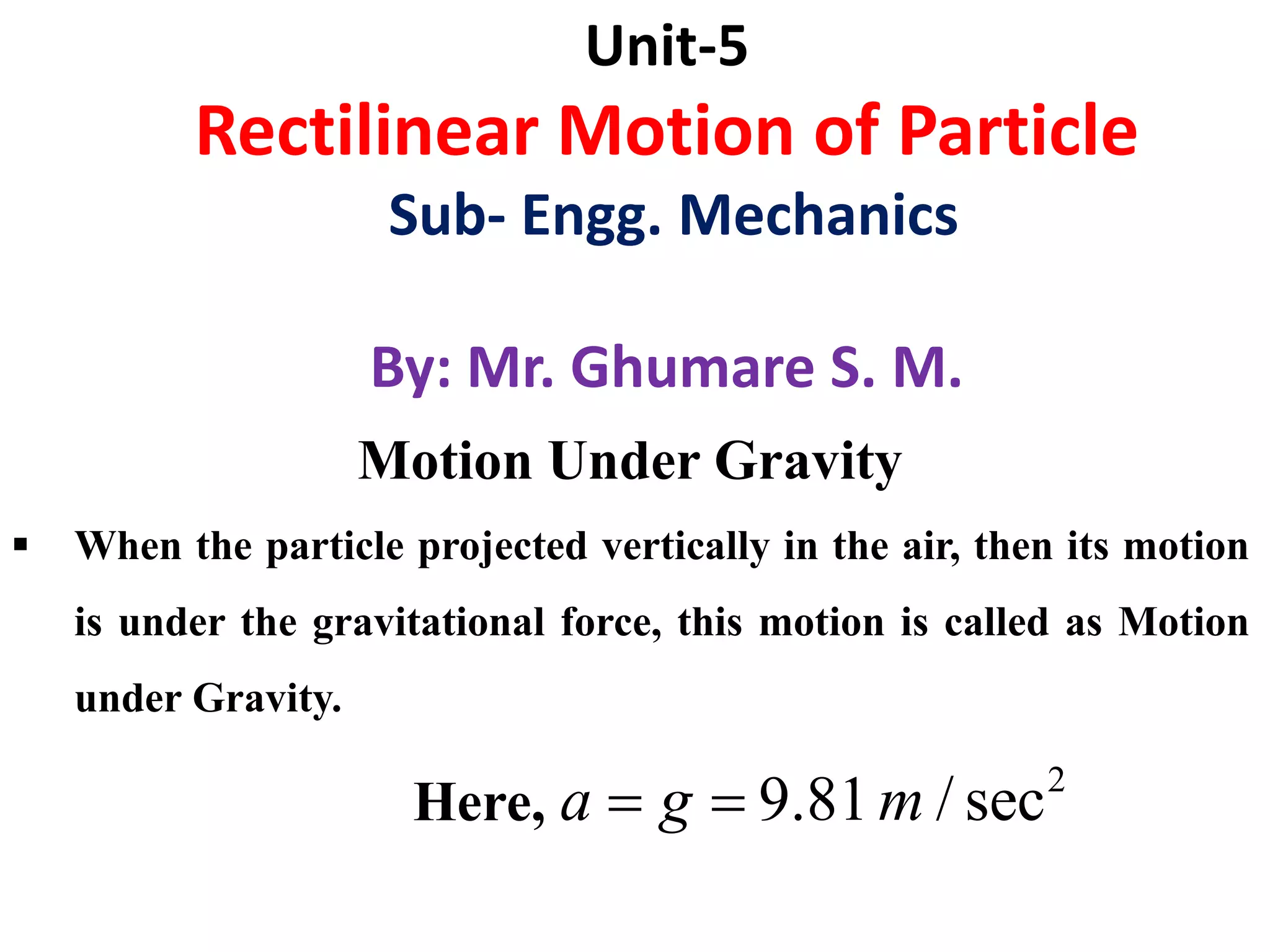
 When the particle projected vertically in the air, then its motion
is under the gravitational force, this motion is called as Motion
under Gravity.
Here,
2
9.81 / seca g m 
Motion Under Gravity
• Equations of Rectilinear Motion
 
2
2 2
1
1
(2)
2
2 (3)
v
s
v
u a t
u t a t
u a s
         
       
       
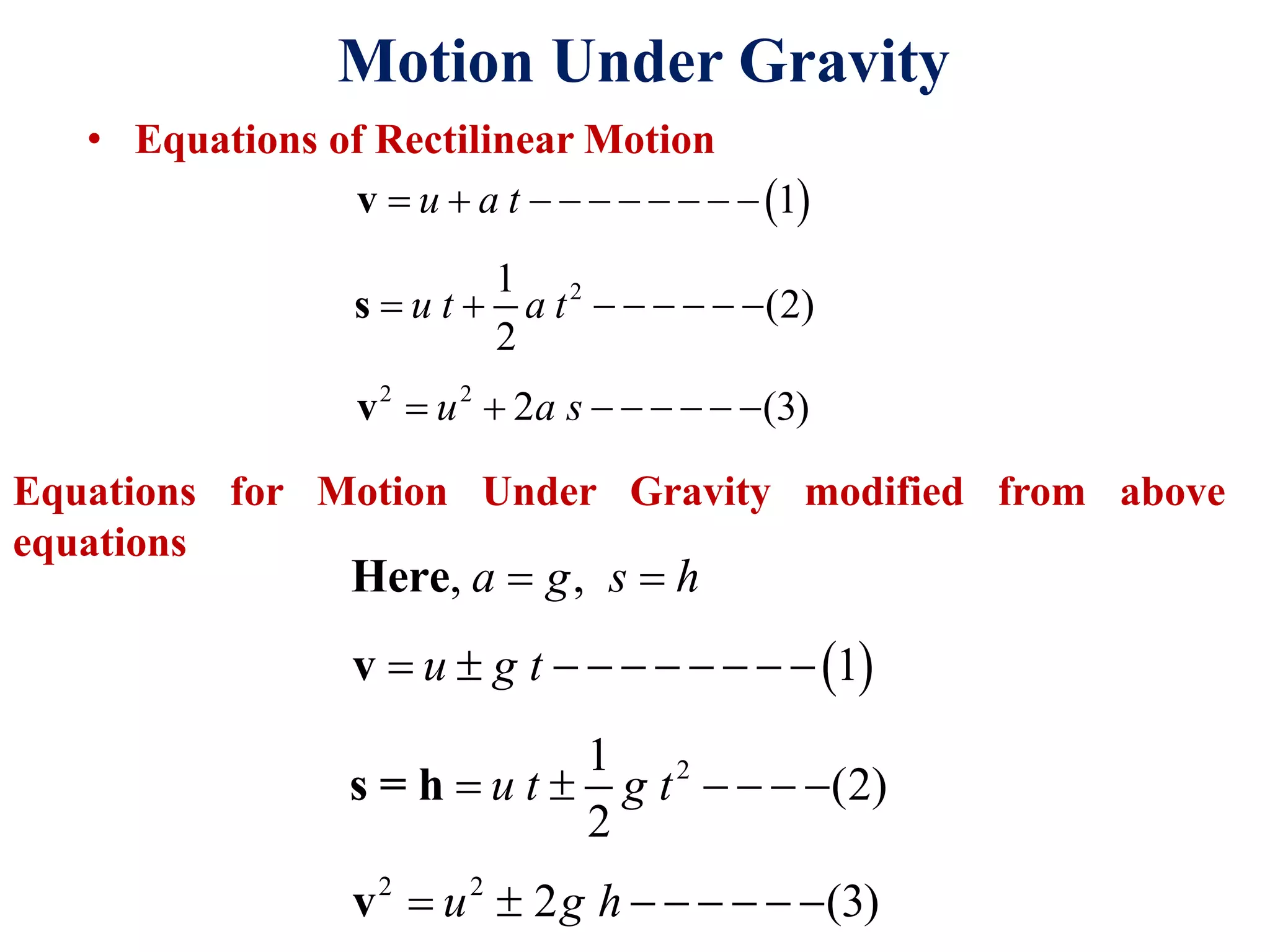
Equations for Motion Under Gravity modified from above
equations
 
2
2 2
, ,
1
1
(2)
2
2 (3)
Here
v
s = h
v
a g s h
u g t
u t g t
u g h
 
         
     
       
Motion under Gravity
• Important Points
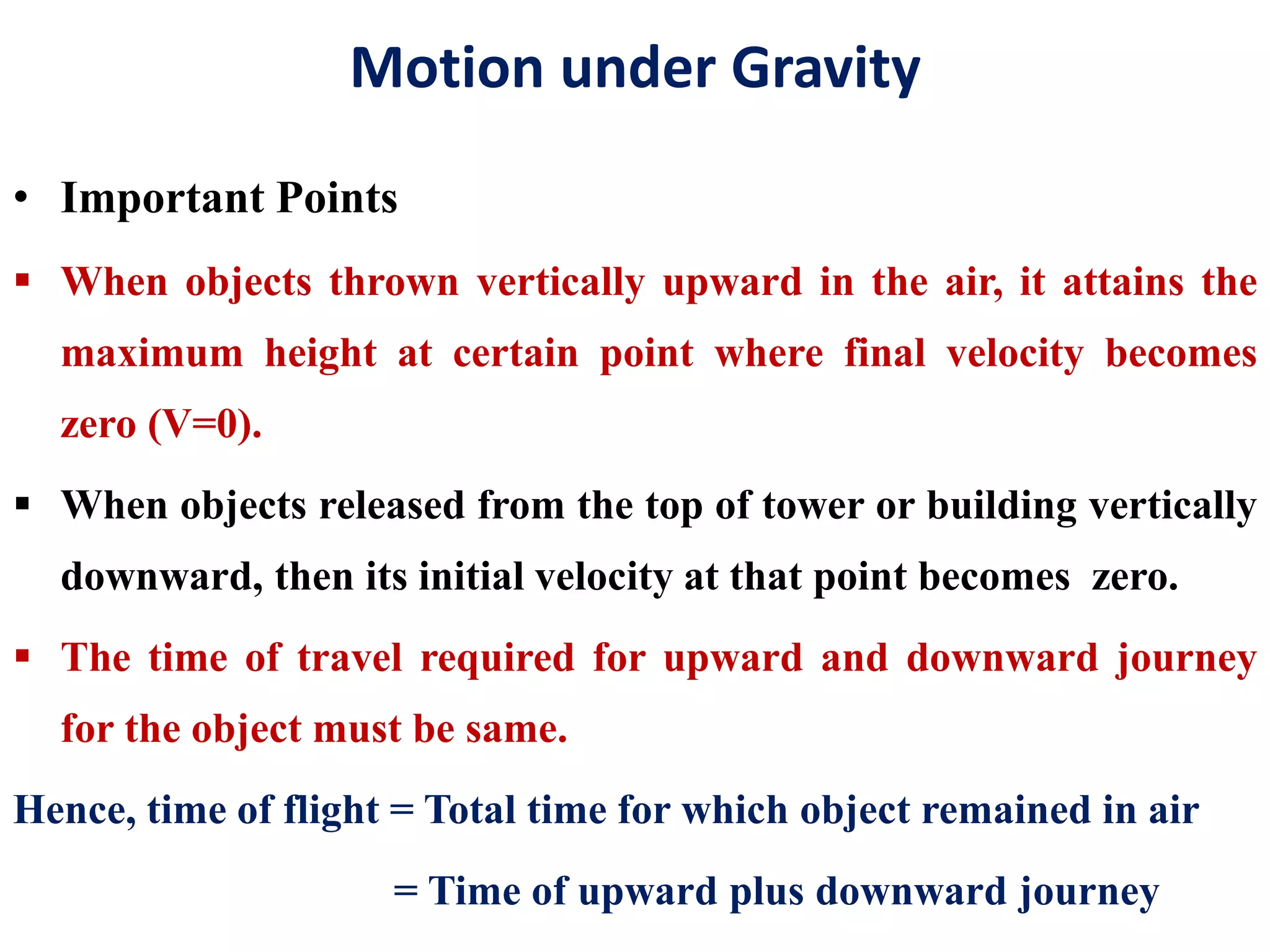
 When objects thrown vertically upward in the air, it attains the
maximum height at certain point where final velocity becomes
zero (V=0).
 When objects released from the top of tower or building vertically
downward, then its initial velocity at that point becomes zero.
 The time of travel required for upward and downward journey
for the object must be same.
Hence, time of flight = Total time for which object remained in air
= Time of upward plus downward journey
Motion under Gravity
• Important Points
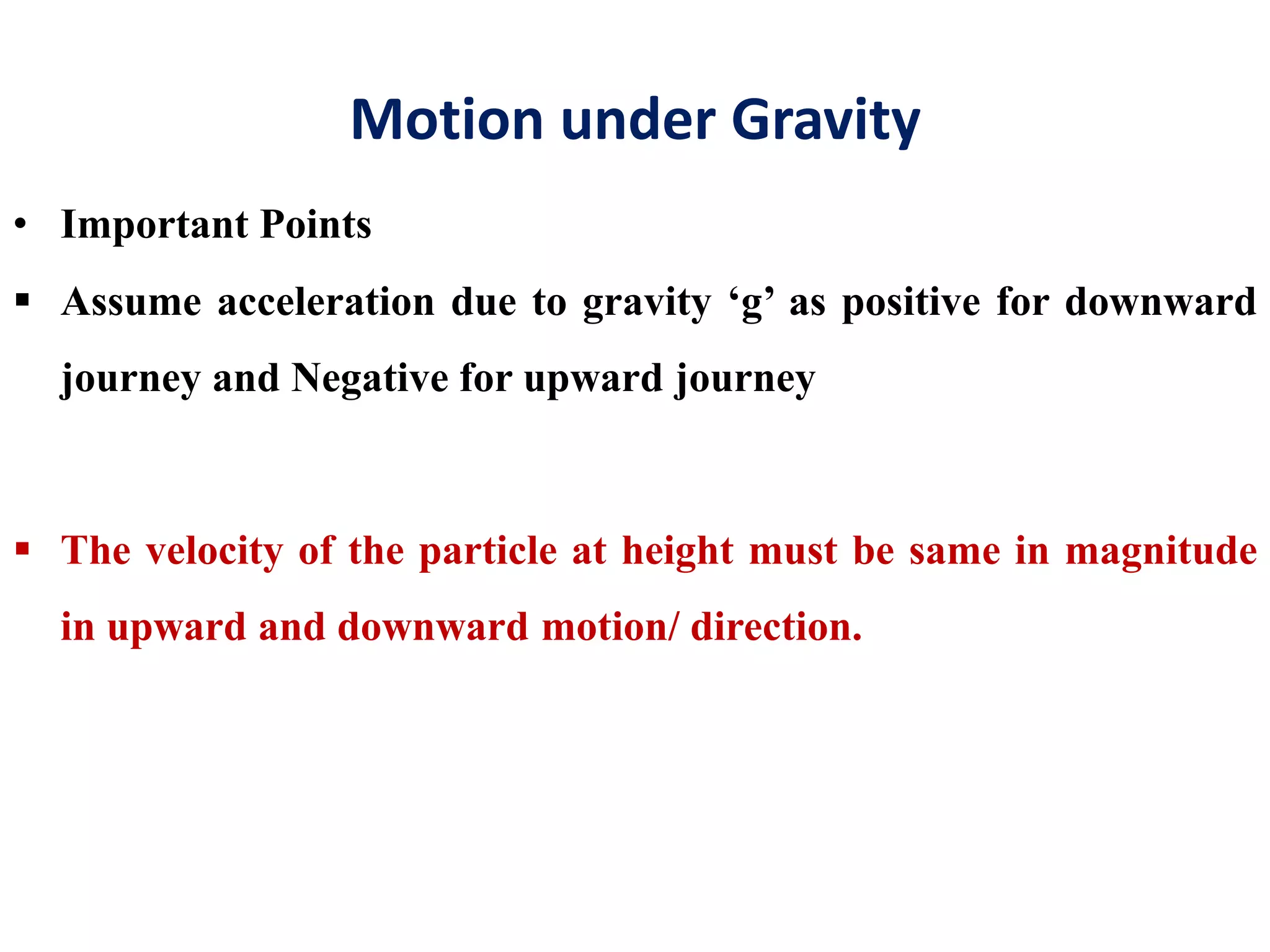
 Assume acceleration due to gravity ‘g’ as positive for downward
journey and Negative for upward journey
 The velocity of the particle at height must be same in magnitude
in upward and downward motion/ direction.
Numerical Example-1
Ex. From, top of the tower 100m high , a stone is dropped down. At
the same time, another stone is thrown upward from the foot of the
tower with a velocity 30 m/sec. When and Where the two stones will
cross each other? Find the velocity of two stones at the time of
crossing.
Given, Ht. of tower 100m
Stone 1 dropped from top, Hence initial velocity = 0
Stone 2 thrown upward with initial velocity = 30 m / s
Let, ‘t’ be the time required for the stones during which both stones
will covers some distance, let us say and .
But, here
1u
2u
1h 2h
1 2 100 (1)h h m        
Example 1 Continue….
• Distance travelled by 1st Stone in downward
direction is as follows,
2
1 1
2
1 1
2
1
2
1
1
2
, , 0
1
2
1
, 9.81
2
4.905 (1)
s
is
then X X
u t g t
s h g ve u
h u t g t
h t
h t
 
  
 

     
Example 1 Continue….
• Distance travelled by 2st Stone in upward
direction is as follows,
2
2 2
2
2 2
2
2
2
2
1
2
, , 30 /
1
2
1
, 30 9.81
2
30 4.905 (2)
s
is
then X X
u t g t
s h g ve u m s
h u t g t
h t t
h t t
 
  
 
 
       
Example 1 Continue….
Total height of the tower is 100 m
In time t both the stones have traveled distance h1 and h2,
1 2
1 2
2 2
1 2
, .(1) (2)
100
100 4.905 30 4.905
100 30 , 3.33sec
.(1) (2),
54.5 45.5
9.81 3.33 , 32.7 / sec
st
1 1
1 1
To find velocity of crossing,
Use v =u +gt for 1 Stone
v = 0 + X v
Put h and h from Eq and
m h h
t t t
t then t s
putting in Eq and
h m and h m
m
 
  
 
 

2 2
2 2
( )
30 9.81 3.33 , 2.7 / sec( )
st
Use v =u -gt for 2 Stone
v = X v m

   
Numerical Example-2
Ball ‘A’ is released from the rest at a height 12 m rom top, At the
same time, another ball is thrown upward 1.5m from the ground. If
the balls cross each other at a height of 6m, Determine the speed at
which ball B was thrown upward.
Given, Ht. of tower 12m
Ball 1 dropped from top, at rest, initial velocity = 0
Stone 2 thrown upward 1.5m from ground, Find
Let, ‘t’ be the time required for the Balls during which both stones
will covers some distance, let us say and .
But, here
1u
2u
1h 2h
1 2 12 1.5 10.5 (1)h h m          
Example 2 Continue….
• Downward distance travelled by Ball A is 6m,
1 1
2
6 , , 0
1
6 0 9.81
2
1.106
iss h m g ve u
t
t Secs
   
 

Downward distance travelled by Ball B =4.5M
2 2
2
2
2
4.5 , , ?
1.106
1
4.5 1.106 9.81 (1.106)
2
9.49 / sec
iss h m g ve u
Put t Secs
X u X
Solving u m
   

 

Thank You

Motion under gravity By ghumare s m

  • 1.
    Unit-5 Rectilinear Motion ofParticle Sub- Engg. Mechanics By: Mr. Ghumare S. M. Motion Under Gravity  When the particle projected vertically in the air, then its motion is under the gravitational force, this motion is called as Motion under Gravity. Here, 2 9.81 / seca g m 
  • 2.
    Motion Under Gravity •Equations of Rectilinear Motion   2 2 2 1 1 (2) 2 2 (3) v s v u a t u t a t u a s                           Equations for Motion Under Gravity modified from above equations   2 2 2 , , 1 1 (2) 2 2 (3) Here v s = h v a g s h u g t u t g t u g h                          
  • 3.
    Motion under Gravity •Important Points  When objects thrown vertically upward in the air, it attains the maximum height at certain point where final velocity becomes zero (V=0).  When objects released from the top of tower or building vertically downward, then its initial velocity at that point becomes zero.  The time of travel required for upward and downward journey for the object must be same. Hence, time of flight = Total time for which object remained in air = Time of upward plus downward journey
  • 4.
    Motion under Gravity •Important Points  Assume acceleration due to gravity ‘g’ as positive for downward journey and Negative for upward journey  The velocity of the particle at height must be same in magnitude in upward and downward motion/ direction.
  • 5.
    Numerical Example-1 Ex. From,top of the tower 100m high , a stone is dropped down. At the same time, another stone is thrown upward from the foot of the tower with a velocity 30 m/sec. When and Where the two stones will cross each other? Find the velocity of two stones at the time of crossing. Given, Ht. of tower 100m Stone 1 dropped from top, Hence initial velocity = 0 Stone 2 thrown upward with initial velocity = 30 m / s Let, ‘t’ be the time required for the stones during which both stones will covers some distance, let us say and . But, here 1u 2u 1h 2h 1 2 100 (1)h h m        
  • 6.
    Example 1 Continue…. •Distance travelled by 1st Stone in downward direction is as follows, 2 1 1 2 1 1 2 1 2 1 1 2 , , 0 1 2 1 , 9.81 2 4.905 (1) s is then X X u t g t s h g ve u h u t g t h t h t              
  • 7.
    Example 1 Continue…. •Distance travelled by 2st Stone in upward direction is as follows, 2 2 2 2 2 2 2 2 2 2 1 2 , , 30 / 1 2 1 , 30 9.81 2 30 4.905 (2) s is then X X u t g t s h g ve u m s h u t g t h t t h t t                 
  • 8.
    Example 1 Continue…. Totalheight of the tower is 100 m In time t both the stones have traveled distance h1 and h2, 1 2 1 2 2 2 1 2 , .(1) (2) 100 100 4.905 30 4.905 100 30 , 3.33sec .(1) (2), 54.5 45.5 9.81 3.33 , 32.7 / sec st 1 1 1 1 To find velocity of crossing, Use v =u +gt for 1 Stone v = 0 + X v Put h and h from Eq and m h h t t t t then t s putting in Eq and h m and h m m           2 2 2 2 ( ) 30 9.81 3.33 , 2.7 / sec( ) st Use v =u -gt for 2 Stone v = X v m     
  • 9.
    Numerical Example-2 Ball ‘A’is released from the rest at a height 12 m rom top, At the same time, another ball is thrown upward 1.5m from the ground. If the balls cross each other at a height of 6m, Determine the speed at which ball B was thrown upward. Given, Ht. of tower 12m Ball 1 dropped from top, at rest, initial velocity = 0 Stone 2 thrown upward 1.5m from ground, Find Let, ‘t’ be the time required for the Balls during which both stones will covers some distance, let us say and . But, here 1u 2u 1h 2h 1 2 12 1.5 10.5 (1)h h m          
  • 10.
    Example 2 Continue…. •Downward distance travelled by Ball A is 6m, 1 1 2 6 , , 0 1 6 0 9.81 2 1.106 iss h m g ve u t t Secs        Downward distance travelled by Ball B =4.5M 2 2 2 2 2 4.5 , , ? 1.106 1 4.5 1.106 9.81 (1.106) 2 9.49 / sec iss h m g ve u Put t Secs X u X Solving u m        
  • 11.