Sub- Solid Mechanics
Axially and Eccentrically Loaded Columns
Lect. 1 Introduction to Column theory
Sanjivani Rural Education Society’s
Sanjivani College of Engineering, Kopargaon-423603
An Autonomous Institute, Affiliated to Savitribai Phule Pune University, Pune
ISO 9001:2015 Certified, Approved by AICTE, Accredited by NAAC (A Grade) & NBA
Department of Civil Engineering
Prepared by:
Dr. Ghumare S. M.
Asso Professor, Civil Engg. Department,
Column / Struts
Introduction:
 Column is a vertical compression member generally used
to carry compressive axial loads.
 Steel Column- Stanchion
 Wooden Column- Post
 Concrete column- R..C.C Column
 Masonry columns- Pillars
Column may fail due to buckling, crushing or due to both.
Types of Columns:
1. Short Column- Short column fails due to excessive
crushing load.
2. Medium Column- Medium column fails due to buckling
or crushing.
3. Long Column- Long column always fails due to buckling
only.
Column / Struts
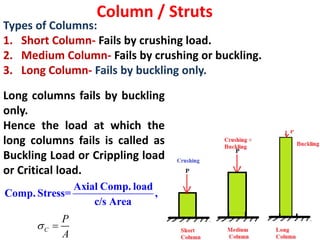
Types of Columns:
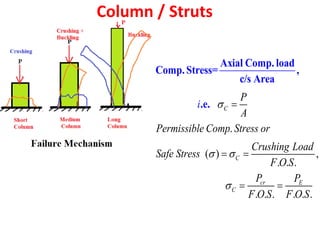
1. Short Column- Fails by crushing load.
2. Medium Column- Fails by crushing or buckling.
3. Long Column- Fails by buckling only.
Long columns fails by buckling
only.
Hence the load at which the
long columns fails is called as
Buckling Load or Crippling load
or Critical load.
Axial Comp. load
Comp. Stress= ,
c/s Area
C
P
A
 
Column / Struts
.
( ) ,
. . .
. . . . . .
Axial Comp. load
Comp.Stress= ,
c/s Area
.e. C
C
cr E
C
P
A
Permissible Comp Stress or
Crushing Load
Safe Stress
F O S
P P
F O S F O S
i 
 


 
 
Methods of analysis of Buckling or
Crippling load
Critical buckling Load can be calculated using
two methods.
1. Euler’s Theory or Euler’s Column Theory
(Used only for Long Columns)
2. Rankine’s Theory or Rankine’s Column Theory
(Used for Short as well as Long Columns)
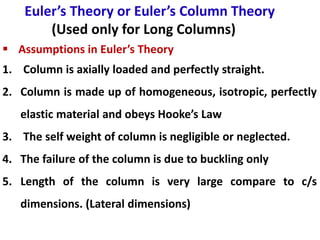
Euler’s Theory or Euler’s Column Theory
(Used only for Long Columns)
 Assumptions in Euler’s Theory
1. Column is axially loaded and perfectly straight.
2. Column is made up of homogeneous, isotropic, perfectly
elastic material and obeys Hooke’s Law
3. The self weight of column is negligible or neglected.
4. The failure of the column is due to buckling only
5. Length of the column is very large compare to c/s
dimensions. (Lateral dimensions)
Sign Convention
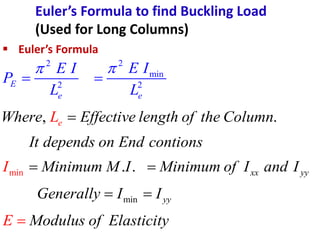
Euler’s Formula to find Buckling Load
(Used for Long Columns)
 Euler’s Formula
2
2
min
2 2
m
mi
in
n
, .
. . x
E
x
e e
e
yy
yy
Where Effective length of the Column
It depends on End contions
Minimum M I Minimum of I and I
Generally I I
Modulus of Elastic
E I
E I
P
L L
L
I
E ity





 
 

.
.
Effective Length (Le)
Definition: It is the length between the two points
of zero Bending moments or
It is the length of an equivalent column of the same material
and c/s with both ends hinged and having same value of
crippling load.
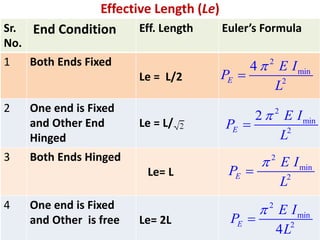
Effective Length (Le)
Sr.
No.
End Condition Eff. Length Euler’s Formula
1 Both Ends Fixed
Le = L/2
2 One end is Fixed
and Other End
Hinged
Le = L/
3 Both Ends Hinged
Le= L
4 One end is Fixed
and Other is free Le= 2L
2
min
2
4
E
E I
P
L


2
min
2
2
E
E I
P
L


2
min
2
E
E I
P
L


2
min
2
4
E
E I
P
L


.
.
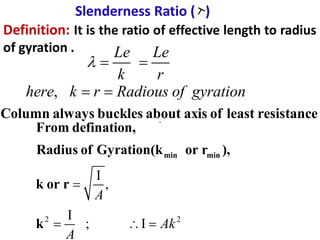
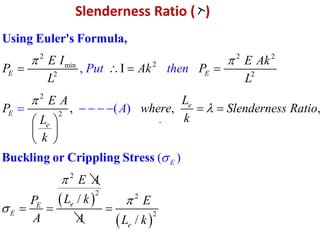
Slenderness Ratio ( )
Definition: It is the ratio of effective length to radius
of gyration .
,
here k r Radious of gyration
 
Le Le
k r
  
Column always buckles about axis of least resistance
2 2
I
,
I
; I
min min
From defination,
Radius of Gyration(k or r ),
k or r
k
A
Ak
A

  
.
.
Slenderness Ratio ( )
 
 
2 2 2
2
min
2 2
2
2
2
2 2
2
I
, , ,
/
/
,
( )
( )
Using Euler's Formula,
Buckling or Crippling Stress E
E E
e
E
e
e
E
E
e
E I E Ak
P Ak P
L L
L
E A
P where Slenderness Ratio
k
L
k
E A
L k
P E
A
P
A L
t t n
A
k
u he








   
 
 
 
 
  
    
.
.
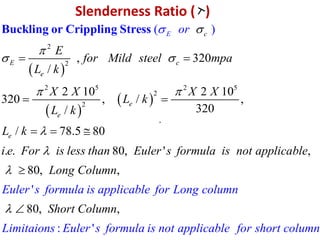
Slenderness Ratio ( )
 
 
 
2
2
2 5 2 5
2
2
, 320
/
2 10 2 10
320 , / ,
320
/
/ 78.5 80
. . 80, ' ,
80
( )
'
, ,
Buckling or Crippling Stress c
E c
e
e
e
e
E
E
for Mild steel mpa
L k
X X X X
L k
L k
L k
i e For is less than Euler s formula is not applicable
Long Column
or
Euler s formula is a


 
 




 
 
  

8
: '
0, ,
pplicable for Long column
Limitaions Euler s formula is not applicable fo
Shor
r sho
t Col
rt co
u n
mn
m
lu
 
.
.
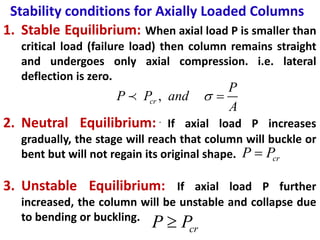
Stability conditions for Axially Loaded Columns
1. Stable Equilibrium: When axial load P is smaller than
critical load (failure load) then column remains straight
and undergoes only axial compression. i.e. lateral
deflection is zero.
2. Neutral Equilibrium: If axial load P increases
gradually, the stage will reach that column will buckle or
bent but will not regain its original shape.
3. Unstable Equilibrium: If axial load P further
increased, the column will be unstable and collapse due
to bending or buckling.
,
cr
P
P P and
A
 
cr
P P

cr
P P

Stability conditions for Axially Loaded Columns
Stable Equilibrium Neutral Equilibrium Un-Stable Equilibrium
Thank You

Solid Mechanics -Introduction to Column Theory.pptx

  • 1.
    Sub- Solid Mechanics Axiallyand Eccentrically Loaded Columns Lect. 1 Introduction to Column theory Sanjivani Rural Education Society’s Sanjivani College of Engineering, Kopargaon-423603 An Autonomous Institute, Affiliated to Savitribai Phule Pune University, Pune ISO 9001:2015 Certified, Approved by AICTE, Accredited by NAAC (A Grade) & NBA Department of Civil Engineering Prepared by: Dr. Ghumare S. M. Asso Professor, Civil Engg. Department,
  • 2.
    Column / Struts Introduction: Column is a vertical compression member generally used to carry compressive axial loads.  Steel Column- Stanchion  Wooden Column- Post  Concrete column- R..C.C Column  Masonry columns- Pillars Column may fail due to buckling, crushing or due to both. Types of Columns: 1. Short Column- Short column fails due to excessive crushing load. 2. Medium Column- Medium column fails due to buckling or crushing. 3. Long Column- Long column always fails due to buckling only.
  • 3.
    Column / Struts Typesof Columns: 1. Short Column- Fails by crushing load. 2. Medium Column- Fails by crushing or buckling. 3. Long Column- Fails by buckling only. Long columns fails by buckling only. Hence the load at which the long columns fails is called as Buckling Load or Crippling load or Critical load. Axial Comp. load Comp. Stress= , c/s Area C P A  
  • 4.
    Column / Struts . () , . . . . . . . . . Axial Comp. load Comp.Stress= , c/s Area .e. C C cr E C P A Permissible Comp Stress or Crushing Load Safe Stress F O S P P F O S F O S i         
  • 5.
    Methods of analysisof Buckling or Crippling load Critical buckling Load can be calculated using two methods. 1. Euler’s Theory or Euler’s Column Theory (Used only for Long Columns) 2. Rankine’s Theory or Rankine’s Column Theory (Used for Short as well as Long Columns)
  • 6.
    Euler’s Theory orEuler’s Column Theory (Used only for Long Columns)  Assumptions in Euler’s Theory 1. Column is axially loaded and perfectly straight. 2. Column is made up of homogeneous, isotropic, perfectly elastic material and obeys Hooke’s Law 3. The self weight of column is negligible or neglected. 4. The failure of the column is due to buckling only 5. Length of the column is very large compare to c/s dimensions. (Lateral dimensions)
  • 7.
  • 8.
    Euler’s Formula tofind Buckling Load (Used for Long Columns)  Euler’s Formula 2 2 min 2 2 m mi in n , . . . x E x e e e yy yy Where Effective length of the Column It depends on End contions Minimum M I Minimum of I and I Generally I I Modulus of Elastic E I E I P L L L I E ity          
  • 9.
    . . Effective Length (Le) Definition:It is the length between the two points of zero Bending moments or It is the length of an equivalent column of the same material and c/s with both ends hinged and having same value of crippling load.
  • 10.
    Effective Length (Le) Sr. No. EndCondition Eff. Length Euler’s Formula 1 Both Ends Fixed Le = L/2 2 One end is Fixed and Other End Hinged Le = L/ 3 Both Ends Hinged Le= L 4 One end is Fixed and Other is free Le= 2L 2 min 2 4 E E I P L   2 min 2 2 E E I P L   2 min 2 E E I P L   2 min 2 4 E E I P L  
  • 11.
    . . Slenderness Ratio () Definition: It is the ratio of effective length to radius of gyration . , here k r Radious of gyration   Le Le k r    Column always buckles about axis of least resistance 2 2 I , I ; I min min From defination, Radius of Gyration(k or r ), k or r k A Ak A    
  • 12.
    . . Slenderness Ratio ()     2 2 2 2 min 2 2 2 2 2 2 2 2 I , , , / / , ( ) ( ) Using Euler's Formula, Buckling or Crippling Stress E E E e E e e E E e E I E Ak P Ak P L L L E A P where Slenderness Ratio k L k E A L k P E A P A L t t n A k u he                            
  • 13.
    . . Slenderness Ratio ()       2 2 2 5 2 5 2 2 , 320 / 2 10 2 10 320 , / , 320 / / 78.5 80 . . 80, ' , 80 ( ) ' , , Buckling or Crippling Stress c E c e e e e E E for Mild steel mpa L k X X X X L k L k L k i e For is less than Euler s formula is not applicable Long Column or Euler s formula is a                   8 : ' 0, , pplicable for Long column Limitaions Euler s formula is not applicable fo Shor r sho t Col rt co u n mn m lu  
  • 14.
    . . Stability conditions forAxially Loaded Columns 1. Stable Equilibrium: When axial load P is smaller than critical load (failure load) then column remains straight and undergoes only axial compression. i.e. lateral deflection is zero. 2. Neutral Equilibrium: If axial load P increases gradually, the stage will reach that column will buckle or bent but will not regain its original shape. 3. Unstable Equilibrium: If axial load P further increased, the column will be unstable and collapse due to bending or buckling. , cr P P P and A   cr P P  cr P P 
  • 15.
    Stability conditions forAxially Loaded Columns Stable Equilibrium Neutral Equilibrium Un-Stable Equilibrium
  • 16.