02-May-21
1
Kinematics
Kinematics
• Kinematics isthe branch of mechanics that
deals with the motion of points, bodies
(objects) and systems of bodies (groups of
objects) without consideration of the mass of
the body and force causing the motion
2.
02-May-21
2
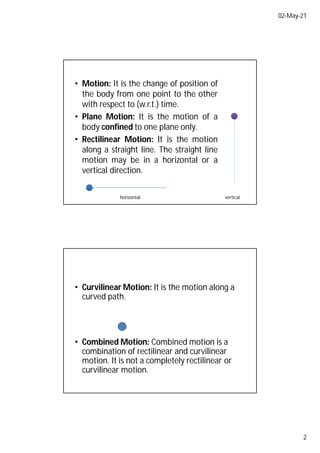
• Motion: Itis the change of position of
the body from one point to the other
with respect to (w.r.t.) time.
• Plane Motion: It is the motion of a
body confined to one plane only.
• Rectilinear Motion: It is the motion
along a straight line. The straight line
motion may be in a horizontal or a
vertical direction.
horizontal vertical
• Curvilinear Motion: It is the motion along a
curved path.
• Combined Motion: Combined motion is a
combination of rectilinear and curvilinear
motion. It is not a completely rectilinear or
curvilinear motion.
3.
02-May-21
3
Terms
• State ofRest: when a body remains in the same
position w.r.t. its surroundings during the given time
interval.
• Path: the direction in which a body moves to reach a
certain destination
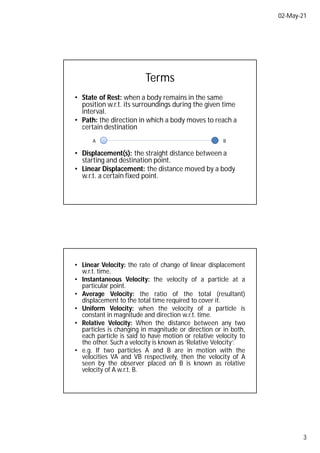
• Displacement(s): the straight distance between a
starting and destination point.
• Linear Displacement: the distance moved by a body
w.r.t. a certain fixed point.
A B
• Linear Velocity: the rate of change of linear displacement
w.r.t. time.
• Instantaneous Velocity: the velocity of a particle at a
particular point.
• Average Velocity: the ratio of the total (resultant)
displacement to the total time required to cover it.
• Uniform Velocity: when the velocity of a particle is
constant in magnitude and direction w.r.t. time.
• Relative Velocity: When the distance between any two
particles is changing in magnitude or direction or in both,
each particle is said to have motion or relative velocity to
the other. Such a velocity is known as ‘Relative Velocity’.
• e.g. If two particles A and B are in motion with the
velocities VA and VB respectively, then the velocity of A
seen by the observer placed on B is known as relative
velocity of A w.r.t. B.
4.
02-May-21
4
• Speed: therate of travel without considering
the direction.
• Acceleration: the rate of change of velocity.
• If acceleration is positive – velocity increases.
• If acceleration is negative (Retardation) –
velocity decreases.
Motion under Uniform Acceleration
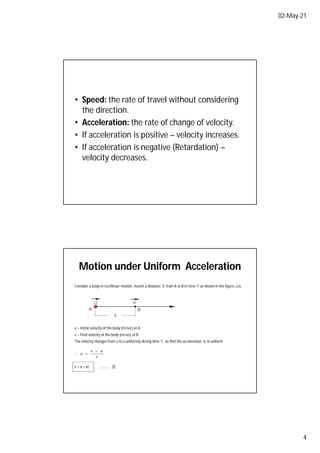
Consider a body in rectilinear motion, travels a distance ‘S’ from A to B in time ‘t’ as shown in the figure. Let,
U
A B
S
V
u – Initial velocity of the body (m/sec) at A
v – Final velocity of the body (m/sec) at B.
The velocity changes from u to v uniformly during time ‘t’, so that the acceleration ‘a’ is uniform.
t
u
v
a
v = u + at ………… (l)
5.
02-May-21
5
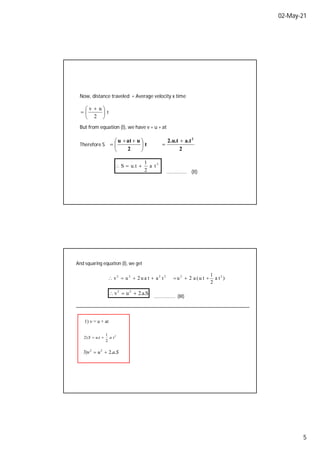
Now, distance traveled= Average velocity x time
t
2
u
v
But from equation (I), we have v = u + at
Therefore S
2
a.t
2.u.t
t
2
u
at
u 2
2
t
a
2
1
t
.
u
S
…..……..… (II)
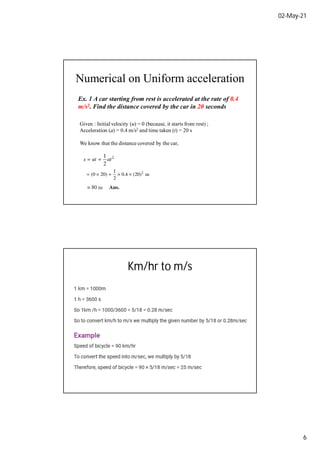
And squaring equation (I), we get
)
t
a
2
1
t
u
(
a
2
u
t
a
t
a
u
2
u
v 2
2
2
2
2
2
S
.
a
.
2
u
v 2
2
………………. (III)
1) v = u + at
2
2
1
.
)
2 t
a
t
u
S
S
a
u
v .
.
2
)
3 2
2
6.
02-May-21
6
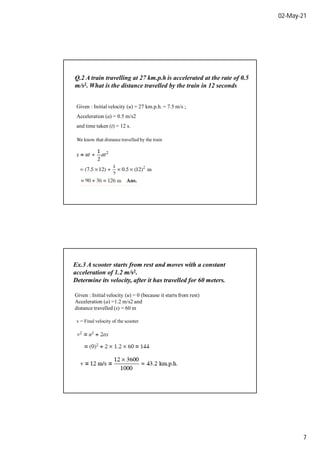
Numerical on Uniformacceleration
Ex. 1 A car starting from rest is accelerated at the rate of 0.4
m/s2. Find the distance covered by the car in 20 seconds
Given : Initial velocity (u) = 0 (because, it starts from rest) ;
Acceleration (a) = 0.4 m/s2 and time taken (t) = 20 s
We know that the distance covered by the car,
Km/hr to m/s
7.
02-May-21
7
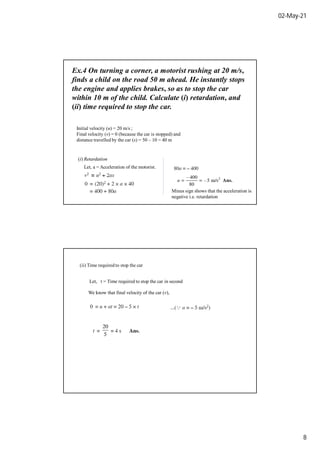
Q.2 A traintravelling at 27 km.p.h is accelerated at the rate of 0.5
m/s2. What is the distance travelled by the train in 12 seconds
Given : Initial velocity (u) = 27 km.p.h. = 7.5 m/s ;
Acceleration (a) = 0.5 m/s2
and time taken (t) = 12 s.
We know that distance travelled by the train
Ex.3 A scooter starts from rest and moves with a constant
acceleration of 1.2 m/s2.
Determine its velocity, after it has travelled for 60 meters.
Given : Initial velocity (u) = 0 (because it starts from rest)
Acceleration (a) =1.2 m/s2 and
distance travelled (s) = 60 m
v = Final velocity of the scooter.
8.
02-May-21
8
Ex.4 On turninga corner, a motorist rushing at 20 m/s,
finds a child on the road 50 m ahead. He instantly stops
the engine and applies brakes, so as to stop the car
within 10 m of the child. Calculate (i) retardation, and
(ii) time required to stop the car.
Initial velocity (u) = 20 m/s ;
Final velocity (v) = 0 (because the car is stopped) and
distance travelled by the car (s) = 50 – 10 = 40 m
(i) Retardation
Let, a = Acceleration of the motorist.
Minus sign shows that the acceleration is
negative i.e. retardation
(ii) Time required to stop the car
Let, t = Time required to stop the car in second
We know that final velocity of the car (v),
9.
02-May-21
9
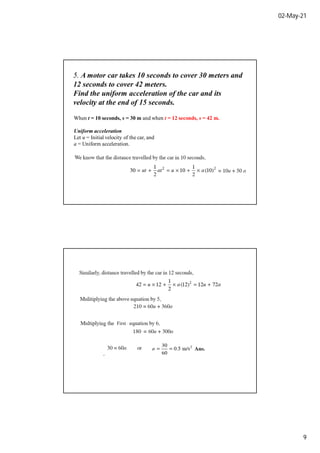
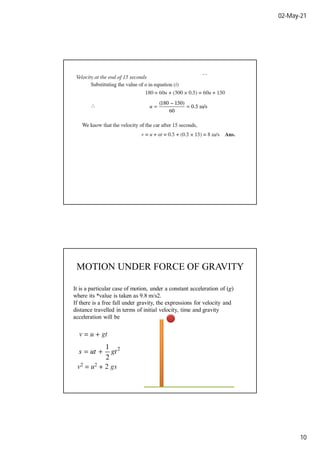
5. A motorcar takes 10 seconds to cover 30 meters and
12 seconds to cover 42 meters.
Find the uniform acceleration of the car and its
velocity at the end of 15 seconds.
When t = 10 seconds, s = 30 m and when t = 12 seconds, s = 42 m.
Uniform acceleration
Let u = Initial velocity of the car, and
a = Uniform acceleration.
First
10.
02-May-21
10
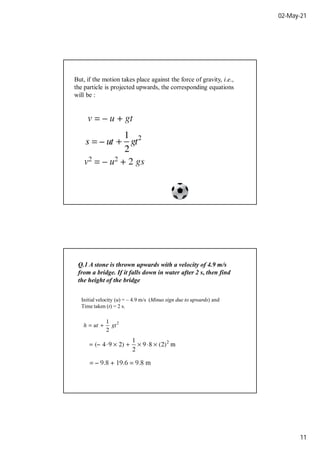
MOTION UNDER FORCEOF GRAVITY
It is a particular case of motion, under a constant acceleration of (g)
where its *value is taken as 9.8 m/s2.
If there is a free fall under gravity, the expressions for velocity and
distance travelled in terms of initial velocity, time and gravity
acceleration will be
11.
02-May-21
11
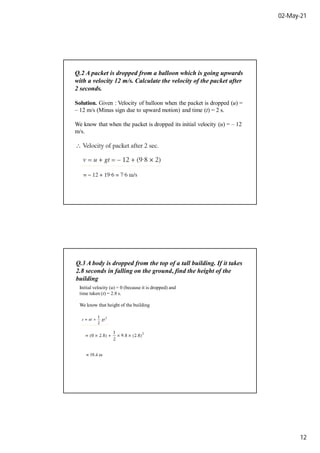
But, if themotion takes place against the force of gravity, i.e.,
the particle is projected upwards, the corresponding equations
will be :
Q.1 A stone is thrown upwards with a velocity of 4.9 m/s
from a bridge. If it falls down in water after 2 s, then find
the height of the bridge
Initial velocity (u) = – 4.9 m/s (Minus sign due to upwards) and
Time taken (t) = 2 s.
12.
02-May-21
12
Q.2 A packetis dropped from a balloon which is going upwards
with a velocity 12 m/s. Calculate the velocity of the packet after
2 seconds.
Solution. Given : Velocity of balloon when the packet is dropped (u) =
– 12 m/s (Minus sign due to upward motion) and time (t) = 2 s.
We know that when the packet is dropped its initial velocity (u) = – 12
m/s.
Q.3 A body is dropped from the top of a tall building. If it takes
2.8 seconds in falling on the ground, find the height of the
building
Initial velocity (u) = 0 (because it is dropped) and
time taken (t) = 2.8 s.
We know that height of the building
13.
02-May-21
13
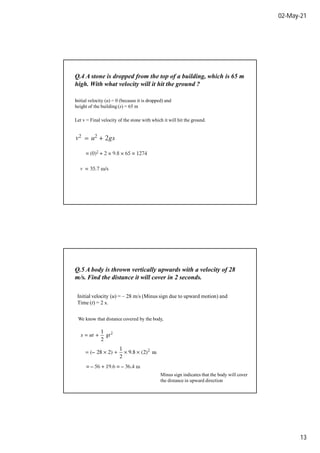
Q.4 A stoneis dropped from the top of a building, which is 65 m
high. With what velocity will it hit the ground ?
Initial velocity (u) = 0 (because it is dropped) and
height of the building (s) = 65 m
Let v = Final velocity of the stone with which it will hit the ground.
Q.5 A body is thrown vertically upwards with a velocity of 28
m/s. Find the distance it will cover in 2 seconds.
Initial velocity (u) = – 28 m/s (Minus sign due to upward motion) and
Time (t) = 2 s.
We know that distance covered by the body,
Minus sign indicates that the body will cover
the distance in upward direction
14.
02-May-21
14
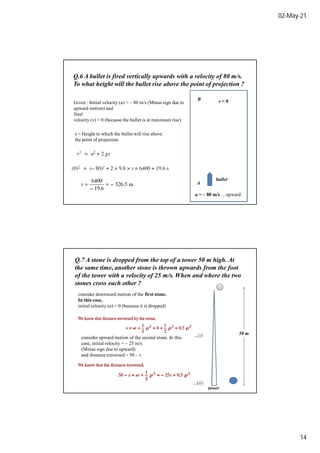
Q.6 A bulletis fired vertically upwards with a velocity of 80 m/s.
To what height will the bullet rise above the point of projection ?
Given : Initial velocity (u) = – 80 m/s (Minus sign due to
upward motion) and
final
velocity (v) = 0 (because the bullet is at maximum rise)
u = – 80 m/s …upward
v = 0
s = Height to which the bullet will rise above
the point of projection.
bullet
A
B
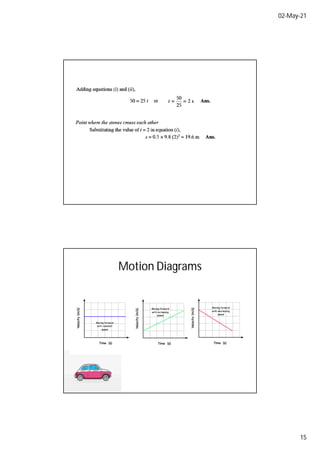
Q.7 A stone is dropped from the top of a tower 50 m high. At
the same time, another stone is thrown upwards from the foot
of the tower with a velocity of 25 m/s. When and where the two
stones cross each other ?
50 m
tower
consider downward motion of the first stone.
In this case,
initial velocity (u) = 0 (because it is dropped)
consider upward motion of the second stone. In this
case, initial velocity = – 25 m/s
(Minus sign due to upward)
and distance traversed = 50 – s
02-May-21
16
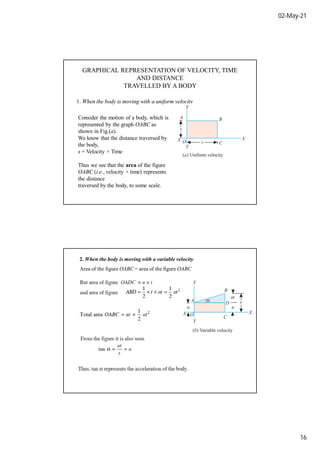
GRAPHICAL REPRESENTATION OFVELOCITY, TIME
AND DISTANCE
TRAVELLED BY A BODY
1. When the body is moving with a uniform velocity
Consider the motion of a body, which is
represented by the graph OABC as
shown in Fig.(a).
We know that the distance traversed by
the body,
s = Velocity × Time
Thus we see that the area of the figure
OABC (i.e., velocity × time) represents
the distance
traversed by the body, to some scale.
Area of the figure OABC = area of the figure OABC
2. When the body is moving with a variable velocity
17.
02-May-21
17
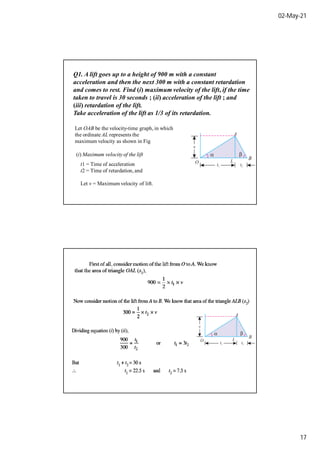
Q1. A liftgoes up to a height of 900 m with a constant
acceleration and then the next 300 m with a constant retardation
and comes to rest. Find (i) maximum velocity of the lift, if the time
taken to travel is 30 seconds ; (ii) acceleration of the lift ; and
(iii) retardation of the lift.
Take acceleration of the lift as 1/3 of its retardation.
Let OAB be the velocity-time graph, in which
the ordinate AL represents the
maximum velocity as shown in Fig
(i) Maximum velocity of the lift
t1 = Time of acceleration
t2 = Time of retardation, and
Let v = Maximum velocity of lift.
18.
02-May-21
18
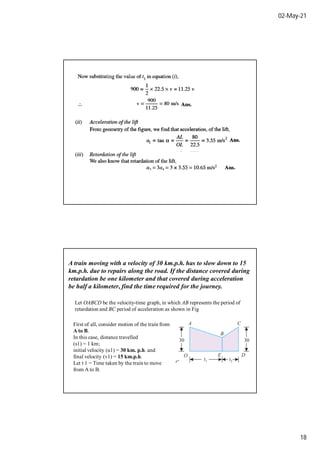
A train movingwith a velocity of 30 km.p.h. has to slow down to 15
km.p.h. due to repairs along the road. If the distance covered during
retardation be one kilometer and that covered during acceleration
be half a kilometer, find the time required for the journey.
Let OABCD be the velocity-time graph, in which AB represents the period of
retardation and BC period of acceleration as shown in Fig
First of all, consider motion of the train from
A to B.
In this case, distance travelled
(s1) = 1 km;
initial velocity (u1) = 30 km. p.h. and
final velocity (v1) = 15 km.p.h.
Let t 1 = Time taken by the train to move
from A to B.
19.
02-May-21
19
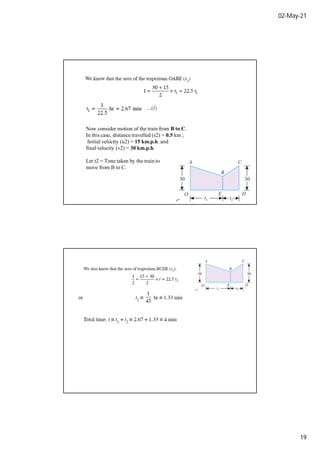
Now consider motionof the train from B to C.
In this case, distance travelled (s2) = 0.5 km ;
Initial velocity (u2) = 15 km.p.h. and
final velocity (v2) = 30 km.p.h.
Let t2 = Time taken by the train to
move from B to C.
20.
02-May-21
20
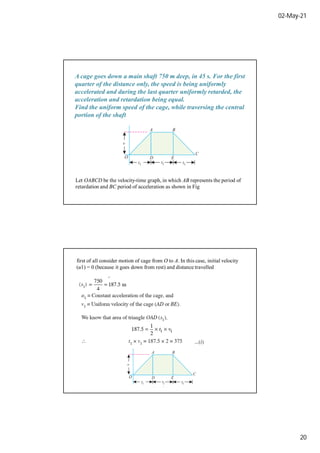
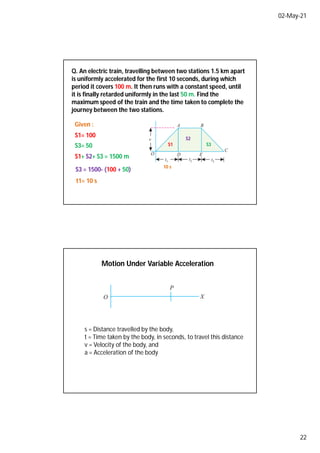
A cage goesdown a main shaft 750 m deep, in 45 s. For the first
quarter of the distance only, the speed is being uniformly
accelerated and during the last quarter uniformly retarded, the
acceleration and retardation being equal.
Find the uniform speed of the cage, while traversing the central
portion of the shaft
Let OABCD be the velocity-time graph, in which AB represents the period of
retardation and BC period of acceleration as shown in Fig
first of all consider motion of cage from O to A. In this case, initial velocity
(u1) = 0 (because it goes down from rest) and distance travelled
21.
02-May-21
21
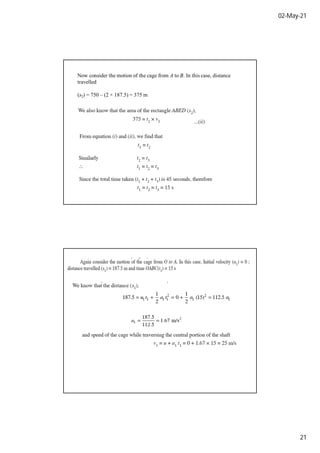
Now consider themotion of the cage from A to B. In this case, distance
travelled
(s2) = 750 – (2 × 187.5) = 375 m
22.
02-May-21
22
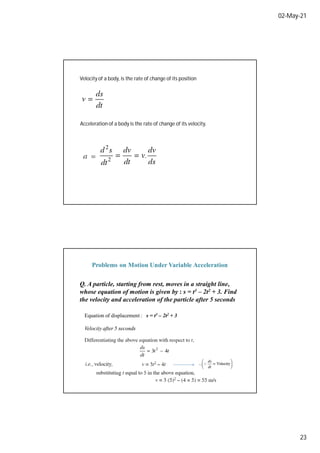
Q. An electrictrain, travelling between two stations 1.5 km apart
is uniformly accelerated for the first 10 seconds, during which
period it covers 100 m. It then runs with a constant speed, until
it is finally retarded uniformly in the last 50 m. Find the
maximum speed of the train and the time taken to complete the
journey between the two stations.
S1= 100
S3= 50 S1 S3
S1+ S2+ S3 = 1500 m
S3 = 1500- (100 + 50)
S2
10 s
t1= 10 s
Given :
Motion Under Variable Acceleration
s = Distance travelled by the body,
t = Time taken by the body, in seconds, to travel this distance
v = Velocity of the body, and
a = Acceleration of the body
23.
02-May-21
23
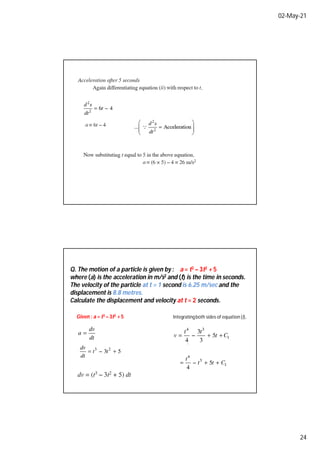
Velocity of abody, is the rate of change of its position
Acceleration of a body is the rate of change of its velocity.
Q. A particle, starting from rest, moves in a straight line,
whose equation of motion is given by : s = t3 – 2t2 + 3. Find
the velocity and acceleration of the particle after 5 seconds
Equation of displacement : s = t3 – 2t2 + 3
Velocity after 5 seconds
Problems on Motion Under Variable Acceleration
24.
02-May-21
24
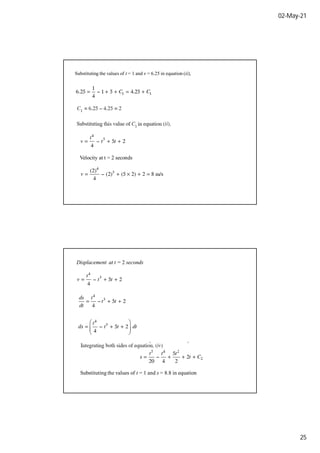
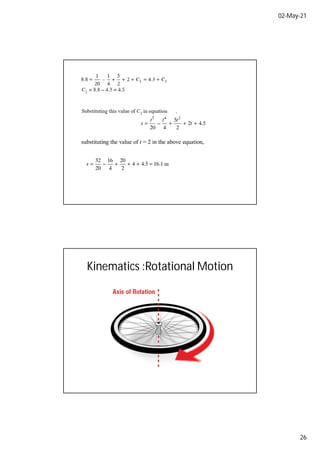
Q. The motionof a particle is given by : a = t3 – 3t2 + 5
where (a) is the acceleration in m/s2 and (t) is the time in seconds.
The velocity of the particle at t = 1 second is 6.25 m/sec and the
displacement is 8.8 metres.
Calculate the displacement and velocity at t = 2 seconds.
Given : a = t3 – 3t2 + 5 Integratingboth sides of equation (i),
25.
02-May-21
25
Substituting the valuesof t = 1 and v = 6.25 in equation (ii),
Velocity at t = 2 seconds
Displacement at t = 2 seconds
Substituting the values of t = 1 and s = 8.8 in equation
02-May-21
27
Angular velocity
Angular acceleration
Angulardisplacement.
Motion of Rotation
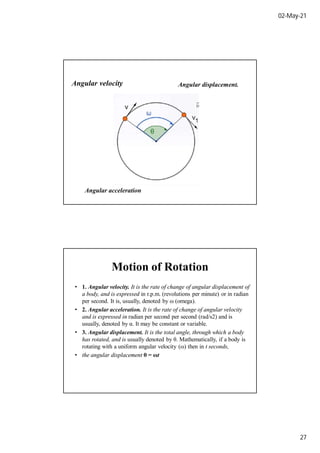
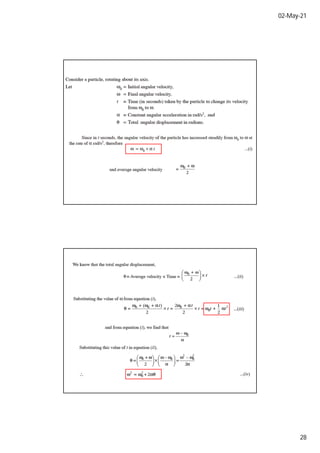
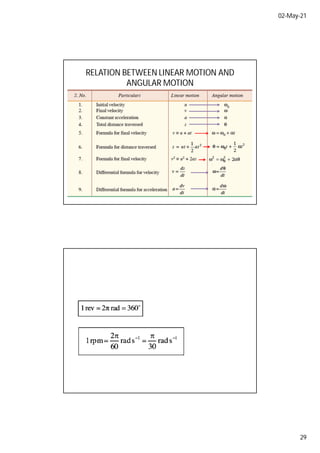
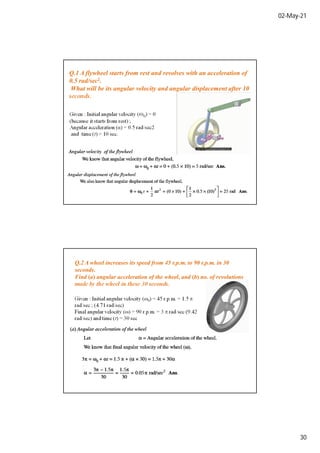
• 1. Angular velocity. It is the rate of change of angular displacement of
a body, and is expressed in r.p.m. (revolutions per minute) or in radian
per second. It is, usually, denoted by ω (omega).
• 2. Angular acceleration. It is the rate of change of angular velocity
and is expressed in radian per second per second (rad/s2) and is
usually, denoted by α. It may be constant or variable.
• 3. Angular displacement. It is the total angle, through which a body
has rotated, and is usually denoted by θ. Mathematically, if a body is
rotating with a uniform angular velocity (ω) then in t seconds,
• the angular displacement θ = ωt
02-May-21
30
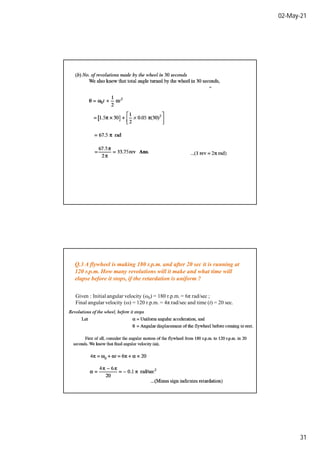
Q.1 A flywheelstarts from rest and revolves with an acceleration of
0.5 rad/sec2.
What will be its angular velocity and angular displacement after 10
seconds.
Given : Initial angular velocity (ω0) = 0
(because it starts from rest) ;
Angular acceleration (α) = 0.5 rad/sec2
and time (t) = 10 sec.
Q.2 A wheel increases its speed from 45 r.p.m. to 90 r.p.m. in 30
seconds.
Find (a) angular acceleration of the wheel, and (b) no. of revolutions
made by the wheel in these 30 seconds.
Given : Initial angular velocity (ω0) = 45 r.p.m. = 1.5 π
rad/sec ; (4.71 rad/sec)
Final angular velocity (ω) = 90 r.p.m. = 3 π rad/sec (9.42
rad/sec) and time (t) = 30 sec
31.
02-May-21
31
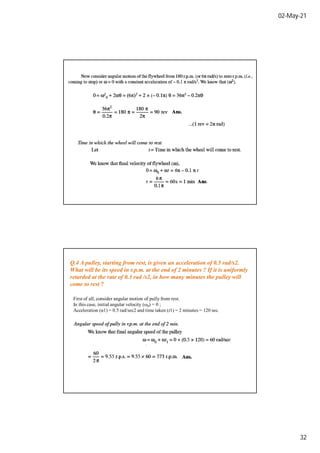
Q.3 A flywheelis making 180 r.p.m. and after 20 sec it is running at
120 r.p.m. How many revolutions will it make and what time will
elapse before it stops, if the retardation is uniform ?
Given : Initial angular velocity (ω0) = 180 r.p.m. = 6π rad/sec ;
Final angular velocity (ω) = 120 r.p.m. = 4π rad/sec and time (t) = 20 sec.
32.
02-May-21
32
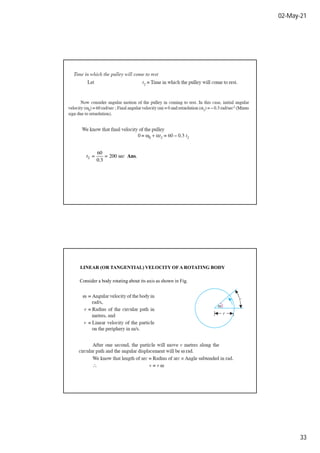
Q.4 A pulley,starting from rest, is given an acceleration of 0.5 rad/s2.
What will be its speed in r.p.m. at the end of 2 minutes ? If it is uniformly
retarded at the rate of 0.3 rad /s2, in how many minutes the pulley will
come to rest ?
First of all, consider angular motion of pully from rest.
In this case, initial angular velocity (ω0) = 0 ;
Acceleration (α1) = 0.5 rad/sec2 and time taken (t1) = 2 minutes = 120 sec.
02-May-21
34
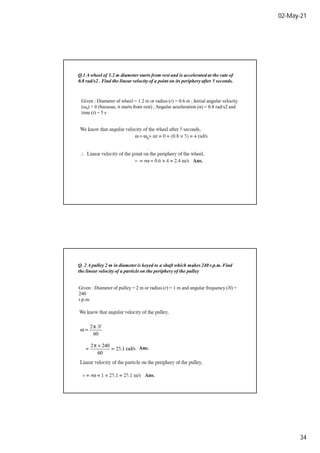
Q.1 A wheelof 1.2 m diameter starts from rest and is accelerated at the rate of
0.8 rad/s2 . Find the linear velocity of a point on its periphery after 5 seconds.
Given : Diameter of wheel = 1.2 m or radius (r) = 0.6 m ; Initial angular velocity
(ω0) = 0 (becasue, it starts from rest) ; Angular acceleration (α) = 0.8 rad/s2 and
time (t) = 5 s
Q. 2 A pulley 2 m in diameter is keyed to a shaft which makes 240 r.p.m.Find
the linear velocity of a particle on the periphery of the pulley
Given : Diameter of pulley = 2 m or radius (r) = 1 m and angular frequency (N) =
240
r.p.m.
35.
02-May-21
35
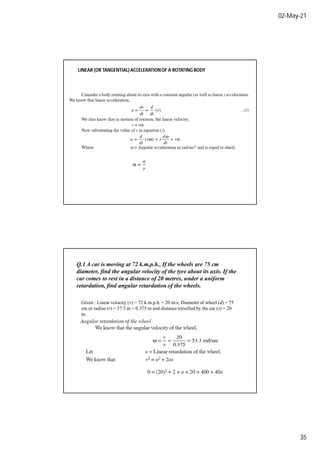
LINEAR (OR TANGENTIAL)ACCELERATIONOFA ROTATING BODY
Q.1 A car is moving at 72 k.m.p.h., If the wheels are 75 cm
diameter, find the angular velocity of the tyre about its axis. If the
car comes to rest in a distance of 20 metres, under a uniform
retardation, find angular retardation of the wheels.
Given : Linear velocity (v) = 72 k.m.p.h. = 20 m/s; Diameter of wheel (d) = 75
cm or radius (r) = 37.5 m = 0.375 m and distance travelled by the car (s) = 20
m.
36.
02-May-21
36
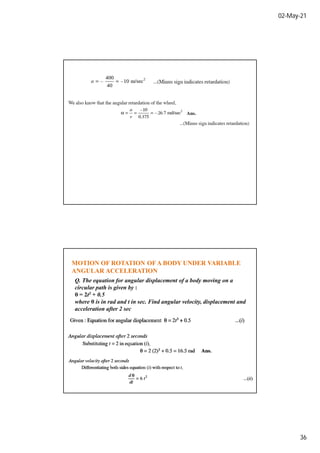
MOTION OF ROTATIONOFA BODY UNDER VARIABLE
ANGULAR ACCELERATION
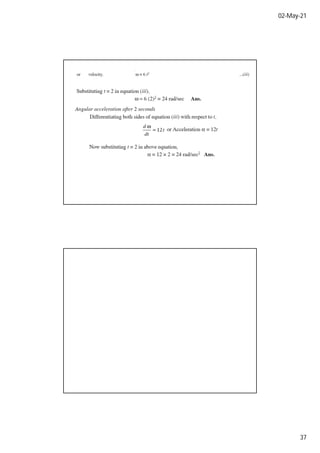
Q. The equation for angular displacement of a body moving on a
circular path is given by :
θ = 2t3 + 0.5
where θ is in rad and t in sec. Find angular velocity, displacement and
acceleration after 2 sec