The document discusses key concepts related to motion including:
1) Motion is defined as a change in position relative to a reference point. Speed is the distance traveled over time, while velocity also includes direction of motion.
2) Speed and velocity can be calculated using the equation distance/time. Resultant velocity combines multiple velocities based on whether they are in the same or opposite directions.
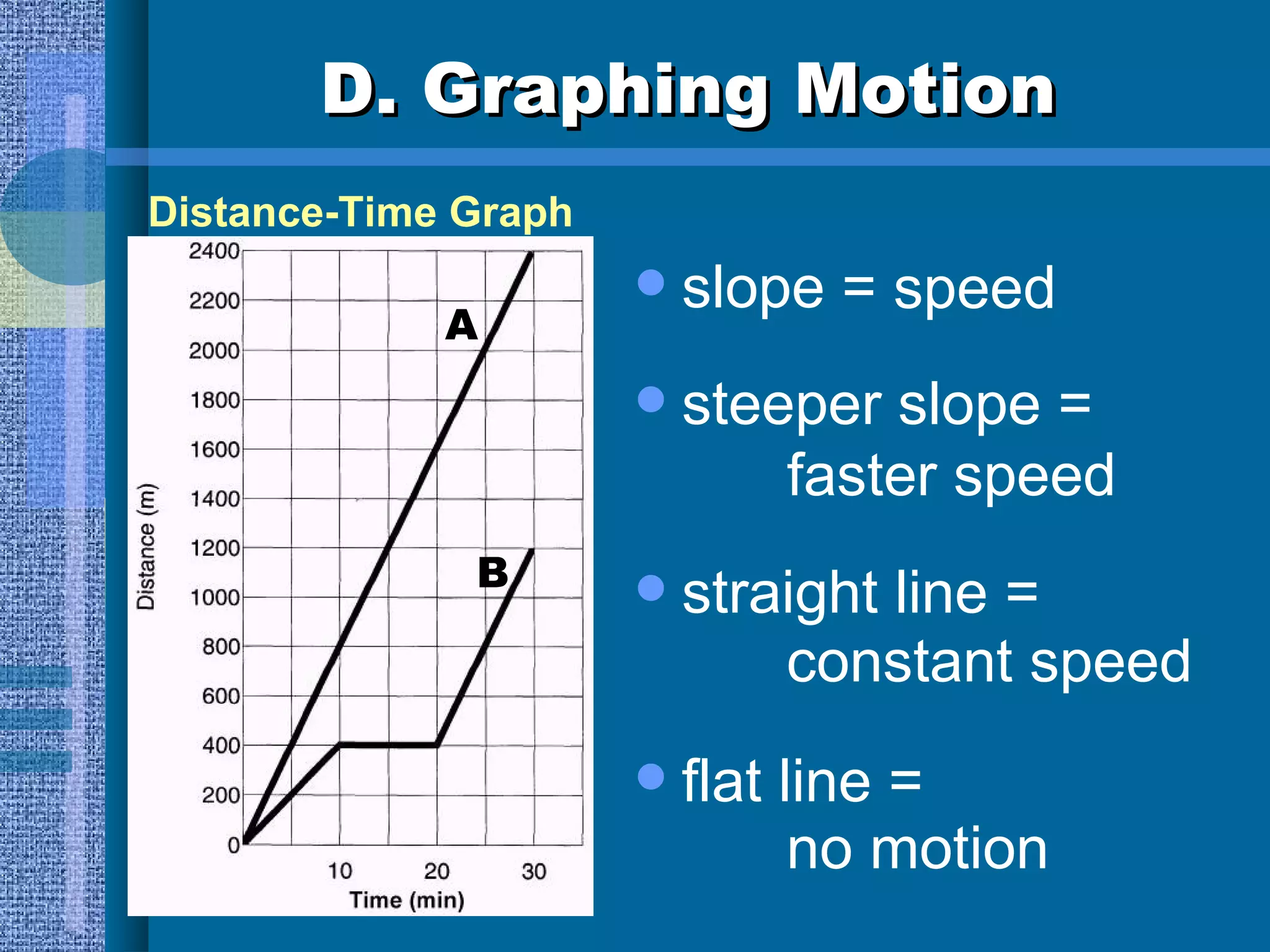
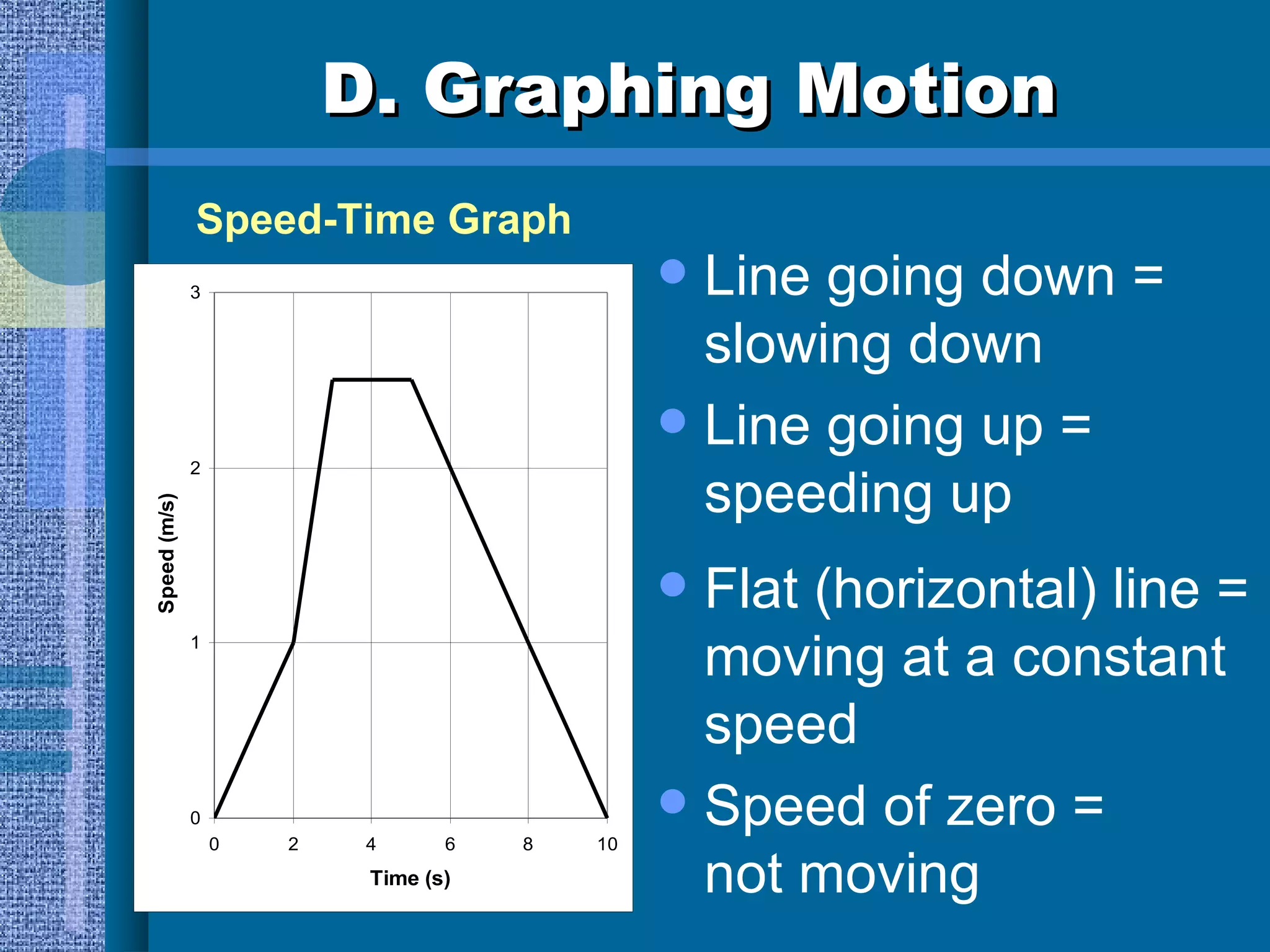
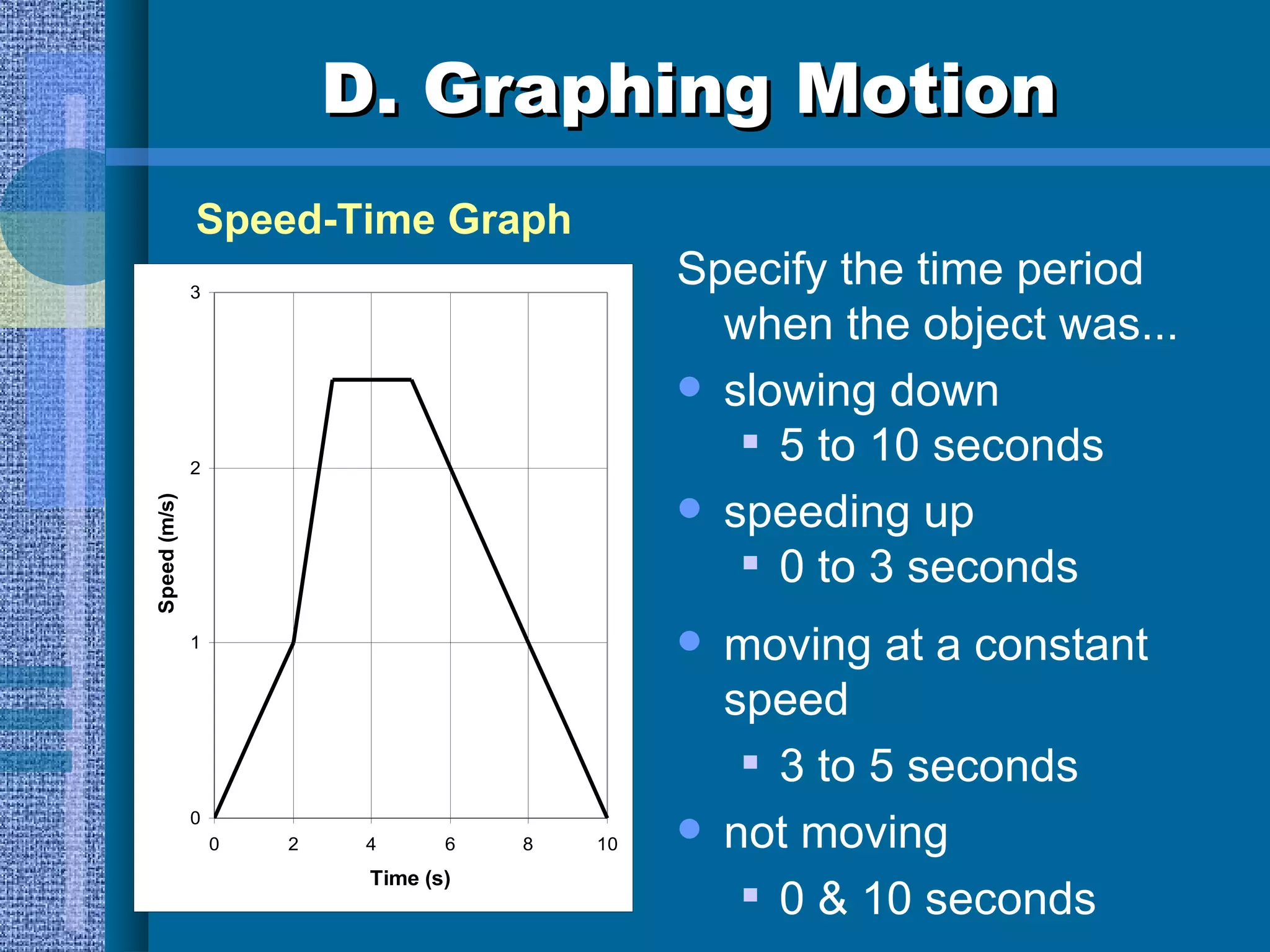
3) Graphs can show motion, with steeper lines on a distance-time graph indicating faster speed and horizontal lines showing constant speed. A speed-time graph can also indicate if an object is slowing, speeding up, or stationary.
Motion & ForcesTo describe Motion, we use these main terms: Motion Speed / Velocity Acceleration
2.
A. Motion Problem:Is your desk moving? We need a reference point ... A nonmoving point from which motion is measured (you have to have one to measure motion!)
3.
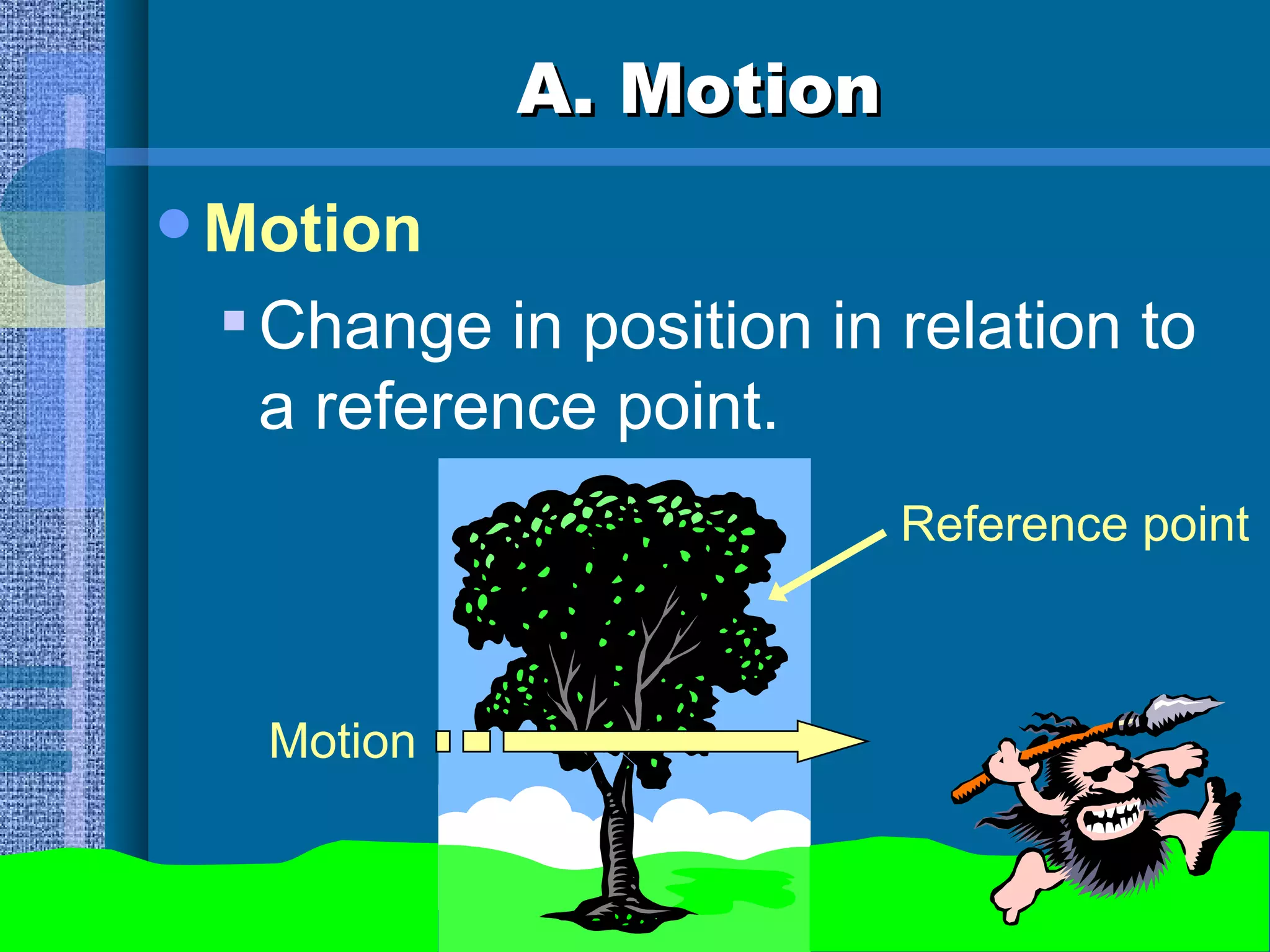
A. Motion MotionChange in position in relation to a reference point. Reference point Motion
4.
A. Motion Problem:You are a passenger in a car stopped at a stop sign. Out of the corner of your eye, you notice a tree on the side of the road begin to move forward. You have mistakenly set yourself as the reference point.
5.
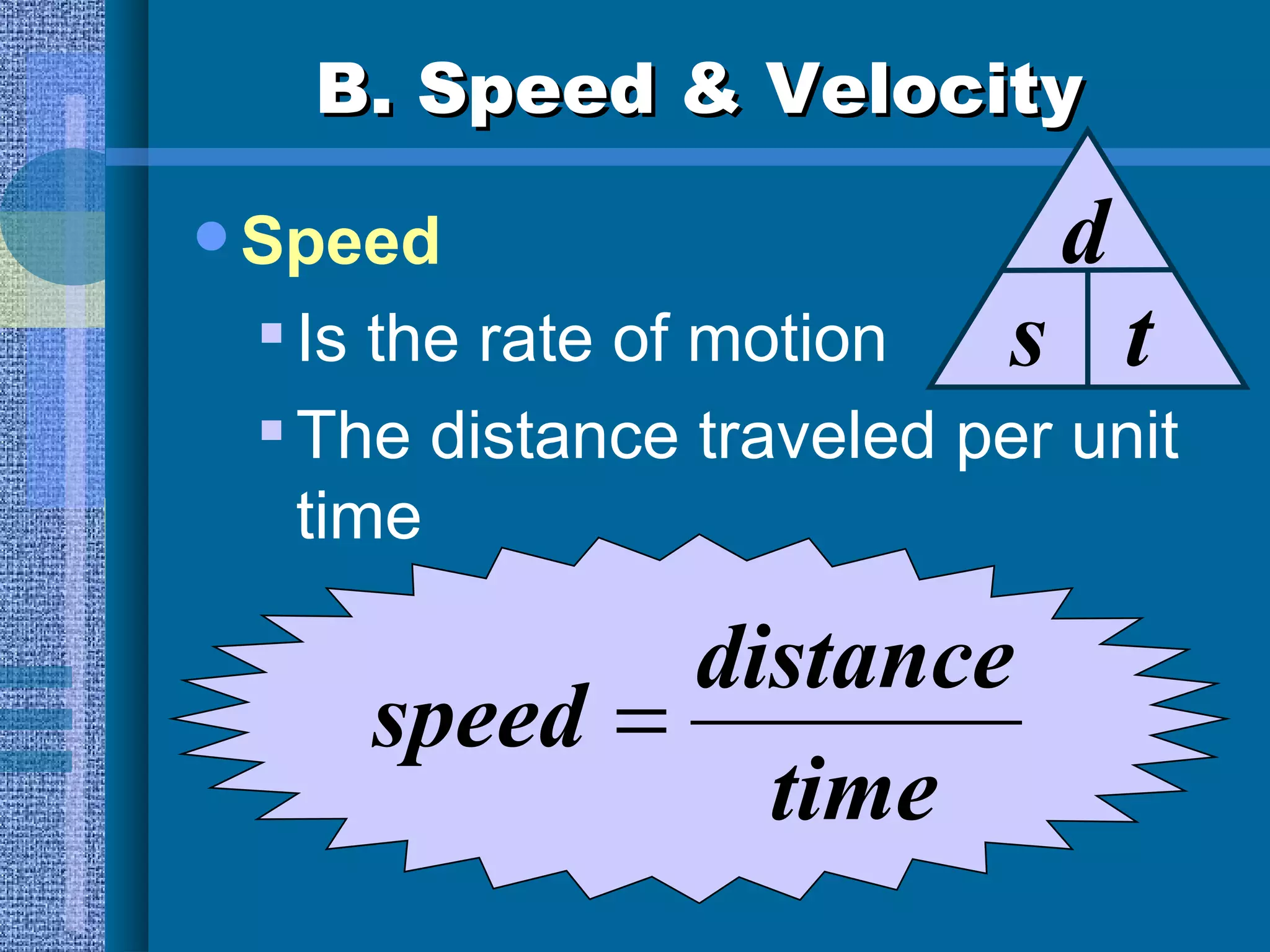
B. Speed &Velocity Speed Is the rate of motion The distance traveled per unit time s d t
6.
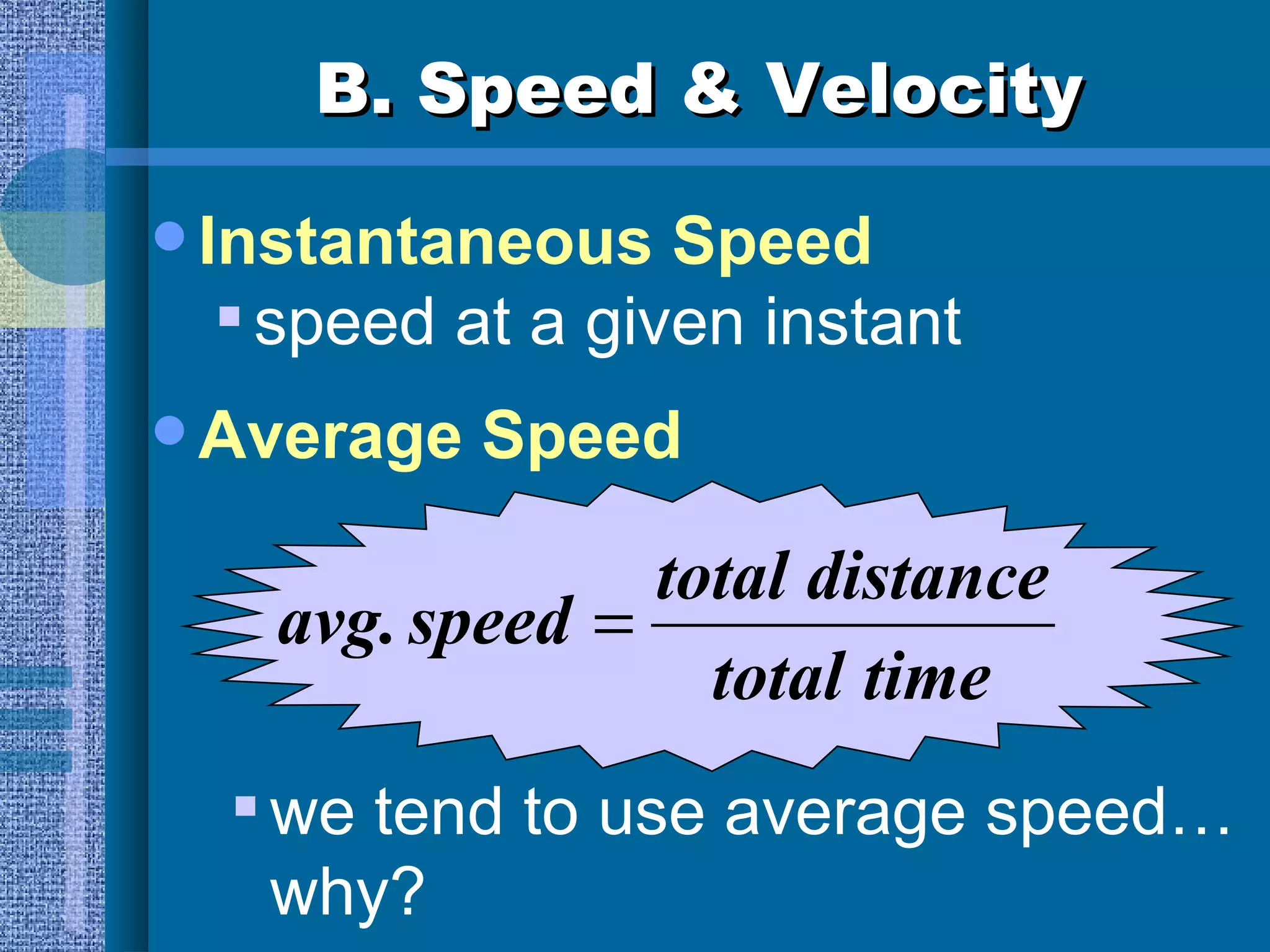
B. Speed &Velocity Instantaneous Speed speed at a given instant Average Speed we tend to use average speed… why?
7.
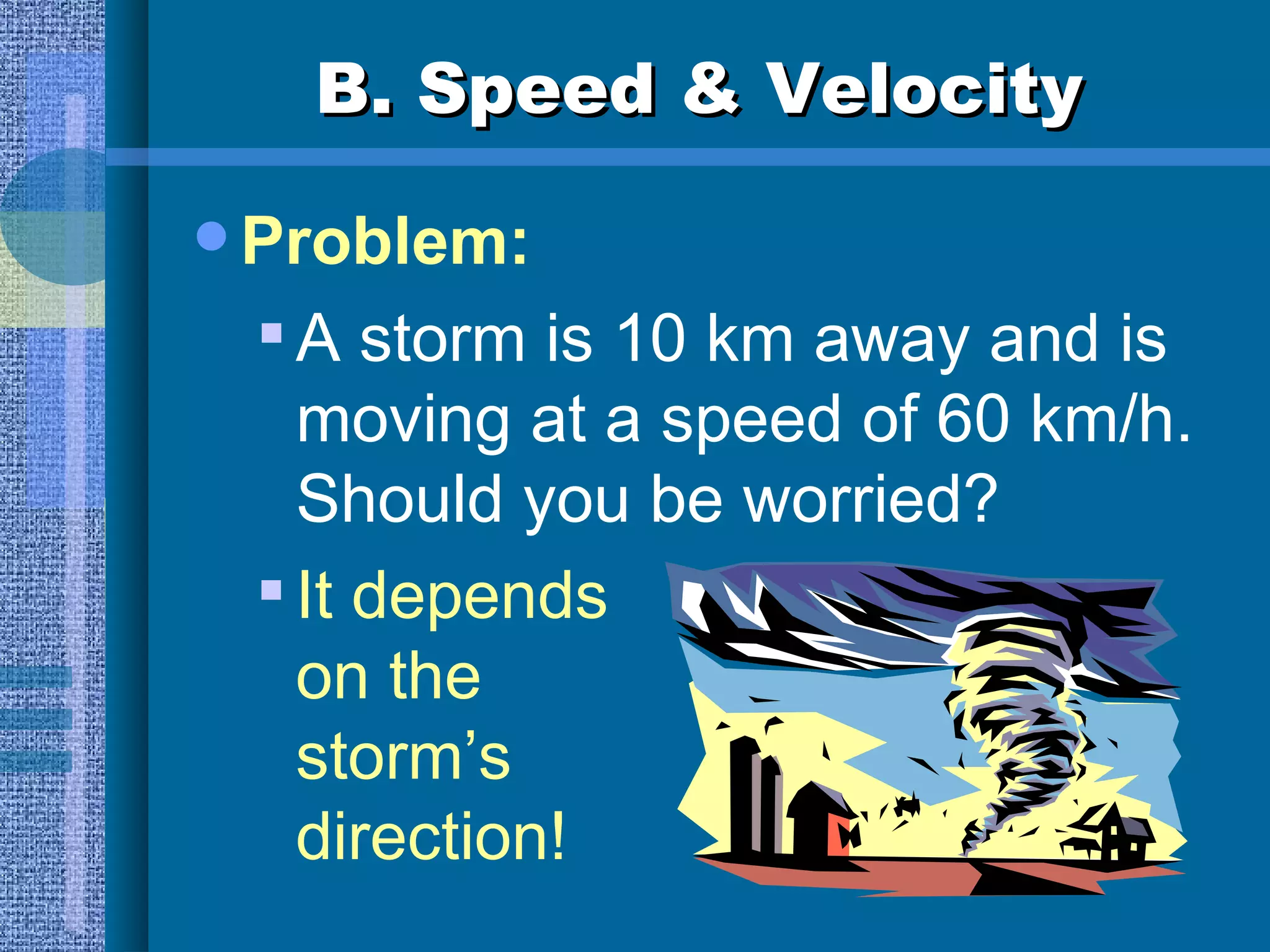
B. Speed &Velocity Problem: A storm is 10 km away and is moving at a speed of 60 km/h. Should you be worried? It depends on the storm’s direction!
8.
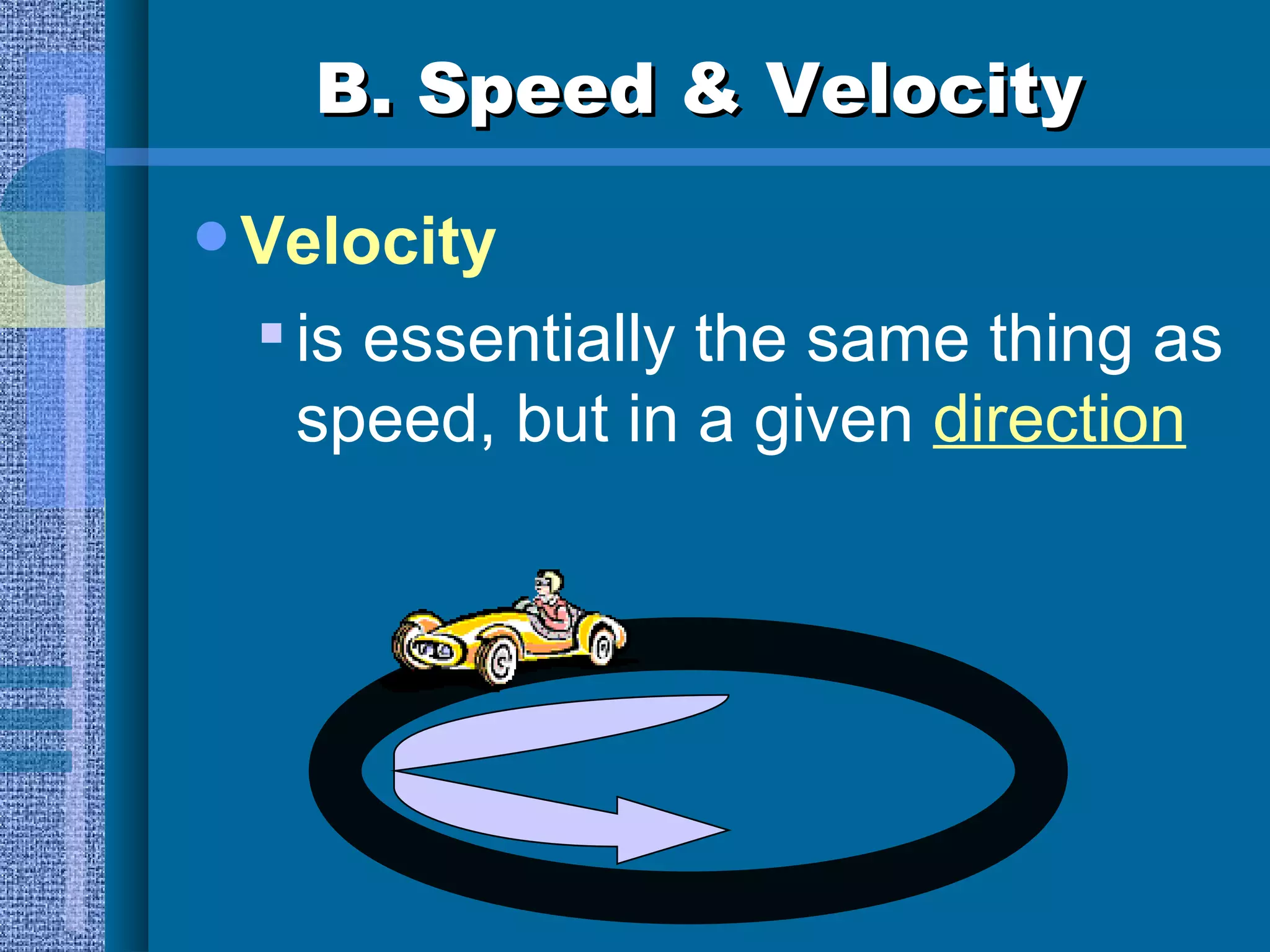
B. Speed &Velocity Velocity is essentially the same thing as speed, but in a given direction
9.
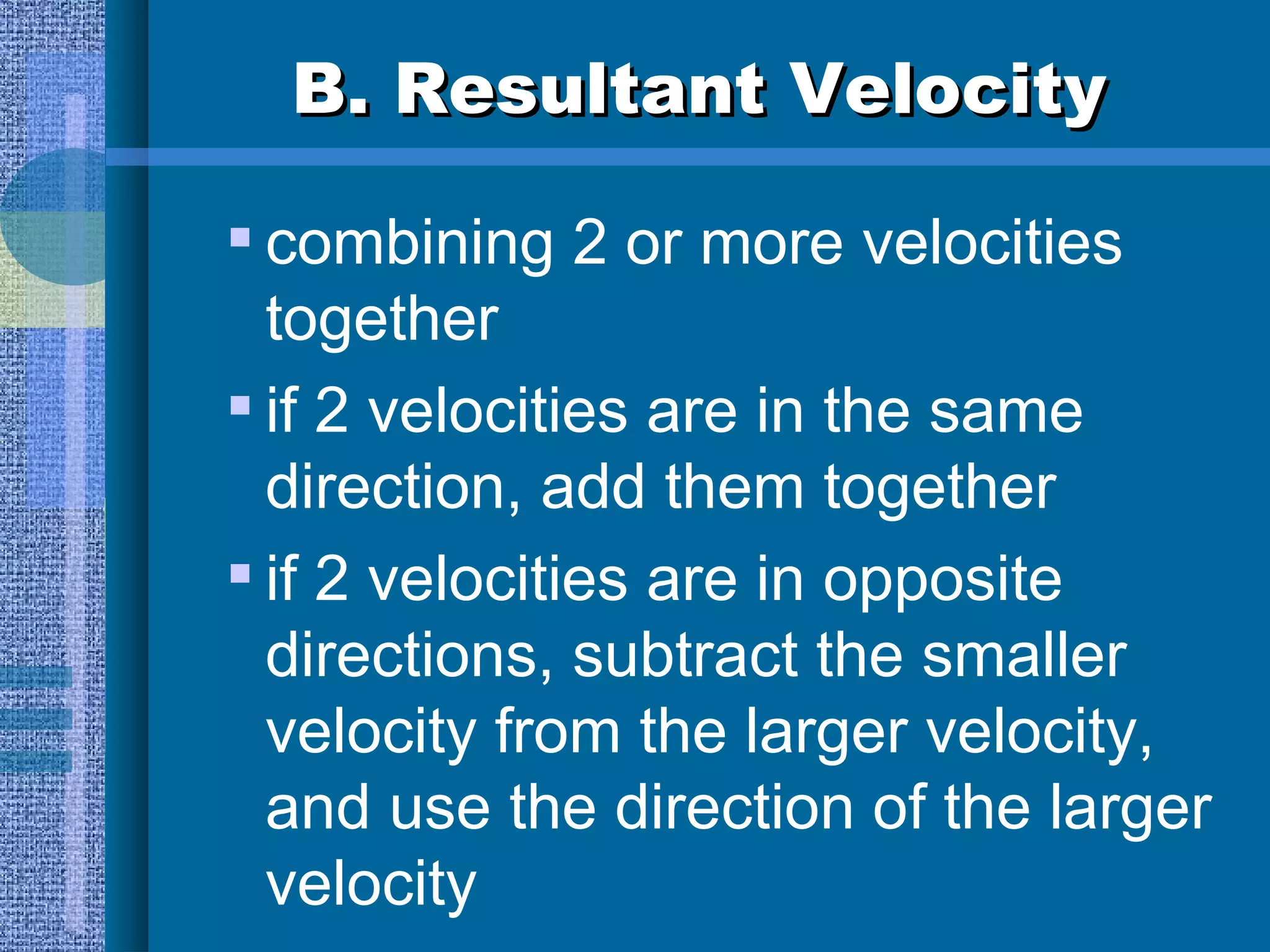
B. Resultant Velocitycombining 2 or more velocities together if 2 velocities are in the same direction, add them together if 2 velocities are in opposite directions, subtract the smaller velocity from the larger velocity, and use the direction of the larger velocity
10.
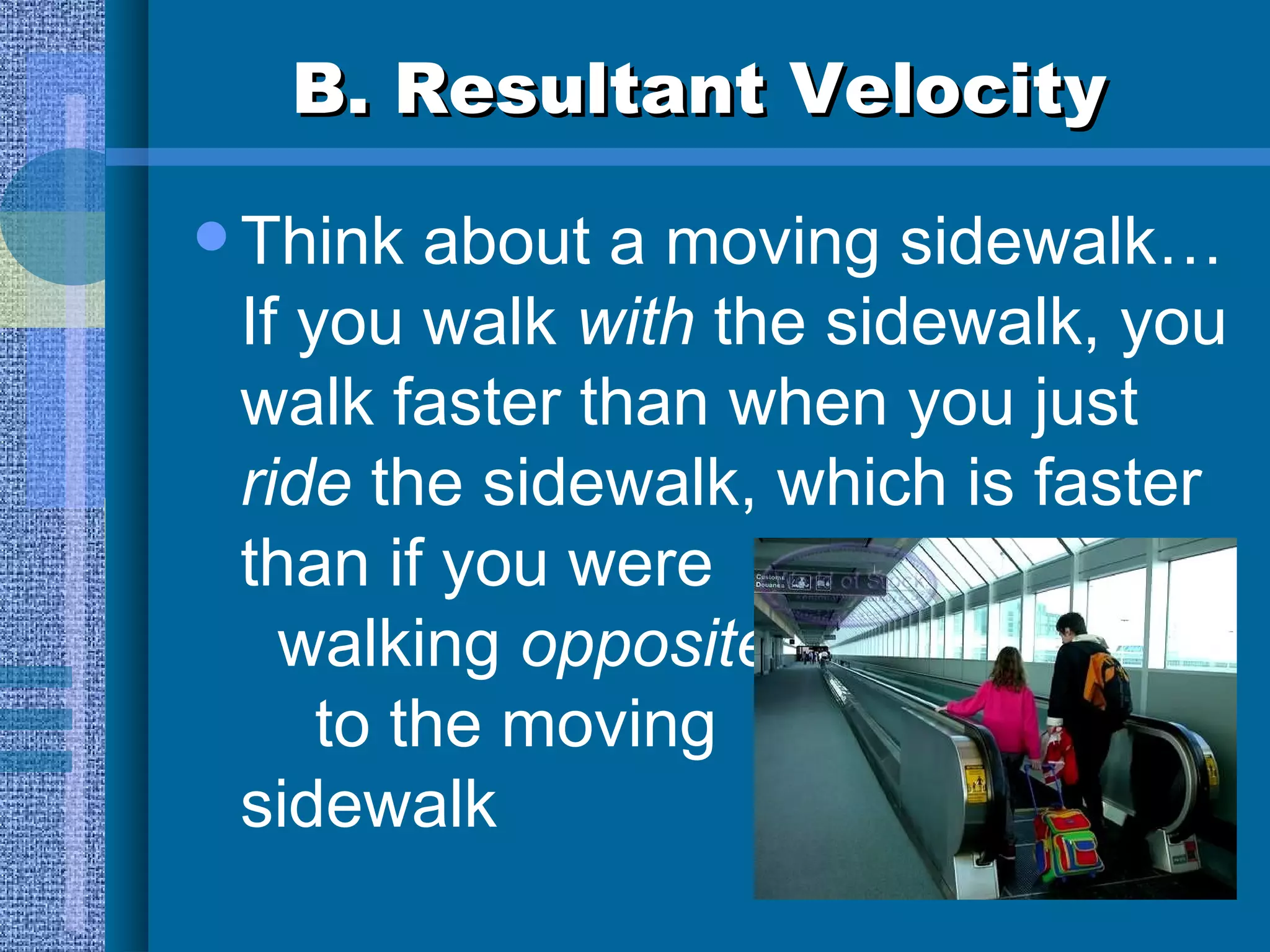
B. Resultant VelocityThink about a moving sidewalk… If you walk with the sidewalk, you walk faster than when you just ride the sidewalk, which is faster than if you were walking opposite to the moving sidewalk
11.
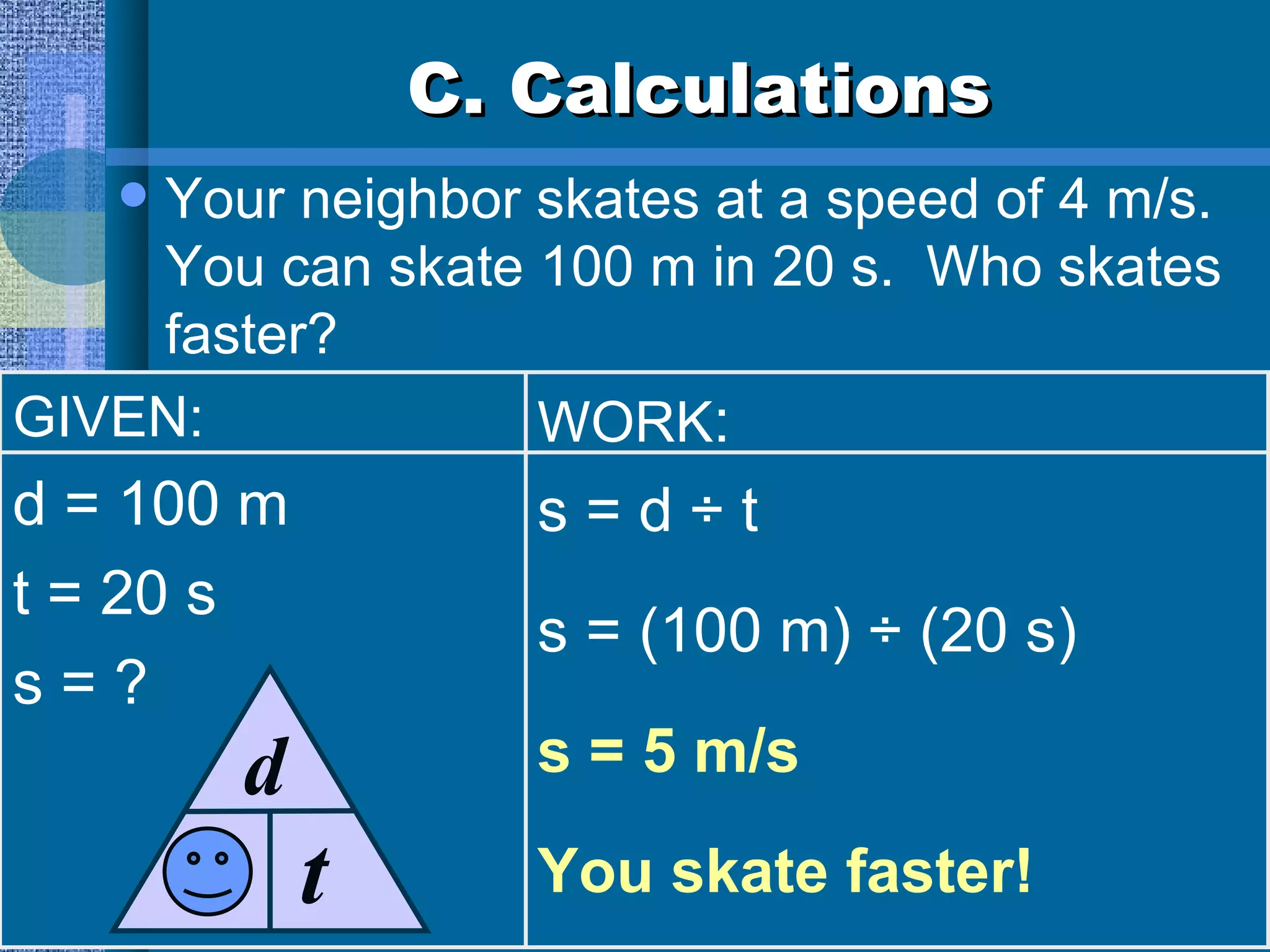
C. Calculations Yourneighbor skates at a speed of 4 m/s. You can skate 100 m in 20 s. Who skates faster? GIVEN: d = 100 m t = 20 s s = ? WORK : s = d ÷ t s = (100 m) ÷ (20 s) s = 5 m/s You skate faster! s d t
12.
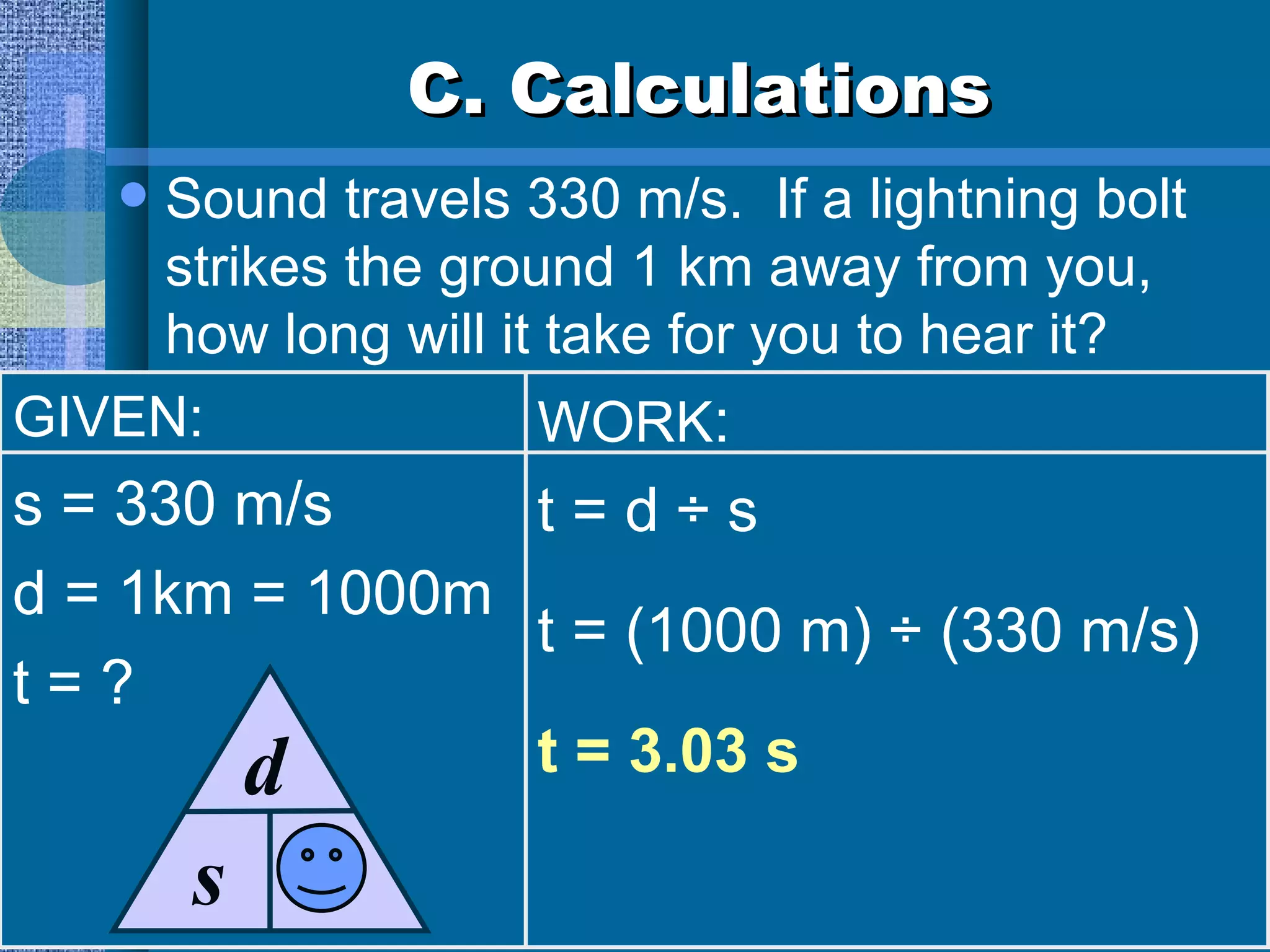
C. Calculations Soundtravels 330 m/s. If a lightning bolt strikes the ground 1 km away from you, how long will it take for you to hear it? GIVEN: s = 330 m/s d = 1km = 1000m t = ? WORK : t = d ÷ s t = (1000 m) ÷ (330 m/s) t = 3.03 s s d t
13.
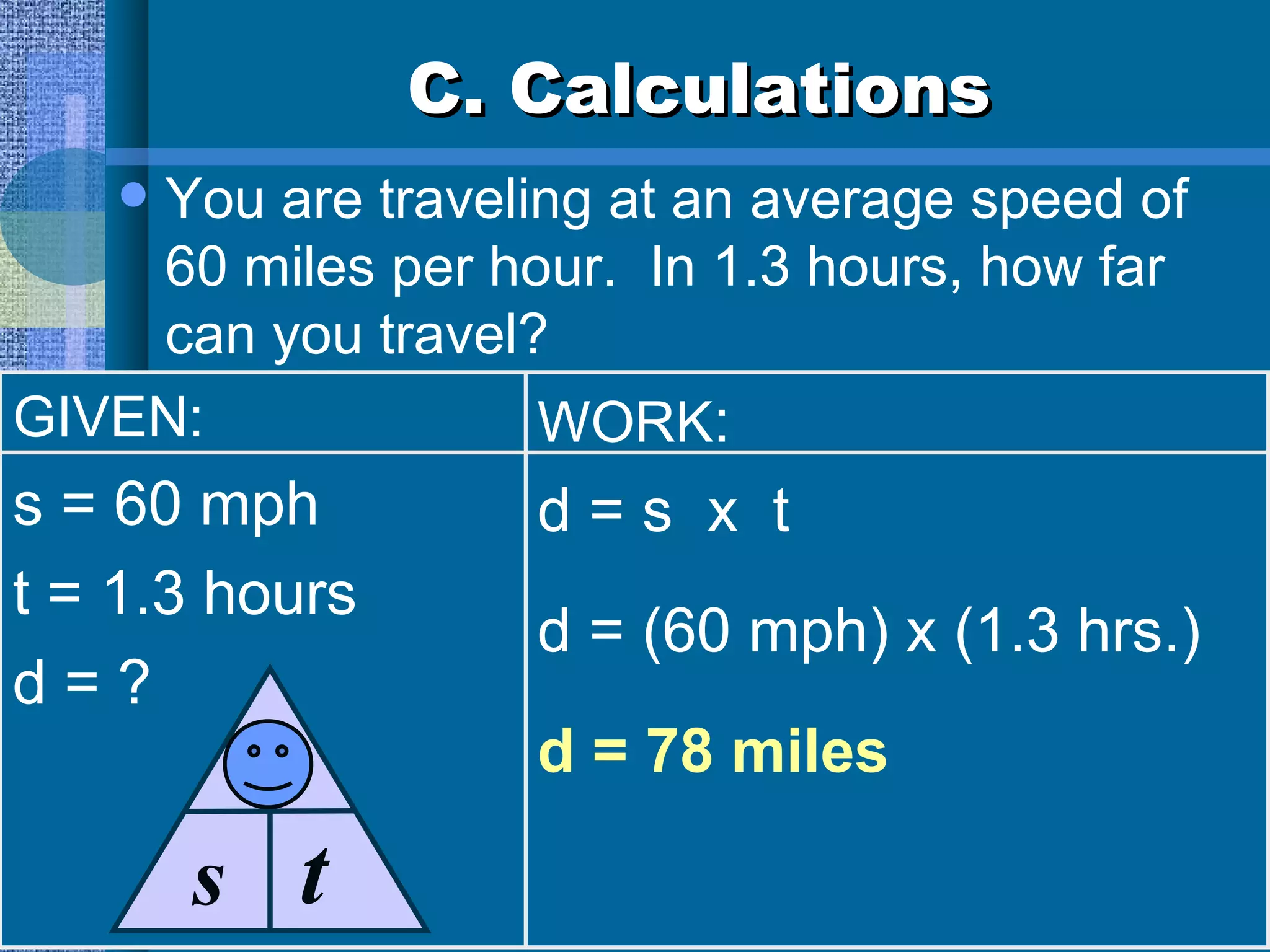
C. Calculations Youare traveling at an average speed of 60 miles per hour. In 1.3 hours, how far can you travel? GIVEN: s = 60 mph t = 1.3 hours d = ? WORK : d = s x t d = (60 mph) x (1.3 hrs.) d = 78 miles s d t
14.
D. Graphing Motionslope = steeper slope = straight line = flat line = faster speed constant speed no motion speed Distance-Time Graph A B
15.
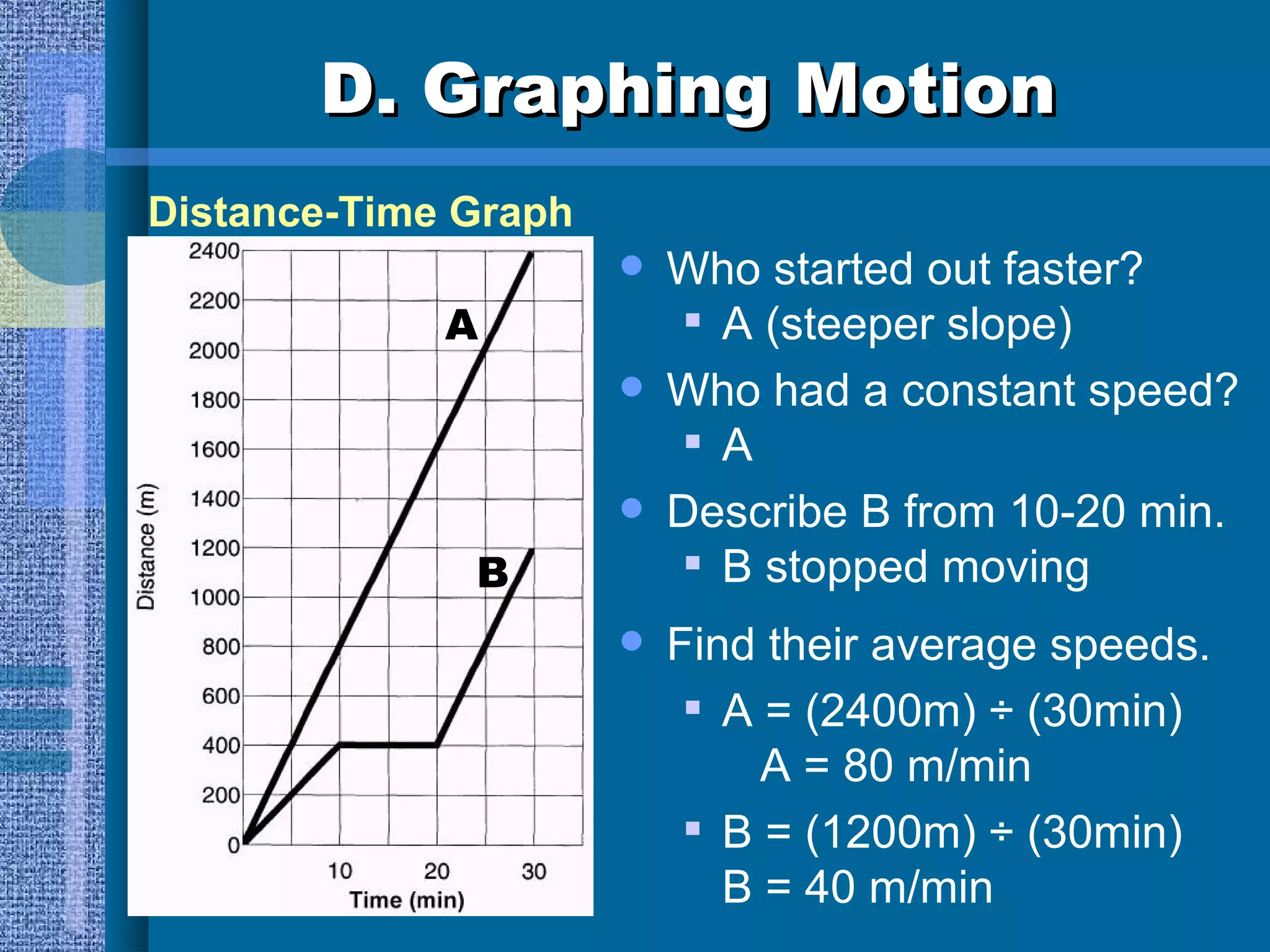
D. Graphing MotionWho started out faster? A (steeper slope) Who had a constant speed? A Describe B from 10-20 min. B stopped moving Find their average speeds. A = (2400m) ÷ (30min) A = 80 m/min B = (1200m) ÷ (30min) B = 40 m/min Distance-Time Graph A B
16.
D. Graphing MotionLine going down = slowing down Line going up = speeding up Flat (horizontal) line = moving at a constant speed Speed of zero = not moving Speed-Time Graph
17.
D. Graphing MotionSpecify the time period when the object was... slowing down 5 to 10 seconds speeding up 0 to 3 seconds moving at a constant speed 3 to 5 seconds not moving 0 & 10 seconds Speed-Time Graph