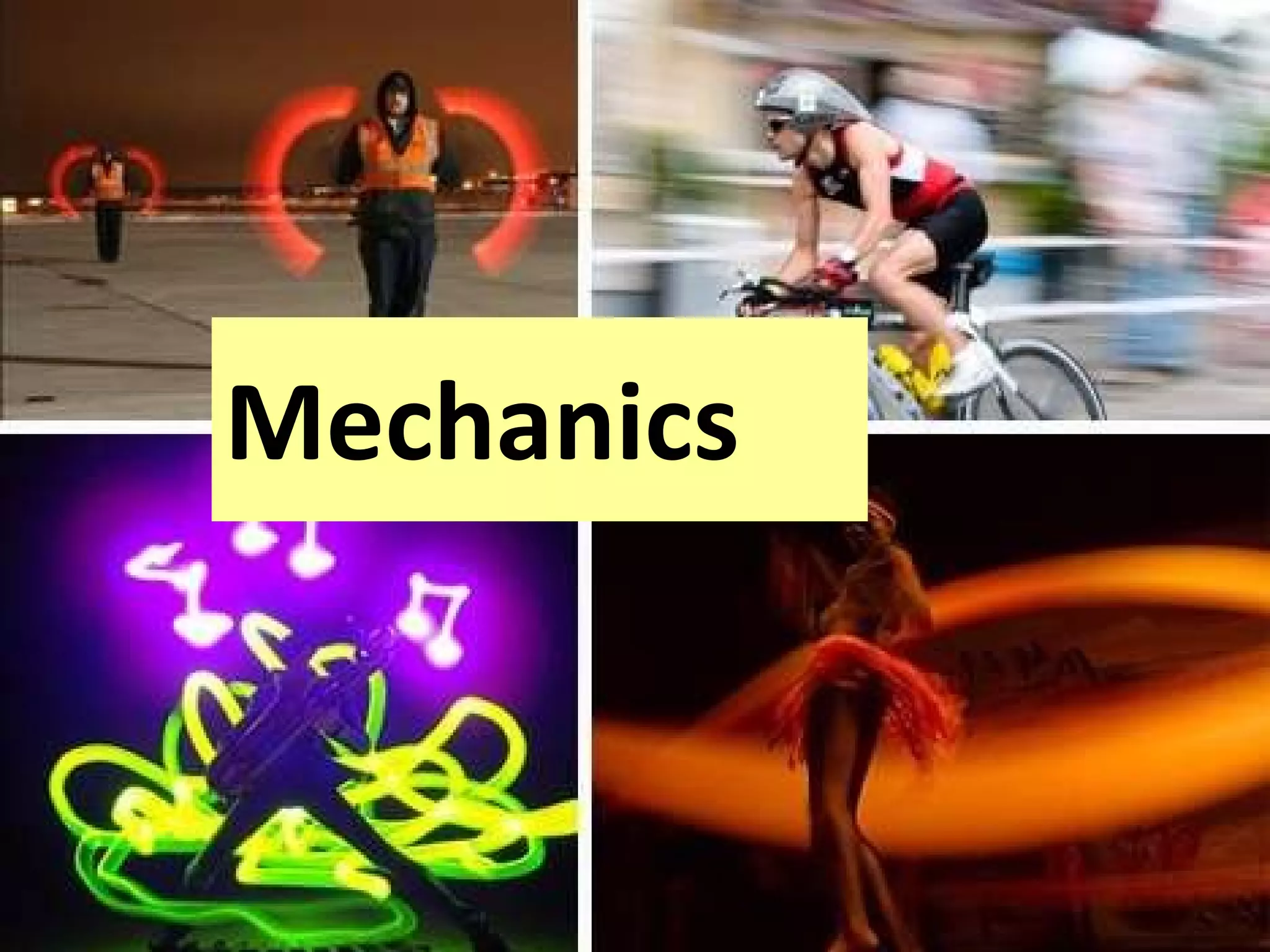
Mechanics
MECHANICS the sub branch of classical physics that is concerned with the forces  acting on bodies , whether at rest or in motion. is divided into statics, kinematics and dynamics
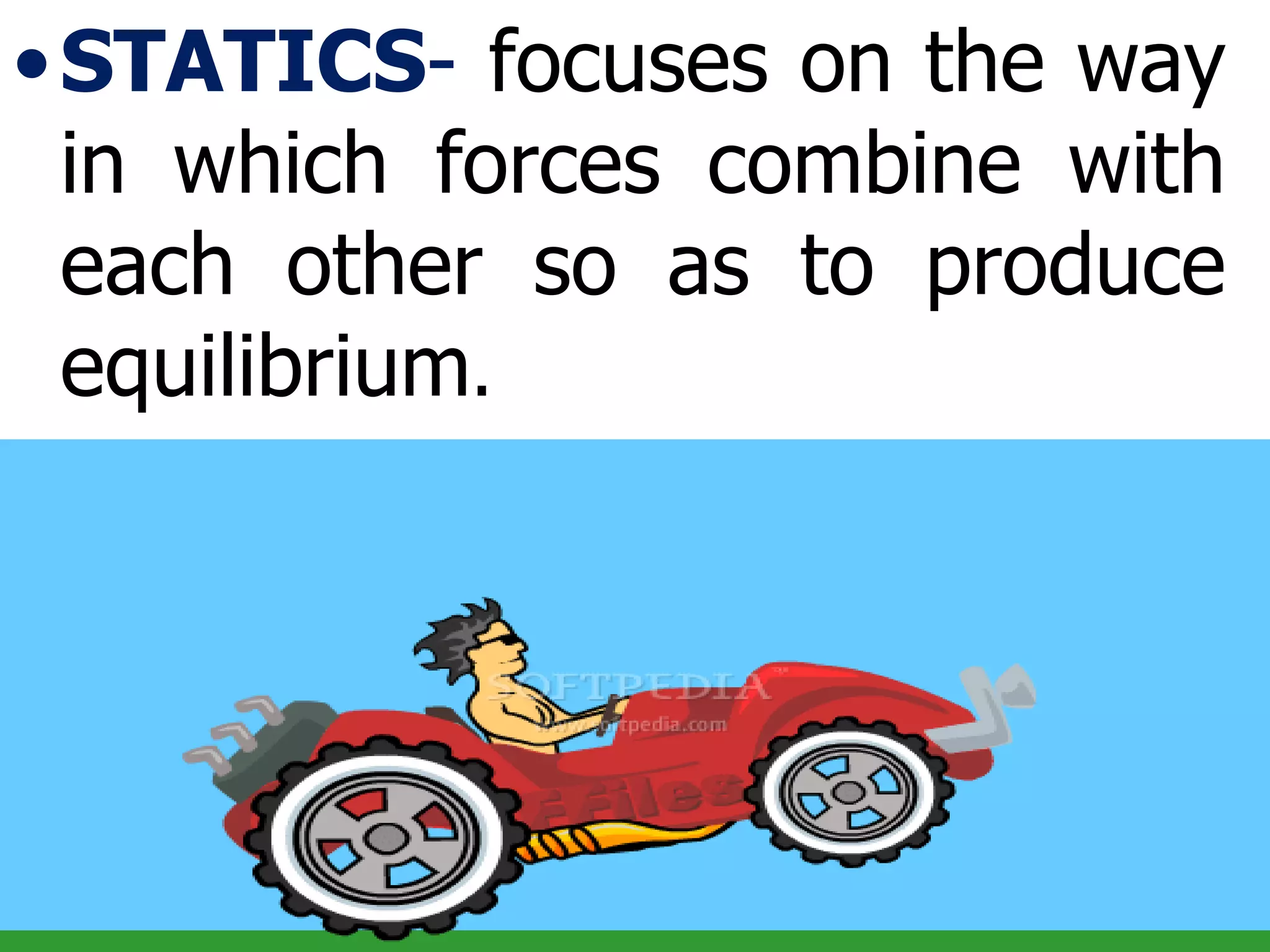
STATICS -  focuses on the way in which forces combine with each other so as to produce equilibrium .
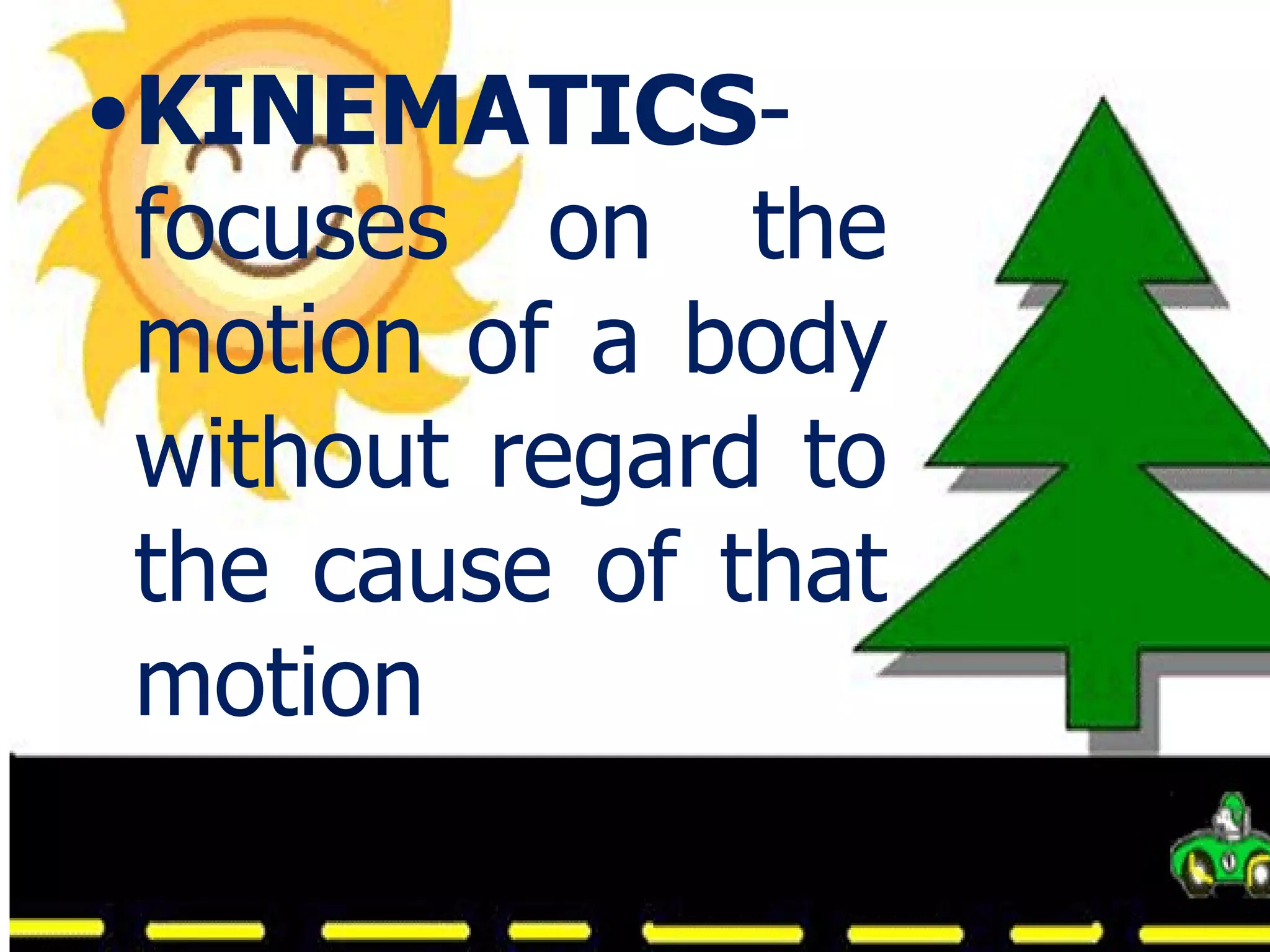
KINEMATICS - focuses on the motion of a body without regard to the cause of that motion
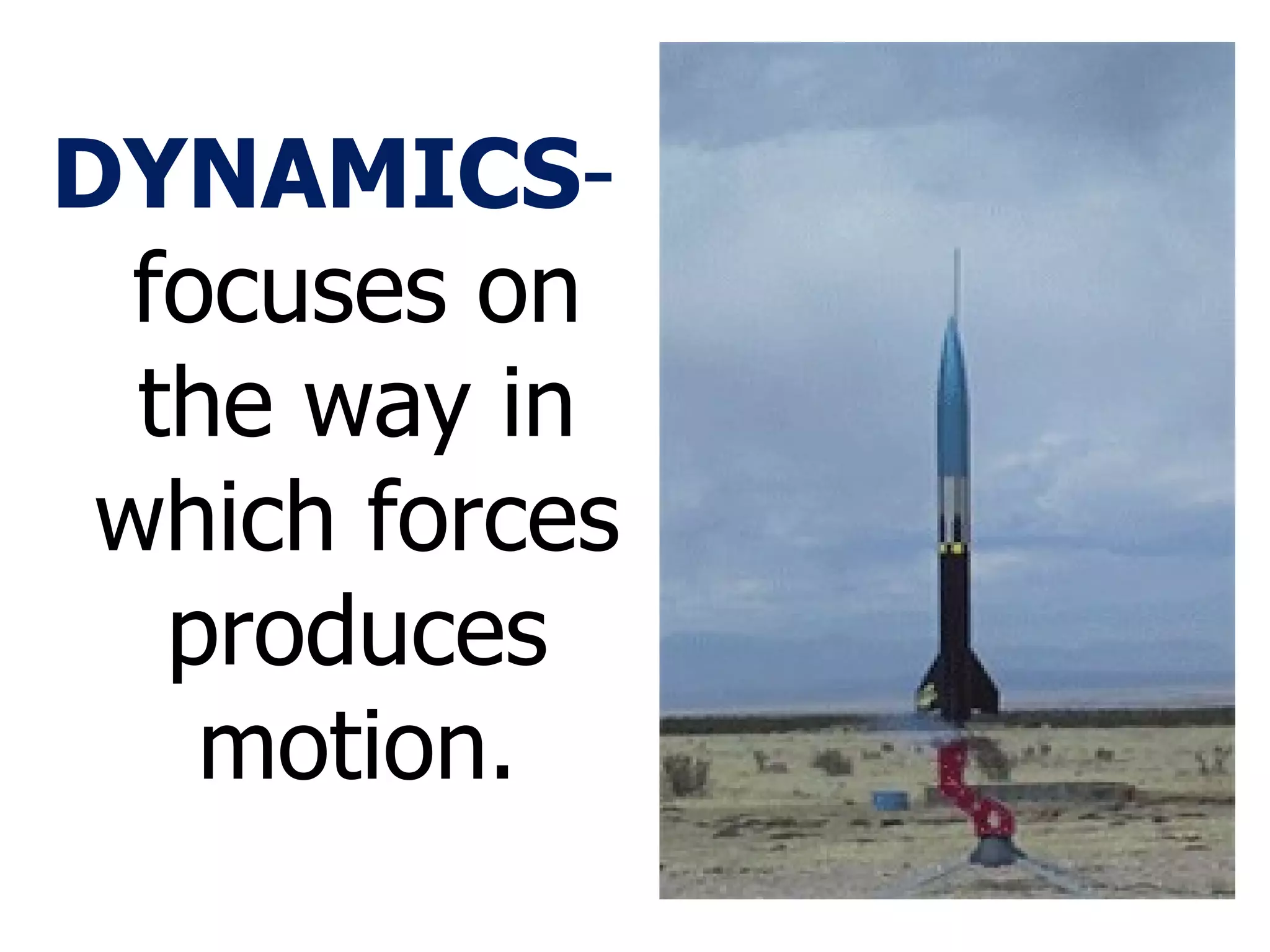
DYNAMICS -  focuses on the way in which forces produces motion.
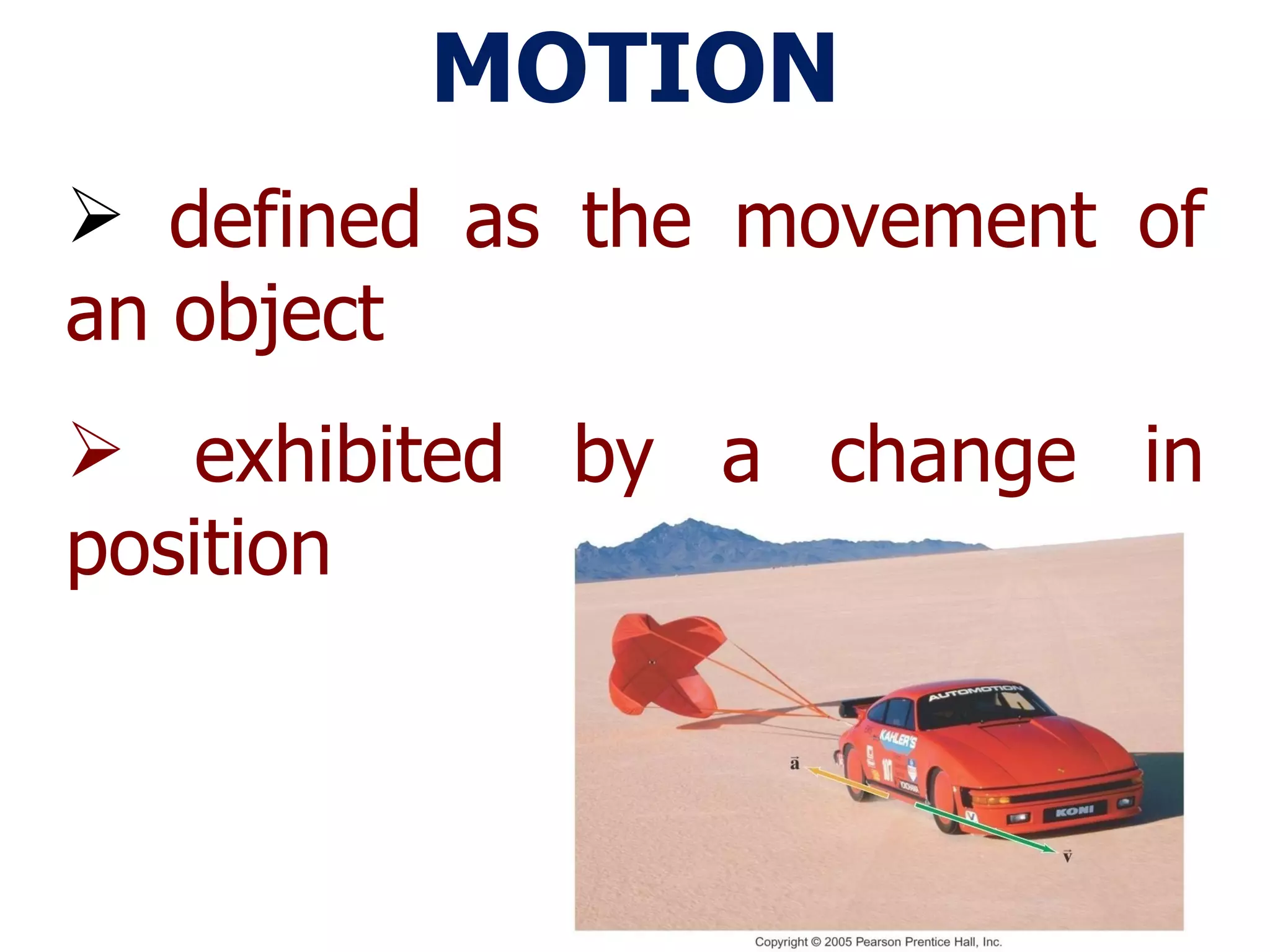
MOTION defined as the movement of an object exhibited by a change in position
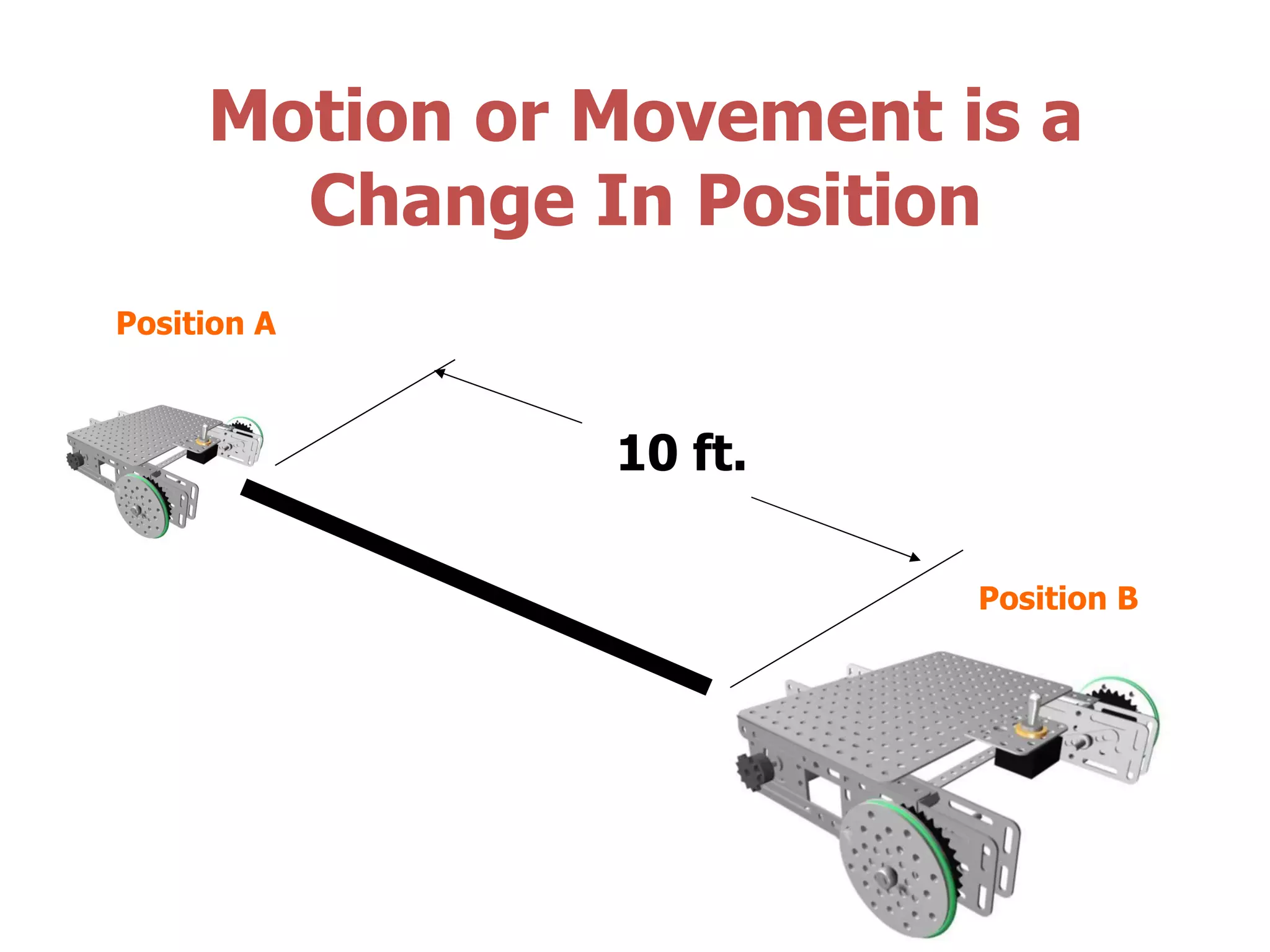
Motion or Movement is a Change In Position 10 ft. Position A Position B
There are many ways of describing motion: 1.  Rectilinear motion-   the motion of an object traveling at a straight path. 2.  Curvilinear motion-   an object traveling in a curved path 3.  Angular motion   -  an object traveling at certain angles
MOTION IS RELATIVE it may be described by specifying how far something has traveled in changing position and time. a  reference frame  is  a physical entity such as the earth’s surface, the deck of a ship or a moving vehicle to which the position and the motion of an object is relative.
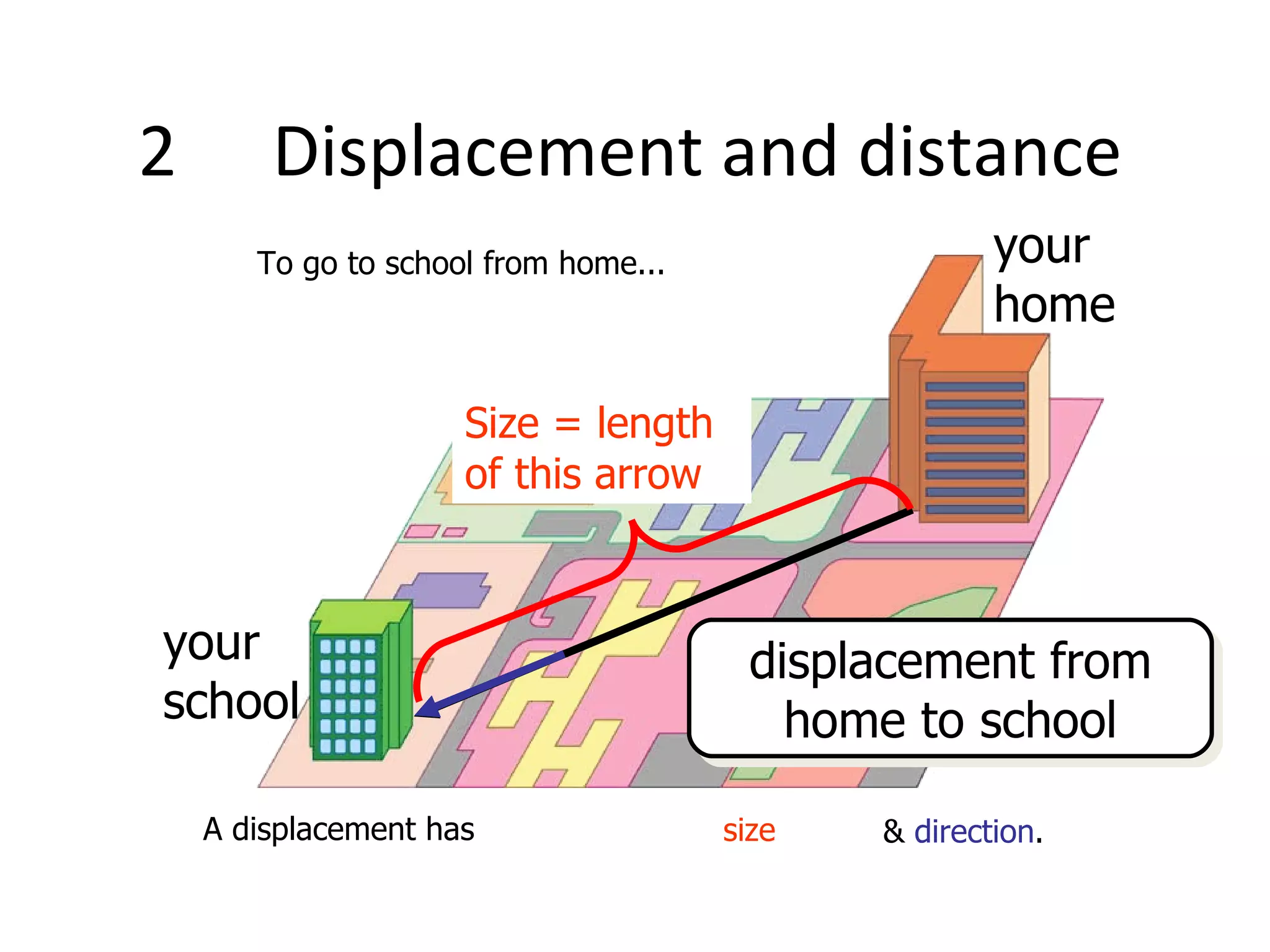
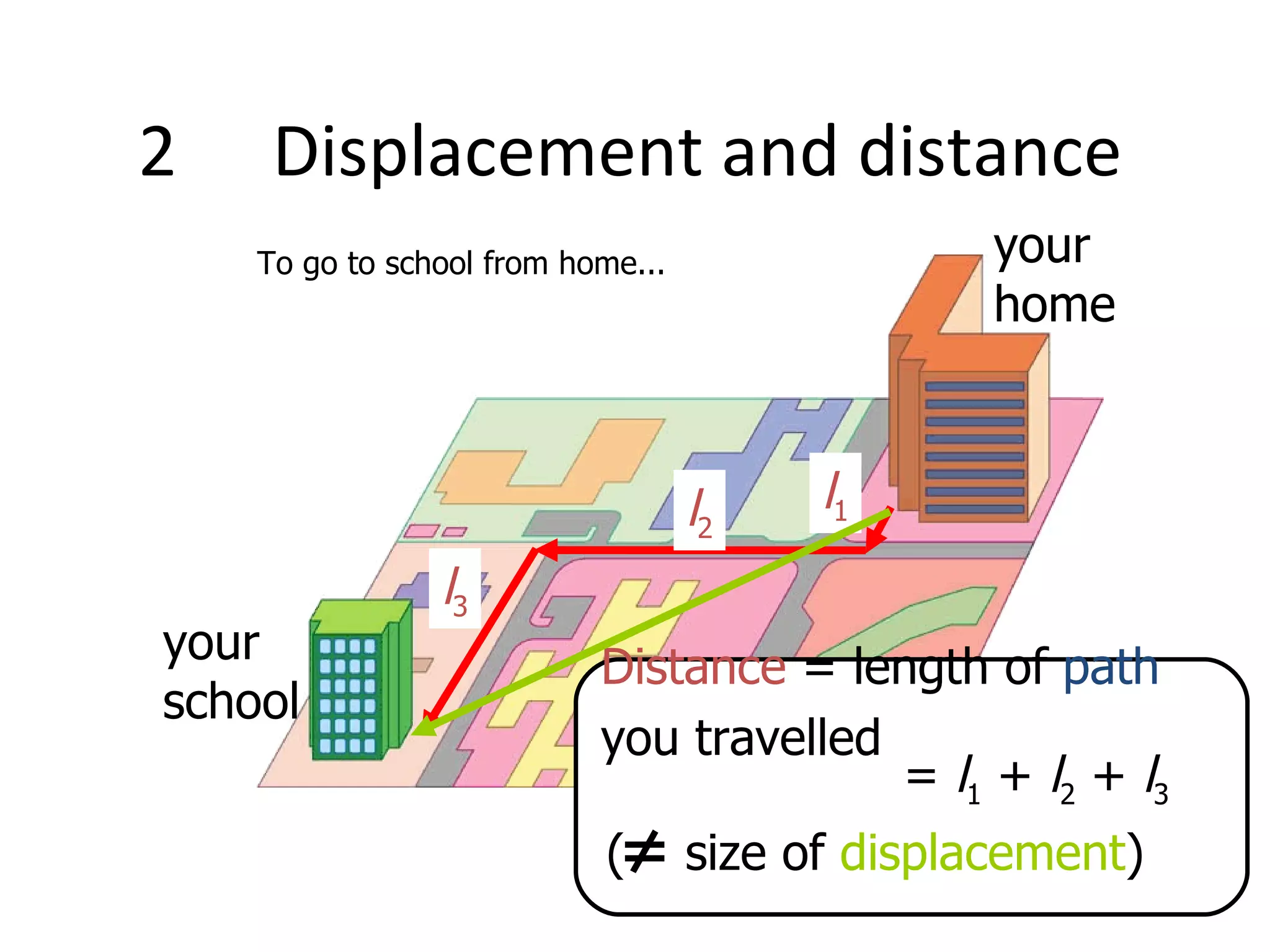
DISTANCE AND DISPLACEMENT DISTANCE   -  the total path length traversed by an object moving from one location to another  - a scalar quantity which has only magnitude.
2.  DISPLACEMENT-  refers to the straight line distance between the starting and end points. - a vector quantity which has both magnitude and direction
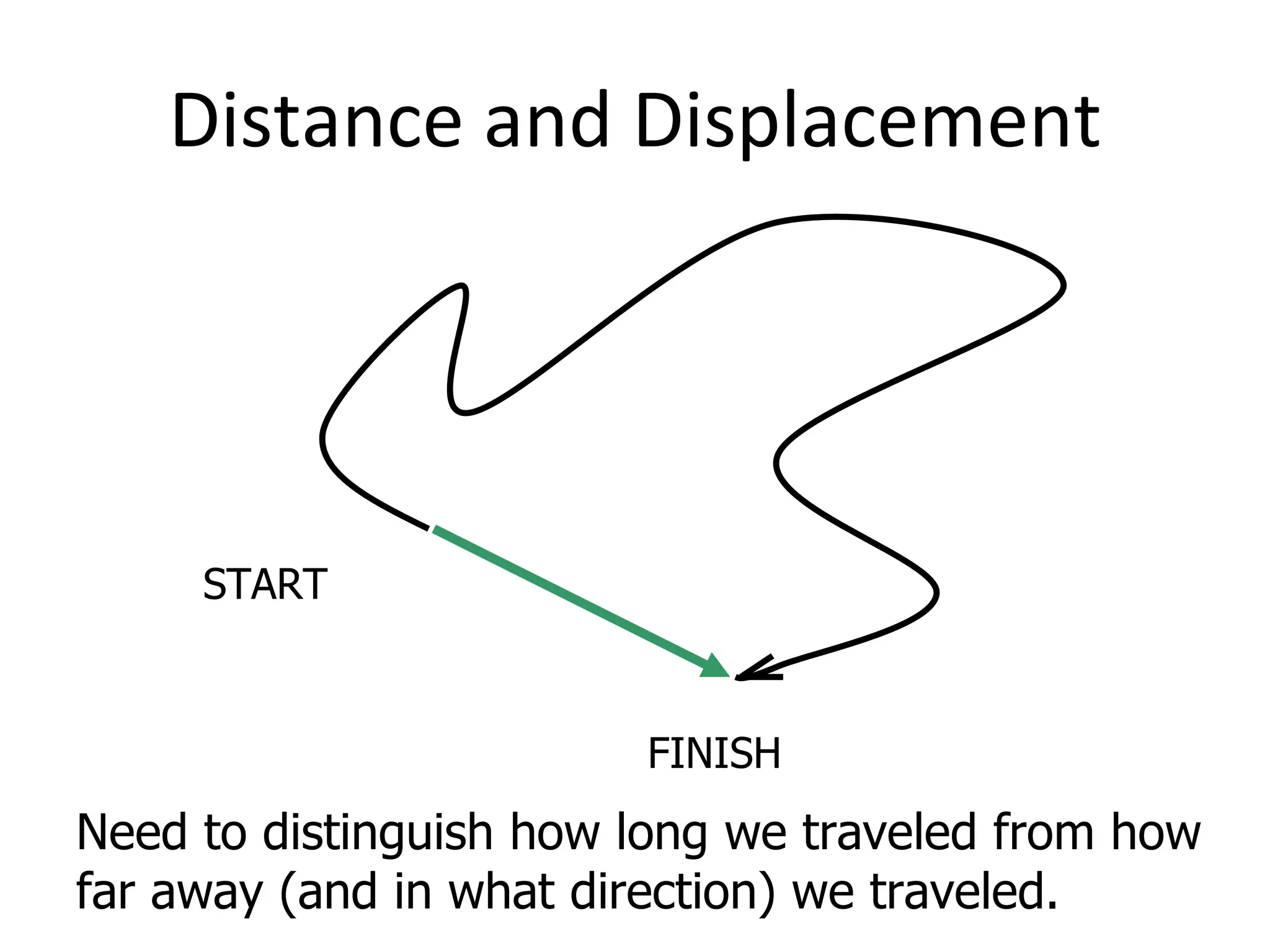
Distance and Displacement START FINISH Need to distinguish how long we traveled from how far away (and in what direction) we traveled.
2 Displacement and distance your home your school A displacement has Size = length of this arrow displacement from home to school To go to school from home... size &  direction .
2 Displacement and distance Distance  = length of  path   you travelled (   size of  displacement ) l 1 l 2 l 3 To go to school from home... your home your school =  l 1  +  l 2  +  l 3
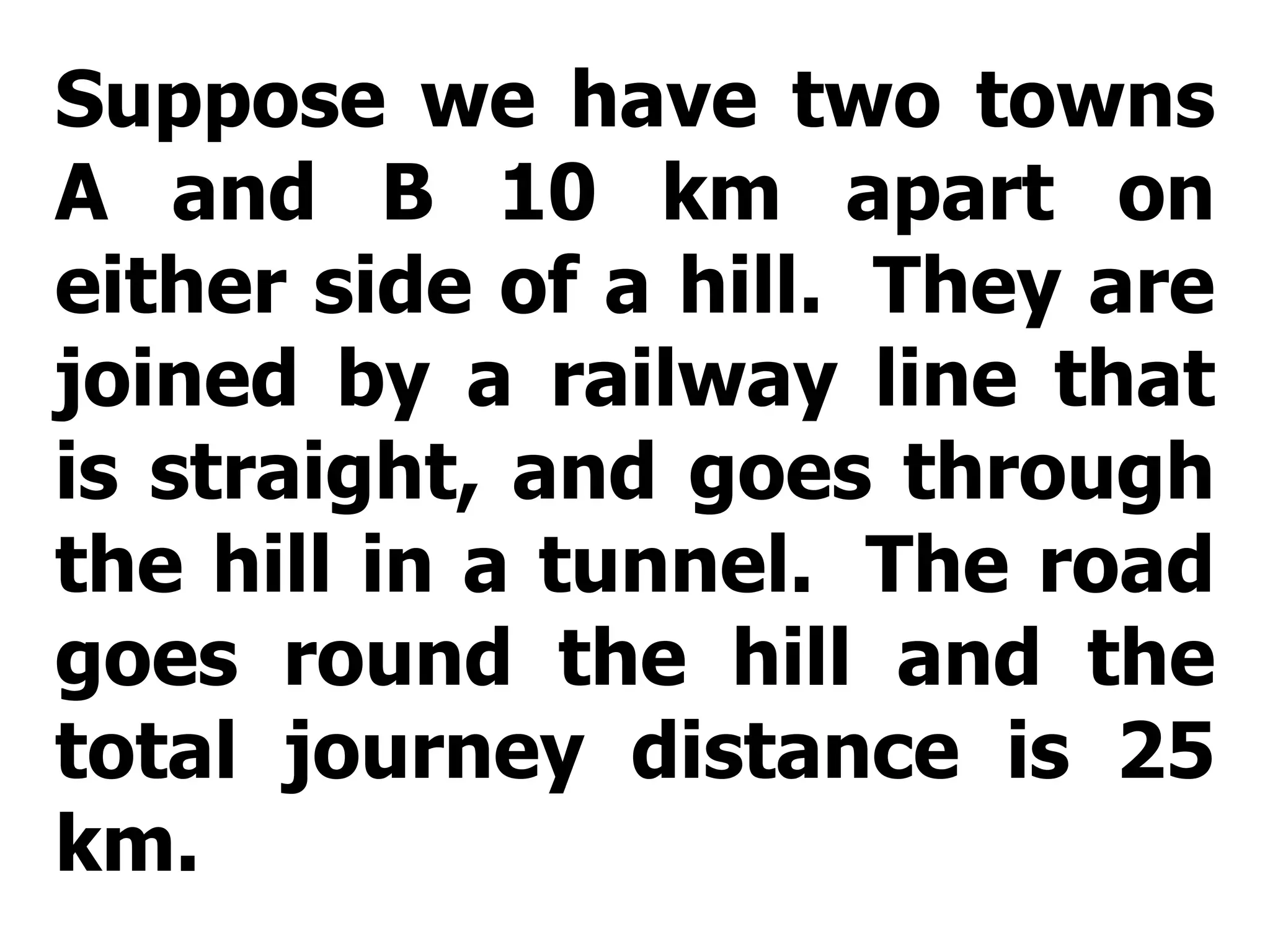
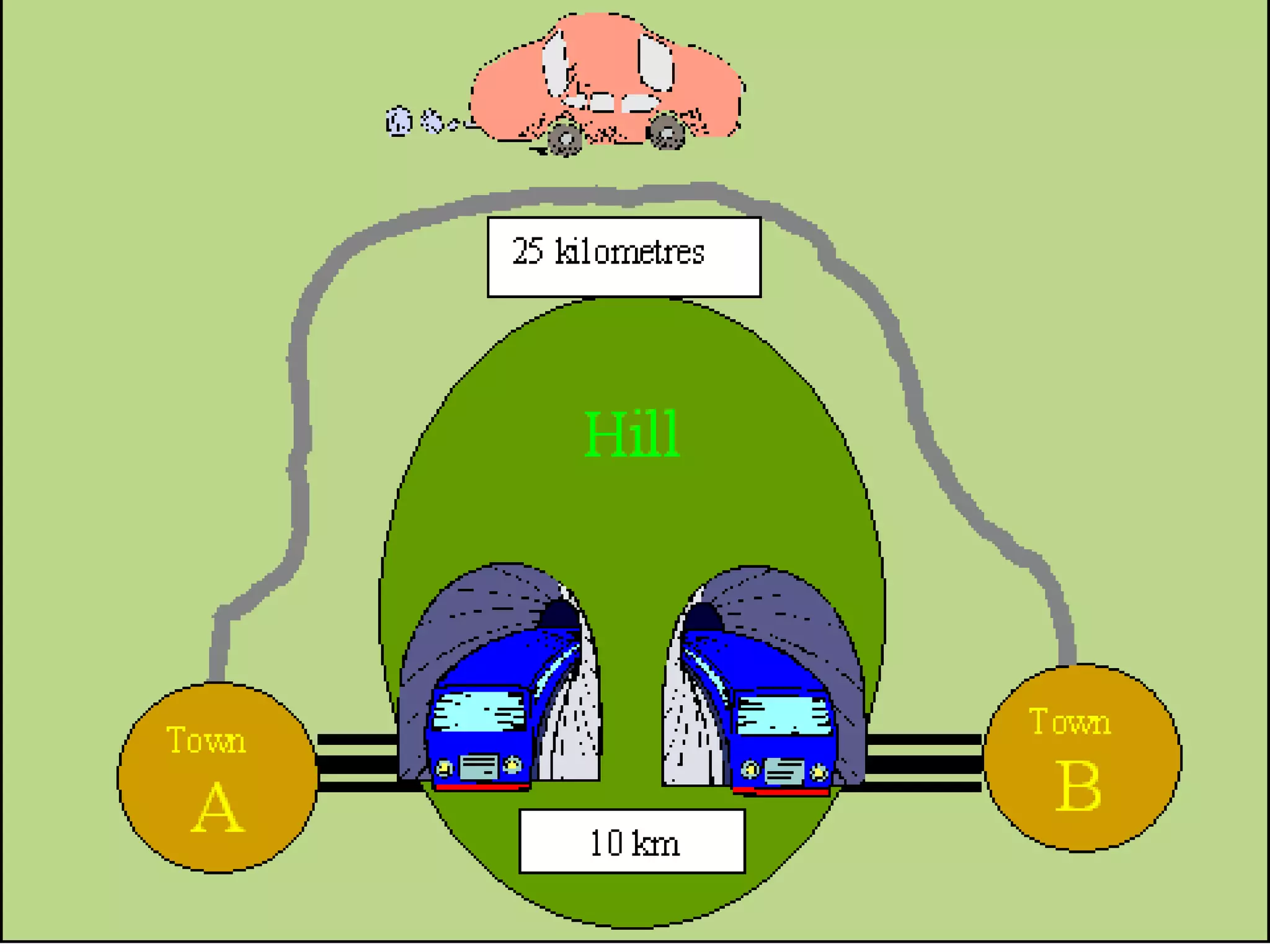
Suppose we have two towns A and B 10 km apart on either side of a hill.  They are joined by a railway line that is straight, and goes through the hill in a tunnel.  The road goes round the hill and the total journey distance is 25 km.
 
So the distance is 25 km.  The displacement (the straight-line distance in a particular direction) between A and B is 10 km due East.
If we go from A to B and back again, the distance is 50 km, but the displacement is 0.
SAMPLE PROBLEM: On his way to school, Jed traveled 100 m North, 300 m East, 100 m North, 100 m East , 100 m North. a. Find the total distance traveled by Jed. b. Determine the displacement made by Jed.
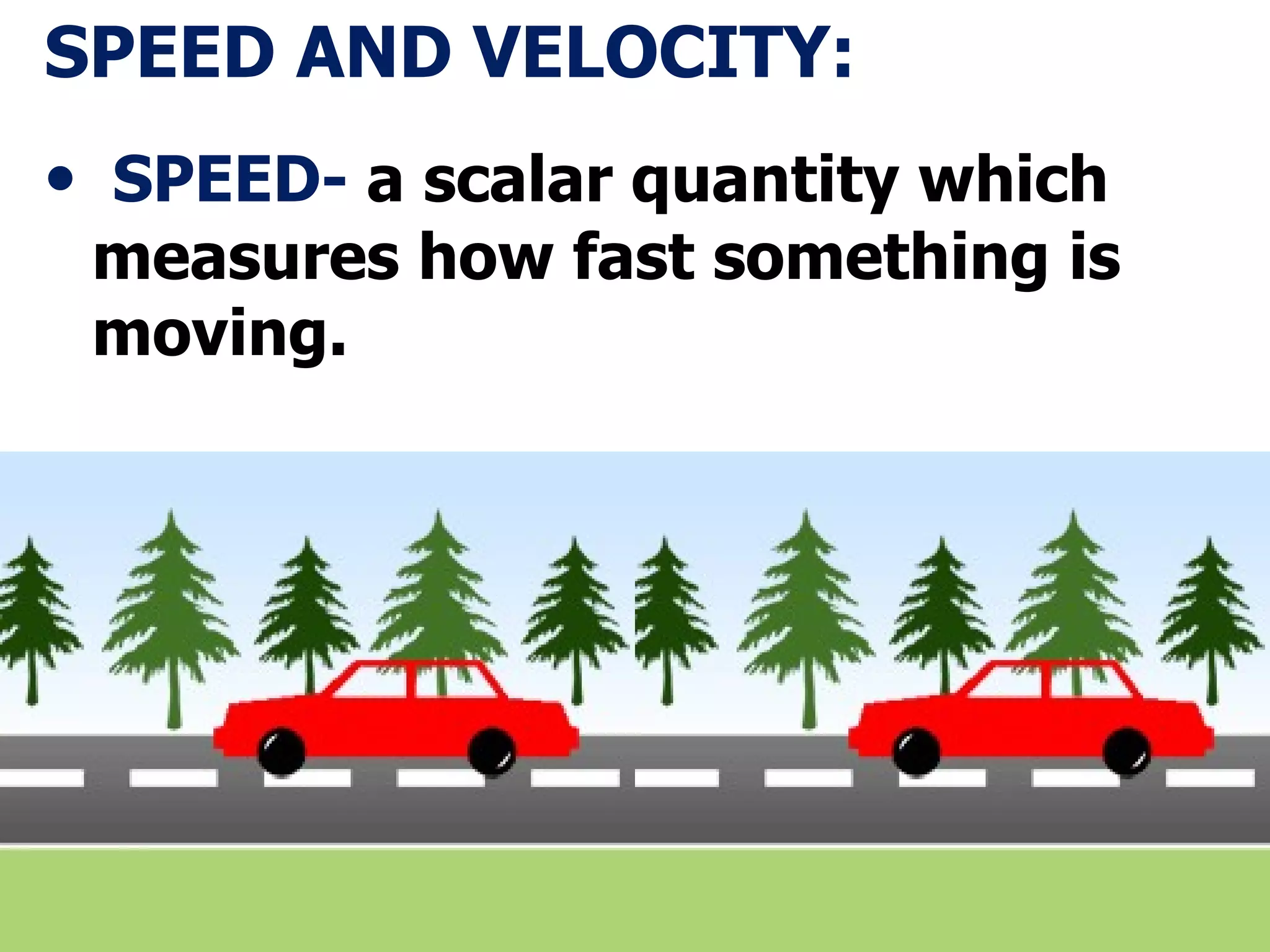
SPEED AND VELOCITY: SPEED-  a scalar quantity which measures how fast something is moving.
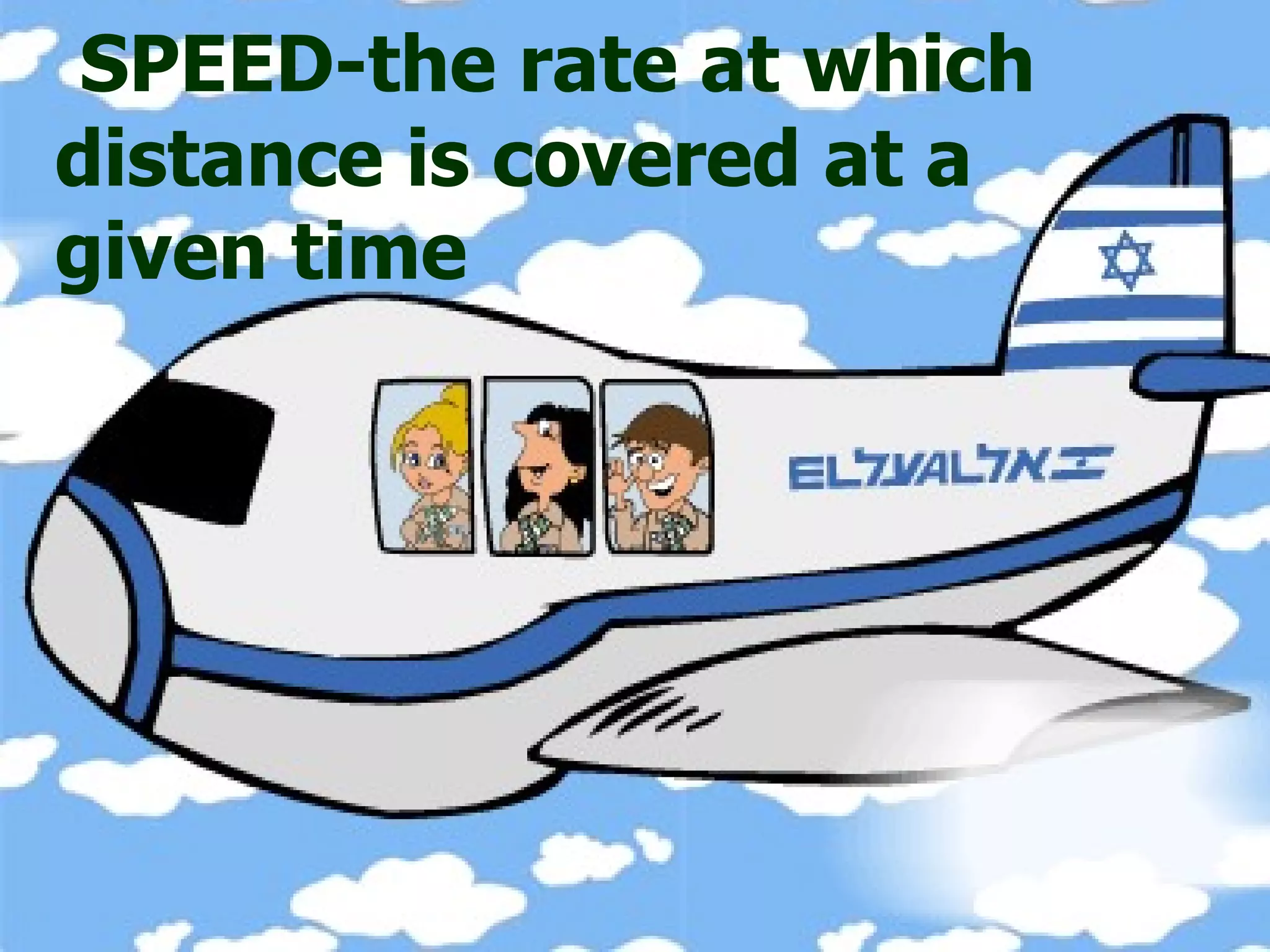
SPEED-the rate at which distance is covered at a given time
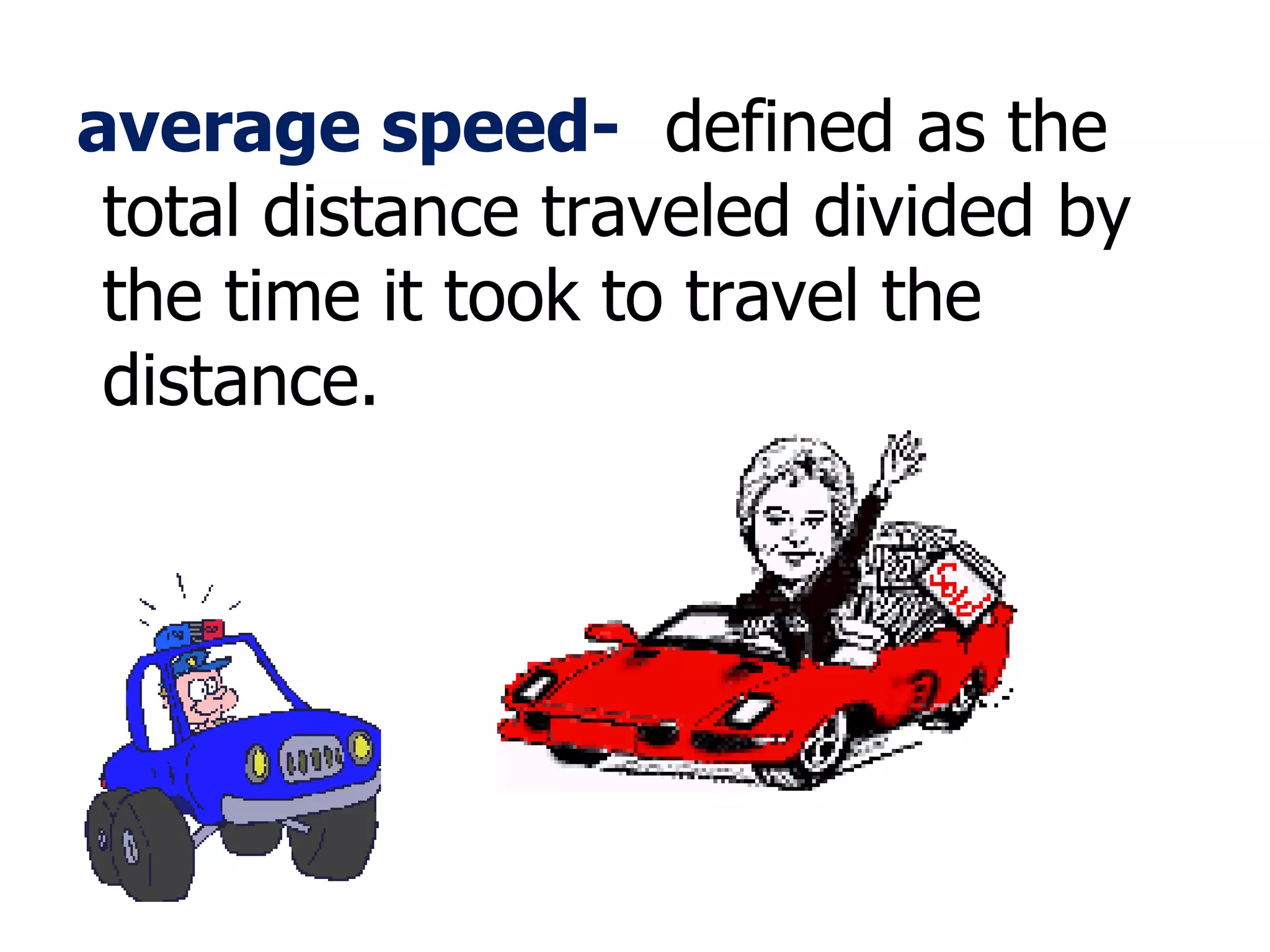
average speed-   defined as the total distance traveled divided by the time it took to travel the distance.
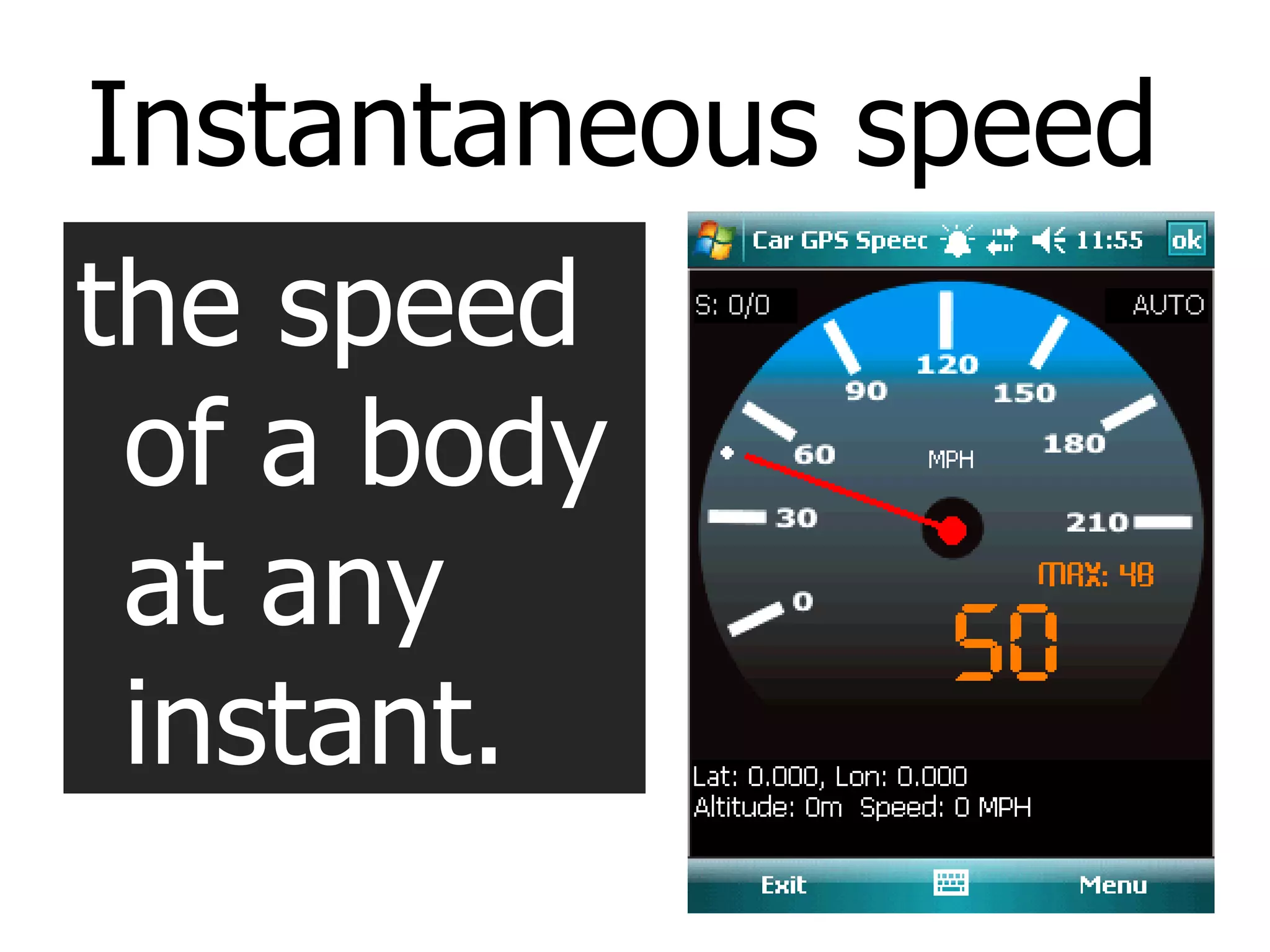
the speed of a body at any instant. Instantaneous speed
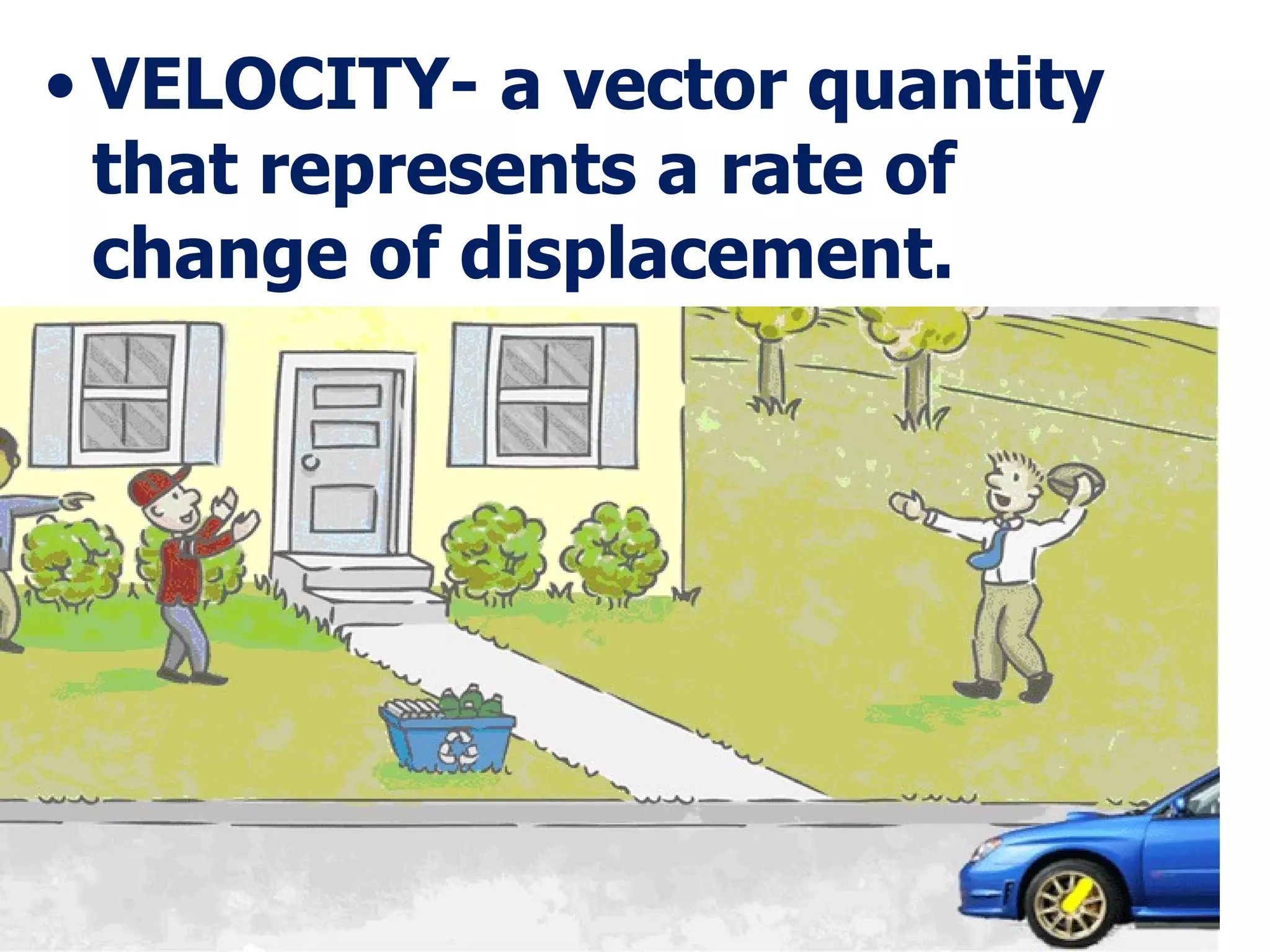
VELOCITY- a vector quantity that represents a rate of change of displacement.
Problems:  1. Rachel watches a thunderstorm from her window. She sees  the flash of lightning bolt and begins counting the seconds until she hears the clap of thunder 5.0 seconds later .
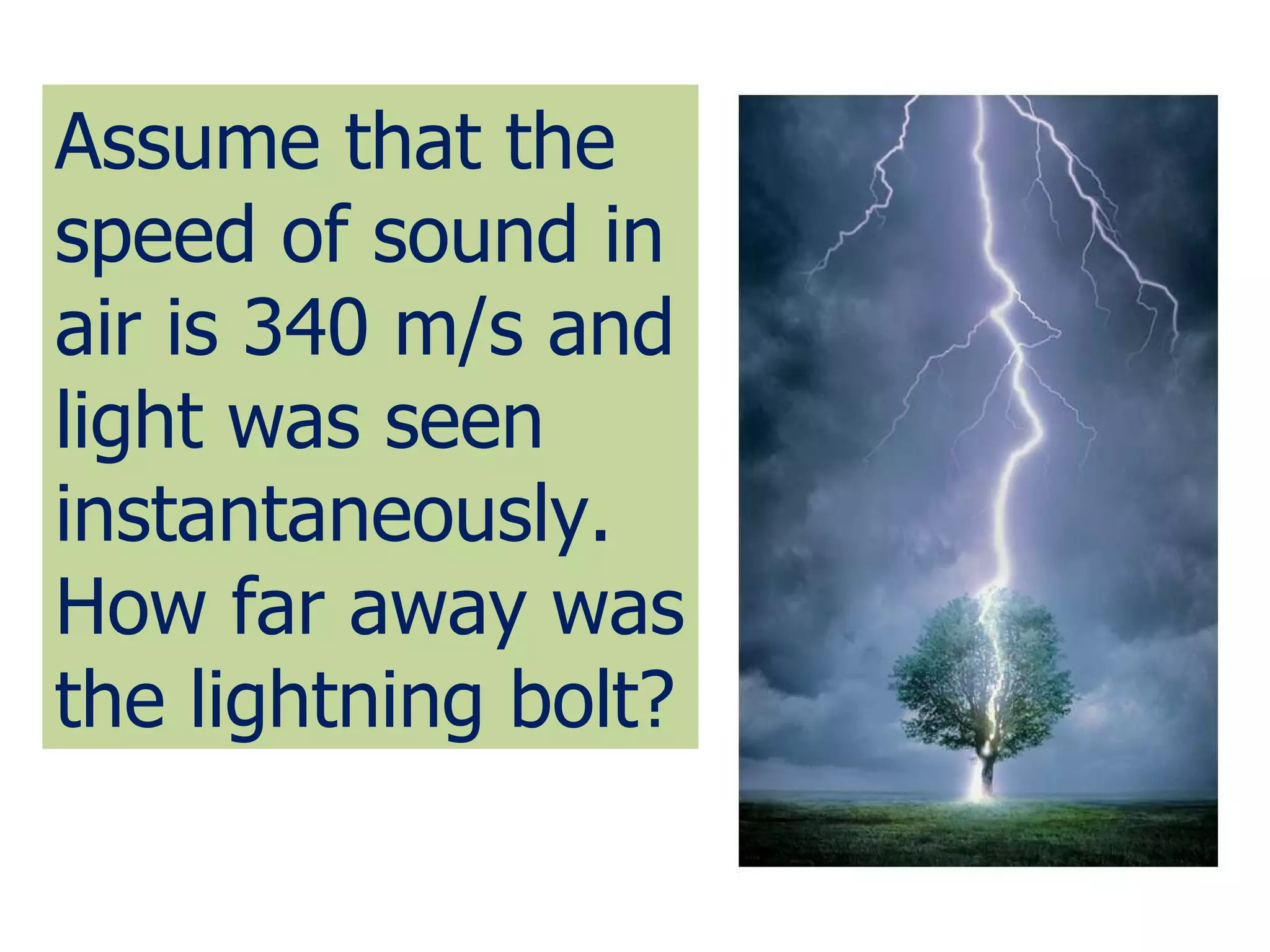
Assume that the speed of sound in air is 340 m/s and light was seen  instantaneously. How far away was the lightning bolt?
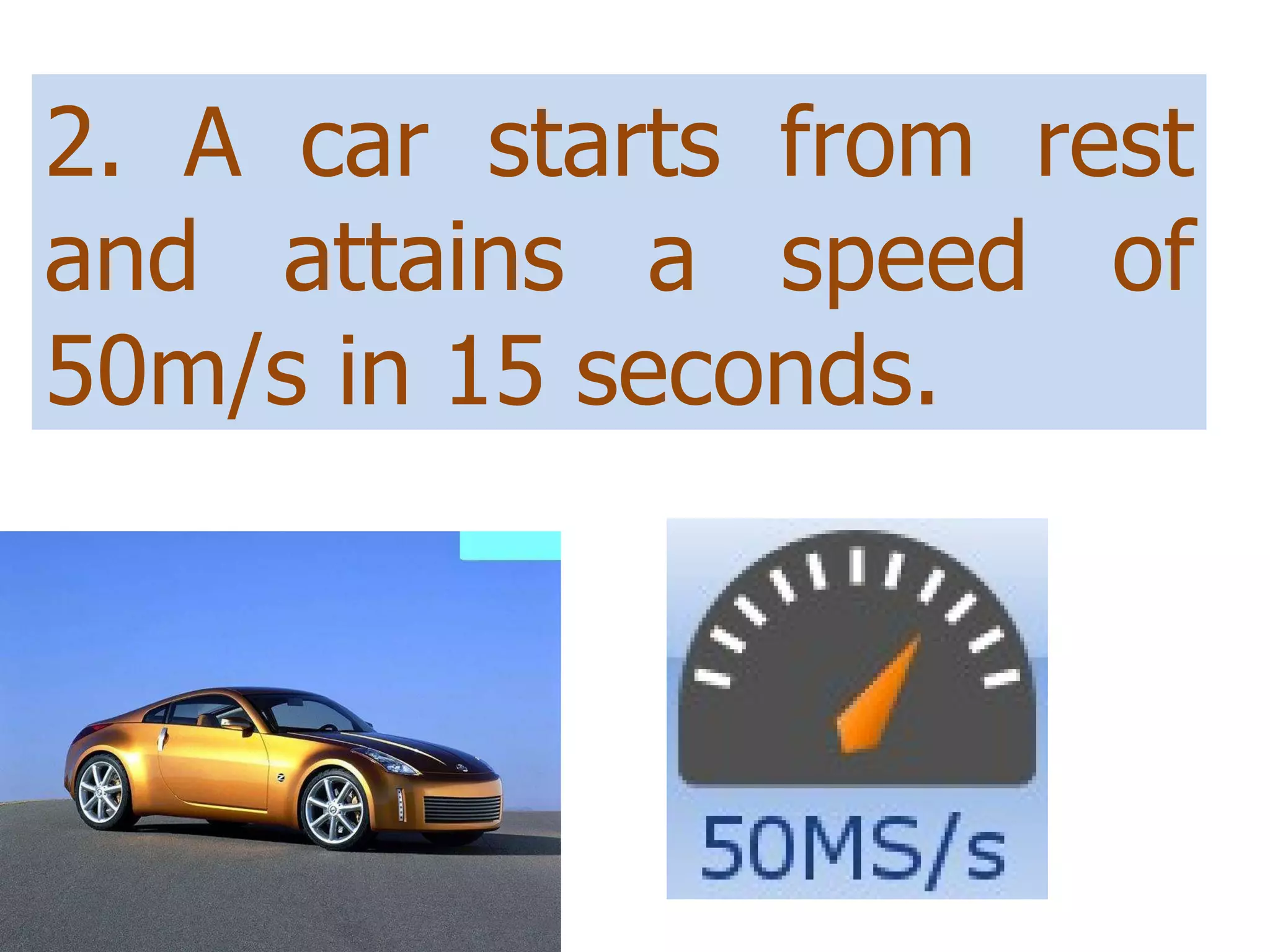
2. A car starts from rest and attains a speed of 50m/s in 15 seconds.
How far has the car traveled in 15 seconds?
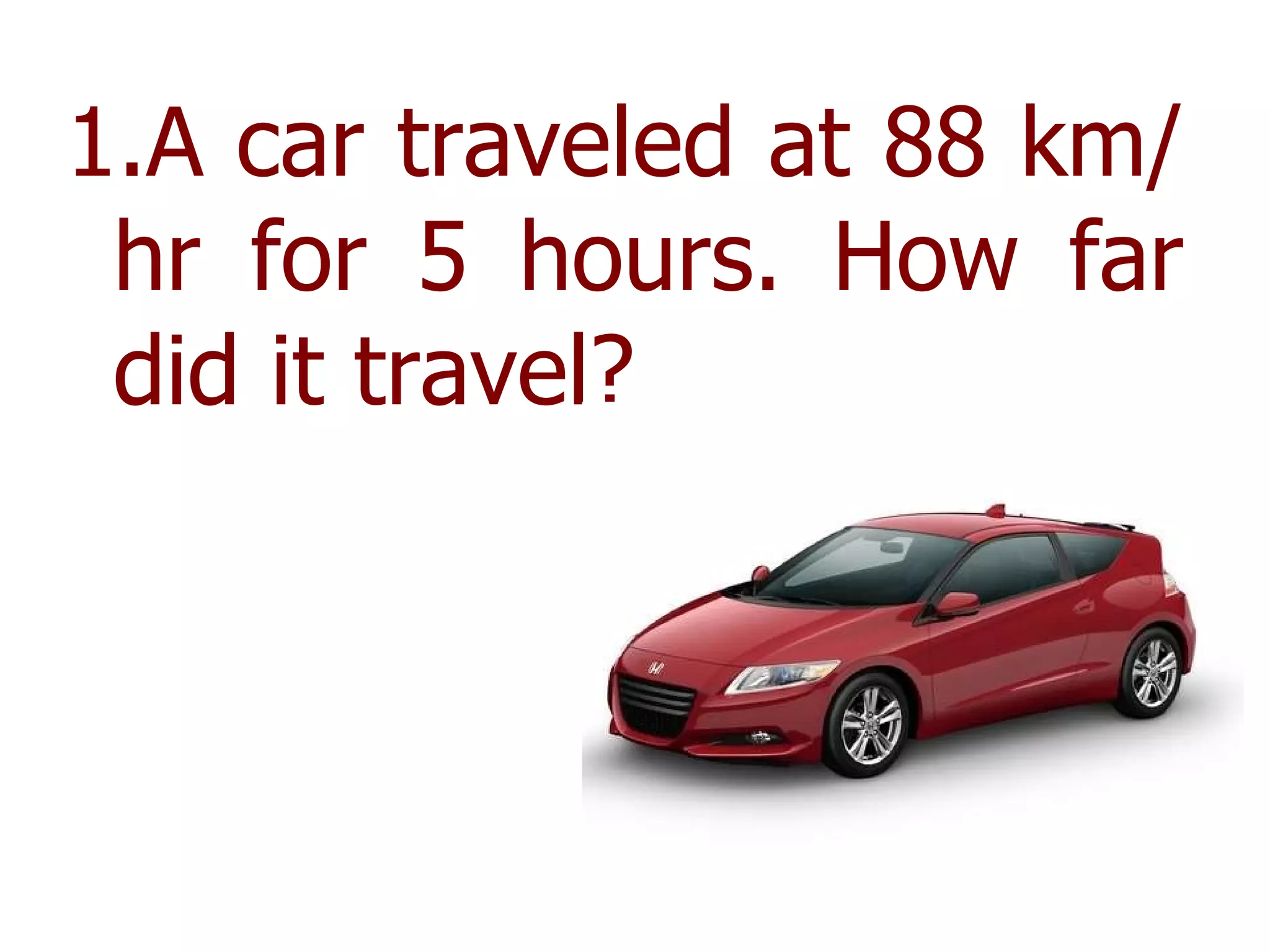
A car traveled at 88 km/hr for 5 hours. How far did it travel?
Justin walks 5 km/hr. How long did it take him to travel 15 km?
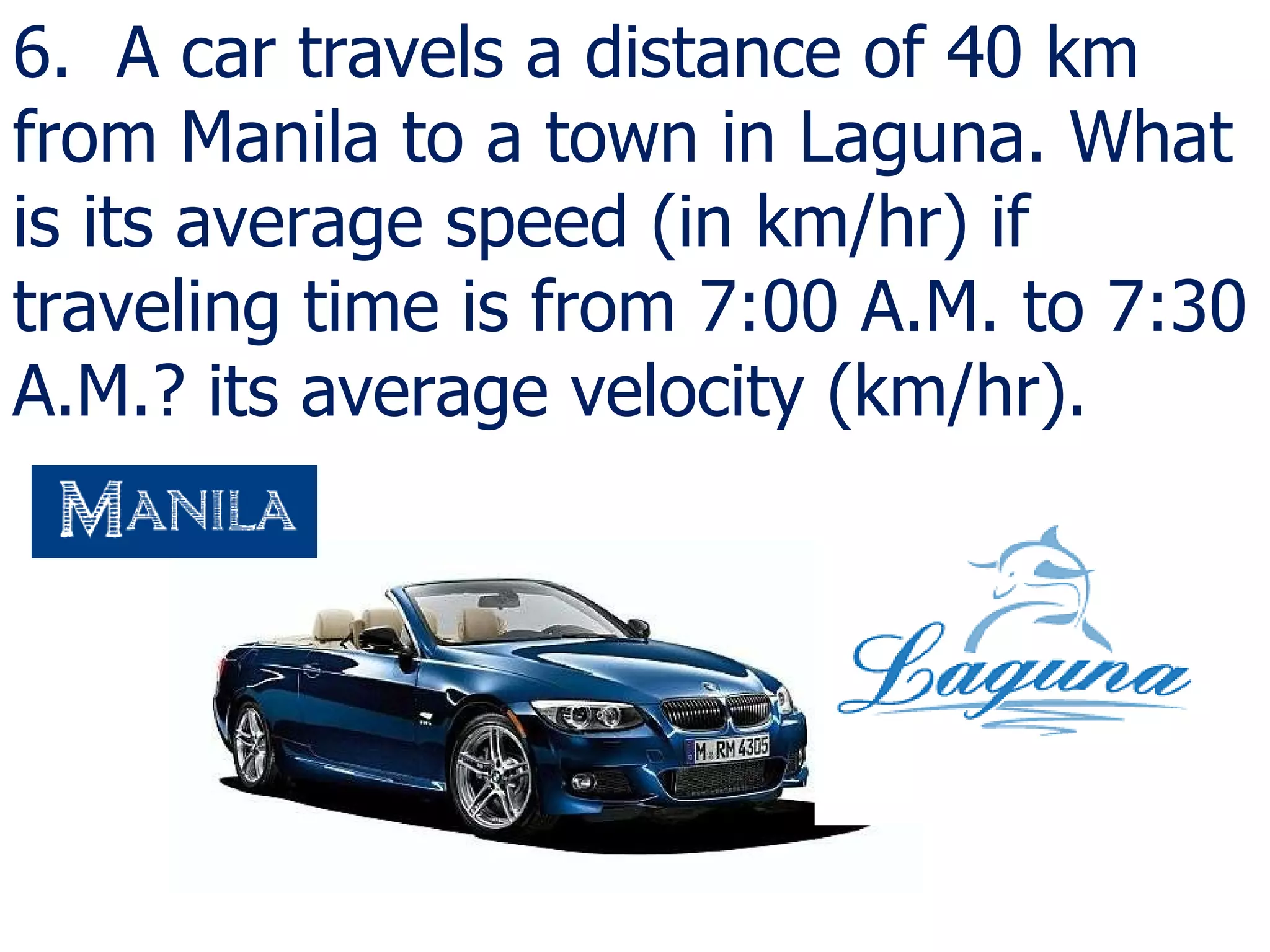
6.  A car travels a distance of 40 km from Manila to a town in Laguna. What is its average speed (in km/hr) if traveling time is from 7:00 A.M. to 7:30 A.M.? its average velocity (km/hr).
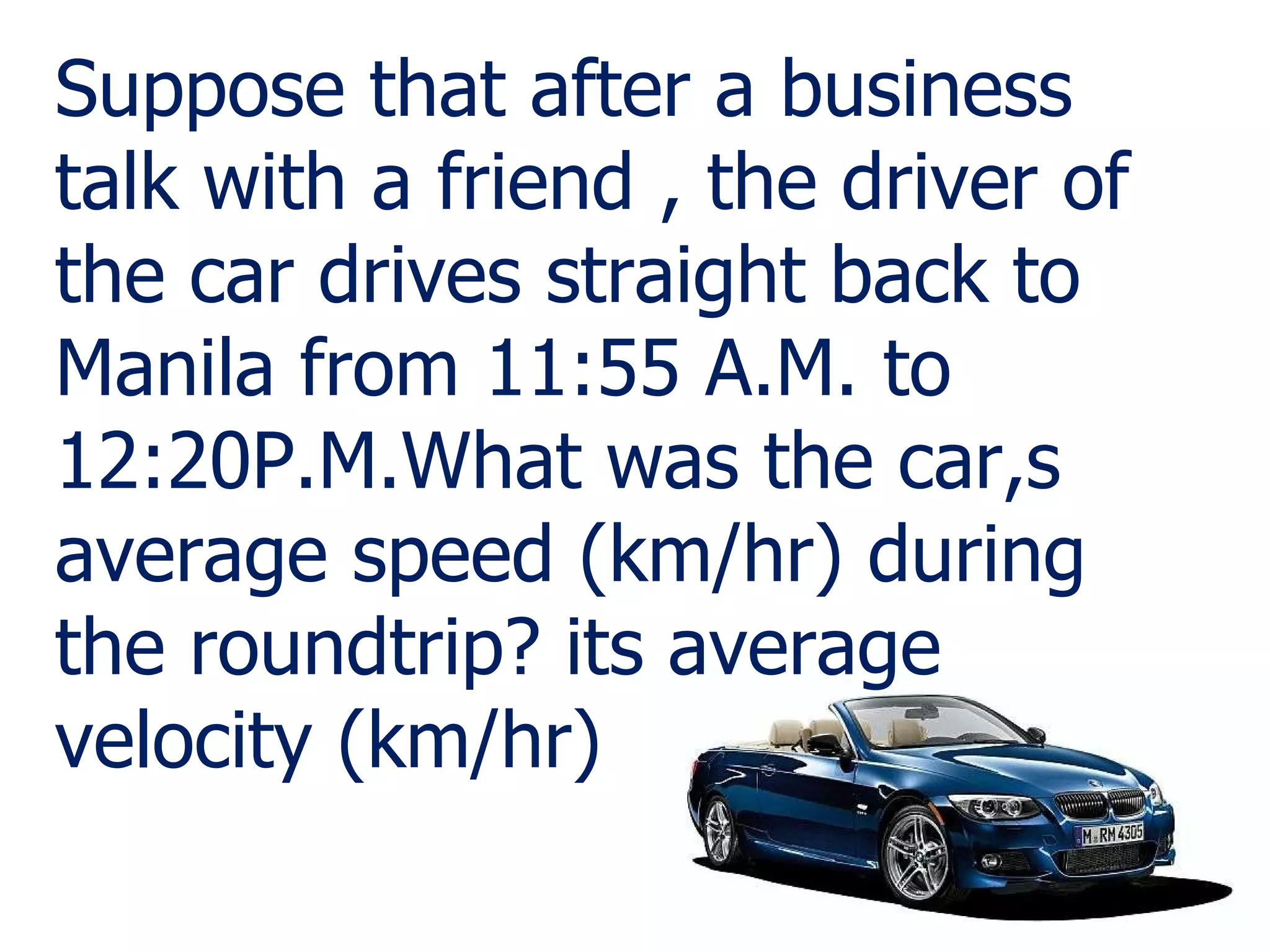
Suppose that after a business talk with a friend , the driver of the car drives straight back to Manila from 11:55 A.M. to 12:20P.M.What was the car,s average speed (km/hr) during the roundtrip? its average velocity (km/hr)

Motion speed and velocity

  • 1.
  • 2.
    MECHANICS the subbranch of classical physics that is concerned with the forces acting on bodies , whether at rest or in motion. is divided into statics, kinematics and dynamics
  • 3.
    STATICS - focuses on the way in which forces combine with each other so as to produce equilibrium .
  • 4.
    KINEMATICS - focuseson the motion of a body without regard to the cause of that motion
  • 5.
    DYNAMICS - focuses on the way in which forces produces motion.
  • 6.
    MOTION defined asthe movement of an object exhibited by a change in position
  • 7.
    Motion or Movementis a Change In Position 10 ft. Position A Position B
  • 8.
    There are manyways of describing motion: 1. Rectilinear motion- the motion of an object traveling at a straight path. 2. Curvilinear motion- an object traveling in a curved path 3. Angular motion - an object traveling at certain angles
  • 9.
    MOTION IS RELATIVEit may be described by specifying how far something has traveled in changing position and time. a reference frame is a physical entity such as the earth’s surface, the deck of a ship or a moving vehicle to which the position and the motion of an object is relative.
  • 10.
    DISTANCE AND DISPLACEMENTDISTANCE - the total path length traversed by an object moving from one location to another - a scalar quantity which has only magnitude.
  • 11.
    2. DISPLACEMENT- refers to the straight line distance between the starting and end points. - a vector quantity which has both magnitude and direction
  • 12.
    Distance and DisplacementSTART FINISH Need to distinguish how long we traveled from how far away (and in what direction) we traveled.
  • 13.
    2 Displacement anddistance your home your school A displacement has Size = length of this arrow displacement from home to school To go to school from home... size & direction .
  • 14.
    2 Displacement anddistance Distance = length of path you travelled (  size of displacement ) l 1 l 2 l 3 To go to school from home... your home your school = l 1 + l 2 + l 3
  • 15.
    Suppose we havetwo towns A and B 10 km apart on either side of a hill.  They are joined by a railway line that is straight, and goes through the hill in a tunnel.  The road goes round the hill and the total journey distance is 25 km.
  • 16.
  • 17.
    So the distanceis 25 km.  The displacement (the straight-line distance in a particular direction) between A and B is 10 km due East.
  • 18.
    If we gofrom A to B and back again, the distance is 50 km, but the displacement is 0.
  • 19.
    SAMPLE PROBLEM: Onhis way to school, Jed traveled 100 m North, 300 m East, 100 m North, 100 m East , 100 m North. a. Find the total distance traveled by Jed. b. Determine the displacement made by Jed.
  • 20.
    SPEED AND VELOCITY:SPEED- a scalar quantity which measures how fast something is moving.
  • 21.
    SPEED-the rate atwhich distance is covered at a given time
  • 22.
    average speed- defined as the total distance traveled divided by the time it took to travel the distance.
  • 23.
    the speed ofa body at any instant. Instantaneous speed
  • 24.
    VELOCITY- a vectorquantity that represents a rate of change of displacement.
  • 25.
    Problems: 1.Rachel watches a thunderstorm from her window. She sees the flash of lightning bolt and begins counting the seconds until she hears the clap of thunder 5.0 seconds later .
  • 26.
    Assume that thespeed of sound in air is 340 m/s and light was seen instantaneously. How far away was the lightning bolt?
  • 27.
    2. A carstarts from rest and attains a speed of 50m/s in 15 seconds.
  • 28.
    How far hasthe car traveled in 15 seconds?
  • 29.
    A car traveledat 88 km/hr for 5 hours. How far did it travel?
  • 30.
    Justin walks 5km/hr. How long did it take him to travel 15 km?
  • 31.
    6. Acar travels a distance of 40 km from Manila to a town in Laguna. What is its average speed (in km/hr) if traveling time is from 7:00 A.M. to 7:30 A.M.? its average velocity (km/hr).
  • 32.
    Suppose that aftera business talk with a friend , the driver of the car drives straight back to Manila from 11:55 A.M. to 12:20P.M.What was the car,s average speed (km/hr) during the roundtrip? its average velocity (km/hr)