Motion and Forces
Describing Motion
•Motion
•Speed & Velocity
Newton’s First Law
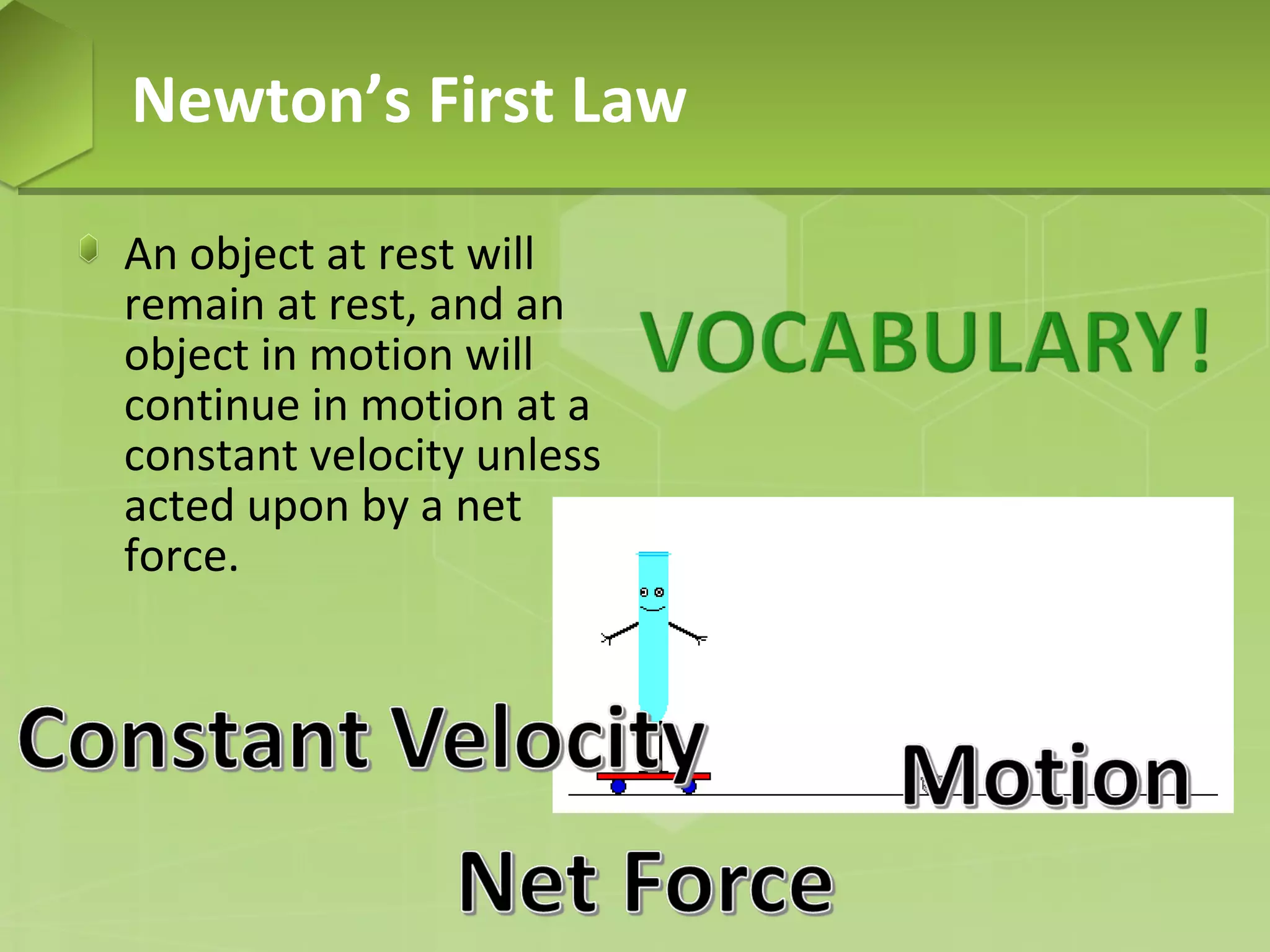
An object at rest will
remain at rest, and an
object in motion will
continue in motion at a
constant velocity unless
acted upon by a net
force.
Motion
Problem:

− Is your desk moving?

We need a reference point...

− nonmoving point from which motion is measured
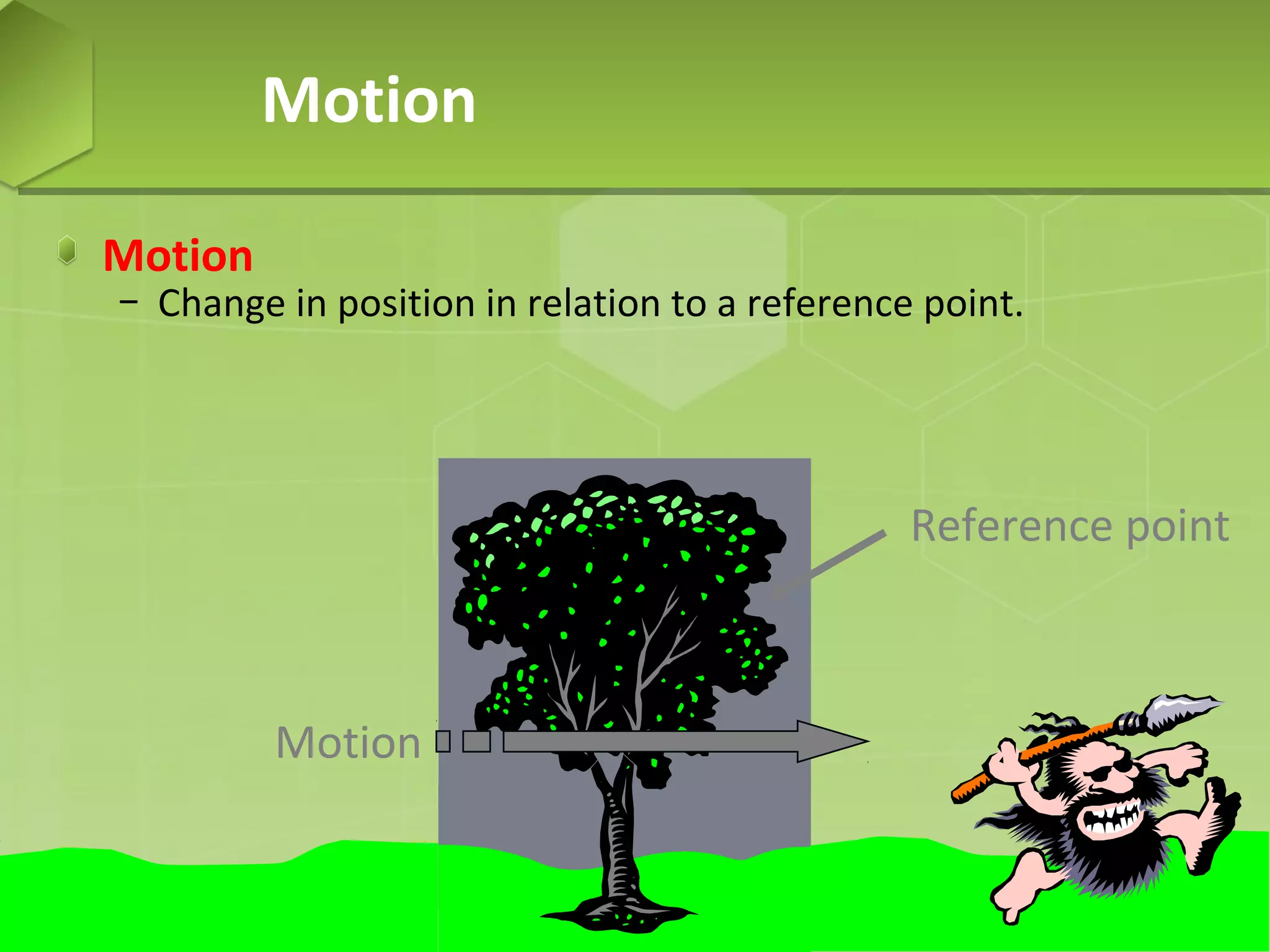
Motion
Motion

− Change in position in relation to a reference point.

Reference point

Motion
Relative Motion
If you are sitting in a chair reading this sentence, you
are moving.
You are not moving relative to your desk or your school
building, but you are moving relative to the other
planets in the solar system and the Sun.
Motion
• Distance

• Distance describes how far an object has
moved.
• The SI unit of length or distance is the
meter (m). Longer distances are
measured in kilometers (km).
• Shorter distances are measured in
centimeters (cm).
Motion
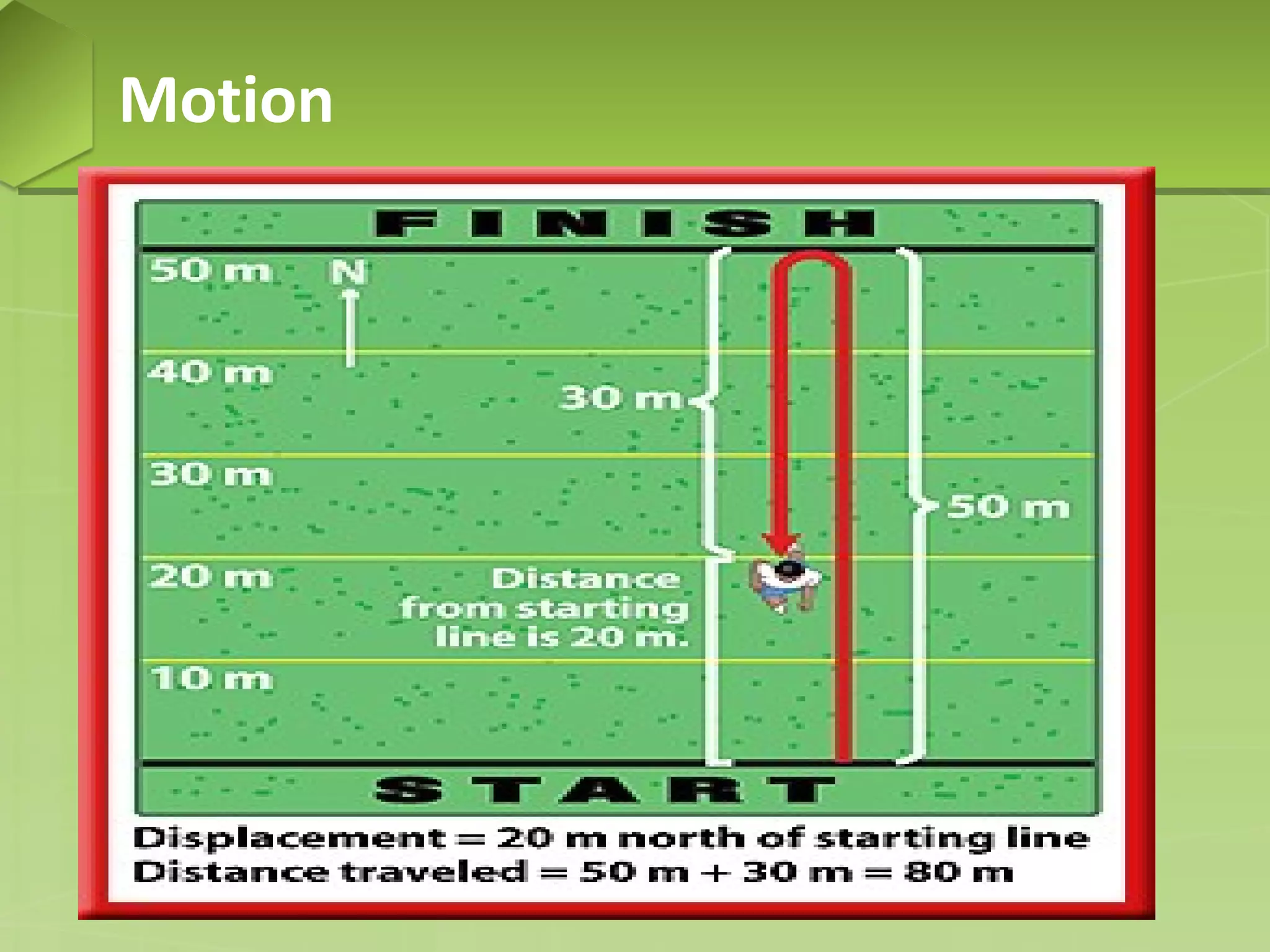
• Displacement is the distance and direction of an
object's change in position from a reference point.
• Suppose a runner jogs to the 50-m mark and then
turns around and runs back to the 20-m mark.
• The runner travels 50 m in the original direction
(north) plus 30 m in the opposite direction (south),
so the total distance she ran is 80 m.
Motion
Problem:
• You are a passenger in a car stopped at a stop
sign. Out of the corner of your eye, you notice
a tree on the side of the road begin to move
forward.
• You have mistakenly set yourself as the
reference point.
Speed & Velocity
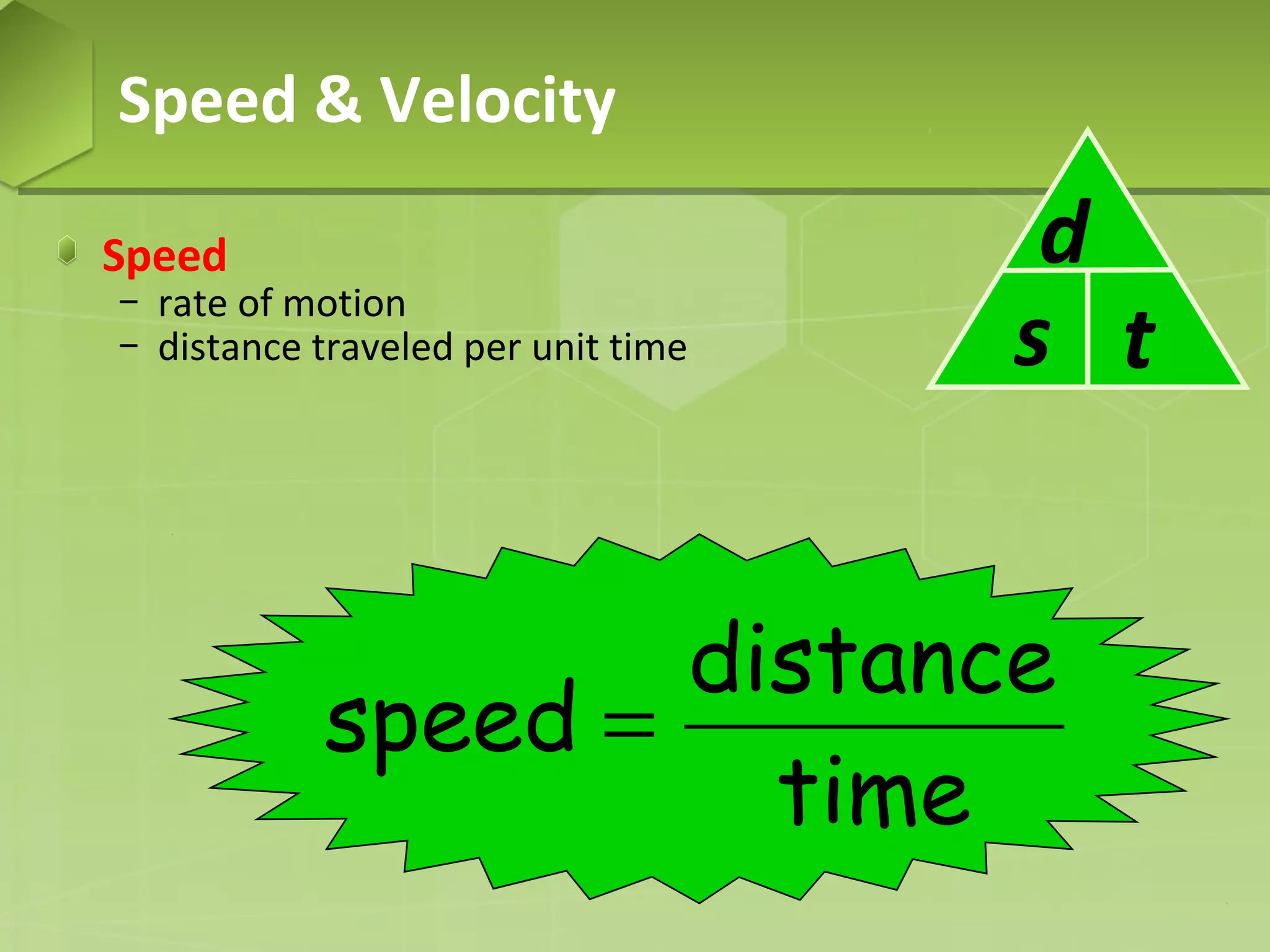
Speed

− rate of motion
− distance traveled per unit time

d
s t

distance
speed =
time
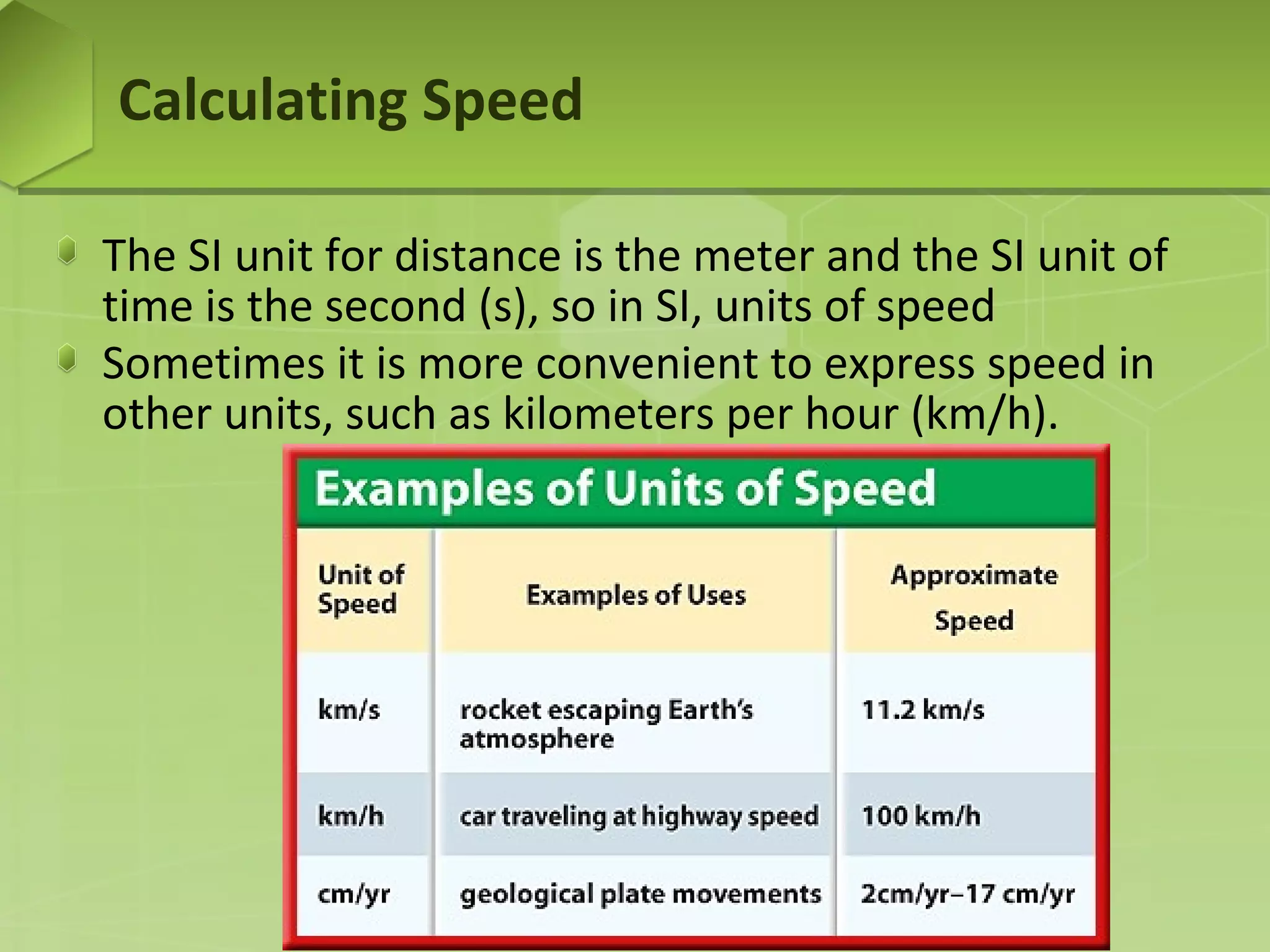
Calculating Speed
The SI unit for distance is the meter and the SI unit of
time is the second (s), so in SI, units of speed
Sometimes it is more convenient to express speed in
other units, such as kilometers per hour (km/h).
Speed & Velocity
Instantaneous Speed

− speed at a given instant
− Speed odometer reading

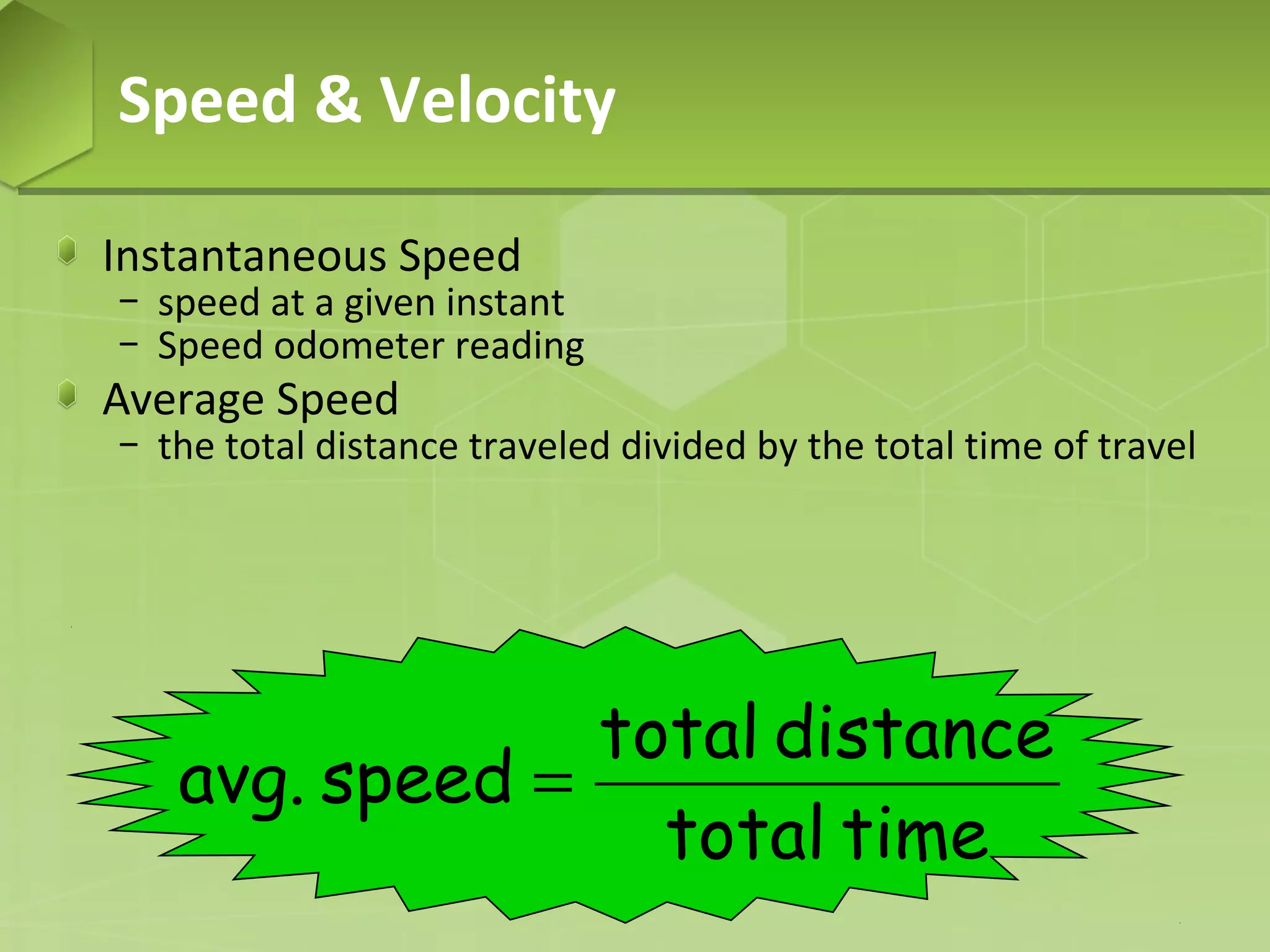
Average Speed

− the total distance traveled divided by the total time of travel

total distance
avg. speed =
total time
Changing Instantaneous Speed
When something is speeding up or slowing down, its
instantaneous speed is changing.
If an object is moving with constant speed, the
instantaneous speed doesn't change.
To determine direction you need to know the velocity
Speed & Velocity
Problem:

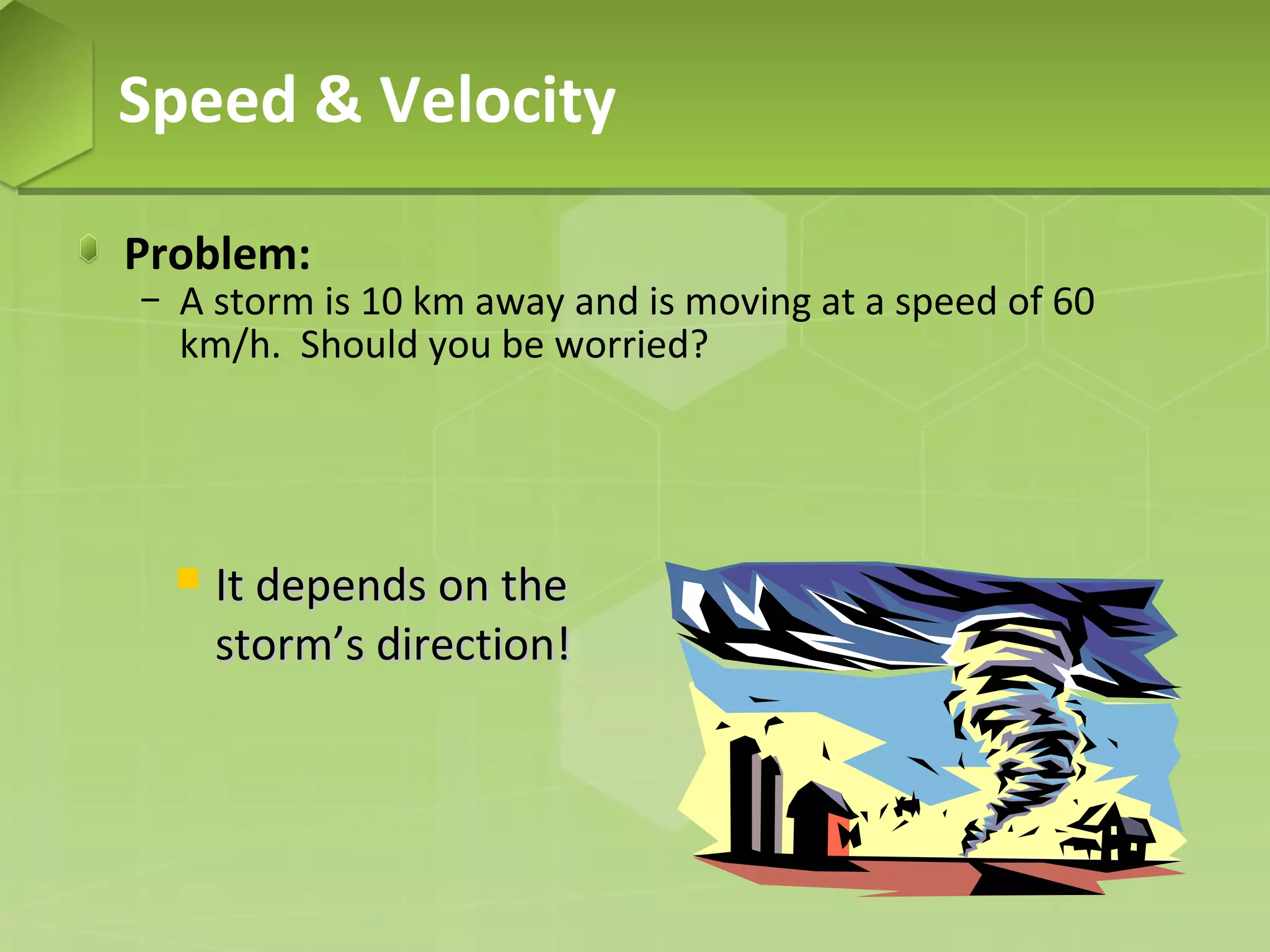
− A storm is 10 km away and is moving at a speed of 60
km/h. Should you be worried?



It depends on the
storm’s direction!
Speed & Velocity
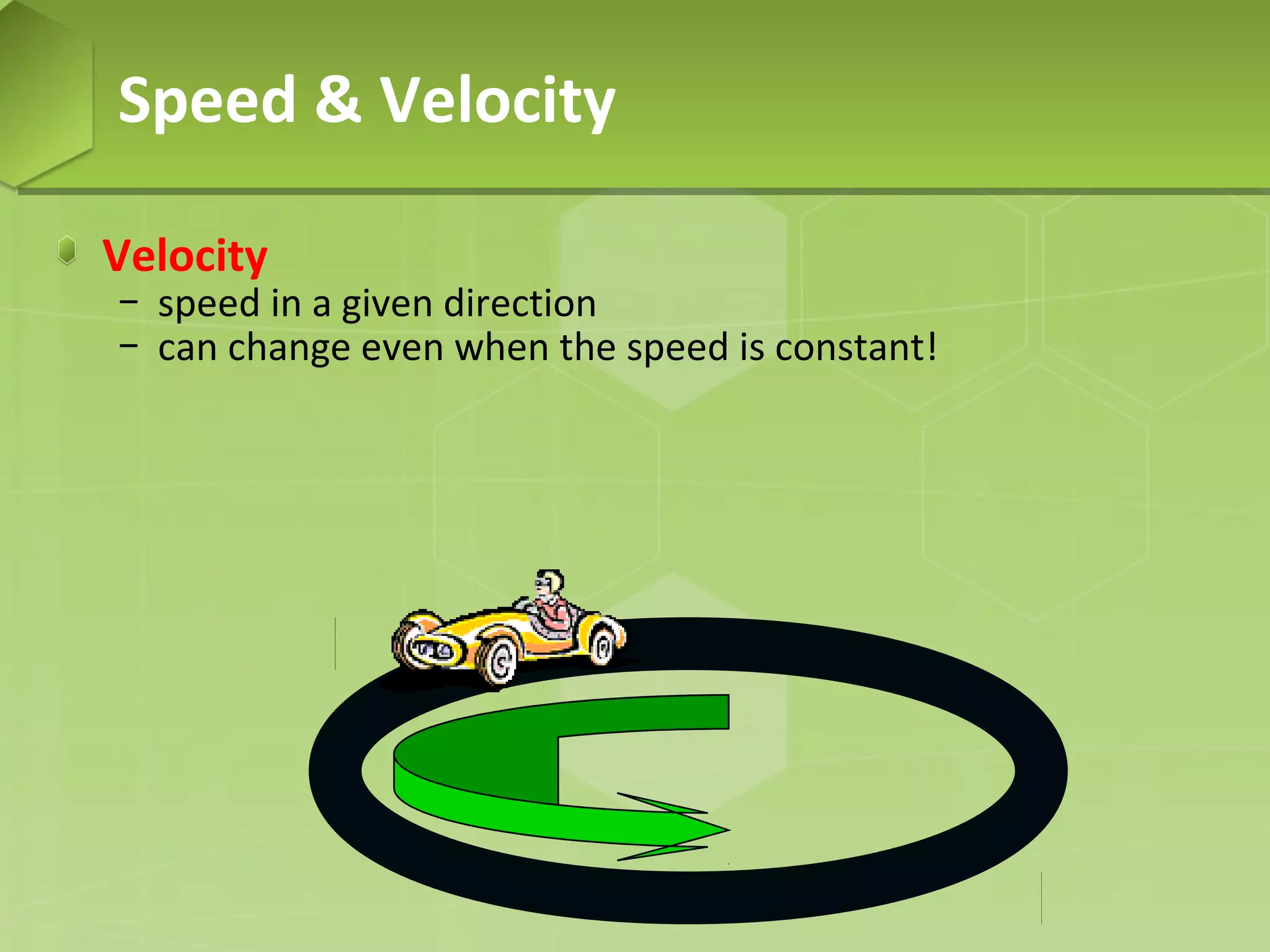
Velocity

− speed in a given direction
− can change even when the speed is constant!
Speed an Acceleration Video
Calculations


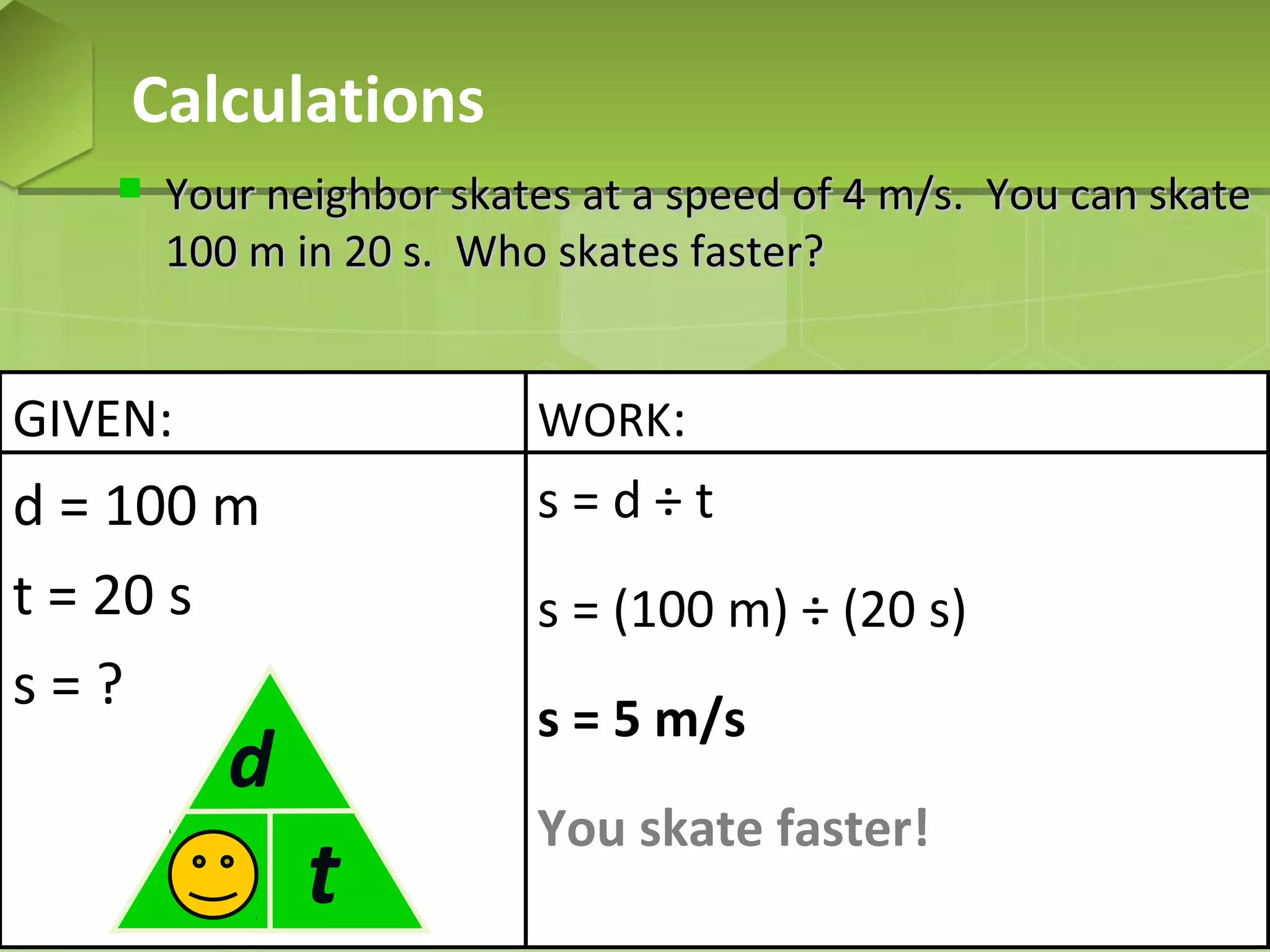
Your neighbor skates at a speed of 4 m/s. You can skate
100 m in 20 s. Who skates faster?

GIVEN:

WORK:

d = 100 m
t = 20 s
s=?

s=d÷t

d
s t

s = (100 m) ÷ (20 s)
s = 5 m/s
You skate faster!
Calculations


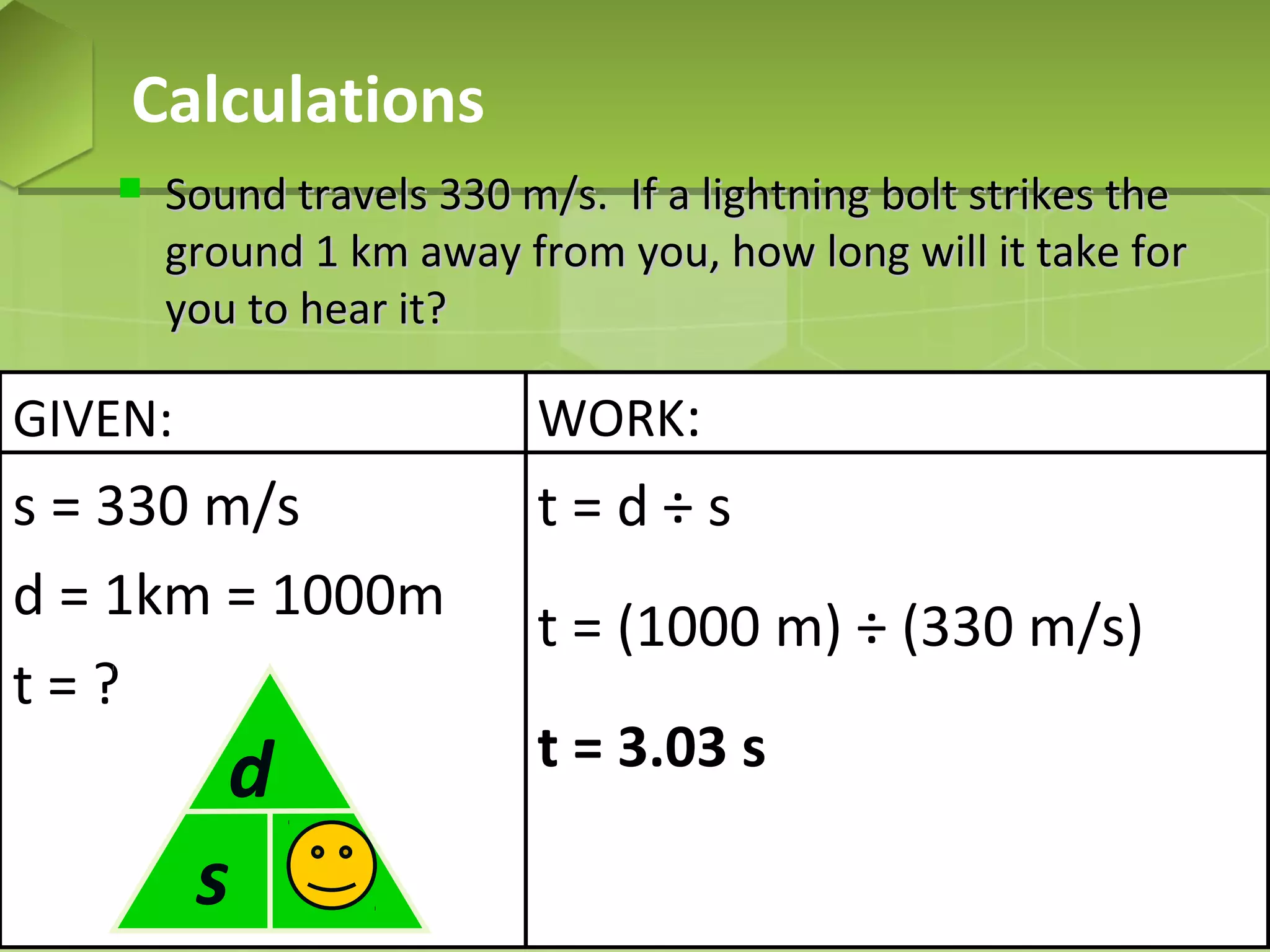
Sound travels 330 m/s. If a lightning bolt strikes the
ground 1 km away from you, how long will it take for
you to hear it?

GIVEN:

WORK:

s = 330 m/s
d = 1km = 1000m
t=?

t=d÷s

d
s t

t = (1000 m) ÷ (330 m/s)
t = 3.03 s
Graphing Motion
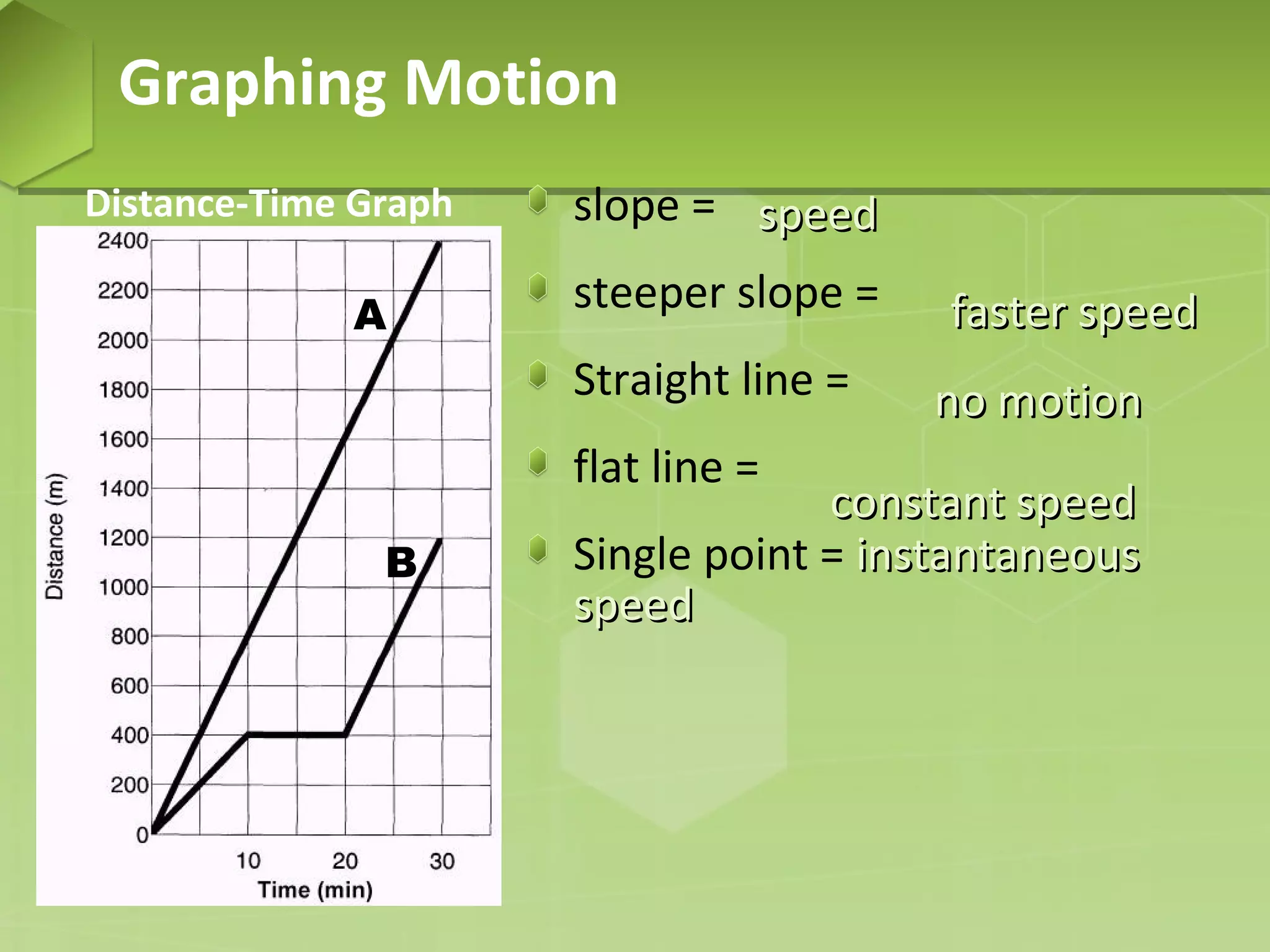
Distance-Time Graph
A

slope = speed
steeper slope =
Straight line =
flat line =

B

faster speed
no motion

constant speed
Single point = instantaneous
speed
Graphing Motion
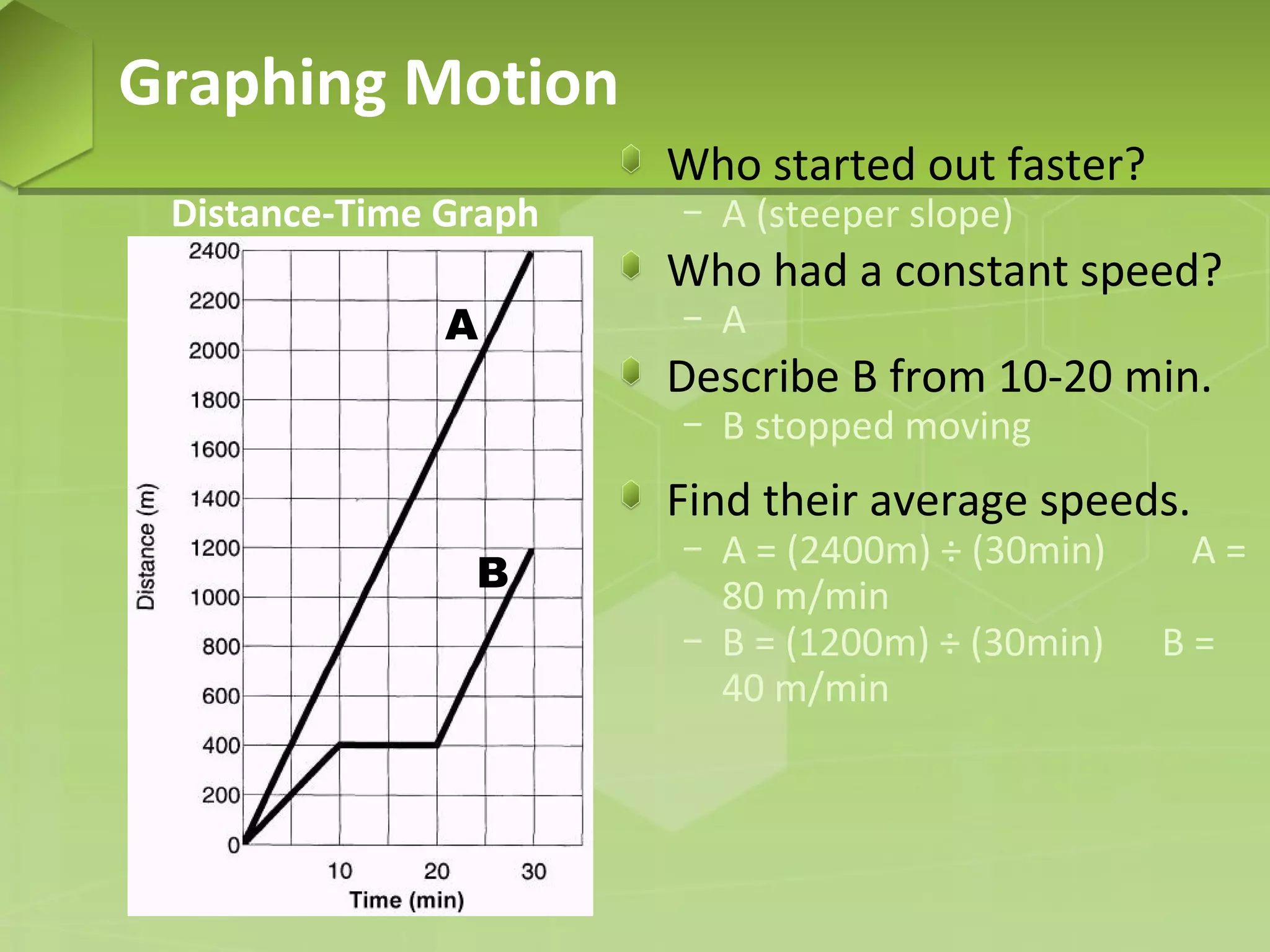
Distance-Time Graph
A

Who started out faster?
− A (steeper slope)

Who had a constant speed?
− A

Describe B from 10-20 min.
− B stopped moving

Find their average speeds.
B

− A = (2400m) ÷ (30min)
80 m/min
− B = (1200m) ÷ (30min)
40 m/min

A=

B=
Graphing Motion
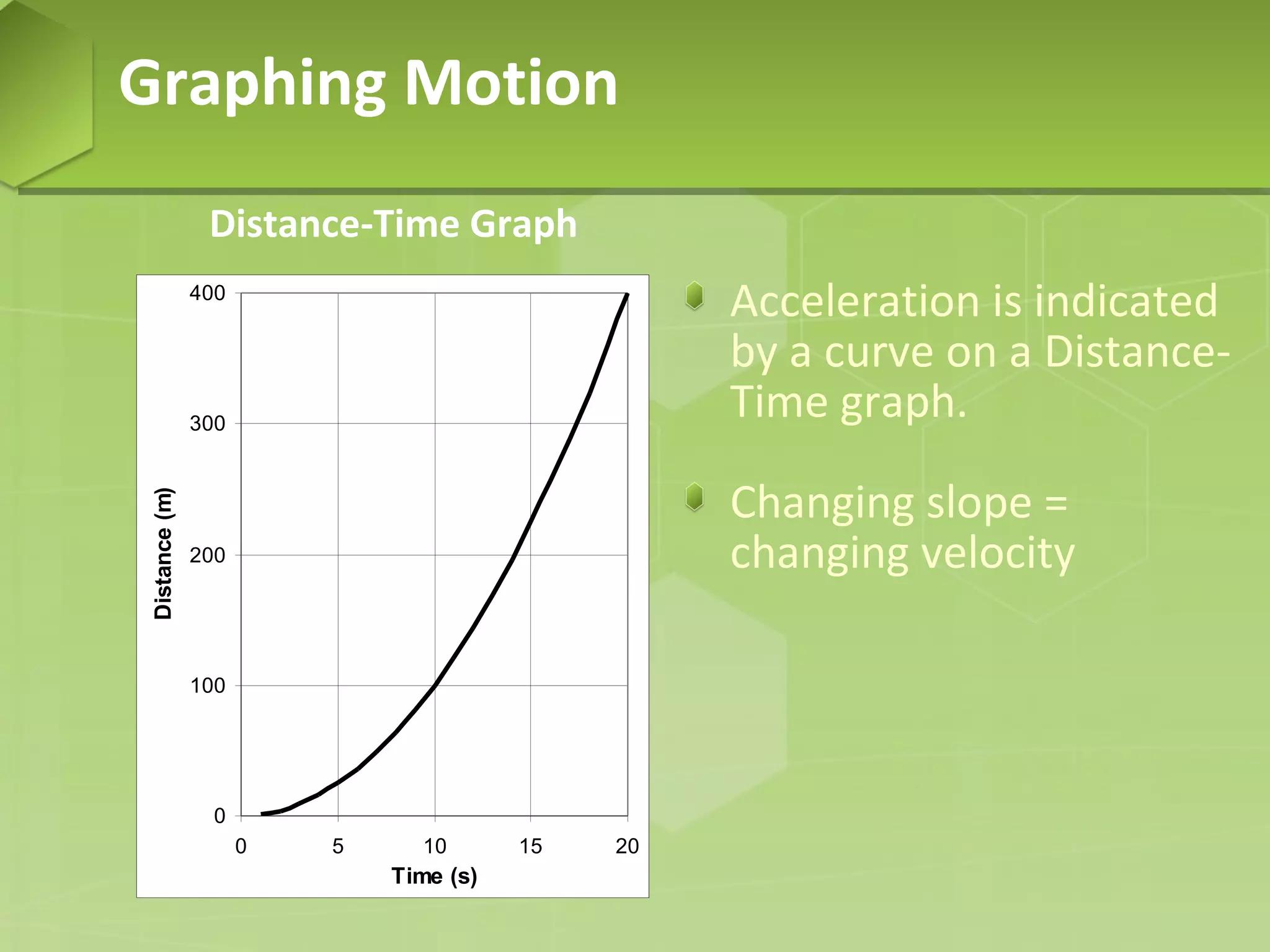
Distance-Time Graph

Acceleration is indicated
by a curve on a DistanceTime graph.

400

Distance (m)

300

Changing slope =
changing velocity

200

100

0
0

5

10

Time (s)

15

20
Graphing Motion
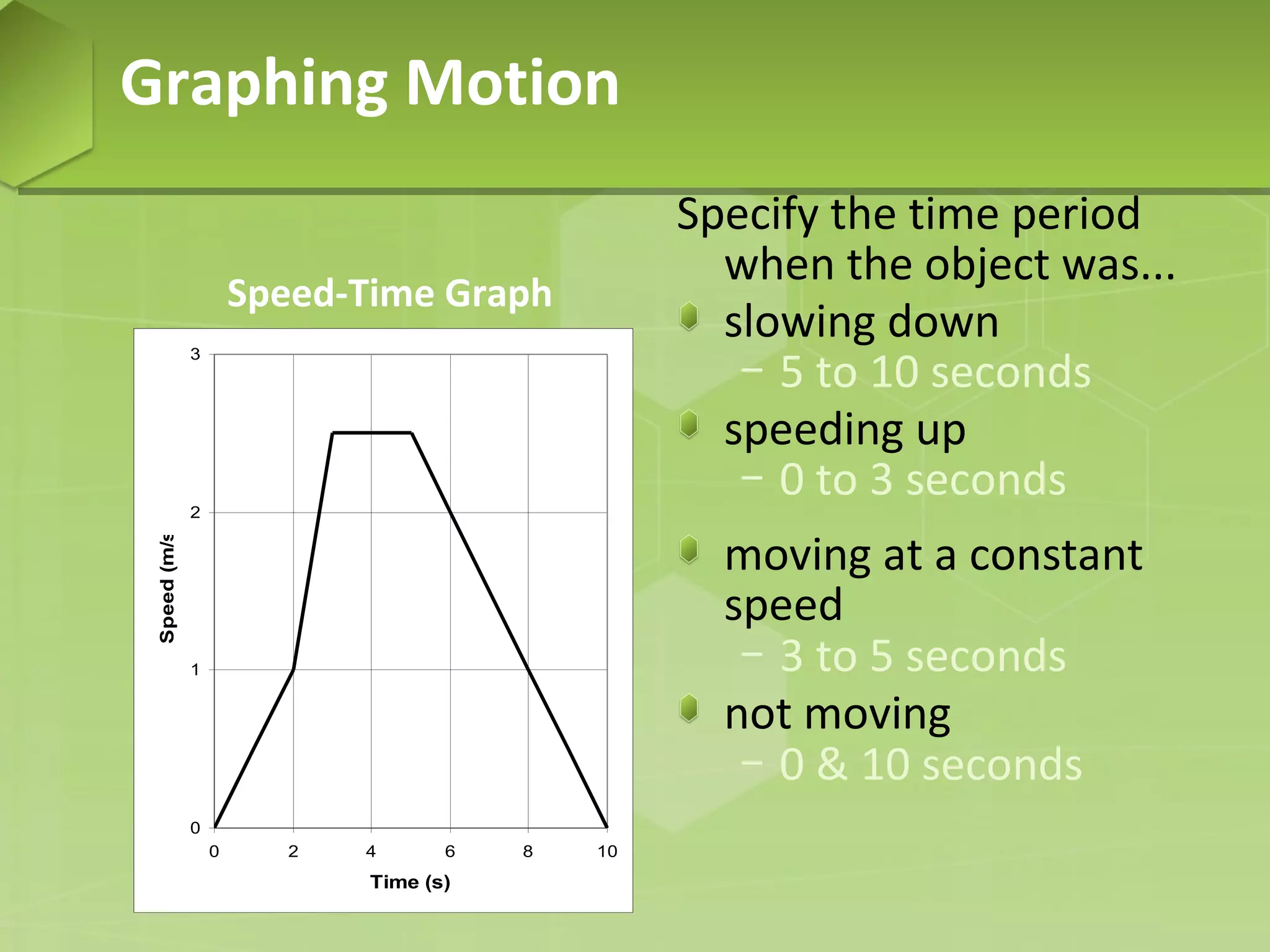
Specify the time period
when the object was...
slowing down
− 5 to 10 seconds
speeding up
− 0 to 3 seconds

Speed-Time Graph
3

2

Speed (m/s)

moving at a constant
speed
− 3 to 5 seconds
not moving
− 0 & 10 seconds

1

0
0

2

4

6

Time (s)

8

10
Speed and Velocity

Check on Learning
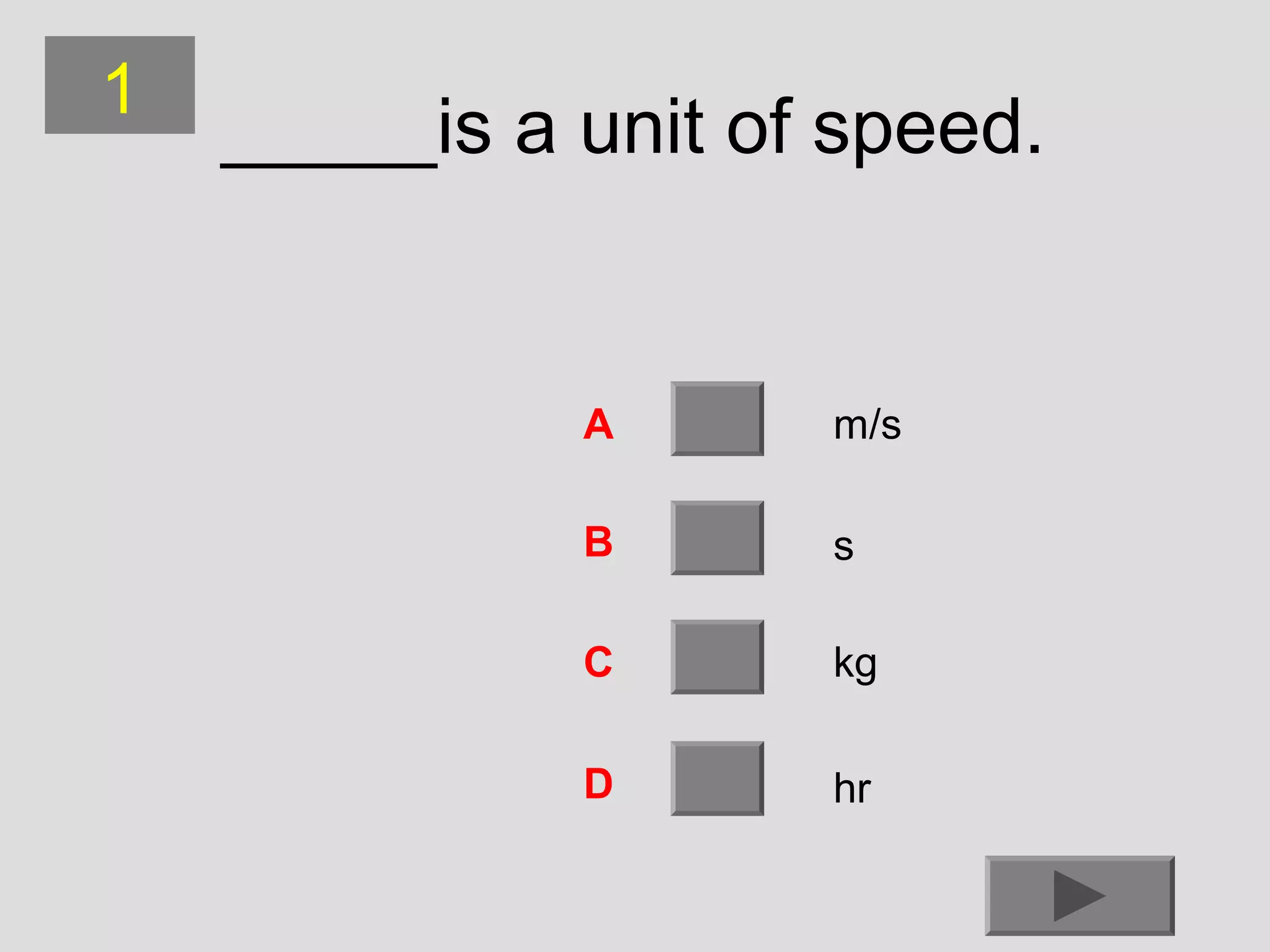
1

_____is a unit of speed.

A

m/s

B

s

C

kg

D

hr
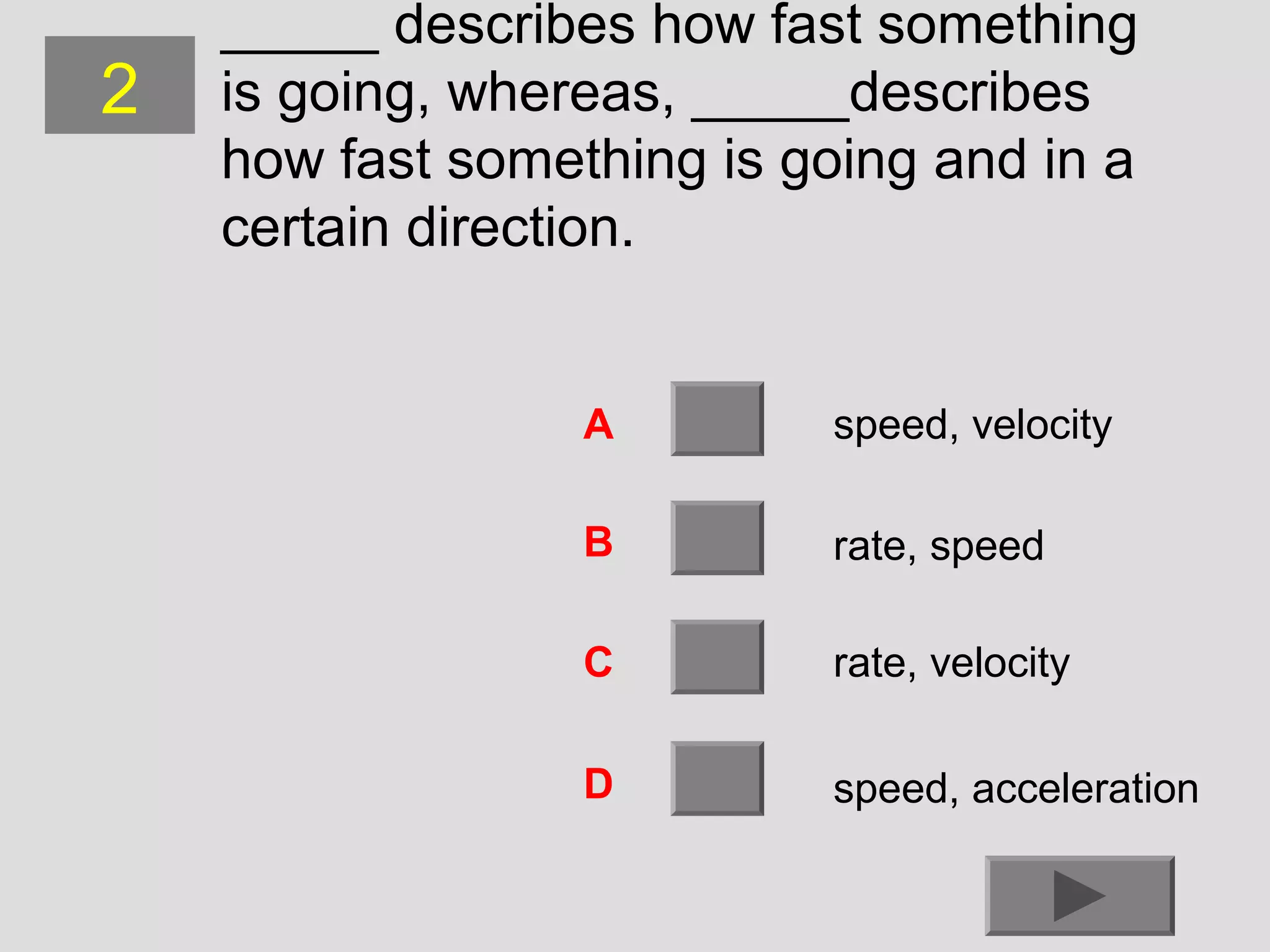
2

_____ describes how fast something
is going, whereas, _____describes
how fast something is going and in a
certain direction.

A

speed, velocity

B

rate, speed

C

rate, velocity

D

speed, acceleration
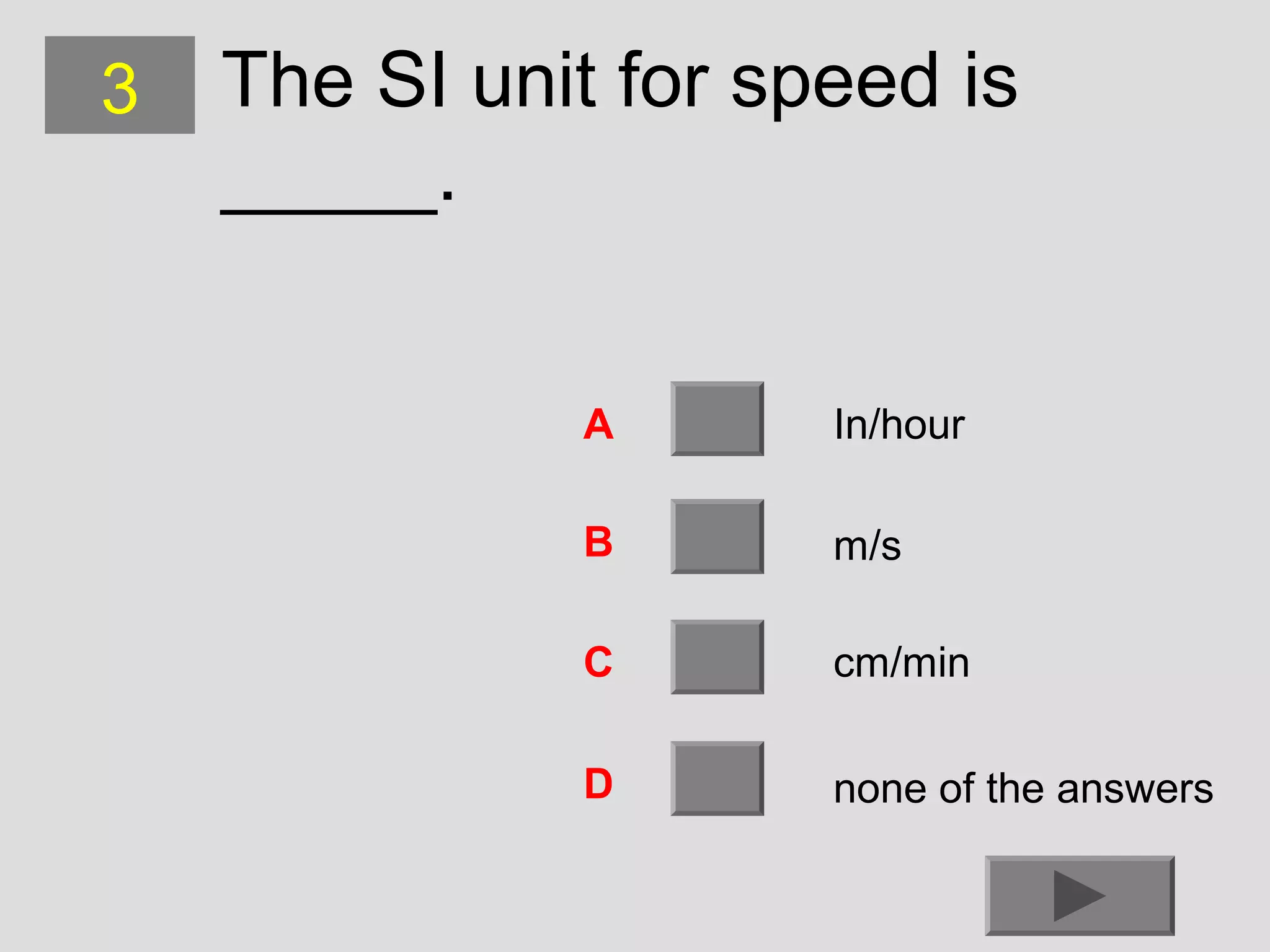
3

The SI unit for speed is
_____.
A

In/hour

B

m/s

C

cm/min

D

none of the answers
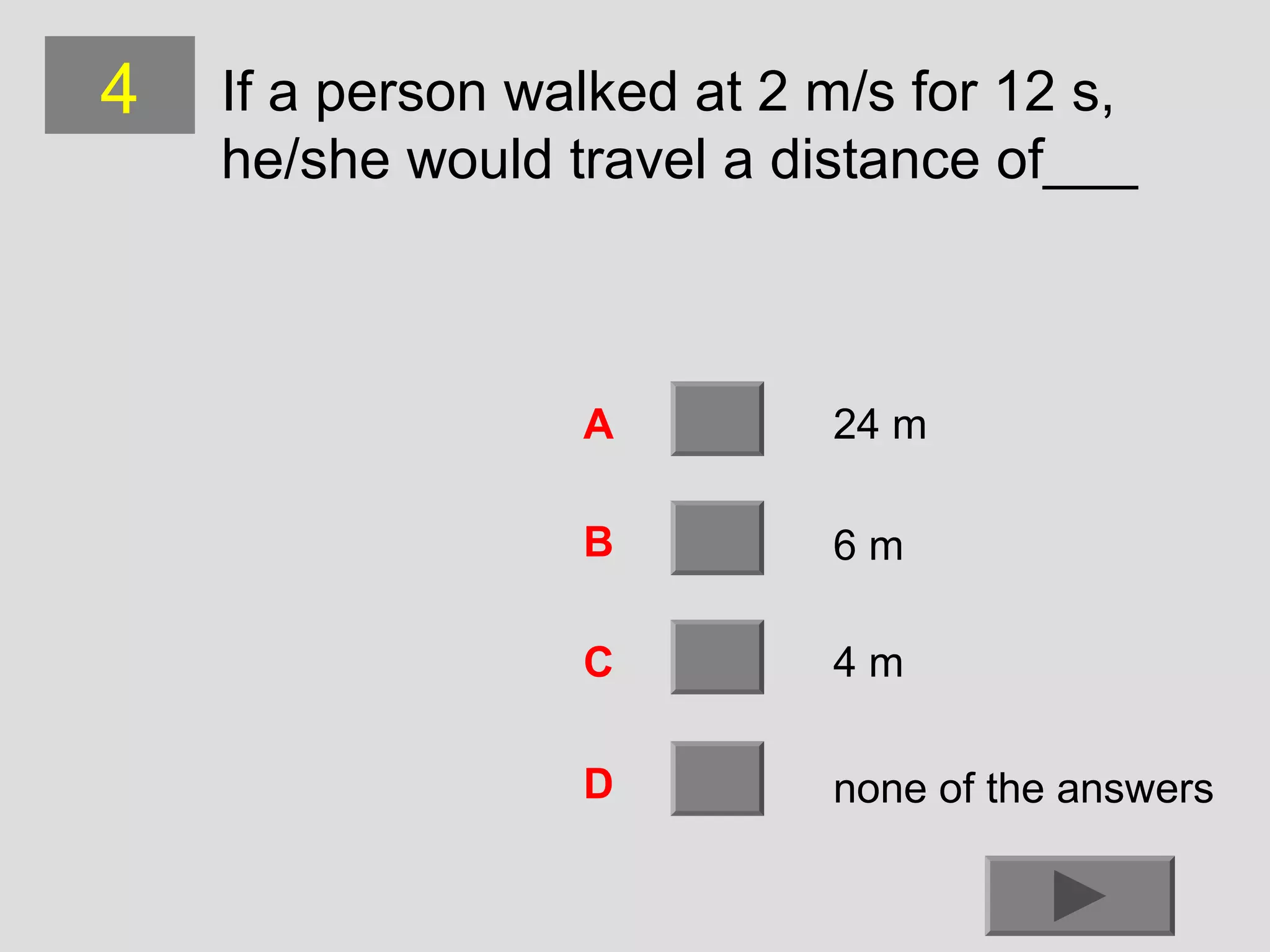
4

If a person walked at 2 m/s for 12 s,
he/she would travel a distance of___

A

24 m

B

6m

C

4m

D

none of the answers
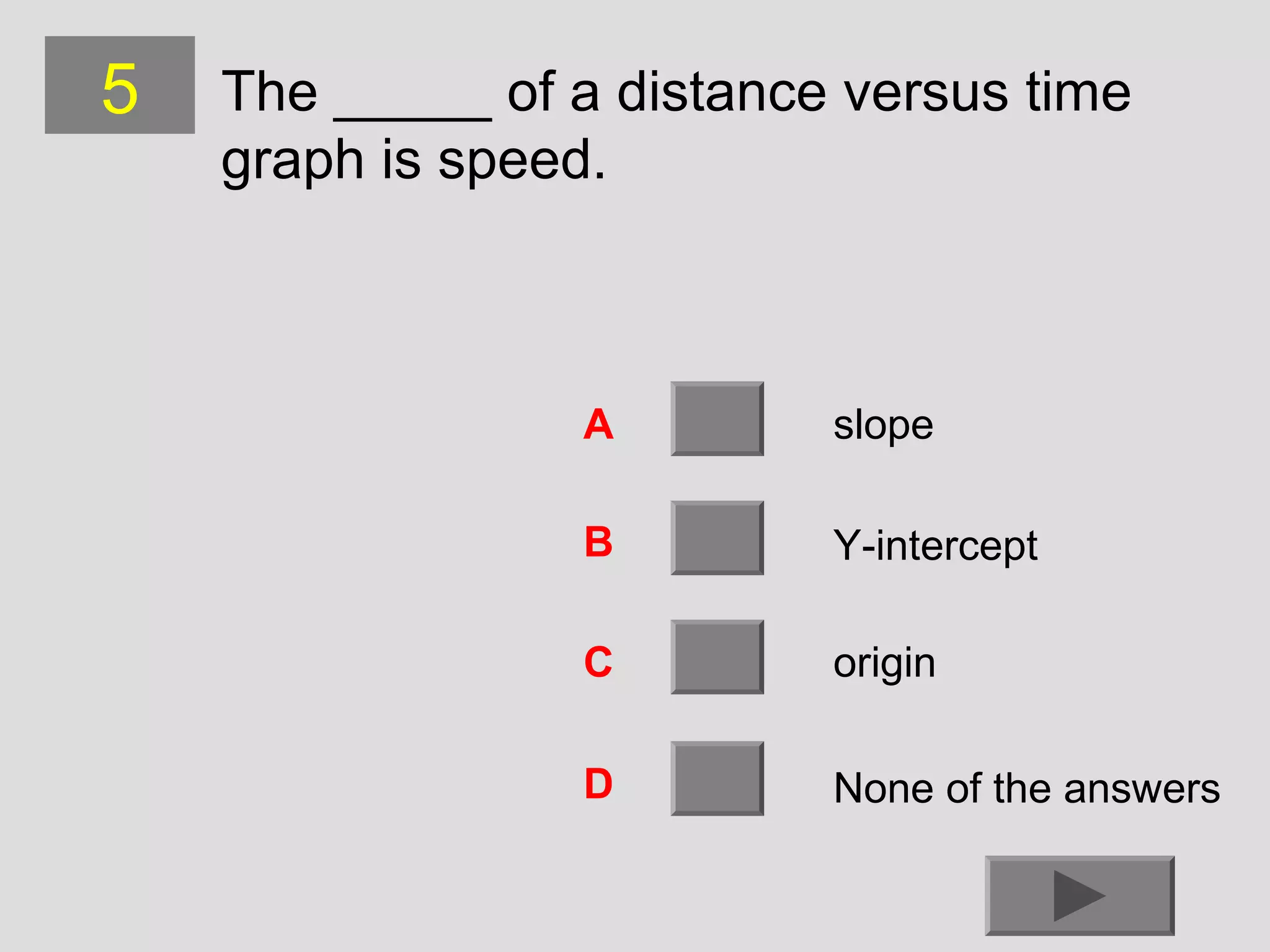
5

The _____ of a distance versus time
graph is speed.
A

slope

B

Y-intercept

C

origin

D

None of the answers
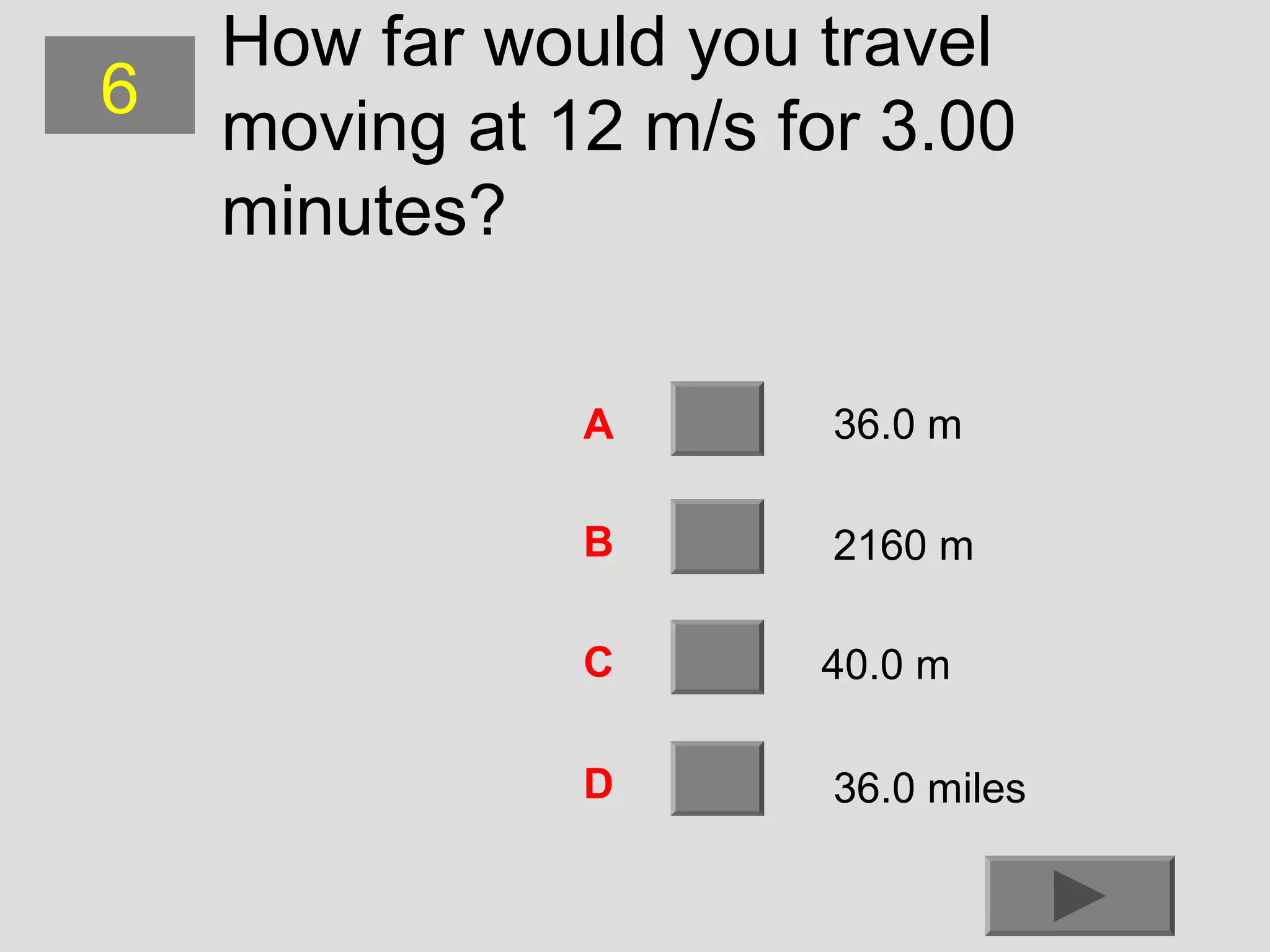
6

How far would you travel
moving at 12 m/s for 3.00
minutes?
A

36.0 m

B

2160 m

C

40.0 m

D

36.0 miles
7

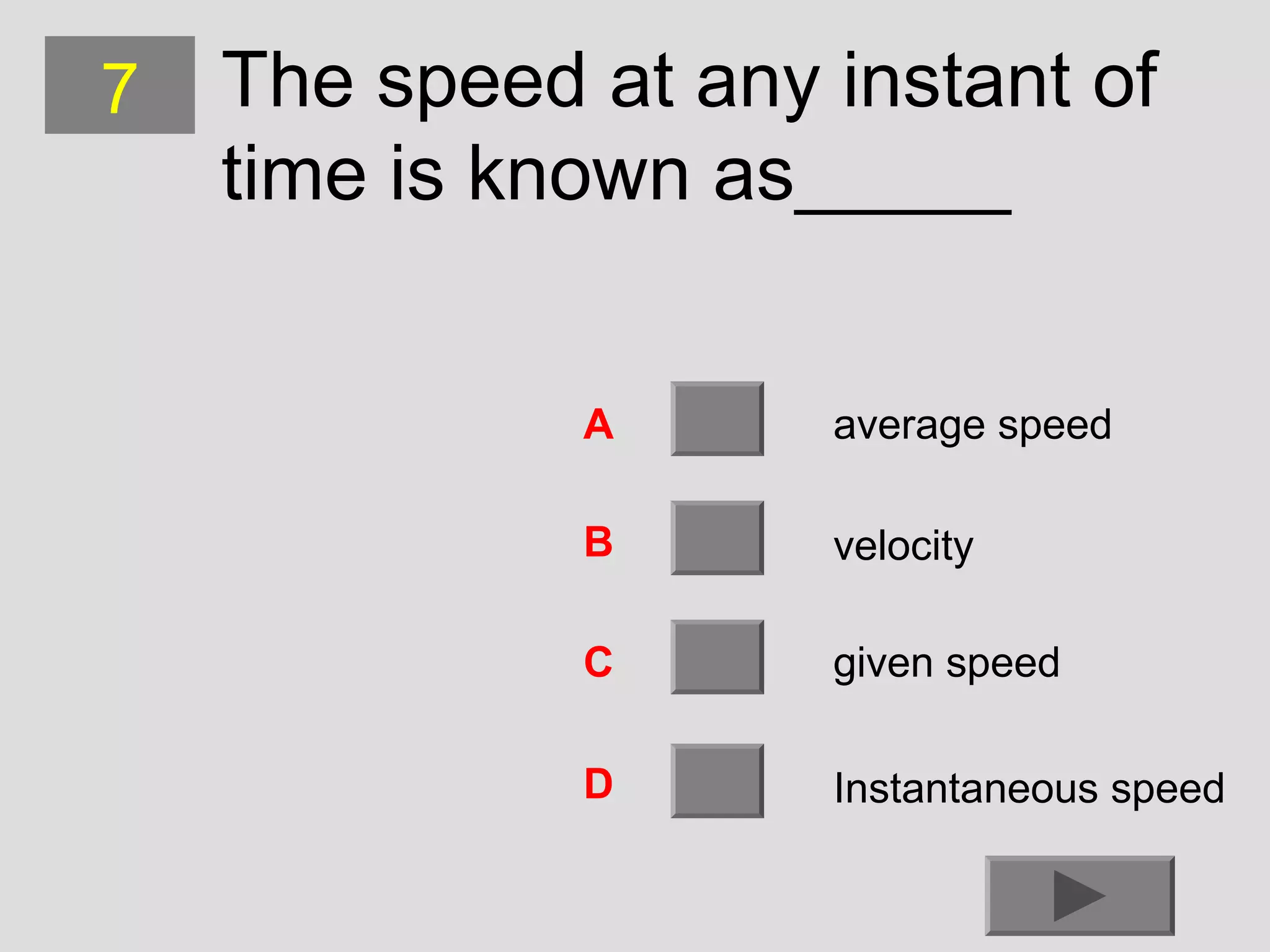
The speed at any instant of
time is known as_____
A

average speed

B

velocity

C

given speed

D

Instantaneous speed
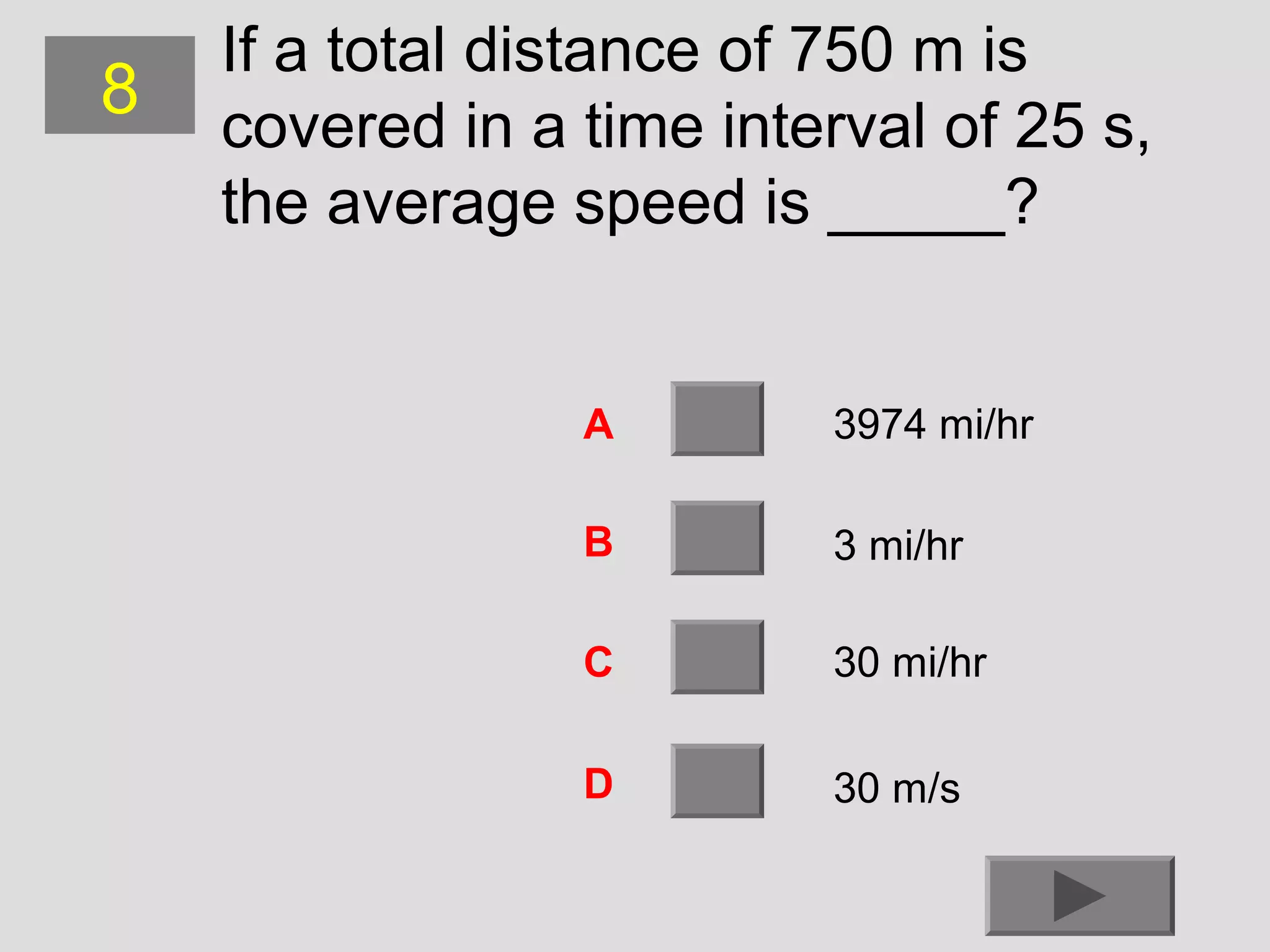
8

If a total distance of 750 m is
covered in a time interval of 25 s,
the average speed is _____?

A

3974 mi/hr

B

3 mi/hr

C

30 mi/hr

D

30 m/s
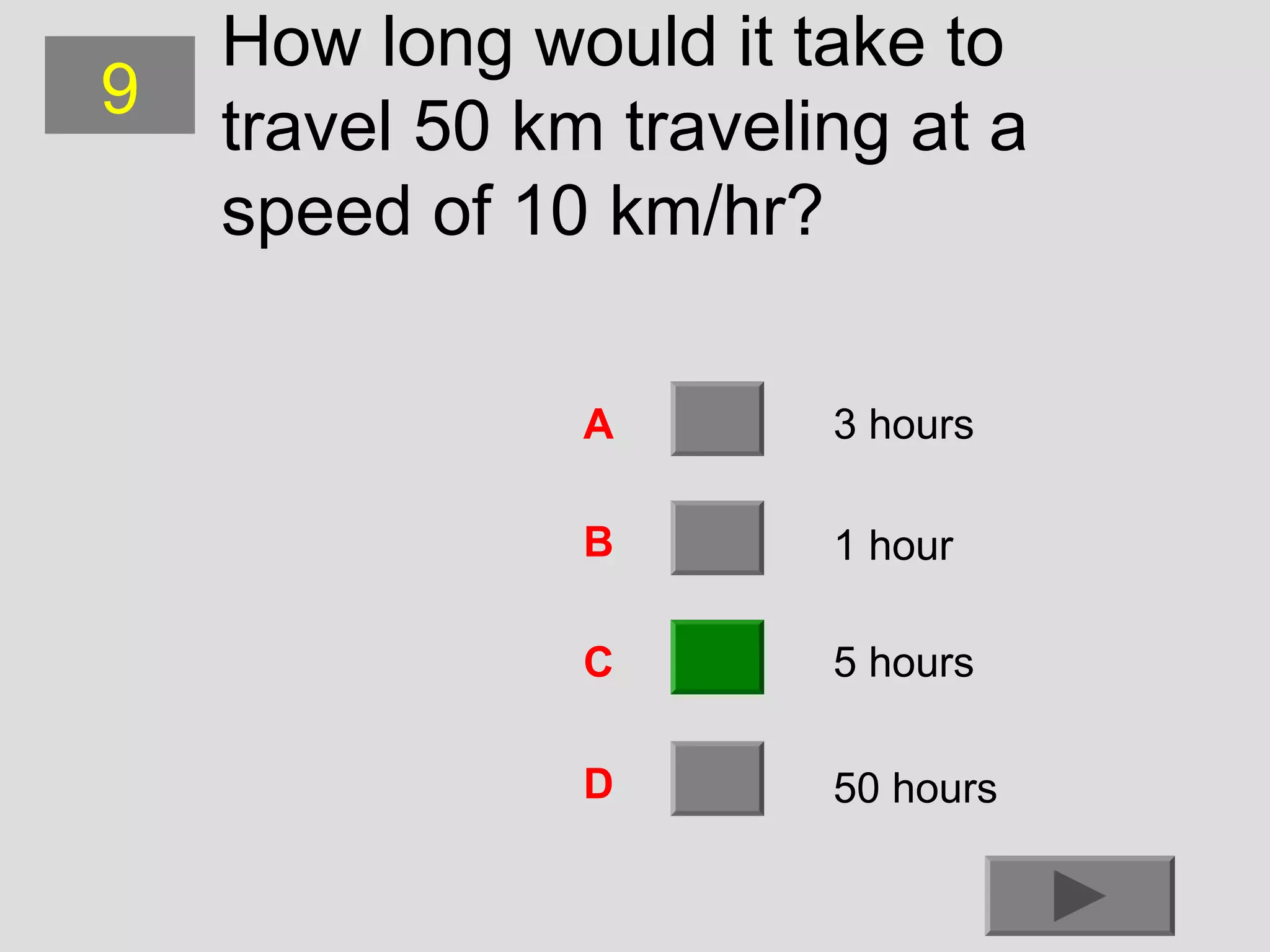
9

How long would it take to
travel 50 km traveling at a
speed of 10 km/hr?
A

3 hours

B

1 hour

C

5 hours

D

50 hours
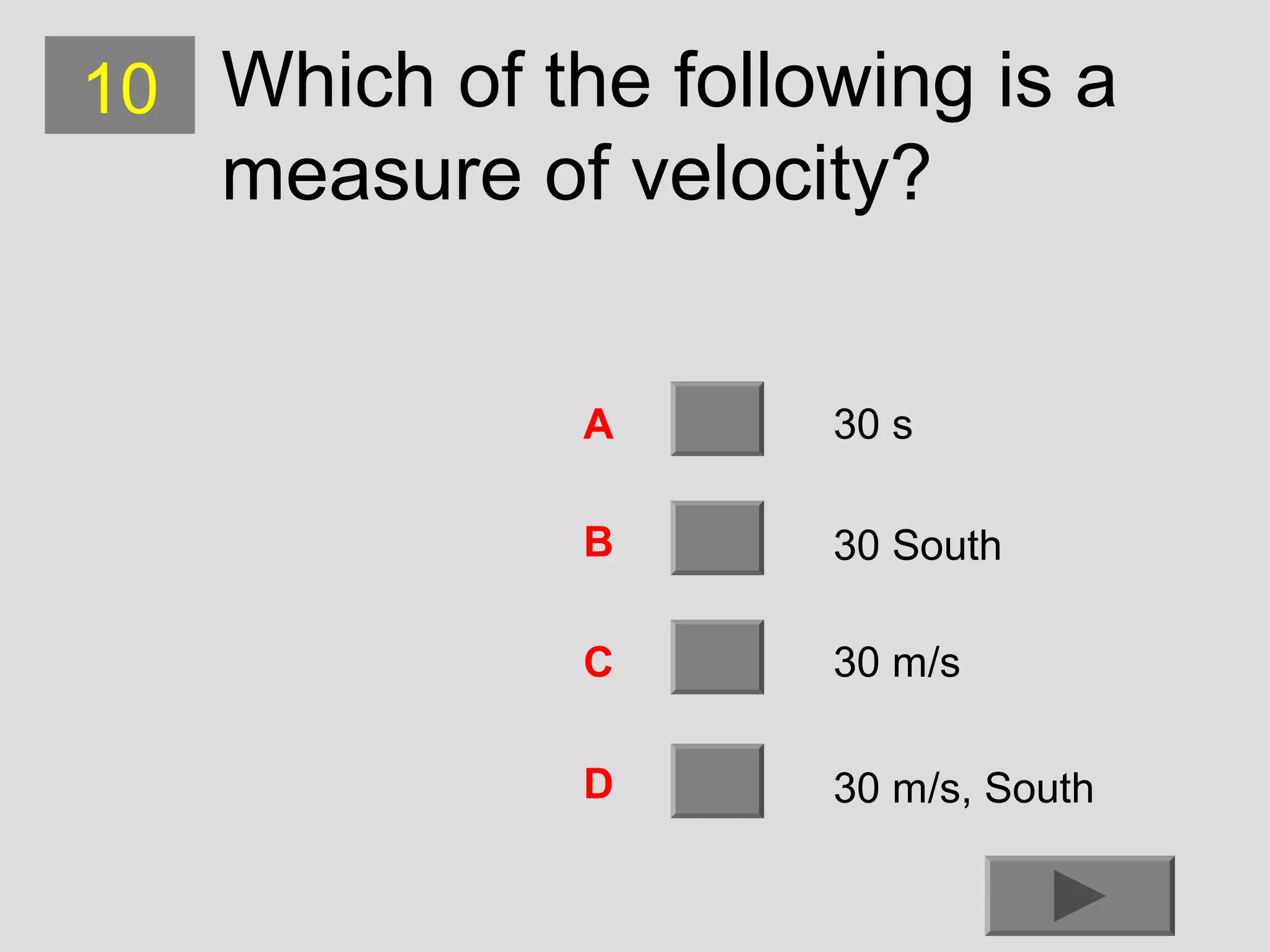
10 Which of the following is a

measure of velocity?
A

30 s

B

30 South

C

30 m/s

D

30 m/s, South
Well done. You’re
finished!
Well
done!
Try
again!

541 powerpoint

  • 1.
    Motion and Forces DescribingMotion •Motion •Speed & Velocity
  • 2.
    Newton’s First Law Anobject at rest will remain at rest, and an object in motion will continue in motion at a constant velocity unless acted upon by a net force.
  • 3.
    Motion Problem: − Is yourdesk moving? We need a reference point... − nonmoving point from which motion is measured
  • 4.
    Motion Motion − Change inposition in relation to a reference point. Reference point Motion
  • 5.
    Relative Motion If youare sitting in a chair reading this sentence, you are moving. You are not moving relative to your desk or your school building, but you are moving relative to the other planets in the solar system and the Sun.
  • 6.
    Motion • Distance • Distancedescribes how far an object has moved. • The SI unit of length or distance is the meter (m). Longer distances are measured in kilometers (km). • Shorter distances are measured in centimeters (cm).
  • 7.
    Motion • Displacement isthe distance and direction of an object's change in position from a reference point. • Suppose a runner jogs to the 50-m mark and then turns around and runs back to the 20-m mark. • The runner travels 50 m in the original direction (north) plus 30 m in the opposite direction (south), so the total distance she ran is 80 m.
  • 8.
    Motion Problem: • You area passenger in a car stopped at a stop sign. Out of the corner of your eye, you notice a tree on the side of the road begin to move forward. • You have mistakenly set yourself as the reference point.
  • 9.
    Speed & Velocity Speed −rate of motion − distance traveled per unit time d s t distance speed = time
  • 10.
    Calculating Speed The SIunit for distance is the meter and the SI unit of time is the second (s), so in SI, units of speed Sometimes it is more convenient to express speed in other units, such as kilometers per hour (km/h).
  • 11.
    Speed & Velocity InstantaneousSpeed − speed at a given instant − Speed odometer reading Average Speed − the total distance traveled divided by the total time of travel total distance avg. speed = total time
  • 12.
    Changing Instantaneous Speed Whensomething is speeding up or slowing down, its instantaneous speed is changing. If an object is moving with constant speed, the instantaneous speed doesn't change. To determine direction you need to know the velocity
  • 13.
    Speed & Velocity Problem: −A storm is 10 km away and is moving at a speed of 60 km/h. Should you be worried?  It depends on the storm’s direction!
  • 14.
    Speed & Velocity Velocity −speed in a given direction − can change even when the speed is constant!
  • 15.
  • 16.
    Calculations  Your neighbor skatesat a speed of 4 m/s. You can skate 100 m in 20 s. Who skates faster? GIVEN: WORK: d = 100 m t = 20 s s=? s=d÷t d s t s = (100 m) ÷ (20 s) s = 5 m/s You skate faster!
  • 17.
    Calculations  Sound travels 330m/s. If a lightning bolt strikes the ground 1 km away from you, how long will it take for you to hear it? GIVEN: WORK: s = 330 m/s d = 1km = 1000m t=? t=d÷s d s t t = (1000 m) ÷ (330 m/s) t = 3.03 s
  • 18.
    Graphing Motion Distance-Time Graph A slope= speed steeper slope = Straight line = flat line = B faster speed no motion constant speed Single point = instantaneous speed
  • 19.
    Graphing Motion Distance-Time Graph A Whostarted out faster? − A (steeper slope) Who had a constant speed? − A Describe B from 10-20 min. − B stopped moving Find their average speeds. B − A = (2400m) ÷ (30min) 80 m/min − B = (1200m) ÷ (30min) 40 m/min A= B=
  • 20.
    Graphing Motion Distance-Time Graph Accelerationis indicated by a curve on a DistanceTime graph. 400 Distance (m) 300 Changing slope = changing velocity 200 100 0 0 5 10 Time (s) 15 20
  • 21.
    Graphing Motion Specify thetime period when the object was... slowing down − 5 to 10 seconds speeding up − 0 to 3 seconds Speed-Time Graph 3 2 Speed (m/s) moving at a constant speed − 3 to 5 seconds not moving − 0 & 10 seconds 1 0 0 2 4 6 Time (s) 8 10
  • 22.
  • 23.
    1 _____is a unitof speed. A m/s B s C kg D hr

  • 24.
    2 _____ describes howfast something is going, whereas, _____describes how fast something is going and in a certain direction. A speed, velocity B rate, speed C rate, velocity D speed, acceleration
  • 25.
    3 The SI unitfor speed is _____. A In/hour B m/s C cm/min D none of the answers
  • 26.
    4 If a personwalked at 2 m/s for 12 s, he/she would travel a distance of___ A 24 m B 6m C 4m D none of the answers
  • 27.
    5 The _____ ofa distance versus time graph is speed. A slope B Y-intercept C origin D None of the answers

  • 28.
    6 How far wouldyou travel moving at 12 m/s for 3.00 minutes? A 36.0 m B 2160 m C 40.0 m D 36.0 miles
  • 29.
    7 The speed atany instant of time is known as_____ A average speed B velocity C given speed D Instantaneous speed
  • 30.
    8 If a totaldistance of 750 m is covered in a time interval of 25 s, the average speed is _____? A 3974 mi/hr B 3 mi/hr C 30 mi/hr D 30 m/s
  • 31.
    9 How long wouldit take to travel 50 km traveling at a speed of 10 km/hr? A 3 hours B 1 hour C 5 hours D 50 hours
  • 32.
    10 Which ofthe following is a measure of velocity? A 30 s B 30 South C 30 m/s D 30 m/s, South
  • 33.
  • 34.
  • 35.

Editor's Notes

  • #2 Motion (Basic) Note: This video template is optimized for Microsoft PowerPoint 2010. In PowerPoint 2007, video elements will play, but any content overlapping the video bars will be covered by the video when in slideshow mode. In PowerPoint 2003, video will not play, but the poster frame of the videos will remain in place as static images. The video: Plays automatically after each slide transition. Is 15 seconds long. Seamlessly loops for infinite playback. To add slides or change layout: To add a new slide, on the Home tab, in the Slides group, click the arrow under New Slide, then click under Motion Background Theme, then select the desired layout. To change the layout of an existing slide, on the Home tab, in the Slides group, click Layout, then select the desired layout. Other animated elements: Any animated element you insert will begin after the slide transition and the background video has started.