Ch. 3 & 4
Motion & Forces
II. Describing Motion
 Motion
 Speed & Velocity
 Acceleration
Newton’s First Law
 Newton’s First Law of Motion
An object at rest will remain at
rest and an object in motion
will continue moving at a
constant velocity unless acted
upon by a net force.
motion
constant velocity
net force
A. Motion
 Problem:
Is your desk moving?
 We need a reference point...
nonmoving point from which
motion is measured
A. Motion
 Motion
Change in position in relation to
a reference point.
Reference point
Motion
A. Motion
Problem:
 You are a passenger in a car
stopped at a stop sign. Out of the
corner of your eye, you notice a
tree on the side of the road begin
to move forward.
 You have mistakenly set yourself
as the reference point.
B. Speed & Velocity
 Speed
rate of motion
distance traveled per unit time
time
distance
speed 
v
d
t
B. Speed & Velocity
 Instantaneous Speed
speed at a given instant
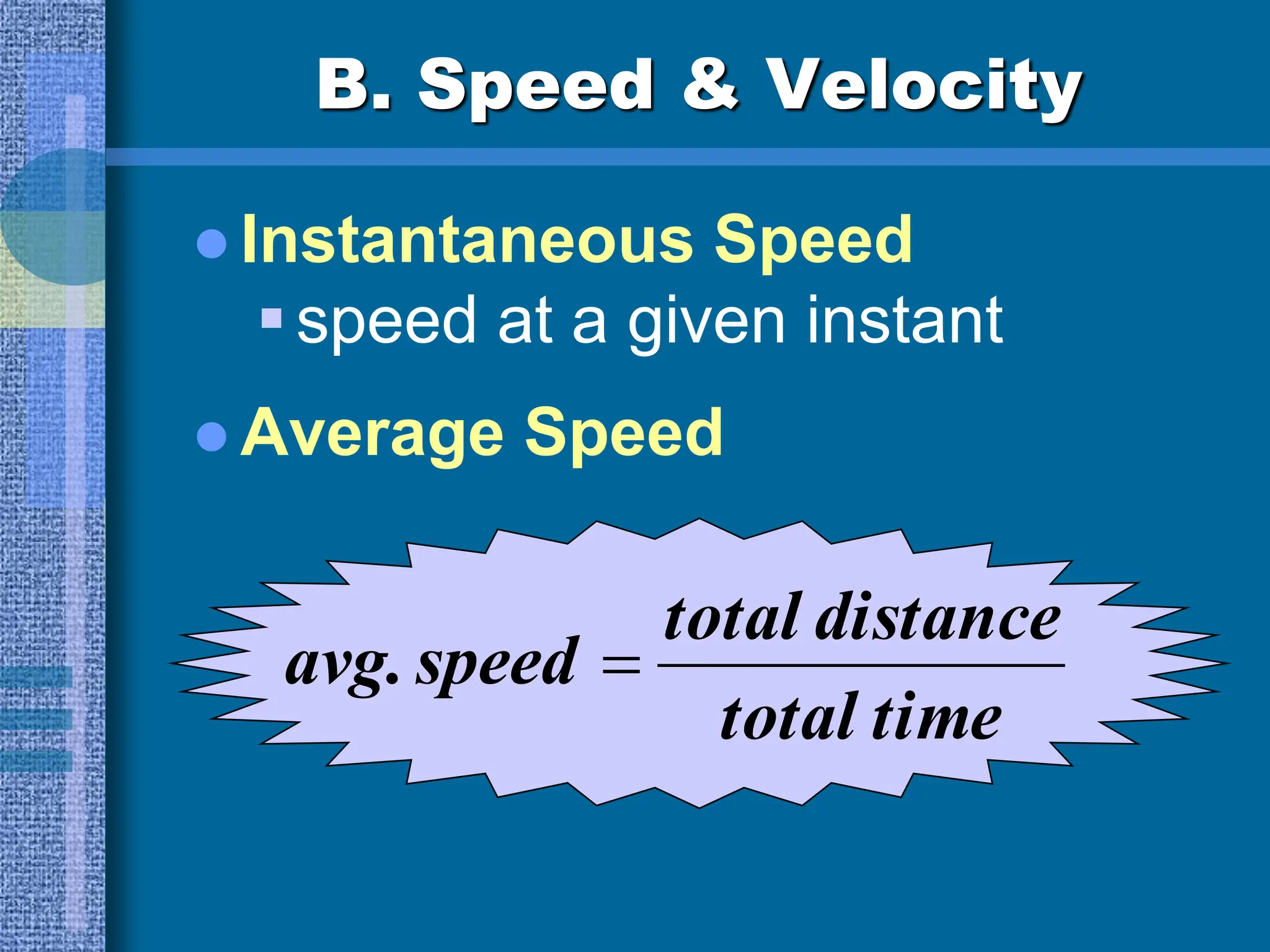
 Average Speed
time
total
distance
total
speed
avg. 
B. Speed & Velocity
 Problem:
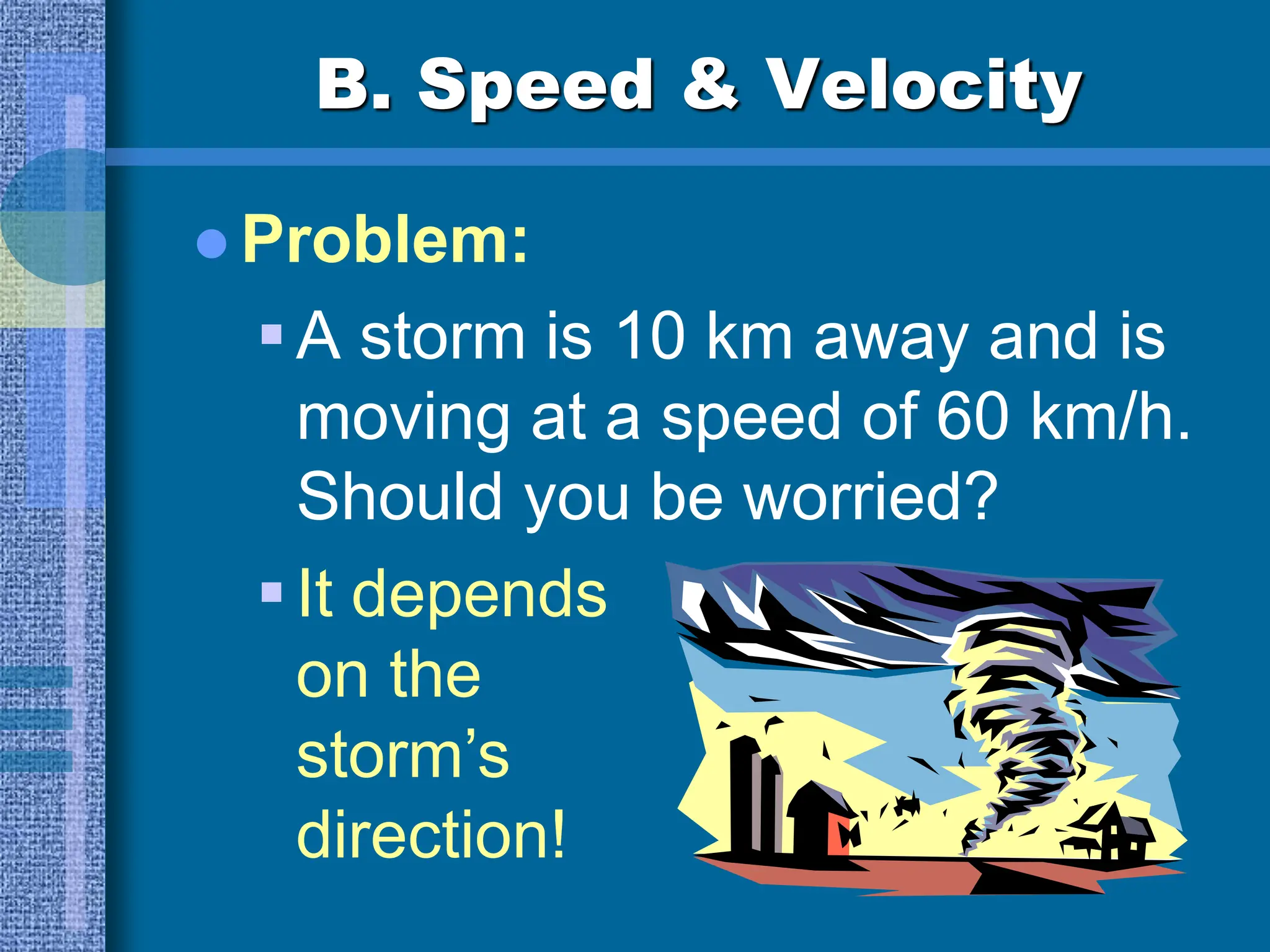
A storm is 10 km away and is
moving at a speed of 60 km/h.
Should you be worried?
It depends
on the
storm’s
direction!
B. Speed & Velocity
 Velocity
speed in a given direction
can change even when the
speed is constant!
C. Acceleration
 Acceleration
the rate of change of velocity
change in speed or direction
t
v
v
a
i
f 

a: acceleration
vf: final velocity
vi: initial velocity
t: time
a
vf - vi
t
C. Acceleration
 Positive acceleration
“speeding up”
 Negative acceleration
“slowing down”
D. Calculations
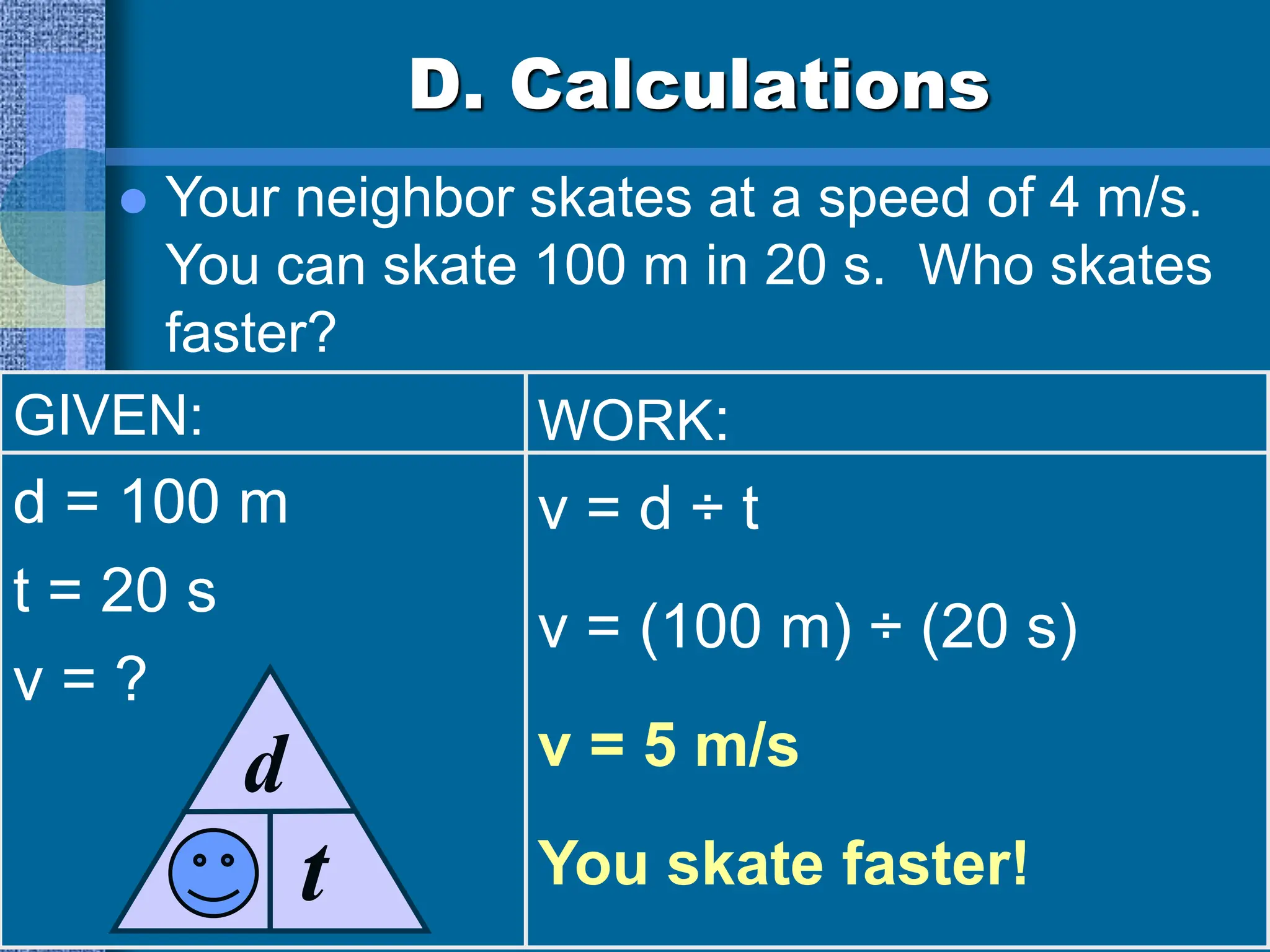
 Your neighbor skates at a speed of 4 m/s.
You can skate 100 m in 20 s. Who skates
faster?
GIVEN:
d = 100 m
t = 20 s
v = ?
WORK:
v = d ÷ t
v = (100 m) ÷ (20 s)
v = 5 m/s
You skate faster!
v
d
t
D. Calculations
 A roller coaster starts down a hill at 10 m/s.
Three seconds later, its speed is 32 m/s.
What is the roller coaster’s acceleration?
GIVEN:
vi = 10 m/s
t = 3 s
vf = 32 m/s
a = ?
WORK:
a = (vf - vi) ÷ t
a = (32m/s - 10m/s) ÷ (3s)
a = 22 m/s ÷ 3 s
a = 7.3 m/s2
a
vf - vi
t
D. Calculations
 Sound travels 330 m/s. If a lightning bolt
strikes the ground 1 km away from you,
how long will it take for you to hear it?
GIVEN:
v = 330 m/s
d = 1km = 1000m
t = ?
WORK:
t = d ÷ v
t = (1000 m) ÷ (330 m/s)
t = 3.03 s
v
d
t
D. Calculations
 How long will it take a car traveling 30 m/s
to come to a stop if its acceleration is
-3 m/s2?
GIVEN:
t = ?
vi = 30 m/s
vf = 0 m/s
a = -3 m/s2
WORK:
t = (vf - vi) ÷ a
t = (0m/s-30m/s)÷(-3m/s2)
t = -30 m/s ÷ -3m/s2
t = 10 s
a
vf - vi
t
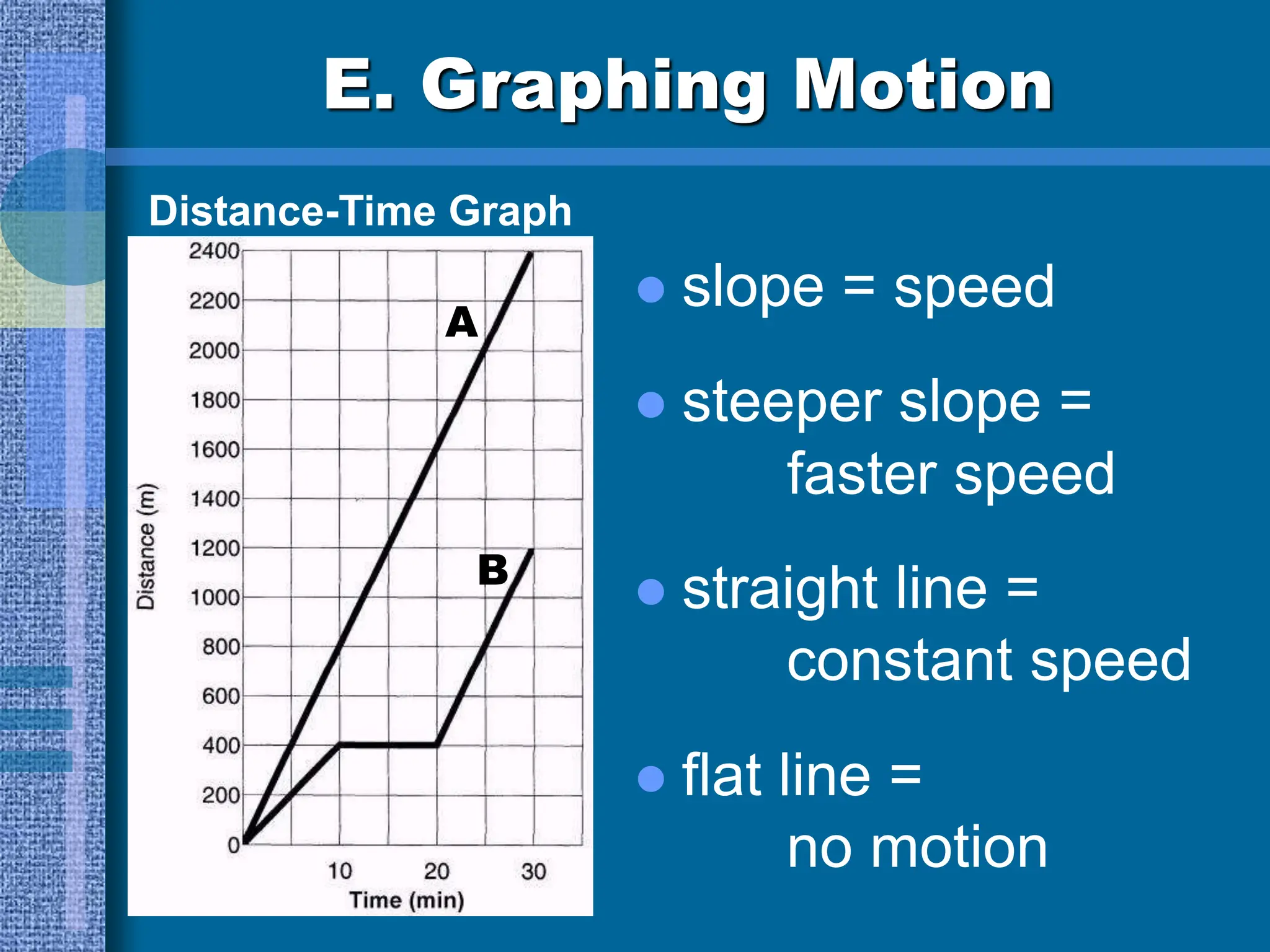
E. Graphing Motion
 slope =
 steeper slope =
 straight line =
 flat line =
Distance-Time Graph
A
B
faster speed
constant speed
no motion
speed
E. Graphing Motion
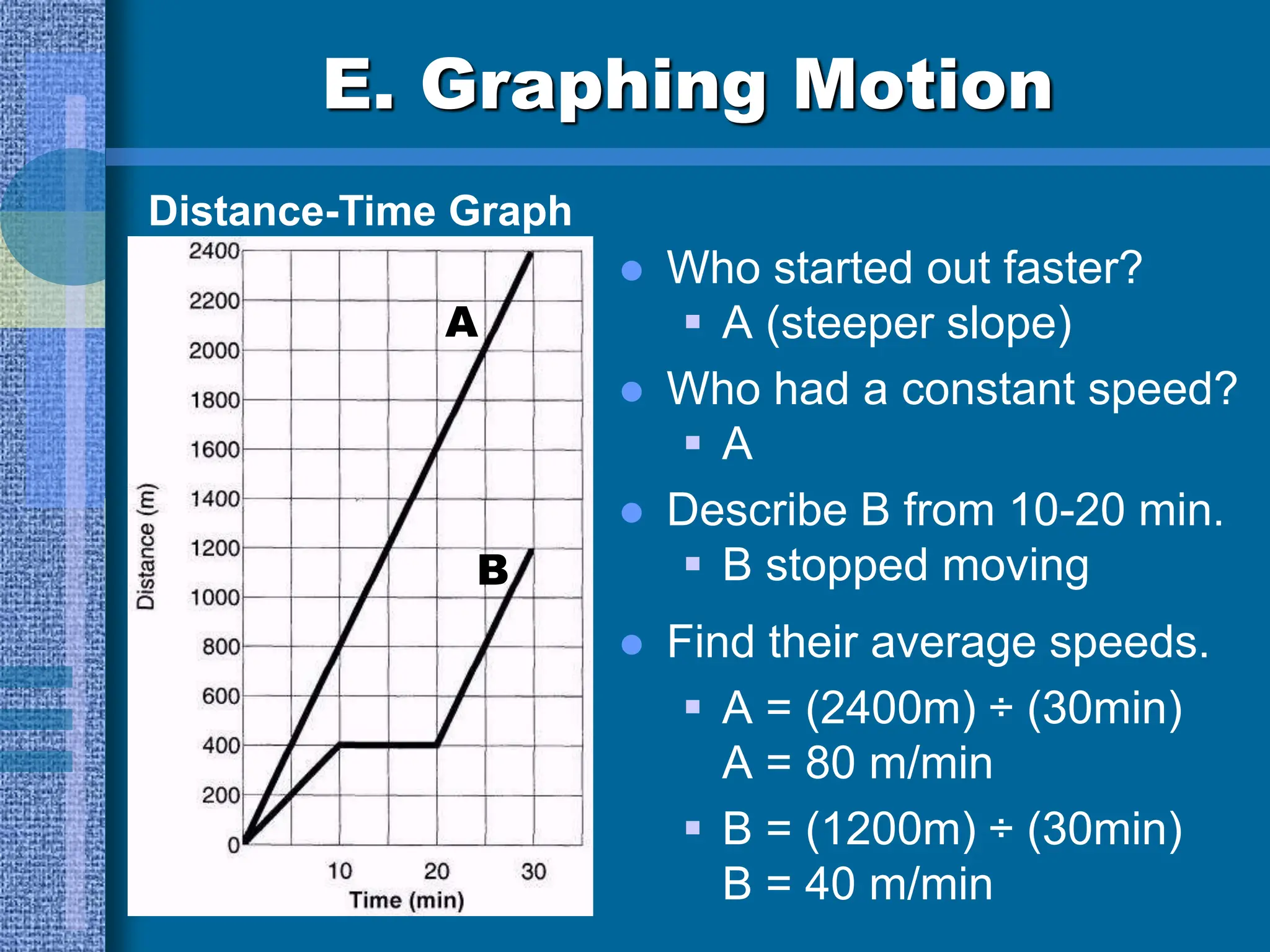
 Who started out faster?
 A (steeper slope)
 Who had a constant speed?
 A
 Describe B from 10-20 min.
 B stopped moving
 Find their average speeds.
 A = (2400m) ÷ (30min)
A = 80 m/min
 B = (1200m) ÷ (30min)
B = 40 m/min
Distance-Time Graph
A
B
0
100
200
300
400
0 5 10 15 20
Time (s)
Distance
(m)
Distance-Time Graph
E. Graphing Motion
 Acceleration is
indicated by a
curve on a
Distance-Time
graph.
 Changing slope =
changing velocity
E. Graphing Motion
0
1
2
3
0 2 4 6 8 10
Time (s)
Speed
(m/s)
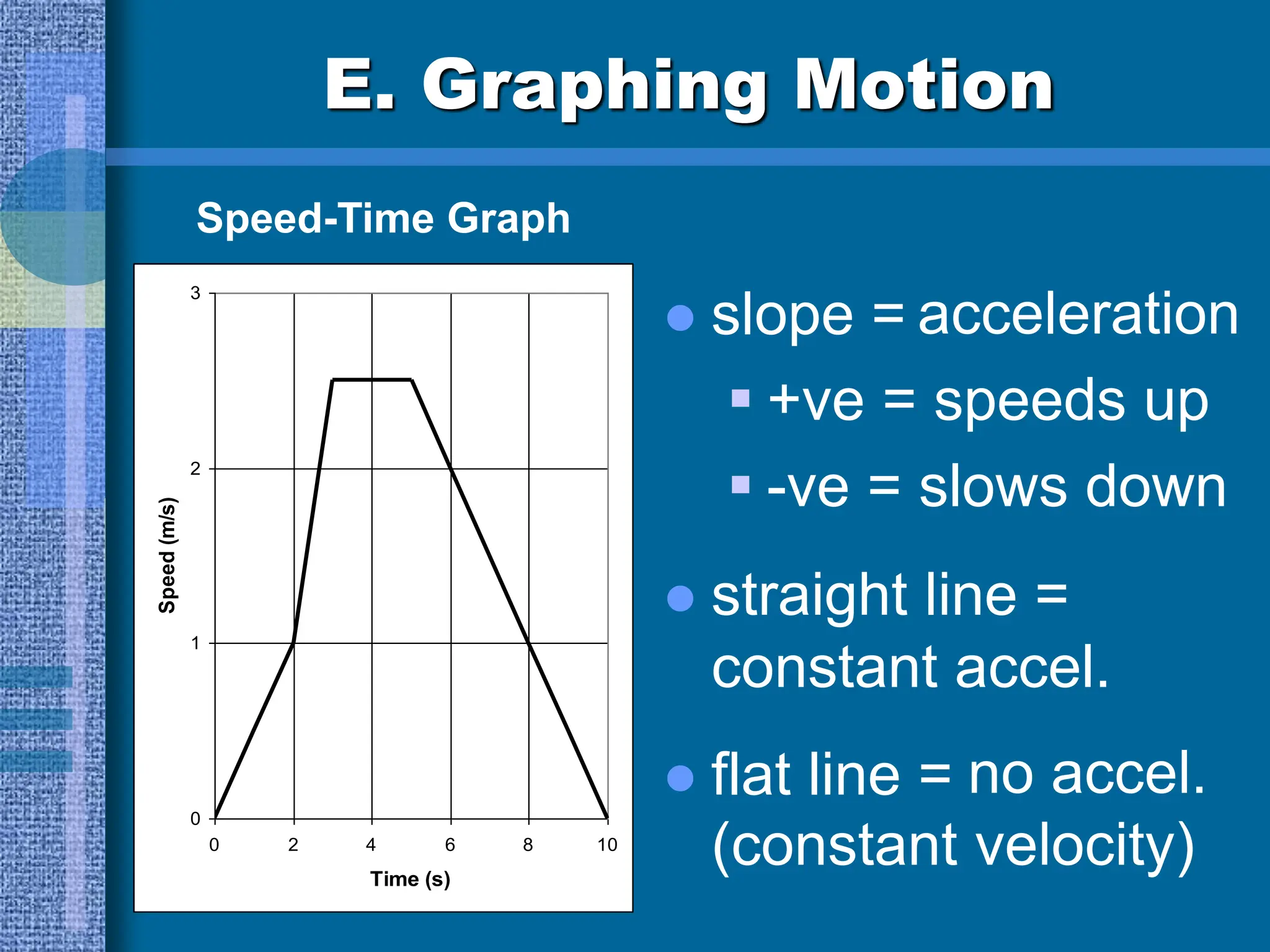
Speed-Time Graph
 slope =
 straight line =
 flat line =
acceleration
 +ve = speeds up
 -ve = slows down
constant accel.
no accel.
(constant velocity)
E. Graphing Motion
0
1
2
3
0 2 4 6 8 10
Time (s)
Speed
(m/s)
Speed-Time Graph
Specify the time period
when the object was...
 slowing down
 5 to 10 seconds
 speeding up
 0 to 3 seconds
 moving at a constant
speed
 3 to 5 seconds
 not moving
 0 & 10 seconds

Describing motion, velocity, displacement

  • 1.
    Ch. 3 &4 Motion & Forces II. Describing Motion  Motion  Speed & Velocity  Acceleration
  • 2.
    Newton’s First Law Newton’s First Law of Motion An object at rest will remain at rest and an object in motion will continue moving at a constant velocity unless acted upon by a net force. motion constant velocity net force
  • 3.
    A. Motion  Problem: Isyour desk moving?  We need a reference point... nonmoving point from which motion is measured
  • 4.
    A. Motion  Motion Changein position in relation to a reference point. Reference point Motion
  • 5.
    A. Motion Problem:  Youare a passenger in a car stopped at a stop sign. Out of the corner of your eye, you notice a tree on the side of the road begin to move forward.  You have mistakenly set yourself as the reference point.
  • 6.
    B. Speed &Velocity  Speed rate of motion distance traveled per unit time time distance speed  v d t
  • 7.
    B. Speed &Velocity  Instantaneous Speed speed at a given instant  Average Speed time total distance total speed avg. 
  • 8.
    B. Speed &Velocity  Problem: A storm is 10 km away and is moving at a speed of 60 km/h. Should you be worried? It depends on the storm’s direction!
  • 9.
    B. Speed &Velocity  Velocity speed in a given direction can change even when the speed is constant!
  • 10.
    C. Acceleration  Acceleration therate of change of velocity change in speed or direction t v v a i f   a: acceleration vf: final velocity vi: initial velocity t: time a vf - vi t
  • 11.
    C. Acceleration  Positiveacceleration “speeding up”  Negative acceleration “slowing down”
  • 12.
    D. Calculations  Yourneighbor skates at a speed of 4 m/s. You can skate 100 m in 20 s. Who skates faster? GIVEN: d = 100 m t = 20 s v = ? WORK: v = d ÷ t v = (100 m) ÷ (20 s) v = 5 m/s You skate faster! v d t
  • 13.
    D. Calculations  Aroller coaster starts down a hill at 10 m/s. Three seconds later, its speed is 32 m/s. What is the roller coaster’s acceleration? GIVEN: vi = 10 m/s t = 3 s vf = 32 m/s a = ? WORK: a = (vf - vi) ÷ t a = (32m/s - 10m/s) ÷ (3s) a = 22 m/s ÷ 3 s a = 7.3 m/s2 a vf - vi t
  • 14.
    D. Calculations  Soundtravels 330 m/s. If a lightning bolt strikes the ground 1 km away from you, how long will it take for you to hear it? GIVEN: v = 330 m/s d = 1km = 1000m t = ? WORK: t = d ÷ v t = (1000 m) ÷ (330 m/s) t = 3.03 s v d t
  • 15.
    D. Calculations  Howlong will it take a car traveling 30 m/s to come to a stop if its acceleration is -3 m/s2? GIVEN: t = ? vi = 30 m/s vf = 0 m/s a = -3 m/s2 WORK: t = (vf - vi) ÷ a t = (0m/s-30m/s)÷(-3m/s2) t = -30 m/s ÷ -3m/s2 t = 10 s a vf - vi t
  • 16.
    E. Graphing Motion slope =  steeper slope =  straight line =  flat line = Distance-Time Graph A B faster speed constant speed no motion speed
  • 17.
    E. Graphing Motion Who started out faster?  A (steeper slope)  Who had a constant speed?  A  Describe B from 10-20 min.  B stopped moving  Find their average speeds.  A = (2400m) ÷ (30min) A = 80 m/min  B = (1200m) ÷ (30min) B = 40 m/min Distance-Time Graph A B
  • 18.
    0 100 200 300 400 0 5 1015 20 Time (s) Distance (m) Distance-Time Graph E. Graphing Motion  Acceleration is indicated by a curve on a Distance-Time graph.  Changing slope = changing velocity
  • 19.
    E. Graphing Motion 0 1 2 3 02 4 6 8 10 Time (s) Speed (m/s) Speed-Time Graph  slope =  straight line =  flat line = acceleration  +ve = speeds up  -ve = slows down constant accel. no accel. (constant velocity)
  • 20.
    E. Graphing Motion 0 1 2 3 02 4 6 8 10 Time (s) Speed (m/s) Speed-Time Graph Specify the time period when the object was...  slowing down  5 to 10 seconds  speeding up  0 to 3 seconds  moving at a constant speed  3 to 5 seconds  not moving  0 & 10 seconds

Editor's Notes