Honors Physics Good Morning! Please… Hand in your homework to the bin in the front of the room (factor label method worksheet probs a, c, e, g & index cards) Work on the warm-up problem:  A one-thousand page book is 4.00 cm thick. What is the thickness of one page in a number from 0 to 999, with an appropriate unit prefix? (Note: the pages in the book are two-sided).
Agenda Physics in the news Go over homework Unit pre-assessment Dimensional analysis Begin new unit
Pre-Unit Activity: Motion in Pictures Look at the following pictures, and take 1 minute to right down your thoughts about each picture. Here are a few suggestions to start your brainstorming: What do you think of when you see this picture? What type of motion is happening in the picture? Does this picture remind you of something – a movie, place, etc.? Relate this picture to something you have seen, done, etc.


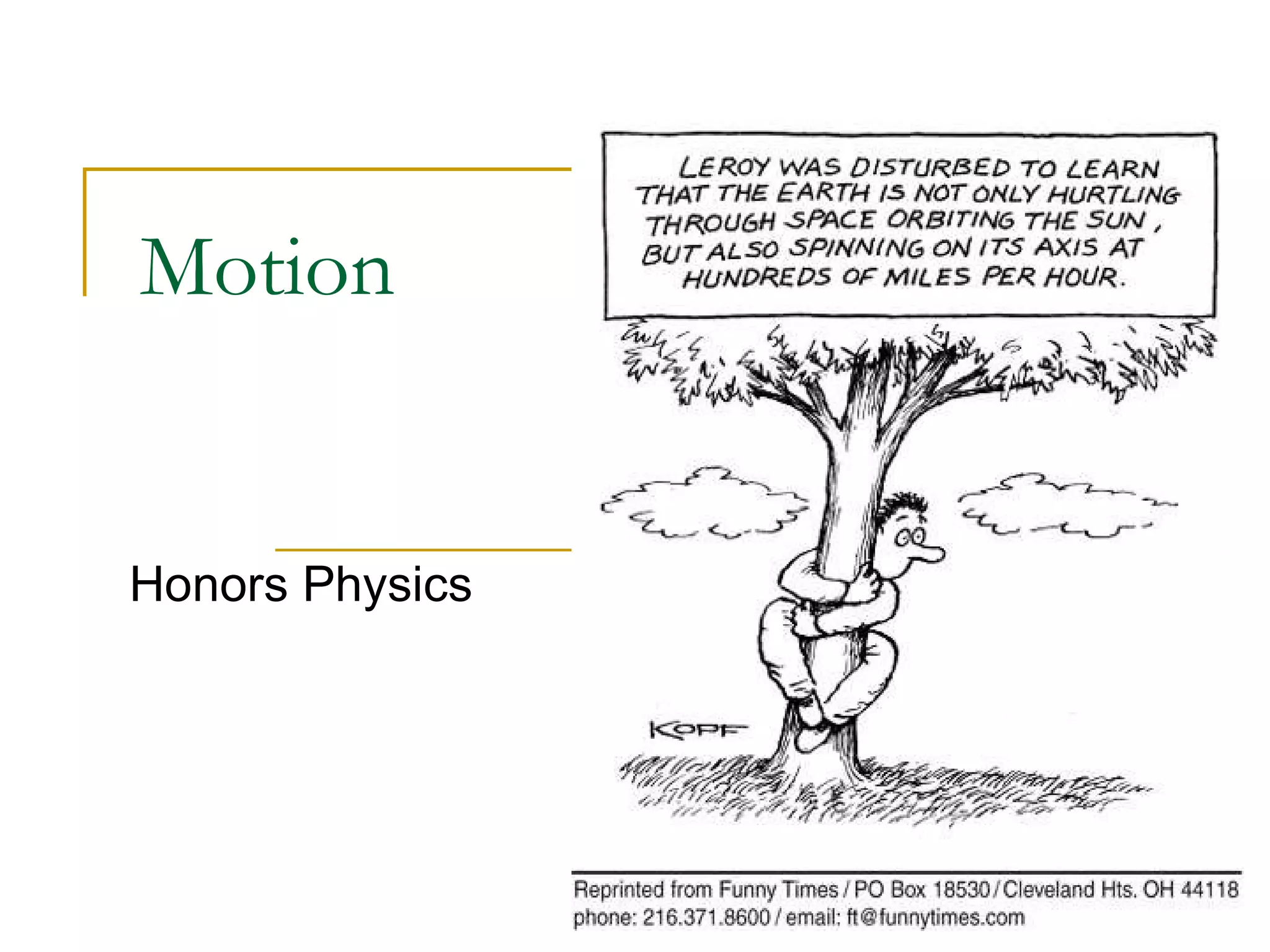
Motion Honors Physics
YOU deserve a speeding ticket! Here is the scenario! You wake up late and have 20 minutes to get to school and you especially do not want to be late for physics! You decide to travel at 65 mph in a 55 mph zone. Unfortunately, Officer Manchester pulls you over. You see, the LAW states that you must pay $10 for every mile you are over the speed limit. Therefore, you MUST pay $100 to cover the fine. Being a law abiding citizen you agree, and pay the fine. But as you begin to leave you hear officer Manchester say……..
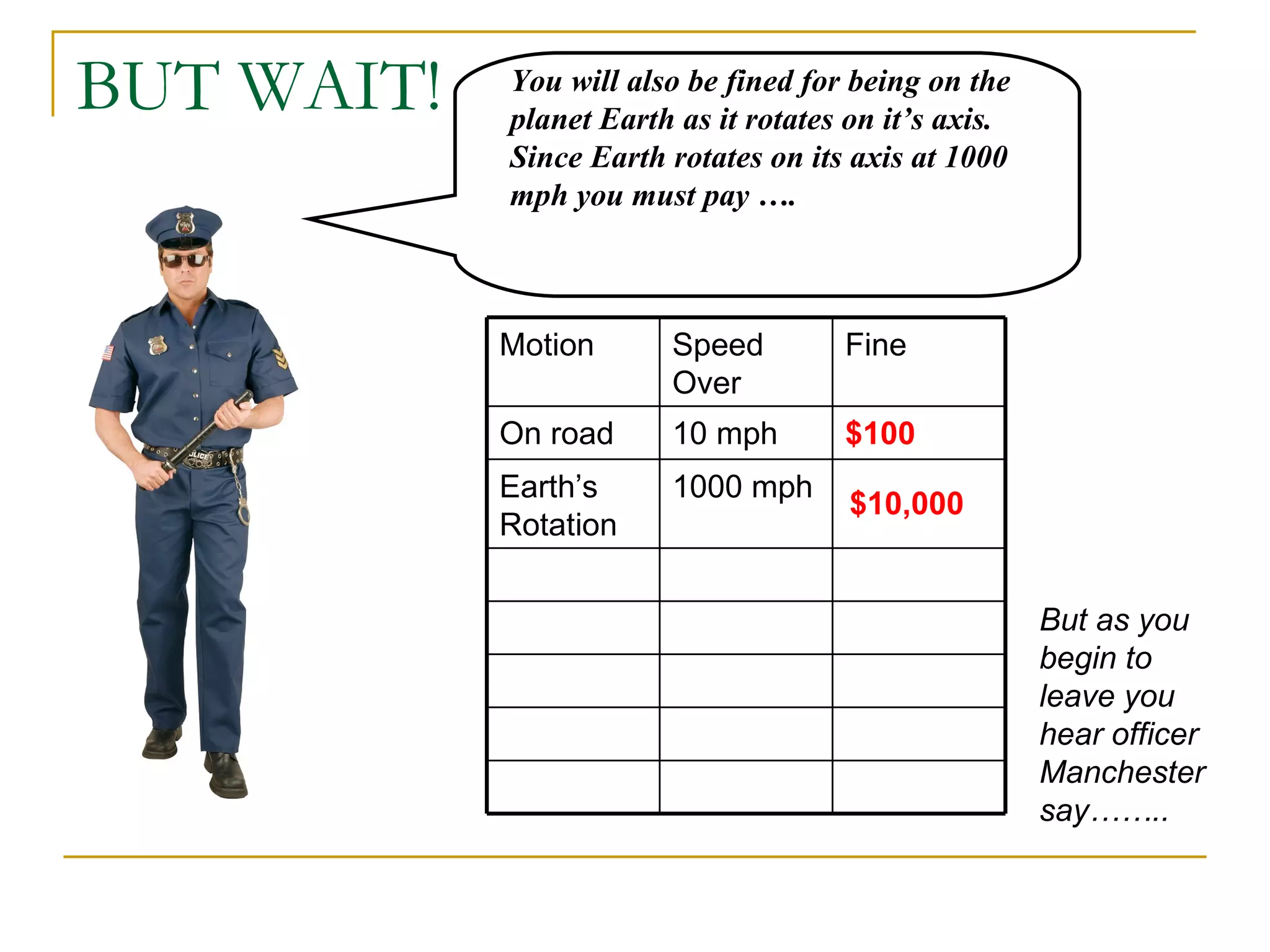
BUT WAIT! You will also be fined for being on the planet Earth as it rotates on it ’s axis. Since Earth rotates on its axis at 1000 mph you must pay …. But as you begin to leave you hear officer Manchestersay…….. $10,000 Motion Speed Over Fine On road 10 mph $100 Earth ’s Rotation 1000 mph
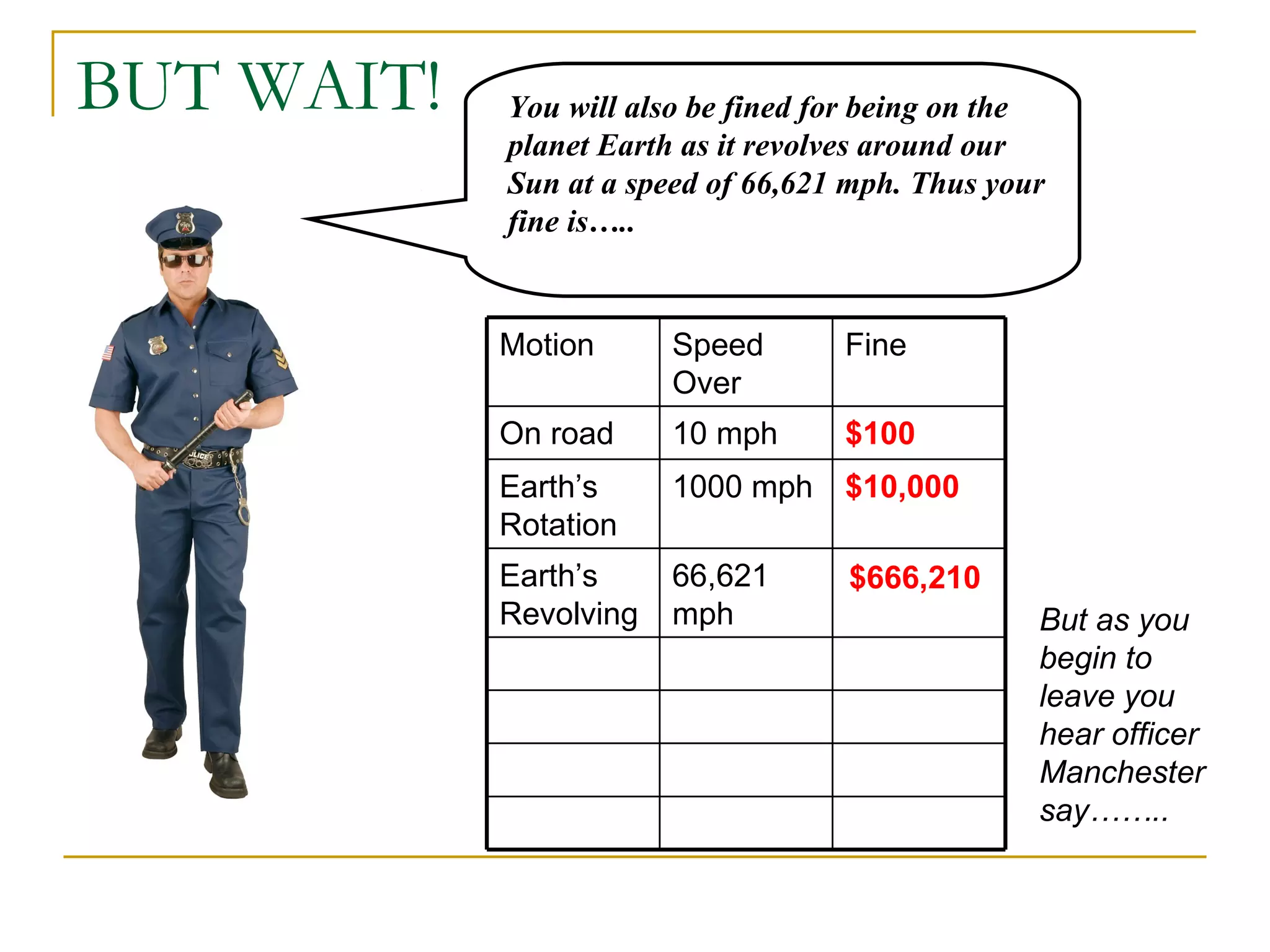
BUT WAIT! You will also be fined for being on the planet Earth as it revolves around our Sun at a speed of 66,621 mph. Thus your fine is…..   But as you begin to leave you hear officer Manchester say…….. $666,210 Motion Speed Over Fine On road 10 mph $100 Earth ’s Rotation 1000 mph $10,000 Earth ’s Revolving 66,621 mph
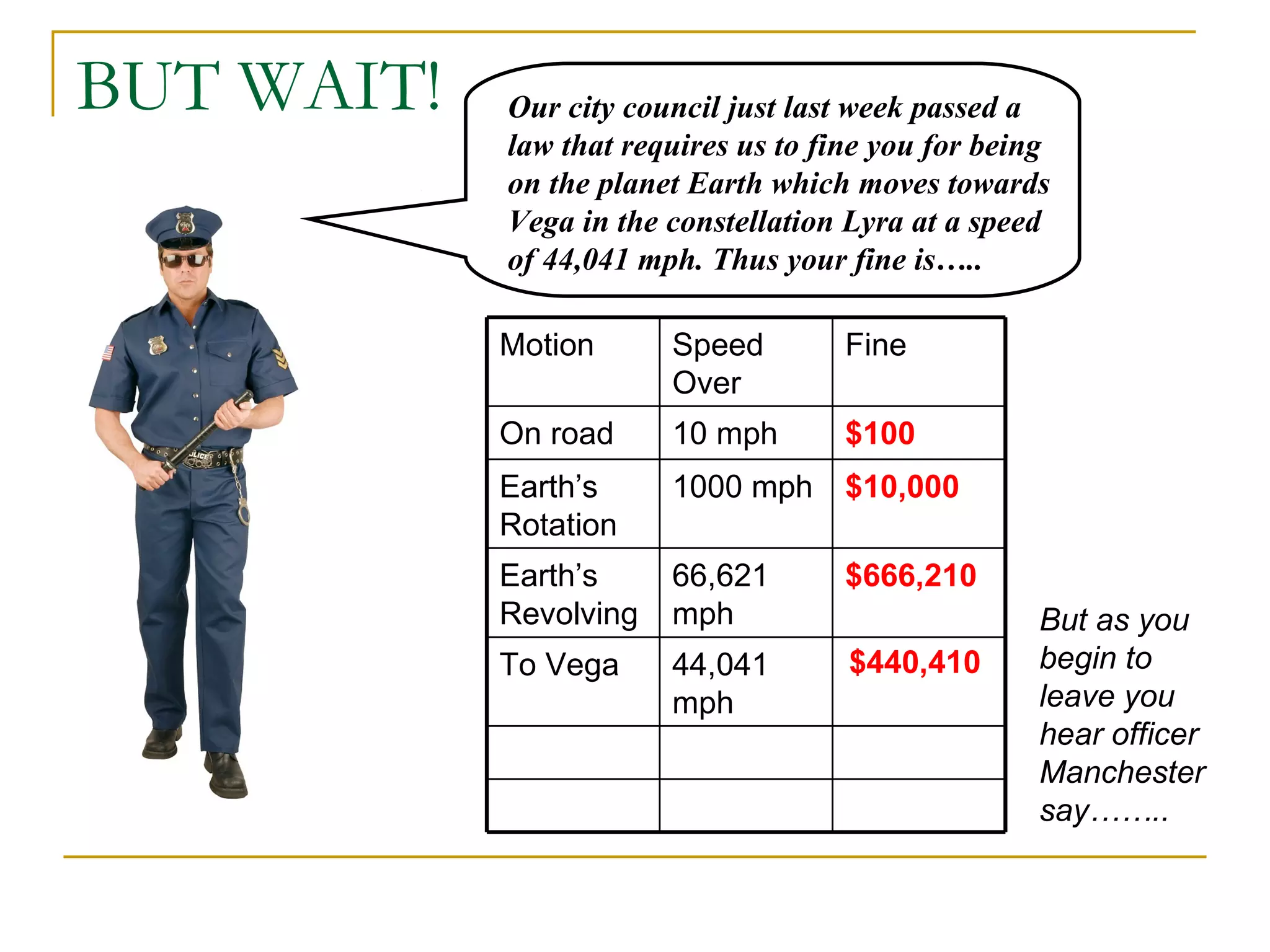
BUT WAIT! Our city council just last week passed a law that requires us to fine you for being on the planet Earth which moves towards Vega in the constellation Lyra at a speed of 44,041 mph. Thus your fine is…..   But as you begin to leave you hear officer Manchester say…….. $440,410 Motion Speed Over Fine On road 10 mph $100 Earth ’s Rotation 1000 mph $10,000 Earth ’s Revolving 66,621 mph $666,210 To Vega 44,041 mph
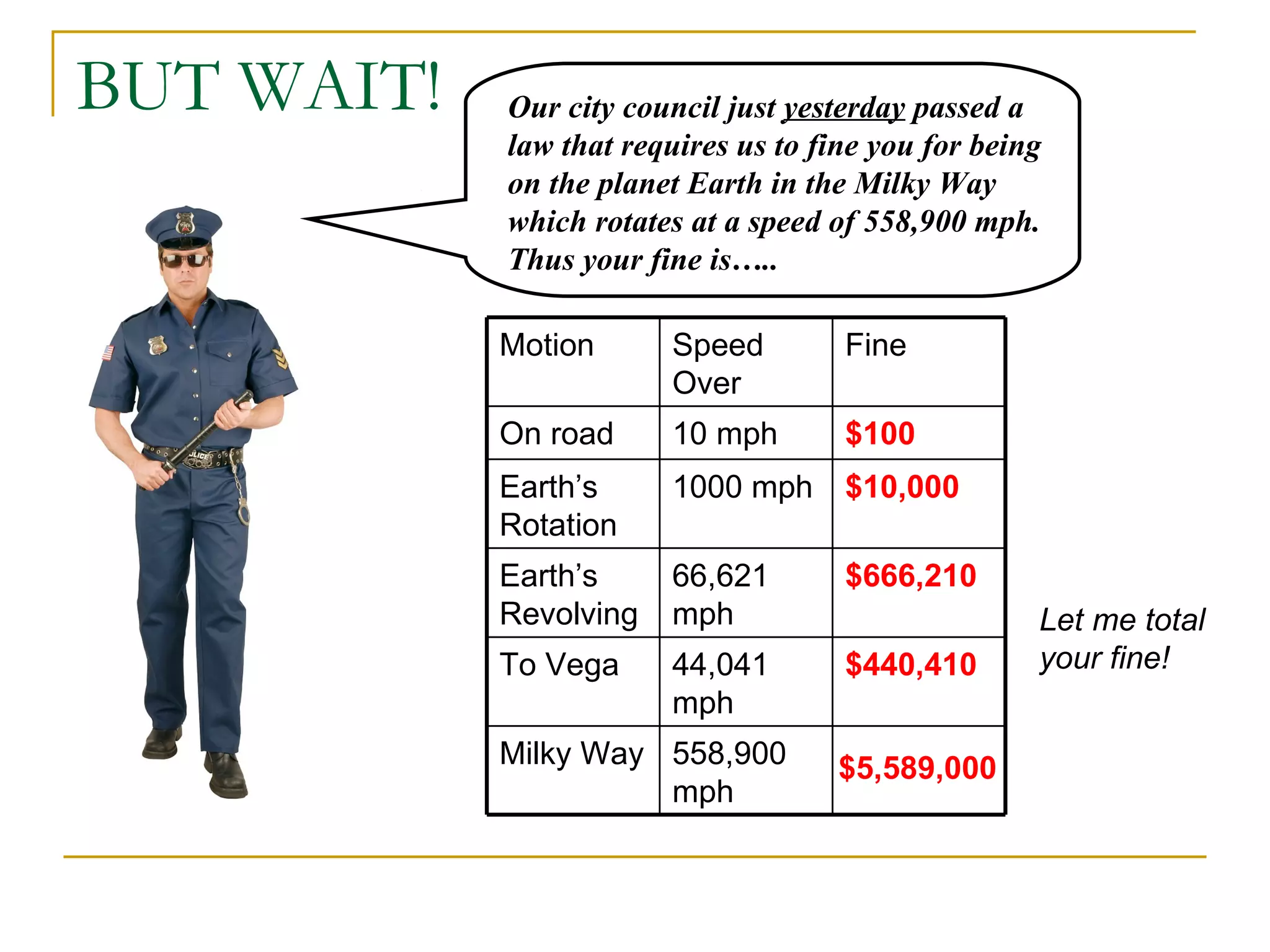
BUT WAIT! Our city council just  yesterday  passed a law that requires us to fine you for being on the planet Earth in the Milky Way which rotates at a speed of 558,900 mph. Thus your fine is…..   Let me total your fine! $5,589,000 Motion Speed Over Fine On road 10 mph $100 Earth ’s Rotation 1000 mph $10,000 Earth ’s Revolving 66,621 mph $666,210 To Vega 44,041 mph $440,410 Milky Way 558,900 mph
You owe……(somehow) Your total fine is: $6,705,720 Now be a law abiding citizen and PAY UP!
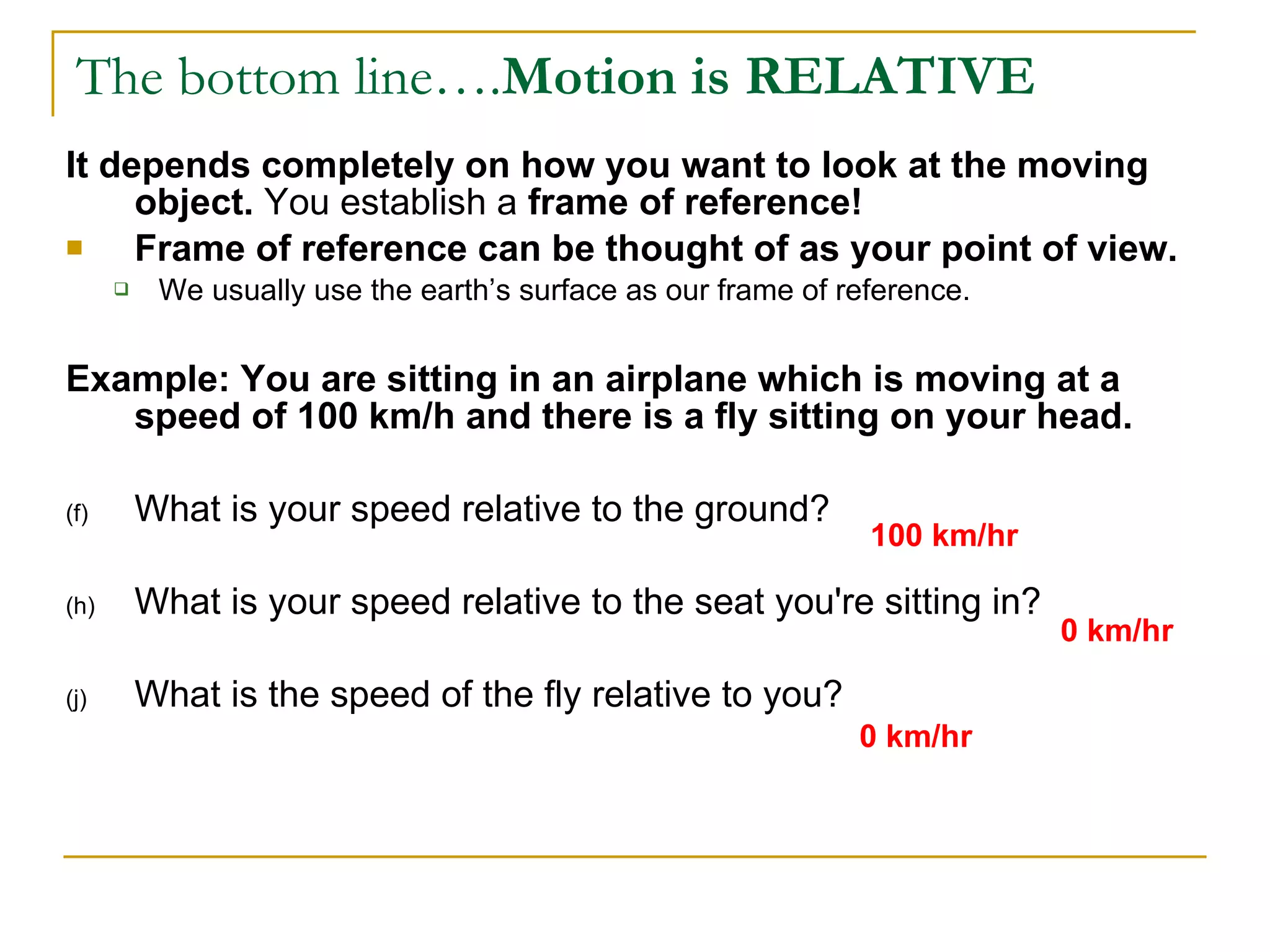
The bottom line…. Motion is RELATIVE It depends completely on how you want to look at the moving object.  You establish a  frame of reference! Frame of reference can be thought of as your point of view.  We usually use the earth’s surface as our frame of reference.  Example: You are sitting in an airplane which is moving at a speed of 100 km/h and there is a fly sitting on your head. What is your speed relative to the ground? What is your speed relative to the seat you're sitting in? What is the speed of the fly relative to you? 100 km/hr 0 km/hr 0 km/hr
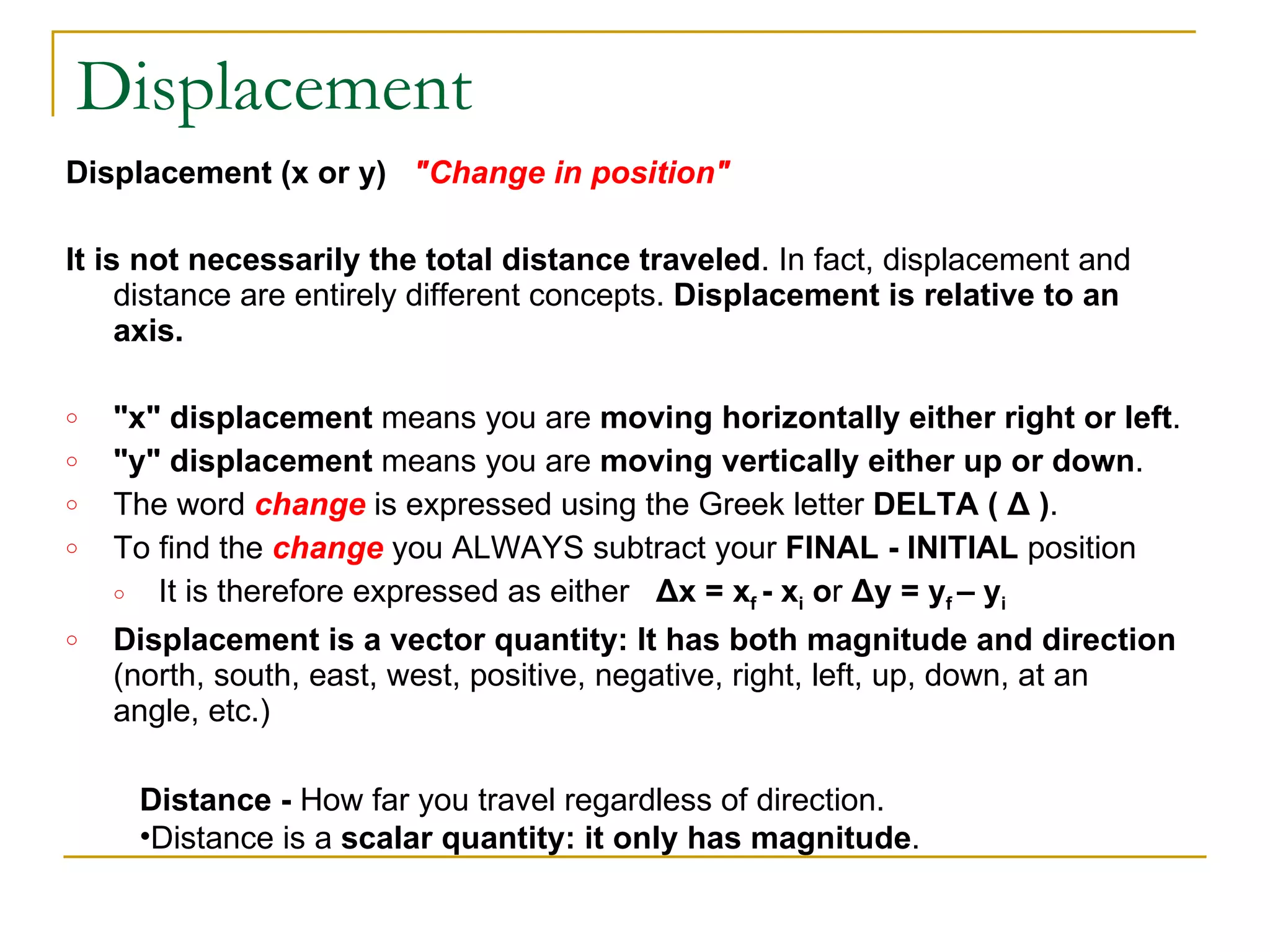
Displacement Displacement (x or y)    "Change in position"   It is not necessarily the total distance traveled . In fact, displacement and distance are entirely different concepts.  Displacement is relative to an axis. "x" displacement  means you are  moving horizontally either right or left . "y" displacement  means you are  moving vertically either up or down . The word  change  is expressed using the Greek letter  DELTA ( Δ ) . To find the  change  you ALWAYS subtract your  FINAL - INITIAL  position It is therefore expressed as either    Δx = x f  - x i  o r  Δy = y f  – y i Displacement is a vector quantity: It has both magnitude and direction  (north, south, east, west, positive, negative, right, left, up, down, at an angle, etc.) Distance -  How far you travel regardless of direction. Distance is a  scalar quantity: it only has magnitude .
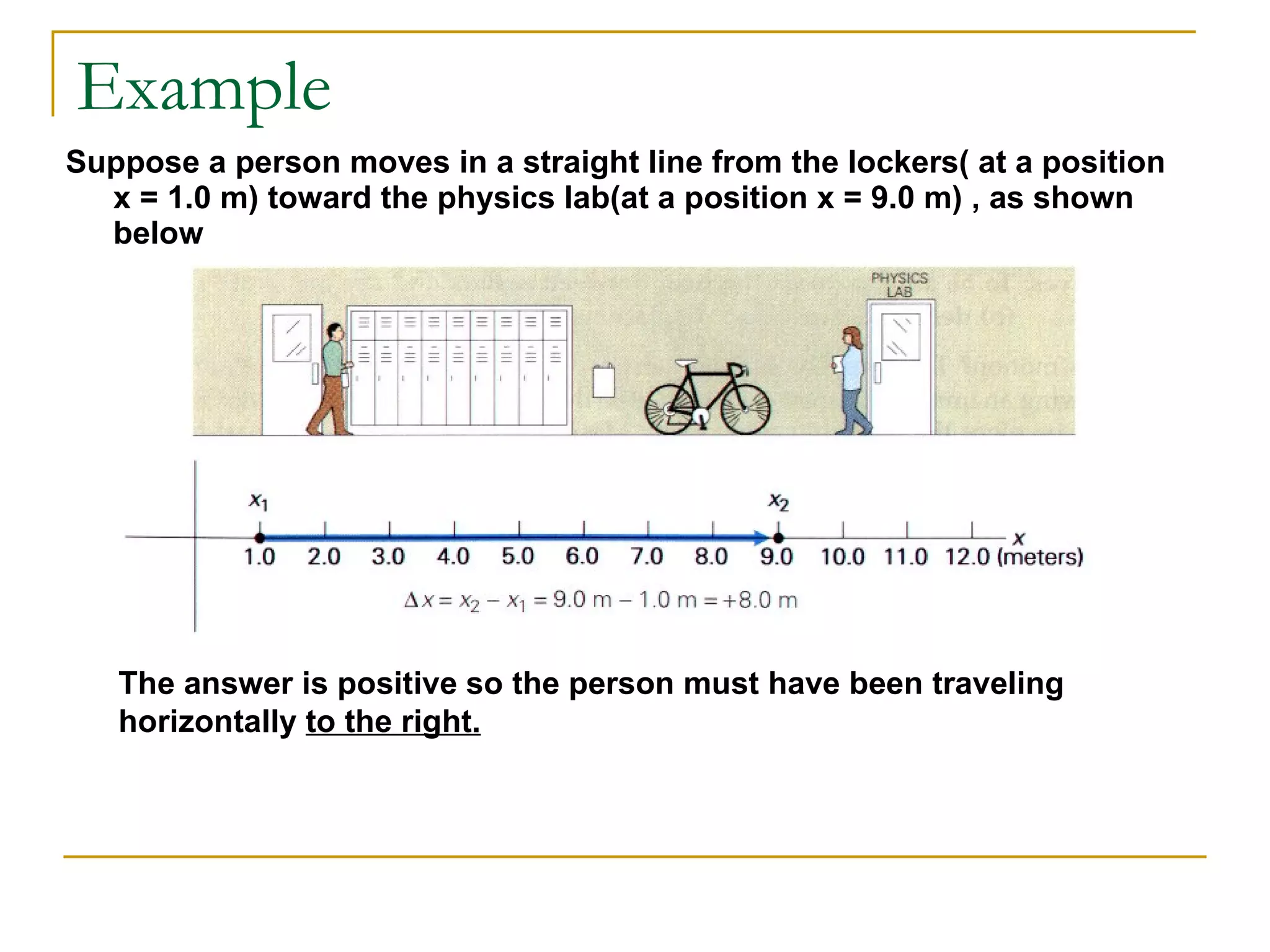
Example Suppose a person moves in a straight line from the lockers( at a position  x = 1.0 m) toward the physics lab(at a position x = 9.0 m) , as shown below The answer is positive so the person must have been traveling horizontally  to the right.
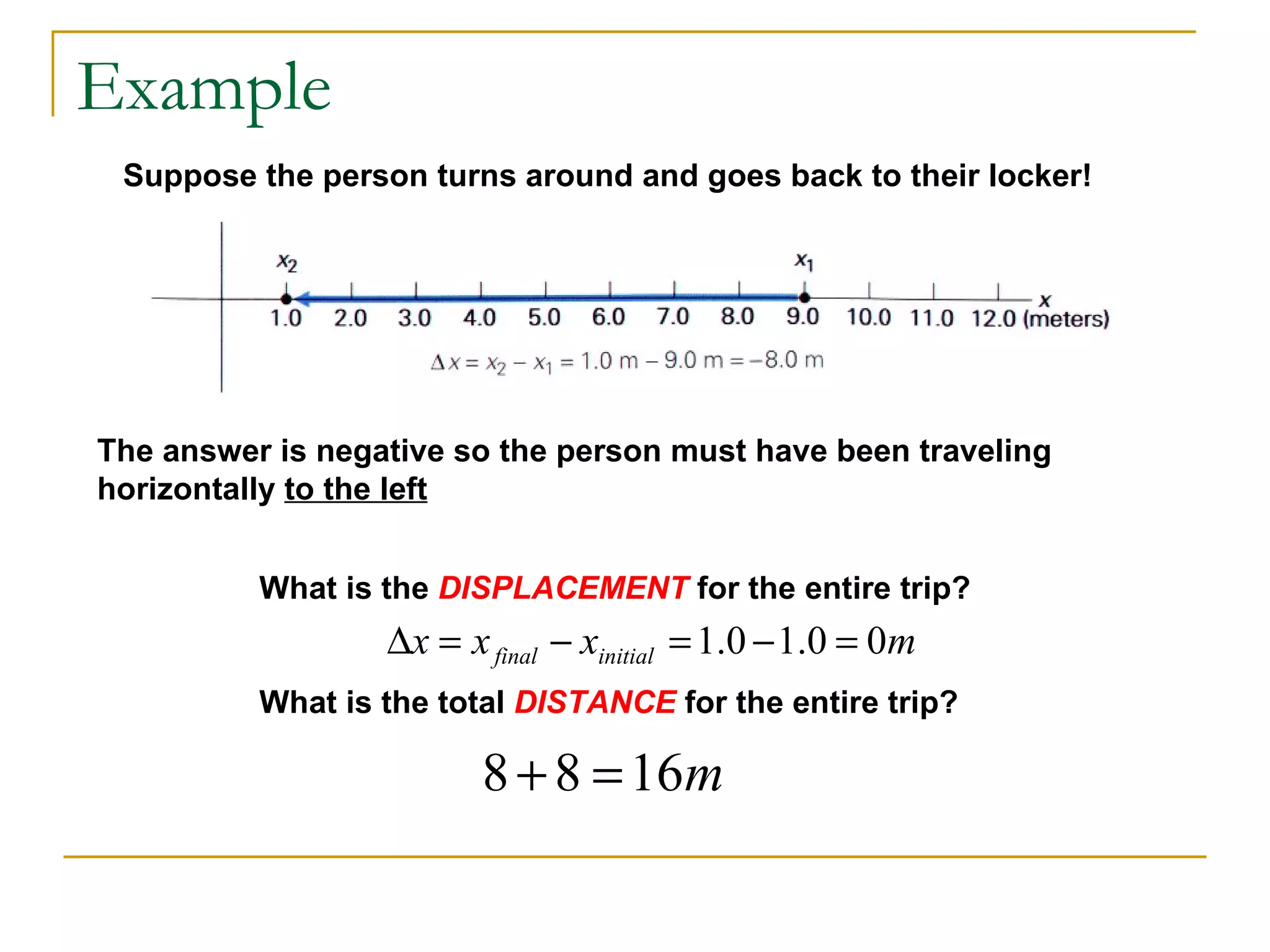
Example Suppose the person turns around and goes back to their locker! The answer is negative so the person must have been traveling horizontally  to the left What is the  DISPLACEMENT  for the entire trip? What is the total  DISTANCE  for the entire trip?
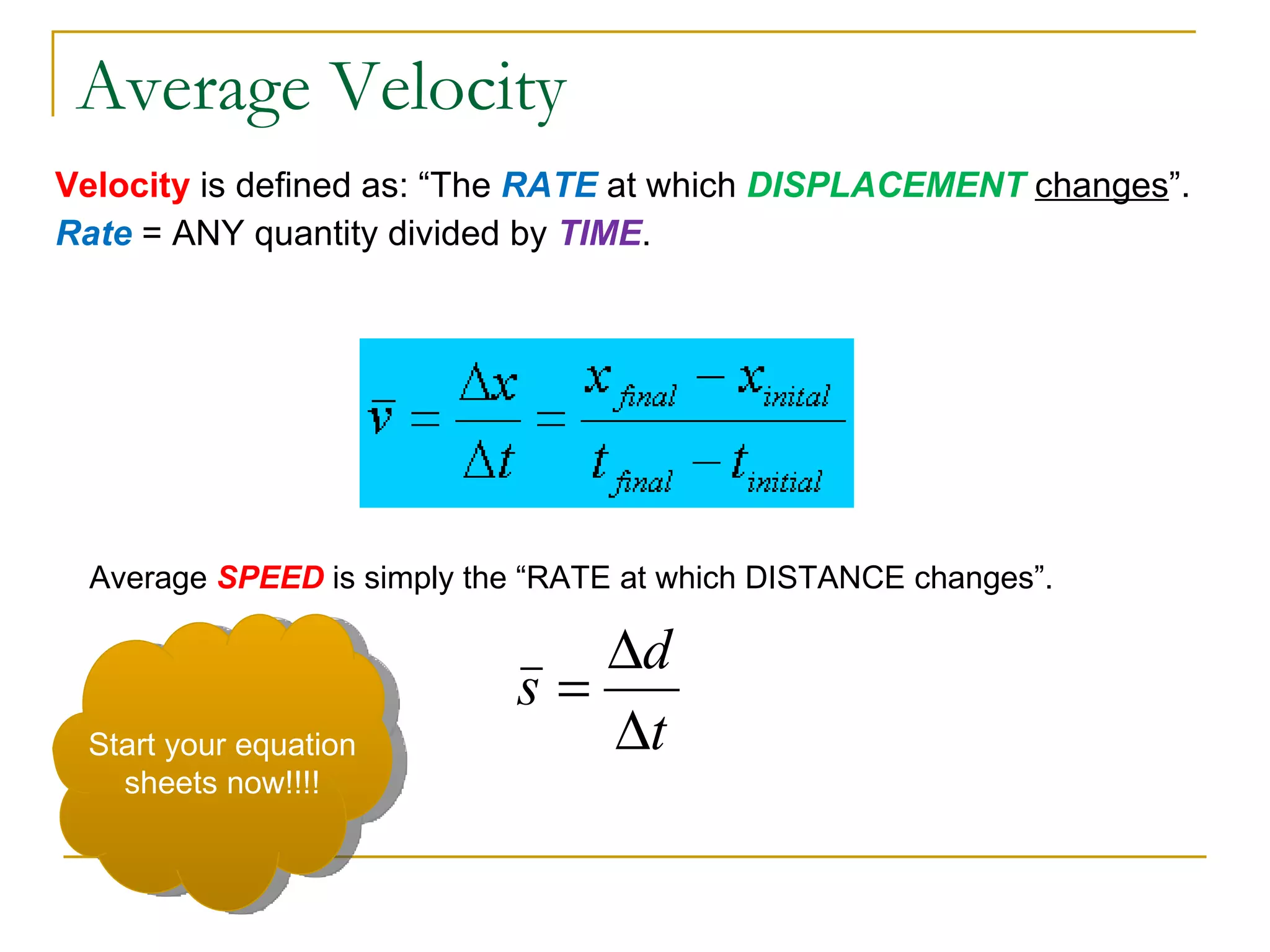
Average Velocity Velocity  is defined as:  “The  RATE  at which  DISPLACEMENT   changes ”.  Rate  = ANY quantity divided by  TIME .  Average  SPEED  is simply the  “RATE at which DISTANCE changes”. Start your equation sheets now!!!!
Homework Problem #5 You are driving home from school steadily at 65 miles/hour for 130 miles. It then begins to rain and you slow to 55 mph. You arrive home after driving 3 hours and 20 minutes. (a) how far is your hometown from school?  (b) What was your average speed? Steps for solving: Draw and write out the information given Identify unknown values Identify equations to use Hint: break the problem into two trip segments
Test information for Friday Measurement Accuracy (no calculations of relative error) Precision (no calculations of standard deviation) Significant figures Unit prefixes (know giga through nano) Scientific notation Factor label method Dimensional analysis
White board Responses What is the difference between a vector and a scalar quantity? Provide an example of each.  Teacher Evaluation forms
 
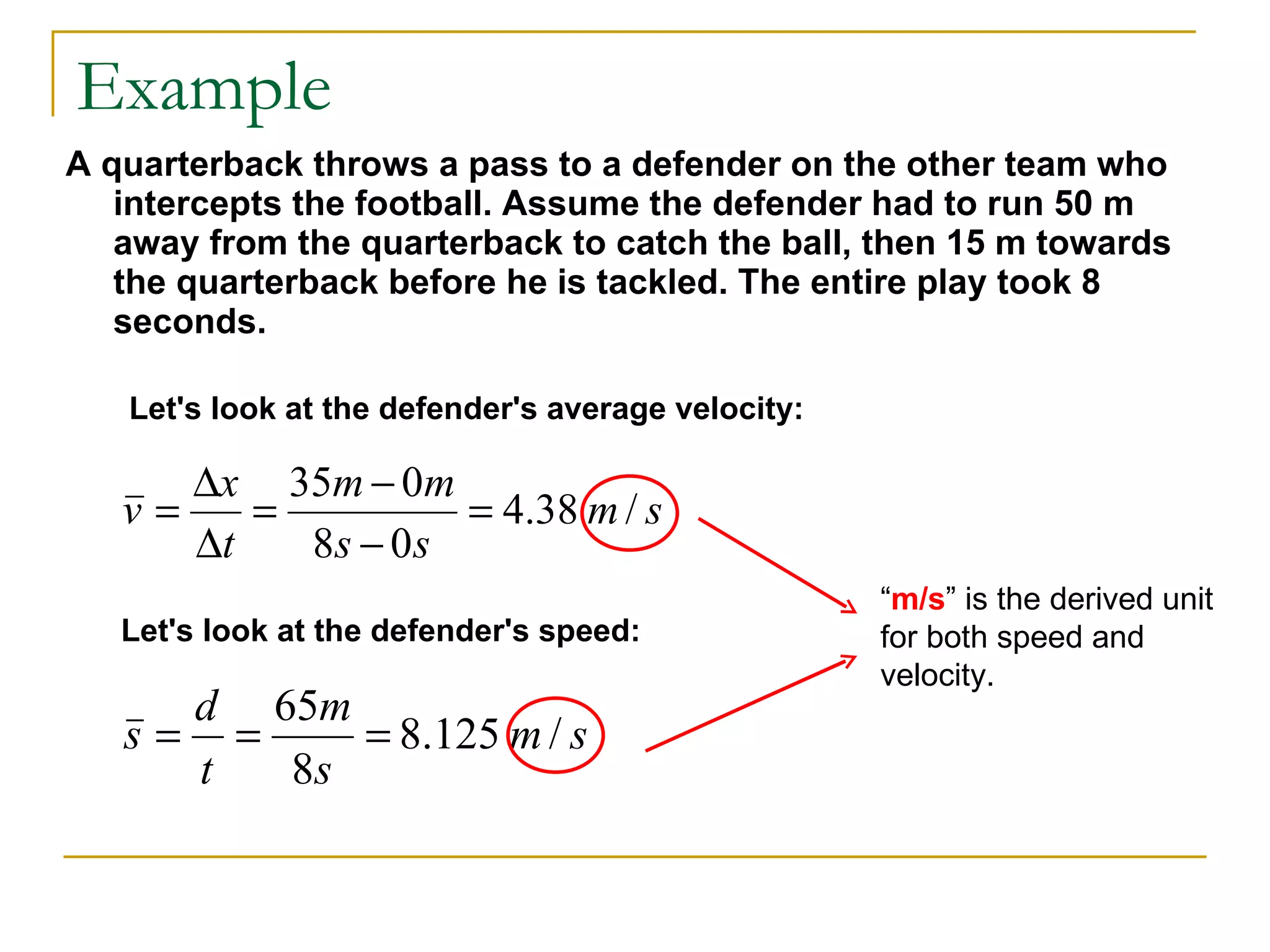
Example A quarterback throws a pass to a defender on the other team who intercepts the football. Assume the defender had to run 50 m away from the quarterback to catch the ball, then 15 m towards the quarterback before he is tackled. The entire play took 8 seconds.   Let's look at the defender's average velocity: Let's look at the defender's speed: “ m/s ” is the derived unit for both speed and velocity.
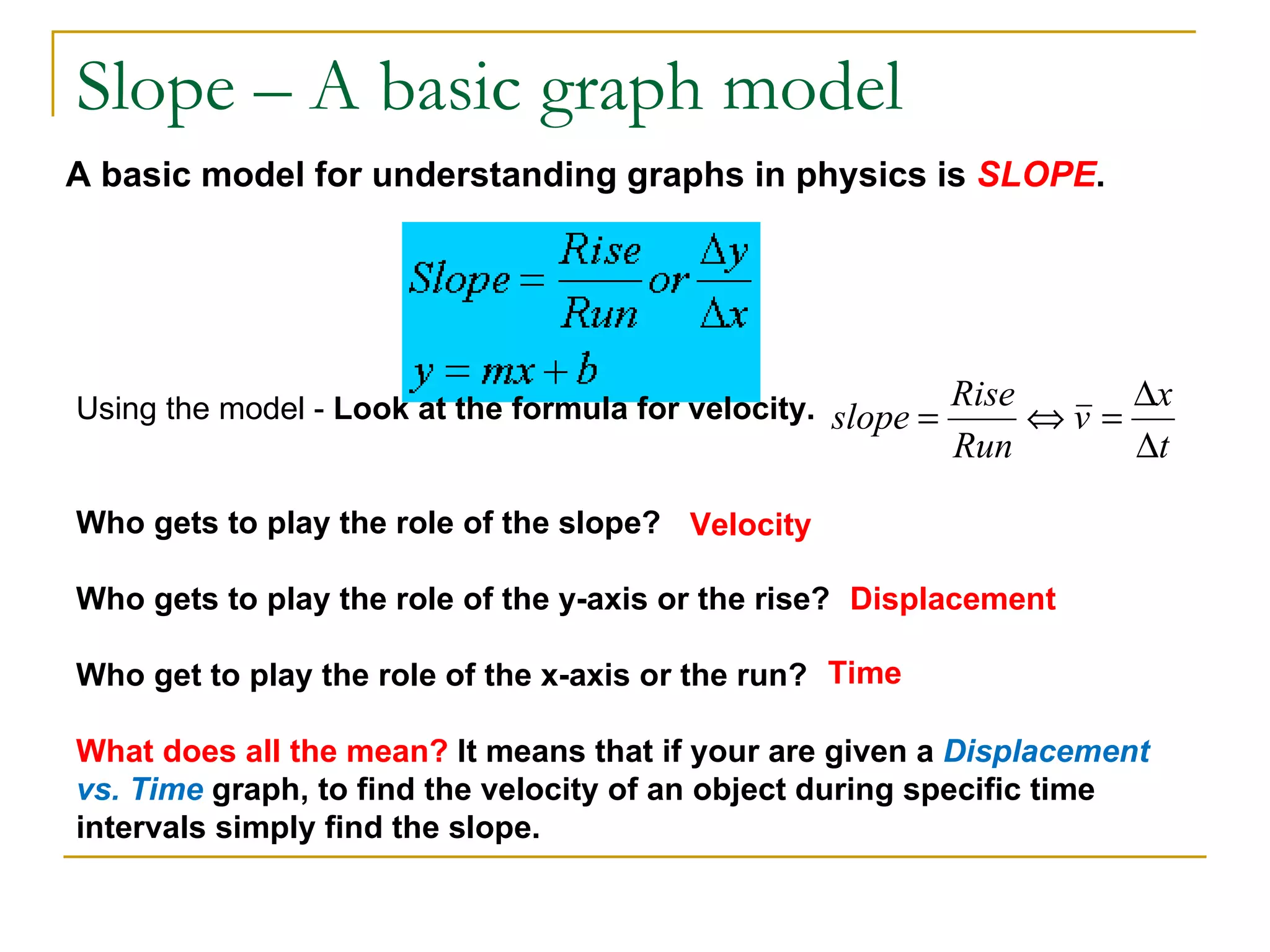
Slope – A basic graph model A basic model for understanding graphs in physics is  SLOPE .  Using the model -  Look at the formula for velocity. Who gets to play the role of the slope?  Who gets to play the role of the y-axis or the rise?  Who get to play the role of the x-axis or the run?  What does all the mean?  It means that if your are given a  Displacement vs. Time  graph, to find the velocity of an object during specific time intervals simply find the slope.   Velocity Displacement Time
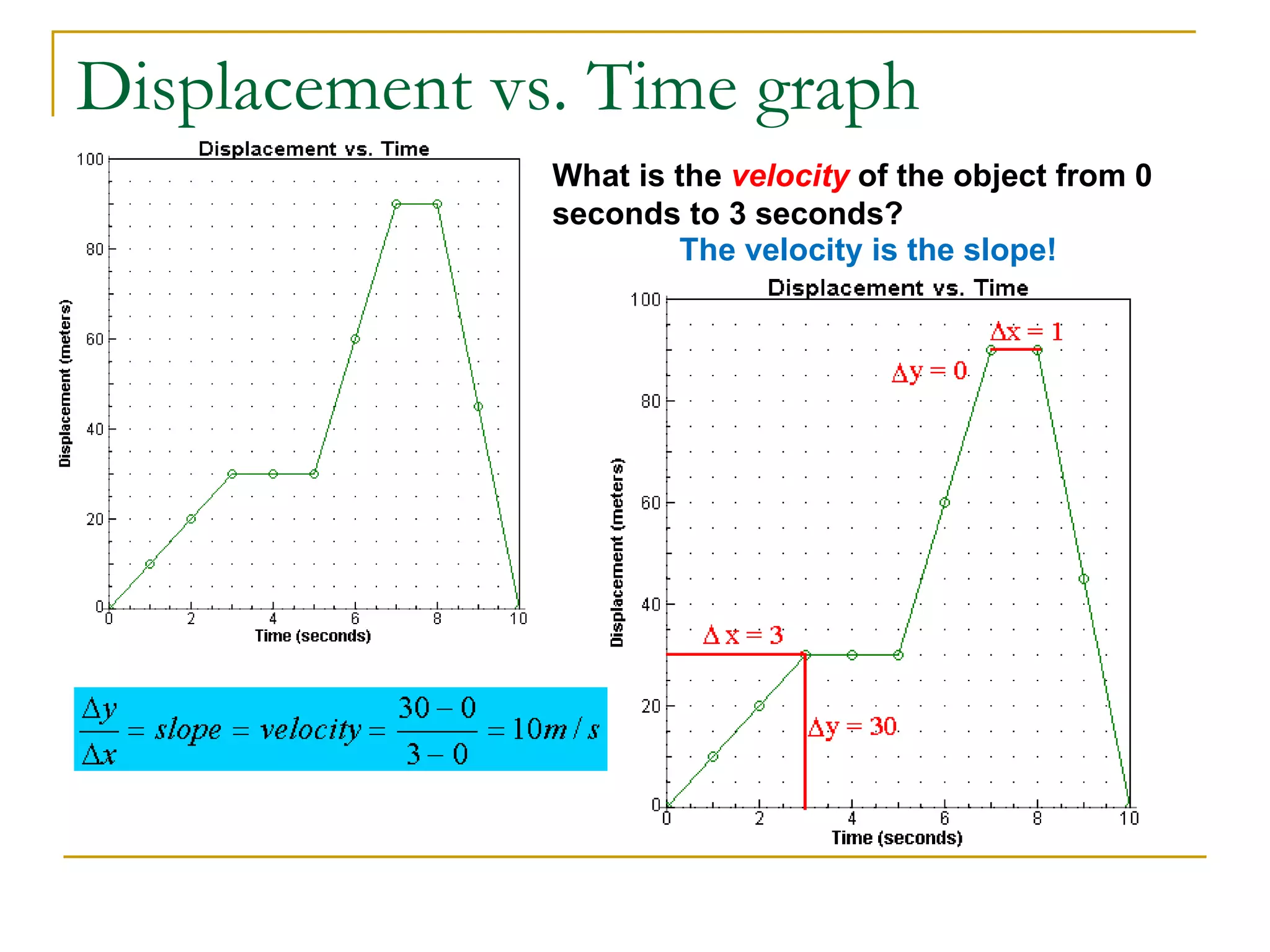
Displacement vs. Time graph What is the  velocity  of the object from 0 seconds to 3 seconds? The velocity is the slope!
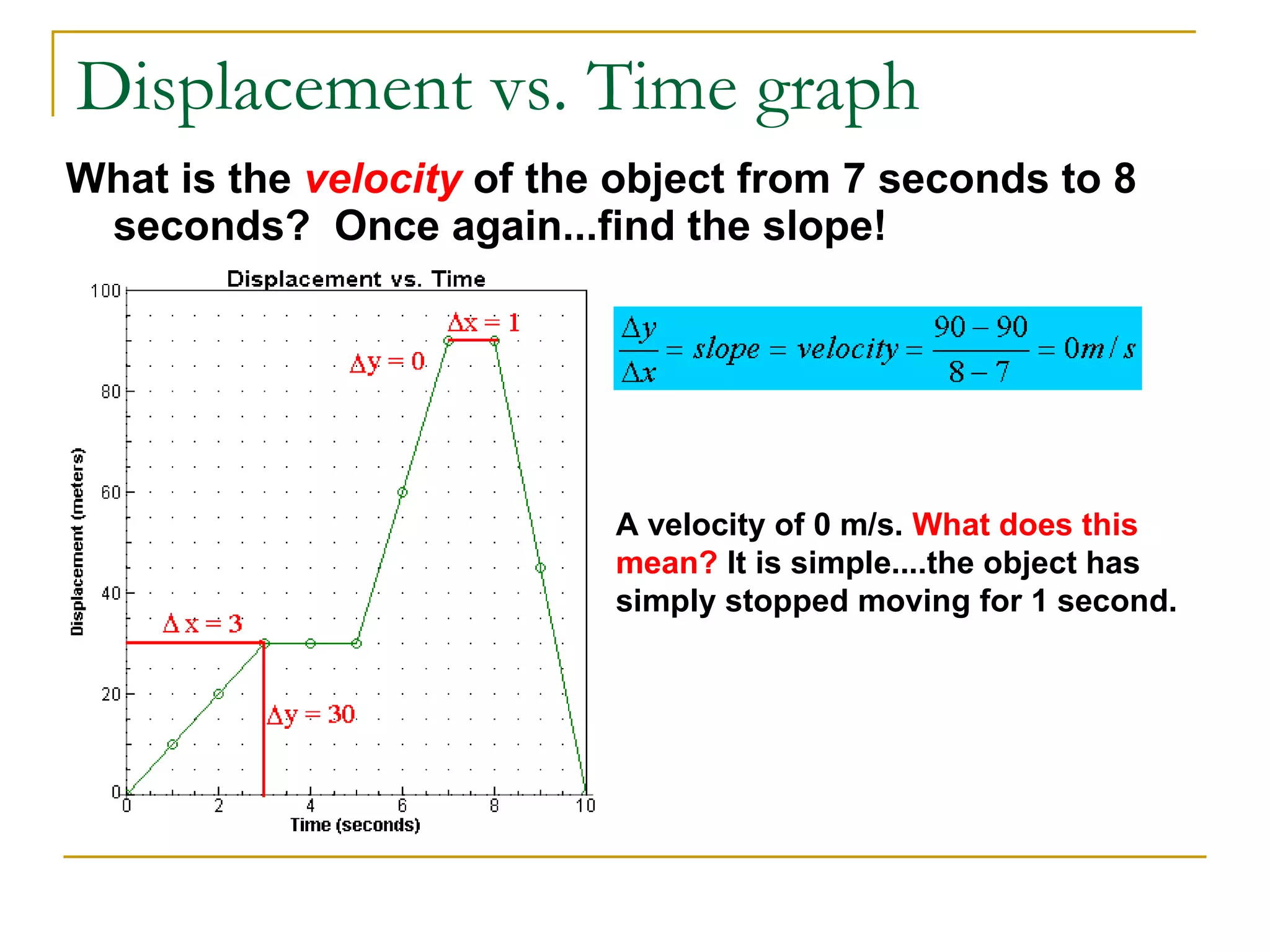
Displacement vs. Time graph What is the  velocity  of the object from 7 seconds to 8 seconds?  Once again...find the slope!   A velocity of 0 m/s.  What does this mean?  It is simple....the object has simply stopped moving for 1 second.
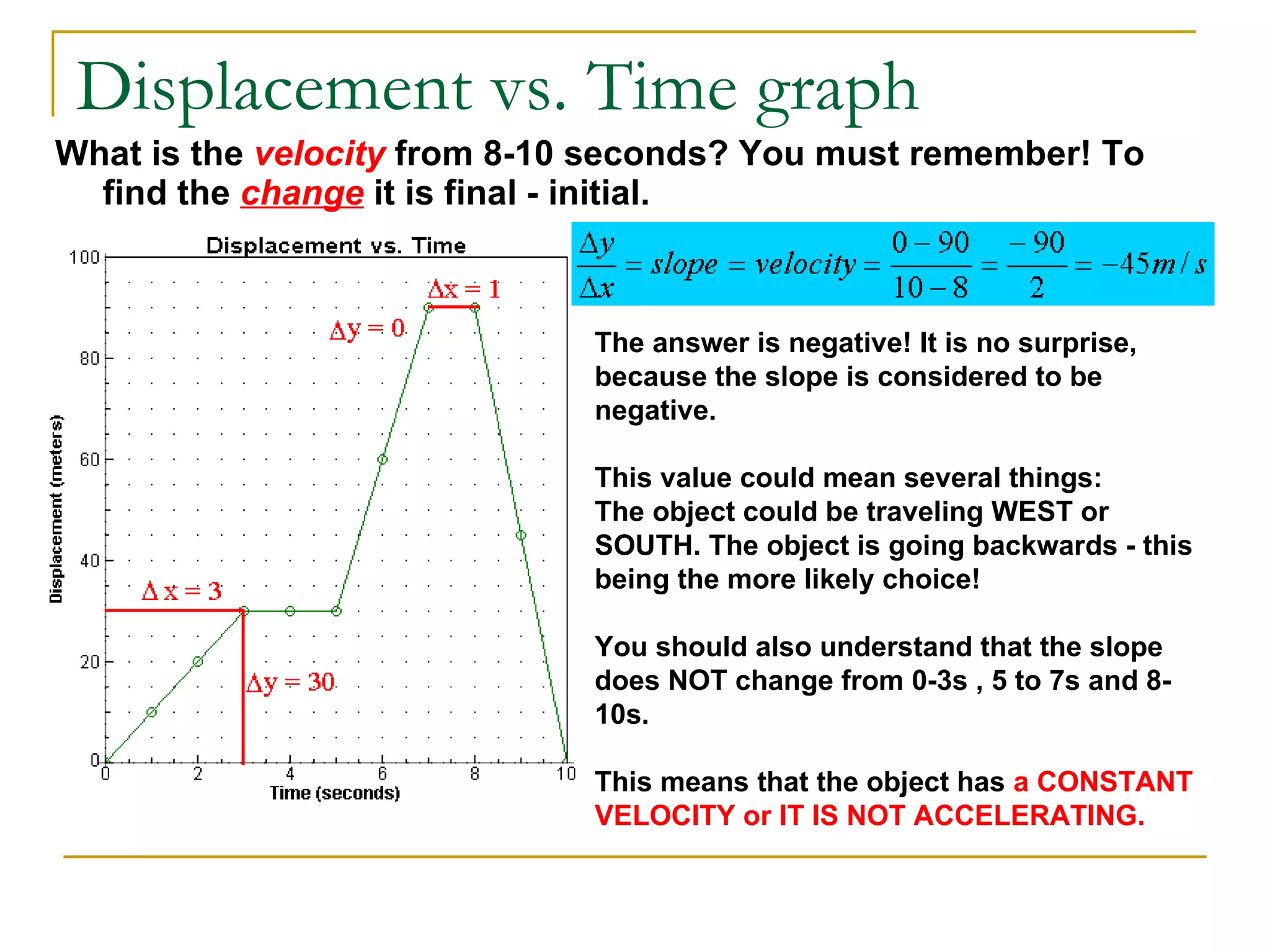
Displacement vs. Time graph What is the  velocity  from 8-10 seconds? You must remember! To find the  change  it is final - initial.   The answer is negative! It is no surprise, because the slope is considered to be negative.  This value could mean several things:   The object could be traveling WEST or SOUTH.   The object is going backwards - this being the more likely choice! You should also understand that the slope does NOT change from 0-3s , 5 to 7s and 8- 10s.   This means that the object has  a CONSTANT VELOCITY or IT IS NOT ACCELERATING.
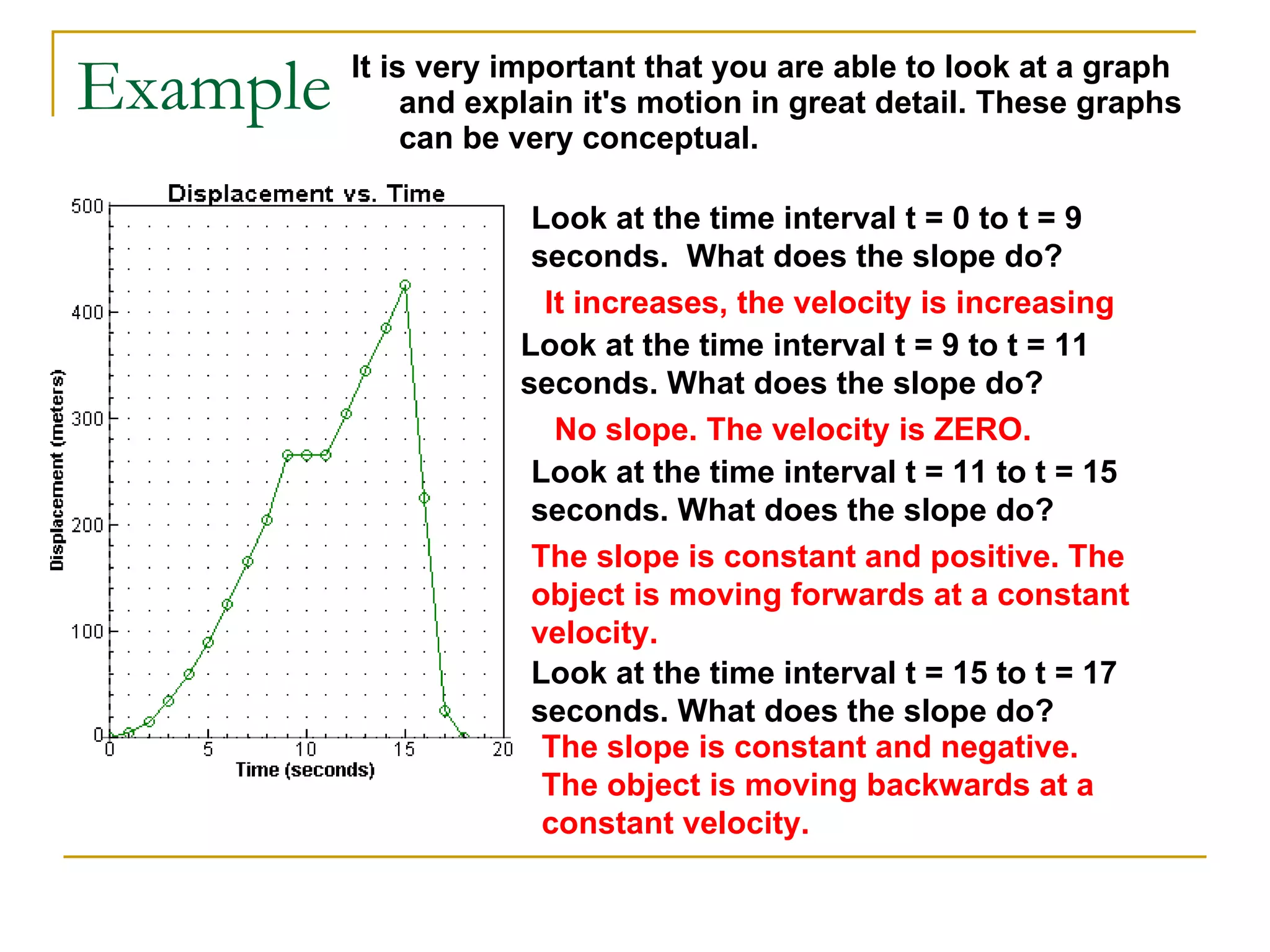
Example It is very important that you are able to look at a graph and explain it's motion in great detail. These graphs can be very conceptual. Look at the time interval t = 0 to t = 9 seconds.  What does the slope do?   It increases, the velocity is increasing Look at the time interval t = 9 to t = 11 seconds. What does the slope do?   No slope. The velocity is ZERO. Look at the time interval t = 11 to t = 15 seconds. What does the slope do?   The slope is constant and positive. The object is moving forwards at a constant velocity. Look at the time interval t = 15 to t = 17 seconds. What does the slope do?   The slope is constant and negative. The object is moving backwards at a constant velocity.

Honors methods of motion

  • 1.
    Honors Physics GoodMorning! Please… Hand in your homework to the bin in the front of the room (factor label method worksheet probs a, c, e, g & index cards) Work on the warm-up problem: A one-thousand page book is 4.00 cm thick. What is the thickness of one page in a number from 0 to 999, with an appropriate unit prefix? (Note: the pages in the book are two-sided).
  • 2.
    Agenda Physics inthe news Go over homework Unit pre-assessment Dimensional analysis Begin new unit
  • 3.
    Pre-Unit Activity: Motionin Pictures Look at the following pictures, and take 1 minute to right down your thoughts about each picture. Here are a few suggestions to start your brainstorming: What do you think of when you see this picture? What type of motion is happening in the picture? Does this picture remind you of something – a movie, place, etc.? Relate this picture to something you have seen, done, etc.
  • 4.
  • 5.
  • 6.
  • 7.
  • 8.
  • 9.
  • 10.
  • 11.
  • 12.
    YOU deserve aspeeding ticket! Here is the scenario! You wake up late and have 20 minutes to get to school and you especially do not want to be late for physics! You decide to travel at 65 mph in a 55 mph zone. Unfortunately, Officer Manchester pulls you over. You see, the LAW states that you must pay $10 for every mile you are over the speed limit. Therefore, you MUST pay $100 to cover the fine. Being a law abiding citizen you agree, and pay the fine. But as you begin to leave you hear officer Manchester say……..
  • 13.
    BUT WAIT! Youwill also be fined for being on the planet Earth as it rotates on it ’s axis. Since Earth rotates on its axis at 1000 mph you must pay …. But as you begin to leave you hear officer Manchestersay…….. $10,000 Motion Speed Over Fine On road 10 mph $100 Earth ’s Rotation 1000 mph
  • 14.
    BUT WAIT! Youwill also be fined for being on the planet Earth as it revolves around our Sun at a speed of 66,621 mph. Thus your fine is….. But as you begin to leave you hear officer Manchester say…….. $666,210 Motion Speed Over Fine On road 10 mph $100 Earth ’s Rotation 1000 mph $10,000 Earth ’s Revolving 66,621 mph
  • 15.
    BUT WAIT! Ourcity council just last week passed a law that requires us to fine you for being on the planet Earth which moves towards Vega in the constellation Lyra at a speed of 44,041 mph. Thus your fine is….. But as you begin to leave you hear officer Manchester say…….. $440,410 Motion Speed Over Fine On road 10 mph $100 Earth ’s Rotation 1000 mph $10,000 Earth ’s Revolving 66,621 mph $666,210 To Vega 44,041 mph
  • 16.
    BUT WAIT! Ourcity council just yesterday passed a law that requires us to fine you for being on the planet Earth in the Milky Way which rotates at a speed of 558,900 mph. Thus your fine is….. Let me total your fine! $5,589,000 Motion Speed Over Fine On road 10 mph $100 Earth ’s Rotation 1000 mph $10,000 Earth ’s Revolving 66,621 mph $666,210 To Vega 44,041 mph $440,410 Milky Way 558,900 mph
  • 17.
    You owe……(somehow) Yourtotal fine is: $6,705,720 Now be a law abiding citizen and PAY UP!
  • 18.
    The bottom line….Motion is RELATIVE It depends completely on how you want to look at the moving object. You establish a frame of reference! Frame of reference can be thought of as your point of view. We usually use the earth’s surface as our frame of reference. Example: You are sitting in an airplane which is moving at a speed of 100 km/h and there is a fly sitting on your head. What is your speed relative to the ground? What is your speed relative to the seat you're sitting in? What is the speed of the fly relative to you? 100 km/hr 0 km/hr 0 km/hr
  • 19.
    Displacement Displacement (xor y)   "Change in position" It is not necessarily the total distance traveled . In fact, displacement and distance are entirely different concepts. Displacement is relative to an axis. "x" displacement means you are moving horizontally either right or left . "y" displacement means you are moving vertically either up or down . The word change is expressed using the Greek letter DELTA ( Δ ) . To find the change you ALWAYS subtract your FINAL - INITIAL position It is therefore expressed as either   Δx = x f - x i o r Δy = y f – y i Displacement is a vector quantity: It has both magnitude and direction (north, south, east, west, positive, negative, right, left, up, down, at an angle, etc.) Distance - How far you travel regardless of direction. Distance is a scalar quantity: it only has magnitude .
  • 20.
    Example Suppose aperson moves in a straight line from the lockers( at a position  x = 1.0 m) toward the physics lab(at a position x = 9.0 m) , as shown below The answer is positive so the person must have been traveling horizontally to the right.
  • 21.
    Example Suppose theperson turns around and goes back to their locker! The answer is negative so the person must have been traveling horizontally to the left What is the DISPLACEMENT for the entire trip? What is the total DISTANCE for the entire trip?
  • 22.
    Average Velocity Velocity is defined as: “The RATE at which DISPLACEMENT changes ”. Rate = ANY quantity divided by TIME . Average SPEED is simply the “RATE at which DISTANCE changes”. Start your equation sheets now!!!!
  • 23.
    Homework Problem #5You are driving home from school steadily at 65 miles/hour for 130 miles. It then begins to rain and you slow to 55 mph. You arrive home after driving 3 hours and 20 minutes. (a) how far is your hometown from school? (b) What was your average speed? Steps for solving: Draw and write out the information given Identify unknown values Identify equations to use Hint: break the problem into two trip segments
  • 24.
    Test information forFriday Measurement Accuracy (no calculations of relative error) Precision (no calculations of standard deviation) Significant figures Unit prefixes (know giga through nano) Scientific notation Factor label method Dimensional analysis
  • 25.
    White board ResponsesWhat is the difference between a vector and a scalar quantity? Provide an example of each. Teacher Evaluation forms
  • 26.
  • 27.
    Example A quarterbackthrows a pass to a defender on the other team who intercepts the football. Assume the defender had to run 50 m away from the quarterback to catch the ball, then 15 m towards the quarterback before he is tackled. The entire play took 8 seconds. Let's look at the defender's average velocity: Let's look at the defender's speed: “ m/s ” is the derived unit for both speed and velocity.
  • 28.
    Slope – Abasic graph model A basic model for understanding graphs in physics is SLOPE . Using the model - Look at the formula for velocity. Who gets to play the role of the slope? Who gets to play the role of the y-axis or the rise? Who get to play the role of the x-axis or the run?  What does all the mean? It means that if your are given a Displacement vs. Time graph, to find the velocity of an object during specific time intervals simply find the slope. Velocity Displacement Time
  • 29.
    Displacement vs. Timegraph What is the velocity of the object from 0 seconds to 3 seconds? The velocity is the slope!
  • 30.
    Displacement vs. Timegraph What is the velocity of the object from 7 seconds to 8 seconds?  Once again...find the slope! A velocity of 0 m/s. What does this mean? It is simple....the object has simply stopped moving for 1 second.
  • 31.
    Displacement vs. Timegraph What is the velocity from 8-10 seconds? You must remember! To find the change it is final - initial. The answer is negative! It is no surprise, because the slope is considered to be negative. This value could mean several things: The object could be traveling WEST or SOUTH. The object is going backwards - this being the more likely choice! You should also understand that the slope does NOT change from 0-3s , 5 to 7s and 8- 10s. This means that the object has a CONSTANT VELOCITY or IT IS NOT ACCELERATING.
  • 32.
    Example It isvery important that you are able to look at a graph and explain it's motion in great detail. These graphs can be very conceptual. Look at the time interval t = 0 to t = 9 seconds. What does the slope do? It increases, the velocity is increasing Look at the time interval t = 9 to t = 11 seconds. What does the slope do? No slope. The velocity is ZERO. Look at the time interval t = 11 to t = 15 seconds. What does the slope do? The slope is constant and positive. The object is moving forwards at a constant velocity. Look at the time interval t = 15 to t = 17 seconds. What does the slope do? The slope is constant and negative. The object is moving backwards at a constant velocity.